
Beaching a jet ski on a sandbar should mean total relaxation, not constant worry that the current will sweep your watercraft into the next bay or into the hull of a nearby boat. The wrong anchor — too light, wrong type for sand, or poorly constructed — turns a perfect day on the water into an anxious scramble. This guide cuts through the noise to find the anchors engineered specifically to hold a personal watercraft securely where you leave it.
I’m Min — the co-founder and writer behind Gadgets Feed. My process involves cross-referencing material grades, auger dimensions, customer stress-tests from real shallow-water environments, and the mechanical holding power each design delivers for lightweight, high-value craft like jet skis.
After analyzing dozens of options, reading hundreds of verified owner accounts, and weighing every spec from helix pitch to handle ergonomics, I’ve assembled the definitive shortlist for the best anchor for jetski.
How To Choose The Best Anchor For Jet Ski
Choosing an anchor for a jet ski is different from anchoring a larger boat. Jet skis are light, sit high on the water, and get pushed around easily by wind and current. A traditional fluke or plow anchor meant for 20-foot cruisers is overkill and won’t grab in soft sand. You need a dedicated sand anchor designed for shallow, non-rocky bottoms.
Auger Anchor vs. Mushroom vs. Spike
The anchor type determines everything. Auger-style screw anchors dig deep into sand and create suction as water holds the sand down, offering the highest holding power for the weight. Spike anchors are lighter and simpler — you step or push them in at an angle — but they depend entirely on sand density. Mushroom anchors rely purely on weight and are best for muddy bottoms, not clean sandbars. For a jet ski, an auger-style sand anchor provides the most reliable hold in the widest range of conditions.
Material and Corrosion Resistance
Saltwater and stainless steel are non-negotiable for a PWC anchor. 316 stainless steel offers the best corrosion resistance, especially against the chlorides in seawater, and is the preferred material for premium anchors. 304 stainless steel is still durable but more prone to surface pitting over many seasons in salt. Aluminum anchors are rust-proof and ultra-light, making them easy to carry, but they may deform in very hard-packed sand or when used with larger craft. Avoid any coated steel or carbon steel — once the coating is scratched, rust takes over quickly.
Length and Holding Power
For a jet ski, an auger anchor between 17 and 36 inches is typical. A 17-inch anchor is sufficient for light use on calm days with shallow sand, but a 36-inch anchor provides dramatically better bite in loose sand or when wind and current pick up. Shorter anchors may require diving down to set them if the water is more than a foot deep. The holding power also depends on the helix diameter — a wider auger displaces more sand and resists pull-out forces better.
Quick Comparison
On smaller screens, swipe sideways to see the full table.
| Model | Category | Best For | Key Spec | Amazon |
|---|---|---|---|---|
| VEVOR Sand Anchor | Auger | All-around holding in saltwater | 36″ length, 316 SS, 4400 lb capacity | Amazon |
| Insaga Sand Anchor | Auger | Budget-friendly beaching | 17″ length, 304 SS, 30mm helix | Amazon |
| SandShark Lite Series | Auger | Lightweight reliability | 18″ length, 316 SS, padded case | Amazon |
| COOPER ANCHOR | Mushroom | Calm, soft bottoms | 2.2 lb nylon; for craft up to 12ft | Amazon |
| Newport 10lb Mushroom | Mushroom | Mud and soft silt bottoms | 10 lb PE-coated cast iron, complete kit | Amazon |
| WAVESRX Spike Anchor | Spike | Ultra-light, easy deployment | 12″ length, aluminum alloy, 16 oz | Amazon |
| SandShark SuperSport 3.0 | Auger | Extreme holding and adjustability | 29″-48″ telescoping, composite/alu | Amazon |
In‑Depth Reviews
1. VEVOR Sand Anchor

The VEVOR Sand Anchor strikes the best balance of holding power, corrosion resistance, and kit completeness for a jet ski owner. Its 36-inch shaft is made from 316 stainless steel, which is the industry standard for saltwater resilience — more pitting-resistant than the 304 grade used in cheaper anchors. The rated 4400 lb load capacity is far beyond what a PWC will ever exert, but that margin ensures the auger stays buried even during wakes from passing cruisers.
The removable T-handle with foam grip is a practical feature: you screw the anchor in, remove the handle, and stow it cleanly. The included bungee dock line adds essential shock absorption — without it, the anchor can jerk out of the sand during wave action. Owners report the anchor holds a Yamaha FX HO in busy bays with strong currents after a full season of saltwater use, with no rust or deformation visible.
Two minor flaws: the foam grips on the handle can rotate when wet, so a dab of superglue fixes them permanently, and the T-handle rod is small enough to be lost if not tethered. The included carry bag is thin, but it prevents scratches on your hull. At this price point for 316 stainless and a 36-inch auger, the VEVOR delivers premium spec at a mid-range cost.
Why it’s great
- Full 36-inch auger depth grips deep into loose sand
- 316 stainless steel holds up to continuous saltwater exposure
- Bungee line included prevents anchor pull-out from wave action
Good to know
- Foam handle grips can spin loose when wet — secure with adhesive
- T-handle rod is small and easy to misplace; drill a tether hole
2. Insaga Sand Anchor
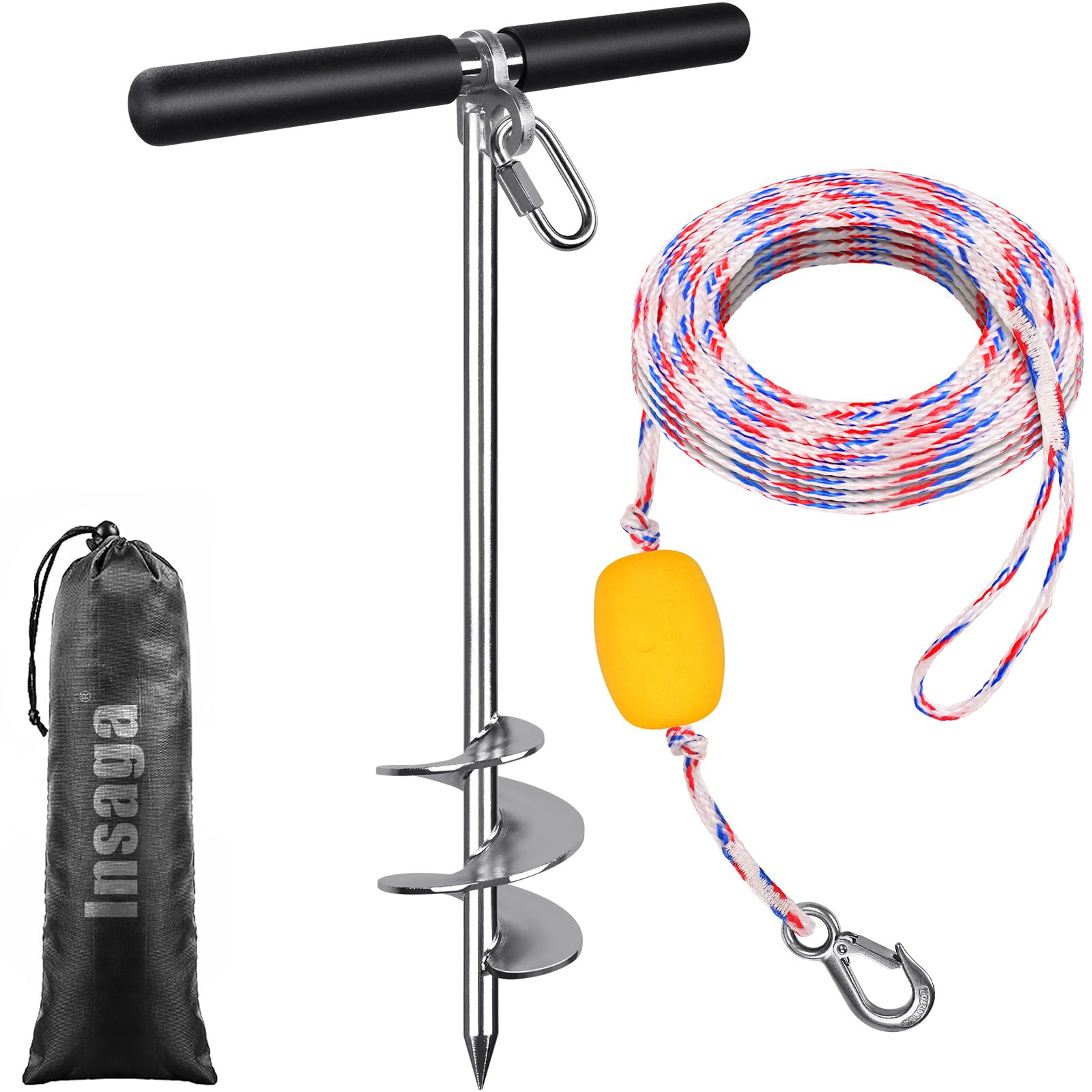
The Insaga Sand Anchor is the entry-level gold standard for jet ski beaching, costing substantially less than comparable 316 steel models. It uses 12mm solid 304 stainless steel with a 30mm double-sided helix and a fully welded construction. A removable crossbar aids installation, making it easy to screw into sand by hand or with minimal effort.
Real-world testing shows the 17-inch length holds a 22-foot pontoon without issue, which means it’s more than adequate for a single jet ski in moderate conditions. The 32-foot PE rope that comes with the kit is plenty for typical sandbar anchoring. Owners report using two units in tandem for stable positioning around other boats, which speaks to the predictable holding power.
The main limitation is the 304 stainless steel — it will endure years of use, but in full-time saltwater environments, 316-grade is more resistant to crevice corrosion. The rubber handles on the crossbar can detach, and some owners solved this with a drop of superglue. For a jet ski used mostly on weekends in freshwater or mixed conditions, the Insaga is a high-value choice that punches above its price.
Why it’s great
- Solid 304 stainless steel with 30mm helix provides strong holding
- Includes crossbar for easy manual installation in sand
- Bundled 32ft rope and carabiner means no extra purchases
Good to know
- Handle grips can detach and require adhesive to stay on
- 304 steel is less corrosion-resistant than 316 in constant saltwater
3. SandShark Lite Series Anchor
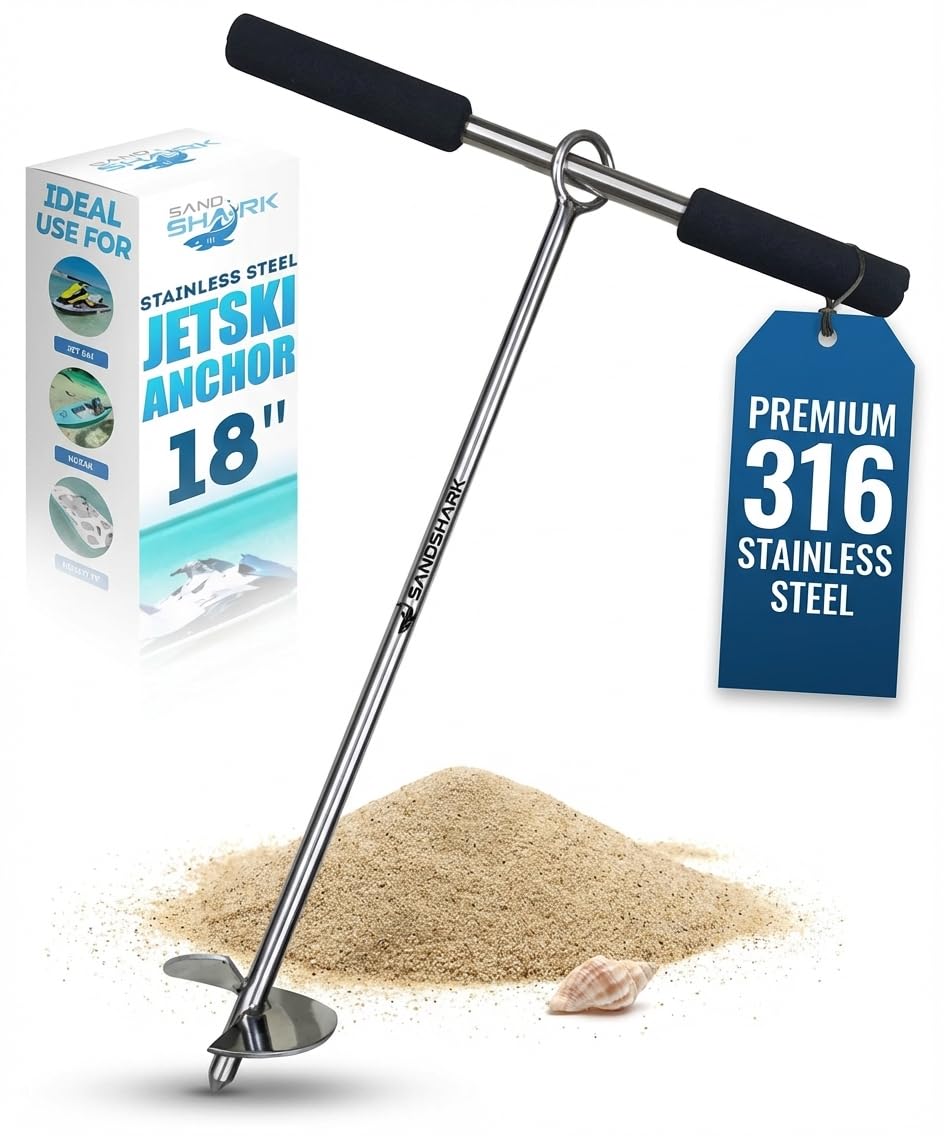
The SandShark Lite Series has been on the market since 2017 and has amassed a loyal following for its simple, effective design. It is made from polished 316 stainless steel, ensuring it resists saltwater corrosion for many seasons. The 18-inch shaft is compact enough to store easily but long enough to get a solid bite in soft sand.
What sets SandShark apart is the company’s customer service: one owner reported losing a part and received a replacement at no cost. The anchor has been proven in extreme scenarios — one verified review describes it holding a 2200 lb fiberglass boat through a 60 mph wind storm with 2-foot waves. That is far beyond what a jet ski needs, but it confirms the margin of safety.
The padded carry bag is a nice inclusion for protecting your jet ski’s storage compartment. However, the handle has some lateral play, and the 18-inch depth means you may have to dive in water deeper than 2 feet to install it. There is no extension option, so if you routinely anchor in deeper water, the longer VEVOR may be preferable. For a jet ski anchoring near shore, this is a compact, corrosion-proof workhorse.
Why it’s great
- 316 stainless steel is fully saltwater-proof for long-term use
- Compact 18-inch length fits in tight storage compartments
- Proven holding power in extreme weather conditions
Good to know
- Handle has some lateral movement; may need a set screw for tight fit
- 18-inch shaft requires diving if water is deeper than 2 feet
4. WAVESRX Aluminum Spike Anchor
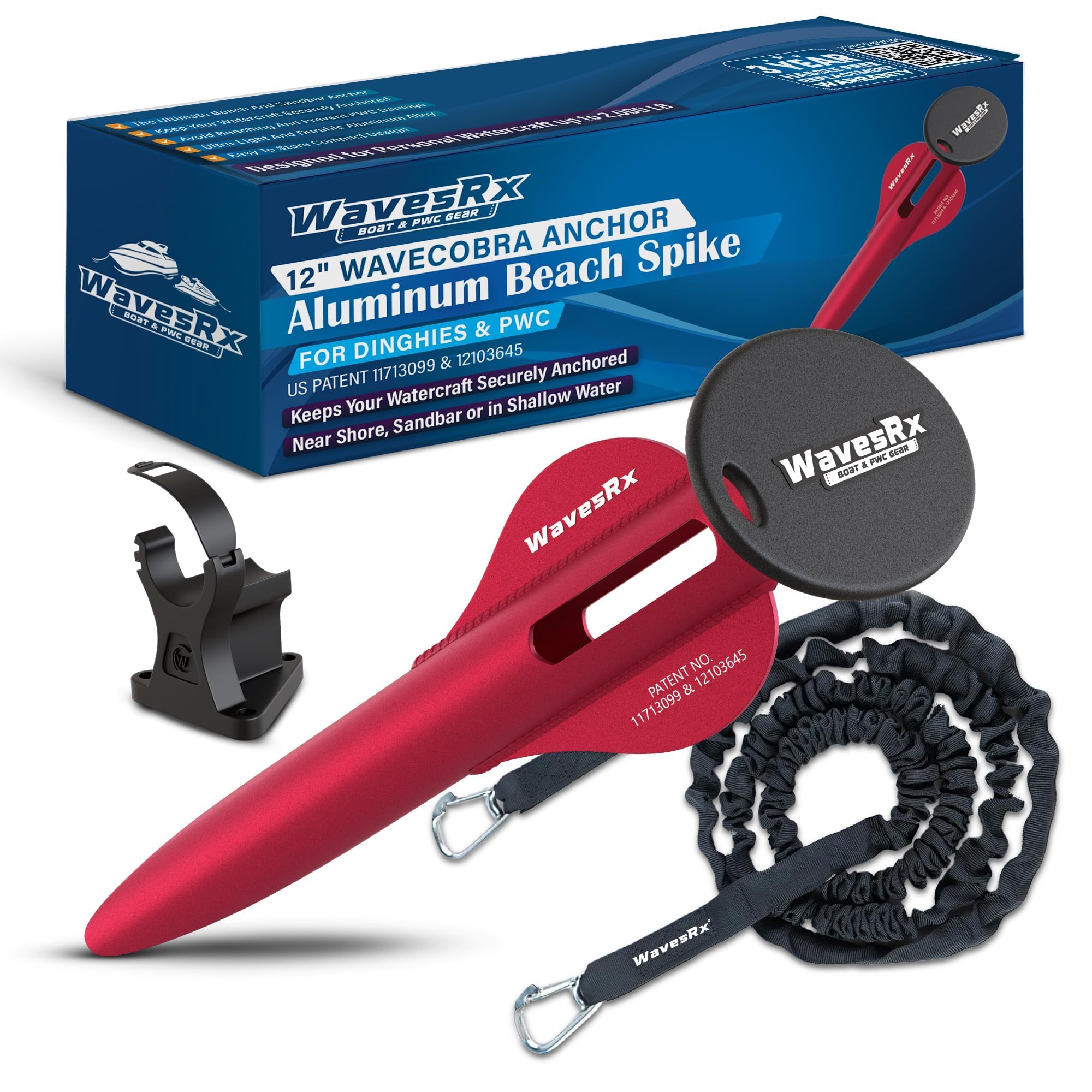
The WAVESRX takes a completely different approach, using a patented spike design made from 100% aluminum alloy that weighs just 16 ounces. At this weight, it’s the lightest anchor in the roundup — you can carry it to the beach in one hand without any strain. The 12-inch length is short, but the design relies on being stepped into the sand at a 15-degree angle rather than being screwed in like an auger.
For a jet ski parked on a sandbar in calm conditions, this anchor is exceptionally convenient. The bright anodized red finish prevents rust entirely and makes it easy to spot if dropped. The kit includes quality rope and a carry bag. Owners report excellent customer service from WAVESRX, with a 3-year hassle-free replacement warranty backing the product.
The limitation is that it works best in soft, unpacked sand. In hard-packed sand or very dense sediment, the spike cannot penetrate sufficiently and may not hold. The installation hardware can be brittle if overtightened. This is not an anchor for deep water, strong currents, or windy conditions — but as a quick-deploy parking anchor for a sandbar lunch stop, its lightness and simplicity are hard to beat.
Why it’s great
- Ultra-light 16 oz — easiest anchor to carry and deploy
- Aluminum alloy is 100% rust-proof for life
- Patented spike design is simple to step into soft sand
Good to know
- Not effective in hard-packed or rocky sediment
- Mounting hardware can break if over-tightened
5. SandShark SuperSport 3.0

The SandShark SuperSport 3.0 is the most versatile anchor in this lineup, featuring a telescoping shaft that adjusts from 29 inches to 48 inches. This means you can use it in shallow ankle-deep water or extend it to anchor in several feet of water without needing to dive. The construction uses a mix of reinforced nylon, engineering-grade plastic composite resin, and aircraft-grade aluminum, making it both strong and relatively lightweight.
The auger design creates suction once screwed into the sand, effectively locking the anchor in place. Collapsible handles fold flat for storage, and the included padded nylon case prevents rattling in your jet ski’s storage compartment. One owner reported that this anchor saved his pontoon boat during 60 mph gusts — the anchor held while only the lower post bent, which is an extreme testament to its grip.
Owners of SeaDoo jet skis report it holds their craft securely at the sandbar. The telescoping feature does add complexity — the mechanism requires occasional cleaning to prevent sand from jamming it. Also, the composite materials are not as scratch-resistant as all-metal designs. For the jet ski owner who wants maximum adjustability across different anchoring depths, the SuperSport is the premium choice.
Why it’s great
- Telescoping from 29 to 48 inches adapts to any water depth
- Auger suction design provides extreme holding power
- Collapses into compact padded case for easy storage
Good to know
- Telescoping mechanism needs occasional sand cleaning
- Composite materials may scratch if dragged across rough surfaces
6. COOPER ANCHOR 2.2lb Nylon Anchor

The COOPER ANCHOR is a fundamentally different type of anchor — a small, all-nylon mushroom-style anchor made in Australia. Weighing just 2.2 pounds, it is designed for personal watercraft and boats up to 12 feet in length. Unlike the screw-in auger designs, this is a pick-and-throw anchor: you tie it off and let it settle on the bottom.
Where this anchor excels is on soft, muddy lake bottoms where auger anchors lose their bite. The nylon construction is completely rust-proof and will never stain your hull. Owners who pair it with a 4-foot length of chain and a bungee line report it holds a SeaDoo in 15 mph winds on soft lake bottoms without any drift. The compact size means it stores easily in a jet ski glove box.
The major limitation is that it is not a sand anchor — on a clean sandbar, the 2.2 lb weight will not grip effectively, and your jet ski will drift with the current. It also requires proper scope (rope length relative to water depth) to hold. For PWC users who anchor in calm lakes, rivers, or protected bays with soft sediment, this is a simple, reliable, and corrosion-proof solution. For sandbar beachgoers, look to the auger anchors instead.
Why it’s great
- All-nylon — zero corrosion, will never rust or stain
- Compact size fits in a jet ski glove box or small storage
- Works perfectly on soft mud and silt bottoms
Good to know
- Not designed for sandbar anchoring; will drag in sand
- Requires adding chain and bungee for optimal holding
7. Newport Premium 10lb Mushroom Anchor Kit
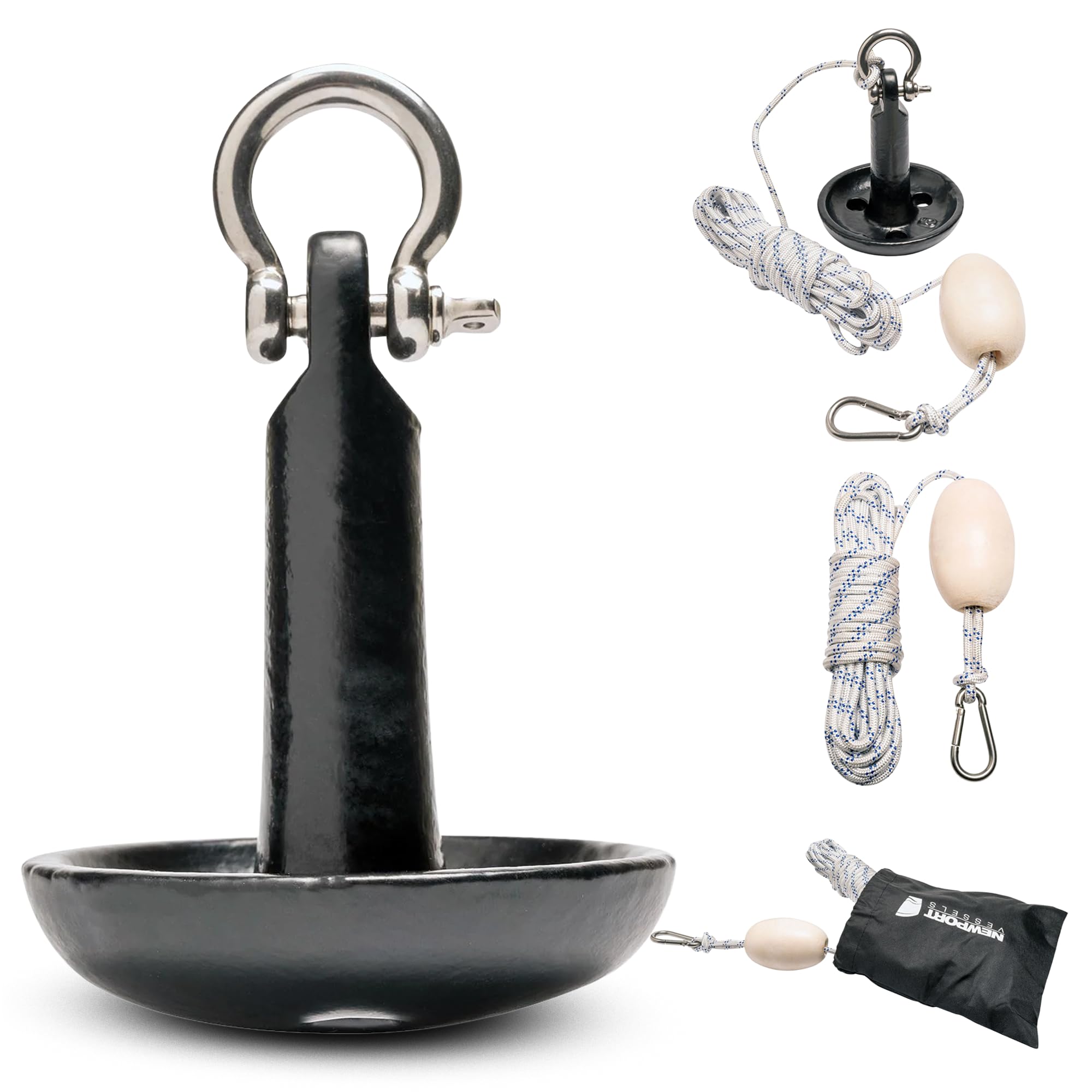
The Newport Premium 10lb Mushroom Anchor Kit is the most complete anchor package in this review. It includes the mushroom anchor itself, a 30-foot rope, a floating buoy, a stainless steel shackle, a carabiner, and a carrying bag — everything you need to anchor straight out of the box. The anchor is PE-coated cast iron, which means the heavy weight is encased in a smooth, durable polyethylene layer that protects the hull from scratches and the anchor from corrosion.
This kit is designed for lakes, bays, and ponds with a mud, soft sand, or silt bottom. The 10-pound weight is recommended for boats from 10 to 15 feet, which covers the vast majority of jet skis. Owners report it working perfectly for tying off inflatable dinghies and large floats in calm lake conditions. The complete nature of the kit is its strongest advantage — you don’t need to source rope, shackles, or a bag separately.
However, for a jet ski owner who primarily beaches on sandbars, this anchor is not ideal. The mushroom design relies entirely on weight and suction on a soft bottom — on a hard sandbar or in clean sand, it will not dig in and can slide. The included knots and shackle may need to be redone with a proper anchor hitch for reliability. For lake users with muddy or silty bottoms who want a turnkey kit, this is a solid choice with a 1-year warranty.
Why it’s great
- Complete kit includes rope, buoy, shackle, bag — ready to use
- PE coating protects boat from scratches and prevents rust
- 10 lb weight provides strong hold on mud and silt bottoms
Good to know
- Not designed for clean sandbar anchoring; will drag on sand
- Knots and shackle may need retying for secure setup
FAQ
What is the difference between a sand auger anchor and a fluke anchor for a jet ski?
Do I need a bungee line between the anchor and my jet ski?
Can I use an aluminum spike anchor in hard-packed sand?
Final Thoughts: The Verdict
For most jet ski owners, the best anchor for jetski is the VEVOR Sand Anchor because its 36-inch 316 stainless steel auger provides maximal holding power in sand, the bungee line prevents pull-out, and the complete kit offers everything you need at a value that beats comparable 316-steel anchors. If you want a compact, corrosion-proof option that stores easily and comes from a brand known for excellent customer support, the SandShark Lite Series is a reliable choice. And for a quick, ultra-light anchor that you can deploy in seconds on a calm sandbar, the WAVESRX Spike Anchor is the lightest, most convenient option available.