
Our readers keep the lights on and my morning glass full of iced black tea. As an Amazon Associate, I earn from qualifying purchases.
Specs are compiled from manufacturer listings and verified buyer reviews and can change over time — please confirm the key details on the product page before buying.
Buying anchor rope is really a question of matching three things to your boat: how thick the line is, how long it needs to be, and how much pull it can take before it lets go. Get those three right and your boat stays put in a chop. Get them wrong and you either drag in the middle of the night or fight a coil of rope that tangles every time you pull it out of the locker. This guide walks through nine real anchor lines, explains what every measurement on the label actually means in plain terms, and tells you which one fits a small fishing boat, which one suits a 35-foot cruiser, and which ones are best saved for light weekend duty. If you just want the short answer, the top pick below carries the strongest combination of length, breaking strength, and owner satisfaction on the list. Every spec in this article comes straight from the manufacturers’ published figures and the verified owner feedback on each listing.
I’m Min — the founder and writer behind Gadgets Feed. This guide is built by comparing the manufacturers’ published specifications and the patterns across verified customer reviews, so you get each pick’s real strengths and trade-offs instead of marketing spin.
To make the right call you mostly need to understand diameter, length, and breaking strength before you buy anything. That is exactly what this breakdown of best anchor rope covers for you.
Our Picks at a Glance


How To Choose The Best Anchor Rope
Three numbers on the label do almost all the work: the diameter, the length, and the breaking strength. Everything else — the material, the thimble, the color — is a refinement on top of those three. Here is how to read each one without getting lost.
Diameter Controls Your Hardware Fit
Anchor rope comes in 3/8 inch and 1/2 inch diameter in this lineup, and the difference matters more than the number suggests. A 3/8 inch line (about the thickness of a typical garden hose) is lighter and easier to handle, and it is the common pick for boats up to 16 to 27 feet. A 1/2 inch line is noticeably beefier, weighs more in your hand, and suits larger boats because the thicker weave handles higher loads. The critical thing most first-time buyers miss: your anchor chain, shackle, and windlass are all sized to a specific diameter. A 1/2 inch rope will not pass cleanly through hardware built for 3/8 inch line, and a 3/8 inch rope in oversized hardware can slip. Match the rope diameter to your existing gear before you order.
Length And Scope: The Rule That Keeps You Put
Length is not about how deep the water is — it is about scope, the ratio of rope paid out to water depth. A typical anchoring scope runs around three feet of line for every one foot of depth, and some conditions call for more. That means a 50-foot line handles shallower anchoring comfortably, while a 100-foot line opens up deeper spots or rougher conditions where you want more rope out. If you routinely anchor in deeper water, going longer is almost always the safer call, because you can always pay out less than you have but you cannot invent rope you did not bring. One buyer with the 150-foot option runs a 3:1 scope in 50 feet of water off the bow and keeps 100 feet for the stern.
Breaking Strength vs Working Load
Breaking strength is the point at which the rope snaps; working load is the much lower figure the maker says you should actually pull against day to day. On premium lines, a working load is listed separately so you know the safe continuous pull. Boats in choppy water also generate sudden shock loads on the line that can far exceed the dead weight of the boat, which is exactly why the makers build in that large gap between working load and breaking point. Bigger diameter and denser material push both numbers up.
Material: Nylon vs MFP vs Polyester
Nylon stretches and absorbs shock loads well, which is why it is a common choice for anchor rode. MFP (a lightweight polypropylene blend) floats and resists water absorption, making it easy to retrieve and reducing the risk of a line sinking and snagging a propeller. Polyester sits in between, offering moderate stretch with good resistance to kinking. Each has a place, and the right one depends on whether float, shock absorption, or low stretch matters most to you.
Quick Comparison
| Model | Best For | Length | Diameter | Breaking Strength | Amazon |
|---|---|---|---|---|---|
| Young Marine 3/8″ x 150′ Nylon Double Braided Anchor Line★ Best Overall | Boats up to 27′, all-round anchoring | 150 ft | 3/8 in | 4035 lb | Amazon |
| MARINE SYSTEM 3/8″ x 100′ Premium Solid Braid MFP GreyBest Value | Boats under 16′, light and floating | 100 ft | 3/8 in | 1565 lb | Amazon |
| VEITHI Premium 50 ft x 1/2″ Solid Braid MFP Anchor LineBest Color Choice | Boats up to 25′, docking and anchoring | 50 ft | 1/2 in | 2513 lb | Amazon |
| ORLANG 50 ft X 1/2″ 3-Strand Twisted Nylon Anchor Line | Boats under 30′, beach and sandbar anchoring | 50 ft | 1/2 in | 4543 lb | Amazon |
| HOKINETY 3/8″ x 150FT Marine Grade Anchor Line MFP | Kayaks, small boats up to 16′, floating | 150 ft | 3/8 in | 2000 lb | Amazon |
| DEDU 100 FT 1/2″ Double Braided Anchor Line | Boats up to 35′, towing and mooring | 100 ft | 1/2 in | 4600 lb | Amazon |
| Better Boat Premium 100 Ft Double Braided White Nylon | Small fishing boats, visibility at night | 100 ft | 3/8 in | 4035 lb | Amazon |
| VEITHI 100 ft x 1/2″ 3 Strand White Anchor Line | Boats up to 35′, towing and docking | 100 ft | 1/2 in | 4542 lb | Amazon |
| NovelBee 3/8″ X 200 Feet Double Braid Nylon Anchor Line | Deep water, mooring lines, houseboats | 200 ft | 3/8 in | — | Amazon |
In‑Depth Reviews
1. Young Marine Made 3/8 Inch 100FT 150FT Black Nylon Anchor Line Double Braided Anchor Rope/Line with Thimble (3/8″ x 150′)
Our pick — over 4.5★ from 850+ verified ratings; the strongest balance of quality and price.
A 150-foot nylon double braid with 4035 pounds of breaking strength — the longest line here backed by the most owner praise.
For anyone running a boat up to 27 feet who wants one line that covers a wide range of anchor depths, this is the one to start with. The 150-foot length is the standout number: it lets you pay out a proper scope in deeper spots without buying a second rode. The 3/8 inch diameter keeps the line manageable on deck, and the 4035-pound breaking strength is the highest of any 3/8 inch line in this roundup — more than double the 1565-pound figure on the MARINE SYSTEM line below.
The build is nylon double braid, which means the rope has a jacket woven over an inner core — that construction resists kinking and keeps the line round under load. A marine-grade stainless steel thimble (a metal liner that protects the rope’s end loop from chafing against a shackle) sits at the anchor end. The black color is a real advantage for duck hunting, since it disappears against dark water and shadow. Owners praise the overall quality most of all, and one buyer rigs a 3:1 scope in 50 feet of water off the bow while keeping 100 feet on the stern. The weave stays tight and the line does not kink badly, which keeps retrieval smooth over a long season.
The honest trade-off: the durability story splits. Some owners find the line very strong right away, while a handful report fraying after a single hard use in abrasive conditions. That is a fair caveat for anyone planning to drag this rode over rocky bottoms repeatedly. For typical anchoring, docking, and mooring on a boat under 27 feet, the combination of length, breaking strength, and the low occurrence of complaints still puts this at the top of the pile. The 1-year manufacturer warranty backs it up.
What makes it the pick
- 150-foot length gives genuine scope flexibility in deeper water
- 4035-pound breaking strength — the top figure among 3/8 inch lines here, versus 1565 pounds on the MARINE SYSTEM line
- Marine-grade stainless steel thimble protects the eye splice
- Black color blends in for duck hunting and low-light use
Where it asks for care
- Fraying reported in a small number of cases after repeated abrasive contact
- Longer line takes more locker space than a 50 or 100 foot rode
- Not designed for the heaviest loads of a large cruiser
Made for: owners of boats up to 27 feet who want one long, strong rode that handles both bow and stern anchoring without buying extra line.
Look elsewhere if: you need a rope certified for a much heavier boat, or you plan to drag it over rocky bottoms on every trip.
2. MARINE SYSTEM Made 3/8 Inch 100FT 150FT Premium Solid Braid MFP Grey Anchor Line Braided Anchor Rope/Line with Stainless Steel Thimble and Shackle (3/8″ x 100′ Grey)
The floatable 100-footer that stays soft and tangle-free — a smart match for boats under 16 feet.
If you fish from a small boat, kayak, or runabout, this MARINE SYSTEM line is often the better fit than a longer, heavier rode. The 3/8 inch diameter runs 100 feet long, and the MFP (a lightweight floating polypropylene blend) construction means the rope stays on the surface rather than sinking into the prop zone. The breaking load is 1565 pounds, and the maker recommends it for boats under 16 feet — so this is not the line to grab if you run a heavier setup. For a small boat it lines up nicely.
The standout feature is the stainless steel thimble and shackle kit, which arrives pre-spliced so you can connect your anchor chain without extra hardware. The rope stays flexible through its life and resists tangling better than many alternatives. Owners rate the quality highest, with softness, tangle-resistance, and appearance also drawing steady praise. One buyer notes they anchor in up to about 50 feet of water and finds the 100-foot length plenty, while another values the grey color because it hides dirt better than white. The grey also avoids the bleached look that plagues lighter cords after a season in salt water.
Set your expectations on load: at 1565 pounds of breaking strength, this line sits well below the 3/8 inch nylon options higher on this list. That is the natural trade-off for a floating, lightweight material. If your boat stays well under 16 feet and you want a rode that comes back easily and never sinks, the MARINE SYSTEM is the sharp buy here. For anything bigger, step up to a thicker line.
The floating edge: MFP construction keeps the line above the water, which makes retrieval simpler and reduces snag risk around the propeller — a genuine plus on a small boat.
Sized for small craft: rated for boats under 16 feet with a 1565-pound breaking load, so it works best as a light-duty rode rather than a heavy anchor system.
Reach for this if you run a boat under 16 feet and want a floating, soft line that comes back to hand without a fight.
Step up if your boat is heavier or you anchor in rough water — you will want the higher 4035-pound breaking strength of the Young Marine line.
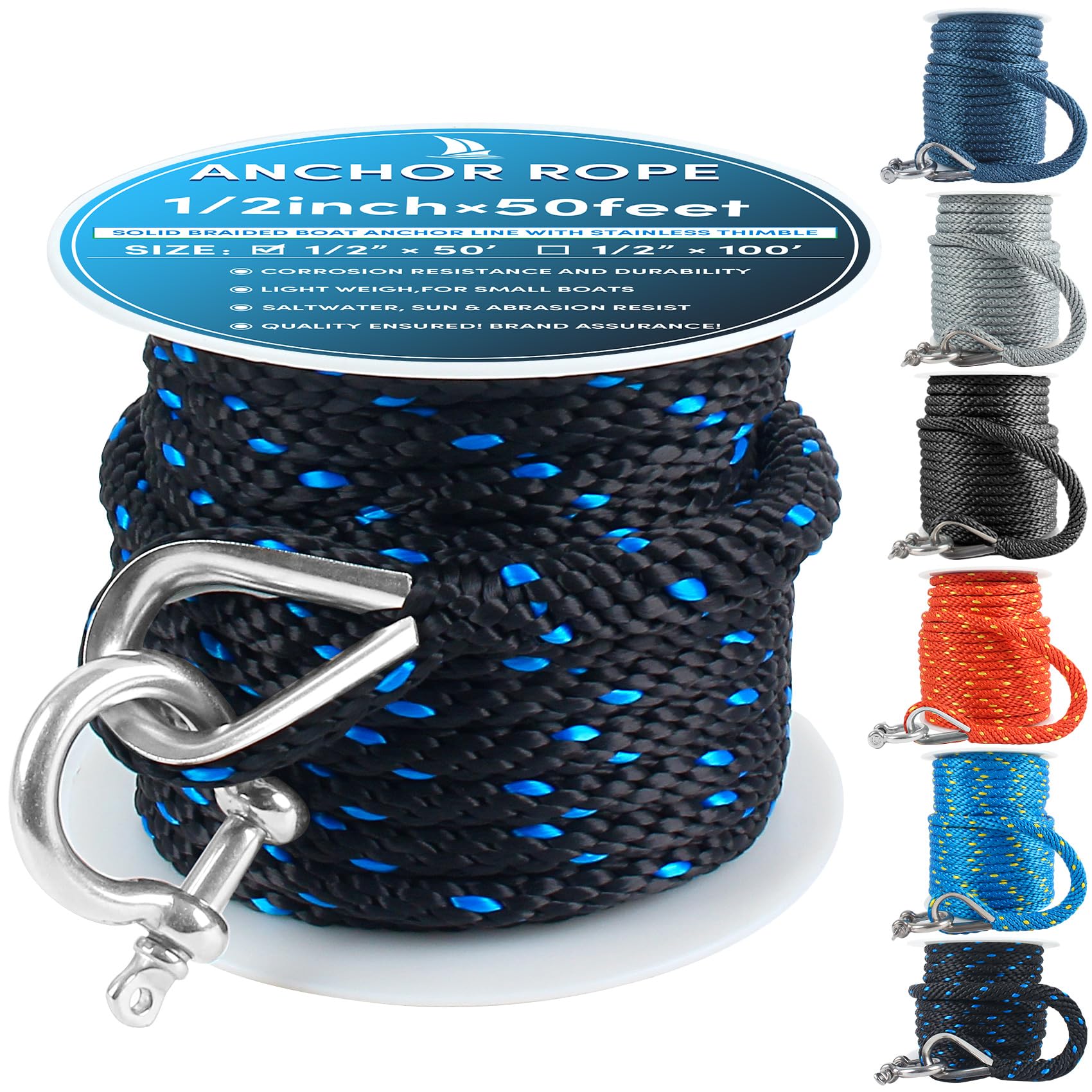
3. Premium Anchor Rope 50 ft x 1/2 inch, Solid Braid MFP Anchor Line Boat Rope with Thimble & Shackle – Black/Blue
Half-inch thick, 50 feet long, and pre-fitted with a shackle — a compact rode for boats up to 25 feet.
This is the pick for someone who anchors in reasonably shallow water and wants a thick, easy-to-grip line without a long coil taking up space. The 1/2 inch diameter is the beefier of the two common sizes, and at 50 feet the line is short enough to stow easily. It carries a 2513-pound breaking strength with a 500-pound recommended maximum working load. The MFP material floats, resists saltwater, gas, oil, acids, abrasion, and UV exposure, and it is softer on the hands than a stiff twisted line.
The solid braid construction has a real advantage you feel the first time you cut it: unlike twisted or diamond braided rope, it will not unravel when trimmed with a knife or scissors. The included stainless steel thimble and shackle make anchor hookup quick, and one end is heat-sealed to prevent fraying. Owners rate the functionality highest, followed by the color and the softness of the line. The available colors — white, black, blue, navy, and grey — let you match your boat’s trim.
That said, the durability picture on this line is mixed, and the manufacturer itself warns of a limited load: this rope is intended for small boats, and the listing advises choosing carefully if your hull is larger. Some long-term buyers report solid service through multiple seasons, while others note it is better suited to lighter use than to hard anchoring every weekend. If your boat is well under 25 feet and you anchor casually, this is a sensible, well-priced rode. If you need a line to tackle heavy loads or a bigger boat, look at the DEDU or VEITHI options below.
Thick and soft in hand: at 1/2 inch, this is the heavier of the common rope sizes, and the MFP solid braid feels supple rather than wiry — easy to grip and easy to coil back into a locker.
Honest about load limits: the maker is upfront that this line suits smaller boats, with a 2513-pound breaking strength and a 500-pound working load, so size it against your hull before you commit.
Good fit for: a small boat owner who anchors casually in shallower water and wants a thick, quiet-handling line with matching colors.
Think twice if: your boat is larger or you anchor hard every weekend — the durability feedback here is mixed and the maker flags the load limit.
4. Anchor Rope 50 ft X 1/2 inch, 3-Strand Twisted Nylon Anchor Line, Boat Rope with Stainless Steel Thimble and Shackle for Boating, Anchoring, Mooring, Pulling (Black)
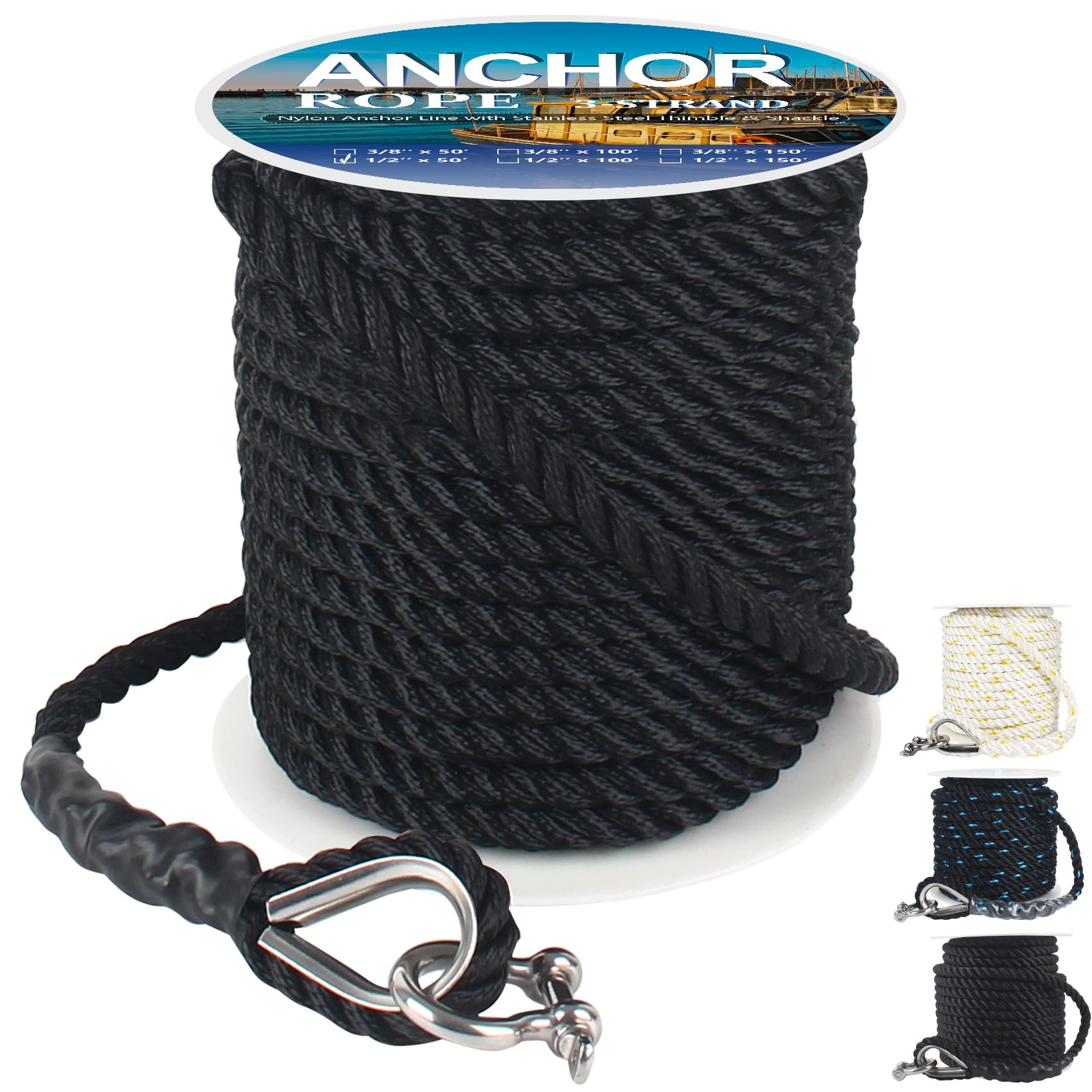
A 4543-pound twisted nylon line that absorbs shock in choppy water — built for boats under 30 feet.
The defining number on this ORLANG rode is its 4543-pound breaking strength — among the highest in this entire roundup and the reason it earns a spot for anyone who anchors in active water. The 3-strand twisted nylon construction (three cords coiled together into one rope) distributes load evenly and stretches slightly under pull, which helps absorb the sudden jolts when waves hit a moored boat. The recommended maximum working load is 956 pounds, and the maker advises it for boats under 30 feet.
The 1/2 inch diameter and 50-foot length make it a compact, heavy-duty rode for a mid-sized boat. Nylon resists seawater corrosion, UV, and weather, so it holds up over a long season. The stainless steel thimble reduces chafe at the anchor end, and one end is heat-sealed so it stays easy to grip. Where this line suits owners best is beach and sandbar anchoring, which is exactly where the reviewers with this rope report using it — including one handling line on a Great Lakes boat.
The caveat: this is the least-reviewed pick in the roundup, so the long-term durability story is thinner than the top products. One experienced sailor found the line did not match his expectation of a fully marine-grade nylon rode and would not trust it as a primary anchor line on a windlass. For a weekend sandbar anchor or a spare rode, that concern is smaller. For a windlass-fed primary anchor line on a serious offshore boat, size up accordingly. There is no manufacturer warranty on this line.
Numbers worth noting
- 4543-pound breaking strength and 956-pound working load
- 3-strand twisted nylon absorbs shock from waves and wake
- Stainless steel thimble and shackle included
- Sized up to 30-foot boats, so it handles more hull than the 25-foot picks
Worth weighing first
- Smallest review base in the lineup — long-term durability evidence is thinner
- One experienced sailor would not use it as a primary windlass line
- No manufacturer warranty
Worth it for: a weekend boater running under 30 feet who wants high breaking strength for sandbar and beach anchoring without a long rope.
skip it if: this line is meant to be your primary windlass rode on a serious offshore boat — the durability data here is too thin to be certain.
5. Boat Anchor Rope 3/8 Inch x 150FT – Marine Grade Anchor Line Premium Solid Braid MFP Dock Line with Stainless Steel Thimble & Shackle for Boat, Kayak, Dock Boating Accessories – Black
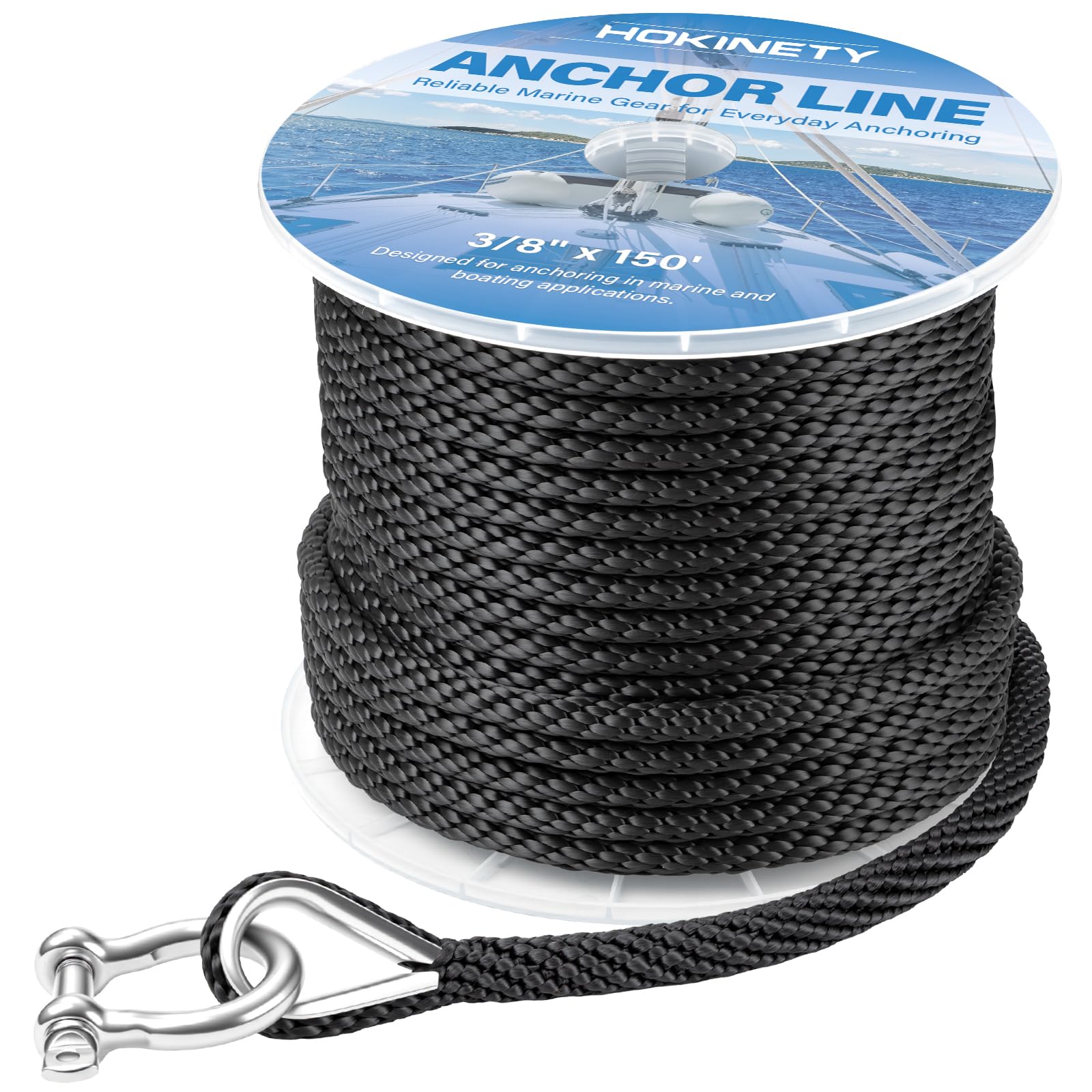
A floating 150-footer built for kayaks and small boats — plenty of length without the weight of thicker line.
For kayak, jet ski, and small boat owners, the HOKINETY line delivers what matters most: length and float without a heavy rope. The 3/8 inch diameter runs 150 feet, matching the longest pick on this list, but the MFP construction keeps the line lightweight and naturally buoyant. That float means it stays off the bottom and away from the prop, and the recommended use is for boats up to 16 feet. The 2000-pound breaking strength sits comfortably above the MARINE SYSTEM 1565-pound figure while staying below the heavy nylon lines above.
It is a solid braid design, which means abrasion resistance, flexibility, and strength in one weave, and it resists saltwater, UV, oil, and harsh weather. A marine-grade stainless steel thimble protects the pre-spliced eye, and the line comes ready to connect to chains or shackles. Owners praise the quality above all, and several report buying it again to outfit a second boat. The black color stays inconspicuous on deck.
The trade-off is straightforward: this is a light-duty rode with a 2000-pound breaking strength, so it is not the pick for a bigger boat or heavy anchoring loads. If you need a long line for a kayak, tender, or runabout and want the ease of a floating rope, this is a very natural fit. If you need raw breaking strength for a heavier hull, the Young Marine or ORLANG lines lead on that front. No manufacturer warranty is listed.
Length without weight: 150 feet of floating 3/8 inch MFP gives kayakers and small-boat owners scope for deeper anchoring without hauling heavy line in and out.
Light-duty by design: 2000 pounds of breaking strength keeps this in the small-craft bracket — ideal for a kayak or tender, not a heavier hull.
Ideal for: kayak, jet ski, and small-boat owners who want a long, floating, easy-to-handle line that stays off the bottom.
Not the one if: your boat is heavier or you need maximum breaking strength — reach for the Young Marine or ORLANG options for that job.
6. Anchor Rope 100 FT 1/2 in, Double Braided Anchor Line with 316 Stainless Steel Thimble & Shackle, Boat Anchor Rope Ideal for Towing, Mooring, Deck, Anchoring, Boats Up to 35′ – Blue
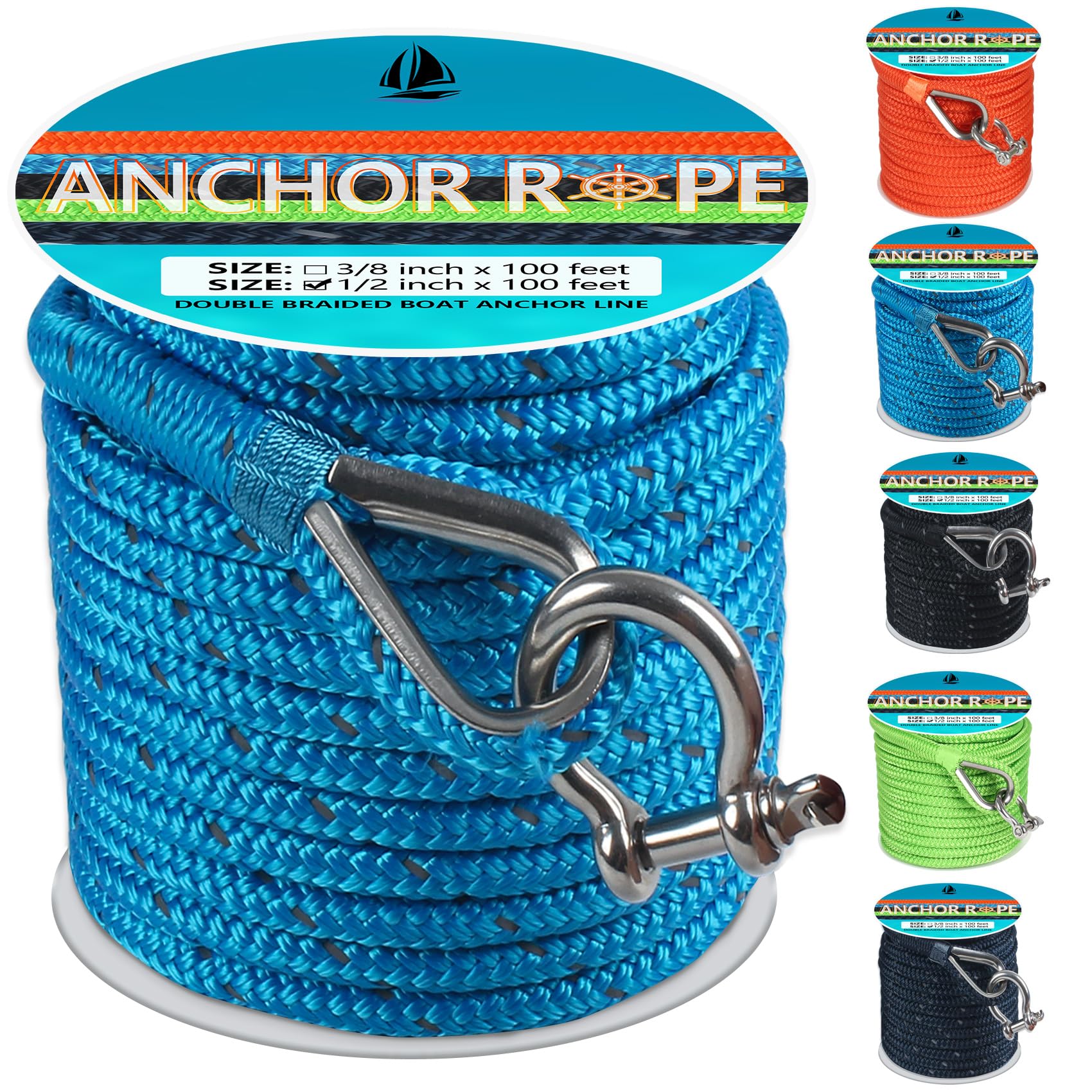
A 4600-pound double braid with 316 stainless hardware — the highest breaking strength in this roundup.
If you need a rode rated for a bigger boat, this DEDU line is the one to beat on raw strength. The 4600-pound breaking strength is the highest figure anywhere in this lineup, and the 100-foot length at 1/2 inch diameter makes it a serious anchor rode for boats up to 35 feet. The maker specifies 316 stainless steel for the thimble and shackle — a marine-grade alloy chosen for corrosion resistance in salt water — and the double braid weave resists tangling, will not unravel when cut, and stays smooth on the hands.
The construction also absorbs shock while resisting salt water, gas, oil, and UV, and the thick 1/2 inch line resists scratching your boat’s finish. Owners praise the quality of the line most of all, and one buyer reports it holding a 24-foot boat as it should. Reflective strips are available on select colors for nighttime tracking — a small but genuinely useful detail. The rope comes assembled with the thimble and shackle already in place, so hookup is a two-minute job.
The one recurring gripe is the shackle: one buyer found it small for a 100-foot rope and upgraded it. That is an easy, inexpensive fix rather than a dealbreaker, but worth knowing if you plan to run this as your primary anchor line. For anyone with a larger boat who wants the top breaking strength here — and a hardware kit that already includes the 316 stainless components — this is a strong buy.
Why it earns a top spot
- 4600-pound breaking strength — the highest number in this roundup
- 316 stainless steel thimble and shackle for serious saltwater duty
- Double braid resists tangling, kinking, and unravelling when cut
- Rated for boats up to 35 feet with a reflective color option
Fine print that matters
- Included shackle can feel small for a 100-foot rope
- Heavier and bulkier than a 3/8 inch line at the same length
- No manufacturer warranty listed
Choose this if: your boat is up to 35 feet and you want the highest breaking strength here paired with 316 stainless hardware.
Consider otherwise if: you want a lighter, thinner line for easy handling on a small boat, or you want the shackle sized up from the start.
7. Better Boat Premium Anchor Rope, 100 Ft Double Braided White Nylon Marine

A reflective-thread nylon rode that lights up at night — 100 feet of soft-handling double braid with 4035 pounds of breaking load.
The defining feature here is the reflective thread woven into the line — a genuine safety gain for anyone who anchors or docks after dark, since the rope glints back light from a flashlight or boat light so you can find the line quickly. That sits on top of a 3/8 inch, 100-foot double braided nylon construction with an 820-pound working load and 4035-pound breaking load. Nylon gives this line stretch for shock absorption, which is what you want in an anchor rode that has to take the pull of waves.
The marine-grade stainless steel thimble is pre-spliced and professionally whipped, reducing chafe and spreading load at the anchor end. The line resists salt water, constant sun, oil, and abrasion, and it coils smoothly without fighting back. Owners praise the quality, durability, and value most, and one names the reflective strands as the reason they like this line. A 15-pound anchor on a small fishing boat is exactly the kind of setup this rope is designed for.
The main caveat involves color: the blue version had its dye bleed on first use for one buyer, who wished they had ordered white instead. If you want the reflective version in blue, be ready for that possibility on the first soak. Otherwise, this is a well-loved rode with a long owner history and a reflective safety feature that earns its keep every time you navigate home after sunset.
Safety built in: the reflective thread woven through the line makes it easy to spot after dark — a practical bonus for late returns and mooring in low light.
Soft on the hands: the double braid nylon is smooth and comfortable to pull, and it coils back into a locker without kinking or tangling.
Reach for this if you anchor a small fishing boat, want a soft, easy-coiling rode, and value the reflective thread for nighttime visibility.
Choose the white version if you are concerned about dye bleed — the blue line has been reported to release color on the first wet use.
8. Boat Anchor Rope 100 ft x 1/2 inch White, 3 Strand Anchor Line Marine Rope with Stainless Steel Thimble & Shackle Ideal for Towing, Docking, Boats, Mooring, Anchoring, for Boats Up to 35′

A 4542-pound 3-strand polyester rode rated to 35 feet — long, strong, and ready to tow, dock, or moor.
Owners of boats in the 30 to 35 foot range get a full 100 feet of 1/2 inch rope here, with a 4542-pound breaking strength and an 860-pound recommended maximum working load. That is a serious amount of pull for the diameter, and the three-strand twisted polyester construction has a slight stretch so the line absorbs sudden shock loads from waves. Polyester resists salt water, gas, oil, acids, abrasion, and UV, and it holds up without discoloration or noticeable deterioration over a season in salty, sunny air.
The line comes with a firmly spliced stainless steel thimble and shackle, and the other end is heat-sealed for grip. It is a smooth-handling rope — no grinding on the boat’s finish — and the three-strand structure resists kinking and rotation under heavy load. Owners rate the quality, functionality, and value highest, and one runs it on a 32-foot center console. Multiple repeat purchases appear in the feedback, which is always an encouraging sign for a marine rode.
What to watch: the durability story is mixed. Some owners find the line strong and reliable, while others note the braiding can come apart and fray after use — and one calls out a loose thimble and line that unravelled immediately after cutting without tape whipping. That points to handling the line carefully on any cut ends. There is also no manufacturer warranty. For normal anchoring and towing duty on a boat up to 35 feet, it still delivers real value, but keep an eye on the splice and ends.
Why owners keep buying it
- 4542-pound breaking strength with an 860-pound working load
- 100 feet of 1/2 inch polyester rated for boats up to 35 feet
- Stainless steel thimble and shackle pre-spliced and ready
- Repeat owners mention using it across multiple setups
Keep an eye on
- Mixed durability feedback — some report fraying after use
- Loose thimble and unravelling at cut ends reported occasionally
- No manufacturer warranty listed
Made for: boat owners up to 35 feet who want a long, strong twisted rode that handles towing, docking, and mooring in one line.
Watch the details if: you plan to cut and re-splice this line — tape the ends before trimming to avoid unravelling, and check the thimble on arrival.
9. NovelBee 3/8 Inch X 200 Feet Double Braid Nylon Anchor Line (White/Gold)
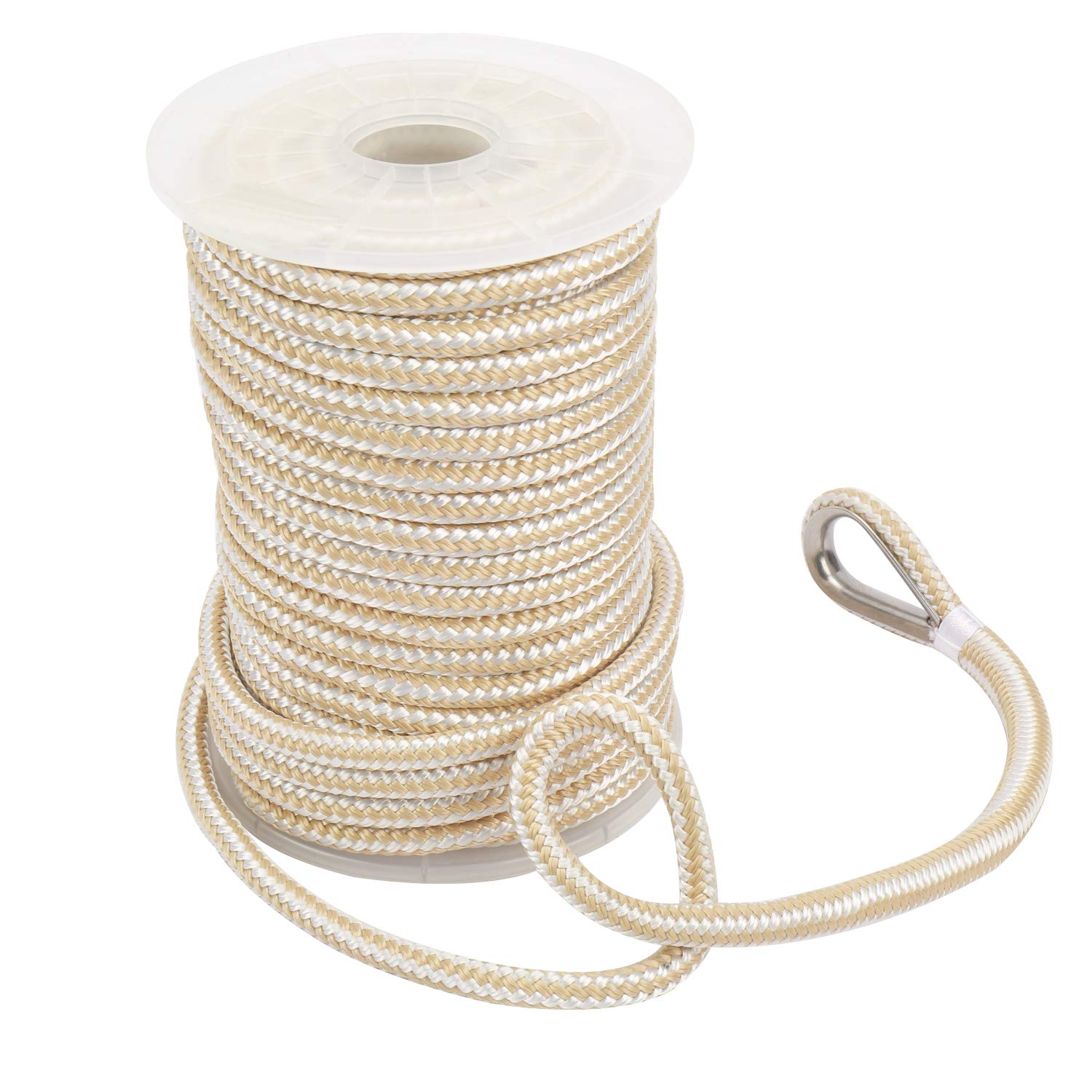
The longest rode in the roundup — 200 feet of 3/8 inch double braid nylon built for deep water and long moorings.
When you need length above all else, the NovelBee gives you 200 feet of 3/8 inch double braided nylon. That is the longest line in this entire roundup — twice the length of the 100-foot picks — and for a deep-water anchorage or a houseboat mooring, the extra rope is exactly what makes the setup work. The braid-on-braid construction (an outer jacket woven over an inner core) gives the rope strength and shock absorption, and nylon the flexibility to handle rough pulls.
The line comes with a stainless steel thimble and a plastic protective end, and the pre-spliced eye is ready to run through your shackle. The White/Gold color option gives it a classic marine look, and the line is rated to be pliable and easy to work with on the dock. Owners use it for anchoring a 26-foot boat on a lake and as braided mooring lines on a houseboat, and the value for the length is widely appreciated. The nylon braid spools well and holds together under normal handling.
The trade-off is the same as with any longer rope: the thimble gauge is on the lighter side, which one owner notes is fine for weekend recreational boating but not intended for the heaviest duty. There is no listed breaking strength on the product page, so if raw load rating is your deciding metric, the Young Marine or DEDU lines give you that number outright. For deep-water anchoring, docking, or as houseboat mooring lines where length matters most, this is the standout pick on length alone.
Length is the whole story: at 200 feet, this is the longest line here — enough rope to set a proper scope in deep water or to braid into custom mooring lines.
Lighter-duty thimble: the thimble gauge runs thinner than premium picks, which is fine for weekend recreational boating but not for a heavy commercial anchoring setup.
Best for: deep-water anchoring, houseboat mooring lines, and any setup where 200 feet of braid-on-braid nylon is the deciding factor.
Look elsewhere if: you need a published breaking-strength figure to shop against, or your setup calls for maximum thimble gauge.
Understanding the Specs
Diameter And Deck Hardware
The diameter — the thickness of the rope itself — is the number to match against your existing anchor setup before anything else. Anchor rope in this lineup runs 3/8 inch and 1/2 inch, and your shackle, chain, and windlass are built for one size, not both. A 1/2 inch line will not pass cleanly through 3/8 inch hardware, and a 3/8 inch rope can slip loose in oversized shackles. Match diameter first, then choose length and strength.
Breaking Strength And Working Load
Breaking strength is the point at which the rope fails; working load is the much lower continuous pull the maker recommends. A line with a 4035-pound breaking strength may carry something like a 820-pound working load — the gap protects you against the sudden shock loads that waves generate on a moored boat. Always shop against the working load for daily duty and leave the breaking strength as your safety margin.
Nylon vs MFP vs Polyester
Nylon stretches and absorbs shock loads, making it a strong choice for an anchor rode in active water. MFP (lightweight polypropylene) floats, stays soft, and resists water absorption — great for small boats and kayaks where retrieval ease and buoyancy matter. Polyester sits between them, with moderate stretch and strong resistance to kinking and UV. None is universally best; choose by whether float, shock absorption, or low stretch fits your use.
Thimbles, Shackles, And Scope
A thimble is a metal liner that fits inside the rope’s end loop (the eye) to protect it from chafing against a shackle or chain. A shackle is the metal connector that joins the thimble to your anchor chain. Both are included on most lines here and add real durability. And remember scope — the ratio of rope paid out to water depth. Three feet of rode per foot of depth is a common target, so a longer line buys you deeper anchoring optionsand more security in rough conditions.
FAQ
What size anchor rope do I need for my boat?
How much anchor rope should I let out when anchoring?
Is nylon or MFP rope better for anchoring?
What does breaking strength mean on an anchor rope?
Can I use anchor rope for docking and towing too?
How long does an anchor rope last?
Do I need a thimble and shackle on my anchor rope?
Will a 1/2 inch anchor rope fit my existing anchor chain?
Is a 150 foot anchor rope better than a 100 foot one?
Should I tape the end of my anchor rope after cutting it?
Final Thoughts: The Verdict
For most boat owners, the anchor line that earns the top spot is the Young Marine 3/8 Inch x 150′ Nylon Double Braided Anchor Line, because its 150 foot length, 4035 pound breaking strength, and marine-grade stainless steel thimble cover the widest range of real anchoring situations without compromise. If you fish from a boat under 16 feet and want a line that floats and comes back to hand easily, reach for the MARINE SYSTEM Premium Solid Braid MFP Grey Anchor Line. And if you run a boat up to 35 feet and need the highest breaking strength in this roundup, grab the DEDU 100 FT 1/2 Inch Double Braided Anchor Line. Sizing diameter to your hardware and length to your anchoring depth will keep your boat where you want it — for owners who anchor in varied depths, the 150 foot option above is the safest place to start.
How We Picked
We do not accept paid placement. Every pick is matched to a real buyer and a real use-case; we do not hands-on test units.
Sources & Methodology
Specifications: manufacturer listings and product documentation. Review insights: verified customer reviews, as of September 2026. Pricing: not shown on this page (it changes often); check the current price via the retailer link.
As an Amazon Associate, Gadgets Feed earns from qualifying purchases. This does not affect which products we feature.