
If you are still squinting at a tiny phone screen glued to your dashboard just to use Google Maps or Spotify, you have already outgrown the patchwork solutions. A dedicated double-DIN receiver with native Android Auto changes the entire driving experience, shifting navigation, music, calls, and messaging onto a bright, responsive touchscreen that stays put, charges your phone, and often includes a backup camera feed. The key divides are screen quality, wireless versus wired connectivity, audio tuning flexibility, and overall system responsiveness—specs that separate a satisfying daily driver from a frustrating lag-fest.
I’m Min — the co-founder and writer behind Gadgets Feed. I have spent countless hours cross-referencing chipset performance, Bluetooth protocol stacks, display panel types, and real-world user feedback to pinpoint which receivers genuinely deliver a lag-free Android Auto experience at every build quality tier.
This guide evaluates nine head units across dozens of concrete metrics to help you identify the best android auto stereo for your vehicle, budget, and daily commute demands without wasting time on units that disconnect mid-route or wash out in direct sunlight.
How To Choose The Best Android Auto Stereo
Selecting the right head unit for daily Android Auto use comes down to more than just brand recognition. You must evaluate the connection method (wired versus wireless), the display panel’s ability to stay readable under direct sun, the audio tuning tools that let you dial in your preferred soundstage, and the chassis size that fits your vehicle’s dash opening without custom fabrication.
Wireless vs. Wired Connectivity: Latency and Battery Management
Wireless Android Auto relies on a Wi‑Fi direct connection between the phone and the head unit after an initial Bluetooth handshake. This convenience eliminates cable clutter and frees your phone for wireless charging, but it introduces a small latency penalty (usually 150–300 ms) and consumes more phone battery if your phone lacks a dedicated Wi‑Fi chipset. Wired connections, especially those using USB 2.0 or higher, deliver near-zero audio lag and keep the phone charged, but they tether the device physically. Check whether a receiver supports both options so you can choose the right mode for long trips versus quick errands.
Display Quality: Resolution, Panel Type, and Sunlight Readability
A 1280×720 resolution (720p) is the baseline for a sharp Android Auto interface at 7 inches. QLED panels offer higher brightness and contrast than standard LCDs, making navigation maps legible even under direct midday sunlight. Capacitive touchscreens respond to light finger taps the same way a modern smartphone does, while resistive screens require more force and feel dated. Always verify the panel type before buying because poor sunlight visibility is the most common complaint across all price ranges.
Audio Processing: DSP, Equalizer Bands, and Pre-Out Voltage
If you plan to keep factory speakers or upgrade to aftermarket components, the built-in Digital Signal Processor (DSP) matters enormously. A unit with a 13‑band or 24‑band graphic EQ and time alignment lets you correct for poor speaker placement and cabin acoustics. The pre-out voltage (2V, 4V, or higher) determines the signal-to-noise ratio when connecting external amplifiers—higher voltage yields cleaner sound. Also check the number of subwoofer outputs if you want low-end punch without an external crossover.
Quick Comparison
On smaller screens, swipe sideways to see the full table.
| Model | Category | Best For | Key Spec | Amazon |
|---|---|---|---|---|
| Pioneer DMH-W2770NEX | Premium | Wireless reliability & sound | Wireless CarPlay, FLAC, HD Radio | Amazon |
| Alpine iLX-W670 | Premium | Sound tuning depth | 13‑band EQ, time correction | Amazon |
| Sony XAV-AX3200 | Mid-Range | Resistive reliability | 2V pre-outs, anti-glare | Amazon |
| Pioneer DMH-1770NEX | Mid-Range | Wired simplicity | 6.8″ capacitive, wired CP/AA | Amazon |
| PLZ 10.1″ Single Din | Mid-Range | Large screen visibility | 10.1″ IPS, BT 5.3, 2 sub outs | Amazon |
| ATOTO A5L | Mid-Range | Full Android OS flexibility | Android OS, 24‑band EQ, OTA | Amazon |
| SJoyBring QLED 7″ | Budget-Friendly | QLED + subwoofer output | 1280×720 QLED, dual subs | Amazon |
| SJoyBring W021 | Budget-Friendly | Compact double-DIN fit | 7″ QLED, 4.2‑ch audio | Amazon |
| HAUXIY 9″ Portable | Budget Entry | Plug-and-play simplicity | 9″ LCD, 4K dash cam, OTA | Amazon |
In‑Depth Reviews
1. Pioneer DMH-W2770NEX

The DMH-W2770NEX sits at the top of the mid‑premium stack for a clear reason: it combines wireless Apple CarPlay and wireless Android Auto with a 6.8‑inch capacitive touchscreen that feels as responsive as a modern phone. The short chassis design simplifies installation in tight dash spaces, and the built‑in HD Radio tuner plus FLAC decode support means lossless audio files play without downsampling. Real‑world users consistently report that the wireless connection remains stable even during long highway stretches, and the backup camera input triggers with minimal delay after shifting into reverse.
Pioneer’s WebLink and Vozsis integrations add Amazon Alexa functionality through a paired smartphone app, giving you voice control over music and navigation without lifting a finger. The 13‑band graphic EQ and high‑pass/low‑pass crossover filters let you shape the sound to match factory or aftermarket speakers, and the 4V pre‑out voltage keeps the signal clean when driving external amplifiers for competition‑level builds.
Some owners have noted that the wireless connection can occasionally drop when the phone overheats on a hot dashboard, though this is not unique to Pioneer. The lack of a built‑in DVD drive and SiriusXM tuner (required separately) are minor omissions for users who still want physical media, but for pure Android Auto performance, this unit is the complete package.
Why it’s great
- Wireless CarPlay/Android Auto with fast reconnection
- Capacitive 6.8″ display with excellent touch response
- FLAC and HD Radio support for high‑fidelity audio
- Short chassis simplifies installation in tight dashes
Good to know
- Wireless performance can degrade in extreme cabin heat
- SiriusXM tuner and backup camera sold separately
2. Alpine iLX-W670

The iLX-W670 brings Alpine’s legendary audio processing heritage into the Android Auto era. Its 13‑band graphic EQ combined with 6‑channel time correction and adjustable crossovers for front, rear, and subwoofer channels gives you studio‑grade control over your car’s acoustic stage. The 7‑inch double‑DIN capacitive display renders maps and album art vividly, and the shallow chassis depth (only 4.5 inches) means it fits almost every modern vehicle without hitting HVAC ducts behind the dash.
Wired Apple CarPlay and Android Auto connections are rock‑solid and lag‑free, and the Sound Boost menu adds expanded bass and mid‑bass controls that can be adjusted directly from the touchscreen. The built‑in Bluetooth module handles hands‑free calling with excellent noise reduction, and the included external microphone can be placed high on the A‑pillar for clear voice pickup even at highway speeds.
The catch is that the iLX-W670 does not support wireless Android Auto, so you need a USB cable every time. Additionally, accessing the parking brake bypass to adjust EQ settings while driving requires purchasing a separate wiring module. For audiophiles who prioritize tuning depth above all else, these trade‑offs are acceptable.
Why it’s great
- 13‑band EQ with 6‑channel time correction for precise staging
- Shallow chassis fits tight dash spaces
- Sound Boost menu for bass and mid‑bass customization
- Excellent noise reduction on hands‑free calls
Good to know
- Wired only — no wireless Android Auto
- Parking brake bypass requires extra module
3. Sony XAV-AX3200
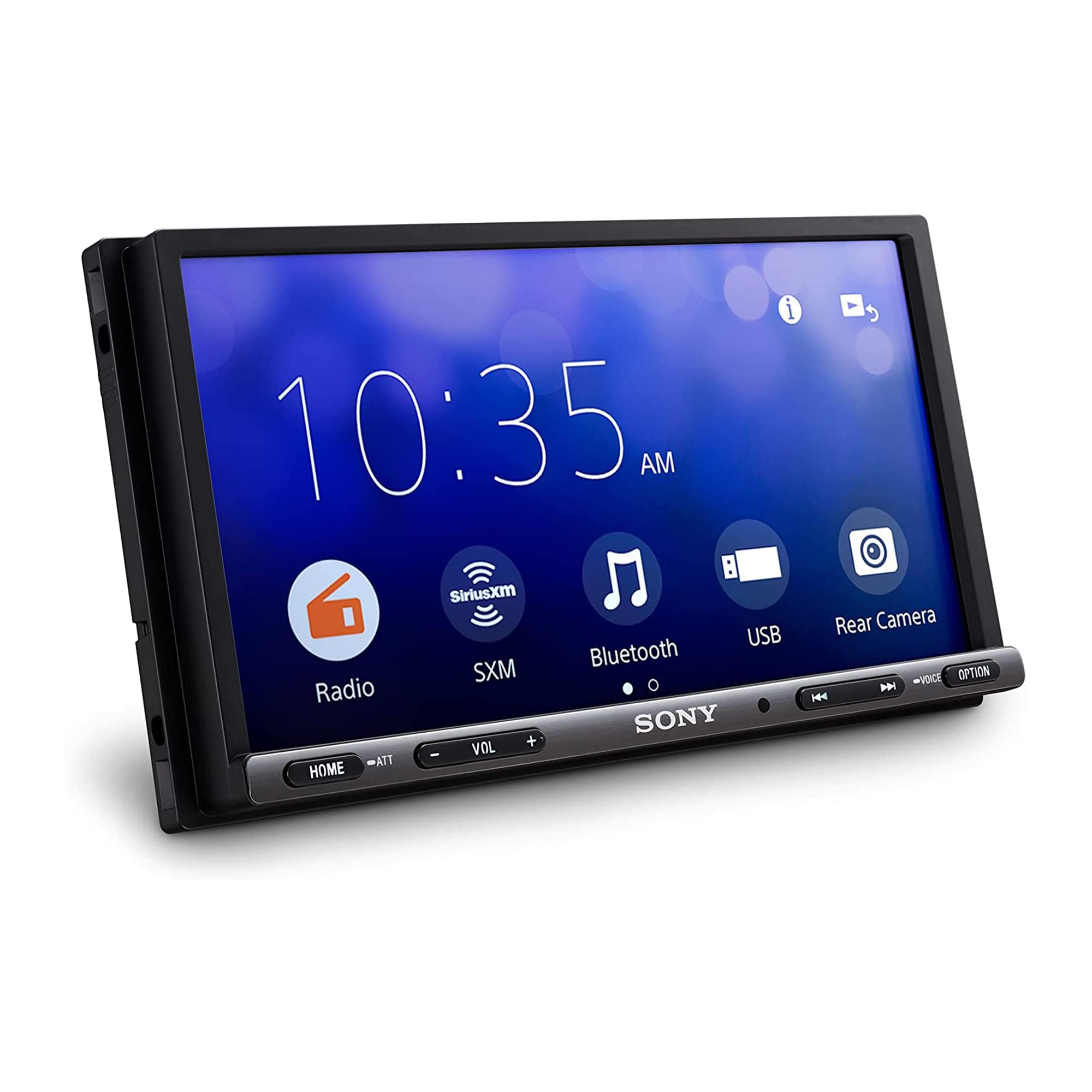
Sony’s XAV-AX3200 takes a different approach by using a resistive touchscreen with an anti‑glare coating instead of a capacitive panel. This deliberate choice reduces fingerprint smudges and improves readability under direct sunlight, but you have to press slightly harder to register taps compared to the glass‑like feel of capacitive units. The 7‑inch display still delivers crisp 800×480 resolution, and the wired Android Auto integration is fast and stable once you pair it with a quality USB‑C cable.
The compact rear chassis makes installation remarkably straightforward in vehicles where space behind the radio is limited. Gold‑plated 2V pre‑outs on front, rear, and subwoofer channels keep signal degradation low, and the built‑in Bluetooth supports hands‑free calling with dual‑microphone noise suppression. Sony’s Extra Bass circuitry adds low‑end punch without distorting, giving factory speakers a noticeable upgrade.
One common feedback point is that the resistive touchscreen feels dated to users accustomed to modern smartphones. The lack of wireless Android Auto is also a limiting factor if you want cable‑free convenience. For drivers who prioritize sunlight legibility and reliable wired performance, the AX3200 is a solid choice.
Why it’s great
- Anti‑glare resistive screen stays readable in bright sun
- Compact rear chassis for easy installation
- Extra Bass circuitry improves low‑end performance
Good to know
- Resistive touch requires firmer presses
- No wireless Android Auto or CarPlay
4. Pioneer DMH-1770NEX

The DMH-1770NEX strips away wireless connectivity to deliver a pure wired Android Auto and Apple CarPlay experience at a price point significantly lower than its wireless sibling. The 6.8‑inch capacitive touchscreen offers the same smooth multitouch response as the W2770NEX, and the 13‑band EQ and crossover settings give you extensive sound shaping tools. The chassis dimensions (7″ wide, 3‑7/8″ tall) fit standard double‑DIN openings without modification in most vehicles.
Users in the real world consistently report that the wired connection is rock‑solid, with zero audio dropouts and instantaneous app launch times — a meaningful advantage over wireless units that can sometimes buffer. The built‑in Bluetooth is fine for hands‑free calls, but music streaming over Bluetooth lacks the audio quality of a wired USB connection. The backup camera input works reliably, and the rear‑view camera can be triggered on demand through a hardwired switch.
The major downside is the absence of wireless Android Auto, which means you must plug in the phone every time you enter the car. Some renewed units have shipped with outdated firmware that causes CarPlay pairing failures, so checking the firmware version immediately upon installation is recommended.
Why it’s great
- Responsive capacitive touch costing significantly less
- 13‑band EQ and high‑pass/low‑pass crossovers
- Wired connection delivers zero audio lag
Good to know
- No wireless Android Auto — cable required every time
- Renewed units may have outdated firmware
5. PLZ 10.1″ Single Din
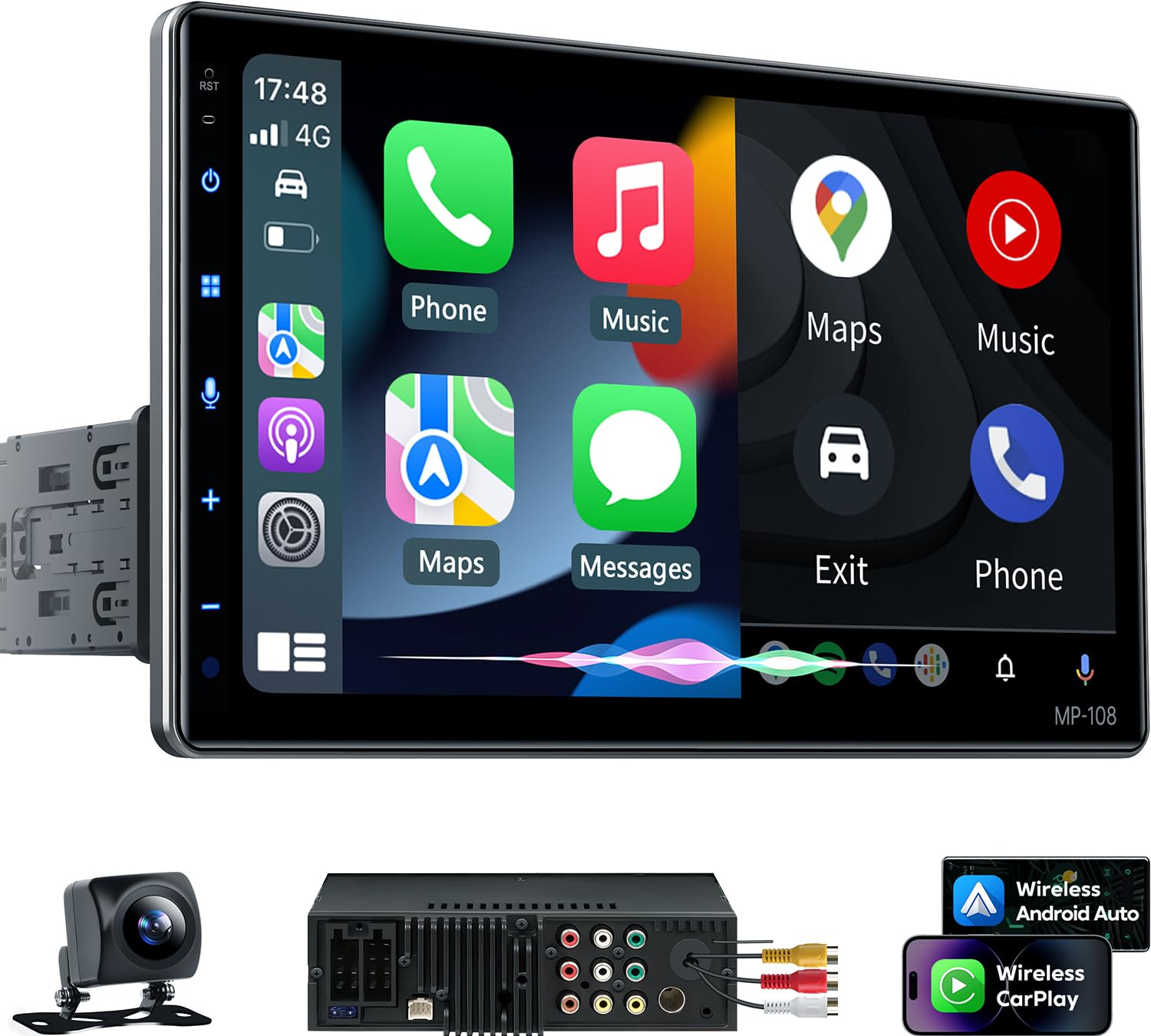
For drivers who want the largest possible display without cutting into the dashboard, the PLZ 10.1‑inch IPS unit is the standout option. The screen stretches across a single‑DIN chassis with a multi‑angle adjustment bracket that lets you tilt the display toward the driver to reduce glare. Wireless Android Auto connects quickly via a dedicated Bluetooth 5.3 module with an external antenna, which minimizes interference compared to units that share a single antenna between Bluetooth and Wi‑Fi.
The built‑in DSP includes a 10‑band graphic EQ and 4.2‑channel pre‑amplifier outputs rated at 60 watts per channel peak (240W total). Dual subwoofer outputs let you run two subwoofers independently without an external crossover, giving you substantial bass control. The wired and wireless MirrorLink works for both iOS and Android, though the wireless mirroring exhibits some frame‑dropping during video playback.
Some users have reported that the included backup camera cable is just long enough for compact sedans but may need an extension for full‑size SUVs and trucks. The touchscreen responsiveness is decent for a budget unit, but there is a slight input lag compared to premium capacitive panels. For the price, the sheer screen real estate and dual‑sub support are unmatched.
Why it’s great
- Huge 10.1″ IPS display with adjustable viewing angle
- Dual subwoofer outputs for serious bass setups
- Bluetooth 5.3 with external antenna reduces dropouts
Good to know
- Backup camera cable may require extension for larger vehicles
- Slight touch input lag compared to premium panels
6. ATOTO A5L

The ATOTO A5L runs a full Android operating system on 2GB of RAM and 32GB of storage, which means you can install Google Play apps directly on the head unit without needing a phone connection. This opens up possibilities like native YouTube playback, Torque Pro for OBD‑II diagnostics, and file‑based navigation apps that work offline. The 7‑inch QLED display delivers vibrant colors and deep blacks, and the 1280×720 resolution makes map details sharp.
What sets the A5L apart is its 24‑band graphic EQ with parametric equalization, 1 Hz crossover steps, and time alignment — tuning capabilities typically found on units costing three times as much. The included AHD backup camera streams a crisp 720P feed at 140° wide angle, and the camera feed can be monitored full‑screen even without reverse engaged, which is useful for checking bike racks or trailers.
The trade‑off is that the standard Android Auto app (ZLink) runs poorly on this processor due to insufficient GPU grunt, making wireless Android Auto nearly unusable for navigation. Many users rely on the native Android interface instead, which works smoothly for apps that are not graphics‑intensive. The A5L is a powerful tool for tinkerers, but it is not the best choice if your primary use case is lag‑free Android Auto mirroring.
Why it’s great
- Full Android OS with Google Play Store access
- 24‑band EQ with parametric and time alignment
- 720P AHD rear camera with live on‑demand feed
Good to know
- ZLink app performance for wireless AA is poor
- 2GB RAM limits multitasking with heavy apps
7. SJoyBring QLED 7″

The SJoyBring 7‑inch QLED unit proves that a vibrant display and wireless Android Auto do not require quadruple‑digit spending. The 1280×720 QLED panel produces noticeably higher contrast than the LCD panels found on comparably priced competitors, making navigation turn‑by‑turn prompts readable even when bright sunlight hits the dashboard. Wireless Android Auto connects reliably after an initial Bluetooth pairing, and the 4.2‑channel audio output with dual subwoofer RCA jacks allows a proper sound system upgrade later.
The installation process is standard for double‑DIN units, but the included frames and brackets accommodate a wide range of vehicle brands. Users specifically praise the customer service team, which provides firmware updates with custom boot logos (adding Ford, Jeep, or Nissan logos on request) within hours. The 240W peak power handling is more than enough for factory speakers, and the steering wheel control support (SWC) works with a direct wire connection in many models without requiring an adapter.
Some users have noted that the button beep noise cannot be easily disabled through the settings menu — you must contact customer support for a firmware tweak. AM radio reception is weaker than factory radios, though FM performance is solid.
Why it’s great
- QLED panel provides excellent color and contrast for the price
- Dual subwoofer outputs enable serious bass setups
- Responsive customer support with custom boot logos
Good to know
- Button beep requires firmware tweak to disable
- AM radio reception is weaker than factory tuners
8. SJoyBring W021

The W021 is essentially a sibling to the previous SJoyBring unit, sharing the same 7‑inch QLED panel and 1280×720 resolution but with a slightly different chassis that fits tighter double‑DIN openings. It supports wireless Android Auto and Apple CarPlay with the same Bluetooth‑Wi‑Fi handshake, and the 4.2‑channel audio output keeps the same dual subwoofer pre‑outs for flexible system expansion. The HD night vision backup camera included in the box captures clear 170° wide‑angle footage even in low‑light conditions.
One area where the W021 pulls ahead is the responsiveness of its touchscreen — users report that the input lag is noticeably lower than the earlier W022 model. The external microphone (included but not pre‑installed) solves the common complaint of muffled call audio when the built‑in mic is positioned too far from the driver. Wireless Android Auto boots quickly and stays connected without dropouts during test drives.
The rear camera cable may be too short for larger SUVs and trucks, requiring a 6‑foot extension. Some users also mention that the optical sensor for automatic dimming is overly sensitive, causing the screen to darken in moderate shade. Customizing the boot logo requires emailing support with proof of purchase, which adds a step compared to brands that offer it in‑settings.
Why it’s great
- Sharp QLED screen with fast wireless AA connection
- 170° ultra‑wide backup camera with night vision
- Dual subwoofer outputs for audio expansion
Good to know
- Camera cable may need extension for large vehicles
- Auto‑dimming sensor can be overly sensitive
9. HAUXIY 9″ Portable
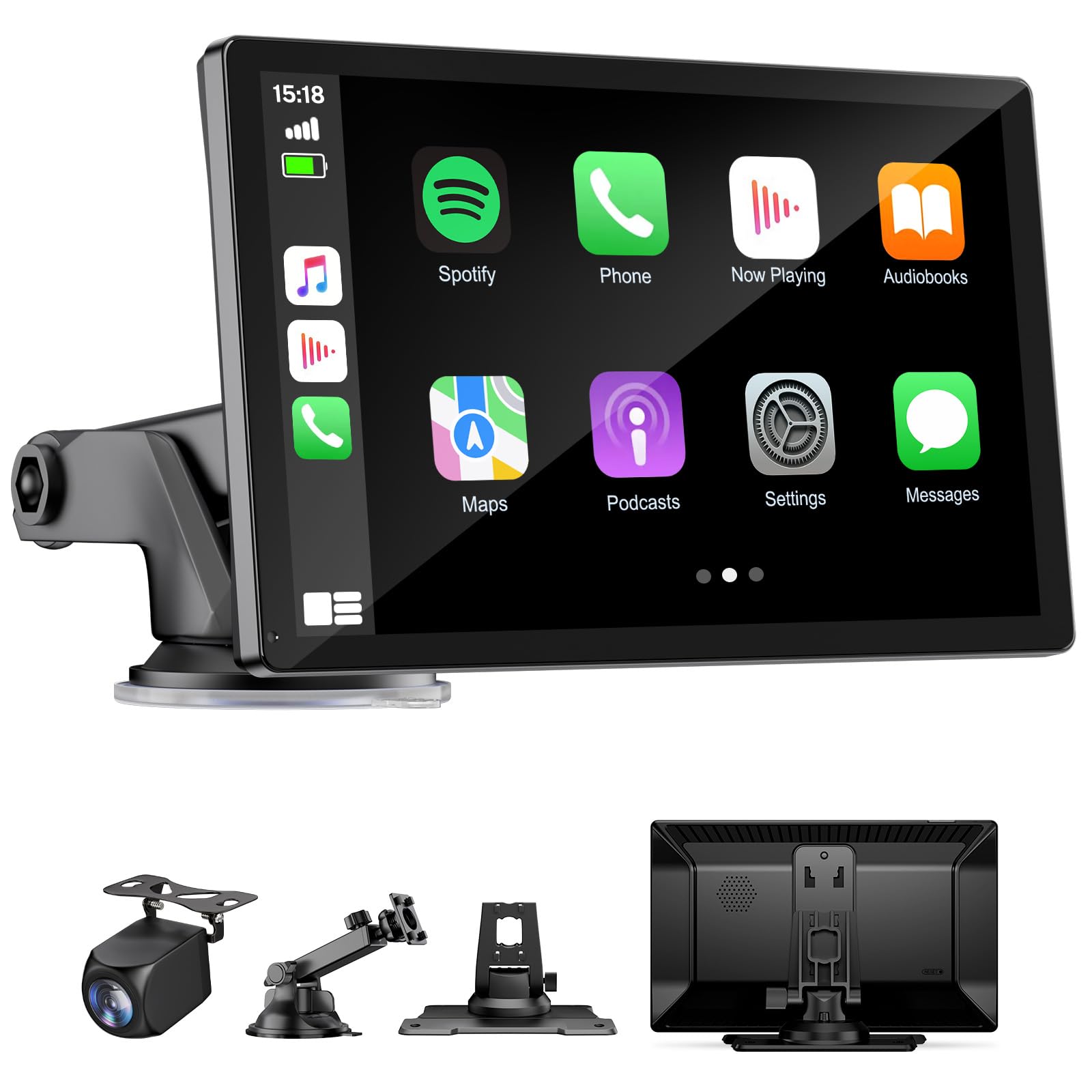
Unlike the other units in this guide, the HAUXIY is a portable 9‑inch display that mounts to the dashboard or windshield via a suction cup or adhesive pad rather than replacing the factory radio. This makes it the ideal entry point for drivers who want Android Auto without cutting into the dash or dealing with complex wiring. The unit connects to the phone via Bluetooth and Wi‑Fi for wireless Apple CarPlay and Android Auto, and it includes a 4K front‑facing dash camera with loop recording and a 64GB memory card pre‑installed.
The backup camera (1080p with night vision) installs separately and connects to the display over a wired cable. The 7‑meter cable length is sufficient for sedans and midsize SUVs, and the camera activates automatically when reverse is engaged. The display supports four audio output methods — Bluetooth streaming to the car radio, built‑in speaker, FM transmitter, and AUX cable — giving you flexibility if your car lacks an auxiliary input or Bluetooth.
Because this is a portable device, the touchscreen sits at eye level on the dashboard rather than flush in the center console. Some users report that the screen can shake slightly on rough roads when using the suction cup mount. For drivers who plan to keep their vehicle for only a few years or have a complex audio system they do not want to disturb, the HAUXIY offers a zero‑commitment path to modern connectivity.
Why it’s great
- Zero installation required — mounts on dash or windshield
- Built‑in 4K dash cam with 64GB memory card included
- Four audio output methods for flexible integration
Good to know
- Suction cup mount may vibrate on rough roads
- Screen sits above dash level, not flush with console
FAQ
Does wireless Android Auto drain my phone battery faster than wired?
How do I know if a double‑DIN unit fits my vehicle’s dash?
Can I use my factory steering wheel controls with an aftermarket Android Auto stereo?
What does the 2V vs 4V pre‑out voltage actually affect?
Final Thoughts: The Verdict
For most users, the best android auto stereo winner is the Pioneer DMH-W2770NEX because it combines wireless Android Auto, a responsive capacitive touchscreen, HD Radio, FLAC support, and a short chassis that fits almost any double‑DIN dash. If you want deep audio tuning with 13‑band EQ and time correction, grab the Alpine iLX-W670. And for a zero‑installation solution that includes a built‑in 4K dash cam, nothing beats the HAUXIY 9″ Portable.