
Our readers keep the lights on and my morning glass full of iced black tea. As an Amazon Associate, I earn from qualifying purchases.
Specs are compiled from manufacturer listings and verified buyer reviews and can change over time — please confirm the key details on the product page before buying.
You want a phone that lasts through a long day and takes a photo worth posting, without spending flagship money. The problem is that budget phones are usually sold on one big number and quietly cut the features you actually touch every day. This guide covers the Android phones that get the balance right: a smooth screen, a camera that holds up in low light, enough storage for your apps and videos, and a battery you can trust to finish the day.
I’m Min — the founder and writer behind Gadgets Feed. This guide is built by comparing the manufacturers’ published specifications and the patterns across verified customer reviews, so you get each pick’s real strengths and trade-offs instead of marketing spin.
Every pick here is judged on the things you feel in real use — screen quality, camera output, battery endurance, and carrier support. The right choice for you depends on where you take your phone each day, so read on to find the best android phone under 5000.
Our Picks at a Glance

How To Choose The Best Android Phone Under 5000
Buying a budget Android phone depends on four things you actually live with every day: how long the battery lasts, how good the screen looks, whether your carrier supports it, and how much storage and memory you get. Get those right and you will not miss the flagship you left behind.
Battery Capacity and Real-World Endurance
Battery capacity is measured in mAh (milliamp-hours — a measure of how much charge the battery holds). A 5000mAh battery is the standard for a full day of mixed use on a mainstream phone. But bigger numbers only help if the phone’s chip and screen are efficient enough to take advantage of them. A rugged phone with a 10000mAh or 20000mAh battery can run for days, but expect more weight in your pocket because of it.
Display Type and Refresh Rate
AMOLED screens (the kind that light each pixel individually) give you deeper blacks and better contrast than LCD panels. A 120Hz refresh rate (how many times per second the screen redraws) makes scrolling and animations feel smoother. Both features draw more power, so phones with high refresh rates often pair a bigger battery to compensate.
Carrier Compatibility
This is the spec that trips up the most buyers. An open up phone only works on networks whose bands it supports. Some budget phones run on 4G LTE only and work with GSM carriers like T-Mobile, Mint, and Metro — but not CDMA networks like Verizon or AT&T. Check the band list on the product page against your carrier before you buy, or you will end up with a phone that cannot make calls.
Quick Comparison
| Model | Best For | Battery | Display | Cellular | Amazon |
|---|---|---|---|---|---|
| Samsung Galaxy A37 5G★ Best Overall | Everyday all-rounder | 5000mAh | 6.7″ Super AMOLED | 5G | Amazon |
| Blackview Rugged PhoneRugged Pick | Rugged work and outdoor use | 10000mAh | 6.56″ 90Hz | 4G LTE | Amazon |
| Motorola Moto G PowerBest Big Screen | Big-screen entertainment on a budget | 5000mAh | 6.8″ 120Hz OLED | 5G | Amazon |
| XIAOMI Redmi 15C | Long battery on a tight budget | 7000mAh | 6.9″ 120Hz | 4G LTE | Amazon |
| Ulefone RugKing 5 Pro | Extreme battery and built-in light | 20000mAh | 6.78″ FHD+ 396ppi | 4G LTE | Amazon |
| Google Pixel 10a | Camera and software support | 4300mAh | Actua 3000-nit | 5G | Amazon |
| TCL NXTPAPER 70 Pro | Eye comfort and reading | 5000mAh | 6.9″ 120Hz NXTPAPER | 5G | Amazon |
| Samsung Galaxy A57 5G | Premium feel and long support | 5000mAh | 6.7″ Super AMOLED Plus | 5G | Amazon |
In‑Depth Reviews
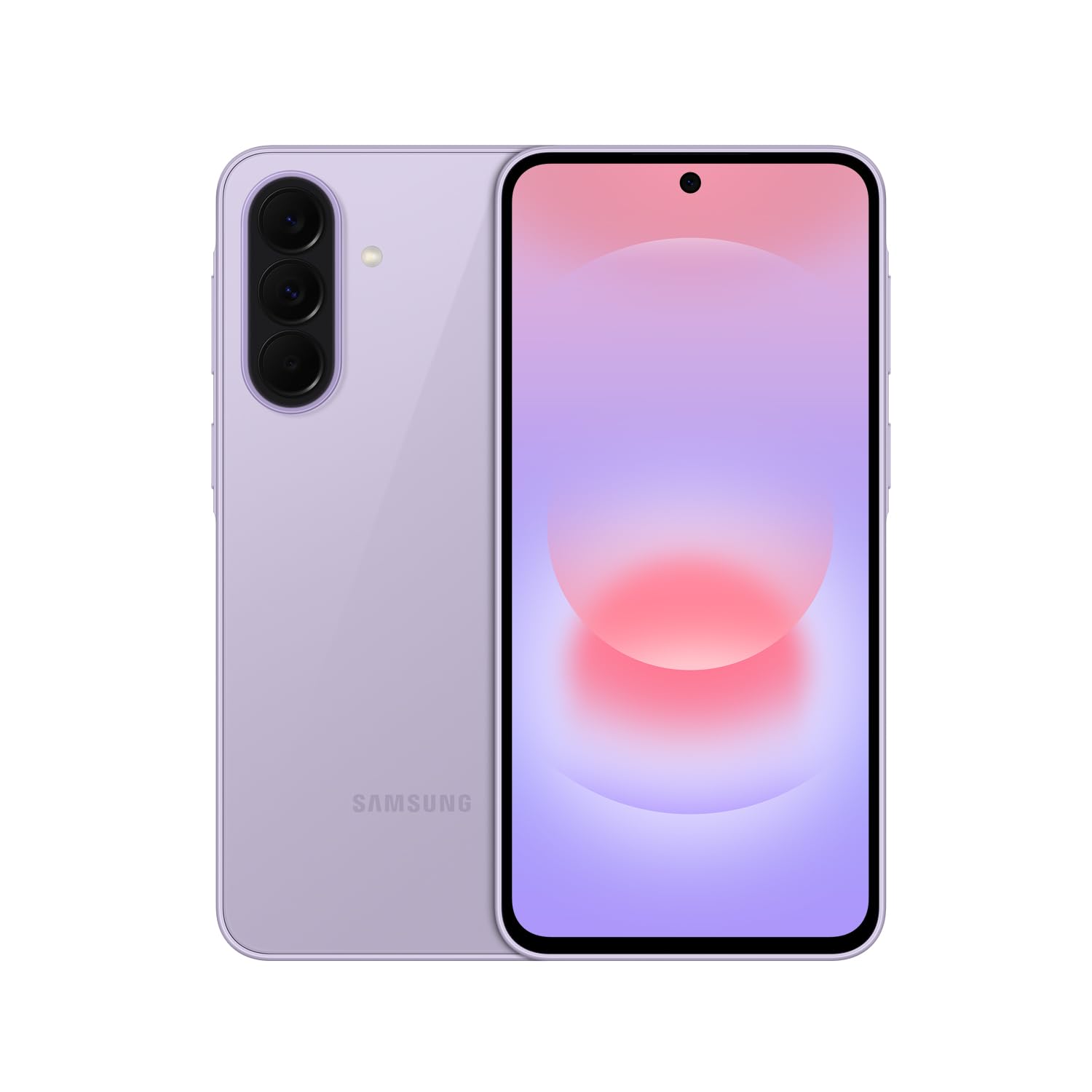
1. Samsung Galaxy A37 5G (2026), 128GB, Awesome Lavender
Our pick — 4.5★ from 350+ verified ratings; the strongest balance of quality and price.
The everyday Galaxy that finally feels like a proper phone, not a compromise.
If you want one phone that does everything well without thinking about it, this is the one to start with. The 6.7″ Super AMOLED display (the kind that lights each dot on its own for deep blacks and punchy color) gives you 385 pixels per inch, so text and photos stay sharp whether you are scrolling or watching video. It runs on the Exynos 1480 chipset and 5G, with IP68 (a rating that means it survives dust and a dunk in water) covering the odd spill or rainy dash.
The triple-lens camera leads with a 50MP main sensor and a “studio-grade” front camera, and Nightography handles low-light shots automatically, so you do not have to fiddle with settings in a dim restaurant. Storage starts at 128GB and expands via microSD. The company promises 6 OS updates and 6 years of security updates, which means you can keep this phone a long while before software support runs dry. Its 5000mAh battery carries 19.03 watt-hours, so it should get you through a full day of normal use.
Owners consistently point to the overall quality as the standout — it feels better than the price suggests, and the camera regularly exceeds expectations for the segment. The honest note is battery life and performance: some find the battery runs down faster than they would like under heavy gaming, and a few wish it had wireless charging, which this model does not include. For light-to-moderate use, none of that should stop you.
What earns the top spot
- 6.7″ Super AMOLED display at 385 pixels per inch stays sharp and colorful
- 50MP main camera with automatic Nightography for low-light shots
- 6 OS updates plus 6 years of security updates extends usable life
- IP68 water and dust resistance for daily accidents
Where it asks you to compromise
- No wireless charging on this model
- Heavy gaming can drain the battery faster than expected
- Only 128GB base storage before microSD expansion
Settle on this if: you want the safest all-around budget Galaxy with a great screen, a capable camera, and years of updates ahead of it.
Otherwise consider: a phone with a bigger battery or IP69K ruggedness if your days are spent outdoors or off the grid.
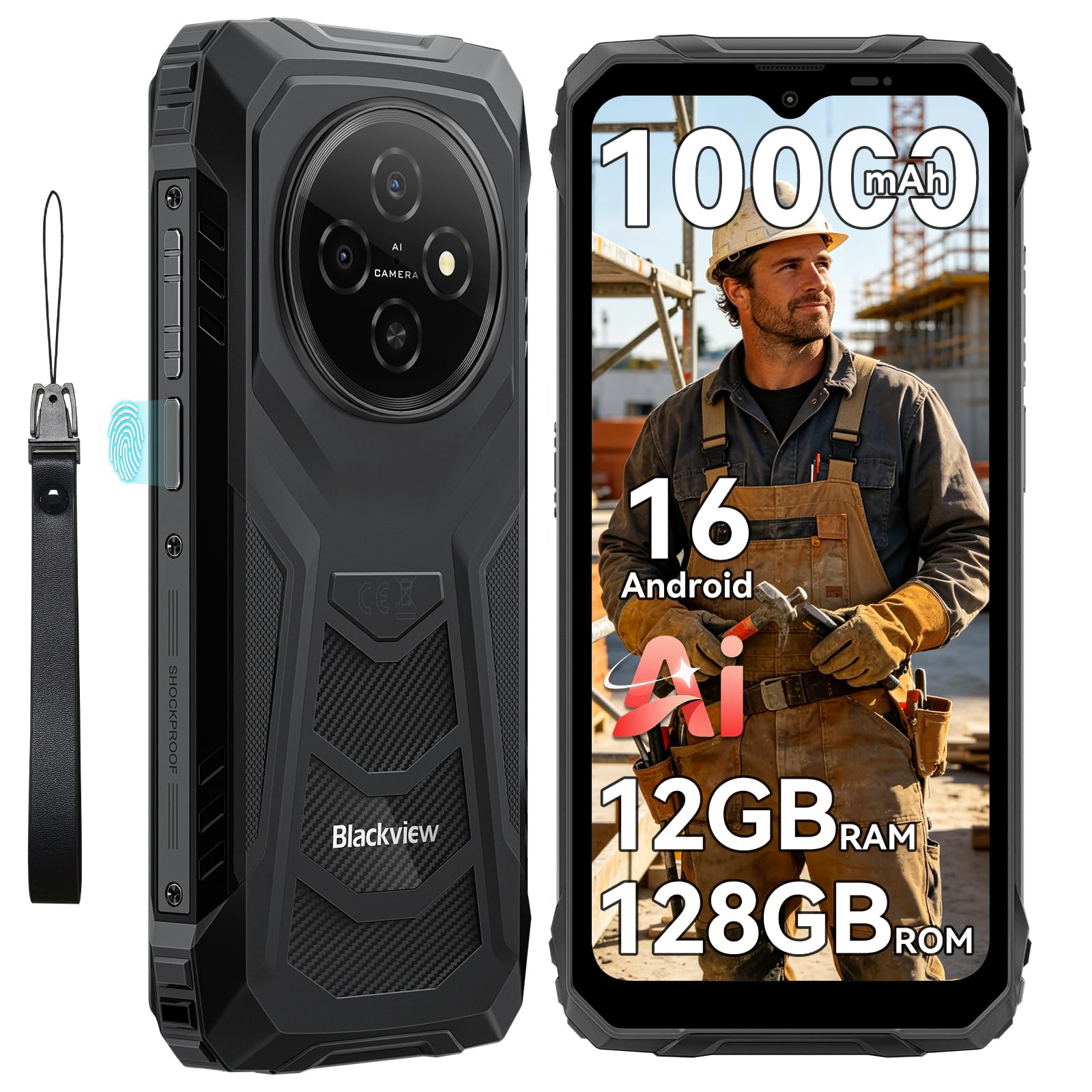
2. Blackview Rugged Phone Android 16, 10000mAh, 12GB+128GB
Built to shrug off a job site, with a battery that laughs at a charge cable.
This is the pick for warehouse shifts, construction work, camping trips, or anyone who keeps dropping their phone. The rugged body is rated for 2-meter drop protection, 2-meter water immersion for 30 minutes, and 100% dust protection, so it survives rain, spills, and hard falls. The 6.56-inch screen runs at 90Hz (a smoother-than-standard refresh for less motion blur when you scroll) with up to 450 nits of brightness.
Where it completely separates from the mainstream phones above is battery: 10000mAh, which works out to 30 watt-hours of stored power, against the Samsung Galaxy A37 5G’s 19.03 watt-hours. That 58% capacity edge translates to up to 20 days standby, 20 hours of talk time, or 8 hours of video playback on a single charge. You also get 12GB of RAM and 128GB of storage expandable to 2TB, plus dual SIM and NFC.
The trade-offs are real and worth naming. It runs on 4G LTE only, and it works with GSM carriers like T-Mobile, Mint Mobile, and MetroPCS but not CDMA networks like Verizon or AT&T. And it is a heavy slab — the bulk is the price of that battery. Owners praise the durability above all else, and buyers report: “Great hardware specs/price, massive battery, durable (survived ~8 weeks in rough work).” A few note bloatware and carrier hiccups, which is why checking your band support first matters more on this phone than most.
Made for: tradespeople, campers, and anyone whose phone lives a harder life than a pocket.
Not the fit if: you are on Verizon or AT&T, since this model supports GSM networks only.
3. Motorola Moto G Power (2025)
A massive, smooth screen with stereo bass, built for long streaming sessions.
For movie nights, YouTube binges, and long video calls, screen size is the feature you notice most. This one gives you a 6.8-inch display running at 120Hz — which means the picture redraws 120 times a second for much smoother scrolling and animation than a standard 60Hz panel. Paired with stereo speakers that put out 1.7x more bass (Motorola’s own internal comparison against the previous generation), it is built for watching, not just browsing.
The camera uses a 50MP sensor with OIS (optical image stabilization — the lens physically counters your hand shake so photos and video stay sharper in low light), and the body wears vegan leather with Corning Gorilla Glass and underwater protection. Inside, a MediaTek Dimensity 6300 chipset and 5G keep things moving, with up to 24GB of RAM when you count RAM Boost. There is a 3.5mm headphone jack, storage expandable via microSD up to 1TB, and a 5000mAh battery that Motorola says goes over a day on a charge.
This is the highest-volume pick in the lineup for a reason — owners love the value and the display. The honest caveat is performance under load: the same chipset that handles everyday tasks well can feel sluggish when you pile on apps, and a few owners mention needing a restart after heavy multitasking. For email, streaming, navigation, and social apps, it stays smooth.
The case for it: combined with 5G, dual SIM, and expandable storage up to 1TB, it is genuinely tough to top for a big-screen media phone on a tight budget.
Buy it for: movies, streaming, and everyday apps on a screen big enough to actually enjoy.
Look elsewhere if: you push your phone hard with heavy games or dozens of open apps at once and want zero slowdown.
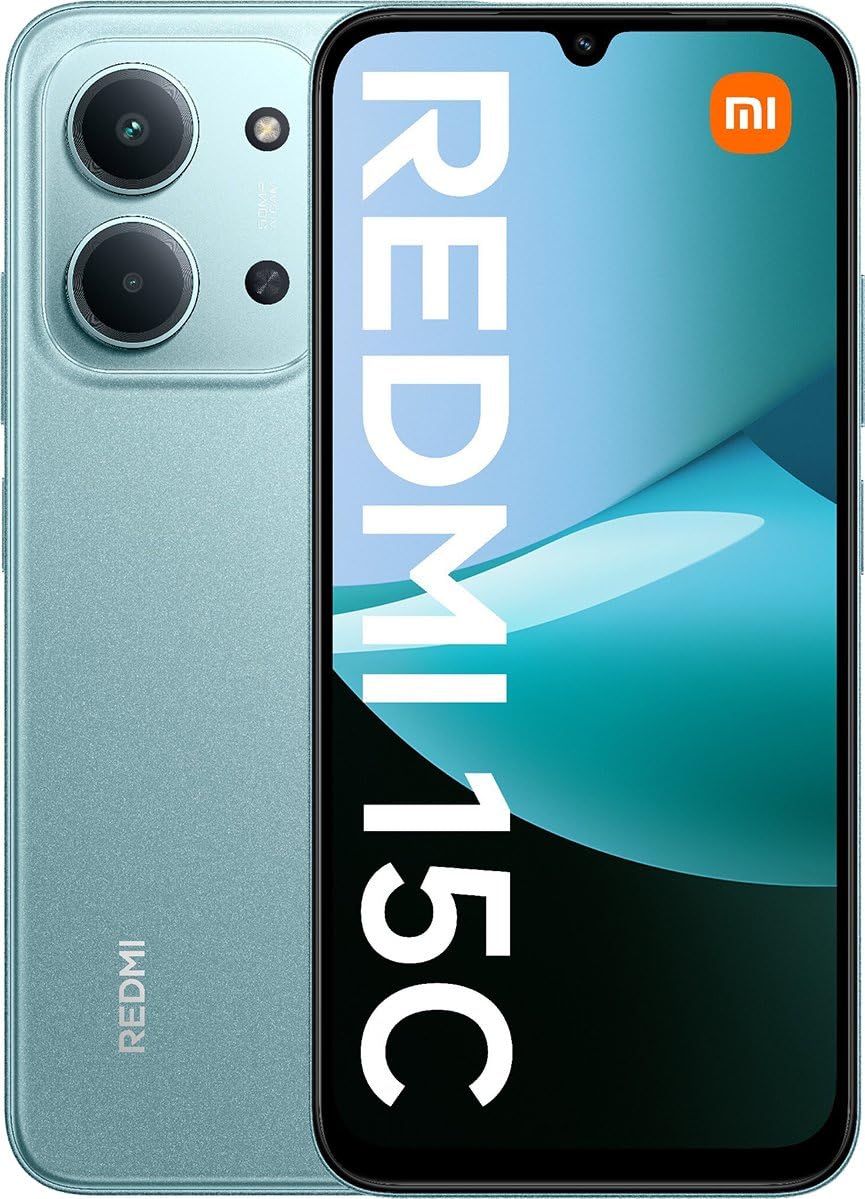
4. XIAOMI Redmi 15C 4G LTE (256GB + 8GB)
A huge battery and a huge screen for far less than most flagships cost.
If battery anxiety is your main gripe, this phone answers it directly. The 7000mAh cell (a big step up from the 5000mAh standard) is rated for up to 24 hours of talk time or 48 hours of standby, and it ships with a 33W fast charger and a protective case in the box. The display is a 6.9-inch panel at up to 1600 resolution with a 120Hz refresh rate, so scrolling stays smooth even on a screen this large.
You also get 256GB of internal storage and 8GB of RAM — generous at this tier — with a 50MP main camera and an 8MP front sensor. Xiaomi includes a 3.5mm headphone jack, a rear fingerprint reader, and face open up, and the phone has been through TÜV Rheinland eye-comfort certifications (independent testing for flicker and low blue light). That matters for long reading sessions.
The catch is carrier support. In the US this model works on T-Mobile, Mint, and similar GSM networks, but not Verizon or AT&T, and it is 4G LTE only — no 5G. Owners generally rate it well on value and picture quality. The recurring caution is reliability over time: most owners are happy, though a rare unit has developed issues within a few months, so buy from a seller with a clear return window.
What buyers highlight: the value and build quality stand out, with one owner praising it as “a high mid-range smartphone at a very low price” that arrives with a fast charger and case already in the box.
Reach for this if: you want maximum battery life and storage for minimum outlay and you are on a GSM network.
Think twice if: you are tied to Verizon or AT&T, or you need 5G speeds for the next few years.
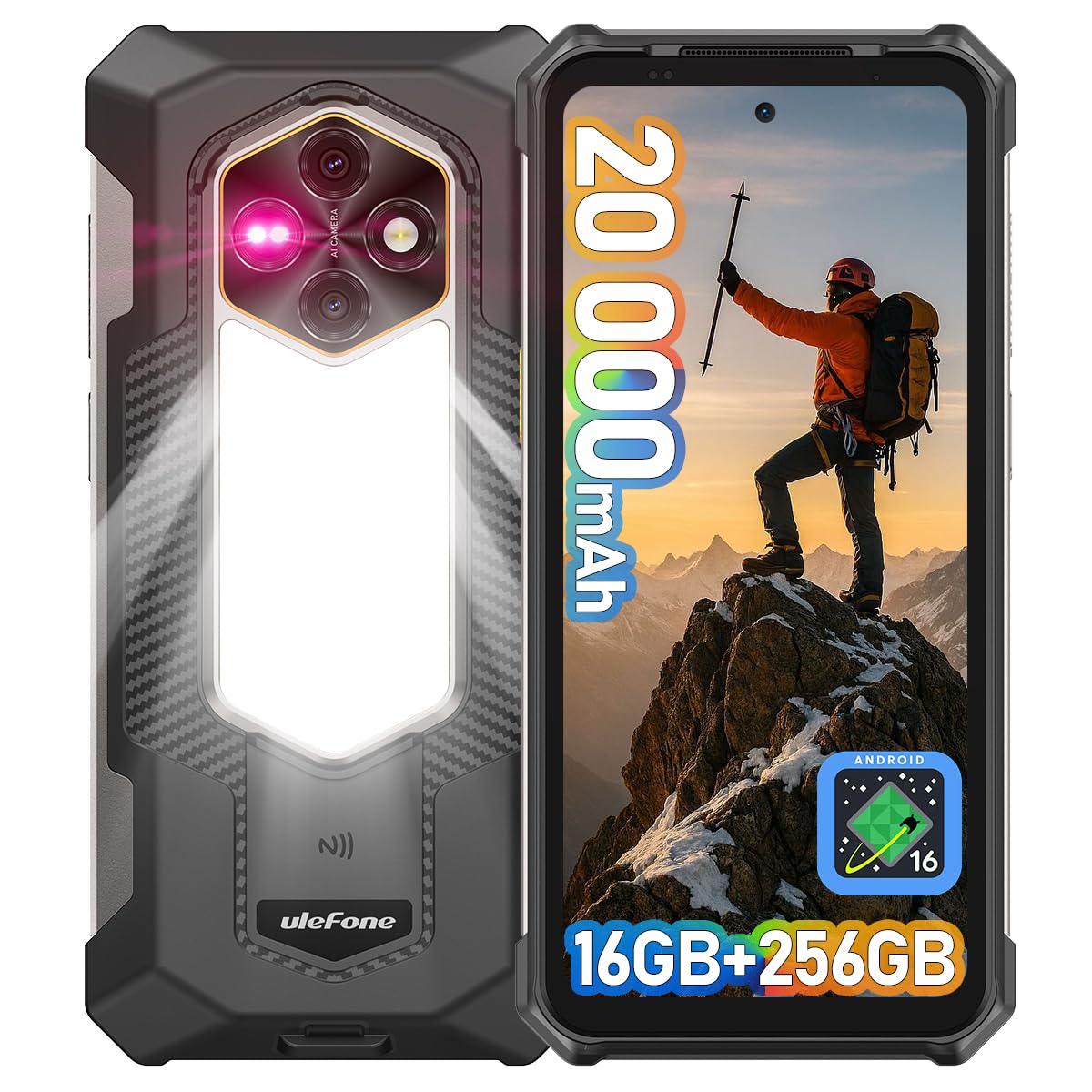
5. Ulefone RugKing 5 Pro Rugged Smartphone
A phone, a power bank, and a flashlight rolled into one armored slab.
This one is for the person who needs a phone to survive the worst day, not just the average one. The 20000mAh battery (double the mainstream standard) supports OTG reverse charging so it can top up your earbuds or tablet, and it pairs with 33W fast charging so the refill is not glacial. The rugged shell earns IP68 and IP69K waterproof ratings plus MIL-STD-810H (a US military durability standard covering drops and temperature extremes), and the 6.78-inch FHD+ screen has Corning Gorilla Glass and 396 pixels per inch.
The camera package is unusually deep for the price: a 64MP main sensor, a 20MP night-vision camera with two infrared LEDs, and a 16MP front camera. There is also a built-in light that puts out 976 lumens from 1,202 LEDs, which owners describe as a genuine flashlight replacement on a night hike. Software is Android 16 with 16GB of combined RAM (8GB physical plus 8GB virtual) and 256GB of storage, expandable to 2TB.
Here is the honest trade: it is heavy. The maker lists it at 629g (1.38lb), and the weight is the single most common note in the reviews — a fair price for a battery this large. It also runs 4G LTE only and does not support AT&T or Cricket. Owners love it anyway, and a wary buyer wrote plainly: “Supremely heavy and somewhat glitchy” — worth knowing before you commit.
What stands out: the build quality earns the most praise here, with the performance, durability, and battery life all drawing strong positive notes from owners.
Pick this if: you want a phone that doubles as a battery bank and a work light for construction, camping, or night shifts.
Pass if: you want something light enough to forget in your pocket, or you are on AT&T or Cricket.
6. Google Pixel 10a – 128GB, Obsidian

The camera-first pick, with software support that keeps it current for years.
If photos and clean software matter more to you than raw specs, this is the phone to beat. The Actua display peaks at 3,000 nits (a brightness measure — that is bright enough to read comfortably in direct sunlight), and the camera is engineered around simple, point-and-shoot results rather than manual tinkering. A 4300mAh battery is rated at 30+ hours of use, and Google backs the Pixel 10a with years of OS and security updates.
On paper the battery looks smaller than the 5000mAh phones above, but customers note real-world endurance that punches well past the number. Features include IP68 water and dust resistance, Corning Gorilla Glass 7i scratch resistance, wireless charging, and the full Gemini AI assistant baked in. It works on all the major carriers including Google Fi, Verizon, T-Mobile, and AT&T — a real advantage over the GSM-only phones on this list.
The main thing to weigh is size. It is a compact phone, which some owners love because it fits pockets easily, and others note as a limitation if they want a huge screen. Some owners also mention the camera softens when you zoom in far. Overall, the camera and the software experience are what buyers keep coming back to, and reviewers point out: “Huge difference, I got the new 10, works great, more great features, awesome camera.”
Why photographers and switchers like it
- 3,000-nit Actua display stays readable in bright sun
- 30+ hour battery estimate backed by strong owner feedback
- Works on all major carriers including Verizon and AT&T
- IP68 water resistance and Gorilla Glass 7i scratch resistance
What to know before buying
- Compact body may feel small if you prefer a big screen
- 4300mAh is smaller than some rivals on this list
- Zoomed-in photos can look soft compared with the close-up shots
Get it if: you want a reliable camera, quick updates, and full carrier freedom in a pocketable size.
Consider a bigger option if: you need the largest possible display or the absolute maximum battery capacity.
7. TCL NXTPAPER 70 Pro open up Android Phone
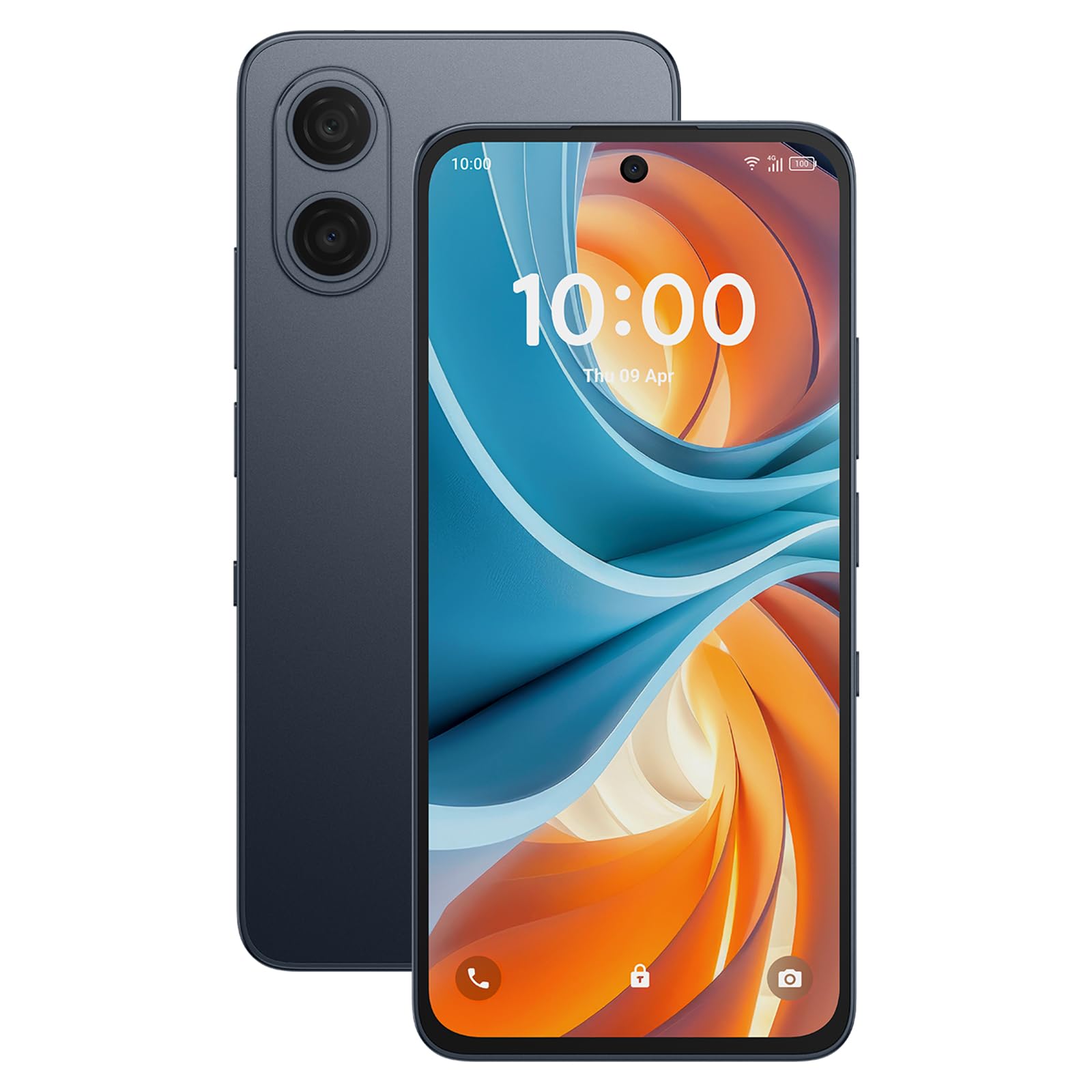
A paper-like screen built for people who read and scroll for hours.
Most phones treat eye strain as an afterthought. This one is designed around it. The 6.9-inch NXTPAPER 4.0 display is anti-glare and flicker-free (flicker can cause discomfort for light-sensitive users), with blue light cut to 3.41% at the hardware level and a smart assistant that adjusts settings for comfort. A dedicated NXTPAPER key cycles through four modes: Standard for browsing, Color Paper for comics and art, Ink Paper for reading, and Max Ink for an e-reader-like view that stretches battery life.
The specs are strong for the tier: 512GB of built-in storage (expandable up to 2TB), a MediaTek Dimensity 7300 chipset, 8GB of RAM with up to 16GB expandable for 24GB total, 5G and WiFi 6E, and stereo dual speakers. The 5000mAh battery is rated for all-day use, and 33W fast charging takes it from 0% to 50% in 38 minutes. The camera system adds a 50MP main sensor, an 8MP ultra-wide, and a 32MP front camera.
The honest caveat is that the matte panel is dimmer outdoors than a glossy screen, and it does not support wireless charging. There is also some bundled software you will want to remove. For anyone who reads, studies, or scrolls late at night, though, owners rate this highly — shoppers say it excels for “reading and browsing,” with “clear text” and an “e-reader feel.”
What to know before buying: plus 5G, WiFi 6E, and IP68 water and dust resistance, this is among the most storage-heavy phones in the lineup at 512GB.
Choose this if: eye comfort, a huge storage drive, and an e-reader mode are the reasons you are buying.
Skip if: you need maximum outdoor screen brightness or you rely on wireless charging.
8. Samsung Galaxy A57 5G (2026), 128GB, Awesome Gray
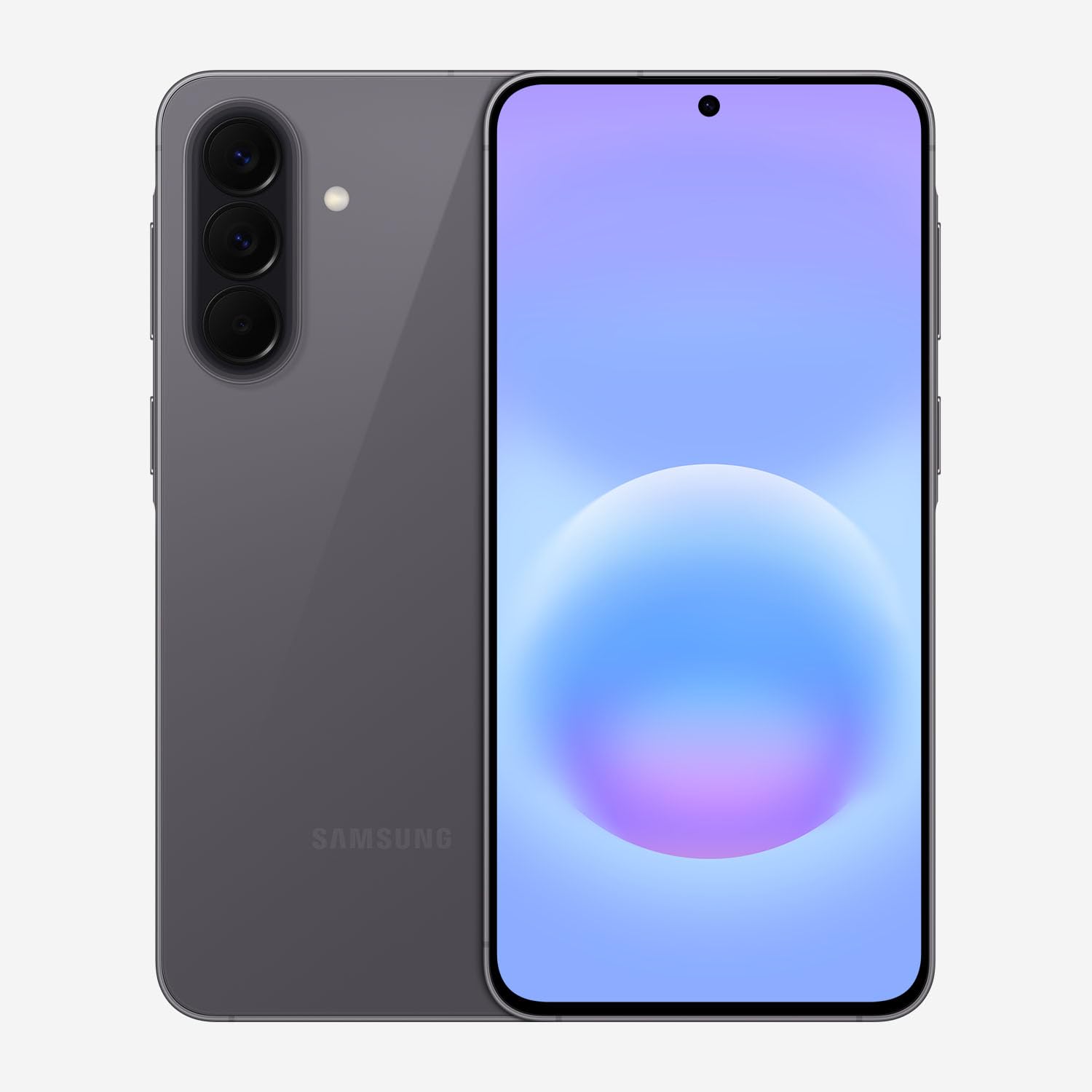
The slim, premium-feel Galaxy that keeps up for years without a flagship price.
If you want a phone that feels closer to top-tier than its price suggests, this is where the money lands best. The 6.7-inch Super AMOLED Plus display (with slimmer bezels for a more rich view) delivers vivid color and deep contrast, and the body is built with a new metal frame plus an improved IP68 rating for drops, splashes, and dust. It is thin and light for an A-series phone, which owners specifically notice.
The 5000mAh battery stores 19.3 watt-hours and supports 45W Super Fast Charging 2.0 (the wattage measures how fast power flows in — a higher number refills the battery more quickly). The triple-lens camera handles Nightography Video for low-light clips, and the phone runs the latest software with 6 OS updates and 6 years of security updates built in. There is also Gemini Live for natural voice interaction and Samsung Wallet for cards and boarding passes.
Owners praise the speed and the battery, with apps opening instantly and the charge making it through the day. A minor note: charging speed depends heavily on which charger you already own, so bring a capable one if you want the fastest refill.
The honest limit: with solid value scores and strong quality feedback, the real question is whether the slimmer body and 45W charging justify moving up from the mid-range pick.
Best matched to: buyers who want a premium-feeling Samsung they can keep for years, with long software support baked in.
Hold off if: you are happy with the A37 5G’s everyday performance and would rather keep that extra budget in your pocket.
Understanding the Specs
Battery Capacity (mAh vs watt-hours)
Milliamp-hours (mAh) tell you how much charge a battery holds, but watt-hours are the fairer way to compare across phones because they combine capacity with voltage. That is why a 10000mAh rugged phone and a 5000mAh mainstream phone are not a simple double — the real gap shows up in watt-hours, where the Blackview’s 30 watt-hours against the A37 5G’s 19.03 watt-hours is a 58% difference in stored power. Higher capacity generally means longer runtime, but weight rises with it.
Display Type and Pixels Per Inch
Pixels per inch (ppi) measures how tightly packed the dots on your screen are; higher means sharper text and less visible pixelation. A phone at 385 ppi or 396 ppi looks crisp at normal viewing distances. AMOLED and Super AMOLED panels light each pixel individually, so they produce deeper blacks and better contrast than LCD. Refresh rate, measured in Hz, controls how smooth motion looks — 120Hz feels noticeably smoother than 60Hz for scrolling and gaming.
Water and Dust Ratings
An IP rating has two digits. The first is dust protection (6 is the highest), and the second is water resistance (8 handles immersion, 9K handles high-pressure spray). IP68 is enough for rain, spills, and a quick accidental dunk. IP69K adds protection against close-range high-pressure jets, which is why the rugged phones here carry it.
Memory, Storage, and RAM Boost
Storage (measured in GB) holds your apps, photos, and videos; many phones here allow microSD expansion up to 1TB or 2TB. RAM (measured in GB) is the short-term workspace for running apps — more RAM means smoother multitasking. Some phones list RAM Boost, which borrows a slice of storage to act as extra RAM; it helps but can reduce available storage while in use.
FAQ
Will an open up Android phone work on my carrier?
How much battery life should I expect from a budget Android phone?
Is AMOLED better than LCD for a budget phone display?
What is the difference between IP68 and IP69K water resistance?
How many years of software updates do these phones get?
Can a rugged phone replace a power bank for charging other devices?
Should I choose 128GB or 256GB of storage?
Do these Android phones support wireless charging?
How heavy is too heavy for a rugged phone?
What processor and RAM do I need for everyday tasks?
Final Thoughts: The Verdict
The best all-around pick on this list is still the Samsung Galaxy A37 5G — it balances a sharp 6.7″ Super AMOLED screen, a capable 50MP camera, and years of software updates in a phone that feels nicer than its price. If battery life is your priority, the Blackview Rugged Phone with its 10000mAh cell will outlast nearly everything here. And if you want the sharpest camera experience and long-term software support, the Google Pixel 10a is the one to reach for. Whichever fits your day, the right choice among these is the one that matches how you actually use your phone.
How We Picked
We do not accept paid placement. Every pick is matched to a real buyer and a real use-case; we do not hands-on test units.
Sources & Methodology
Specifications: manufacturer listings and product documentation. Review insights: verified customer reviews, as of September 2026. Pricing: not shown on this page (it changes often); check the current price via the retailer link.
As an Amazon Associate, Gadgets Feed earns from qualifying purchases. This does not affect which products we feature.