
Our readers keep the lights on and my morning glass full of iced black tea. As an Amazon Associate, I earn from qualifying purchases.
Specs are compiled from manufacturer listings and verified buyer reviews and can change over time — please confirm the key details on the product page before buying.
Whether you are balancing your home’s air conditioning vents, checking if conditions are safe for a drone flight, or trying to figure out why that one room never feels right, an anemometer turns guesswork into hard numbers. Choose a vane-style meter for open outdoor gusts and duct mouths, or a hot-wire probe for reaching deep inside a vent. This guide compares both types so you can pick a reliable tool, not a toy.
I’m Min — the founder and writer behind Gadgets Feed. This guide is built by comparing the manufacturers’ published specifications and the patterns across verified customer reviews, so you get each pick’s real strengths and trade-offs instead of marketing spin.
If you are weighing options, the anemometer you pick needs to match the air you measure, not just the price tag, and this breakdown makes that choice clear.
Our Picks at a Glance


How To Choose The Best Anemometer
An anemometer measures wind speed, but the kind that works for a quick outdoor check is different from the one that gives you trustworthy numbers eight feet inside a heating duct. Match the sensor type to your measurement target: a sailor needs open-air readings, while an HVAC tech needs in-duct accuracy.
Vane vs. Hot-Wire Sensors
A vane-style impeller is durable, reacts to any breeze direction, and suits open spaces like rooftops or fields. A hot-wire probe detects the slightest air movement in confined channels, making it the specialist for ducts and vents. For in-duct measurements, a probe that extends and hinges beats a handheld unit you must jam against the opening.
Accuracy and Units
Read accuracy specs carefully before buying. A ±5% accuracy rating is fine for balancing bedroom vents but insufficient for professional diagnostics. The best tools also let you switch between m/s, km/h, ft/min, knots, and mph, so you can match the unit to your weather app or your sailing charts. Once you know the speed, some meters also calculate CFM (cubic feet per minute) or CMM (cubic meters per minute) once you tell it the duct’s cross-sectional area — that is the number that tells you how much air is actually moving, not just how fast.
Quick Comparison
| Model | Best For | Sensor Type | Max Wind Speed | Connectivity | Amazon |
|---|---|---|---|---|---|
| Testo 410i★ Best Overall | Wireless HVAC diagnostics | Vane Impeller | — | Bluetooth App | Amazon |
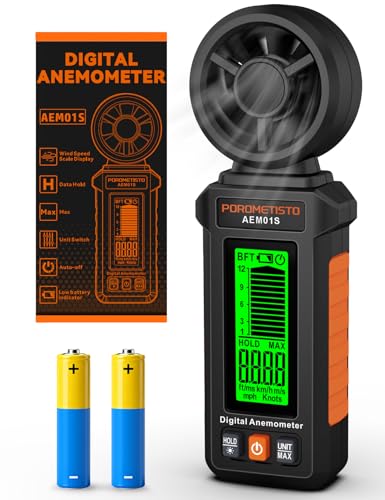
| POROMETISTO AEM01SBest Value | Budget outdoor checks | 8-Blade Vane | 30.00 m/s | None | Amazon |
| AIOMEST AI-100Tripod Pick | Tripod-mounted monitoring | 8-Blade Vane | 65 Mph | None | Amazon |
| Proster Handheld | General outdoor use | Vane Impeller | 67.0 Mph | None | Amazon |
| BTMETER BT-100APP | Bluetooth data logging | 8-Vane | 67.1 Mph | Bluetooth App | Amazon |
| HoldPeak 866B-WM | All-in-one weather data | Vane Impeller | — | None | Amazon |
| AOPUTTRIVER 856A | Full duct CFM analysis | Vane Probe | 100 Mph | USB to PC | Amazon |
| Testo 405i | In-duct hot-wire probing | Hot-Wire | — | Bluetooth App | Amazon |
| Kestrel 3000 | Rugged all-weather field use | Replaceable Impeller | — | None | Amazon |
In‑Depth Reviews
1. Testo 410i Vane Anemometer
Our pick — over 4.5★ from 200+ verified ratings; the strongest balance of quality and price.
The wireless smart probe that turns your phone into a serious HVAC balancing station.
This is the pick for anyone who wants to skip the manual number-crunching and watch readings land on their phone screen. The Testo 410i pairs over Bluetooth to a smartphone app, and it automatically calculates volume flow once you enter the duct dimensions — no separate math, no fumbling with a notepad on a ladder.
It measures air velocity, volume flow, and temperature, and because it does not require air density correction, readings stay stable even when the air is warm or humid. Real owners lean on it for air balancing and troubleshooting, and the accuracy is the thing people call out most. A nice bonus for larger jobs: you can pair several smart probes at once to measure volume flow at multiple outlets to adjust system balance.
At just 276 g, it is a featherweight in the hand, and the included protective cap keeps the impeller safe in a tool bag. The main caveats are software-side: it does not work with the MeasureQuick app right now, and the Testo app occasionally drops the connection. Buyers report it reads a bit rough for a supply duct estimate, which is plenty for a technician’s diagnostics.
What You Are Paying For
- App does the area-to-flow math for you
- Auto volume flow from duct dimensions
- Multi-probe support for system balancing
- Lightweight at 276 g with a protective cap
Where It Trips Up
- No MeasureQuick support at the moment
- App can disconnect and drop readings
- Not a flow-hood replacement for precision tests
Reach for this if: you are a working HVAC tech who wants accurate air balancing data on your phone without doing the volume math.
Look elsewhere if: you need a standalone meter with zero phone dependency, or you rely on MeasureQuick specifically.
2. POROMETISTO AEM01S Anemometer
A budget wind meter with a color-coded alarm that tells you at a glance if it is safe or dangerous out there.
Here is a cheap and cheerful option that works surprisingly well for the money, with a standout a neat extra: the backlight changes color based on wind speed. Green means safe (levels 0–4), orange is caution (levels 5–7), and red is danger (level 8 and above) — so you never have to squint at numbers to know conditions are getting rough.
The measurement range is 0.70–30.00 m/s, with accuracy of ±0.7 m/s below 1.00 m/s and ±(2.0% + 0.5 m/s) above that. It samples every 0.5 seconds, so the display stays responsive, and a HOLD button freezes readings while a long press on MAX records the peak gust. It runs on two included AAA batteries and auto-powers off after 10 minutes to save them.
Owners use it to dial in AC air vents so every room in the house gets the same airflow, and they describe the display as clear and the measurements as quick and consistent.
Smart buy for: drone pilots, RV travelers, and homeowners checking vent balance who want one simple, pocket-friendly meter with a safety warning built in.
3. AIOMEST Digital Anemometer AI-100
The hands-free meter that mounts on a tripod so you can monitor wind over time without holding it.
If you need to track wind continuously — say, for storm spotting or watching conditions change through an afternoon — this meter has a built-in 1/4-inch screw hole at the bottom. That lets you fix it to a tripod and step away, with auto or manual power-off so the battery is not drained when you forget it.
It reads wind speed from 1 to 65 Mph with ±5% accuracy across five units (m/s, km/h, ft/min, knots, Mph), plus wind temperature in ℃/°F and a wind chill indication. The 8 low-friction blades are sensitive enough to track a breeze down to 0.2 Mph, and MAX/MIN/AVG modes keep a running record. It comes with a protective carrying case, a wrist strap, and a screwdriver in the box.
The recurring complaint is the temperature: owners say it does not seem to be very accurate, and one found it 2–3°F off a dial thermometer. Wind speed earns better praise — a storm-spotting owner said readings came within a few percent of the National Weather Service.
Hands-Free Strengths
- 1/4-inch tripod thread for long monitoring
- Sensitive down to 0.2 Mph
- Backlit display with wind chill
- Soft carrying case and spare battery room included
Honest Limitations
- Temperature accuracy is the weak spot
- Backlight times out just when you raise it to a vent
Best if: you want to set it up on a tripod and watch wind trends over time without gripping the unit.
Think twice if: the air temperature reading is your main need — treat it as a rough guide, not a lab-grade thermocouple.
4. Proster Handheld Digital Anemometer

A battle-tested generalist with a big backlit screen that handles everything from drone flights to dust collection.
This is the everyday workhorse with a huge following, and it earns it with a sensitive impeller that measures from the smallest breeze to a 67.0 Mph gust. A drone pilot found it accurate from 1 to 35 Mph, and a sailboat racer trusted it for on-the-water calls — both praised the large LCD backlight for staying readable in low light.
It covers the full spread of units (m/s, km/h, ft/min, mile/h, knots) and adds CFM and CMM airflow modes, with reading hold and max/min functions. The power source is a single 9V 6F22 battery that is included, and a low-battery indicator plus auto power-off saves it. Owners use it for office dust collection checks and storm spotting, and compare its wind accuracy favorably to a Kestrel.
The honest trade-offs: one owner found CFM mode inaccurate without a manual formula, the 9V battery is a bit dated, and there is no lanyard or threaded base for tripods. At 11.3 ounces it is also heavier than the featherweight options here.
Why It Wins People Over
- Sensitive from the lightest breeze to 67.0 Mph
- Large LCD backlight readable in the dark
- Five speed units plus CFM and CMM modes
- Solid build that feels like it will last
Where It Is Clunky
- CFM mode needs a manual area formula to be accurate
- No lanyard or tripod base
- Heavier at 11.3 ounces
Grab it for: a dependable all-rounder that serves drone pilots, sailors, and HVAC homeowners alike while staying affordable.
skip it if: you need a tripod hole, a lanyard, or a meter light enough to forget you are carrying it.
5. BTMETER BT-100APP Anemometer

The Bluetooth meter that logs data to your phone and exports it to Excel for proper record-keeping.
If you want a written record of your measurements, this is the meter to beat. It auto-pairs with iPhones, iPads, and Android devices over Bluetooth, logs the data, and exports it in Excel or txt format — so you can build a report or track conditions over a work session. One owner measured the Bluetooth range at 150 ft before it dropped, and praised it for crosswind compensation in shooting.
On the hardware side, it measures wind speed from 0.67 to 67.1 Mph with ±5% accuracy, along with temperature from -10 to 45℃, and uses two temperature sensors plus eight vanes for sensitivity to very low airflow. A 1/4-inch metal hole at the bottom lets you fix it to a tripod for continuous testing. The auto power-off and adjustable backlight timer keep batteries alive.
It comes as a full kit — case, batteries, USB cable, and lanyard — and owners call the readings consistent and the temperature accurate to within 0.1° of reference gauges. The drawbacks are mostly app-related: the manual skips key setup steps, and the app’s logging functions take a minute to figure out.
Who it suits: long-distance shooters, weather enthusiasts, and HVAC pros who want phone-based logging and clean spreadsheet export from a compact, lightweight gauge.
6. HoldPeak 866B-WM Weather Meter

A full weather station in your palm that adds humidity, dew point, altitude, and barometric pressure to the wind readout.
Most anemometers stop at wind and temperature. This one keeps going, throwing in relative humidity, dew point, altitude, barometric pressure, and wind chill — so you get a complete picture of conditions in a single glance. That makes it a natural fit for long-distance shooting, where one owner found it essential for wind calls at 700–1000m, and for RC pilots who want to know if conditions are flyable.
It records up to 16 sets of barometric pressure data, and since altitude is calculated from that pressure, you can manually correct it for better altitude reads. It comes with a tripod hole and a hand strap to prevent drops, and switches between m/s, km/h, ft/min, knots, and mph. An RC flyer at the club called it “pretty darn accurate,” and a restaurant hood-fan tester verified readings against pulley math and CFM calculations.
The mixed notes are real: one owner found the MPH reading incorrect and used the m/s value doubled as a workaround, and another said temperature read far too high. The battery door also needs a screwdriver, which is an annoyance.
The All-In-One Appeal
- 6-in-1: wind, temp, humidity, dew point, altitude, pressure
- Logs 16 sets of barometric data
- Tripod hole and hand strap included
- Very easy to use without a manual
The Inconsistent Bits
- MPH wind readout has been flagged as incorrect
- Temperature accuracy can run far off
- Battery cover requires a screwdriver
Choose it for: shooters, RC enthusiasts, and outdoors people who want wind, humidity, and pressure data in one rugged-feeling unit.
Be cautious if: you need lab-grade temperature or exact MPH values — verify against a reference first.
7. AOPUTTRIVER 856A CFM Meter

The duct-diving CFM meter with a detachable probe and USB export for serious airflow reports.
This is the tool for HVAC work that needs documentation. It measures air volume directly in CFM or CMM once you input the duct cross-sectional area, handles wind speed up to 100 Mph (45 m/s) with ±3% + 0.2 rdg accuracy, and stores up to 600 records. A detachable extendable probe with a flexible cable reaches deep into ducts and vents, which is the whole point of an airflow meter.
The included USB cable and Windows PC software (Windows 98/XP/7/10 compatible) let you export and analyze those 600 measurement sets in real time — useful for building inspections and compliance documentation. A large LCD shows wind speed, airflow, temperature, and the Beaufort scale together, with a backlight for dim spaces and auto power-off after 5 minutes.
Owners mention it is a great diagnostic help: one used it to reveal that home ductwork was sized for a 3–3.5 ton system rather than the installed 4-ton unit, guiding a smarter replacement decision. The catch is the software: one owner found the data-recording feature non-functional and the included CD incompatible with both Windows 10 and XP.
Perfect for: homeowners comparing AC sizes and techs who need duct airflow diagnostics with a written export trail, so long as the PC software quirks do not scare you off.
8. Testo 405i Hot-Wire Anemometer

The hot-wire specialist with a 15-inch telescopic shaft that reaches way inside tight ducts and vents.
When the measurement point is deep inside a duct, a handheld vane meter just will not do. This hot-wire anemometer solves that with a hinged, telescopic shaft that extends up to 15 inches, so you can push the sensor well into a vent or duct run and get a true reading of the air moving through there. It measures air velocity, temperature, and in-duct airflow, and calculates volume flow when you supply duct dimensions.
Bluetooth 4.0 connects it to your phone or tablet, and the Smart Probe App shows readings as tables and graphs, storing everything for custom reports. Measurement accuracy is ±0.9 °F / ±0.5 °C for temperature, and the response time is 5 seconds. It runs on three included AAA batteries and ships with a certificate of conformity.
HVAC techs have bought a second unit so they can measure return and supply with both hands at once. One owner found it accurate against a pitot tube for dust collection, though the hot-wire bulb is sensitive to buildup and can bend over time, causing errors. Temperature response is slow — one owner waited about 15 minutes for it to stabilize at 32°F from 70°F.
Deep-Reach Strengths
- 15-inch telescopic shaft for tight duct access
- Accurate against pitot-tube references
- App graphs and stores data for reports
- Three AAA batteries included
Specialist Trade-Offs
- Hot-wire bulb is delicate and needs care
- Slow temperature stabilization
- Only suited to air volume measurement
Reach for it if: you service ductwork and need a sensor that physically reaches the airflow, not just the vent opening.
Pass on it if: your work is open-air wind measurement or you need fast temperature response.
9. Kestrel 3000 Pocket Weather Meter

The waterproof, drop-tested field legend built for athletes, firefighters, and anyone who works outdoors.
This is the premium pick that defines rugged. It is waterproof to IP-67, floats if you drop it in a stream, and is drop-tested to military standards (MIL-STD-810G), with a large replaceable impeller that keeps it working for years. The battery is a CR2032 coin cell rated for up to 5 years of life, and it carries a 5-year warranty — a longevity story few competitors match.
It measures heat stress index, relative humidity, dew point temperature, wind chill, air/water/snow temperature, and current/average/maximum wind speeds on a large, clear LCD. That makes it a favorite for athletic training, occupational safety, agriculture, and storm chasing. It performed reliably in extreme Death Valley conditions for a Badwater ultramarathon crew, with a single-digit humidity reading that passed the plausibility test.
Owners praise the quality and accuracy, calling it superior to cheaper meters for wind and humidity. The known quirk is temperature acclimation: it can read about 10°F off for the first 10 minutes until the sensor adjusts, though sweeping it through the air speeds that up to roughly 20 seconds. There is no data logging — this is a live-readout instrument, not a recorder.
Built to Outlast Everything
- IP-67 waterproof and floats
- Drop-tested to MIL-STD-810G
- CR2032 battery lasts up to 5 years
- 5-year warranty and replaceable impeller
The Fine Print
- Temperature needs a few minutes to acclimate
- No data logging or Bluetooth
- Premium pricing for the rugged build
For the field: coaches, firefighters, farmers, and storm chasers who need one accurate, nearly indestructible meter that works in any weather.
Not for you if: you want to log data to a phone or need instant temperature readings without a short acclimation wait.
Understanding the Specs
Accuracy Ratings
When a spec says ±5% or ±3% + 0.2 rdg, that is the margin by which the reading can be off. For balancing bedroom vents, ±5% is perfectly fine. If you are doing professional diagnostics or checking compliance, a tighter tolerance like ±3% matters more, and you want a meter whose accuracy is stated clearly rather than left vague.
CFM and Air Volume
CFM (cubic feet per minute) tells you how much air is moving, not just how fast. To get it, the meter needs the duct’s cross-sectional area, which you enter manually on most models. Some meters calculate this automatically from dimensions you type in, while others need a manual formula — a difference that matters a lot on a job site.
FAQ
What is the difference between a vane and a hot-wire anemometer?
How does an anemometer calculate CFM?
Why do some meters have a tripod hole and others do not?
Will an anemometer work for balancing my home AC vents?
How long does an anemometer battery last?
Can I log and export wind data to my computer?
What is wind chill and why does the meter show it?
Is a more expensive anemometer always more accurate?
Final Thoughts: The Verdict
For most buyers the best anemometer is the Testo 410i because it pairs genuinely useful accuracy with an app that does the volume math for you — the crowd favorite among HVAC owners for good reason. If you are a budget-conscious drone pilot or weekend vent balancer, the POROMETISTO AEM01S delivers reliable readings with a clever color alarm for a fraction of the cost. And if you are an HVAC tech living inside ductwork, the Testo 405i hot-wire probe is the one that physically reaches where others cannot.
How We Picked
We do not accept paid placement. Every pick is matched to a real buyer and a real use-case; we do not hands-on test units.
Sources & Methodology
Specifications: manufacturer listings and product documentation. Review insights: verified customer reviews, as of August 2026. Pricing: not shown on this page (it changes often); check the current price via the retailer link.
As an Amazon Associate, Gadgets Feed earns from qualifying purchases. This does not affect which products we feature.