
Our readers keep the lights on and my morning glass full of iced black tea. As an Amazon Associate, I earn from qualifying purchases.
Specs are compiled from manufacturer listings and verified buyer reviews and can change over time — please confirm the key details on the product page before buying.
A single wrong angle wastes a board, blows a budget, and sends you back to the miter saw in frustration. An angle finder is the small tool that stops that — it reads the exact degree of any corner, inside or out, so your cut lands right the first time. The trick is picking the one that actually holds its calibration and matches how you work.
I’m Min — the founder and writer behind Gadgets Feed. This guide is built by comparing the manufacturers’ published specifications and the patterns across verified customer reviews, so you get each pick’s real strengths and trade-offs instead of marketing spin.
Every tool here was weighed against the same test: does the reading stay repeatable, and does the build survive a shop floor? Whether you trim baseboards or set up a table saw, knowing which angle finder keeps its promise saves you time, material, and the headache of recutting.
Our Picks at a Glance


How To Choose The Best Angle Finder
Every angle finder measures a corner, but the difference between a frustrating tool and a reliable one depends on a few key specs and build choices. Here are the three that matter most.
Accuracy vs. Resolution
Resolution is how many decimal places the screen shows (0.05° is common), while accuracy is how close that number is to reality. A tool can display 0.05° resolution but only be accurate to ±0.5°. For rough carpentry, ±0.3° to ±0.5° is fine. For precision table-saw setups or metal fabrication, you want something closer to ±0.2°.
Form Factor: Protractor vs. Cube
A traditional protractor with two arms is best for measuring an existing corner — you open the arms to match the angle and read the display. A cube-style gauge sits flat on a surface and reads tilt, which is ideal for setting a miter saw blade angle or confirming a level surface. Some people end up needing both, but most home shops start with the protractor style.
Magnets, Lasers, and Extra Features
A magnetic base lets you stick the tool to a steel blade or fence, freeing both hands for adjustments. A built-in laser projects a reference line for layout work, though cheap lasers can drift over time. Decide if you need the tool to simply read an angle or also help you mark it — simpler tools are often the most reliable.
Quick Comparison
| Model | Best For | Accuracy | Resolution | Range | Amazon |
|---|---|---|---|---|---|
| LEXIVON LX-DAF7★ Best Overall | Best Overall | ±0.3° | 0.05° | 360° | Amazon |
| Bosch GAM 220 MFPro Jobsite | Pro Jobsite | — | — | 220° input | Amazon |
| Starrett 505A-7 | Miter Cuts | — | — | Miter read | Amazon |
| Coobeast Cube | Best Value | ±0.2° | 0.05° | 360° | Amazon |
| S&F STEAD & FAST | Mid-Range | ±0.3° | 0.05° | 360° | Amazon |
| Allmeter Digital Gauge | Compact + Backlit | ~0.2° | 0.05° | 360° | Amazon |
| Rainyb 7-Inch | Budget Pick | ±0.5° | 0.05° | 360° | Amazon |
In‑Depth Reviews
1. LEXIVON Aluminum Digital Angle Finder Gauge, 7-Inch (LX-DAF7)
Our pick — over 4.5★ from 600+ verified ratings; the strongest balance of quality and price.
An accuracy-first angle finder that puts repeatable readings ahead of everything else.
The LEXIVON is built around a spec that matters: ±0.3° accuracy backed by individual serial-number testing. That means each unit leaves the factory certified, not just batch-checked, so the 0.05° resolution display actually reflects a reliable measurement. The 7-inch anodized aluminum rule carries laser-etched inch and millimeter marks, giving you a ruler and a protractor in one tool.
Accuracy is the thing owners praise most — dozens of buyers single it out — and the consensus is clear: this tool locks onto the number you need. The heavy-duty zippered pouch protects the aluminum arms on the job, and the 4-button interface (zero, hold, flip, reverse) is simple enough that you do not need a manual on site.
There is one honest trade-off: beyond 90 degrees the error can creep up. Buyers report that at 136.2° the readout shows 1.8° off, so ultra-fine obtuse angles are not this tool’s strongest game. For sub-90° work — miters, trim, table-saw setup — it is a standout.
What Wins People Over
- Certified ±0.3° accuracy with unique serial number traceability
- 360° range handles inside, outside, and reverse angle measurements
- Large LCD with 0.05° resolution is easy to read in shop light
The Trade-Off
- Accuracy drops slightly beyond 90° — less ideal for obtuse-only work
- Long-term durability is still unproven for heavy daily construction use
Grab this if: you need a repeatable sub-90° reading for fine woodworking, cabinet work, or 3D-printing setup and want serial-number proof of calibration.
Pivot if: your work is mostly measuring large obtuse corners (over 100°) where the slight error matters.
2. BOSCH GAM 220 MF 4-in-1 Digital Angle Finder
A 4-in-1 jobsite workhorse that extends to 16 inches and doubles as a miter calculator.
Bosch packs four functions into one aluminum body: an angle finder, a miter calculator, a protractor, and a level. The standout feature is the leg extension that stretches the measuring arms up to 16 inches, letting you reach across wide casings or deep crown molding without a second tool. The illuminated flip display rotates so you always read it right-side up, even when the tool is inverted.
Owners building staircases and handrails praise its ability to figure tricky compound angles on site. The IP54 water and dust resistance means a drop of rain or a cloud of drywall dust does not end the workday. Build quality earns the loudest applause — this is a tool that feels solid in the hand, and owners mention it will last long enough to hand down.
The catch is the cost — it sits at the higher end of the spectrum, and a few owners mention a constant low hum from the electronics. It is also heavy compared to compact gauges, at 2.4 pounds. This is not a throw-in-the-apron tool; it lives in its hard thermoformed case.
Decision maker: If you frame stairs, fit handrails, or cut crown molding for a living, the extended reach and built-in miter calculator save hours per job. For occasional home use, it is overbuilt.
Best for: professional carpenters and metal fabricators who need a dust-proof, water-resistant tool with leg extension for large profiles.
skip it if: your work stays inside a hobby shop and you just need a basic protractor — this is more tool than a weekend project requires.
3. Starrett ProSite Miter Protractor, 7-Inch (505A-7)

An analog miter protractor that reads the cut angle directly — no math required.
The Starrett is different from every other pick on this list: it has no digital display. Instead, a Teflon O-ring allows the ¼-inch-thick aluminum arms to rotate smoothly, and a dial reads the miter cut angle directly off the wall corner. For finish carpenters trimming baseboards and chair rail, this eliminates trial cuts. You set it on the corner, and it tells you exactly where to set the saw.
Quality is the overwhelming theme — well over a hundred owners single out the build. This is a tool that will bend before it breaks. The miter-specific scale only shows cut options (not raw wall angles like 120°), which is exactly what a trim carpenter needs and exactly wrong for someone trying to measure a general geometry. It also lacks a physical lock, so the arms can shift if handled roughly.
Accuracy gets mixed marks because the mechanical readout relies on your eye lining up a pointer — it is not as precise as a digital 0.05° display. But for speed on a jobsite, the trade-off is worth it for many pros.
The trade-off, straight: It is faster than digital for miter cuts but less precise than digital for general angle work. The aluminum body will outlast a cheap plastic digital tool by decades.
Reach for this if: you cut baseboard, chair rail, or crown molding all day and want a direct miter reading without batteries.
Look elsewhere if: you need to measure obtuse wall angles or prefer decimal-degree precision for tool setup.
4. Coobeast Digital Angle Finder with Laser, 4-Side Magnetic Cube

A cube-style gauge with ±0.2° accuracy and dual lasers, all in a rechargeable palm-sized body.
The Coobeast breaks the protractor mold — it is a compact cube with strong magnets on all four sides, so it sticks to any steel surface (saw blade, fence, miter saw base) and reads tilt. The built-in dual red lasers project left, right, or both, giving you a visible reference line for layout. Accuracy is rated at ±0.2° with 0.05° resolution, which is tighter than many larger protractors.
The 400mAh rechargeable battery charges via USB-C, so you never hunt for a coin cell at the wrong moment. The orange aluminum band and backlit LCD make it easy to spot on a cluttered bench. Functionality is the top-rated aspect — owners use it for saw blade alignment, leveling machinery, and quick angle checks.
The magnets draw mixed reactions: some owners find them strong enough for secure attachment, others wish they grabbed harder. The lasers are best for indoor use; sunlight washes them out. This tool is a specialized tilt-and-laser gauge, not a two-arm protractor for measuring existing corners.
What It Does Well
- ±0.2° accuracy is among the tightest on this list
- Four-sided magnets stick to saw blades, fences, and metal surfaces
- USB-C charging means no disposable battery waste
Where It Wavers
- Magnet strength varies — some units hold firmly, others feel weak
- Lasers are weak in direct sunlight; best indoors or in shade
Grab this if: you set up table saws, check blade angles, or need a tilt gauge with a laser reference line and want rechargeable convenience.
Pivot if: you need a traditional two-arm protractor to measure existing corners — this cube reads tilt, not angles between two arms.
5. S&F STEAD & FAST Stainless Steel Digital Angle Finder, 7-Inch
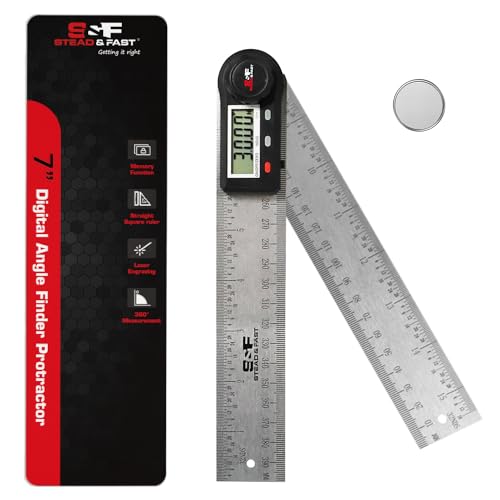
A stainless steel protractor with ±0.3° accuracy that doubles as a full ruler.
The S&F brings stainless steel construction — heavier than aluminum at 6 ounces but more resistant to bending — and a large LCD that reads angles in decimal degrees or degrees/minutes. The 0.05° resolution and ±0.3° accuracy are backed by a unique serial number on each unit. The laser-etched scale on the blade means the ruler marks will not wear off with use.
Quality and accuracy are the top-rated aspects, and owners in cabinet shops praise how quickly it finds unknown angles. The zero and hold functions work as expected: zero out on any surface for relative measurement, and hold locks the reading when the display is blocked. The auto-off kicks in after 5 minutes to save the pre-installed CR2032 battery.
The recurring gripe is the locking mechanism — a few owners find the adjustability finicky, reporting that inconsistent knob tightness can affect the sensor connection. The tool also has sharp edges from the precision-machined body, so handle it with care around finished surfaces.
Confidence call: The stainless body and serial-number accuracy make this a legitimate mid-range contender. The lock-knob inconsistency is the main reason to check the unit on a known angle before critical cuts.
Best for: a cabinet maker or woodworker who wants stainless durability and the option to read angles in degrees or degrees/minutes.
pass on it if: you need a tool that stays set without fussing with the lock knob — the LEXIVON above has fewer moving parts to fight with.
6. Allmeter Digital Angle Gauge & Inclinometer (B0BHSYVYQX)

A tiny 3.53-ounce tilt gauge with a backlit display that fits in a pocket.
The Allmeter is about the size of a deck of cards and weighs just 3.53 ounces, making it the lightest pick here It is a cube-style inclinometer, not a two-arm protractor. You place it on a surface to read tilt, or use the V-slot magnetic base to stick it to a pipe or a saw blade. The backlit white display is readable in full sun and at night, and the auto-invert feature flips the readout when the tool is mounted upside down.
Owners praise its accuracy for micro-adjustments — one used it to set drawer slides at a precise angle, calling it essential for the job. The IP52 water resistance means it can handle a damp shop environment. The 3-minute auto-off saves the two AAA batteries, and the built-in level bubble works without power.
This is a specialized tilt sensor, not a corner measurer. If you need to measure the angle between two walls, this is not the tool. It also displays an “Erro” warning if tilted past 30°, requiring a flat surface for a reading.
Bottom line: For setting miter saw angles, checking machinery level, or confirming a blade tilt, this compact gauge is a precise, portable solution that lives in your tool pouch.
Reach for this if: you want a pocket-sized tilt gauge with a backlit display for checking blade angles, leveling equipment, or automotive work.
Look elsewhere if: you need a traditional protractor to measure wall corners — this cube reads tilt only.
7. Rainyb Digital Angle Finder Tool, 7-Inch

An entry-level digital protractor with bubble levels and a 2000-hour battery claim.
The Rainyb is the most affordable protractor on the list, and it shows in the material — the body is ABS plastic rather than aluminum or stainless steel. It offers a 360° range with ±0.5° accuracy and 0.05° resolution, which is adequate for rough carpentry and hobby work. The ruler edge carries both metric and imperial marks, and the built-in horizontal and vertical bubble levels help check alignment without turning the tool on.
Functionality and quality are the most-praised aspects — owners find it easy to use for measuring right angles and appreciate the hold button that locks the reading when the arms are closed. The manufacturer claims over 2000 hours of continuous operation from the single included CR2 battery, and the auto-off feature extends that further.
Accuracy is a mixed point: some customers note spot-on readings, others find it inconsistent. At this price point, you are trading precision for affordability. The plastic build also means it is less durable on a busy jobsite — it is best suited for a home workshop or occasional use.
Editor’s note: The Rainyb is a fine entry-level tool for the weekend woodworker. The ±0.5° tolerance is looser than the LEXIVON’s ±0.3°, so do not rely on it for fine joinery where a half-degree matters.
Best for: a DIYer on a tight budget who needs a basic digital angle read for trim, shelving, or simple furniture builds.
it’s not for you if: you demand tight accuracy for precision table-saw setup or do production work — step up to the LEXIVON or the Coobeast cube.
Understanding the Specs
Accuracy (±X°)
This is the most important number. It tells you how far the displayed reading can be from the true angle. A tool rated ±0.3° is guaranteed to read within 0.3° of reality. For framing and rough cuts, ±0.5° is fine. For cabinet work, miter setup, or metal fabrication, look for ±0.3° or better.
Resolution (0.05°)
Resolution is how many decimal places the screen can show. A 0.05° resolution display can show angles like 45.10° or 89.95°. A higher resolution (smaller number) does not mean higher accuracy — it just means the screen is more precise. Always check the accuracy spec, not just the resolution.
360° Range
A full 360° range means the tool can measure any angle, including inside corners (90°), outside corners (270°), and reverse angles. Some protractors only read up to 180° or 220°, which is limiting for crown molding or complex framing.
Miter Scale vs. Degree Scale
A miter scale (like on the Starrett) shows you what angle to set your miter saw to — it accounts for the compound geometry of cutting trim. A standard degree scale shows the raw angle of the corner. If you cut crown molding or baseboard, a miter protractor saves a step. For general woodworking, a degree scale is more versatile.
FAQ
Will a digital angle finder work on rounded or curved surfaces?
Can I use an angle finder to set the bevel on my table saw?
What is the difference between an angle finder and a protractor?
How long do the batteries last in a typical digital angle finder?
Should I get a digital or an analog angle finder?
Will a magnetic angle finder damage my saw blade or fence?
What does resolution 0.05° mean in real terms?
Can I use a cube-style angle gauge to measure inside corners on a wall?
How do I calibrate a digital angle finder?
What does IP54 or IP52 mean on an angle finder?
Final Thoughts: The Verdict
For most people, the angle finder winner is the LEXIVON LX-DAF7 because it delivers certified ±0.3° accuracy in a well-built aluminum body at a fair price, backed by owners who trust its readings. If you want a tilt gauge with a laser and rechargeable battery, grab the Coobeast Cube. And for professional trim work where speed matters more than decimals, the Starrett ProSite is the one to reach for.
How We Picked
We do not accept paid placement. Every pick is matched to a real buyer and a real use-case; we do not hands-on test units.
Sources & Methodology
Specifications: manufacturer listings and product documentation. Review insights: verified customer reviews, as of July 2026. Pricing: not shown on this page (it changes often); check the current price via the retailer link.
As an Amazon Associate, Gadgets Feed earns from qualifying purchases. This does not affect which products we feature.