
An angled speaker stand is the single most overlooked upgrade in any listening setup. Whether you are dialing in a surround sound system for movie nights or positioning nearfield monitors on a desk, the difference between sound that fires at your shins versus sound that arrives precisely at ear level is massive — clearer imaging, tighter bass, and a far more convincing stereo field. A stand that simply raises a speaker is not enough; the angle, isolation, and stability of the platform dictate whether the speaker actually performs as it was designed to.
I’m Min — the co-founder and writer behind Gadgets Feed. For this guide, I spent hours analyzing the engineering, load limits, height ranges, and tilt mechanisms of the most-reviewed angled speaker stands on the market to separate the genuinely stable designs from the wobbly compromises.
After filtering through dozens of pairs, these seven models represent the strongest options you can buy today. Whether you prioritize height adjustability, cable management, vibration isolation, or a low-profile desktop footprint, this review of the best angled speaker stands will point you directly to the right pair for your room.
How To Choose The Best Angled Speaker Stands
Choosing the right pair of angled stands is not just about picking something that holds your speakers. You need to match the stand’s height range, platform size, tilt capability, and isolation to your specific room and speaker model. A mismatch in any of these areas can degrade your soundstage or create a stability risk.
Platform Size and Load Capacity
The top plate must be large enough to fully support the base of your speaker without overhang, and the stand must safely exceed the weight of the speaker, usually by a 30-50% margin for safety. Bookshelf speakers can range from 8 to 30 pounds, while studio monitors can weigh up to 60 pounds or more. Check the load capacity per stand — a flimsy stand rated for 11 pounds will not safely hold a pair of heavy passive monitors.
Tilt and Height Adjustability
Not all angled stands allow you to dial in the tilt angle independently of the height. Some use a spring-loaded plate that self-adjusts to the speaker’s shape, while others offer a fixed tilt you set during assembly. For desktop monitors, a tilt range of 0–15 degrees is typical; for floor stands, the height range of 28–51 inches covers most seated listening positions. Prioritize stands that offer both height and tilt so you can aim the tweeter at your ear level without compromising stability.
Vibration Isolation and Base Construction
A stand that transmits vibration into the floor or desk robs your sound of clarity and punch. Look for EVA foam pads, rubber isolation rings, or a hollow column design that lets energy dissipate through the stand rather than into the surface. The base material — tempered glass, heavy alloy steel, or cross-braced metal — determines how much the stand resists lateral movement from heavy bass passages.
Quick Comparison
On smaller screens, swipe sideways to see the full table.
| Model | Category | Best For | Key Spec | Amazon |
|---|---|---|---|---|
| Gator Frameworks Desktop Stands | Premium | Studio nearfield monitors | 0–15° tilt; 60 lbs load | Amazon |
| IsoAcoustics Aperta200 | Premium | High-end isolation | Upto 6.5° tilt; 75 lbs | Amazon |
| Liquid Stands MS112 | Mid-Range | Desktop clamp-on setup | 0–20° tilt; 65 lbs | Amazon |
| MOUNTUP MU9132-L | Mid-Range | Floor-standing bookshelf | 28.3–37.4″H; 22 lbs | Amazon |
| Vondynote Studio Stands | Mid-Range | Tall adjustable stands | 33–51″H; 88 lbs | Amazon |
| MOUNTUP MU9138 | Entry | Surround satellite speakers | 34–43.3″H; 11 lbs | Amazon |
| ELIVED YD5028 | Entry | Affordable bookshelf stands | 34–43.3″H; 11 lbs | Amazon |
In‑Depth Reviews
1. Gator Frameworks Desktop Monitor Stands (GFWSPKSTMNDSK)

The Gator Frameworks desktop stands are the gold standard for nearfield monitor positioning. They offer an adjustable tilt range from flat to 15 degrees, which is enough to aim the tweeter of any 5- to 8-inch studio monitor directly at your ears without placing the stand on foam wedges. The height extends from 10.5 to 14 inches, so they work on standard desk depths up to about 30 inches.
Each stand is built from thick alloy steel with an EVA foam top surface that grips the speaker and absorbs cabinet resonance before it reaches the desk. The 20.6-pound total pair weight gives them a planted feel — 60-pound load capacity means even heavy monitors like the Yamaha HS8 or Adam T7V sit comfortably with no wobble. Rubber feet on the bottom provide enough traction to stay put during bass-heavy playback.
The only tradeoff is the assembly: the tilt mechanism uses bolts that require a hex key, and the height lock is a friction clamp rather than a pin system, so leveling both stands to the exact same tilt angle takes a few minutes of patience. Once locked, however, they hold position without drift.
Why it’s great
- Stepless tilt adjustment from 0 to 15 degrees with positive lock
- EVA foam surface isolates vibration and protects speaker base
- 60-pound capacity handles nearly any nearfield monitor
Good to know
- Friction height clamp can be fiddly to match both stands
- Industrial look may not suit all home decor
2. IsoAcoustics Aperta200 (Silver)

The Aperta200 is not a floor stand — it is a low-profile isolation platform designed to sit on a desk, cabinet, or console. At just 3.5 inches tall, it lifts speakers off the surface while decoupling them via IsoAcoustics’ patented isolation system, which was tested at the National Research Council of Canada. The result is a dramatic reduction in low-end muddiness and a cleaner stereo image.
The stand offers up to 6.5 degrees of tilt, which is subtle but sufficient for dialing in tweeter angle on a shallow desk. The sculpted aluminum body is anodized to a silver finish, and the 7.8-inch width by 10-inch depth platform fits most bookshelf speakers up to 75 pounds. Users report transforming the sound of KEF LS50 and Bowers & Wilkins speakers simply by placing them on these stands.
A few units have been reported with a slight wobble on one of the four rubber feet, indicating that quality control at this premium price point is not flawless. The isolation performance, however, is unmatched — your desk will feel no vibration, and the speaker will sound like it is floating in the room.
Why it’s great
- Patented decoupler eliminates desk resonance completely
- Precision tilt adjustment for perfect tweeter alignment
- Premium anodized aluminum build with high weight capacity
Good to know
- Higher price point than most desktop stands
- Some units may have minor QC wobble on one foot
3. Liquid Stands Studio Monitor Stands (MS112)
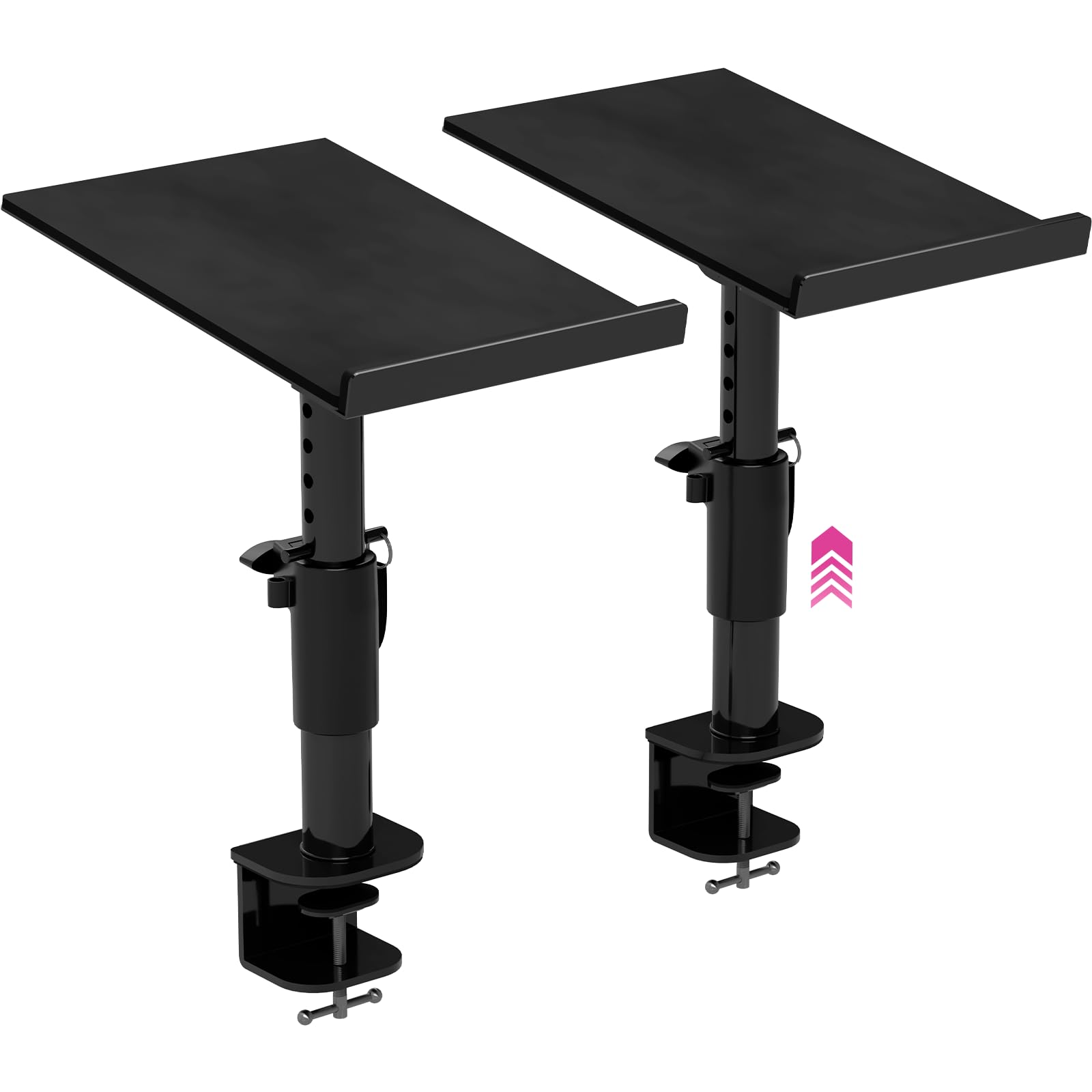
If you want your desk surface completely free, the Liquid Stands MS112 is the answer. These clamp-on mounts attach to a desk edge up to 2 inches thick, holding a 12.5 x 9-inch platform that can tilt from 0 to 20 degrees — the widest tilt range in this lineup. The height adjusts from 9.5 to 13.5 inches, and the whole assembly is stainless steel with a 4-inch clamp base.
What sets the MS112 apart is the versatility: the platform can be used horizontally or vertically, and the included lips can be added or removed to accommodate different monitor shapes. The 65-pound capacity means even heavy studio monitors with large woofers are safe. All contact points are padded with thick isolation foam, and the clamp tightens with wing nuts — no tools needed after initial assembly.
The clamp design means you need a desk with a straight rear edge at least 0.5 inches thick. If your desk has a curved back or a cable management tray, installation becomes complicated. The platform also protrudes about 12 inches forward, so you will lose some desk depth.
Why it’s great
- Widest tilt range (0–20°) for precise angle tuning
- Clamp-on design frees up desk space completely
- Heavy-gauge stainless steel with 65-lb capacity
Good to know
- Requires a flat desk edge without obstructions
- Platform protrudes far forward, reducing usable desk depth
4. MOUNTUP Universal Speaker Stands (MU9132-L)
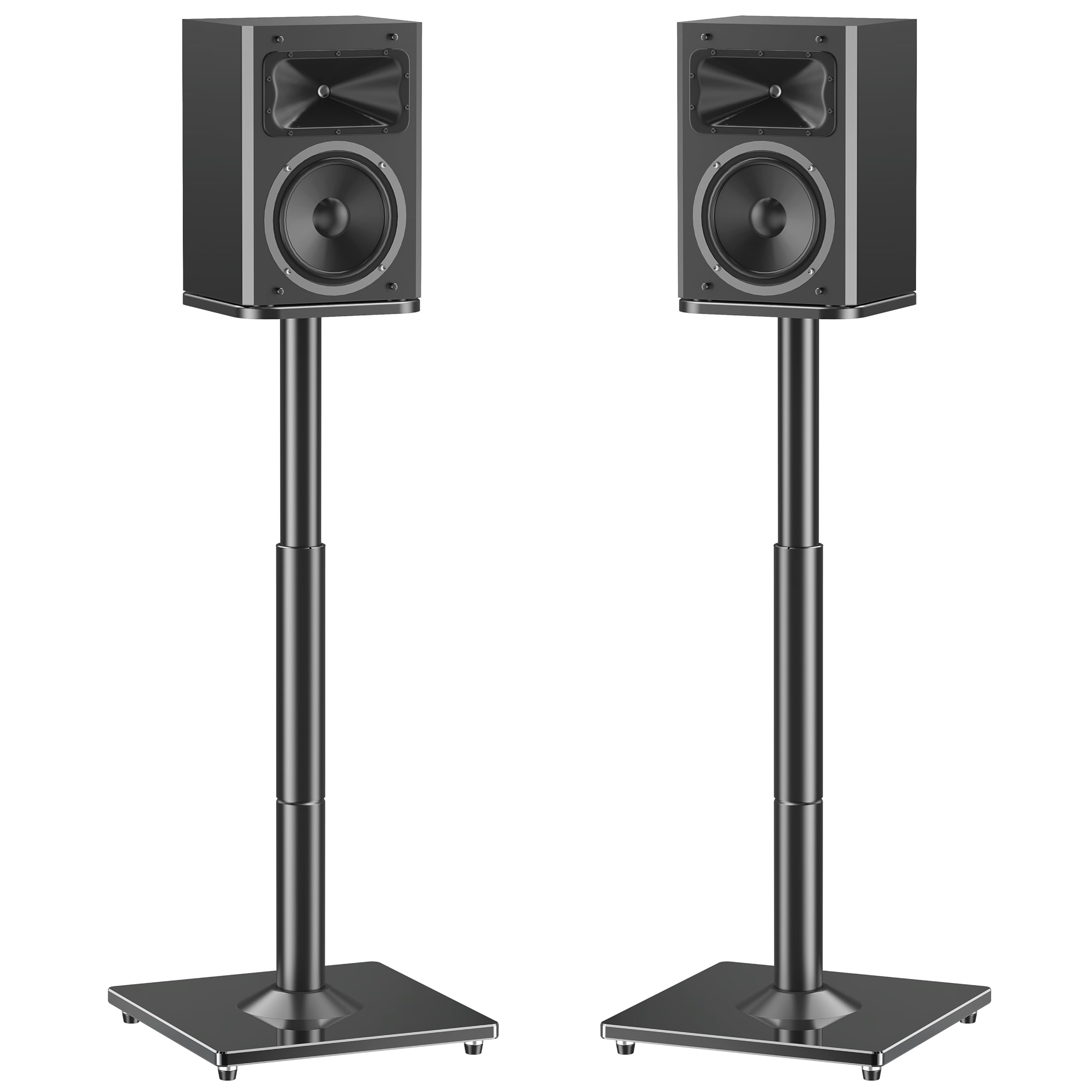
The MOUNTUP MU9132-L is a floor-standing pair designed for surround sound and bookshelf speakers that need to be elevated behind a sofa. The height range of 28.3 to 37.4 inches places most speakers just above ear level for a seated listener, and the 11.8-inch tempered glass base provides a visually light footprint with real stability. The alloy steel column hides speaker wire through a 1.8 x 0.87-inch cable hole.
The top plate is a large 9.8 x 9.8-inch square with anti-slip pads included, making it compatible with bulky speakers like the Sonos Five or larger Klipsch bookshelf models. The 22-pound load capacity per stand is moderate but sufficient for the vast majority of passive bookshelf speakers. Assembly takes roughly 10 minutes using the included Allen key, and the glass base attaches with four bolts for a secure connection.
The use of a glass base means you will want to be careful during assembly — overtightening the bolts could stress the glass. Also, the height adjustment relies on a locking pin, so your height choices are limited to the pre-drilled holes rather than stepless.
Why it’s great
- Sturdy glass base with wide footprint for stability
- Cable management channel keeps wires hidden
- Quick 10-minute assembly
Good to know
- Glass base needs careful bolt tightening to avoid cracks
- Height is limited to pin positions, not continuous
5. Vondynote Studio Monitor Stands (Set of 2)

For those who need extreme height adjustability, the Vondynote stands extend from 33 inches all the way up to 51 inches. This range covers everything from seated ear-level listening to standing-height applications, and the 88-pound load capacity per stand is the highest in this test — enough for heavy passive monitors or even light subwoofer placement.
The platform measures 9 x 9 inches with a 2mm EVA anti-skid pad, and the metal base uses a square-tube cross design that spans 13.5 x 13.5 inches for excellent lateral stability. A built-in wire hole (1.38 x 0.98 inches) routes cables through the hollow column cleanly. The stand includes both rubber feet for hard floors and metal spikes for carpets, so it stays planted on any surface.
The adjustment holes are widely spaced — about 2 inches apart — which means you may not find a perfect height between holes for some listeners. The industrial look is also quite chunky compared to sleeker glass-base stands, so it works best in dedicated listening rooms rather than living spaces.
Why it’s great
- Massive height range (33–51 inches) for any listening position
- Industry-leading 88-pound load capacity per stand
- Large 13.5-inch cross base prevents tipping
Good to know
- Widely spaced adjustment holes limit fine tuning
- Industrial design is less suited to living rooms
6. MOUNTUP Universal Speakers Stands (MU9138)

The MOUNTUP MU9138 is the entry-level option that still delivers most of the features you want from a floor stand. The height adjusts from 34 to 43.3 inches via a telescoping tube with a locking collar, and the spring-loaded top plate expands from 5 to 10 inches to accommodate a wide range of satellite and bookshelf speakers. The plate extends only one way, however, which can shift the speaker off-center and cause a slight lean.
Alloy steel construction with a powder-coated satin finish gives these stands a clean look, and the 9.8 x 9.8-inch base provides a stable footprint. Cable management is built in, with a plastic-protected hole at the pole base. The 11-pound load capacity is light, so these are best suited for small satellite speakers, not heavy bookshelf models. The package includes both rubber feet for hardwood and metal spikes for carpets.
Many users praise the ease of assembly and the overall value, but the single-sided spring plate is the main ergonomic flaw. If your speaker is more than 7 inches wide, you will likely need to use the included fixing bars to keep it centered. For small surround speakers behind a couch, however, these are hard to beat at this level.
Why it’s great
- Spring-loaded top plate fits 5- to 10-inch speakers
- Cable management with plastic wire protector
- Easy 10-minute assembly with all hardware included
Good to know
- One-sided plate extension can cause off-center lean
- 11-pound load limit restricts use to lightweight speakers
7. ELIVED Universal Speaker Stands (YD5028)

The ELIVED YD5028 is a near-direct competitor to the MOUNTUP MU9138, sharing the same price tier, height range, and spring-loaded plate design. The key difference is the piano-style glossy finish on the alloy steel column and the surprising 10-year warranty that ELIVED offers. The base is actually glass with a polished edge, giving it a more refined appearance than the rubber-footed competition.
The spring-loaded bracket adjusts from 5 to 10 inches and includes thick rubber pads to protect the speaker base. The cable management hole is large (1.8 x 0.87 inches) and features a soft rubber grommet to prevent wire abrasion. Assembly is straightforward, and the included hardware kit has extra pieces for those inevitable dropped screws. The 11-pound capacity is identical to the MOUNTUP, so these are also best for satellite or small bookshelf speakers.
Some users noted that the base, while attractive, can be slightly top-heavy with larger speakers — the 9.8-inch footprint is not as wide as the Vondynote’s cross base. The feet also lack a leveling adjustment, so uneven floors may require shims. For the price and the strong warranty, however, these are a solid entry-level choice.
Why it’s great
- Glossy piano finish with polished glass base for a premium look
- 10-year warranty provides long-term peace of mind
- Large cable hole with rubber grommet protects wires
Good to know
- Base can feel top-heavy with larger speakers
- No adjustable feet for leveling on uneven floors
FAQ
Do angled speaker stands really improve sound quality?
Can I use floor speaker stands for studio monitors on a desk?
What is the difference between a spring-loaded plate and a fixed tilt?
How much weight should a stand handle for my bookshelf speakers?
Final Thoughts: The Verdict
For most users, the best angled speaker stands winner is the Gator Frameworks Desktop Monitor Stands because they combine a useful 0–15 degree tilt range, a 60-pound load capacity, and EVA foam isolation at a price that makes sense for serious desktop listeners. If you need true acoustic decoupling and don’t mind spending more, the IsoAcoustics Aperta200 will transform your sound by eliminating all surface resonance. For a floor-standing pair that can reach 51 inches and hold nearly 90 pounds, the Vondynote Studio Stands are the most versatile option available.