
Our readers keep the lights on and my morning glass full of iced black tea. As an Amazon Associate, I earn from qualifying purchases.
Aniline wood dye is the secret behind professional-grade finishes that reveal rather than hide a wood’s natural figure. Unlike pigmented stains that sit on the surface and muddy the grain, aniline dyes penetrate deep, delivering pure, transparent color that makes curled maple, figured walnut, or quartersawn oak pop with three-dimensional depth. The choice between powdered concentrates and ready-to-use liquids, water-base and solvent-base carriers, and single colors versus mixing kits determines everything from your application speed to final clarity.
I’m Min — the co-founder and writer behind Gadgets Feed. After many hours sifting through real-world application reports, lab-backed technical specs, and user experiences across guitar luthiery, fine furniture restoration, and custom cabinetry, I’ve mapped out exactly what differentiates the top aniline dye options on Amazon right now.
This buying guide cuts through the chemical confusion to help you confidently choose the best aniline wood dye for your specific project, whether you’re spraying a burst finish on an electric guitar or restoring a century-old oak floor.
How To Choose The Best Aniline Wood Dye
Selecting an aniline dye is a matter of matching your wood species, finishing schedule, and required precision. The biggest mistake beginners make is treating aniline dye like regular stain — it behaves completely differently because it dissolves fully into the carrier rather than suspending pigment particles.
Powder vs. Liquid Concentrate
Powdered aniline dyes offer the most flexibility and the best value per quart of working stain. A 25-gram packet can produce up to five quarts of dye, and you control the color density by adjusting the powder-to-solvent ratio. Liquid concentrates are more expensive per ounce but eliminate measuring and dust hazards — ideal when you need consistent color across a large project without mixing variables.
Water-Base vs. Alcohol/Solvent-Base Carriers
Water-based dyes are non-toxic, low-odor, and EN 71 safe for children’s toys, but they raise wood grain, requiring a water-pop step before final sanding. Alcohol or solvent-based dyes dry faster, do not raise grain, and can be mixed directly into lacquers and polyurethanes, but they require better ventilation and are more flammable. The choice depends on whether you prioritize safety and ease of cleanup or speed and finishing flexibility.
Quick Comparison
On smaller screens, swipe sideways to see the full table.
| Model | Category | Best For | Key Spec | Amazon |
|---|---|---|---|---|
| Keda Dye 5-Color Powder Kit | Powder Kit | Custom color mixing | 25g per color, 5 quarts each | Amazon |
| Transol 5-Color Solvent Powder Kit | Solvent Powder | Mixing into oil-based finishes | 50g total, 10 quarts yield | Amazon |
| Keda Dye Red Single Powder | Single Powder | Bulk red dye projects | 25g, makes 5 quarts red | Amazon |
| Keda Dye Black Single Powder | Single Powder | Deep black base coats | 25g, makes 1 gallon black | Amazon |
| Liberon Water-Based Ebony Dye | Liquid Water Dye | Non-toxic floor refinishing | 250ml bottle, 2.5-3.75 sqm | Amazon |
| ColorTone Black Liquid Stain | Luthier Liquid | Guitar finishing precision | 2oz bottle, high concentration | Amazon |
| Keda Dye 5-Color Liquid Alcohol Kit | Liquid Solvent Kit | Fast-dry, no grain raise | 5 x 1oz bottles, 2.5 gal yield | Amazon |
In‑Depth Reviews
1. Keda Dye 5-Color Liquid Alcohol Dye Kit

This is the most versatile liquid aniline kit on the market for serious finishers who want immediate results without mixing powder. Each of the five 1-ounce bottles produces roughly half a gallon of working dye when diluted with denatured alcohol or lacquer thinner, giving you a total yield of 2.5 gallons. Because the dye dissolves in solvent, it does not raise wood grain, so you can skip the water-pop sanding step required with water-based dyes.
Users report achieving layered finishes by applying yellow then brown dye with a sanding sealer between coats, followed by gel stain and clear coat — a technique that produces deep, complex color impossible with a single stain application. The kit excels for walnut, maple, and cherry projects where preserving figure is the priority. The 30-day warranty offers limited coverage, but Keda’s quality consistency is well-documented across multiple user projects.
For anyone doing multi-step finishing schedules on figured woods, this liquid kit delivers the speed, transparency, and mixing freedom that justifies its price. The only downside is the need for proper ventilation when working with alcohol or lacquer thinner carriers.
Why it’s great
- No grain raising — skips the water-pop step entirely
- Five colors yield 2.5 gallons of working dye for large projects
- Mixes directly into lacquers, shellac, polycrylic, and epoxy
Good to know
- Requires good ventilation when using alcohol or lacquer thinner
- Layered applications needed for the richest hues seen in demo videos
2. Keda Dye 5-Color Powder Wood Dye Kit

This five-color powder kit from Keda Dye remains the gold standard for finishers who want maximum control over color saturation at the lowest cost per quart. Each of the five bags contains 25 grams of powder — Black, Blue, Brown, Red, and Yellow — and a single bag makes up to five quarts of working dye, giving the kit a total yield of 25 quarts. The coverage per color reaches around 150 square feet, making this viable for furniture-sized projects.
User reports confirm this dye works exceptionally well on oak, pine, poplar, aspen, and hard maple, with the best results on aspen and hard maple. Experienced finishers note that mixing 1/8 teaspoon of powder into 6 ounces of water produces enough dye for 20+ guitar bodies, and a single kit leaves plenty of surplus for future projects. The instructions are minimal, so some color-mixing knowledge helps, but the dye is forgiving — drips vanish with a second coat, and the color deepens significantly after a topcoat of lacquer is applied.
For woodworkers who want to match existing pieces or create custom blends, this kit provides the raw ingredients at a fraction of the cost of pre-mixed liquids. The eco-friendly, water-based formula means no harsh fumes and easy cleanup.
Why it’s great
- 25 total grams per color yields 5 quarts each for massive value
- Eco-friendly, water-based formula with no VOCs during mixing
- Forgiving application — drips and streaks blend out with a second coat
Good to know
- Raises wood grain — requires water-pop sanding before application
- Instructions are vague; color-mixing video research recommended for beginners
3. Transol 5-Color Solvent Powder Dye Kit

Transol takes a different approach by offering a solvent-soluble powder that mixes directly into oil-based polyurethane, lacquer, varnish, and other non-water finishes. This is a rare find because most aniline dyes only dissolve in water or alcohol — Transol’s formula bridges the gap for users who want to tint their existing clear coats without changing their entire finishing system. Each of the five colors comes in a 10-gram packet, and the total kit yield is 10 quarts, or about 2.5 gallons.
Users praise the dye for revealing curl on figured maple with exceptional clarity, and the ability to mix colors for custom shades is a major plus. The USA-made formulation has responsive customer support, and the dye dissolves well in denatured alcohol for those who prefer a wipe-on approach before topcoating. Some users note that the small 10-gram packets run out quickly for larger projects, and the packaging is basic with minimal instructions.
This kit is best for woodworkers who already finish with oil-based products and want the transparency of aniline dye without switching to a water-based workflow. The lower volume per color makes it more of a sampler or small-project solution.
Why it’s great
- Dissolves in oil-based finishes — rare for aniline dyes
- USA-made with responsive customer service
- Brings out curl on figured maple with sharp clarity
Good to know
- Only 10 grams per color — limited volume for large furniture projects
- Basic packaging and sparse instructions for beginners
4. Keda Dye Red Single Powder — 25 Grams

When a project calls for a specific color in bulk, the single-powder packs from Keda eliminate waste. This 25-gram red dye packet makes five full quarts of vibrant red working stain, with the option to dilute further for a pink hue. The powder is water-based and eco-friendly with no VOCs, and it also dissolves in rubbing alcohol for faster drying times. Cleaning up is as simple as rinsing with warm water.
Users working on electric guitar projects report mixing red with blue and a black base coat to achieve deep purple, demonstrating the versatility of single-color powders in custom blending. One user successfully mixed this red with denatured alcohol and warm water, applying 3-4 coats with painter’s tape on military crate-themed entertainment stands, achieving results that exceeded expectations. The dye is potent — one packet in a 400cc squirt bottle, applied in two coats with a torch dry between them, gives deep, rich color on solid wood.
This is the right choice for anyone who needs a large quantity of red dye for a single project or wants to stock a specific color without buying a multi-color kit. The transparent finish preserves wood grain beautifully.
Why it’s great
- 25 grams makes 5 quarts — substantial volume for one color
- Works with water or alcohol for application flexibility
- Transparent finish reveals grain while delivering vibrant red
Good to know
- Single color only — no mixing kit for custom shades
- Powder must be fully dissolved to avoid clumping in finish
5. Keda Dye Black Single Powder — 25 Grams

Keda’s black dye powder is a go-to for finishers who need a deep, transparent black base coat that allows wood grain to show through. The 25-gram packet makes over one gallon of working black stain, and the powder dissolves in either warm water or rubbing alcohol. The dye itself is non-toxic, eco-friendly, and stain-resistant after curing, making it suitable for a wide range of interior woodwork.
Users report excellent results applying this dye in dewaxed shellac to paint ugly Formica black, with a mix ratio of 1.5 teaspoons of powder to 8 ounces of shellac. For electric guitar finishing, 2-3 coats on maple or birch produce a solid black while still showing the wood grain underneath. Some users note that on pine, the dye can appear more purplish-blue than true black, so testing on scrap is essential. A 50/50 mix of blue and red over a black base coat yields a deep purple with sanding between coats.
This single-color pack is ideal for those who need a large quantity of black dye for a project or want a concentrated black to mix into other colors for darkening. The slight color shift on certain woods is the main caveat to consider.
Why it’s great
- 25 grams yields over 1 gallon of black working stain
- Non-toxic and eco-friendly formula with no VOCs
- Transparent finish preserves wood grain under black color
Good to know
- Can appear purplish-blue on pine rather than true black
- Best used with a test piece to confirm final color on your wood
6. Liberon Water-Based Wood Dye — Ebony 250ml
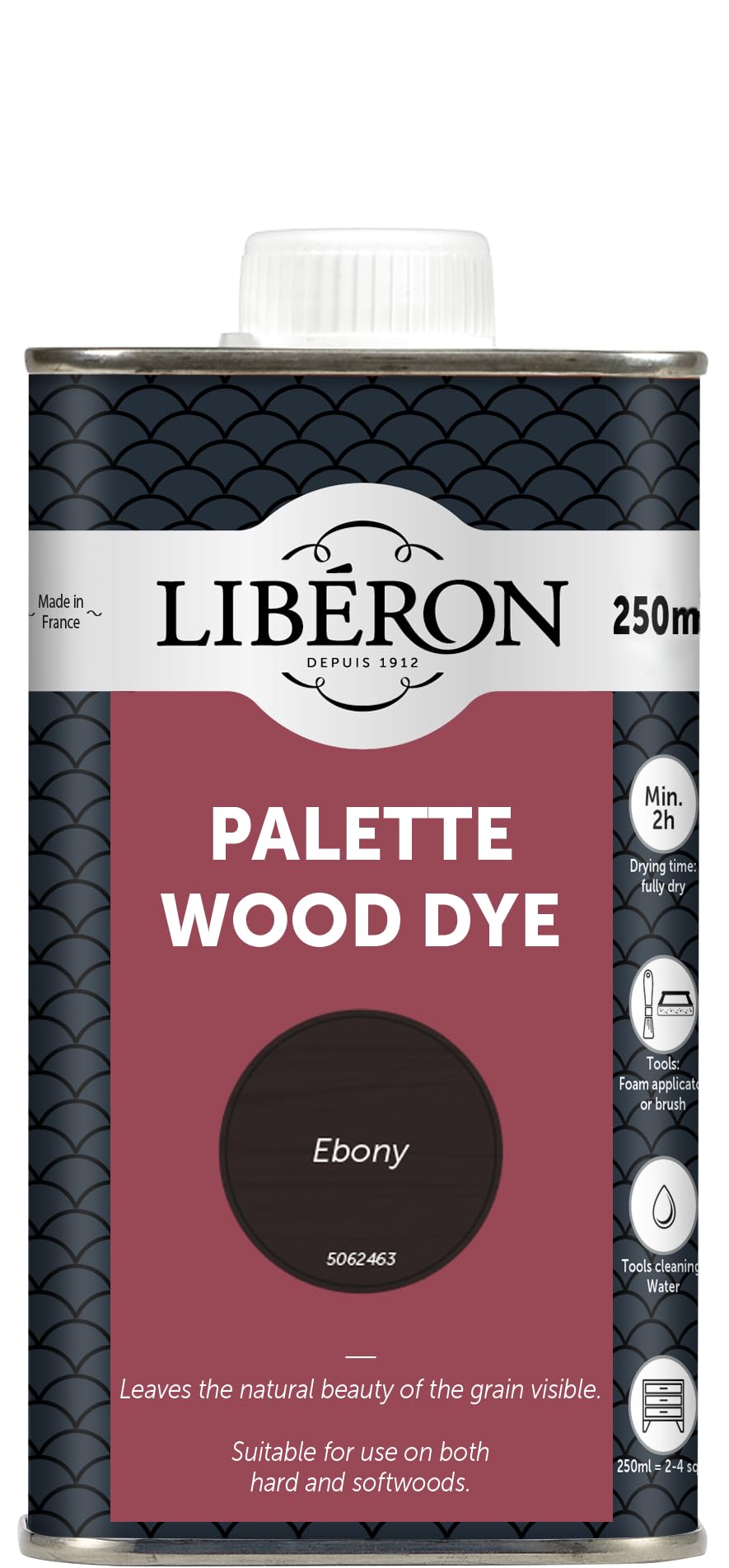
Liberon’s liquid water-based dye is a premium choice for floor refinishing and safety-sensitive projects. It is EN 71 approved for children’s toys and endorsed by the Guild of Master Craftsmen, giving it a credibility edge for interior work. The 250ml bottle covers 2.5 to 3.75 square meters at full strength, and it can be thinned with water to extend coverage or reduce color intensity.
One user refinishing a 100-year-old oak floor mixed this dye 2:1 with water, applied a single coat with lambswool, and achieved an even, rich burgundy-red color that hid the floor’s blotchy variation while preserving every bit of grain. The dye can also be added directly to water-based urethane topcoats — the same user mixed 250ml of dye into 2 gallons of clear satin urethane for two of five coats, enhancing depth. The non-toxic, odorless formula makes it safe for indoor use on kitchen counters and dining tables.
This is the best option for large-area applications like floors and for projects involving children’s furniture or toys where safety certifications matter. The pre-mixed liquid format eliminates measuring errors, though the coverage area is limited per bottle.
Why it’s great
- EN 71 certified safe for children’s toys
- Non-toxic and odorless — ideal for indoor use
- Can be mixed directly into water-based urethane for one-step toning
Good to know
- Only 250ml — limited coverage for large furniture or multiple projects
- Bottle design has reported leakage issues during shipping
7. ColorTone Black Concentrated Liquid Stain — 2oz

ColorTone from StewMac is the most focused aniline dye on this list — it is formulated specifically for stringed instrument finishing. The 2-ounce bottle is highly concentrated; a 1:8 mix with denatured alcohol produces enough working stain for multiple guitar bodies or necks. The dye can be reduced with alcohol or water for wipe-on staining or added directly to nitro lacquer, shellac, waterbase finishes, and catalyzed varnishes for custom toning.
Luthiers report outstanding results mixing this black with other ColorTone colors — one repair tech achieved a perfect match for a Martin D-18 by mixing red mahogany to tobacco brown at a 1:8 ratio. Another user coated a Nyatoh fingerboard, and after proper curing, it looked deep and dark. The stain requires bare wood to absorb evenly; a light poly coat underneath causes uneven results. The Lifetime Promise and expert tech support from StewMac add significant value for professionals who cannot afford finishing failures on expensive instruments.
This is the premium choice for anyone doing guitar, bass, or other instrument finishing where color accuracy and reliability are paramount. The high price per ounce reflects the targeted formulation and brand support, not the raw volume.
Why it’s great
- Formulated specifically for luthier finishing with authentic tonal results
- One 2oz bottle makes multiple cups of working stain due to high concentration
- Lifetime Promise and expert tech support from StewMac
Good to know
- Significantly more expensive per ounce than powder alternatives
- Requires bare wood for even absorption — fails over poly or sealer coats
FAQ
Can I mix powdered aniline dye directly into polyurethane or lacquer?
Why does aniline dye sometimes appear a different color on pine compared to oak?
How do I prevent blotching when using water-based aniline dye on softwoods like pine?
Final Thoughts: The Verdict
For most users, the best aniline wood dye winner is the Keda Dye 5-Color Powder Kit because it offers the best balance of color variety, volume per dollar, and mixing control for any project from guitar finishing to furniture restoration. If you want fast-drying, no-grain-raise convenience for multi-step finishing schedules, grab the Keda Dye 5-Color Liquid Alcohol Kit. And for safety-certified, non-toxic floor and toy refinishing, nothing beats the Liberon Water-Based Wood Dye.
Product prices and availability are accurate as of the date/time indicated and are subject to change. Any price and availability information displayed on Amazon at the time of purchase will apply to the purchase of this product. As an Amazon Associate I earn from qualifying purchases.
CERTAIN CONTENT THAT APPEARS ON THIS SITE COMES FROM AMAZON. THIS CONTENT IS PROVIDED "AS IS" AND IS SUBJECT TO CHANGE OR REMOVAL AT ANY TIME.
Amazon and the Amazon logo are trademarks of Amazon.com, Inc. or its affiliates.