
Our readers keep the lights on and my morning glass full of iced black tea. As an Amazon Associate, I earn from qualifying purchases.
Specs are compiled from manufacturer listings and verified buyer reviews and can change over time — please confirm the key details on the product page before buying.
An anime board game can be a total letdown — a licensed cash grab with a flimsy board and a logo slapped on a boring roll-and-move. But the nine games here are the real deal: they actually use the worlds they adapt, from deck-building adventures in the Four Nations to cooperative missions with the Straw Hats. The list covers the full spectrum of play styles and price tiers, so you can jump straight to the pick that fits your group and get playing tonight.
I’m Min — the founder and writer behind Gadgets Feed. This guide is built by comparing the manufacturers’ published specifications and the patterns across verified customer reviews, so you get each pick’s real strengths and trade-offs instead of marketing spin.
Whether you’re hunting for a gift or a centerpiece for game night, the anime board games on this list represent the best licensed and original designs available right now.
Our Picks at a Glance


How To Choose The Best Anime Board Games
The biggest trap is buying purely on the license and ending up with a shallow game that collects dust after one play. The anime board game space has matured, so the picks below are genuinely well-designed games that happen to feature your favorite characters.
Match the mechanic to your group
Before you pick a series, decide how your group likes to play. Cooperative games have everyone working together to beat the game itself — great for families and friends who don’t want to fight. Competitive deduction games like CLUE-style titles put your detective skills against each other. Deck-building games let you construct your own strategy as you play, trading and buying cards to make a powerful engine.
Know the time commitment
Check the estimated play time before you commit. A 30-minute game like the One Piece Nakama card game is perfect for a quick warm-up, while a 90-minute Cowboy Bebop space opera needs a full evening. Also check the player count — most of these support 2-6 players, but a tight 1-4 game like the deck-builders is a different night than a 6-player party game.
Think about replayability
A good board game stays fun after the fifth playthrough. Look for mechanics that introduce variety — games with different heroes, villains, or missions each time will last longer on your shelf. One-off experiences lose their appeal fast, no matter how much you love the source material.
Quick Comparison
| Model | Best For | Play Time | Players | Mechanic | Amazon |
|---|---|---|---|---|---|
| Monopoly: One Piece★ Best Overall | Families who love classic trading | 60 min | 2-6 | Property Trading | Amazon |
| One Piece NakamaBest Compact Co-op | Travel & quick co-op sessions | 30 min | 1-5 | Cooperative | Amazon |
| CLUE: Dragon Ball ZTop Deduction Pick | Mystery fans who love DBZ | 60 min | 2-6 | Deduction | Amazon |
| CLUE: One Piece | One Piece fans who want a whodunit | — | 2-6 | Deduction | Amazon |
| CLUE: Naruto | Ninja-themed logic puzzles | 60 min | 2-6 | Deduction | Amazon |
| Avatar: Aang’s Destiny | Co-op deck building groups | 60 min | 2-4 | Deck Building | Amazon |
| Cowboy Bebop: Space Serenade | Solo or serious deck builders | 90 min | 1-4 | Deck Building | Amazon |
| Monopoly: My Hero Academia | Collectors & big group sessions | — | 2-6 | Property Trading | Amazon |
| Re;ACT – The Arts of War | 1v1 dueling strategists | 15-30 min | 2 | Dueling Cards | Amazon |
In‑Depth Reviews
1. Monopoly: One Piece Edition
Our pick — over 4.5★ from 350+ verified ratings; the strongest balance of quality and price.
The beloved trading formula reborn in Dressrosa with nine sculpted Straw Hat tokens
The safest bet for a family that already loves Monopoly is this One Piece edition, because it keeps every rule you know while wrapping the board in the Dressrosa tournament arc. The 9 custom sculpted tokens — Luffy, Zoro, Nami, Robin, Brook, Chopper, Usopp, Franky, and Sanji — are the stars here; buyers consistently praise the build quality and vibrant colors. It’s a heavier, more premium feel than a standard set, and the quality is exactly what owners say wins them over first.
Instead of boring Community Chest and Chance, you draw Chest Cards and Flag Cards that trigger alliances and surprises, which injects a fast-paced twist into the classic rhythm. The game runs 60 minutes for 2-6 players ages 8 and up, making it a solid centerpiece for a family night. As buyers report: “My 10 year old big anime fan, loves one piece. Since xmas our family sits around hours playing one piece monopoly.” That sentiment echoes through the reviews — families genuinely sit down for hours with this one.
Board size comes in at 16″L x 11″W, which is slightly broader than the CLUE Dragon Ball Z board (15.75″L x 10.5″W) — a touch more table space but nothing that should scare you off. The only recurring grumble is that the pieces can be hard to tell apart once they’re clustered on the board, a minor nitpick for a game with this much personality.
Why it wins game night
- Nine sculpted Straw Hat tokens feel collectible and premium
- Familiar Monopoly rules mean zero learning curve
- Chest and Flag cards add a real One Piece twist
Minor hurdles
- Tokens can be tricky to tell apart on a busy board
- Full 60-minute sessions need a dedicated table
Reach for this if: you want a proven family classic that both superfans and Monopoly diehards will happily play for years.
Look elsewhere if: you want a quick setup filler — this one needs table space and a full hour.
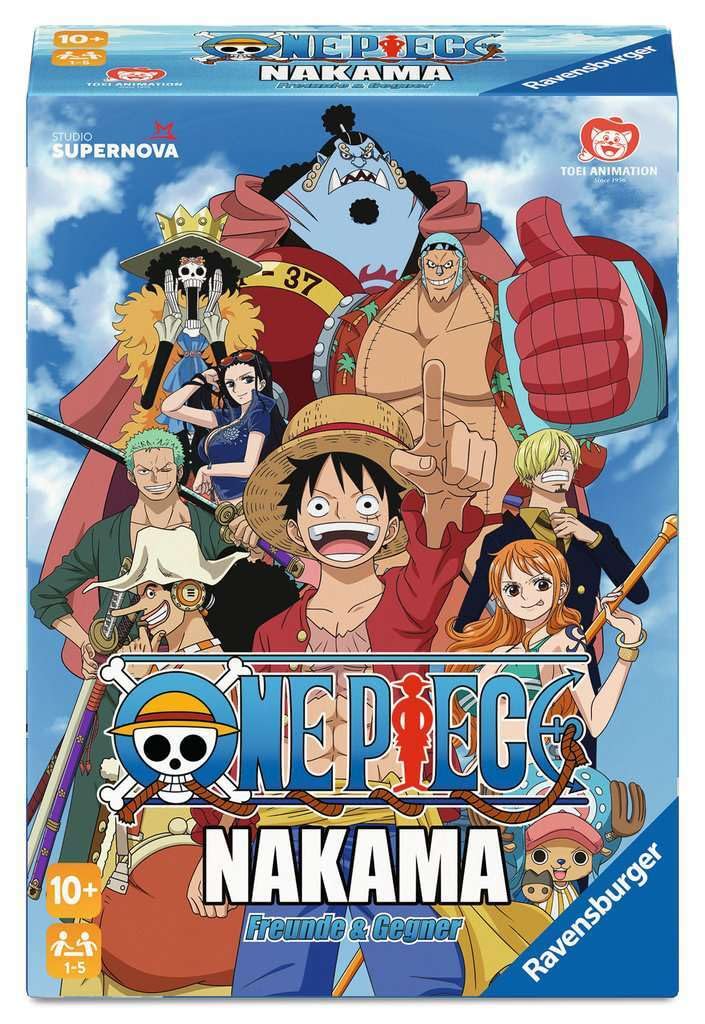
2. Ravensburger One Piece Nakama
A 30-minute cooperative card game packing 100 One Piece characters into a travel-friendly box
You can dive into the One Piece world without clearing the table for an hour — this Ravensburger title delivers a cooperative mission in just 30 minutes, while the Monopoly One Piece edition runs 60 minutes. The compact pack format is built for travel and game nights, letting 1-5 players aged 10 and up team up to recruit friends and defeat enemies from East Blue to Wano. It’s a smart second purchase for any One Piece fan who already has the big-box Monopoly.
The game stands out for its variety: the box brings 100 characters of the One Piece world to the table, and the mechanics mean no two runs play the same. Different heroes and bosses appear each time, and the different difficulty levels keep it interesting for both casual and frequent players. As owners mention: “Highly varied, no two runs alike. Different heroes/bosses each time. No prior series knowledge needed. Recommended.” That last point matters — this works even for someone who has never watched the show.
The catch is the language situation: reports vary depending on which Amazon marketplace ships your unit, and some European customers received German copies without clear notice. If you order this, confirm the language note on your specific listing before checkout to avoid a frustrating surprise.
Perfect for travelers: the compact format slips into a bag, making it the easiest pick here to take to a friend’s house or on a trip.
Grab this when: you want a fast, cooperative One Piece fix that newcomers can learn in minutes.
Think twice if: you’re buying on a marketplace where the language isn’t clearly stated — verify English before checkout.
3. USAOPOLY CLUE: Dragon Ball Z
A deduction classic reimagined with 6 sculpted villain coins and battles across iconic DBZ locations
For fans who want to solve a mystery rather than buy real estate, this Dragon Ball Z version of CLUE keeps the classic whodunit engine and layers on the anime’s best locations. You’ll play as Gohan, Krillin, Goku, Piccolo, Vegeta, or Gotenks, trying to figure out which villain is after the Dragon Ball, who can stop them, and where the battle goes down. The board spans Tenkaichi Budokai, Kame’s Lookout, Master Roshi’s House, and more — pure nostalgia fuel for longtime fans.
The presentation is solid: 6 custom sculpted villain coins (Frieza, Kid Buu, Perfect Cell, Broly, Garlic Jr., and Bojack) have a satisfying heft, and the game supports 2-6 players ages 8 and up for a 60-minute session. One owner summed up the experience: “It’s wild that it’s a themed game but so fun if you do the voices while playing.” It’s a hit at game night, especially with fans who grew up on the series.
The honest trade-off shows up in the details. As customers note, “The board design is a bit lazy… Standard cards and clues,” and there’s a known quirk where a box can arrive with two Frieza pieces. None of it stops the fun for a kid who loves both CLUE and Dragon Ball, but it won’t impress a production-value snob. Board size sits at 15.75″L x 10.5″W — a touch narrower than the Monopoly One Piece’s 16″L x 11″W.
What impresses
- Hefty, collectible villain coins with real weight
- Iconic locations make the board a nostalgia trip
- Classic CLUE rules mean instant pickup
What to know
- Board art is more functional than flashy
- Occasional packaging quirks like duplicate pieces
Best for: a DBZ kid who already loves CLUE and wants their favorite characters in the mystery.
Not the pick if: you want a visually premium board — the art is the weakest link here.
4. CLUE: One Piece Board Game

A lighter, island-hopping CLUE that swaps mansions for Dressrosa, Drum Kingdom, and Water Seven
If the Dragon Ball CLUE feels a bit plain, this One Piece edition raises the bar with a treasure-hunt premise: you’re solving who found the treasure, what it is, and where it’s hidden. You get 9 crew movers — the full Straw Hat lineup — plus themed cards, tokens, and dice, all wrapped in locations like Dressrosa, Drum Kingdom, and Water Seven. At 2.1 pounds, it has a reassuring table presence without being a burden to carry.
The 2-6 player count and ages 8+ range make it a genuinely flexible family pick, and it’s labeled as an expansion for CLUE, meaning it plays like the classic you already know with a One Piece skin. Owner feedback leans heavily on how fun it is: “Love the anime and the board game! So fun!” and “This game uses locations from the anime and the characters. Definitely recommend!” It’s a crowd-pleaser for anyone who loves both One Piece and deduction games.
It’s note the weight difference: at 2.1 pounds this CLUE edition is more substantial than you might expect, which usually speaks to sturdier pieces. The game board comes in at 15.75″L x 10.5″W, the same footprint as the Dragon Ball CLUE version, so it won’t need a bigger table than the rest of the genre.
Great first gift: the instantly recognizable crew plus simple rules make this a safe bet for a One Piece fan who has never played a themed board game before.
Pick this up for: a One Piece lover who wants a fresh treasure hunt instead of a re-skin of the same mystery.
skip it if: you already own the other One Piece CLUE edition and want a totally different mechanic.
5. USAOPOLY CLUE: Naruto

A Hidden Leaf murder mystery where ninja weapons replace lead pipes and candlesticks
The murder-mystery formula gets a shinobi makeover here: a jonin from another village has been murdered, and you must solve who from the Akatsuki did it, what weapon was used, and where they’re hiding. The 6 custom sculpted tokens are a highlight — Chakra Blades, Shuriken, Kunai, Sword, Paper Bomb, and Nunchaku — which feel far more thematic than standard CLUE pieces. As reviewers point out, it’s “perfect for any Naruto fan.”
You’ll play as one of the six main characters — Sai, Hinata, Naruto, Sakura, Kakashi, or Tsunade — each with their own role and ability cards. The 25 Intrigue cards, including 8 Attack Advances cards, add a layer of interaction beyond pure deduction. It supports 2-6 players ages 8 and up for a standard 60-minute session, and the game board holds the same 15.75″L x 10.5″W footprint as the other CLUE editions.
The one recurring note in feedback is the instruction booklet — several owners found the rules a bit confusing on the first read, though they quickly got past it once playing. “Gave instructions are a little confusing. But other than that, the game is so fun and interactive.” It’s a minor speed bump in an otherwise wildly popular pick for Naruto fans.
Ninja-grade fun
- Weapon tokens are cleverly tied to the Naruto world
- Ability cards add a fresh strategic layer to CLUE
- Ages 8+ with 2-6 players covers most groups
Watch out for
- Rulebook is harder to parse than standard CLUE
- Deduction fans may want more depth than card text offers
Choose this for: a Naruto-obsessed teen or adult who wants a strategy-light party game they can play without explaining the universe.
Pass if: you need a game that teaches itself — budget time to read the rules aloud first.
6. Avatar: The Last Airbender — Aang’s Destiny

A cooperative deck-building campaign through the Four Nations with 7 unlockable boxes of challenge
Avatar fans who want actual strategy should look here: this is a true cooperative deck-building game, not a re-skinned roll-and-move. You and up to 3 friends team up as Aang, Katara, Appa, and others to defeat foes and restore balance across the Fire Nation, Earth Kingdom, Water Tribes, and Air Nomads. The game is designed in progressive stages, with the first two stages explicitly built to introduce people who have never played a deck-builder.
The scope is impressive — a massive 378 cards (314 regular, 50 square, 14 oversized) plus 4 player boards. The campaign structure means you open 7 boxes of progressively challenging gameplay, which keeps the experience fresh across multiple sessions. What wins people over is the gameplay itself — it’s the most-mentioned strength by far — with quality and ease of learning close behind. If you’ve played Dominion or Star Realms, this is that kind of engine, but cooperative and themed around mastering bending.
The honest friction point is the rulebook. Feedback consistently flags the directions as confusing, and one common wish is that opening a new box would swap out all cards automatically to simplify things. It takes a full session or two to click, but once it does, the depth and challenge keep families coming back. The board comes in at 12.13″L x 9.07″W, a more compact footprint than the CLUE games above.
Where it shines
- True deck-building depth in a cooperative format
- 7 unlockable boxes give a real campaign arc
- Intro stages teach newcomers the genre smoothly
Where it stumbles
- Rulebook clarity is the top complaint
- Card sorting between boxes takes patience
Right for: groups that love strategy games and want a co-op experience that grows more challenging over many sessions.
Not for: casual families who want to open the box and play with zero homework — this one demands a rules read first.
7. Japanime Games Cowboy Bebop: Space Serenade

A jazzy 90-minute space opera that works solo or with up to 3 crewmates
For the anime purist who also loves a serious deck-builder, this Cowboy Bebop title is in a league of its own. It’s a cooperative deck-building game from the creator of Harmonies, and it brings the full Bebop crew to the table — Spike, Jet, Faye, Ed, and a Vicious miniature all included. The 90-minute estimated play time is the longest on this list, signaling a heavier, more thoughtful experience that rewards repeated plays.
The box is stacked: a rulebook, 5 miniatures, a game board, 4 player boards, 22 Big Shot cards, and 40 character cards. Owners consistently describe it as one of the best deck-builders they’ve played, with real depth in the layers of strategy, and it handles flexible player counts beautifully — great at 4, works well at 3 or 2, and the solo mode is genuinely fun. “A really good deck-builder with a theme that can’t be beat,” as the feedback puts it.
The learning curve is real, and owners admit it can look overwhelming at first (“Can look like a lot at first but once you understand…”). A quick online rules video sorts it out, and the replayability is off the charts — this is the pick that players set up again immediately after finishing. At 11.8″L x 11.8″W, the square board needs a clear table, and the box weighs in at 1.39 kg, so it’s a home-game, not a travel-game.
Built for repeat sessions: the layers of deck-building strategy plus flexible player counts make this the gift that keeps delivering long after the first night.
Buy for: a Cowboy Bebop superfan who already plays deck-builders and wants a themed game with genuine depth.
Avoid if: you want a light party game — this is a committed strategy session, not a casual filler.
8. USAopoly Monopoly: My Hero Academia

The GameStop-exclusive edition with a 7th token
This is the Monopoly for the true collector: a My Hero Academia edition where houses are renamed Rewards and hotels are Trophies, Community Chest becomes “Go Beyond!” and Chance becomes “Plus Ultra!” The custom board features students and teachers from the series, with themed money throughout. The standout hook is the GameStop-exclusive bonus — a 7th token in the form of Stain’s Knife, which lets you play with up to 7 people instead of the standard 6.
The 7 custom tokens are creative picks: Eraserhead’s Visor, Grenade Glove, Deku’s Mask, Dummy Bomb, Shigaraki’s Hand, UA Sigil, and the exclusive Stain’s Knife. It’s aimed at ages 8 and up, and the box size makes it a nice, gift-worthy presence. One owner described it as the “Superior version of Monopoly” because of the 7-player capacity, and the game does require more thought than a standard set according to regular players.
There’s a clear caveat around quality control: a few owners reported broken or cracked pieces straight from the start on arrival. It’s not a widespread pattern — most units arrive fine — but it’s worth checking the pieces as soon as you open it, especially since this edition can be the “last one” in stock. The box itself also has a lot of empty space under the plastic, which collectors may notice but families won’t care about.
What stands out
- Exclusive Stain’s Knife token is genuine collectible value
- Fully re-themed board, cards, and money
What to check
- Some units arrive with broken pieces — inspect immediately
- Premium price tag is for the exclusivity, not the components
Reach for it if: you’re a My Hero Academia collector who wants the exclusive token.
Skip if: broken pieces would ruin the night — this one’s quality control is less consistent than the One Piece Monopoly.
9. Re;ACT – The Arts of War (Deluxe Edition)
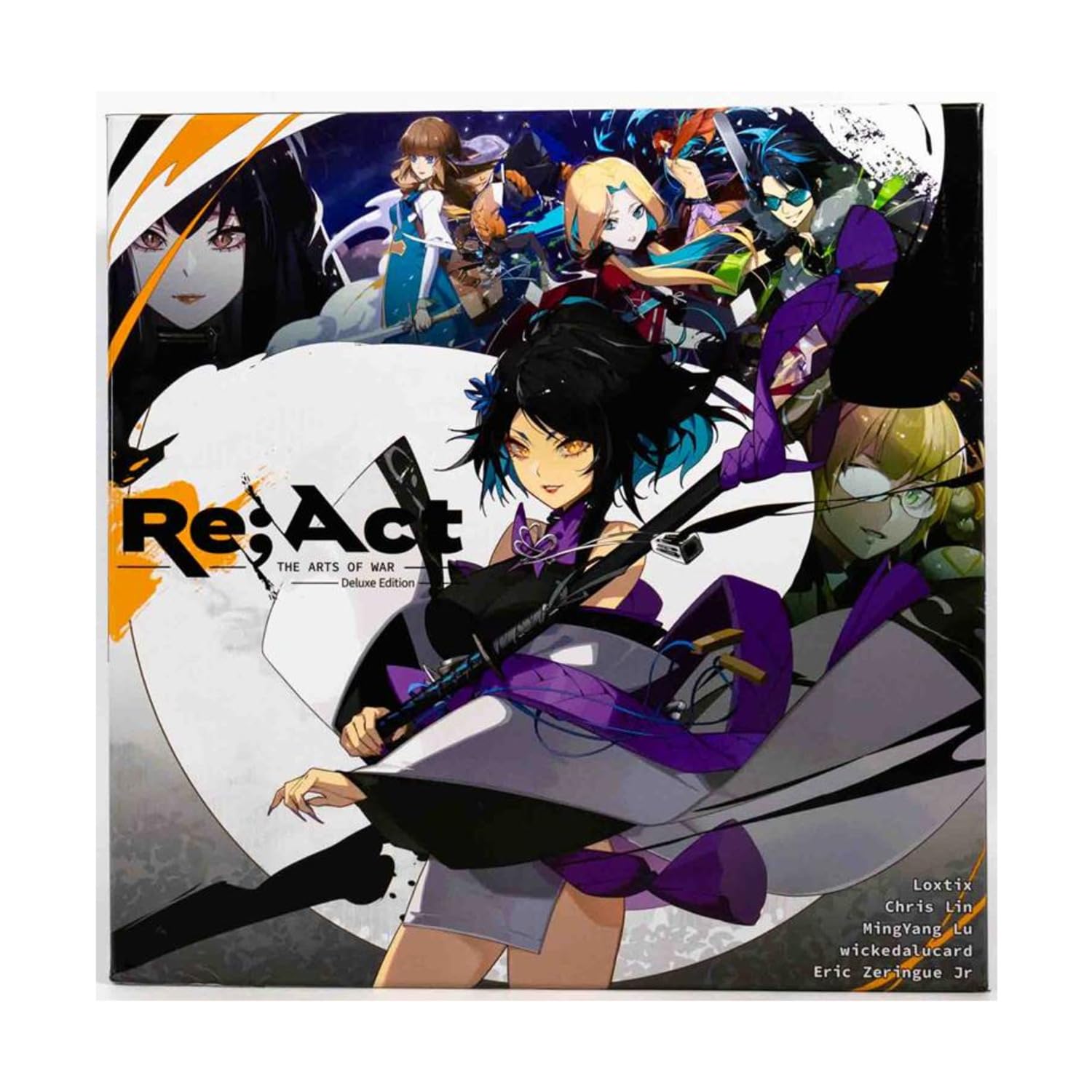
An original anime-styled 1v1 dueling game where fighters battle with magic drawn from art mediums
Not every anime board game has to be a licensed adaptation, and this original creation proves the point. Re;ACT drops you into a world where fighters use magic powers based on art mediums — Calligraphy, Tattoos, and Dance — in fast, 15-30 minute duels. It’s strictly a 2-player experience, making it the perfect pick for a couple or a friendly rivalry rather than a full game night.
The Deluxe Edition is the premium way to play: it comes with 28 Acrylic Standees and 2 Neoprene Playmats inside a larger box, upgrading the whole table feel. With 8 playable characters, each with their own tuck box, setup is quick and there’s no deck-building homework before you play. The first-in, last-out reaction chain system rewards clever combos, and owners consistently describe the depth as high — “at a certain point it feels like chess with a bit of chance.”
The art is by acclaimed artists wickedalucard and loxtix, giving it a genuinely gorgeous, original manga style that stands out on a shelf. The main friction point is the physical standees: a few owners found the acrylic pieces don’t fit perfectly into their platforms, a minor annoyance in an otherwise polished production. At 13″L x 13″W, the board is a comfortable square for a head-to-head match.
Why it’s a keeper
- Neoprene playmats and acrylic standees feel genuinely premium
- Deep reaction-chain system rewards repeated play
- Original art by acclaimed creators stands apart from re-skins
The small stuff
- Standees fit loosely in their base platforms
- Strictly 2-player — no bigger group option
Buy this if: you want a gorgeous, fast, strategically deep duel for you and one rival — and you love supporting original anime-style art.
Pass if: you need a game for 3+ players; this one is strictly a head-to-head showdown.
Understanding the Specs
Fundamental Mechanics
The core engine of the game — whether it’s property trading (Monopoly-style), deduction (CLUE-style), cooperative deck-building, or dueling cards. This determines how your group interacts: are you competing against each other, or working together against the game? A family that loves chaos might prefer the trading of Monopoly, while a tight-knit group may love the team effort of a cooperative game like Aang’s Destiny.
Player Count and Time
Check both before you buy. Player count tells you the balance for your group — a 2-player duel is a very different night than 6 players around a property board. Play time is about pacing: a 30-minute game is a warm-up, while a 90-minute campaign is the main event. Match these to how your group actually plays, not how you’d like them to play.
FAQ
Do you need to have watched the anime to enjoy these games?
What is the difference between a cooperative game and a competitive game?
Which games are best for younger kids around 8 years old?
How long does a typical game session last?
Can I play any of these games by myself?
What does deck-building mean in these games?
Are these games officially licensed products?
Which game has the best replay value?
What should I check before buying a Ravensburger One Piece Nakama?
Final Thoughts: The Verdict
For most families, the best anime board games choice is the Monopoly: One Piece Edition because it pairs the most beloved trading mechanics with nine premium sculpted Straw Hat tokens and a 60-minute session that keeps everyone engaged. If you want a fast, cooperative game you can take anywhere, grab the Ravensburger One Piece Nakama. And for a serious strategy night — especially solo or with a small crew — the Cowboy Bebop: Space Serenade is the one to reach for time and time again.
How We Picked
We do not accept paid placement. Every pick is matched to a real buyer and a real use-case; we do not hands-on test units.
Sources & Methodology
Specifications: manufacturer listings and product documentation. Review insights: verified customer reviews, as of August 2026. Pricing: not shown on this page (it changes often); check the current price via the retailer link.
As an Amazon Associate, Gadgets Feed earns from qualifying purchases. This does not affect which products we feature.