
Our readers keep the lights on and my morning glass full of iced black tea. As an Amazon Associate, I earn from qualifying purchases.
Specs are compiled from manufacturer listings and verified buyer reviews and can change over time — please confirm the key details on the product page before buying.
If your ankles feel shaky on a run, your feet ache by midday at a standing desk, or you are rehabbing a sprain that keeps coming back, an ankle balance board can strengthen the small stabilizer muscles your regular workout misses. The challenge is picking the right one — a single-axis rocker board (which tilts only one way) is a different tool from a 360-degree wobble board (which tilts in every direction). This guide breaks down six models by their real specs and confirmed buyer experiences, so you can match a board to your goal and skill level without guesswork.
I’m Min — the founder and writer behind Gadgets Feed. This guide is built by comparing the manufacturers’ published specifications and the patterns across verified customer reviews, so you get each pick’s real strengths and trade-offs instead of marketing spin.
Here you will find a no-nonsense breakdown of the six most effective ankle balance boards on the market, each matched to a specific use case, so you can confidently choose the best ankle balance board for your recovery, fitness, or daily comfort.
How To Choose The Best Ankle Balance Board
Picking an ankle balance board depends on matching how you move on it (rocking side-to-side vs. wobbling in all directions) with what your ankles actually need right now. Here are the three specs that separate a helpful tool from a shelf-clutterer.
Movement Type: Rocker vs. Wobble
A rocker board tilts on a single axis — forward-backward or left-right. This controlled motion is ideal for early rehab and beginners because the board does not slide out sideways. A wobble board (or 360-degree board) tilts in every direction, which demands more from the stabilizing muscles in your foot and ankle. If you are recovering from a sprain, start with a rocker. If you want sports training or deeper core engagement, a wobble board is the right pick.
Platform Size and Capacity
Board width determines how comfortably both feet fit side by side. Standard boards range from a compact 14-inch diameter to a roomy 20-inch square. Pair that with the maximum weight recommendation: most adult boards support between 300 and 400 pounds. A larger platform is more forgiving for standing-desk use; a smaller one is easier to store and pack.
Material and Surface Texture
Boards are made from wood (Baltic birch, maple, or bamboo) or impact-resistant plastic. Wood is quieter and feels more solid, but plastic is lighter and often easier to clean. The top surface matters most — a non-skid texture keeps your feet planted whether you wear shoes, socks, or go barefoot. If you plan to use the board on hard floors, check that the bottom has grip pads or you will want a mat underneath.
Quick Comparison
| Model | Best For | Movement Type | Weight Capacity | Platform Size | Amazon |
|---|---|---|---|---|---|
| Fitterfirst Professional Rocker Board – 20” | Serious ankle rehab with adjustable difficulty | Rocker (single-plane tilt, 10-15° adjustable) | 350 Pounds | 20″ x 20″ | $159.95Amazon |
| Whirly Board Wide 360˚ | Standing desk and full-body balance training | 360° spin, rock, tilt, bounce | 400 Pounds | 28″ x 10″ | $189.95Amazon |
| Body Sport Rocker Board | PT beginners wanting a smooth, controlled rock | Single-axis rocker (front-to-back) | 400 Pounds | 14″ x 14″ | $44.99Amazon |
| StrongTek Wooden Balance Board | Transitional training from rocker to wobble | 360° wobble with cross-base control | 350 Pounds | 17.5″ x 13.5″ | $38.99Amazon |
| Mobo Board | Foot-specific strength and big-toe control | Rocker with anatomical foot axis | 300 Pounds | 14.7″ x 13.9″ | $89.95Amazon |
| SIDEKICK AxisBoard | Structured ankle rehab with an exercise app | Split-board with adjustable peg heights | — | — | $89.00Amazon |
In‑Depth Reviews
1. Fitterfirst Professional Rocker Board – 20”

The wide, sturdy rocker that physical therapy offices themselves choose for ankle rehab.
The Fitterfirst gives you a 20-inch by 20-inch platform versus the Body Sport Rocker Board’s 14-inch by 14-inch surface, so both feet land naturally with room to spare. It tilts on a single plane forward and backward, but you can set the tilt angle to 10, 12, or 15 degrees using two adjustable domes underneath, which lets you increase the challenge as your ankle strengthens. At 7.5 pounds it is the heaviest board here, and buyers report you should place it on a non-slip mat on hard floors.
The Baltic birch plywood construction feels dense and quiet. The maximum weight recommendation is 350 pounds. Reviewers mention that the adjustable three-height domes make progressive strength training straightforward, and one buyer with ankle dorsiflexion work called it “really great for serious ankle rehab,” noting the cost equals about one physical therapy visit.
What stands out
- Widest platform (20″ x 20″) for a stable, comfortable two-foot stance
- Adjustable tilt (10°, 12°, 15°) lets you progress difficulty without buying a new board
- Weighs 7.5 lbs — feels planted and durable underfoot
What to know
- Heavier than other boards if you plan to carry it between rooms
- Rocker-only motion — not for 360-degree wobble training
- Needs a mat underneath on tile or hardwood to prevent sliding
Reach for this if: You want a clinical-grade rocker board with adjustable difficulty for long-term ankle rehab or balance training at home.
Look elsewhere if: You need a board that easily fits in a backpack or one that spins and wobbles for dynamic sports drills.
2. Whirly Board Wide 360˚
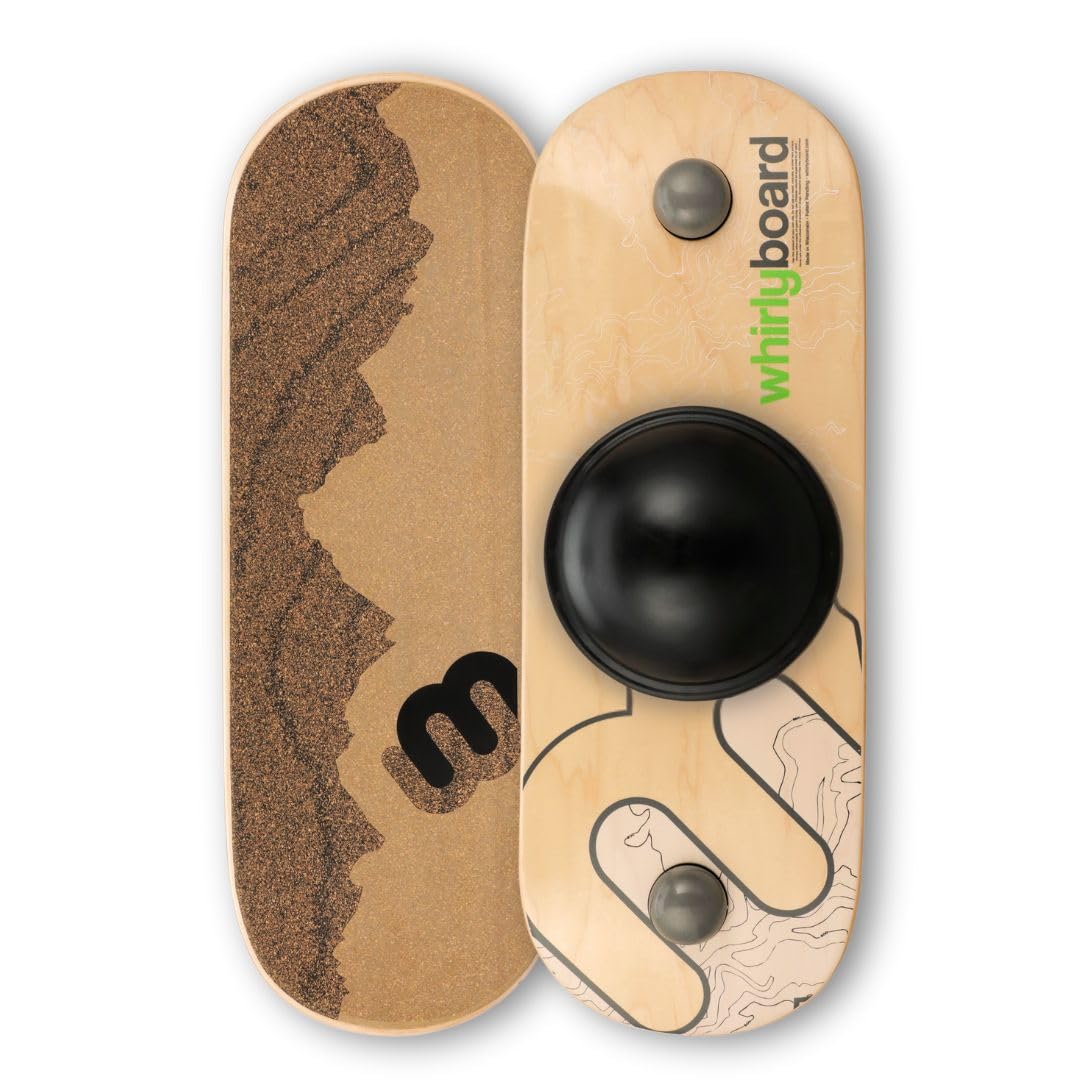
The premium maple spinning board that keeps your legs moving while you work.
Unlike the Fitterfirst rocker, which only tilts one way, the Whirly Board uses three semi-spherical balance points to create a 360-degree spinning motion — you can rock, tilt, spin, and even bounce. The deck is made from 8-ply Canadian maple (28 inches long by 10 inches wide) and supports up to 400 pounds. The cork-rubber grip tape on top gives solid traction whether you wear shoes or socks, and an optional stabilizing ring is available for beginners. It is handcrafted in Northern Wisconsin and comes with a lifetime replacement guarantee.
Owners mention it “eliminated minor aches and pains” from standing at a desk and found it immediately engaged core and lower body muscles. One reviewer who stands 80% of the workday said they got stronger quickly. The catch is the difficulty curve — several owners note it is challenging initially and recommend holding a desk or wall for support and using a mat on hard floors.
Keeps you active all day: The 360° spinning motion gently shifts your weight so you stay engaged without bouncing or wobbling wildly — ideal for a standing desk or active sitting breaks.
Not for early rehab: The multiple axes of motion make it too unstable for a freshly sprained ankle. Stick with a single-axis rocker if you are in early recovery.
Grab it for: Reducing fatigue at a standing desk, improving posture while you work, or training for surfing, snowboarding, or skateboarding.
skip it if: You need a simple rehab board for post-injury ankle recovery — the unconstrained motion is too advanced.
3. Body Sport Rocker Board
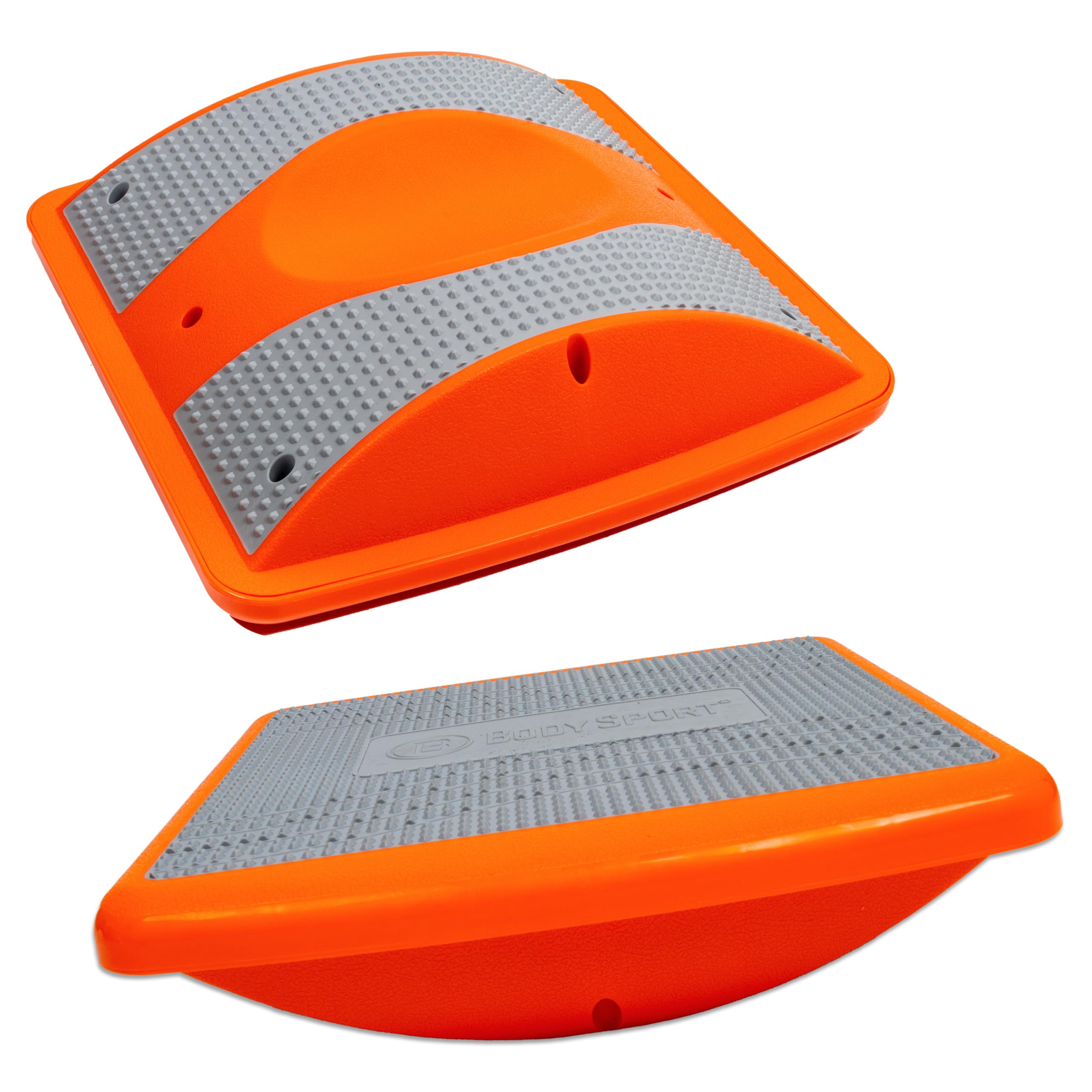
The lightweight plastic rocker with a silkier feel than many wooden boards.
The Body Sport offers a single-axis front-to-back rocking motion that is noticeably smooth — one reviewer noted they “tried several others (the wooden ones) and they did not operate smoothly and/or the ‘teeter’, esp front to back, was very unbalanced.” At 3.6 pounds versus the Fitterfirst at 7.5 pounds, it is much easier to carry between the clinic, the office, and home. The 14-inch by 14-inch platform is compact but comfortable, and the non-skid textured surface grips typical home and office flooring well.
The maximum weight recommendation is 400 pounds. The impact-resistant plastic construction is durable and easy to wipe clean. Some buyers mention flipping the board over for lower back stretching — it doubles as a gentle stretch wedge. The key trade-off: at 3.75 inches tall, the smaller platform means your feet sit closer together than on the 20-inch Fitterfirst.
Why people like it
- Smooth, balanced rocking motion without the wobble of wooden rockers
- Lightweight (3.6 lbs) and easy to tuck under a desk or couch
- 400 lb capacity in a compact footprint
Trade-offs
- 14-inch platform is noticeably smaller than the 20-inch Fitterfirst
- Plastic surface can feel less premium underfoot than wood
- Single-axis rocker only — no progressive tilt or wobble option
Perfect for: A physical therapy patient or desk worker who wants an affordable, smooth rocker that stores easily and is simple to use.
Not ideal if: You want a wide, wood-platform board with adjustable tilt levels for progressive training.
4. StrongTek Wooden Balance Board

The cross-base wobble board that bridges the gap between rocker and full round-base wobble.
StrongTek designed this board for users who find basic rockers too easy but round wobble boards too intimidating. The 360-degree directional wobble lets you tilt in any direction, but the cross-shaped base creates a larger floor-contact area that feels more controlled than a traditional round wobble board. The platform is made from lauan hardwood plywood and measures 17.5 inches by 13.5 inches, with a maximum weight of 350 pounds and a weight of 2.23 kilograms.
Customers note “daily use works stabilizing leg muscles; noticeable improvement in weeks.” One 70-year-old reviewer said it was “so helpful with balance” and paired it with YouTube exercise videos. A recurring frustration in reviews is that the four corner pads have weak adhesive and tend to fall off — a super-glue fix is common. If you want a middle step before committing to a round-base board, the StrongTek is the most approachable wobble trainer available.
Cross-base control: The wider base contact area prevents the board from tipping too aggressively, so you learn wobble stability without the scary “catch” of a round board.
Corner pads are a weak point: Multiple reviewers point out that the edge protectors peel off quickly — an easy DIY fix, but worth knowing upfront.
Best for: Someone who has mastered a basic rocker board and wants to upgrade to 360-degree wobble training with a safety net.
Not for: Anyone needing a single-axis rocker for early rehab — the free wobble motion can stress an unstable ankle.
5. Mobo Board

The bamboo rocker designed by a biomechanics expert to wake up the big toe and arch.
The Mobo Board is not a general balance board — its “Toe Box Technology” and anatomical axis are engineered to target the muscles inside your foot that control arch stability and big-toe push-off power. Designed by Jay Dicharry, a well-known physical therapist and author, it works on a rocker principle but with a sculpted footbed that cues proper alignment. At 1.53 kilograms it is one of the lightest wood boards here, and it folds completely flat for travel.
The results in reviews are striking: one buyer mentioned that the board “enabled wearing 2.5-inch high heels after double knee replacement” after being limited to 0.75-inch heels previously. Another runner said it strengthened feet and ankles enough to run pain-free 16 miles. Several reviewers describe the price as high for a simple-looking rocker, but nearly all conclude it is effective for targeted foot strength. Note that the rocker pieces lack grip on slick floors — a non-slip mat is recommended.
What makes it unique
- Toe Box Technology and anatomical axis target foot arch and big-toe strength directly
- Folds completely flat for easy storage and travel
- Proven results for plantar fasciitis, post-surgery recovery, and runner durability
Limitations
- 300 lb max weight is lower than most boards in this guide
- Bare rocker bases can slip on hardwood and tile without a mat
- Premium price for a specialized foot tool — not meant for general wobble training
Get this if: You have a specific foot issue like plantar fasciitis, weak arches, or big-toe stiffness, or you are a runner wanting targeted foot strength.
Pass if: You need a high-capacity board for general ankle rehab or a 360-degree wobble trainer — this is a foot-specialist tool, not an all-rounder.
6. SIDEKICK AxisBoard
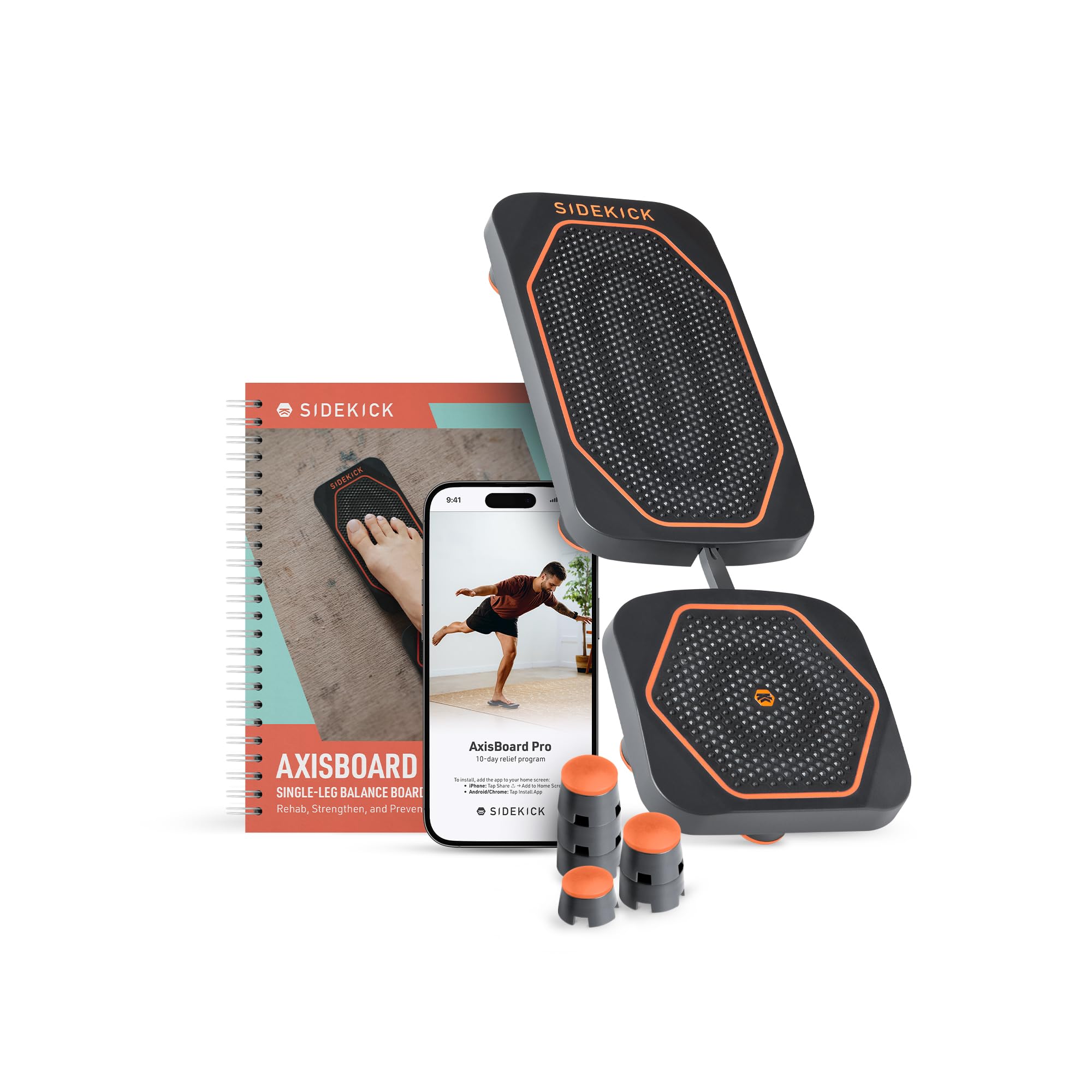
The guided rehab board that tells you exactly what to do on day 1, day 2, and beyond.
Unlike every other board on this list, the AxisBoard is a kit: a split-board design with stackable pegs, a 125-page guide, and lifetime access to the Sidekick app with structured 10-day programs for specific goals (plantar fasciitis, Achilles pain, ankle sprains). The split-board activates the stabilizing muscles on each side of the foot independently, and the stackable pegs let you adjust height to progress the difficulty. The brand states it is recommended by 60-plus physical therapists and comes with a lifetime warranty.
Buyers are enthusiastic: one reported the AxisBoard “resolved posterior tibial tendonitis” and got them back to running 50 miles per week. Another said the app and booklet made it easy to follow a routine. The biggest downside is, as one reviewer put it directly, “high price but highly effective” — you are paying for the structured program as much as the hardware. The carrying pouch makes it genuinely portable, which the larger wood boards are not.
Guided rehab path: The 10-day programs and video tutorials remove the guesswork — no need to figure out your own routine or search for exercises online.
Premium for hardware: If you already know how to structure your own ankle exercises, a simpler rocker board may give you the same movement for less money.
Choose this for: A structured, guided ankle rehab program at home — especially if you are recovering from a specific injury and want clear daily instructions.
pass on it if: You just need a wobble or rocker board for general balance training and do not need the app or guide.
Understanding the Specs
Movement Axis — Rocker vs. Wobble
The movement type determines how the board challenges your ankles. A rocker board tilts along a single axis — front-to-back or side-to-side — which is predictable and controlled. A wobble board (or 360-degree board) tilts in every direction, forcing your foot and ankle stabilizers to react to unpredictable angles. Rocker boards are safer for early rehab and beginners; wobble boards build more comprehensive balance and are better for sports training.
Weight Capacity and Platform Area
Weight capacity tells you the maximum user weight the board is designed to support safely — most range from 300 to 400 pounds. Platform area (length times width) affects comfort and stability: a larger platform like 20″ x 20″ lets both feet sit naturally without crowding, while a 14″ x 14″ board is more compact and stores easily. A bigger platform is generally better for standing-desk use; a smaller one is fine for short PT sessions.
FAQ
Should I get a rocker board or a wobble board for ankle rehab?
How long should I use an ankle balance board each day?
Can I use an ankle balance board on carpet?
What is the difference between a balance board and a wobble board?
Will an ankle balance board help with plantar fasciitis?
How much weight can most ankle balance boards hold?
Are wooden balance boards better than plastic ones?
Can a balance board help with standing desk fatigue?
Is the SIDEKICK AxisBoard worth the higher price?
How do I know when I have progressed to a more difficult board setting?
Final Thoughts: The Verdict
For the majority of shoppers, the best ankle balance board winner is the Fitterfirst Professional Rocker Board – 20” because of its wide platform, adjustable tilt, and proven clinical design. If you want a structured, app-guided rehab program with daily instructions, grab the SIDEKICK AxisBoard. And for strengthening your feet through a biomechanically designed rocker, the standout is the Mobo Board.
How We Picked
We do not accept paid placement. Every pick is matched to a real buyer and a real use-case; we do not hands-on test units.
Sources & Methodology
Specifications: manufacturer listings and product documentation. Review insights: verified customer reviews, as of July 2026. Pricing: not shown on this page (it changes often); check the current price via the retailer link.
As an Amazon Associate, Gadgets Feed earns from qualifying purchases. This does not affect which products we feature.
Product prices and availability are accurate as of the date/time indicated and are subject to change. Any price and availability information displayed on Amazon at the time of purchase will apply to the purchase of this product. As an Amazon Associate I earn from qualifying purchases.
CERTAIN CONTENT THAT APPEARS ON THIS SITE COMES FROM AMAZON. THIS CONTENT IS PROVIDED "AS IS" AND IS SUBJECT TO CHANGE OR REMOVAL AT ANY TIME.
Amazon and the Amazon logo are trademarks of Amazon.com, Inc. or its affiliates.