4 Best Ankle Brace For Pronation | Arch Pain? These Stop the Roll

Our readers keep the lights on and my morning glass full of iced black tea. As an Amazon Associate, I earn from qualifying purchases.

Specs are compiled from manufacturer listings and verified buyer reviews and can change over time — please confirm the key details on the product page before buying.

If you have overpronation, your ankle rolls inward too much every time you take a step. That stresses your arch, your shin, and your knee. The fix is an ankle brace that controls that inward roll while still letting you move, run, and play. The four picks here all do that — but each one handles it at a different level of support, bulk, and cost — so you only pay for what you actually need.

I’m Min — the founder and writer behind Gadgets Feed. This guide is built by comparing the manufacturers’ published specifications and the patterns across verified customer reviews, so you get each pick’s real strengths and trade-offs instead of marketing spin.

So if you need a slim brace for daily shoes or a stiff stabilizer for serious recovery, these reviews cut through the noise to help you pick the right ankle brace for pronation for your specific situation and activity level.

Our Picks at a Glance

BioSkin TriLok Ankle Brace
Best OverallBioSkin TriLok Ankle Brace4.4★216 ratingsA figure-8 stabilizer that marries an arch-lift strap with lateral control for sporty overpronation.Check Price on Amazon

How To Choose The Best Ankle Brace For Pronation

Not every ankle brace tackles pronation the same way. Some use a strap under your arch to lift it. Others use stiff plastic splints on the sides to physically block the roll. Here is what to look at before you buy.

Arch Lift vs. Side Stabilization

A brace that fights pronation has to stop your foot from collapsing inward. Some do this with a strap that runs under your arch and pulls up. That works for mild overpronation and plantar fasciitis (arch pain). Others use rigid side bars — either plastic or metal — that brace the ankle joint itself. For moderate to heavy pronation, especially after a sprain, look for a brace that combines both strategies.

Your Shoe and Activity Matter

The bulkiest stabilizers will not fit inside your regular sneakers or work shoes. If you need to wear the brace all day under normal clothes, a low-profile wrap or a slim design with thin side splints is critical. If you only wear it for sports or recovery at home, you can choose a sturdier, more immobilizing brace. Reviews consistently show that a brace you cannot fit in your shoe becomes a brace you do not wear.

Strap System and Ease of Use

Figure-8 straps and multi-strap closures offer a very custom fit, but they can be frustrating to put on correctly — many buyers report that the first few attempts require a video or patience. A simpler hook-and-loop wrap is easier to get on and off but may shift during high-intensity activity. Decide whether you value convenience or adjustability more.

Quick Comparison

Model Best For Weight Support Type Key Feature Amazon
BioSkin TriLok★ Best Overall Overpronation + post-sprain return to sport 0.35 Pounds Figure-8 strap + arch lift FootLok Arch-Lift for pronation Amazon
Pronation Spring Control Wrap Mild pronation & plantar fasciitis in daily shoes 0.02 Pounds Compression wrap Ultra-light, shoe-friendly Amazon
BioSkin APX Post-surgery / acute sprain with pronation control 0.13 Kilograms Figure-8 wrap + rigid side straps Anti-roll rigid straps Amazon
Bauerfeind CaligaLoc Chronic instability / ligament injury — partial immobilization 8 ounces Rigid splint + straps Integrated pronation wedge Amazon

In‑Depth Reviews

★ Best Overall

1. BioSkin TriLok Ankle Brace

Our pick — over 4★ from 200+ verified ratings; the strongest balance of quality and price.

Figure-8 + Arch LiftFits in most shoes

A figure-8 stabilizer that marries an arch-lift strap with lateral control for sporty overpronation.

The standout feature is the FootLok strap — it runs under your arch and pulls upward, directly managing overpronation while you cut, jump, or run. Unlike a basic wrap that just compresses, the TriLok adds a figure-8 stirrup strap (a strap that wraps in a figure-eight pattern to lock the ankle from rolling side to side), so you get two kinds of support in one low-profile package. At 0.35 Pounds it is noticeably heavier than the Pronation Spring Control Wrap (which weighs 0.02 lb)but that weight comes from the structured nylon/lycra material and the integrated support system.

Owners mention it is “effective for lateral malleolus fracture recovery; reduces pain from 8 to 4 in 24 hours.” The catch is the learning curve — customers note the strap path is confusing and the brace is tough to drive in. Sizing can also be tricky if your ankle is swollen. One buyer used it for power walking and running after replacing a lost podiatrist-given brace, calling it “so good I replaced it,” which speaks to its return-to-play value.

Why it wins for sport

  • FootLok arch strap directly targets overpronation while you cut, jump, or run
  • Figure-8 and stirrup design stabilizes inversion/eversion (rolling inward and outward)
  • Hypoallergenic, breathable, and fits in cleats and trainers
  • Bilateral design works on either foot

A few setup hurdles

  • Strap routing takes practice and a video to learn
  • Slippery outer fabric requires strapped shoes to stay snug
  • Sizing is tricky if swelling is present

Reach for this if: you play court or field sports and need arch support plus lateral stability in a brace that still fits your regular athletic shoes.

The one caveat: it is not a quick slip-on — budget a few practice rounds to learn the strap path.

Budget Champion

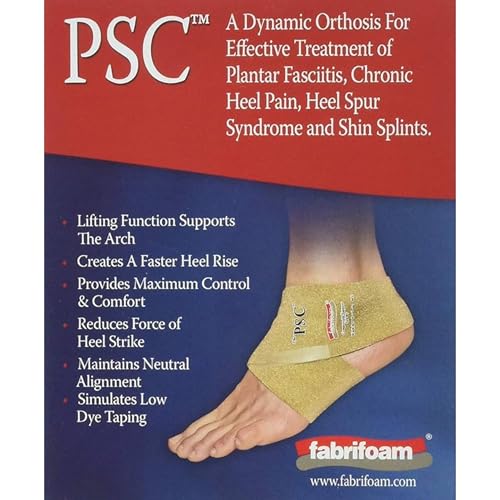
2. Pronation Spring Control (PSC) Ankle Wrap

Ultra-light 0.02 lbWear with sandals

A featherweight, shoe-friendly wrap that targets plantar fasciitis pain without the bulk.

You can wear it with sandals or any shoe. Several reviewers point out it made a “HUGE difference” for plantar fasciitis and heel spur pain. The design is a simple hook-and-loop wrap that applies adjustable compression and mild arch support, not a rigid stabilizer. It is meant for walking and daily wear, not for heavy cutting sports.

The honesty about its durability is important: one buyer reports “I wore it for about 10 days and it was destroyed.” This is a disposable-level product — cheap enough to replace, but not built for months of abuse. One user with a heel spur found it reduced pain when worn 8-10 hours a day. It is also one of the few options available in an extra-small size, which buyers praised for petite feet. If you need lateral ankle stabilization like the BioSkin TriLok provides, this wrap will not stop ankle rolling.

Light enough to forget

  • Weighs 0.02 lb — almost unnoticeable in any shoe
  • Fits with sandals, not just sneakers
  • Easy to clean and reusable if handled gently
  • Extra-small size available for narrow feet

Built for temporary use

  • Destroyed after ~10 days for one buyer — not a long-term brace
  • Only mild arch support, not for heavy pronation or sprains
  • No lateral ankle stabilization

Pick it if: you need cheap daily arch support for plantar fasciitis and want something invisible under sandals or flats.

skip it if: you need to stop ankle rolling or want a brace that lasts more than a few weeks.

Post-Injury Stabilizer

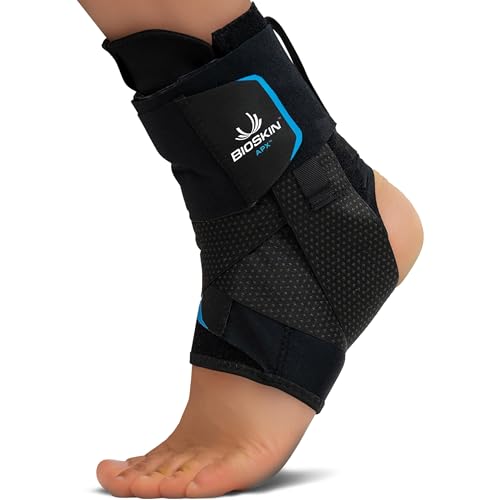
3. BioSkin APX Sprained Ankle Brace

No Lace Figure-8Rigid side straps

A no-lace, figure-8 wrap with rigid straps aimed at recovery from sprains, surgery, and chronic instability.

The APX uses rigid anti-roll straps that run along the sides of the ankle to block inversion and eversion (inward and outward rolling) — the exact motions that overpronation worsens. Unlike the TriLok, this one is built for a recovery phase: one buyer called it a “post-calcaneus surgery brace” that stabilized overpronation on uneven terrain and let them reduce pain meds. It also has a forefoot adjustment strap for a more custom fit than a basic wrap.

Reviewers report it provides solid side and rear support, but the instructions are unclear — one reviewer noted you need “an engineering degree to figure out how to put it on.” The dimensions (1.25 x 5.25 x 7 inches) make it significantly more compact than the bulky TriLok, but buyers still caution it fits best in athletic shoes, not narrow dress shoes. At 0.13 Kilograms it is versus the TriLok at 0.35 lb, but the slim side bars keep the profile flat enough for most sneakers and boots.

Strong recovery support

  • Rigid side straps prevent rolling and overpronation
  • Slim, flat side bars fit inside shoes and slippers
  • No-lace design is quick to tighten once you learn it
  • Bilateral — works on left or right foot

Setup frustration

  • Strap routing is confusing — poor instruction drawings
  • Some buyers find it too tight or hard to adjust
  • Not recommended for narrow or high-heel shoes

Who it works for: anyone recovering from a moderate sprain or surgery who needs anti-roll stability in a slim package that fits inside everyday athletic shoes. It is a better choice than the TriLok if you prioritize a slim profile over arch support.

One warning: if you are impatient with a learning curve, the strap system requires several tries to get right.

Maximum Stabilization

4. Bauerfeind CaligaLoc Ankle Brace

Pronation WedgePartial immobilization

A medical-grade splint with a built-in pronation wedge for serious ligament injuries and chronic instability.

The CaligaLoc is the most aggressive pronation fighter here because it has an integrated pronation wedge — a small lift under the heel that tilts the hindfoot to take pressure off the lateral ligaments (the ligaments on the outside of the ankle). On top of that, a rigid plastic splint extends over the base of the fifth metatarsal (the bone on the outer side of your foot) and is strapped down with four adjustable Velcro straps, creating partial immobilization. This is for ligament tears, post-operative recovery, or chronic ankle instability that a simple wrap cannot control.

The trade-off is size and convenience. Shoppers say it is “only helpful to walk around the house with socks on” because it does not fit inside any regular shoe. One 5’1″ user found the leg shaft uncomfortable and too long. One user whose spouse needs an ankle replacement called it a “miracle” for stabilization. At 8 ounces it is the heaviest pick, but that weight comes from the plastic splint and multi-strap system that physically block the ankle from rolling. One reviewer also noted that over-tightening caused lower leg swelling, so the fit is finicky. This brace is far bulkier than the BioSkin TriLok or the APX.

Uncompromising stability

  • Built-in pronation wedge specifically targets overpronation
  • Rigid plastic splint provides partial immobilization
  • Four adjustable straps for a precise, secure fit
  • Used for ligament tears, post-op, and chronic instability

Bulk and fit issues

  • Does not fit in any regular shoe — wear at home or with loose slippers
  • Leg shaft can be uncomfortable for shorter users
  • Over-tightening can cause lower leg swelling
  • More expensive — a premium investment

Who needs this: anyone with a torn ligament, chronic instability, or post-surgical needs who wants maximum pronation control and does not need to fit the brace inside shoes.

Who should pass: if you need a brace for daily walking or sports, the bulk and shoe incompatibility will make it impractical.

Understanding the Specs

Pronation Wedge

A pronation wedge is a built-in lift under the heel that tilts the back of your foot slightly outward. This takes stress off the lateral ligaments (outside ankle ligaments) and directly counteracts the inward-rolling motion of overpronation. You will only find this in high-end splints like the Bauerfeind CaligaLoc — it is a clinical feature for ligament injuries, not a daily-wear convenience.

Figure-8 Wrap vs. Standard Compression

A figure-8 wrap runs one strap around the ankle in an 8-shaped pattern, giving you targeted stability on both sides of the joint. Standard compression wraps just squeeze the whole area. If you are fighting pronation after a sprain, the figure-8 is better because it locks the ankle from rolling inward. If you only need mild arch support for walking, a basic wrap like the Pronation Spring Control is lighter and simpler.

FAQ

Will an ankle brace for pronation fit inside my regular sneakers?
It depends on the brace. Low-profile wraps like the Pronation Spring Control and slim designs like the BioSkin APX fit inside most athletic shoes. The BioSkin TriLok also fits in most cleats, trainers, and court shoes. The bulky Bauerfeind CaligaLoc does not fit in any regular shoe — it is meant for at-home wear or with loose slippers.
What is the difference between a pronation brace and a standard ankle brace?
A standard ankle brace mostly prevents you from rolling your ankle outward. A pronation brace specifically has a feature — like an arch-lift strap, a pronation wedge under the heel, or a medial support (a support on the inner side of the ankle) — that stops your foot from collapsing inward when you step. If you are treating overpronation, you need that specific feature.
Can I wear an ankle brace for pronation while playing sports?
Yes, but only if you pick a brace designed for sport. The BioSkin TriLok and the APX are both built for running, volleyball, basketball, soccer, and pickleball. The Pronation Spring Control is for walking only, and the Bauerfeind CaligaLoc is too bulky for most sports.
How long does a typical ankle pronation brace last?
It varies widely by build. The Pronation Spring Control is a lightweight wrap that some buyers report wears out after about 10 days of daily use. The BioSkin models (TriLok and APX) are made from nylon, lycra, and polyester with strong straps, and reviews suggest they hold up for months of regular wear. The Bauerfeind CaligaLoc, with its rigid plastic splint, is the most durable but also the most expensive.
Do I need a brace for overpronation if I already have arch supports in my shoes?
Arch supports lift your foot from below, but they do not stop the ankle joint itself from rolling inward. A pronation brace adds ankle-level control that orthotics alone cannot provide. For moderate to severe overpronation, especially after a sprain, a brace plus orthotics is a common combination recommended by podiatrists.
How do I figure out my correct size for a pronation brace?
Most braces use your regular shoe size as a guide. The BioSkin TriLok and APX have sizing charts based on shoe size. The Bauerfeind CaligaLoc also uses shoe size. Always measure the circumference of your ankle if the brand provides a circumference chart. Some braces, like the TriLok, have a learning curve with strap adjustment, so do not worry if the first fit feels off.
Is a figure-8 brace better for pronation than a lace-up brace?
A figure-8 brace creates targeted straps that cross the ankle joint in a pattern that directly controls inversion and eversion (inward and outward rolling) — the rolling motion of pronation. Lace-up braces provide even compression across the whole ankle but do not have the same directional pull. For pronation, a figure-8 design is generally more effective at stopping the inward roll.
Can I use an ankle pronation brace after surgery?
Yes, but only specific models. The BioSkin APX is explicitly used as a post-calcaneus surgery brace, according to buyer reviews. The Bauerfeind CaligaLoc is designed for post-operative recovery after ligamental suturing or reconstruction. Always check with your surgeon or physical therapist before wearing any brace after surgery to ensure it matches your recovery protocol.
Will a pronation brace help with plantar fasciitis?
It can, because overpronation often contributes to plantar fasciitis by putting extra strain on the arch. The Pronation Spring Control wrap and the BioSkin TriLok with its FootLok arch-lift strap are both reported by buyers to help with plantar fasciitis pain. If your heel pain is linked to your foot rolling inward, a pronation brace may provide relief.
Are pronation braces washable?
The BioSkin TriLok is hand wash only. The Pronation Spring Control is made from moisture-wicking ProWrap material that is washable and reusable. The BioSkin APX should be cleaned according to its care tag. The Bauerfeind CaligaLoc’s velour straps and foam padding can be spot-cleaned. Always check the specific product instructions, as machine washing can damage the straps and rigid components.

Final Thoughts: The Verdict

Across the board, the best ankle brace for pronation winner is the BioSkin TriLok because it combines a direct arch-lift for overpronation with a figure-8 stabilizer for lateral control, all in a package that fits inside athletic shoes and earned a 4.4/5 rating. If you want a cheap, invisible wrap for daily plantar fasciitis relief, grab the Pronation Spring Control Wrap. And for a post-surgery or chronic instability scenario where maximum stabilization matters more than shoe fit, the standout is the Bauerfeind CaligaLoc with its integrated pronation wedge.

How We Picked

We do not accept paid placement. Every pick is matched to a real buyer and a real use-case; we do not hands-on test units.

Sources & Methodology

Specifications: manufacturer listings and product documentation. Review insights: verified customer reviews, as of July 2026. Pricing: not shown on this page (it changes often); check the current price via the retailer link.

As an Amazon Associate, Gadgets Feed earns from qualifying purchases. This does not affect which products we feature.

Related Guides

Please use a real email you check. If it's fake or mistyped, your message won't reach us and we can't reply — wrong addresses are rejected automatically.