
Our readers keep the lights on and my morning glass full of iced black tea. As an Amazon Associate, I earn from qualifying purchases.
Specs are compiled from manufacturer listings and verified buyer reviews and can change over time — please confirm the key details on the product page before buying.
An ankle brace for tendonitis has one job: hold the joint steady enough that a swollen tendon can calm down while you keep walking, working, and playing. Squeeze too light and the pain flares back up; squeeze too hard and you cut off circulation. The picks below split cleanly into lace-up braces that lock the ankle and compression sleeves that hug the tendon, so you can match the brace to your day rather than guessing.
I’m Min — the founder and writer behind Gadgets Feed. This guide is built by comparing the manufacturers’ published specifications and the patterns across verified customer reviews, so you get each pick’s real strengths and trade-offs instead of marketing spin.
Two braces can both feel snug, yet only one keeps a sore tendon from getting re-injured. What separates a real ankle brace for tendonitis from a sleeve that just feels tight depends on three things: how rigid it is, where the straps sit, and how much room it takes up in your shoe. Below you’ll see how each of those changes what a brace can do, plus the fit traps that send people back to the size chart.
Our Picks at a Glance

How To Choose The Best Ankle Brace For Tendonitis
Peroneal tendonitis sits on the outside of the ankle, Achilles tendonitis sits at the back, and plantar fasciitis pulls at the arch — so the location of your pain should steer which brace shape you buy. Decide what you need the brace to do before you shop: stop the ankle from rolling during sport, cushion a specific tendon during walking, or simply keep steady compression on all day.
Lace-up with stabilizers versus a pull-on sleeve
If your ankle has rolled before, or you are easing back into sport, a lace-up brace with plastic or foam side stays is the pick — those stays (firm strips down each side) lock the joint against the sideways motion that strains a tendon. A pull-on sleeve sits closer to the skin and slides into shoes with almost no bulk, so it suits long days on your feet and mild tendon irritation rather than instability. Many of the strongest picks here combine both, pairing a stretchy sock with a wrap-around strap you can tighten or loosen as swelling changes.
Fit is where most returns happen
Ankle braces are sized in three different ways: by shoe size, by ankle circumference, and occasionally by both — so always check the specific chart on the page rather than assuming your sneaker size transfers. A brace that is a touch too tight will dig into the tendon when your ankle swells, while one that is a touch too loose slides down mid-stride. If you land right at the top or bottom of a size range, that is the moment to read the sizing notes carefully rather than guess.
Quick Comparison
| Model | Best For | Support Style | Weight | Closure | Amazon |
|---|---|---|---|---|---|
| ZAMST A2-DX★ Best Overall | Heavy sprains and chronic instability in sport | Lace-up with side stabilizers | 5.44 oz | Velcro strap | Amazon |
| Sleeve Stars Ankle SupportBest Value | Everyday tendon compression and all-day wear | Compression sleeve with strap | 2.12 oz | Adjustable strap | Amazon |
| ZOELION Ankle BraceBest Everyday Comfort | Plantar fasciitis and Achilles support in shoes | 3D knit sleeve with fishnet strap | — | Pull-on with X-strap | Amazon |
| ProCare Stabilized Ankle Support | Lace-up stability that fits inside work shoes | Lace-up with stays | 5.64 oz | Lace and strap | Amazon |
| Fitomo Ankle Brace | Adjustable figure-8 support for recovery and sport | Figure-8 with removable splints | — | Hook & Loop | Amazon |
| Med Spec ASO Speed Lacer | Fast lace-up compression for practices and shifts | Speed lacer with figure-8 straps | 5.6 oz | Hook & Loop, Lace-Up | Amazon |
| DonJoy Stabilizing PRO | Durable low-profile bracing for long shifts | Lace-up with removable stays | 5.6 oz | Lace and elastic strap | Amazon |
| Neo-G Achilles Tendon Support | Achilles tendon cushioning during rehabilitation | Compression sleeve with silicone insert | 0.08 kg | Pull On | Amazon |
| BioSkin TriLok | Arch and ankle supported together for PTTD | Arch strap plus figure-8 wrap | 6.4 oz | Figure-8 | Amazon |
In‑Depth Reviews
1. ZAMST A2-DX Ankle Brace
Our pick — over 4.5★ from 500+ verified ratings; the strongest balance of quality and price.
The built-in side stabilizers that keep a rolling ankle from ever reaching the point of a twist.
If your tendonitis came from repeated ankle rolls on a court, this is the brace that stops the roll in the first place. The ZAMST A2-DX pairs a lace-up shell with rigid side stabilizers, and those stays are the reason owners treat it as protection rather than padding. It weighs 5.44 ounces, so it is the heavier end of this group — but that weight is what makes the joint feel fenced in.
Support is clearly the headline here, and quality sits right behind it in owner feedback. Basketball players are the loudest fans: the brace is built to sit inside basketball shoes and hold the ankle against the twisting that a torn or strained peroneal tendon cannot handle. A size 12 shoe wearer advises going half a shoe size up when wearing it, which matters if you plan to play in it rather than wear it around the house. One buyer’s verdict on why it’s worth the money: “I use these everytime I play bball.”
The honest trade-off is comfort and putting it on, which owners call mixed: the rigid shell supports hard, but it is not a pull-on. You thread laces and set straps, and you should not crank them so tight that the tendon area presses. There is also a left and a right version, so ordering the correct foot is on you. A parent buying for a 10-year-old basketball player solved the wet-feet problem by unlacing the top two slots, getting the foot in, then relacing for support — worth knowing before you decide it is too fussy.
What players get
- Rigid side stabilizers resist the inversion that strains tendons
- Right/left-specific sizing gives a closer, more secure fit
- Fits inside athletic shoes for basketball and volleyball
- Support and quality are the two things owners praise most
What to expect
- Dye from socks can bleed into the white fabric
- Lacing and strapping takes more time than a slip-on sleeve
- Ordering for the wrong foot is an easy mistake
- Not the brace to buy if you want instant on-and-off
Best fit for: anyone who has rolled an ankle more than once and wants the joint locked against repeat twisting during sport.
Think twice if: you want a brace you can throw on in two seconds flat — this one rewards a proper lacing routine.
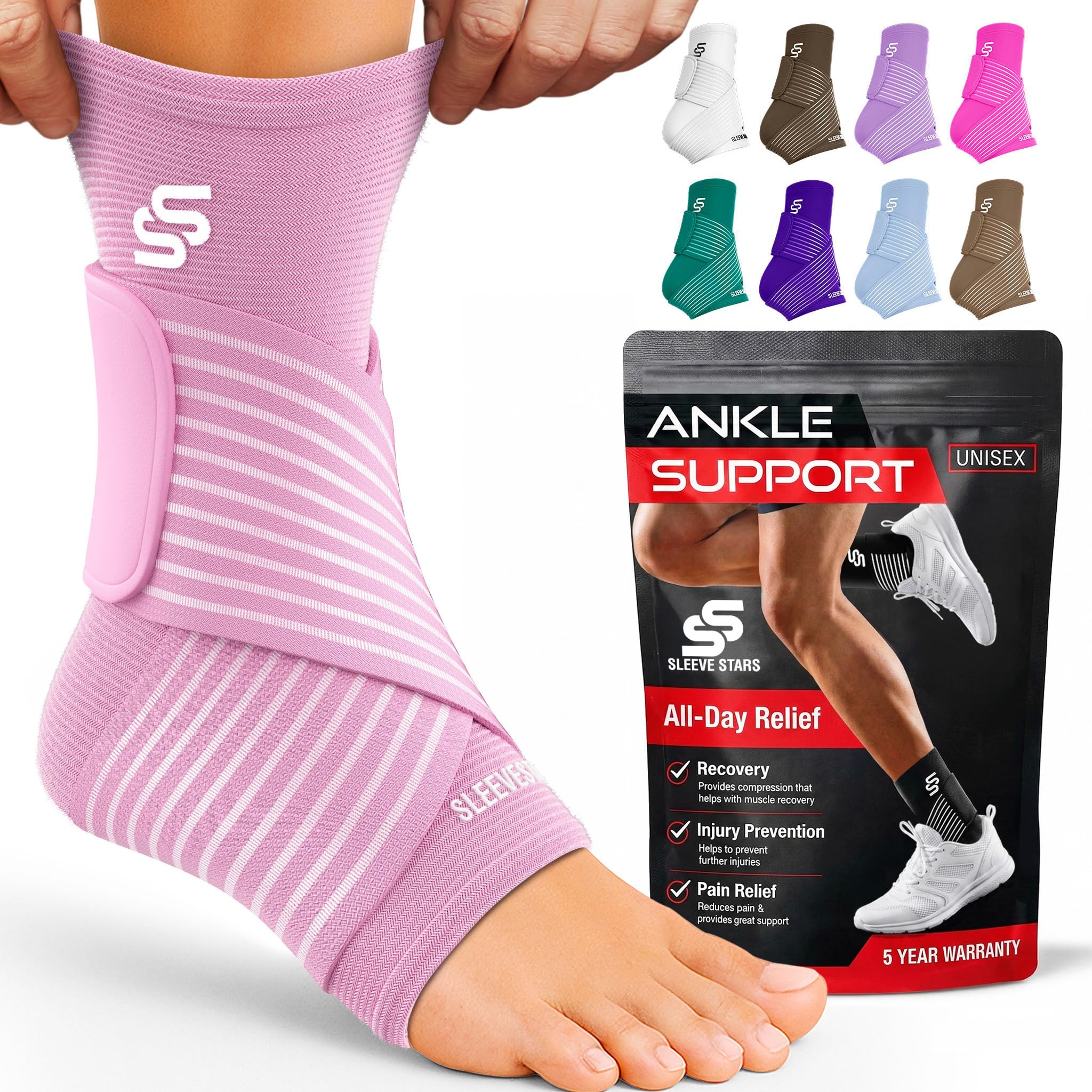
2. Sleeve Stars Ankle Support
A two-piece compression sleeve and strap that slips into shoes and disappears — until you need it.
The Sleeve Stars splits into a sock and a separate adjustable strap, and that two-part design is the trick that makes it work on a tendon. The sock compresses, the strap is where you dial support for a walk, a shift, or a run. At 2.12 ounces it is the lightest pick on this list, which is exactly why it fits in normal shoes without making you size up. A buyer recovering from a bad sprain wore it in size 9 shoes and called it easy to put on.
Compression and support are the points owners keep returning to on this one, and it pulls double duty for plantar fasciitis and heel spurs alongside general tendon complaints. It also nudges ahead of the ZAMST on weight — 2.12 ounces against 5.44 — so if in-shoe bulk is your sticking point, that gap is the reason to lean this way. An Achilles tendinitis user wore it eight hours a day with noticeable relief, and another wearer found the positionable strap more supportive than a plain slip-on sleeve.
It comes as a single, not a pair — the one thing that catches people out, since the listing photo can read like two. The other honest note is durability, where feedback splits: some keep it going for a long stretch, others report it giving out faster under heavy daily use. And if you have sensitive skin, wear it over a thin sock; the raised logo has caused irritation for at least one wearer who had to remove it.
Why it wins on value: genuinely adjustable compression, lightest build here, easy to wear all day without switching shoes.
Before you buy: it ships as one unit, so order two if you want a spare or a matched set.
Take this one if: you want discreet, all-day tendon compression that fits under your regular shoes without a lacing ritual.
Pass if: you need firm anti-roll structure for sport — a sleeve will not stop a hard twist the way a braced shell does.
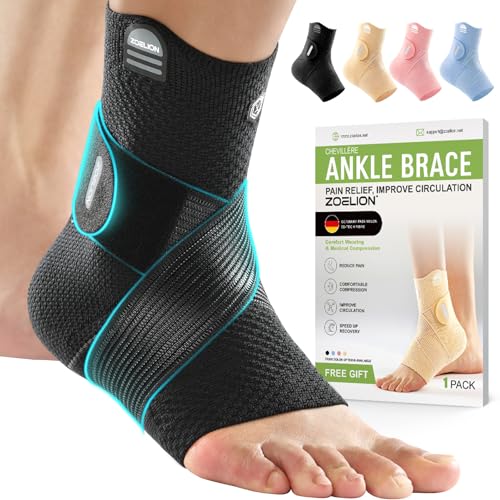
3. ZOELION Ankle Brace Compression Support
A knit sleeve with three compression zones and a strap you can add or pull when the tendon complains.
The ZOELION is where fit and comfort get the most attention, and the construction explains why. It uses a 3D-knit fabric split into three zones: a soft area across the instep, firmer compression hugging the arch and heel, and finished edges designed not to dig or slip. A removable fishnet strap adds arch and Achilles support when you want it, and slides away when you do not. Owners call it comfortable with the right amount of compression, and the design stays low enough to wear without buying bigger shoes.
Pain relief is what this brace is bought for, and buyers report it lands. A long-suffering plantar fasciitis case felt relief after weeks of pain, and a runner who had returned several other braces kept this one. If you need it to survive sweat and repeat washing, the knit holds its shape and support after laundering. The top pull-tabs on both sides make it easier to work on, which sounds minor until your hands are the thing that hurt too.
The catch shows up in two places. In tight work boots the thickness can press enough to feel like it is cutting off the foot, so it is best matched to running shoes or roomier footwear. And a few owners feel it bind across the top of the foot — note if you have a high instep or a sensitive spot there. For everything from mild sprains to arthritis and Achilles tendonitis, this is a comfortable middle ground rather than a rigid locker.
Wins people over
- Three-zone knit targets compression to the arch and heel
- Removable strap lets you add support on demand
- Stays put all day without sliding or bunching
- Holds its shape and support after washing
Worth knowing first
- Too thick for snug work boots in some cases
- Can bind across the top of the foot
- A sleeve, not rigidity for serious instability
- Single unit, so ordering a spare is a separate buy
Good buy for: daily wearers with plantar fasciitis or Achilles discomfort who want comfort first and a strap for bad days.
Reconsider if: you live in tight work boots or need maximum anti-roll structure under high-impact sport.
4. ProCare Stabilized Ankle Support Brace

A lace-up workhorse with removable stays that fits either foot and slides into real shoes.
Support is what the ProCare is built around, and it delivers that with a lace-up frame plus removable articulated medial and lateral stays — the strips that add side-to-side stability. A full circumferential elastic strap wraps the whole thing and applies tibia/fibula compression, which is the pressure that helps a strained tendon at the ankle feel steadier. It is constructed from 800D ballistic nylon with a reinforced eyelet area, so the lacing points are the part designed to take the abuse.
It fits either the left or right foot, which helps if both ankles have taken turns giving you trouble. Buyers recovering from torn ligaments report wearing it all day at work without issues. It also sits well behind the other ankle brace here for fitting shoes rather than dominating them. If a bulky brace has kept you out of your normal footwear, this is the one to note — the low-profile design was made for that problem.
The recurring friction point is getting it on and off by yourself, which owners describe as mixed: the lace-and-strap sequence takes learning, and there is a specific order to the long laces, two side straps, and the ankle strap. Durability is also a mixed note, with owners reporting roughly a year and a half of life from it. Get the sequence down and it becomes a reliable daily piece; fight it and you will dread it.
The pitch: strong lace-up stability that actually fits inside shoes, with side stays you can pull out when you want less rigidity.
Plan around this: the multi-strap sequence is fiddly the first few times — learn it once and it stops being an issue.
Pick it if: you want hospital-style lace-up support you can wear during a full workday and swap between feet.
skip it if: you want a single-motion brace you can throw on and off without thinking.
5. Fitomo Ankle Brace with Removable Side Splints
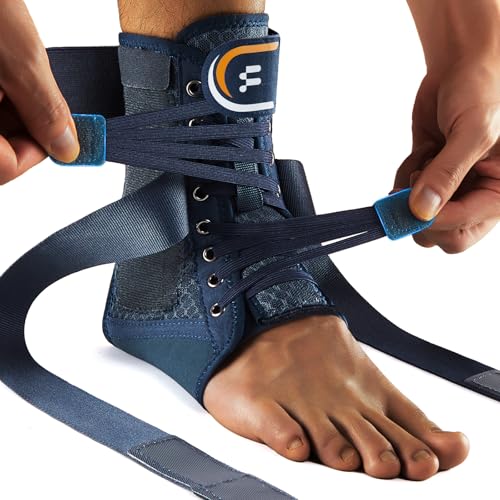
A figure-8 strap you can loosen for the office and tighten for the court, splints and all.
What sets the Fitomo apart is how much of its support you can dial in or dial out. A figure-8 strap wraps the ankle and lets you fine-tune compression, two removable side splints add rigidity for recovery days, and a top strap locks everything down. Take the splints out and it softens into something you can wear for ordinary days without feeling armored. The blend is polyester, nylon, and plastic, and owners describe the fit as precise — the size chart is called accurate, and it slips into workout shoes and casual flats without bunching under the heel.
Buyers praise the build quality and the fit most, and the value comes up repeatedly, since people are comparing it to far bulkier protective boots. One kitchen worker wore it through 10 to 12 hour shifts and felt relief after a single day, still holding up roughly a year later. If you sweat in it, the material breathes rather than cooking the ankle.
Two things to know. The side splints are rigid by design, so if you want a totally soft hug, this is not that — the splints are the point. And a kitchen-shift wearer found the stitched edges caused blisters against ankle socks, so taller socks solve it. It is firm support, not immobilization, so it suits tendonitis that needs control without a locked joint.
What stands out
- Figure-8 strap fine-tunes compression activity by activity
- Removable splints flip between recovery rigidity and daily flex
- Accurate sizing and a low profile that fits most shoes
- Breathable materials keep sweat down during long wear
Keep in mind
- Stitched edges can rub against ankle socks
- Rigid splints may feel like too much for very mild cases
- Hand wash only, so it needs a little care
- Not designed for full immobilization
Best for: anyone whose support needs change from hour to hour — loose for the desk, tight for the gym.
Look elsewhere if: you want a soft, unstructured sleeve or you need rigid immobilization after a severe injury.
6. Med Spec ASO Speed Lacer Ankle Stabilizer

The speed-lace brace for when you need locked-in support in seconds, mid-practice not mid-fuss.
The ASO Speed Lacer answers a very specific problem: you want lace-up support but you do not want to tie laces. Its quick-pull hook and loop closure tightens evenly in seconds, and the figure-8 stabilizing straps secure the heel against inversion and eversion — the sideways motions that strain ankle tendons. The oversized finger loops let you dial tension one-handed, which is useful when swelling changes and you need to micro-adjust without stopping what you are doing.
Support leads owner praise by a wide margin, with ease of use right up there, and the two are linked: because the closure is so quick, people actually use it consistently. It is bilateral, so it fits either ankle, and it works for basketball, volleyball, soccer, football, pickleball, tennis, running, and gym sessions. A user recovering from a broken leg above the ankle walked and drove in it pain-free. Compared with the DonJoy above it, the tongue is less bulky and the emphasis leans toward speed and repeatable compression.
Sizing is where the complaints cluster. The brace runs on a cusp for some people, and one owner between small and medium sized down and found it fit better than sizing up as the chart suggested. It is not fully rigid either — it stabilizes and prevents rolling like a high-top, but it is not an immobilizer, so it will not lock the joint flat. Wear a sock underneath to manage that.
Why it stands out: even, repeatable compression from a one-handed pull, so you can tighten or loosen without re-tying anything.
Watch the sizing: if you sit between two sizes, that choice — not the brace itself — decides whether it feels right.
Choose it if: you want reliable lace-up support you can put on quickly and adjust as the day goes.
Not for you if: you need a truly rigid, immobile joint lockdown after a major injury.
7. DonJoy Stabilizing PRO Ankle Brace

A low-profile shell with removable stays that survives hospital shifts and still fits your shoes.
DonJoy’s Stabilizing PRO is aimed at people who need firm support for hours on their feet, not just a game. It uses 800D ballistic nylon with a reinforced eyelet area — the same durable build language as the ProCare above — and it carries removable articulated medial and lateral stays. Those stays are described as enhancing proprioception, which in plain terms is your body’s sense of where the ankle is, the feedback that helps you catch a roll before it becomes a strain. A full circumferential elastic strap adds tibia/fibula compression around the joint.
Owners lean on two strengths here: effectiveness and quality. The durability holds up under serious use — people with posterior tibial tendon dysfunction (PTTD, a worn or torn tendon that supports your arch), including one owner who is a severe case, replace it roughly every one to one and a half years while wearing it for 12-hour hospital shifts. It fits in all shoes with the right sock thickness, and it wears on either foot. Stability is what it is bought for — keeping the ankle from rolling during movement.
The fair caveat is comfort and putting it on, where feedback is mixed. The multi-step lace, figure-8, and ankle-strap routine takes patience, and it may need readjusting as swelling changes. A heavy-use wearer also found the heel binding could dig and the Velcro straps could wear at sneaker lining. None of that undercuts its job — it is simply a brace you learn to live with rather than a throw-on.
Built for real wear
- Ballistic nylon and reinforced eyelets take daily abuse
- Removable articulated stays add or reduce rigidity
- Low profile fits inside shoes without changing fit
- Bilateral design works on either ankle
The honest downsides
- Multi-strap routine takes time to put on and adjust
- May need re-tightening as swelling shifts
- Heel binding can dig for some wearers
- Velcro can scuff up sneaker lining over time
Right for: long-shift wearers and chronic instability cases who want premium, durable support that still slips into shoes.
Not right for: anyone who wants a fast pull-on they can shed in seconds.
8. Neo-G Achilles Tendon Support

A pull-on sleeve with a silicone cushion built right over the Achilles, where it does the most good.
If the pain sits at the back of your ankle rather than the sides, the Neo-G is shaped for exactly that spot. A silicone tendon cushion sits over the Achilles to add support and ease pressure during daily movement, and the sleeve is knitted from breathable fabric blended with polyamide, polyester, elastane, polyurethane, and cotton. It pulls on rather than lacing, and it wears on either the left or right ankle. The maker describes a Multi Zone Compression, which means the pressure is graded around the ankle rather than even.
Owners prize comfort and quality most, and the fit earns its own share of praise. One user wore it up to eight hours without pain, and reviewers call the sleeve slim enough to wear with most shoes. The application sock included in the box helps you pull it on smoothly, and the material helps move moisture so it does not sit damp against your skin.
The one thing to weigh is that a cuff-style sleeve supports soft tissue rather than locking a joint — a wearer aiming for firmer heel hold felt it did not press as much as expected. It is covered by a specific care routine too: hand wash cold, no fabric softener, dry flat, no tumble drying, bleaching, ironing, or dry cleaning. Treat it that way and the knit keeps its stretch.
Where it shines: targeted Achilles cushioning in a breathable, lightweight sleeve that disappears under most shoes.
Keep in mind: it is soft support, so it will not deliver the firm joint hold of a lace-up brace.
Reach for this if: your Achilles is the tender spot and you want cushioning you can wear all day without fuss.
Think twice if: your ankle rolls and you need firm anti-roll structure, or you want a machine-washable piece.
9. BioSkin TriLok Ankle Brace

The brace that supports your arch and your ankle together, not as two separate problems.
Most braces here treat the ankle as the whole story; the TriLok argues the arch is part of it. A FootLok strap lifts and supports the arch while a figure-8 wrap stabilizes the ankle, so the foot and joint are held together instead of separately. That is the design that separates it from a plain compression sleeve, and it is why people with plantar fasciitis and posterior tibial tendon dysfunction gravitate toward it. It weighs 6.4 ounces, the heaviest pick here, and it is built from nylon and Lycra.
Support is what owners value most, and quality sits right behind it — some describe it as a lifesaver for repeated sprains. It wears on either foot and can be strapped to control rolling inward or outward, which suits PTTD, plantar fasciitis, and Achilles tendonitis alike. A podiatrist-prescribed user said it matched the professional version they were shown at a fraction of the cost, lasting about a year of daily use. It runs by shoe size rather than ankle circumference, which is a different approach from most of this list.
Here is the honest part, and it is the loudest theme in owner feedback: there are four straps and a specific wrap path, and it takes a few wears to learn. Several owners needed the video before it clicked, and Velcro straps that stick together make the first tries frustrating. There are also rare fit notes — a seam that presses on the arch for one wearer, and a size chart that ran off for another (that buyer found the large fit wide feet better than the medium) — which is why checking the shoe-size chart before ordering matters here more than anywhere else on this list.
The case for it
- Arch-lift strap plus figure-8 wrap support foot and ankle together
- Wears on either foot and controls inward or outward roll
- Low profile fits trainers, flats, boots, and cleats
- Hypoallergenic, breathable nylon and Lycra build
The learning curve
- Four straps and a specific wrap path take practice
- Velcro straps can stick together while applying
- Sized by shoe size, so the chart matters
- Rare reports of a seam pressing on the arch
Worth it for: people with PTTD, plantar fasciitis, or repeated sprains who want the arch and ankle addressed as one unit.
Consider a simpler brace if: you know you will not invest the several tries it takes to master the wrap.
Understanding the Specs
Rigidity and side stabilizers
Rigidity is how much a brace resists sideways motion — the twisting that strains a tendon. Lace-up braces with side stays, like the ZAMST and DonJoy, hold the joint more firmly and suit people who roll their ankles. Pull-on sleeves and knits, like the Neo-G and ZOELION, offer softer support better suited to comfort and all-day wear. Match rigidity to your activity: firmer for sport, softer for work and recovery.
Compression and weight
Compression is the gentle squeeze that helps a swollen tendon feel supported, and adjustable straps let you dial it as swelling changes. Weight tells you how it will feel in a shoe — an ankle brace can run from a feathery sleeve like the Sleeve Stars at 2.12 ounces up to a heavier structured build like the BioSkin TriLok at 6.4 ounces. Lighter means less noticeable underfoot; heavier usually means more structure.
FAQ
Will an ankle brace fit inside my regular shoes?
Do I need a lace-up brace or a compression sleeve for tendonitis?
How do I size an ankle brace correctly?
Can I wear an ankle brace all day at work?
Which brace is best for Achilles tendonitis specifically?
How long should an ankle brace last?
Are these braces washable?
What is the difference between a figure-8 brace and a straight lace-up?
Can I wear the same brace on either ankle?
Will a brace stop my tendon from rolling during basketball?
Final Thoughts: The Verdict
For most people chasing tendon relief, the ankle brace for tendonitis winner is the ZAMST A2-DX because its rigid side stabilizers stop the ankle roll that keeps re-injuring a strained tendon, and it is built to fit inside your game shoes. If you want light, all-day compression that vanishes under normal footwear, grab the Sleeve Stars Ankle Support. And for plantar fasciitis or PTTD, where the arch and ankle need holding together, the BioSkin TriLok is the one to reach for.
How We Picked
We do not accept paid placement. Every pick is matched to a real buyer and a real use-case; we do not hands-on test units.
Sources & Methodology
Specifications: manufacturer listings and product documentation. Review insights: verified customer reviews, as of September 2026. Pricing: not shown on this page (it changes often); check the current price via the retailer link.
As an Amazon Associate, Gadgets Feed earns from qualifying purchases. This does not affect which products we feature.