
Our readers keep the lights on and my morning glass full of iced black tea. As an Amazon Associate, I earn from qualifying purchases.
Specs are compiled from manufacturer listings and verified buyer reviews and can change over time — please confirm the key details on the product page before buying.
The biggest pain with ankle guards is simple: you need real support to prevent re-injury, but most braces are so bulky you can’t fit your foot back into your shoe. The result is either you go without protection or you walk around in one shoe with the other foot bare. The picks here solve that conflict — each one proves you don’t have to choose between genuine stability and wearing your normal footwear.
I’m Min — the founder and writer behind Gadgets Feed. This guide is built by comparing the manufacturers’ published specifications and the patterns across verified customer reviews, so you get each pick’s real strengths and trade-offs instead of marketing spin.
After studying the owner experience across hundreds of ratings and reviews for nine of the top-rated models, this is the definitive guide to the ankle guards that actually work for daily wear, sports, and recovery without forcing you to change how you dress.
Our Picks at a Glance
How To Choose The Best Ankle Guards
Picking the right ankle guard depends on understanding what level of stability you actually need and what your daily routine looks like. A runner with chronic instability needs something very different from someone recovering from a grade-2 sprain who just wants to walk without pain. Here are the three things to get right.
Support Level: Sleeve, Figure-8, or Lace-Up Stabilizer
The lightest option is a compression sleeve — it provides even pressure to reduce swelling and improve circulation, but it does not prevent your ankle from rolling. A figure-8 strap wraps around the heel and across the instep to resist inversion (the rolling motion that causes most sprains). For the highest level of protection, a lace-up stabilizer with removable plastic side stays gives you rigid lateral support that comes closest to athletic taping.
Profile Thickness: The Real Shoe-Fit Decider
This is the category’s most overlooked spec. A standard ankle brace can add 5-8mm of material around the ankle, which forces you to size up your shoes or wear looser footwear. A thin-profile brace like a 1.5mm design slides into snug sneakers, dress shoes, and even work boots without altering your normal fit. Measure the space inside your typical shoe before you buy.
Adjustability: Velcro vs. Pull-On vs. Lace-Up
Hook-and-loop closures (Velcro) let you dial tension precisely as swelling changes throughout the day. Pull-on sleeves are the easiest to put on but offer zero adjustability. Lace-up designs provide the most even, customizable compression from bottom to top, but they take the longest to fasten. If you plan to wear the guard for full workdays or through multiple sports sessions, adjustability matters more than speed of application.
Quick Comparison
| Model | Best For | Thickness / Profile | Support Type | Number of Items | Amazon |
|---|---|---|---|---|---|
| Fitomo 1.5mm Ultra Thin★ Best Overall | Invisible daily wear | 1.5mm | Figure-8 | 1 | Amazon |
| Fitomo Quick Lace UpTop Performer | Sports with flexible support | Moderate | Lace-up with removable stabilizers | 1 | Amazon |
| Med Spec ASO Speed LacerSpeed Pick | Fast lace-up for athletes | Low-profile | Lace-up with figure-8 | 1 | Amazon |
| JIUFENTIAN Ultra-Breathable Copper | Budget multi-pack value | Thin knit | Figure-8 / Sleeve | 2 | Amazon |
| ACE Ankle Brace with Side Stabilizers | Bilateral lateral support | Moderate | Stabilizer / Wrap | 1 | Amazon |
| AGPTEK Lace Up Stabilizer | Quick 1-second fastening | Moderate | Lace-up with side stabilizers | 1 | Amazon |
| Aircast Air-Stirrup | Medical-grade acute injury | Moderate | Air-cell stirrup | 1 | Amazon |
| WHCOOL Slim-Fit Brace | Cool air fabric + auto-shaped pads | Slim | Lace-up with auto-shaped pads | 1 | Amazon |
| Bauerfeind MalleoTrain | Premium medical-grade recovery | Low-profile knit | Compression with massage pads | 1 | Amazon |
In‑Depth Reviews
1. Fitomo 1.5mm Ultra Thin Ankle Brace
Our pick — over 4.5★ from 250+ verified ratings; the strongest balance of quality and price.
The guard so thin it disappears under your socks while still catching every roll.
This is the pick for anyone who has ever bought an ankle brace and then had to leave their sneakers unlaced because the brace was too thick. At 1.5mm of microfiber fabric with a visible ventilation grid, this Fitomo brace is thinner than most compression socks — and its entire build is engineered to let you wear any shoe normally. The figure-8 strap wraps the instep and heel to resist inversion, while an inner silicone grip keeps everything from sliding around. What wins people over is the combination of near-invisible support and the satisfaction of not having to change footwear at all.
Buyers report the elastic cross-strap stretches over 3-4 months of near-daily use but remains functional. The only real trade-off is that the thin material can feel warm in hot climates; a few owners recommend removing it periodically to let the foot air out. Still, the crowd favorite consensus is clear: this is the best ankle brace owners say they have ever had for the balance of support, price, and the fact that it actually fits inside your sneakers.
Why It Dominates
- 1.5mm thickness is virtually undetectable under socks and fits all shoe types from running shoes to work boots
- Figure-8 strap and inner silicone grip work together to prevent rolling without restricting normal motion
- Over 30 owners praise the support level — the most-discussed feature by a wide margin
The Only Heads-Up
- Thin design can get warm in hot climates; occasional removal helps
- Elastic strap stretches noticeably after several months of near-daily wear
Reach for this if: you need a daily ankle guard you can forget you are wearing — one that slips into any shoe without forcing a compromise on stability.
Look elsewhere if: you need rigid lateral stays for post-surgery immobilization or you live in a very hot climate and plan all-day wear without removing the brace.
2. Fitomo Quick Lace Up Ankle Brace with Removable Stabilizers
More support than braces twice the price, with stabilizers you can pull out when you don’t need them.
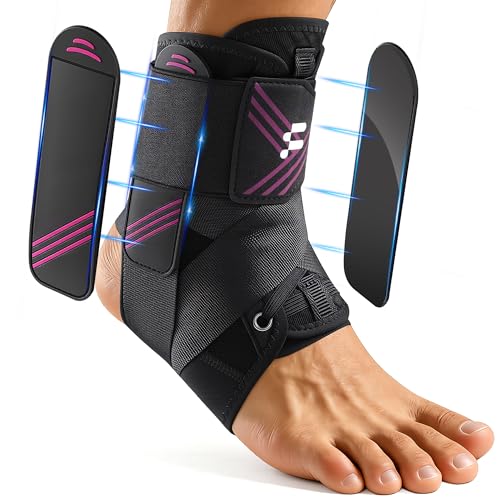
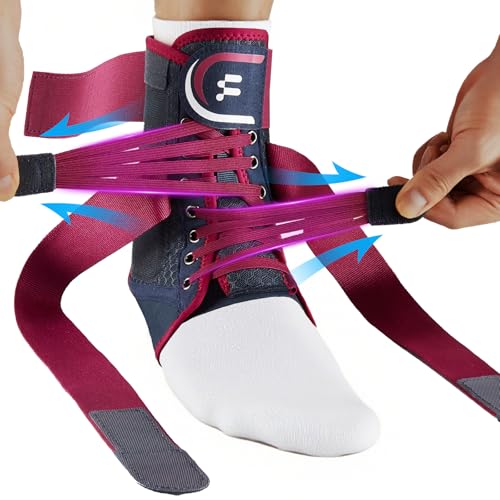
Where the 1.5mm Fitomo is the invisible everyday guard, this is the heavy-lifting cousin for active recovery. Its Triple-Lock system combines a top compression strap, dual removable side stabilizers molded from plastic, and crossing straps that create a figure-8 pattern. The defining trick is those removable stabilizers — keep them locked in for volleyball or basketball to resist side-to-side rolling, or pop them out for daily walking when you want a lighter feel. The crowd favorite consensus is that this brace provides more support for a painful ankle than many other braces.
The Velcro has held up well after 6+ months of daily use according to owners, and the brace stays secure without needing constant readjustment during basketball or long work hours. The most discussed feature is support with well over 60 owners singling it out. The honest trade-off is bulk — at moderate thickness it is fine for athletic shoes but will feel snug in very tight dress shoes. It is also sold as a single unit. For anyone recovering from a sprain who wants one brace that scales from rehab back to sport, this is the middle ground that works.
What Stands Out
- Triple-Lock system with removable stabilizers covers recovery through high-intensity sport in one brace
- Owners mention it stays in place during basketball and workouts without slipping or shifting
- Support is the most-praised aspect — buyers consistently call it superior to more expensive options
The Catch
- Moderate profile may not fit inside very tight flats or narrow dress shoes
- Pack contains only one brace; if you need two, expect to buy a second unit
Ideal for: the active person who wants a single brace that transitions from recovery walks to weekend pickup games without buying two different products.
Better to skip if: you need an ultra-thin profile for formal shoes or you expect two braces in the box.
3. Med Spec ASO Speed Lacer Ankle Stabilizer
Your ankle gets taped-level support in the time it takes to pull a zipper.
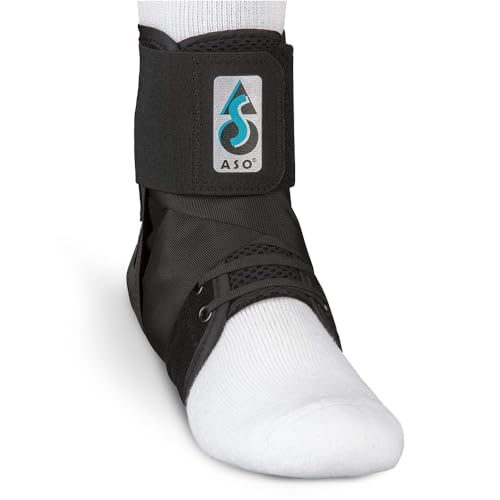
The ASO Speed Lacer solves the biggest frustration with traditional lace-up braces: the time it takes to get them on. A quick-pull hook-and-loop closure tightens the laces evenly in seconds, then figure-8 stabilizing straps lock the heel down to resist inversion and eversion. Podiatrists and physical therapists frequently recommend this design for post-fracture recovery, and athletes use it as a taping replacement because it provides a repeatable level of compression every time you put it on — no guesswork, no re-tying mid-practice. It weighs just 5.6 ounces, so you barely feel it during drills, travel, or long shifts on your feet.
The bilateral build fits either ankle, and customers note that a single wrap with a sock underneath prevents any rubbing or irritation. For comparison, the Speed Lacer sits noticeably lower-profile than the Aircast Air-Stirrup but provides significantly more lateral stability than a simple pull-on sleeve. The honest limit: it is not designed for full immobilization — it allows natural ankle flexion, which is great for sport but not for strict post-surgery rest. If you need even compression across the whole ankle without the bulk of standard lace-ups, this is the proven tournament-day choice.
The defining edge: the quick-pull lacing delivers consistent compression in seconds — owners coming back from severe sprains say it got them back to work on day three.
One honest note: because it allows natural flexion, this brace is for active stabilization, not for rigid post-operative immobilization.
4. AGPTEK Lace Up Ankle Stabilizer
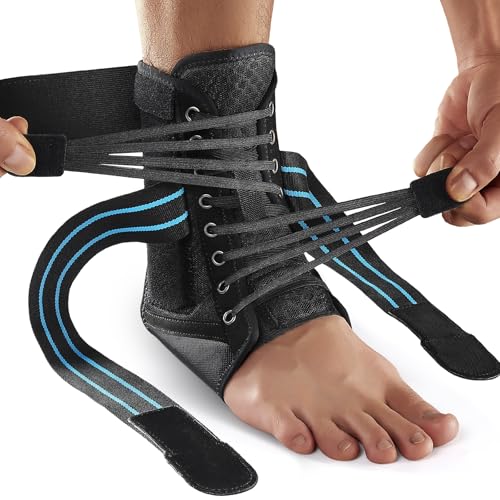
A lace-up stabilizer that fastens in one second — no more fumbling with tangled laces.
The AGPTEK brace packs what you’d expect from a premium lace-up design — reinforced dual side stabilizers, X-cross compression straps, and a top wrap for full 360-degree support — but adds a quick-lace system with dual-direction hook-and-loop fasteners that secures the brace in about a second. The removable lateral splints let you choose between rigid protection during rehabilitation or flexible mobility for sports. Owners coming off ankle fractures say the quality actually beats the brace their doctor provided, with stronger Velcro that stays grippy after weeks of daily use.
The standout here is that the slim design fits inside shoes more easily than most lace-up stabilizers, though reviewers point out that if you have a wide foot or significant swelling, you should size up. The most-praised feature is support, with over a dozen owners highlighting how the figure-8 strap and side stays prevented rolling during pickleball and hiking. The recurring sizing note is honest: the large runs slightly small, fitting a 13-inch ankle and size-9 shoe well but leaving larger builds wanting more room. For the price, it delivers a level of stability that rivals medical-office braces.
The big win: a 1-second fastening system that puts this ahead of traditional lace-up braces in daily convenience — owners call it the best lace-up brace they have owned for the money.
Who should size up: if your ankle measures on the upper edge of a size range or you anticipate swelling, go one size larger than your usual fit.
5. Bauerfeind MalleoTrain Ankle Support Brace
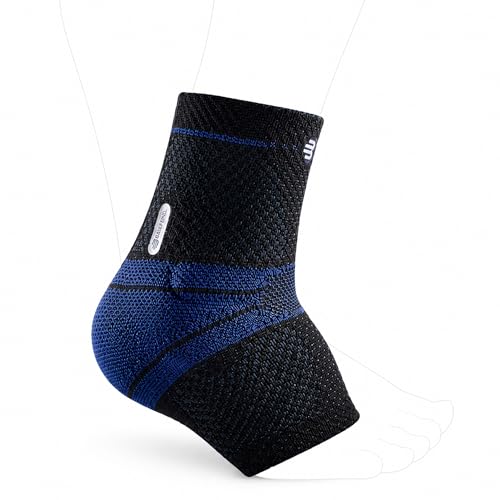
German-engineered compression that massages the joint as you move — without a single strap.
Everything about the MalleoTrain is different from standard braces. There are no Velcro straps, no laces, no plastic side stays. Instead, a smooth medical-grade compression knit integrates two anatomically contoured viscoelastic pads that sit on the inner and outer ankle bones. As you walk, these pads redistribute pressure and gently massage the malleoli to reduce swelling and improve proprioception — your brain’s awareness of where your ankle is in space. The result is a brace that stabilizes the joint without restricting any movement, and it is thin enough to look like a high-end sock under trousers or athletic wear. The crowd favorite consensus is that it provides excellent support for posterior tibial tendonitis and post-fracture recovery.
The MalleoTrain is machine-washable and made in Germany with a brand history spanning 80+ years. For comparison, it is significantly more expensive than any other guard here — a premium that reflects the material quality, the medical-grade compression knit, and the fact that it replaces the bulk of traditional braces with intelligent knit architecture. The most-discussed drawback is the price, with owners acknowledging it is expensive but often concluding it is worth it for the comfort and durability. If you have ongoing instability or chronic pain and you are tired of bulky braces, this is the luxury solution that actually delivers a different experience.
The best feature: the viscoelastic pads provide targeted compression that redistributes pressure during movement — owners with trimalleolar fractures report improved gait and reduced pain from first wear.
The honest barrier: at the highest price point in this guide, it is a commitment; but owners consistently say the knit holds its shape through repeated machine washing and years of use.
6. Aircast Air-Stirrup Ankle Support Brace

The gold-standard stirrup brace that hospitals use, built for the worst ankle sprains.
If you have ever had a serious ankle injury in a clinic or ER, there is a good chance this is the brace they gave you. The Aircast Air-Stirrup uses semi-rigid plastic shells lined with Duplex aircell technology — an air-filled cushion system that compresses and releases with each step to pump fluid out of the joint and reduce swelling. It is designed for acute ankle injuries, post-operative use, and grade I, II, and III sprains. The anatomical shells conform closely to the ankle, so while it is more substantial than a fabric brace, it still fits inside most shoes, including boots and dress shoes. Shoppers say it is very successful at eliminating pain during hiking and that physical therapists frequently recommend this specific model.
The trade-off is that the plastic shells can shift forward or backward depending on how tightly you fasten the straps, and finding the ideal tightness sometimes requires a few adjustments during the day. The most commonly mentioned limitation is that the brace is only available in white, which shows dirt faster. But for anyone dealing with a grade-2 or -3 sprain, post-surgery recovery, or chronic instability where inversion is a constant fear, this is the most proven design in the category — the one that resists inversion more effectively than taping while leaving normal flexion virtually unrestricted.
The clinical advantage: Duplex aircell technology promotes circulation and reduces edema more effectively than fabric-only braces — owners call it the best combination of comfort and support for class-2/3 sprains.
The adjustment note: the brace’s position depends heavily on strap tension; a few buyers mention needing to readjust after initial wear to avoid the plastic pressing on the ankle sides.
7. WHCOOL Slim-Fit Ankle Brace with Auto-Shaped Pads

A cool-running brace with self-shaping pads that contour to your ankle bones without pressure points.
WHCOOL’s brace solves the heat and irritation problem that thinner braces sometimes create. The main body uses a silky-skin-touch material with laser-cut holes across the entire foot for breathability, and the heel extends to the sole with low-elastic thin fabric so there is no bunching under your arch. The defining feature is the pair of auto-shaped soft pads on both sides of the ankle — instead of rigid plastic, these pads are designed to contour anatomically to your malleoli, providing maximum support without pressing directly on the bone. The hook-and-loop fastening laces in just one second with a dual-direction system that creates a balanced 360-degree wrap.
Owners have found this brace surprisingly effective for permanent conditions like drop foot — the firm support holds the foot at a 90-degree angle while remaining thin enough to fit in normal shoes. Multiple buyers report that this brace allowed them to continue a 4-5 mile daily walking regimen after struggling with looser ankles and supination. The main difficulty is that applying it is slightly more involved than a pull-on sleeve; a few owners wished the brace had visual markings to guide the strap placement. If breathability and all-day coolness are your priority, this is the most ventilated option in the lineup.
Where it shines: the air fabric and laser-cut holes keep feet noticeably cooler than solid-knit braces — owners with permanent ankle conditions wear it for miles of daily walking without overheating.
Getting it on: the dual-direction strapping system is more involved than a simple pull-on; first-time users may need a few tries to get the tension balanced.
8. ACE Ankle Brace with Side Stabilizers
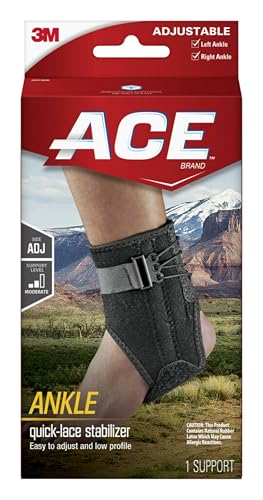
The pharmacy-shelf staple that has been holding ankles steady for years — simple and proven.
The ACE brace does nothing fancy, and that is exactly why it works for so many people. Reinforced side stabilizers limit lateral motion (the movement that causes sprains) while a wrap-around design lets you dial in your preferred level of compression. It is an easy-to-use one-piece design that comes on and off quickly, and the breathable fabric helps keep skin dry during all-day wear. Owners who play pickleball, basketball, or run regularly say it provides a great range of motion while supporting a wobbly ankle — and one long-term reviewer reported getting two years of durability out of a single unit.
The most-praised aspect is support, mentioned by well over 60 owners. The mixed feedback centers on fit and comfort: some find the sole area uncomfortable for all-day standing, and the sizing can be tricky if you are between standard shoe sizes. The Velcro holds well according to owners. If you want a familiar, no-surprises brace from a brand sold in nearly every drugstore, this is a solid pick. The honest caveat is that the lace-up adjustment takes a bit of effort to get snug — one owner described it as a struggle at first but easy once dialed in.
The enduring strength: side stabilizers built into a classic wrap design that owners have trusted for years with injuries ranging from minor sprains to weak ligaments — and a single brace has held up through two years of running, jumping, and climbing.
The sizing reality: comfort and fit get mixed feedback; if you are between sizes, the snugger option usually works better for active sports, while the larger size suits all-day casual wear.
9. JIUFENTIAN Ultra-Breathable Copper Ankle Braces (2-Pack)
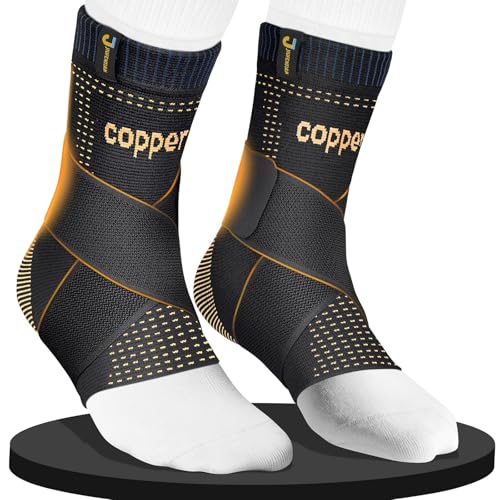
Two braces for the price of one, with copper-infused fabric that fights odor during extended wear.
This is the budget-friendly value champion for a reason: you get two complete braces (sleeves plus removable figure-8 straps) at a price that typically buys a single unit. The AirFlow knit uses high-density knitting technology to deliver firm, even pressure while remaining thinner than standard sleeves, and the copper infusion adds antimicrobial and odor-control properties that matter when you wear a brace for hours at work or during sweaty sports. The figure-8 wrap pattern weaves through the outer ankle, underfoot, and inner ankle to create 3D support that limits inward rolling during walks or light sports. The crowd favorite consensus is that the support works well for plantar fasciitis and general sprains, with owners frequently mentioning immediate pain relief by the end of their first day wearing it.
Support is the top praised aspect with more than 50 owners highlighting it, closely followed by pain relief. The mixed feedback centers on fit — 46 owners rate it as mixed, meaning the sizing chart needs careful measuring. A minority of owners mention that the strap can cause mild top-of-foot pain after a full day of wear, particularly if cinched tightly. This is the only brace in the lineup that comes as a two-pack, making it the obvious pick if you need guards for both ankles or want a backup. For the cost, it delivers legitimate compression and anti-roll support that competes with mid-range singles.
Why It Wins On Value
- Two complete braces in the box — sleeves and figure-8 straps — at a price that typically buys one unit
- Copper-infused knit provides natural odor control for all-day and sports wear
- Support and pain relief are the most-discussed features, with buyers calling it effective for plantar fasciitis and sprains
The Trade-Offs
- Fit gets mixed reviews from owners — measure your ankle circumference carefully before ordering
- Strap can cause mild top-of-foot discomfort by late afternoon if overtightened
Ideal for: anyone who needs two ankle guards (one for each ankle or a backup) on a tight budget — the value-per-brace ratio is class-leading in this guide.
Better for looser wear: if you have a sensitive instep, keep the figure-8 strap at a moderate tension rather than pulling it tight, and consider wearing a thin sock underneath.
Understanding the Specs
Figure-8 Strap vs. Lace-Up vs. Compression Sleeve
The figure-8 strap wraps around the heel and across the top of the foot in an X pattern, which directly resists the inward rolling motion that causes most ankle sprains. A lace-up design pulls the brace tight from bottom to top, giving you more even compression across the entire ankle but taking longer to put on. A compression sleeve slides on like a sock — it provides pressure to reduce swelling but does not prevent your ankle from twisting sideways. Knowing which mechanism your injury needs is the single most important decision you will make.
Removable Side Stabilizers
Some braces include rigid or semi-rigid plastic stays that sit on the inner and outer sides of the ankle. These are the primary defense against inversion and eversion (rolling in or out). The advantage of removable stabilizers is that you can keep them in during early recovery for maximum protection, then take them out as you heal for a lighter, more flexible feel during sports or daily wear. If you are buying for a single injury that you expect to heal, a brace with removable stays gives you two levels of support in one product.
Profile Thickness (1.5mm vs. Standard)
Standard ankle braces add roughly 5-8mm of material around the ankle joint, which often forces you to loosen your shoelaces or buy larger shoes. An ultra-thin brace at 1.5mm is built from microfiber fabric with a ventilation grid, making it virtually invisible under socks and compatible with snug-fitting sneakers, work boots, and even formal shoes. If you plan to wear the guard all day without changing your footwear, thickness is the spec that makes or breaks the experience.
Breathability and Moisture Management
Wearing a brace for hours traps heat and sweat against your skin, which can lead to irritation or odor. AirFlow knits, laser-cut ventilation holes, and copper-infused fabrics are three different ways manufacturers address this. AirFlow and laser-cut holes provide active airflow paths. Copper-infused materials add antimicrobial properties that reduce bacterial growth and odor. If you plan to wear the brace during sports or for full work shifts, prioritize one of these ventilation features over a solid knit.
FAQ
What is the difference between a figure-8 strap and a lace-up ankle brace?
How tight should my ankle brace feel?
Will an ankle brace fit inside my normal shoes?
Can I wear an ankle guard on both feet at the same time?
How long does a typical ankle brace last with daily use?
Can I wash my ankle brace?
What level of support do I need for a grade 1 ankle sprain?
Is copper-infused fabric in ankle braces actually effective?
Can I wear an ankle guard while playing basketball or volleyball?
How do I measure my ankle for the correct brace size?
Final Thoughts: The Verdict
For most people, the ankle guards winner is the Fitomo 1.5mm Ultra Thin Ankle Brace because it solves the single biggest complaint in this category — bulk — without sacrificing the figure-8 stability that actually prevents re-injury. If you need rigid lateral support for sports or early recovery, grab the Fitomo Quick Lace Up with its removable stabilizers. And for premium medical-grade compression that feels like a second skin, the Bauerfeind MalleoTrain is the investment piece that owners say justifies itself through years of daily wear.
How We Picked
We do not accept paid placement. Every pick is matched to a real buyer and a real use-case; we do not hands-on test units.
Sources & Methodology
Specifications: manufacturer listings and product documentation. Review insights: verified customer reviews, as of July 2026. Pricing: not shown on this page (it changes often); check the current price via the retailer link.
As an Amazon Associate, Gadgets Feed earns from qualifying purchases. This does not affect which products we feature.