
Our readers keep the lights on and my morning glass full of iced black tea. As an Amazon Associate, I earn from qualifying purchases.
Specs are compiled from manufacturer listings and verified buyer reviews and can change over time — please confirm the key details on the product page before buying.
If you have a water softener, your water heater’s factory magnesium anode rod is slowly turning your hot showers into a rotten-egg nightmare. That smell is hydrogen sulfide gas, created when softened water reacts with the magnesium rod. The fix is swapping in an aluminum or zinc rod, or a powered titanium unit that stops corrosion without sacrificing itself.
I’m Min — the founder and writer behind Gadgets Feed. This guide is built by comparing the manufacturers’ published specifications and the patterns across verified customer reviews, so you get each pick’s real strengths and trade-offs instead of marketing spin.
This guide ranks the best anode rod for softened water picks, from budget aluminum-zinc rods to premium powered titanium models that last decades.
Our Picks at a Glance


How To Choose The Best Anode Rod For Softened Water
You need an anode rod that stops the rotten-egg smell in your softened water without forcing you to climb into a cramped closet. Your choice depends on three things: the metal it’s made from, how it fits your tank, and if you want a sacrificial rod you replace every few years or a powered rod you install once. Here’s what actually matters.
Aluminum-Zinc vs Magnesium: The Sulfur Connection
Magnesium rods react with the sulfates in softened water to create hydrogen sulfide — the rotten egg gas. That’s why aluminum or aluminum-zinc alloy rods are the standard recommendation for softened water. They eliminate the odor source rather than just masking it.
Sacrificial vs Powered: The Big Trade-Off
A sacrificial aluminum rod decays over time to protect your tank, so you’ll replace it every few years. A powered titanium rod uses a small electric current instead of sacrificing itself, which means it doesn’t wear out — most carry 20-year warranties. Powered rods cost more upfront but eliminate the replacement cycle.
Fit First: Length, Thread, and Clearance
Check your tank’s thread size — most use a standard 3/4″ NPT connection. For clearance, flexible segmented rods bend into tight spaces, while solid rods need more headroom above the tank. If your water heater has a dedicated anode port, a hex-head rod is the standard choice; if not, you’ll need one that installs in the hot water outlet.
Quick Comparison
| Model | Best For | Type | Length | Weight | Amazon |
|---|---|---|---|---|---|
| Eau 44″ Flexible★ Best Overall | Rotten egg smell fix | Aluminum-Zinc | 44″ | — | Amazon |
| HertzEagle PoweredBest Powered Value | Large tanks up to 89 gal | Powered Titanium | — | 0.63 kg | Amazon |
| Corro-Protec BradfordPremium Pick | Bradford White outlet install | Powered Titanium | — | — | Amazon |
| Suburban 232768 | RV water heaters | Aluminum | 9″ | 8.48 oz | Amazon |
| ARTIVILLE Powered | Compact electric tanks | Powered Titanium | 9.4″ | 11.7 oz | Amazon |
| About Fluid 44″ | Detailed instructions | Aluminum-Zinc | 44″ | — | Amazon |
| Tandefio 29″ | Well water with manganese | Aluminum-Zinc | 29″ | — | Amazon |
| Water Connection 46.5″ | Bradford White tanks | Aluminum-Zinc | 46.5″ | — | Amazon |
| Corro-Protec 10-39 | Small tanks, permanent fix | Powered Titanium | 12″ | 15.04 oz | Amazon |
In‑Depth Reviews
1. Eau 44″ Flexible Aluminum Zinc Anode Rod
Our pick — over 4.5★ from 500+ verified ratings; the strongest balance of quality and price.
The flexible 44-inch fix that bends into tight spaces and kills the rotten egg smell for good.
This is the crowd favorite for softened water homes because it swaps the problem-causing magnesium for an aluminum-zinc blend that stops the sulfur reaction at its source. The 44″ rod is hinged into four segments, each under 12 inches, so you can slide it into a low-ceiling tank without any extra headroom — owners with cramped water heater closets call this the whole reason they chose it.
The kit arrives with Teflon sealing tape and a 27mm chrome socket, so everything you need is in the box. What wins people over is the sheer quality — the most-praised aspect by a wide margin — with many calling it better than the factory-installed rod. One buyer reports the installation went smoothly and plans to check wear in 3 years; another with a low ceiling says the old rod was “the threads were all that was left” before this fix.
It fits standard 3/4″ NPT (National Pipe Thread, the common US plumbing thread) connections across A.O. Smith, Rheem, Reliance, Richmond, Kenmore, State, GE, and more. The only real decision is if you want a sacrificial rod at all — this one will decay to protect your tank, so plan to inspect it every couple of years.
Why it wins
- Eliminates rotten egg smell within days, per owner reports.
- Four-segment flexible design fits low-ceiling tanks
- Socket and Teflon tape included in the box
- Fits most major water heater brands via 3/4″ NPT
Know before you buy
- You may need a 1/2″ drive socket — one buyer had to borrow one
- Sacrificial rod, so it wears down and needs replacement
Reach for this if: you have a tight installation space and a sulfur smell that bleach treatments only temporarily fixed. It’s the most balanced pick for the money.
Look elsewhere if: you never want to swap a rod again — a powered titanium unit is the set-and-forget alternative.
2. HertzEagle Powered Anode Rod
A powered titanium rod that ends the smell in 24 hours and shrugs off softened water’s extra corrosiveness.
If you’re done with the sacrificial-rod replacement cycle, this powered unit is the smart middle ground between budget aluminum and top-tier premium. It uses a titanium rod with a small electric current instead of decaying metal, and the manufacturer says it handles “even the heightened corrosiveness that comes with softened water” — exactly the problem this category exists to solve.
Installation is the most-praised aspect by far, with owners noting the long neck lets a pipe wrench grip it easily. One report describes replacing three heaters in six years before this rod fixed hard-water issues, leaving water softer, clearer, and smell-free. The rotten egg smell disappears within 24 hours in most cases., and the green LED on the power supply confirms the circuit is live.
The trade-offs are minor but real. The bolt needs a non-standard 1-3/16″ socket, so check your toolkit first. It’s rated for 40-89 gallon tanks and excludes Bradford White. And while it carries a 20-year warranty, one early unit shipped with a dead power pack — though the seller replaced it the next day, which buyers called great service.
Why it’s a standout
- Eliminates sulfur smell within 24 hours.
- 20-year warranty on a titanium rod
- Handles softened water corrosiveness
- Long neck makes wrench installation easy
Consider this first
- Needs a non-standard 1-3/16″ socket
- Not compatible with Bradford White tanks
Best for: homeowners with 40-89 gallon tanks on softened water who want powered protection without the premium-brand price tag.
skip it if: you own a Bradford White — you’ll need the outlet-install model instead.
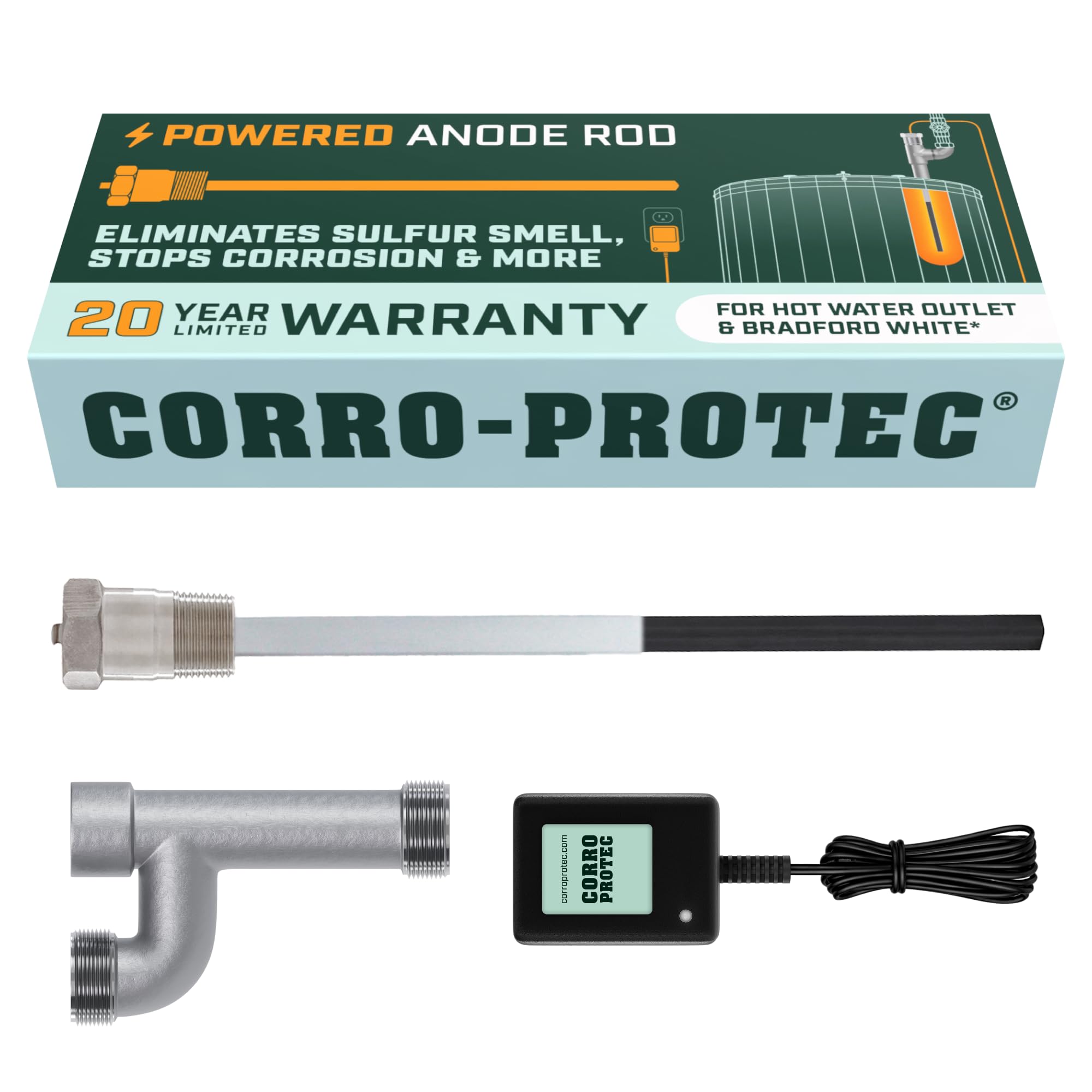
3. Corro-Protec Powered Anode Rod for Bradford White & Hot Water Outlet
The premium powered rod that fits Bradford White tanks and kills sulfur smells in under a day.
This is the specialist’s answer for among the most common frustrations: Bradford White water heaters lack a dedicated anode port, so your only option is the hot water outlet. This powered titanium rod is built for exactly that install, fitting any standard 3/4″ NPT thread and covering 10-120 gallon tanks. It also works for Bosch and A.O. Smith models, and it’s the rescue option when your old anode is stuck in the port.
What owners rave about is speed — the rotten egg smell disappears completely within the first day for most., even after years of failed fixes like well shocking, softeners, and UV filters. One DIY owner installed it on a Bradford White RG2PV75H6N and saved a plumber quote. The odor-removal praise is the most common theme by a landslide, followed closely by installation ease.
This is the most expensive pick here, and the honest trade-offs are real. The included stainless steel Wye fitting needs firm force to tighten, and leaks are the most common negative theme — so use gray Teflon tape designed for stainless steel. It’s a premium investment, but the 20-year warranty and never-replace-again design justify the cost for many.
Why so many choose it: odor elimination is the single most-discussed outcome, with owners reporting the smell gone overnight after years of temporary fixes.
The honest catch: the Wye fitting install is more involved than a standard rod, and a minority of buyers report leaks at the stainless threads — take the tightening instructions seriously.
Get this if: you own a Bradford White and want a permanent, 20-year-warranty fix for softened-water odor.
Think twice if: you’re handy but not patient — the Wye fitting demands firm force and gray Teflon tape done right.
4. Corro-Protec Powered Anode Rod (10-39 Gallon)
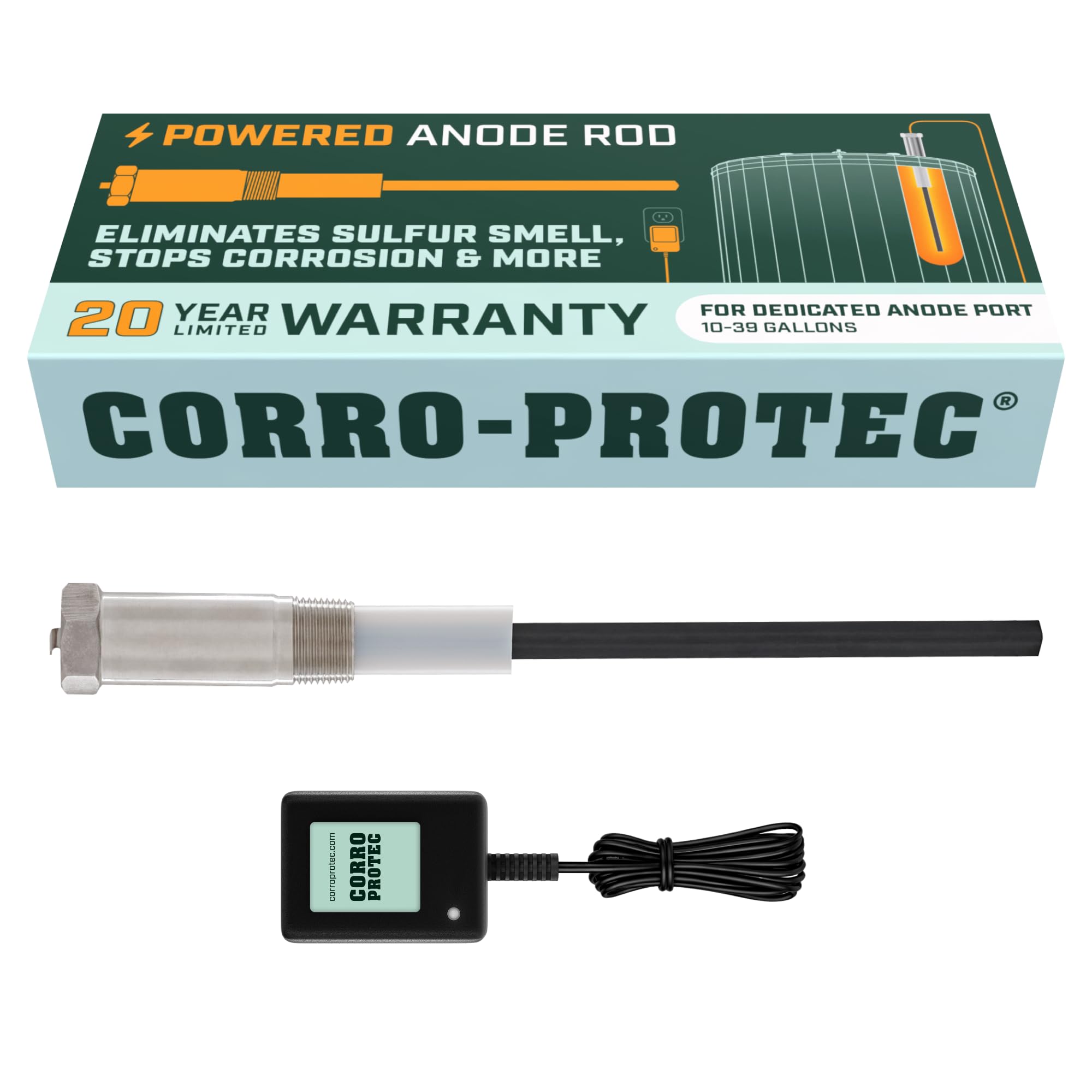
A Canadian-made powered rod for small tanks that ends sulfur smells and corrosion permanently.
For water heaters in the 10-39 gallon range — think RVs, vacation trailers, and small apartments — this powered titanium rod is the premium permanent fix. It’s manufactured in Canada since 2006 and carries a 20-year warranty, and unlike sacrificial rods, it doesn’t disintegrate, so there’s no replacement cycle to remember.
Owners mention the sulfur smell drops 80-90% within 5 hours and is fully gone within 24 hours. One buyer with a vacation trailer notes it took about two weeks to fully clear, so patience helps with stubborn cases. The most-praised outcome is odor removal, with installation as the second most-common win — the included 12-foot power cord reaches most outlets without extension.
The unit is certified lead-free and holds the Water Quality Association Gold Seal. It fights corrosion at any water hardness level, including softened water’s extra aggression. The trade-off is cost — it’s a serious investment for a small tank, and opinions on value are genuinely split, with some calling it overpriced for the size.
Standout feature: the 12-foot cord and dedicated-anode-port install mean it fits tight spaces where you’d otherwise need to crawl — owners with cramped crawlspace tanks call this the reason they bought it.
Know the cost: this is the premium option for small tanks; a sacrificial aluminum rod costs far less but needs periodic replacement.
Choose this for: an RV, trailer, or small home tank where you want one-and-done protection with a 20-year warranty.
Pass if: your tank is over 39 gallons — you’ll need the larger model instead.
5. Water Connection 46.5″ Aluminum Anode Rod
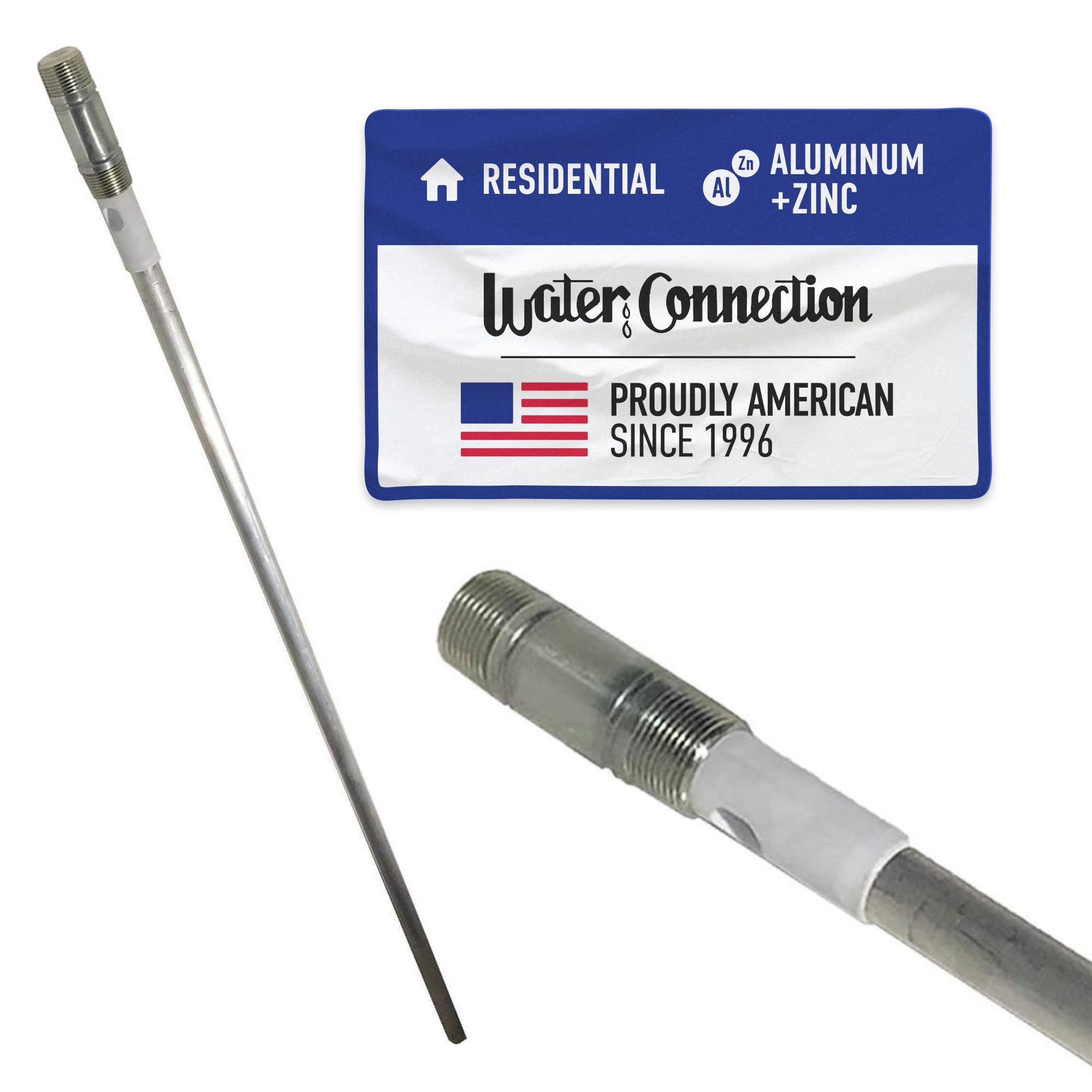
A solid 46.5-inch aluminum-zinc rod built specifically for the hot water outlet on Bradford White tanks.
Bradford White tanks usually need their anode in the hot water outlet rather than a dedicated port, and this rod is designed for exactly that. The 3/4″ NPT threads with a 3″ nipple make installation straightforward, and the 46.5″ length provides more sacrificial material than typical rods. The aluminum-zinc blend stops the sulfur reaction that magnesium starts with softened water.
The manufacturer specifies military-grade A420 aluminum meeting U.S. Mil-A-18001K/W standards for corrosion resistance. Owners with Bradford White 50-gallon tanks report swapping it in about 10 minutes, and one calls it “exactly what I needed.” The thicker 3/4″ diameter gives more material to sacrifice than the 5/8″ rods some competitors use.
There are two honest caveats. First, you need at least 4 feet of clearance above the tank — if you don’t have that headroom, this solid rod won’t fit and you’ll need a flexible version. Second, owners note fit can be model-specific; measure your tank’s outlet setup first. One user with truly bad water replaces it twice a year to keep the tank healthy.
Built for a purpose: this is the rare sacrificial rod made for the hot water outlet position, not the standard anode port.
Mind the clearance: the 46.5″ solid length demands 4 feet of overhead space — measure before you buy.
Reach for this if: you have a Bradford White or A.O. Smith tank with an outlet-mounted anode and at least 4 feet of ceiling clearance.
Look elsewhere if: your tank is in a tight crawlspace — the flexible option is the better fit there.
6. About Fluid 44″ Flexible Aluminum/Zinc Anode Rod

A flexible Michigan-made rod with plumber-written instructions that take the guesswork out of installation.
This kit is built by a fifth-generation plumber in Southeast Michigan, and it shows in the details. The 44″ rod is hinged into four segments using 304 stainless steel connectors that won’t rust, so each segment slips into the tank one by one in tight spaces. The aluminum-zinc alloy replaces the factory magnesium rod that causes hydrogen sulfide gas in softened water.
Owners consistently praise the instructions — one buyer calls them “very complete and obviously written by someone whose first language was English.” The odor removal works within a day or two for most., and a long-term user reports a 10-year heater lasting over 20 years with no rust when the rod is replaced every 2-3 years. The kit includes a full roll of Teflon tape, not the small thimble-size roll other brands ship.
The honest downsides: several owners warn about value, calling it pricey for what it is, and one rare case saw the smell return within weeks. Some installations need an impact gun to remove the old rod first. For most buyers, though, the clear guidance and reliable odor fix make it worth a look.
The thing everyone mentions: the step-by-step printed manual is genuinely helpful — a rarity in this category — and the stainless hinges hold up in tight installs.
Value watch: opinions on price are mixed, so it’s worth comparing against the similar Eau flexible rod.
Best for: first-time DIYers who want a hand-held walkthrough and a flexible rod for a cramped tank closet.
pass on it if: you’re purely chasing the lowest price — the entry-level flexible rods deliver the same result for less.
7. Tandefio 29″ Aluminum Zinc Anode Rod

A solid 29-inch aluminum-zinc rod that tames stubborn well-water sulfur smells other rods can’t touch.
For homes on well water with high manganese content, this rod has a devoted following. One owner says this zinc alloy mix is “the only rod that removes the stink from my hot water,” which has high manganese. The 29-inch length with a 0.75-inch diameter and 3/4″ NPT thread fits most standard tanks, and the included sleeve works with a 1-1/16″ socket.
The quality is the most-praised aspect, with buyers calling it nicely made and easy to cut to size with a hacksaw. It solves sulfur smells in well water, per multiple reports., and the universal compatibility works across most brands. The zinc content is what does the heavy lifting for odor control.
The trade-offs are minor. At 29 inches it’s shorter than the 44-inch flexible rods, so it needs more overhead clearance for installation. And one reviewer noted the packaging didn’t clearly mark the alloy composition, even though the listing states aluminum-zinc. For well-water homes, though, the results speak for themselves.
Why well-water homes love it: the zinc-heavy alloy tackles manganese-driven sulfur smells that generic rods leave behind.
Measure first: at 29 inches solid, you’ll want reasonable clearance above the tank for installation.
Reach for this if: your water has manganese or a sulfur smell that other rods haven’t fixed.
Look elsewhere if: your tank sits in a low-ceiling tight spot — the flexible rods are the easier install there.
8. Suburban 232768 Water Heater Aluminum Anode Rod

The RV-standard aluminum rod that slips into Suburban tanks at 8.48 ounces — a direct factory replacement.
If you own an RV with a Suburban water heater, this is the rod your tank was built for. The 9-inch aluminum rod is the OEM (Original Equipment Manufacturer, meaning it’s the exact part the factory uses) replacement for models like the SW10DE, and owners confirm it fits without modification — one buyer simply says “fit fine.” At 8.48 ounces it’s noticeably lighter than powered units like the 11.7-ounce ARTIVILLE, but for a sacrificial rod, weight isn’t the point; fit is.
The proper fit is the most-praised aspect, with value for money close behind. One owner notes it lasts about 4 years at 50% deterioration in an SW10DE — replace it then to protect the tank. It absorbs the corrosive action of hot water, which is its whole job. The aluminum material is the right choice for softened water, avoiding the magnesium-sulfur reaction.
There are a few honest notes. The threads can feel rough and need a bit more force to screw in, though customers note no leaks. There’s no O-ring included, so you’ll need sealant paste or Teflon tape. And durability gets mixed feedback — some reviewers point out long life while others replace sooner, so annual inspection is wise. Also, check your thread size: Suburban uses 3/4″, while Atwood uses 1/2″.
The factory-match advantage: this is the exact recommended model for SW10DE tanks, so there’s zero guesswork on fit.
Small effort required: grab Teflon tape or pipe dope for the threads, and expect a tight — but leak-free — screw-in.
Get this if: you have a Suburban RV water heater and want a drop-in aluminum replacement that’s easy to source.
Think twice if: you have an Atwood tank — the thread size differs and this won’t fit.
9. ARTIVILLE Hex-Head Powered Titanium Anode Rod

A compact 9.4-inch powered titanium rod that delivers noticeable smell improvements within a month.
This is the entry point into powered anode rods — it uses a titanium element with an electric charge instead of a decaying metal rod. At just 9.4 inches, it’s far shorter than the 44″ flexible rods, making it a tidy fit for electric tanks with dedicated anode ports in the 40-80 gallon range. The 3/4″ NPT thread matches most standard connections.
Functionality is the most-praised aspect, with owners reporting the metallic smell in hot water noticeably improved after about a month — one buyer says it “worked great to get rid of sulfur smell in water.” The quality is well-regarded too, with one owner noting the machining is clean and the directions clear. A green LED (a small light that shows power is on) on the power supply confirms the system is working.
The honest limitations are worth knowing. One buyer couldn’t install it at all because the old anode wouldn’t come out — you may need an impact wrench for that job. It excludes Bradford White and Bock tanks, which need extra hardware. And while the powered design should last years, that longevity isn’t proven yet given how new the product is.
What wins people over: the smell improvement is real and noticeable — shoppers say metallic and sulfur odors fading within weeks.
Plan for the old rod: removal is the hard part; budget for an impact wrench if your old anode is seized.
Best for: electric tank owners who want powered protection at a friendlier price than the Canadian premium brands.
it’s not for you if: you own Bradford White or Bock — you’ll need the outlet-install models instead.
Understanding the Specs
Sacrificial vs Powered Anodes
A sacrificial anode (aluminum or aluminum-zinc) corrodes on purpose to protect your tank, so it slowly wears away and needs replacing every few years. A powered anode (titanium with an electric charge) protects the tank without decaying — install it once and it can last 20 years, which is why those models carry long warranties.
Aluminum-Zinc vs Magnesium
Magnesium rods react with sulfates in softened water to create hydrogen sulfide — the rotten egg smell. Aluminum or aluminum-zinc alloys don’t cause that reaction, which is why they’re the standard choice for softened water. If you see sulfur staining or smell eggs, switching from magnesium to aluminum-zinc is the first fix to try.
Thread and Fit Standards
Most residential water heaters use a standard 3/4″ NPT thread for the anode rod. But the mounting location varies — some tanks have a dedicated anode port on top, while Bradford White models need the rod in the hot water outlet. Check your tank’s setup before ordering, and note that RV brands differ: Suburban uses 3/4″ while Atwood uses 1/2″.
Clearance and Flexibility
Solid rods need overhead space above the tank — the Water Connection model requires 4 feet of clearance. Flexible segmented rods hinge into four parts, each under 12 inches, so they slide into low-ceiling closets and crawlspaces without extra headroom. Measure your installation space first to know which style you need.
FAQ
Why does my water heater smell like rotten eggs after installing a water softener?
Can I use a magnesium anode rod with softened water?
How often should I replace a sacrificial anode rod?
What’s the difference between a sacrificial and a powered anode rod?
Will a powered anode rod work with my existing water softener?
How do I know which thread size my water heater needs?
My Bradford White tank has no anode port. What are my options?
Does a flexible or solid anode rod protect my tank better?
Why does my new aluminum-zinc rod still smell slightly?
Are powered anode rods worth the higher upfront cost?
Final Thoughts: The Verdict
If you want one dependable pick, the best anode rod for softened water is the Eau 44″ Flexible Aluminum Zinc because it kills the rotten egg smell fast, fits tight spaces, and ships with the socket and tape you need. If you’d rather never swap a rod again, the HertzEagle Powered handles softened water’s extra corrosiveness with a 20-year warranty. And for Bradford White owners, the Corro-Protec outlet model is the proven premium fix. Whichever you pick, matching the metal to your water chemistry is the single move that ends the sulfur smell for good.
How We Picked
We do not accept paid placement. Every pick is matched to a real buyer and a real use-case; we do not hands-on test units.
Sources & Methodology
Specifications: manufacturer listings and product documentation. Review insights: verified customer reviews, as of August 2026. Pricing: not shown on this page (it changes often); check the current price via the retailer link.
As an Amazon Associate, Gadgets Feed earns from qualifying purchases. This does not affect which products we feature.