
A sealed acrylic world where the quiet scrape of sand particles against plastic is the only soundtrack. You are watching a single worker heave a grain three times its own body weight, drag it to the surface, and drop it onto a growing mountain of excavation debris. This is not a toy — it is a behavioral observatory, a living lesson in logistics, and a slice of underground civilization brought into your living room. The best ant farm kits are precision tools for this exact experience, and choosing the wrong one means watching ants die from dehydration, mold, or simple escape through a poorly sealed lid.
I’m Min — the co-founder and writer behind Gadgets Feed. I have spent hundreds of hours comparing ant farm designs, analyzing customer failure patterns like condensation buildup and escape-proof seal integrity, and cross-referencing tunnel starter tools against sand granulometry to find the setups that actually sustain a colony.
I have compiled the most thorough data set on current models to help you find the best ant farm that will keep your colony digging, eating, and breeding for months — not just the first three days.
How To Choose The Best Ant Farm
Not all ant farms are built to sustain a colony. Many entry-level kits use nutrient gel that dries out, lacks structural integrity for tunneling, and cannot support a queen. Serious ant-keeping starts with understanding four critical factors that separate a thriving habitat from a death trap.
Sand Type and Moisture Control
The substrate is the colony’s entire world. Real sand allows ants to dig stable tunnels that do not collapse. Gel habitats prevent natural tunneling angles and often lead to ants drowning or getting stuck. Look for kits that include sterilized quartz sand or dedicated play sand — the grain size should be fine enough for small harvester ants to grasp but coarse enough to hold a tunnel shape. A proper hydration system — either a built-in water tower or a calibrated dropper system — lets you maintain 30–40 percent sand moisture without flooding the nest. Too wet and mold grows; too dry and tunnels cave in.
Escape-Proof Seals and Ventilation
The single biggest failure point in mid-range ant farms is the lid seal. An ant can squeeze through a gap as thin as a sheet of paper. The best designs use a double-gasket acrylic system or a child-lock mechanism that requires a specific motion to open. Ventilation holes must be screened with mesh fine enough to block tiny workers — if you can see light through the gap, ants will find it. Some premium models add a red transparent cover that calms ants by mimicking darkness while letting you watch without disturbing their cycle.
Viewing Area and Magnification
A flat rectangular viewing pane gives you a clear cross-section of tunnel architecture. Curved or domed surfaces distort the image and make it harder to spot food storage chambers and queen cells. Built-in magnifying glasses — either in the lid or as separate tools — let you examine individual ants carrying eggs or feeding larvae. The ideal viewing depth is around 1.5 to 2 inches; anything shallower limits tunnel complexity, and anything deeper makes it hard to see the back wall clearly.
Queen Space and Colony Expansion
If you intend to keep a queen — the only way to have a long-term colony — the nest must include a dedicated chamber large enough for her to move and lay eggs. Many entry-level kits are too shallow to accommodate a queen ant and her retinue of workers and brood. Premium models include modular expansion ports via rubber hose connectors, so you can link additional nest boxes as the colony grows. Without this feature, you are limited to observing short-lived worker ant behavior for a few weeks before the colony dies out.
Quick Comparison
On smaller screens, swipe sideways to see the full table.
| Model | Category | Best For | Key Spec | Amazon |
|---|---|---|---|---|
| Lumen Hotel Ant Farm Nest | Premium | Serious Colony Keeping | Expansion ports + Hydration tower | Amazon |
| ELNMLHT Ant Farm Castle | Premium | Double-Sided Viewing | 11.8 x 5.9 inch viewing area | Amazon |
| National Geographic Ant Habitat Kit | Mid-Range | Light-Up Terrarium | Built-in magnifiers + LED base | Amazon |
| WodGod Illuminated Ant Habitat | Mid-Range | Classroom Observation | Top-down LED + 500g quartz sand | Amazon |
| Educational Insights GeoSafari Ant Factory | Mid-Range | STEM Classroom Kit | 12 x 9 inch escape-proof habitat | Amazon |
| Kahopy Ant Farm Castle | Mid-Range | Thick Acrylic Safety | Thickened acrylic + water tower | Amazon |
| Tigerific Ant Farm | Budget | First-Time Ant Keepers | 9 x 7 inch real sand habitat | Amazon |
In‑Depth Reviews
1. Lumen Hotel Ant Farm Nest with Built-in LED Lights
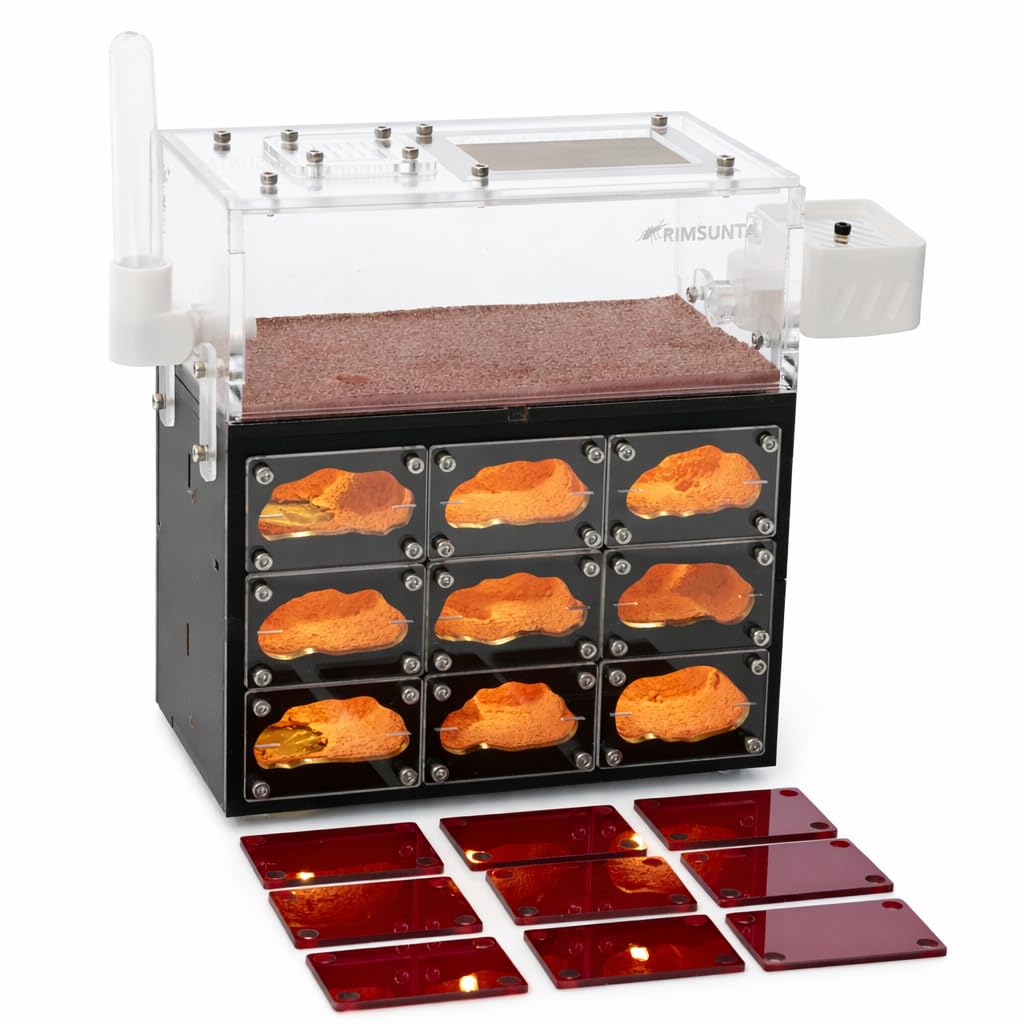
This is the only ant farm on this list that was designed by someone who actually keeps ant colonies, not a toy company repackaging a 1970s mold. The Lumen Hotel features a dedicated hydration tower that keeps the nest moist for three to four weeks without direct water injection into the substrate — eliminating the mold problem that kills most amateur colonies. The living area sits at a generous 7.48 by 7.09 inches with a red transparent acrylic cover that lets you observe ant activity without triggering panic in the colony.
The modular expansion system is the standout feature. Three ports — front, left, and right — connect to additional nest boxes via standard rubber hose, so when your queen starts laying brood and the colony outgrows its initial space, you simply plug in another unit. This is the only kit here that supports multi-generational queen-right colonies. The built-in LED lights in each chamber provide shadow-free observation day or night without heating the nest.
A dedicated garbage compartment slides out for cleaning without disturbing the main nest. Some units arrive with loose wiring on the LED strip, and the assembly relies on picture-based instructions that require patience. But for anyone serious about keeping a colony longer than six weeks, this is the only true long-term solution in this price tier.
Why it’s great
- Modular expansion ports support colony growth indefinitely
- Hydration tower provides 3-4 weeks of water without mold risk
- Red light cover allows daytime observation without stressing ants
- Separate garbage compartment simplifies cleaning
Good to know
- LED wiring may require re-soldering on some units
- No printed manual — rely on product images for assembly
- Requires specific ant species that thrive in plaster/acrylic nests, not all sand-tunnelers
2. ELNMLHT Ant Farm Castle

The ELNMLHT Ant Farm Castle gives you a full front-and-back view of the colony with an 11.8-by-5.9-inch acrylic panel that shows both the surface activity zone and the underground tunnel network simultaneously. This double-sided design lets you watch ants excavate from one side while observing how they organize their trash pile and food storage on the other — something single-pane farms cannot show.
The automatic water supply system uses a refill hole that delivers moisture through a built-in reservoir, so you only need to add water every 10 days. This is a massive practical improvement over manual dropper systems that require daily attention. The kit includes yellow dedicated sand, a water tower with a drinking tube for the colony, separate chambers for egg-laying, food storage, and an excavation dump area that gives ants a dedicated waste spot instead of piling debris against the viewing pane.
Instructions are extremely vague — customers consistently report trial-and-error setup with the water system, and the sand moisture balance takes a few attempts to get right. The slim 1.85-inch depth means the nest can tip if bumped, and condensation builds up on the acrylic if the room is humid. For the price, however, the viewing area and the included tool kit (tweezers, dropper, magnifier, decoration tree) make this the best value for educational settings where multiple kids need to see the colony clearly.
Why it’s great
- Double-sided viewing panels for complete tunnel observation
- Auto-water system reduces maintenance to once per 10 days
- Dedicated egg-laying and trash compartments reflect real colony organization
- Generous tool kit included for feeding and cleaning
Good to know
- Setup instructions are vague — expect trial-and-error for moisture levels
- Slim design makes the nest prone to tipping when bumped
- Condensation builds up quickly in humid environments
3. National Geographic Ant Habitat Kit
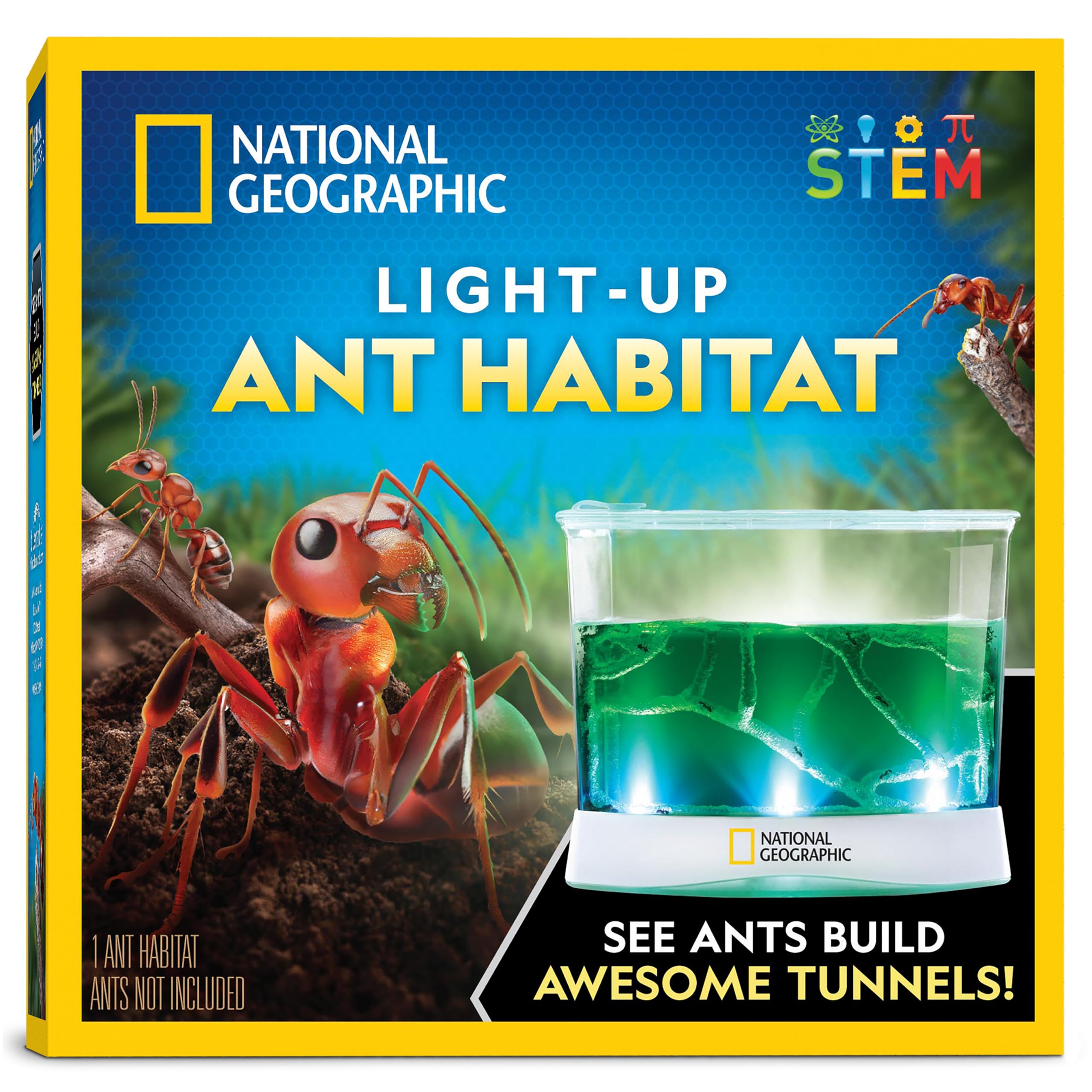
National Geographic partnered with Blue Marble (a Toy of the Year Award winner) to produce this light-up terrarium that uses translucent nutrient gel instead of sand — a deliberate design choice that makes the habitat completely mess-free and eliminates the sand-dust problem that bothers many parents. The gel contains nutrients ants eat directly, so there is no separate feeding station or food dish to refill. The built-in LED base illuminates the gel from below, creating a glowing display that looks spectacular in a dark room.
The habitat includes two magnifying glasses built into the lid plus an additional handheld magnifier, giving you three magnification points to inspect individual ant anatomy and tunneling details up close. The tunnel starter tool lets you create initial pathways to guide the ants into their first digging spots — a subtle but important feature because ants are more likely to start excavating in gel if they see an existing channel. The kit is compatible with ants from Ants Alive, and the gel itself is pre-sterilized to prevent mold growth.
The gel substrate is not suitable for ants that require sand or soil to build stable tunnels — gel tunnels collapse differently and many species cannot reproduce in it. The nutrient gel also dries out over time, and once it shrinks, the ants lose their structural environment. This is a display-focused kit, not a long-term colony habitat. For beginners who want to watch worker ants dig without dealing with sand moisture, feeding schedules, or mold management, it is the cleanest option.
Why it’s great
- Nutrient gel eliminates need for separate feeding and water management
- Three magnifiers built-in for detailed individual observation
- LED base creates dramatic nighttime viewing display
- No sand dust or moisture calibration required
Good to know
- Gel substrate cannot support queen reproduction or long-term colonies
- Gel dries out and shrinks over time, reducing usable tunnel space
- Ants sold separately and can be expensive to order
4. WodGod Illuminated Ant Habitat
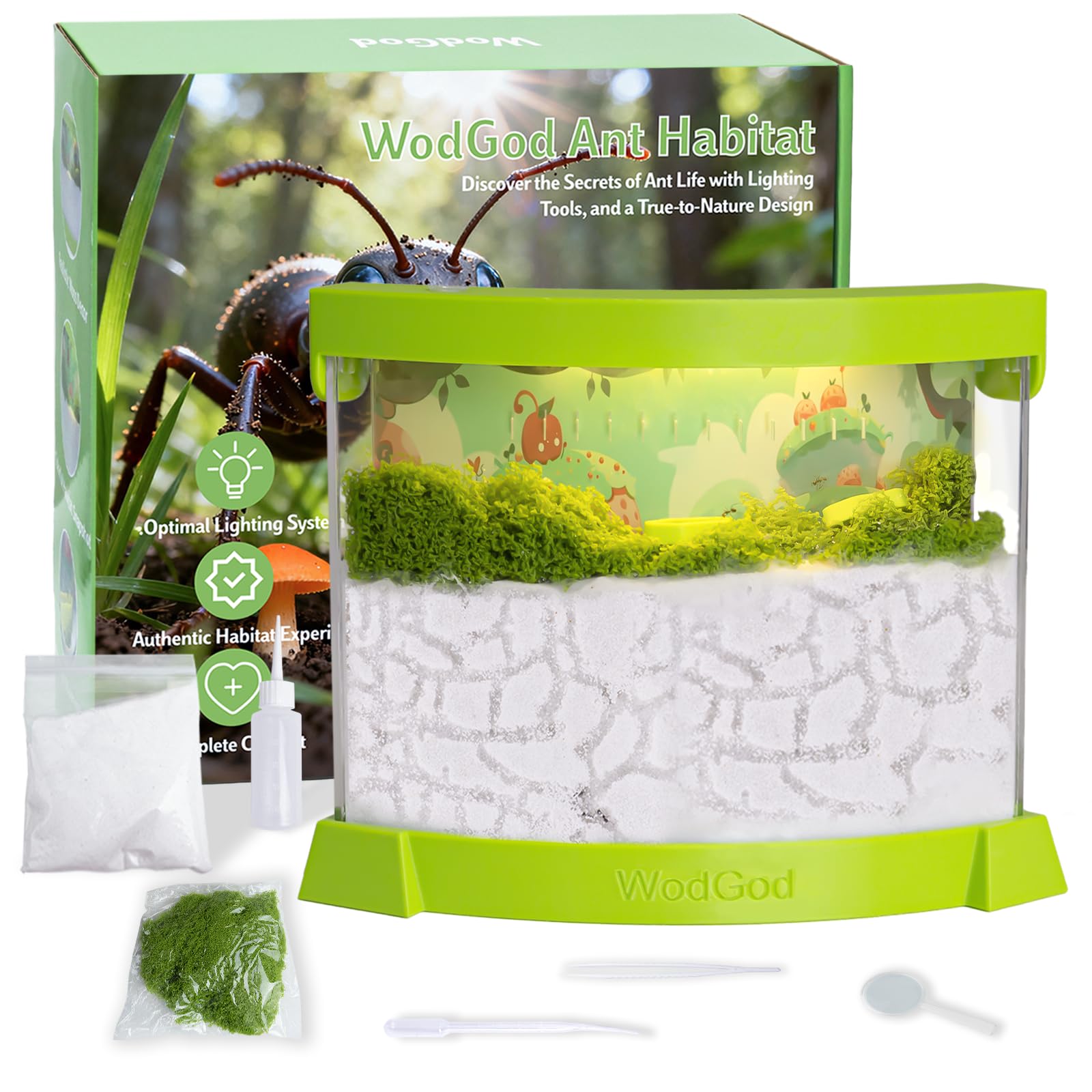
The WodGod Illuminated Ant Habitat takes a different approach to lighting: instead of a base-mounted LED, it uses a top-down LED strip that illuminates the entire sand surface without creating shadows inside the tunnels. This is critical for observation because underground chambers are naturally dark — the top-down angle lets you see the full depth of the tunnel network without the ants retreating from bright light. The habitat comes with 500 grams of sterilized quartz sand, which has a uniform grain size that supports stable tunnel angles.
The kit includes realistic moss strands and a printed landscape backdrop that mimics a natural forest floor environment. While decorative, the moss also provides a secondary texture that ants can use as anchor points for their tunnel entrances. The anti-escape tweezers and calibrated dropper let you manage food placement and water addition precisely. The overall dimensions of 8.66 by 11.02 inches give a tall viewing area that lets ants dig deeper vertical shafts rather than just shallow horizontal runs.
Build quality varies between units — some customers report the acrylic arriving cracked or with fingerprints inside the sealed viewing area. The sand moisture instructions suggest adding more water than most ants need, leading to hard-packed sand that prevents digging. The moss strands are essentially green yarn, not real moss, and may be ignored by the ants entirely. For the price, the LED concept is well-executed, but the habitat requires careful sand moisture calibration to function properly.
Why it’s great
- Top-down LED illuminates tunnels without casting shadows inside chambers
- Sterilized quartz sand with uniform grain size supports stable tunnel architecture
- Tall 11-inch viewing area encourages deep vertical tunnel digging
- Complete tool kit includes dropper, tweezers, and magnifier
Good to know
- Quality control issues — some units arrive cracked or dirty
- Instruction manual recommends too much water, hardening the sand
- Decorative moss is synthetic yarn, not functional for ant behavior
5. Educational Insights GeoSafari Ant Factory
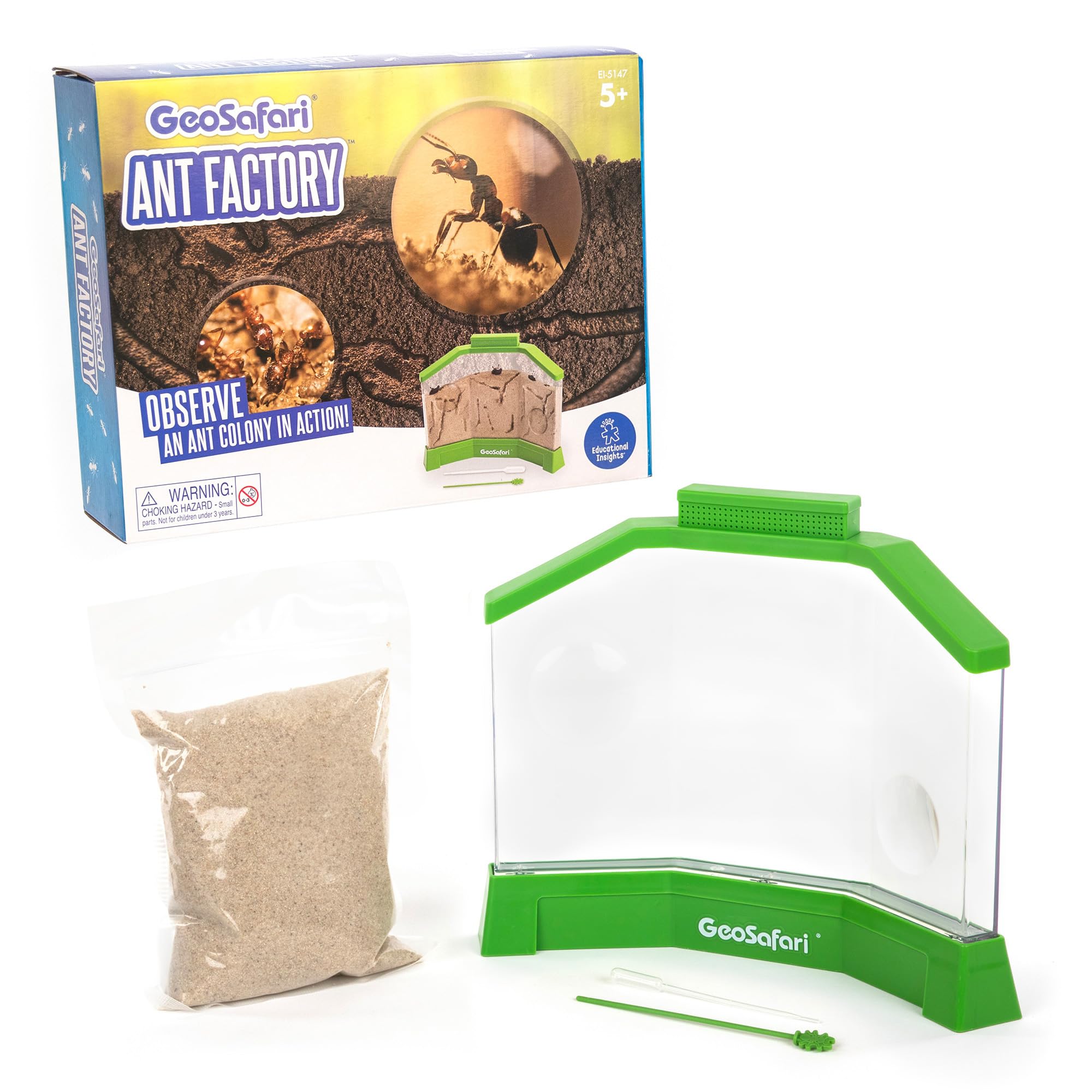
Educational Insights has been making classroom science kits since the 1960s, and the GeoSafari Ant Factory shows that institutional experience in its design. The escape-proof habitat measures 12 by 9 inches — the largest base footprint on this list — with built-in magnification spots at the top and a separate stand that elevates the entire farm for group viewing. The included activity guide is a full science curriculum with journaling prompts, observation charts, and factual content about ant anatomy and colony roles.
The kit ships with special ant sand that is pre-screened to the ideal particle size for harvester ant tunneling. This is a significant advantage over generic play sand because the grains lock together at the right moisture level to prevent cave-ins. The feeding tool is a long spoon designed to deposit food into the habitat without breaking the seal. The habitat also includes a redemption card for ordering live harvester ants, though shipping fees and state restrictions apply.
Some customers report that the ant sand settles and compacts faster than expected, requiring periodic loosening. The habitat does not include a built-in hydration system, so you must manually mist the sand every few days — a step that is easy to forget and can lead to tunnel collapse if the sand dries out. The farm is designed primarily for worker ants without a queen, so expect colony activity to decline after about four to six weeks. It is the best option for teachers running a single-term science unit.
Why it’s great
- Largest habitat footprint at 12 x 9 inches for classroom group viewing
- Pre-screened ant sand eliminates guesswork on grain size
- Full activity guide with journaling and science curriculum content
- Built-in magnification spots for detailed individual observation
Good to know
- No built-in hydration system — requires manual misting every few days
- Sand compacts over time, requiring periodic loosening
- Designed for worker ants without a queen, colony lifespan ~4-6 weeks
6. Kahopy Ant Farm Castle
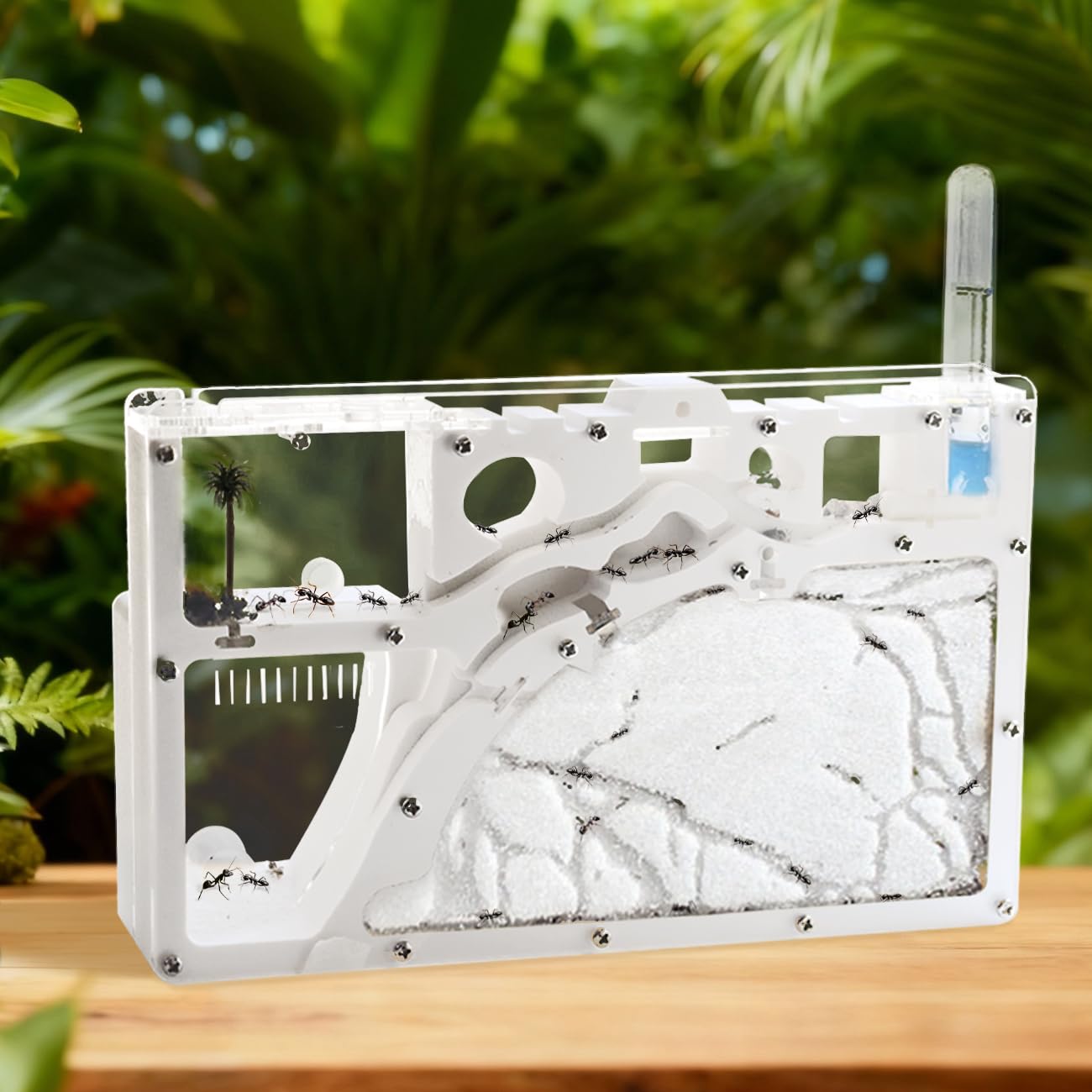
The Kahopy Ant Farm Castle uses thickened acrylic walls that are significantly more impact-resistant than the thin plastic used in budget kits. This matters when a child drops the farm or leans on it during observation — a cracked seal means escaped ants. The child lock mechanism on the top cover requires a two-step sliding motion to open, which prevents curious fingers from accidentally releasing the colony while still allowing adult access for feeding and cleaning.
The automatic water supply system includes a water tower with a tube that ants can drink from directly, plus a flood outlet at the rear that drains excess water if you overfill. This flood prevention feature is unique in this price range — it means you cannot accidentally drown the colony by adding too much water through the refill hole. The kit includes a decorative tree, food basin, and flag that make the habitat feel like a tiny diorama.
The biggest persistent complaint is mold. Because the water seeps between the acrylic cover and the sand, mold colonies form on the inner surface of the viewing pane within weeks. Once mold appears, it is impossible to clean without fully disassembling the farm and removing all the sand. The lid seal is also not completely ant-proof — several customers report ants escaping through the top opening when opened for feeding. The habitat works best if you use the small water hole near the sand for hydration instead of the round sand cover.
Why it’s great
- Thickened acrylic walls resist impacts and prevent cracking
- Child lock mechanism prevents accidental ant escapes
- Flood outlet drains excess water, preventing colony drowning
- Includes decorative elements for an engaging display
Good to know
- Mold grows between acrylic layers within weeks and is impossible to clean
- Lid seal is not fully ant-proof during feeding access
- Water system design promotes condensation against viewing surfaces
7. Tigerific Ant Farm for Live Ants

The Tigerific Ant Farm is the most affordable entry into sand-based ant keeping, and it includes real sand rather than gel — a critical advantage over many kits at this price point. The 9-by-7-inch transparent colony gives you multiple viewing angles, and the included AntWay Connector Tube lets ants move between the main habitat and a secondary container if you choose to expand. The kit ships with two bags of sand, a water dropper, and a 20-page color learning booklet that covers ant anatomy, colony roles, and less-known facts like the ability of some ants to swim.
The learning booklet is genuinely impressive for a budget kit — it explains the roles of queen, worker, and soldier ants, how ants search for food, and the evolutionary history of the species. There is also a coupon for ordering live harvester ants at a discounted price, though you will pay separate shipping. The included ant documentary video gives a multimedia layer to the educational experience that most kits in this tier lack entirely.
The plastic construction is lightweight and feels less durable than acrylic alternatives. The connector tube arrives bent on some units and does not hold its shape, confusing ants and preventing proper movement between spaces. The farm is too small to support a queen colony, and ants die within weeks because no queen means no reproduction. The sand also tends to dry out quickly, requiring frequent misting that is not clearly documented in the instructions. It is a functional starter kit for a child’s first ant observation experience, but expect to upgrade within a few months if interest continues.
Why it’s great
- Real sand substrate supports natural tunneling behavior
- 20-page learning booklet covers advanced ant biology topics
- Connector tube allows basic expansion to secondary container
- Includes discount coupon for live ant purchase
Good to know
- Connector tube arrives bent, confusing ant movement
- Plastic construction feels less durable than acrylic alternatives
- Too small for queen colony — ant lifespan limited to a few weeks
FAQ
Can I keep a queen ant in a standard ant farm?
Why does my ant farm smell bad and how do I fix it?
Can I use ants I catch from my backyard?
Final Thoughts: The Verdict
For most users, the best ant farm winner is the Lumen Hotel Ant Farm Nest because its modular expansion ports, red light cover, and large-capacity hydration tower support actual queen-right colony keeping rather than just worker observation. If you want a double-sided viewing panel for classroom or family sharing, grab the ELNMLHT Ant Farm Castle. And for a budget-friendly sand-based starter with a real educational booklet, nothing beats the Tigerific Ant Farm.