
An antenna that isn’t tuned is just an expensive dummy load. The difference between a resonant radiator and a cold piece of wire comes down to a single tool: a device that measures impedance, return loss, and standing wave ratio across a defined frequency sweep. Without it, you’re guessing — and in amateur radio, guessing means lost power, burnt finals, and frustrated hours at the tuner.
I’m Min — the co-founder and writer behind Gadgets Feed. I’ve analyzed the technical specifications, firmware capabilities, and real-world accuracy data for the top antenna analyzers on the market to separate the serious test equipment from the toys.
This guide breaks down every critical spec, from dynamic range to calibration stability, to help you choose the best tool for your bench or field kit. Whether you’re a QRPer adjusting a portable dipole or a contester optimizing a multi-band yagi, these are the best antenna analyzer options available right now.
How To Choose The Best Antenna Analyzer
Choosing an antenna analyzer is a trade-off between frequency range, measurement precision, and ease of use in the field. A high-end unit like the Comet CAA-500 Mark II offers instant band sweep and analog needles for muscle-memory tuning, while a NanoVNA-based device gives you deep vector network analysis for a fraction of the cost. Your decision hinges on how much you need Smith charts, PC connectivity, and calibration rigor versus raw simplicity and ruggedness.
Frequency Range and Dynamic Range
The analyzer’s frequency coverage must match the bands you operate. For HF (1.8-30 MHz) and VHF/UHF (144-450 MHz), a range of 100 kHz to 1.5 GHz is sufficient. Above 1.5 GHz, the SI5351 clock chip used in many NanoVNA variants suffers from harmonic artifacts and degraded dynamic range — look for units with dedicated mixers if you work above 3 GHz. Dynamic range (measured in dB) determines how accurately the analyzer can resolve small impedance differences; below 60 dB, you’ll see noise dominate your measurements above 500 MHz.
Connector Type and Calibration Standards
SMA connectors are common on budget analyzers but wear out after dozens of connect-disconnect cycles, degrading return loss measurements. N-type connectors, found on the AURSINC SAA-2N and premium units, are threaded, 50-ohm impedance-matched to 5 GHz, and survive years of field abuse. Calibration standards (OPEN, SHORT, LOAD) must match the connector type — mismatched kits introduce systematic errors that no amount of firmware correction can fix. Some analyzers, like the RigExpert Stick, include a self-calibration routine that reduces user error.
Display, Battery, and PC Connectivity
A 4-inch or larger touchscreen is essential for viewing Smith charts and multi-trace sweeps without squinting. For field work, a battery capacity of at least 3000 mAh (1950 mAh minimum) ensures several hours of continuous scanning. PC connectivity via USB (preferably USB-C) enables exporting Touchstone (.snp) files for simulation in ADS or SimSmith, a critical feature for serious antenna design. Some units, like the TinySA Ultra+, combine spectrum analysis and signal generation, turning a single device into a full RF lab.
Quick Comparison
On smaller screens, swipe sideways to see the full table.
| Model | Category | Best For | Key Spec | Amazon |
|---|---|---|---|---|
| Comet CAA-500 Mark II | Premium | Instant band sweep & analog needles | 1.8-500 MHz, dual metering | Amazon |
| RigExpert Stick 230 | Premium | Pocket-sized field tuning | 100 kHz-230 MHz, e-ink | Amazon |
| SeeSii TinySA Ultra+ ZS407 | Premium | Spectrum analysis + signal gen | 100 kHz-7.3 GHz, 5000 mAh | Amazon |
| AURSINC TinySA Ultra+ ZS406 | Mid-Range | Spectrum + VNA hybrid | 100 kHz-5.4 GHz, 32 GB SD | Amazon |
| MINI1300 | Mid-Range | Dedicated SWR scanning | 0.1-1300 MHz, TDR mode | Amazon |
| NanoVNA-F V2 | Mid-Range | Large screen & long battery | 50 kHz-3 GHz, 5000 mAh | Amazon |
| SEESII SAA-2N (with Testboard) | Mid-Range | Durable N-connector VNA | 50 kHz-3 GHz, 3000 mAh | Amazon |
| AURSINC SAA-2N V2.2 | Mid-Range | Robust steel enclosure VNA | 50 kHz-3 GHz, 201 scan points | Amazon |
| SEESII NanoVNA-H4 | Budget-Friendly | Entry-level VNA for HF/VHF | 9 kHz-1.5 GHz, 1950 mAh | Amazon |
In‑Depth Reviews
1. Comet CAA-500 Mark II

The Comet CAA-500 Mark II is the gold standard for amateur radio operators who want to sweep an entire band at the press of a button. Its auto band sweep function selects the amateur band, hits Sweep Center, and graphs the SWR curve across the frequency range in seconds — no calibration routines, no PC software, no learning curve. The dual metering (cross-needle analog display plus a color digital screen) lets you read SWR and impedance simultaneously, a feature that saves time when you’re adjusting a tri-band yagi on a tower.
Build quality is exceptional. The 2.2-pound chassis houses six AA alkaline or NiMH cells with a built-in trickle charger, giving up to 10 hours of continuous operation. The analyzer uses an SO-239 connector for bands up to 300 MHz and an N-type connector for the 300-500 MHz range, meaning you can test 6 meters, 2 meters, and 70 cm without adapters. It overlays up to five sweeps on the display, letting you compare before-and-after tuning adjustments in real time.
The CAA-500 has no USB data export and no Smith chart plotting — this is a pure SWR and impedance meter, not a vector network analyzer. If you need to measure cable loss, filter response, or complex impedance across a wide sweep, you’ll outgrow it fast. But for its intended purpose — rapid, reliable antenna tuning in the field — it remains the benchmark that other analyzers try to match.
Why it’s great
- Instant band sweep with graphical SWR curve
- Simultaneous SWR and impedance reading via cross-needle meter
- Rugged build with dual connector ports for VHF and UHF
Good to know
- No PC connectivity or data export
- No Smith chart or cable loss measurement
- Heavy at 2.2 pounds with batteries installed
2. RigExpert Stick 230

The RigExpert Stick 230 is purpose-built for the portable operator who needs to tune a multi-band EFHW or a coil-loaded vertical without carrying a benchtop instrument. Its form factor is a 7.28-inch stick with an e-ink display that remains perfectly readable in direct sunlight — a critical advantage when you’re in a field at noon during a POTA activation. The frequency range is limited to 230 MHz (covering 160 meters through 1.25 meters), but the measurement focus is tight: SWR, return loss, and cable impedance.
The UHF (SO-239) connector is standard for 50-ohm feedlines, and the square-wave output signal covers 0.1 to 230 MHz with no harmonic spurs. Users report that the analyzer delivers SWR readings that match the Comet CAA-500 Mark II within 0.1:1 across the HF bands, despite the RigExpert costing significantly less. It also measures capacitance and inductance of reactive loads, a niche feature useful for designing loading coils and matching networks.
The battery performance is the main trade-off — the internal lithium cell provides about 30 minutes of continuous scanning before dropping power, though it charges quickly via USB. The menu system takes deliberate effort to learn, and the e-ink display has a slow refresh rate that makes real-time tuning feel sluggish. For QRP/CW operators who value sunlight readability and pocket portability above all else, this is the definitive tool.
Why it’s great
- Sunlight-readable e-ink display for field use
- Accurately measures SWR, return loss, and reactive components
- Pocket-sized form factor fits in a radio bag
Good to know
- Limited to 230 MHz maximum frequency
- Battery life is short under continuous use
- Menu navigation requires practice
3. SeeSii TinySA Ultra+ ZS407
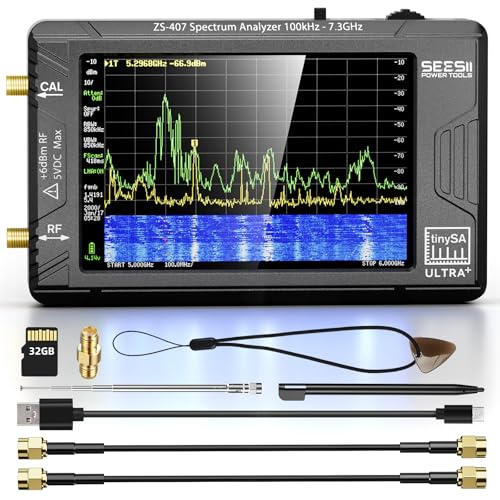
The SeeSii TinySA Ultra+ ZS407 pushes the frequency ceiling of portable spectrum analysis to 7.3 GHz, calibrated to 8 GHz for lab use. This is not just an antenna analyzer — it’s a full RF instrument that functions as both a spectrum analyzer with 200 Hz to 850 kHz RBW and a signal generator producing MF/HF/VHF sine waves, UHF square waves, and mixed outputs. For the ham radio operator who also works on Wi-Fi 6E at 6 GHz, satellite downlinks, or 5G NR, this single device replaces several benchtop tools.
The 4-inch touchscreen supports 450 scan points per trace, and the latest V0.5.4 hardware firmware includes ESD protection on the input, automatic self-calibration, and a 5000 mAh battery that runs for up to 10 hours. It comes with a 32 GB microSD card pre-installed for storing sweeps and screenshots. PC control via TinySA-APP over USB allows real-time data transfer to a laptop for deep analysis — a workflow that’s impossible with dedicated SWR analyzers.
The ZS407 is still a consumer-tier instrument, not an Agilent replacement. Its phase noise at -108 dBc/Hz at 100 kHz offset is good for the price but won’t satisfy lab-grade SNR measurements. The input is sensitive to DC and overdrive — users must use an attenuator and DC block when testing unknown signals to avoid damage. For the enthusiast who wants to detect StarLink downlinks, verify filter insertion loss, and tune antennas up to 7 GHz, the TinySA Ultra+ is an extraordinary value.
Why it’s great
- Covers 100 kHz to 7.3 GHz in one device
- Built-in signal generator for stimulus-response testing
- 10-hour battery life with USB-C charging
Good to know
- Requires external attenuator and DC block for safe input
- Phase noise and DANL not suitable for lab-grade work
- Screen is small for dense spectrum plots
4. AURSINC TinySA Ultra+ ZS406
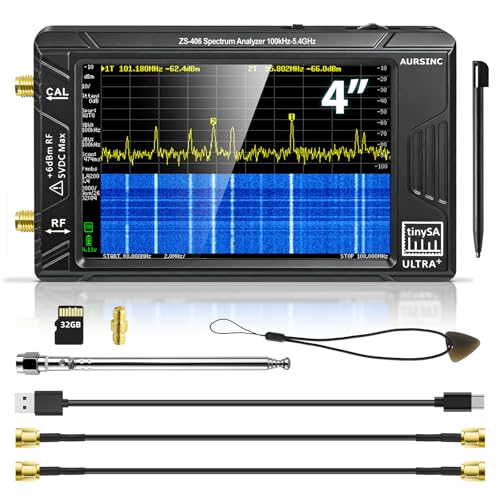
The AURSINC TinySA Ultra+ ZS406 is the predecessor to the ZS407 and covers 100 kHz to 5.4 GHz, making it ideal for operators working up to the 5 GHz Wi-Fi and C-band satellite range. Like its higher-frequency sibling, it functions as both a spectrum analyzer and a signal generator, with the same 4-inch resistive touchscreen and USB-C connectivity. The key difference is the price — it sits at a lower entry point while still offering the same 5000 mAh battery and 32 GB microSD storage.
Phase noise is rated at -108 dBc/Hz at 100 kHz offset, and the DANL bottoms out at -166 dBm/Hz, which is sufficient for identifying spurious emissions and verifying filter skirts. The built-in LNA adds 20 dB of gain below 3.5 GHz, helping to pull in weak signals during spectrum sweeps. The device also serves as a signal generator with sine output from 100 kHz to 900 MHz and square wave output from 800 MHz to 4.4 GHz, enabling insertion loss tests on coax and duplexers.
The ZS406 is not a vector network analyzer — it cannot measure S-parameters, plot Smith charts, or compute cable velocity factor. It’s a spectrum analyzer that happens to include a signal generator and very basic VNA-like functionality through the TinySA-APP PC software. For users who need precise VNA measurements (complex impedance, group delay, S11 phase), a dedicated VNA like the SAA-2N is a better choice. But for hunting interference, verifying transmitter harmonics, and doing rough antenna characterization, the ZS406 is an exceptional tool.
Why it’s great
- Affordable spectrum analyzer with 5.4 GHz coverage
- Built-in signal generator and LNA for gain
- 32 GB SD card stores thousands of sweeps
Good to know
- No full VNA functionality (no Smith charts)
- Input requires DC block and attenuator for safety
- Touchscreen can be finicky without stylus
5. MINI1300 Antenna Analyzer

The MINI1300 is a dedicated SWR analyzer designed for users who want a simple, dedicated tool without the complexity of a VNA’s menu structure. Its 4.3-inch touchscreen displays single-point SWR (1.0-1999), scanning SWR (1.0-20.0), and Time Domain Reflectometry (TDR) sweeps from 0.1 to 1300 MHz. The interface is built around a single measurement mode per press — select frequency, press Sweep, read the curve — making it the most accessible option for new operators.
TDR mode is a standout feature at this price point. It measures the distance to a cable fault or open circuit by injecting a pulse and timing the reflection, accurate to within a few feet on coax runs up to 500 feet. The firmware is locked (no updates possible per the manufacturer), but the v1.04 firmware on current units is stable and accurate, with verified readings matching known-good antennas on 2m, 70cm, and 1.25m bands. The unit runs on a rechargeable battery that holds charge well for hours of field testing.
The MINI1300 has no PC connectivity, no Smith chart, and no data export — it’s a closed system. The manual is a mix of broken English, German, and Chinese characters, so you’ll rely on YouTube tutorials to learn the interface. The included SMA calibration kit is functional but fragile; users who upgrade to an N-type cal kit report more consistent readings. For the price, it’s the best pure SWR analyzer for the builder who doesn’t want to fight with calibration routines.
Why it’s great
- Simple one-button sweep with large touchscreen
- TDR mode finds cable faults without extra gear
- Covers HF, VHF, and UHF in a single unit
Good to know
- Firmware cannot be updated
- No PC control or data export
- SMA calibration kit feels flimsy
6. NanoVNA-F V2

The NanoVNA-F V2 stands out in the crowded NanoVNA market for one simple reason: a 5000 mAh battery that delivers over 7 hours of continuous use. For field operations where an AC outlet is out of reach and a USB power bank is extra weight, this battery capacity is transformative. The 4.3-inch IPS TFT LCD is the largest touchscreen among the NanoVNA variants, offering a clear view of Smith charts and SWR plots in bright outdoor light.
The measurement range is 50 kHz to 3 GHz, with the SI5351-based harmonic extension providing 40 dB dynamic range at 1 GHz. Users report that firmware updates (to v0.1.1) add Time Domain Reflectometry (TDR) and improved marker functions, making it more versatile than the factory-firmware units. The aluminum housing shields the SMA connectors from external RF interference, reducing measurement jitter in high-EMI environments near broadcast towers or solar inverters.
The unit cannot be used as a power bank despite the large battery — the USB interface is input-only. The touchscreen is resistive, requiring a stylus or fingernail press for accurate calibration. At 5.51 x 2.95 x 0.79 inches, it’s larger than other NanoVNA models, making it less pocket-friendly but more readable. For the operator who spends all day on a tower tuning multiple antennas, the NanoVNA-F V2’s battery life alone justifies the upgrade.
Why it’s great
- 5000 mAh battery lasts 7+ hours of continuous scanning
- Large 4.3-inch IPS display with wide viewing angle
- Firmware upgradeable with TDR support
Good to know
- Larger chassis is less portable than NanoVNA-H4
- Resistive touchscreen requires firm pressure
- Battery cannot be used to charge other devices
7. SEESII SAA-2N (with Testboard Kit)
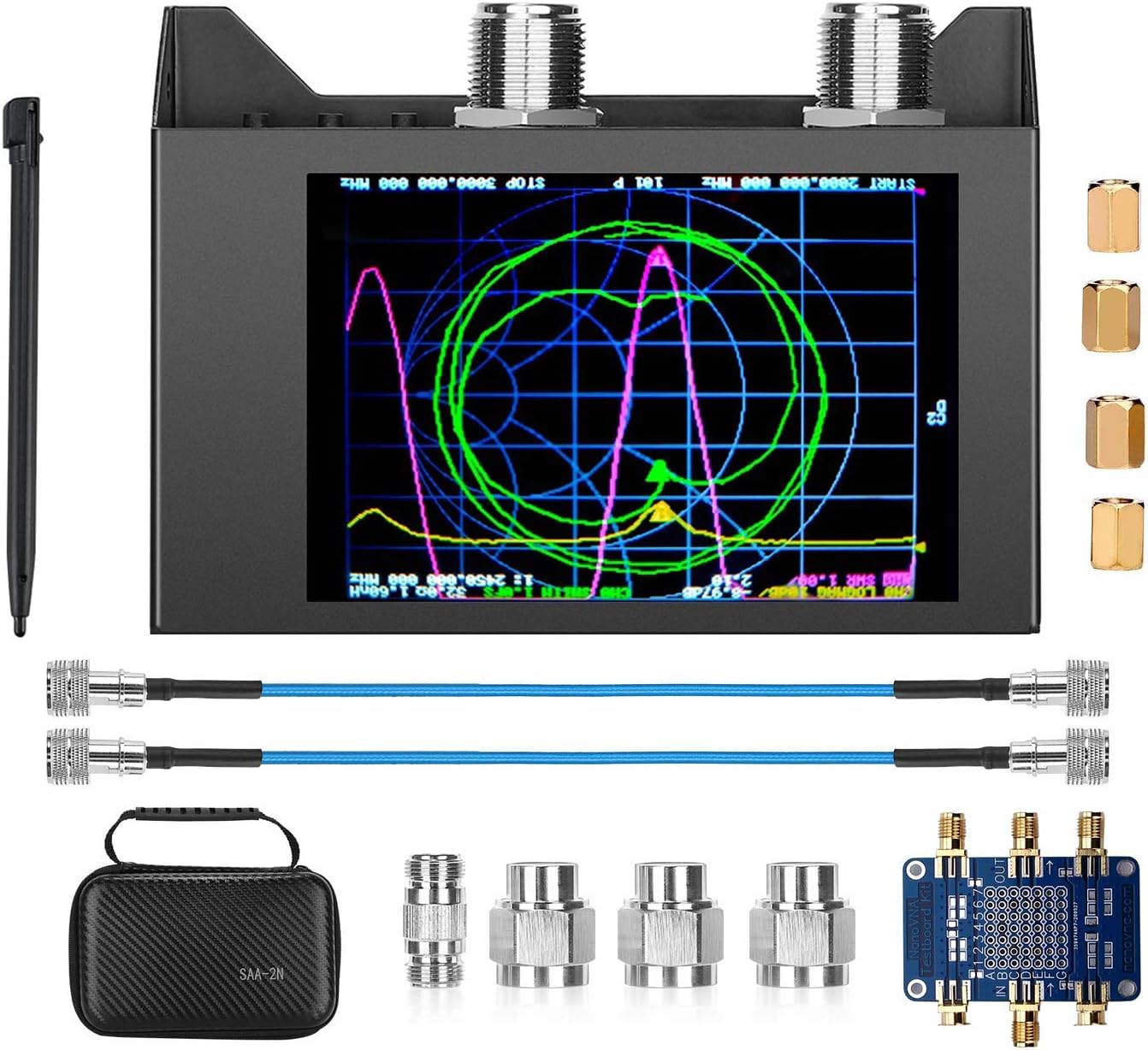
The SEESII SAA-2N uses N-type connectors instead of the fragile SMA found on budget NanoVNAs, extending the life of the RF port beyond hundreds of connect cycles. The calibration routine is manual — the unit does not load calibration data at startup and requires recalibration after every frequency change. This is a deliberate trade-off for precision: a fresh calibration at each sweep eliminates interpolation errors that can skew SWR readings at band edges.
The 4-inch touchscreen provides a clear view of the Smith chart, S11 and S21 traces, and group delay. Dynamic range is rated at 70 dB up to 1.5 GHz and 60 dB up to 3 GHz, with S11 noise floor at -50 dB and -40 dB respectively. For 99% of amateur antenna work (HF through 70 cm), these numbers translate to usable measurements with less than 1.02 SWR error. The included testboard kit adds a prototyping platform for building filters and impedance matching networks, making this a true bench tool.
The manual is a weak point — it doesn’t explain the manual calibration workflow clearly, and new users often struggle with the “no auto-load” design. YouTube tutorials fill the gap, but the learning curve is steeper than the NanoVNA-H4. The aluminum housing is lighter than the steel-clad AURSINC SAA-2N, which is an advantage in a go-bag. For the operator who keeps their analyzer on the bench and wants N-type durability, this is the best value SAA-2N variant.
Why it’s great
- Durable N-type connectors instead of SMA
- Includes testboard kit for prototype circuits
- Aluminum housing is lightweight and shielded
Good to know
- Requires manual recalibration after each frequency change
- Steep learning curve for beginners
- Manual is poorly translated
8. AURSINC SAA-2N V2.2

The AURSINC SAA-2N V2.2 is a direct competitor to the SEESII SAA-2N, but it uses a steel enclosure that adds heft and durability at the cost of portability. It measures the same 50 kHz to 3 GHz range with identical dynamic range specs (70 dB up to 1.5 GHz, 60 dB above), but it supports 201 scan points per sweep — double the 101-point limit of the NanoVNA-H4. This means smoother traces and finer resolution when sweeping narrow bandwidths, crucial for tuning high-Q filters and cavity resonators.
The N-type connectors are a major upgrade over SMA. They are threaded, 50-ohm matched to 3 GHz, and resist the mechanical wear that plagues SMA ports after field use. The unit ships with a set of N-type calibration standards (OPEN, SHORT, LOAD), two 50cm N-type cables, and an EVA storage bag. The battery capacity is listed as 3000 mAh (some units show 1950 mAh depending on manufacturing batch), which is adequate for a full day of testing but not as long as the NanoVNA-F V2.
The manual calibration requirement applies here too — the SAA-2N V2.2 does not retain calibration across power cycles or frequency changes. This design ensures measurement accuracy by eliminating interpolation errors, but it also means you must save calibration data to one of the 10 memory slots and reload it after each startup. The steel case tends to rust if stored in damp environments, so a dry bag is recommended. For the operator who values N-type ruggedness and high scan-point density, this is the mid-range king.
Why it’s great
- N-type connectors for long-term reliability
- 201 scan points for smooth, high-resolution sweeps
- Steel enclosure protects against drops and RF interference
Good to know
- Steel case adds weight and can rust in humidity
- Requires manual calibration frequency change
- Battery life varies by production batch
9. SEESII NanoVNA-H4

The SEESII NanoVNA-H4 is the entry point into the NanoVNA ecosystem, offering Vector Network Analysis for a fraction of the cost of dedicated instruments. It covers 9 kHz to 1.5 GHz using the SI5351 clock chip, with 101 fixed-scan points per sweep. The 4-inch touchscreen is a significant improvement over the original NanoVNA’s smaller display, making it easier to read Smith charts and SWR traces during field work.
The calibration routine uses the supplied SMA OPEN, SHORT, and LOAD standards, and the unit accepts calibration saves to a microSD card (up to 32 GB, not included). PC connectivity via NanoVNASaver allows exporting Touchstone (.snp) files for simulation software, making it a real engineering tool despite its low price. The 1950 mAh battery provides enough charge for several hours of intermittent use in the field, and the USB-C charging port is a welcome modern touch.
The limitations are real: the 101-point scan grid means traces appear jagged when sweeping wide bands, and the SI5351 harmonics introduce artifacts above 300 MHz that can mislead inexperienced users. The SMA connectors wear out after about 100 connect cycles, so buying spare adapter cables is wise. The supplied calibration kit is a single 50-ohm SMA load (not a comprehensive set of three). For the absolute cheapest path into VNA-level antenna analysis, the NanoVNA-H4 is unbeatable, but expect to invest time learning its quirks.
Why it’s great
- Lowest-cost entry to vector network analysis
- PC software support for Touchstone file export
- USB-C charging with adequate field battery life
Good to know
- Limited to 101 scan points per sweep
- SMA connectors wear out relatively fast
- SI5351 harmonics degrade accuracy above 300 MHz
FAQ
Why does my NanoVNA require recalibration after every power cycle?
What is the real frequency limit of the NanoVNA-H4 using the SI5351 chip?
Can I use an antenna analyzer to measure cable loss and velocity factor?
Final Thoughts: The Verdict
For most users, the best antenna analyzer winner is the AURSINC SAA-2N V2.2 because it combines N-type connector durability, high 201-point resolution, and wide 3 GHz coverage at a price that doesn’t force compromise. If you want pure field simplicity with analog feedback, grab the Comet CAA-500 Mark II. And for deep RF analysis that doubles as a spectrum analyzer, nothing beats the SeeSii TinySA Ultra+ ZS407.