
Our readers keep the lights on and my morning glass full of iced black tea. As an Amazon Associate, I earn from qualifying purchases.
Cutting the cord on cable doesn’t mean cutting out live local news, sports, and network primetime. The key is pulling in a clean, uncompressed signal directly from broadcast towers, bypassing monthly subscription fees entirely. Finding the right antenna for broadcast TV depends entirely on your distance from transmitters, the surrounding terrain, and the specific frequency bands your local stations use.
I’m Min — the co-founder and writer behind Gadgets Feed. I’ve logged countless hours analyzing signal-gain specifications, customer reception reports, and installation feedback to determine which antennas consistently deliver reliable performance across varied environments. This guide breaks down exactly what separates a fringe-reception champ from a suburban noise-maker.
The most reliable way to escape recurring bills is to install the best antenna for broadcast tv that matches your specific distance to towers and building materials.
How To Choose The Best Antenna For Broadcast TV
Before you buy, you need to know what’s broadcasting in your area. Use a site like rabbitears.info to map your local towers, their compass direction, their channel numbers (real RF channel, not virtual), and the signal strength at your address. This data tells you exactly which band—UHF (channels 14-36) or High-VHF (channels 7-13)—matters most, which directly dictates the antenna design you need.
UHF vs. VHF: The Two Critical Bands
A common misconception is that one antenna design works equally well for all channels. Most high-gain antennas are optimized for UHF frequencies, which carry the bulk of modern digital stations. However, if you have High-VHF channels (usually CBS, NBC, or PBS affiliates in many markets) within 40 miles, you must buy an antenna with dedicated VHF elements—typically a straight rod or “V” dipole. Models without VHF elements will completely miss those channels, no matter how strong the UHF performance is.
Gain (dBi) and Range Reality
Advertised ranges of 5000+ miles are physically impossible without a repeater on a satellite. Real-world range is determined by antenna gain measured in dBi (decibels relative to an isotropic source). A quality outdoor antenna with 8-12 dBi of UHF gain is realistically capable of 60-80 miles under clear line-of-sight conditions. For suburban or wooded areas, subtract 30-50 percent from the maximum claim. Focus on gain figures and customer reception reports from similar terrain, not the inflated number on the box.
Amplified vs. Passive: When to Boost
An amplifier (preamp) is not a magic bullet. If you are within 30 miles of towers with strong signals, an amplifier can actually overload your TV tuner, causing pixelation or channel loss. Amplifiers are best used in fringe areas (60+ miles) or when you need to split the signal to multiple TVs. In urban or dense suburban areas, a passive antenna (no amplifier) often delivers a cleaner, more stable picture with fewer dropped signals.
Quick Comparison
On smaller screens, swipe sideways to see the full table.
| Model | Category | Best For | Key Spec | Amazon |
|---|---|---|---|---|
| Antennas Direct ClearStream 4V | Premium | Fringe suburban & rural | Four UHF phased loops + VHF bar | Amazon |
| Televes DAT BOSS Mix LR | Pro Grade | Extreme fringe & interference | 38 dBi VHF / 46 dBi UHF with auto-gain | Amazon |
| Antennas Direct ClearStream 2V | Mid-Range | Suburban 30-50 miles | Two UHF loops + VHF dipole | Amazon |
| Five Star Yagi Satellite HD Antenna | Value | Outdoor attic mount | 8 dB VHF / 12 dB UHF gain | Amazon |
| Susbrothe 6000+ Miles Long Range | Budget | Entry-level indoor/outdoor | 52 ft RG6 coax, AC adapter included | Amazon |
| Antennas Direct 8-Element Bowtie | Multi-Directional | Targeting towers in multiple directions | 70+ mile UHF, 36 x 50 inch panel | Amazon |
| Qellaff Smart TV Antenna | Compact | Indoor or travel | Smart IC chip, 38 ft coax cable | Amazon |
In‑Depth Reviews
1. Antennas Direct ClearStream 4V
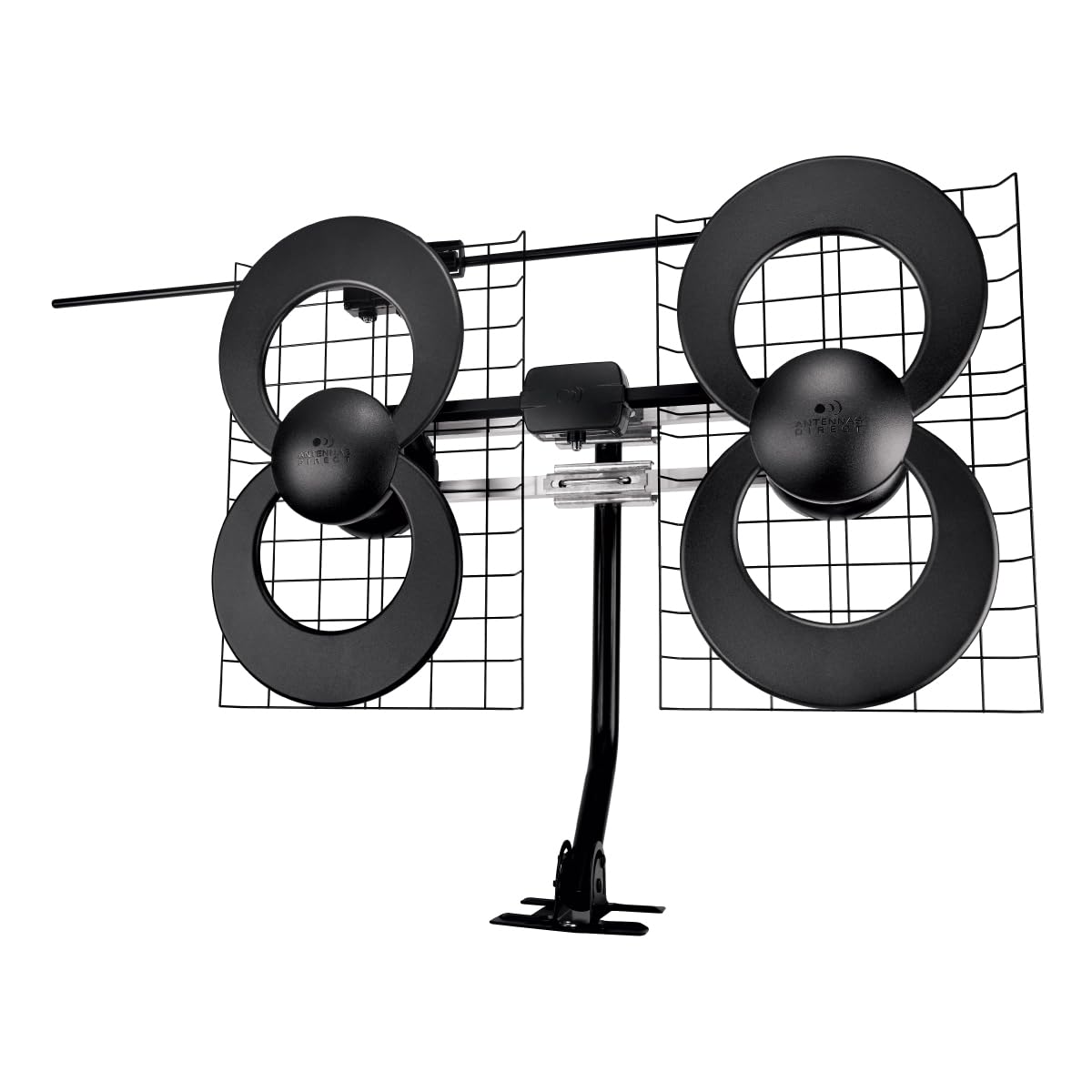
The ClearStream 4V is a proven workhorse for suburban and rural fringe reception. Its four patented phased UHF loops, combined with a dedicated High-VHF dipole element, deliver a genuine 70+ mile range where line-of-sight permits. The included reflectors add forward gain and reject multipath interference that causes pixelation, making this a favorite among users who previously struggled with cheaper flat-panel designs.
Customer reports consistently show users pulling 60-70+ channels from 35-45 miles away, even with heavy tree cover or when mounted in an attic 7 feet lower than a previous roof antenna. The VHF kit assembly is straightforward but some users noted the reflector wire requires precise alignment. The antenna measures 27.8 inches wide and comes with a 20-inch mast with a pivoting base for versatile mounting.
This antenna is ATSC 3.0 (NextGen TV) ready and handles both 4K and 8K UHD broadcasts. It does not include a preamp, which is actually a strength for users within 35 miles of towers—passive operation avoids overloading the tuner. For longer runs or extreme fringe, adding an aftermarket preamp like the Channel Master CM-7778 is a common upgrade path that many reviews recommend.
Why it’s great
- Excellent isolation of UHF and VHF with dedicated elements
- Strong 70+ mile range verified by thousands of installations
- Reflectors effectively block rear and side multipath interference
Good to know
- Coax cable not included—requires separate purchase of RG6
- Assembly requires careful alignment of VHF reflector wires
- No preamp may need an add-on for runs over 50 feet or extreme fringe
2. Televes DAT BOSS Mix LR
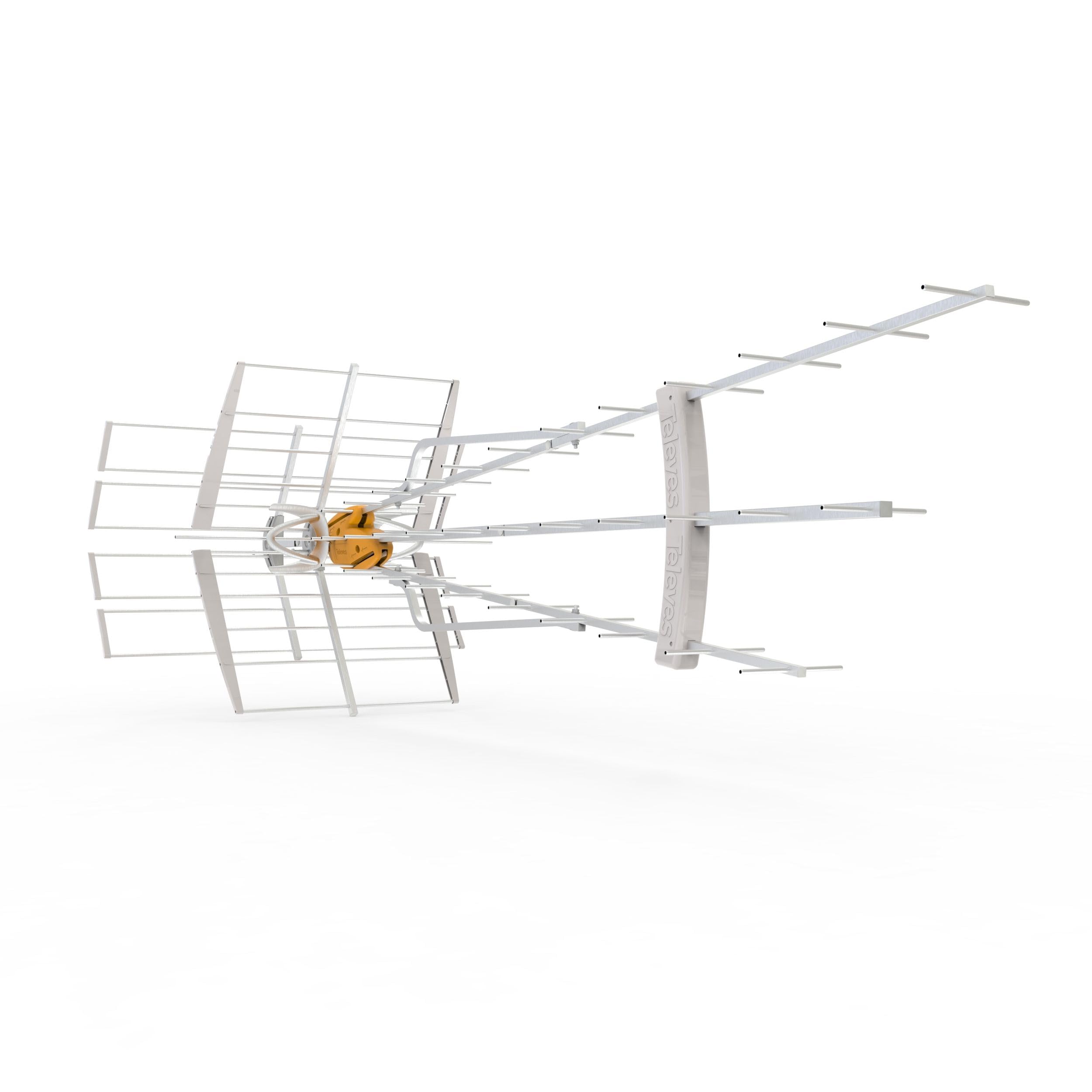
When you’re in extreme fringe territory—70 miles out with hills, trees, or nearby cell towers drowning the signal—the Televes DAT BOSS Mix LR is the answer. Its proprietary TForce intelligent gain control automatically adjusts amplification independently per band (38 dBi High-VHF, 46 dBi UHF), preventing both weak reception and overloading. The built-in FM and LTE/4G/5G filtering is a game-changer for anyone living near a cellular tower.
The stacked triple-boom design uses multiple directors and reflectors to achieve superior front-to-back ratios (12 dB VHF, 25 dB UHF), sharply rejecting multipath interference. Real-world installs from rural Wisconsin and the Seattle fringe show gains of 16+ additional channels over previous setups, with total channel counts exceeding 100 in some cases. The antenna is large—84 inches long—and requires proper mast support, but the all-metal and ABS construction ensures years of outdoor durability.
It ships with a UL-listed 12V dual-output power inserter, mast clamps, and a weather boot. The passive pass-through mode ensures you still get channels even if the power inserter fails. This is the most expensive option here, but for users in truly challenging reception zones, the Televes eliminates pixelation and weak signals that lesser antennas can’t fix.
Why it’s great
- Auto-gain per band prevents overload and signal dropout
- Built-in LTE/5G/4G and FM filtering for interference-prone areas
- Market-leading 46 dBi UHF gain with 100-mile rated range
Good to know
- Very large footprint (84 inches long) requires substantial mounting space
- Higher price point best suited for fringe or severe interference zones
- Assembly is more complex than simpler loop designs
3. Antennas Direct ClearStream 2V
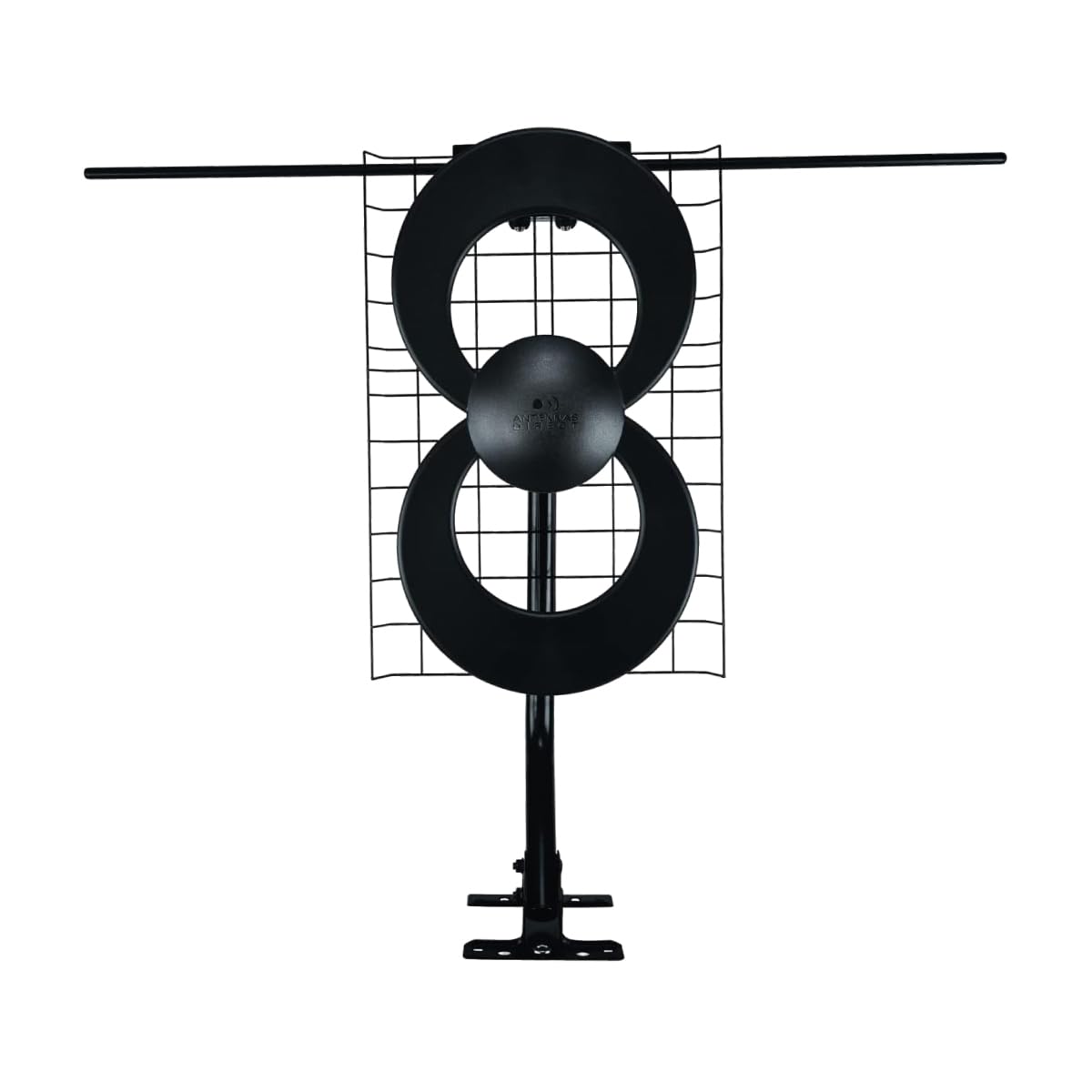
The ClearStream 2V is the sweet spot for suburban users 30-50 miles from towers who need both UHF and High-VHF coverage without breaking the bank. Its double-loop UHF design with a reflector and a separate VHF dipole provides 60+ miles of range in practice, with many users reporting 70+ channels in metropolitan areas. At 18 inches tall and 31.4 inches wide, it’s compact enough for attic mounting yet powerful enough to replace larger yagi designs.
Customer reviews consistently highlight how easy it is to assemble and mount. One user in a valley with heavy tree cover mounted it at 20 feet on a chimney and received 14 digital channels from Youngstown (40 miles) and Cleveland (48 miles). Another user in the Seattle suburbs picked up 70 channels with 65 perfectly clear, matching picture quality to their previous cable subscription. The included 20-inch mast with pivoting base works on vertical or horizontal surfaces.
Like its larger sibling, the 2V does not include a coax cable, so budget for a length of RG6. It’s also a passive antenna, which is ideal for areas with strong signals but may require an amplifier for runs over 50 feet or splitter use. The lifetime manufacturer warranty on the antenna itself adds peace of mind for long-term outdoor installation.
Why it’s great
- Excellent performance-to-price ratio for suburban installations
- Compact enough for attic mounting yet powerful for its size
- Dedicated VHF dipoles ensure High-VHF channel reception
Good to know
- Coax cable not included in the box
- May require an external preamp for runs over 50 feet or extreme fringe
- Not designed for Low-VHF (channels 2-6) reception
4. Antennas Direct 8-Element Bowtie
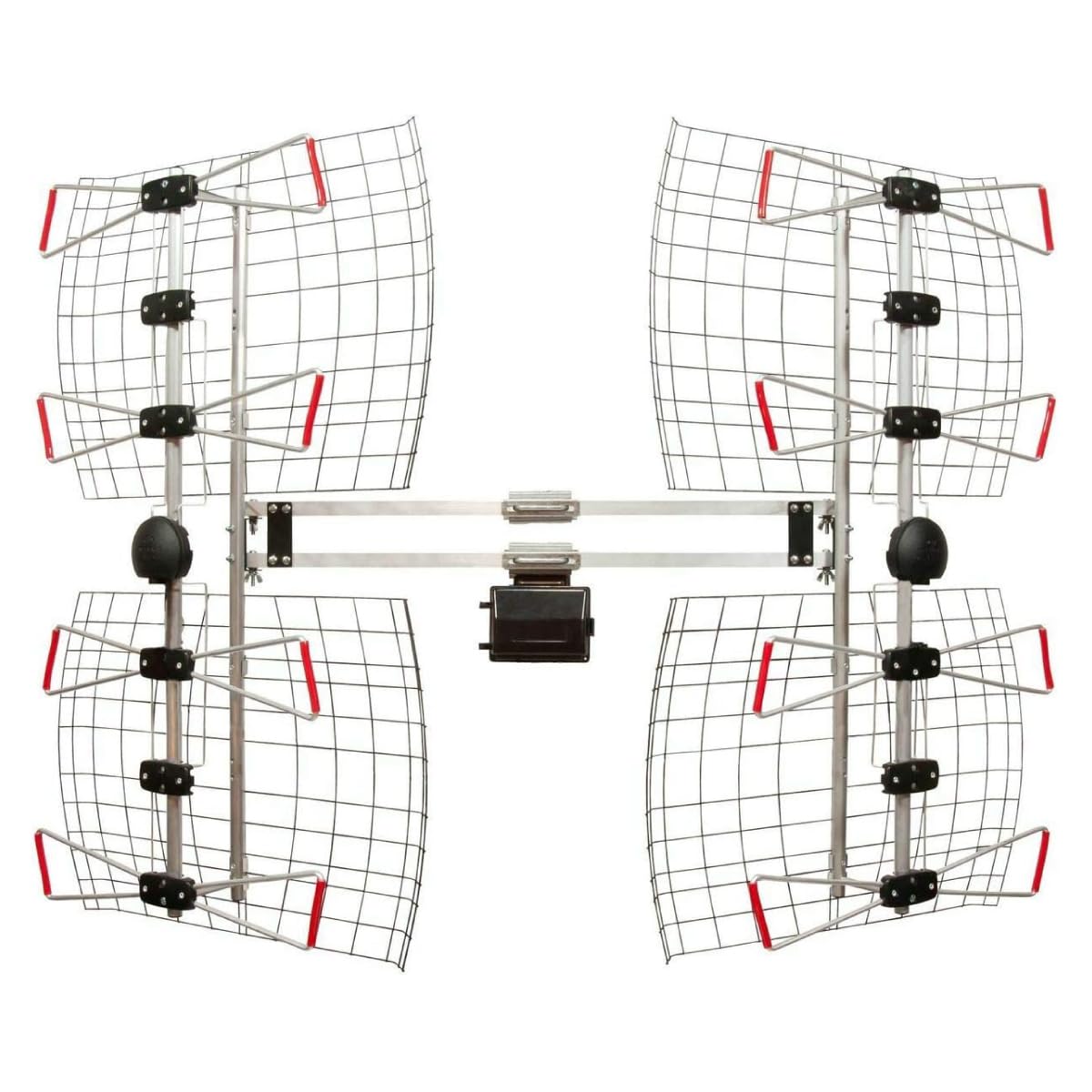
The DB8e is a specialized UHF powerhouse designed for markets where broadcast towers are spread across multiple compass headings. Its 8 driven active elements are arranged in two phased bays that can be aimed independently, allowing you to target towers in different directions simultaneously—perfect for users between two metro areas. The large reflector surface provides 70+ miles of range with excellent multipath rejection.
Real-world reports from Upstate New York demonstrate this capability: one user pointed one bay toward Binghamton and the other toward Syracuse, receiving multiple channels from both cities 50 miles away. Another user in Orlando pulled in a Melbourne station 60 miles away through a large oak tree. The antenna requires careful aiming using a DTV signal meter app, and some users note that morning dew can slightly degrade signal until it evaporates.
This antenna is strictly UHF—it has no VHF elements. If your market has High-VHF channels, you’ll need to add a separate VHF antenna and a combiner. The DB8e is also large (36 x 50 inches) and heavy (10 pounds), requiring a sturdy mast and proper wind bracing. For users whose primary challenge is pulling in UHF channels from multiple directions, this is the most effective tool available.
Why it’s great
- Dual-bay design allows simultaneous targeting of multiple tower clusters
- Exceptional UHF gain for fringe and wooded areas
- Large reflector surface rejects rear interference effectively
Good to know
- No VHF elements requires a separate antenna for channels 7-13
- Large and heavy frame needs robust mounting and wind protection
- Precise aiming is critical and can require trial and error
5. Five Star Yagi Satellite HD Antenna

Ignore the absurd 200-mile claim on the box—this is a solid, no-frills Yagi-style antenna that delivers genuine 12 dB UHF and 8 dB VHF gain for a remarkably low price. The extended-length receiving elements provide more surface area than many competing Yagi antennas in this price tier, which translates to real-world capability of 50-70 miles under decent conditions. The build quality is impressive for the price point, with weather-resistant construction and lightning protection built in.
Customer reports from the Chicago suburbs show one user pulling in 70+ channels with this antenna mounted in a basement window only 25 miles from the broadcast towers. Another user upgraded from a failing old 108-inch antenna and gained 11 additional channels, including a difficult low-power station. The included 40-foot RG6 coax cable and 20-inch mounting pole provide most of what you need for a basic outdoor or attic installation.
Be aware that this antenna does not perform well on Low-VHF (channels 2-6). The included J-pole mount has thin metal that some reviewers found insufficient for long-term outdoor durability—if you’re mounting on a roof exposed to high winds, consider upgrading to a sturdier mast. Assembly is straightforward but requires a few tools; the included instructions rely on photos rather than written steps.
Why it’s great
- Excellent 12 dB UHF gain for under
- Includes 40 ft RG6 coax and mounting pole in the box
- Weatherproof design with lightning protection
Good to know
- 200-mile range claim is wildly unrealistic—realistic range is 50-70 miles
- Included J-pole mount is thin metal not ideal for high-wind roof mounting
- Weak performance on Low-VHF signals (channels 2-6)
6. Susbrothe 6000+ Miles Long Range TV Antenna
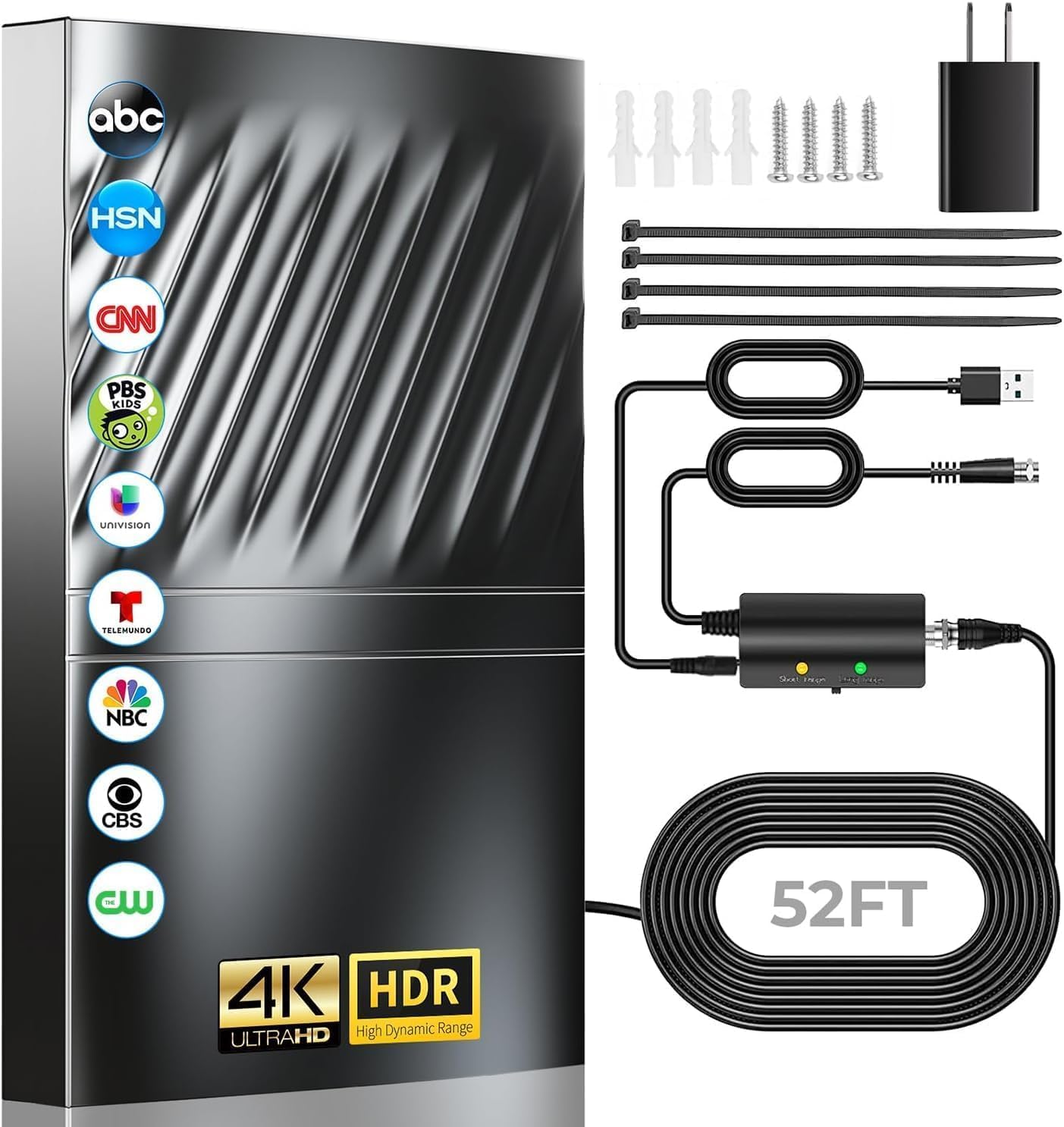
The Susbrothe antenna is a budget-friendly amplified flat panel that punches above its weight class for entry-level cord-cutters. The 2026 upgraded smart IC chip and amplifier booster do help clean up signals in the 30-50 mile range, despite the absurd 6000-mile marketing number. The 52-foot coaxial cable and included AC adapter (no need to hunt for a USB wall plug) set it apart from similarly priced competitors that shortchange you on cable length.
User reviews from rural areas confirm it works well for picking up the major networks—ABC, CBS, NBC, Fox—with clear 1080p and some 4K channels. One reviewer in a wooded area got 46 channels indoors and over 50 when moving it outdoors. The built-in filter for cellular and FM interference is a genuine benefit if you live near a cell tower. The slim, flat design is easy to hide behind a TV or mount on a wall without an eyesore.
The most important tip from experienced users: start with the amplifier set to “short range” if you are within 35 miles of towers. The long-range setting can overload the tuner with too strong a signal, causing pixelation and channel loss. Re-scan for channels after moving the antenna even a few feet. The amplifier booster does require power, so make sure your TV has a USB port or use the included AC adapter.
Why it’s great
- 52 ft coaxial cable is generous and allows flexible placement
- AC power adapter included—no need for TV USB port
- Effective filtering of cellular and FM interference
Good to know
- 6000-mile range claim is marketing hype, not physics
- Amplifier can overload tuner if too close to towers
- Requires power via USB or AC adapter to operate
7. Qellaff Smart TV Antenna

The Qellaff antenna is an affordable, compact option designed for indoor use in apartments or homes within 35 miles of broadcast towers. Its “2026 upgraded smart IC chip” is marketing speak for a basic amplifier, but the unit does deliver clean 1080p and 4K HDR signals when placed correctly near a window. The 38-foot coaxial cable is sufficient for most indoor layouts, and the included double-sided adhesive tape makes wall mounting simple.
Customer reviews are consistent: users in suburban areas report 60-80 channels after finding the right window or wall location. One cabin owner in a wooded area was impressed to get 80 channels after a quick repositioning near a window. The compact size (8.2 inches tall) means it won’t dominate your wall space, and the low-profile black finish blends into most decor. The signal booster has a short-range and long-range toggle, which helps avoid overload in strong signal areas.
The biggest caveat is that this is not a solution for rural or fringe reception—it lacks the raw physical aperture of a Yagi or loop antenna. The USB power adapter is not included (only the USB cable), so your TV must have a USB port for power or you’ll need to supply your own wall adapter. For an urban or inner-suburban user who wants a quick, no-fuss cord-cutting solution, this is a perfectly serviceable starter antenna.
Why it’s great
- Ultra-compact design fits anywhere with adhesive mounting
- Short-range/long-range toggle prevents tuner overload
- Simple plug-and-play setup in under 5 minutes
Good to know
- Not powerful enough for rural or fringe reception beyond 35 miles
- USB power adapter not included in the package
- Signal quality heavily dependent on precise window placement
FAQ
What does the “mile range” advertised on antennas actually mean?
Do I need an amplified antenna if I live 30 miles from broadcast towers?
Can I use an outdoor antenna indoors in my attic?
What is the difference between an 8VSB tuner and an ATSC 3.0 tuner for antenna reception?
Final Thoughts: The Verdict
For most users, the best antenna for broadcast tv is the Antennas Direct ClearStream 2V because it delivers the right balance of UHF and VHF reception for the 30-50 mile suburban sweet spot at a fair price. If you live in a fringe area 60+ miles from towers or battle severe interference, grab the Televes DAT BOSS Mix LR—its intelligent auto-gain and LTE filtering solve problems no other antenna can. And for the budget-conscious cord-cutter getting started, the Five Star Yagi Antenna offers genuine 12 dB UHF gain for under , proving you don’t need to spend a fortune to cut the cord.