
If your living room is a graveyard of HD channels you never watch, the single fix isn’t a more expensive cable package—it’s the piece of passive electronics sitting between your TV and the broadcast towers. That’s the only thing separating you from flawless, uncompressed 1080p and 4K signals that are already flooding through the air you breathe. Local over-the-air broadcasts deliver better picture quality than most cable feeds because there’s no compression re-encoding between the studio and your screen, and the only upfront cost is the antenna itself.
I’m Min — the co-founder and writer behind Gadgets Feed. After spending dozens of hours analyzing reception patterns, VHF/UHF frequency response data, preamplifier gain tables, and hundreds of verified buyer reports, I’ve narrowed the market down to the seven models that actually solve the core problem of locking onto local transmitters without dropouts.
Whether you’re in a dense urban core with skyscraper shadows or a fringe rural zone 70 miles from the nearest tower, this guide to the antenna for local channels in my area will show you exactly which build quality, frequency support, and range rating matter for your specific geography and home layout.
How To Choose The Best Antenna For Local Channels In My Area
Choosing the right antenna starts with ignoring the marketing range numbers and looking at three concrete factors: your distance to broadcast towers, the frequency bands those towers use, and the building materials between the antenna and those towers. Every antenna you consider is a compromise between gain, directionality, and physical size.
Distance and Direction to Broadcast Towers
The single most important variable is where you live relative to the TV transmitters. Apps like AntennaWeb or the FCC’s DTV Reception Maps give you exact tower locations, compass headings, and signal strength predictions. If you’re within 15 miles with clear line-of-sight, a passive indoor flat antenna like the Channel Master FLATenna works perfectly. Beyond 30 miles or behind hills, you need an outdoor Yagi design with real gain—the Televes DAT BOSS or the Five Star unit begin to earn their keep at those ranges.
VHF vs. UHF Support
Channel numbers are not frequency bands. High-VHF (channels 7-13) requires longer antenna elements than UHF (channels 14-36). Many compact indoor antennas effectively skip VHF support, which means you lose ABC, CBS, or NBC if those affiliates broadcast on VHF. The Antennas Direct ClearStream 2V and the Televes DAT BOSS explicitly call out dual-band support with separate element sets—that’s not a luxury, it’s a requirement in markets where VHF towers are still active.
Pre-Amplification and Filtering
A preamp boosts weak signals, but an amplifier cannot fix a bad antenna—it only amplifies everything, including noise and interference. In dense urban areas, too much gain overloads the tuner and causes pixelation. The Televes TForce system and the 1byone built-in preamp both include LTE/4G/5G filtering, which is critical if a cell tower sits within a quarter mile of your home. Without filtering, cellular signals create visible artifacts on UHF channels.
Quick Comparison
On smaller screens, swipe sideways to see the full table.
| Model | Category | Best For | Key Spec | Amazon |
|---|---|---|---|---|
| Channel Master FLATenna | Indoor Flat | Urban / Suburban 35-mile range | 35-mile range, ATSC 3.0 ready | Amazon |
| McDuory Yagi Outdoor | Outdoor Yagi | Medium-range 150-mile max claim | 150-mile claim, VHF/UHF, passive | Amazon |
| GE Outdoor 29884 | Outdoor Yagi | Suburban 70-mile range | 70-mile range, 4K/1080P support | Amazon |
| 1byone Omni-Directional | Outdoor Omni | Multi-directional 100+ mile claim | 360° reception, built-in preamp | Amazon |
| Five Star Outdoor Yagi | Outdoor Yagi | Long-range 200-mile claim | 200-mile claim, ATSC 3.0 ready | Amazon |
| Antennas Direct ClearStream 2V | Indoor/Outdoor Multi | Suburban 60+ mile range | 60+ mile range, multi-directional | Amazon |
| Televes DAT BOSS Mix LR | Pro Outdoor Yagi | Fringe / Rural 100-mile range | 100-mile, 46 dBi UHF gain, filter | Amazon |
In-Depth Reviews
1. Antennas Direct ClearStream 2V
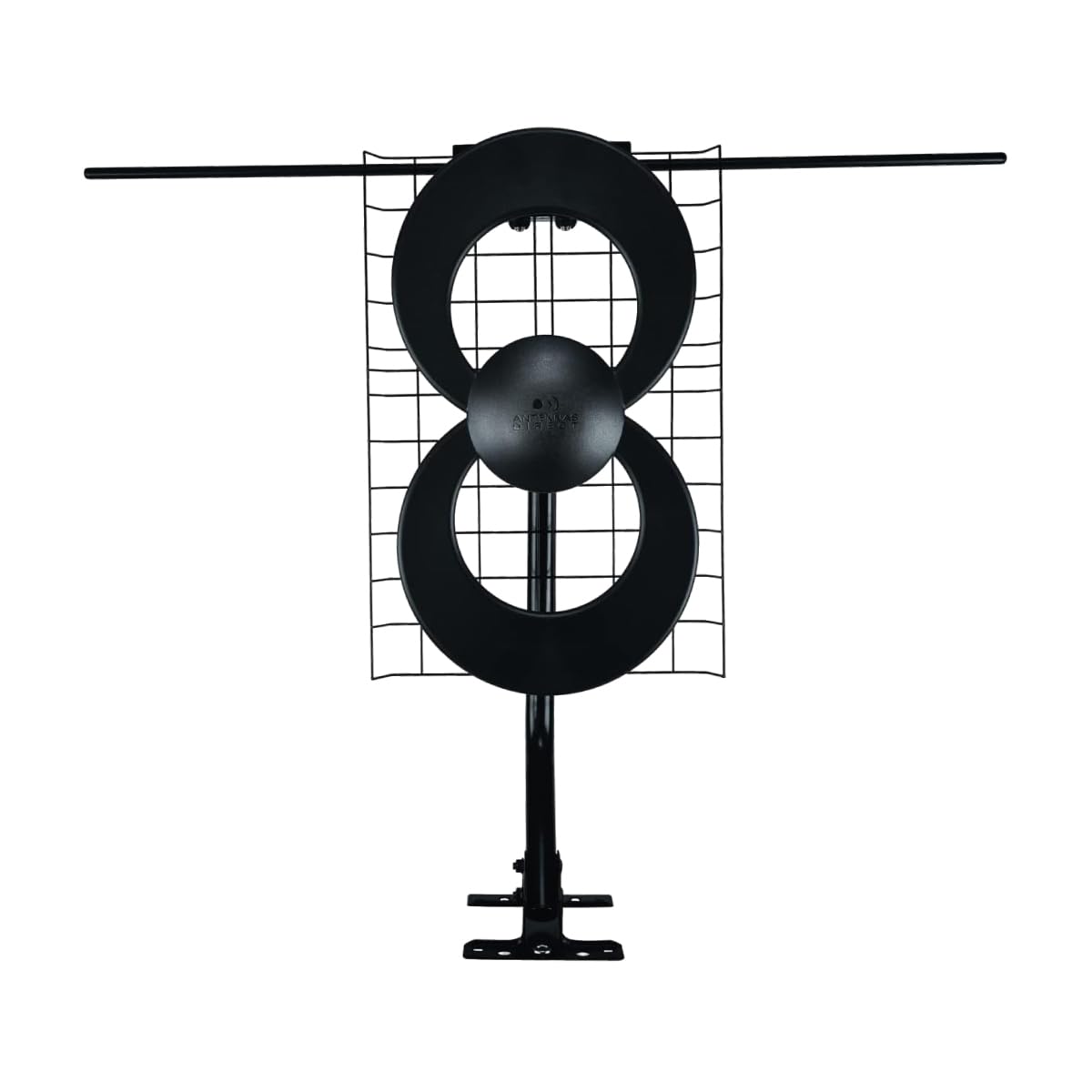
The ClearStream 2V uses a double-loop dipole element with a separate Hi-VHF component and a rear reflector that delivers true multi-directional UHF and focused Hi-VHF response. At 60-plus miles of tested reception, it hits the sweet spot for suburban buyers who face moderate tree cover and roof obstructions without needing a giant beam. The 20-inch mast with pivoting base supports vertical or horizontal mounting indoors, in an attic, or on an outdoor bracket.
Buyer feedback confirms 70 to 85 scanned channels in locations 38 to 48 miles from towers, with 1080p quality matching or exceeding the same channels delivered via cable. The open loop design inherently resists multipath interference—signals bouncing off buildings—better than flat-panel alternatives. It also supports ATSC 3.0 NextGen TV natively, so you’re not locking yourself into an obsolete standard.
One notable gap: the box does not include a coaxial cable, which is a minor annoyance during first-time setup. Reviewers 40 miles from towers behind a ridge needed an external pre-amp to stabilize low-VHF signals, but that’s more of a site-specific issue than a design flaw. For the majority of suburban and urban-fringe buyers, this is the most balanced performer on the list.
Why it’s great
- Separate Hi-VHF element captures channels 7-13 that flat indoor antennas miss entirely
- Reflector blocks rear interference, improving signal-to-noise ratio
- Compact enough to mount indoors on a top-floor window yet rated for continuous outdoor exposure
Good to know
- Coaxial cable sold separately, adding -15 to the total cost
- Weakest on low-VHF (channels 2-6), which still exist in some markets
2. Televes DAT BOSS Mix LR 149884
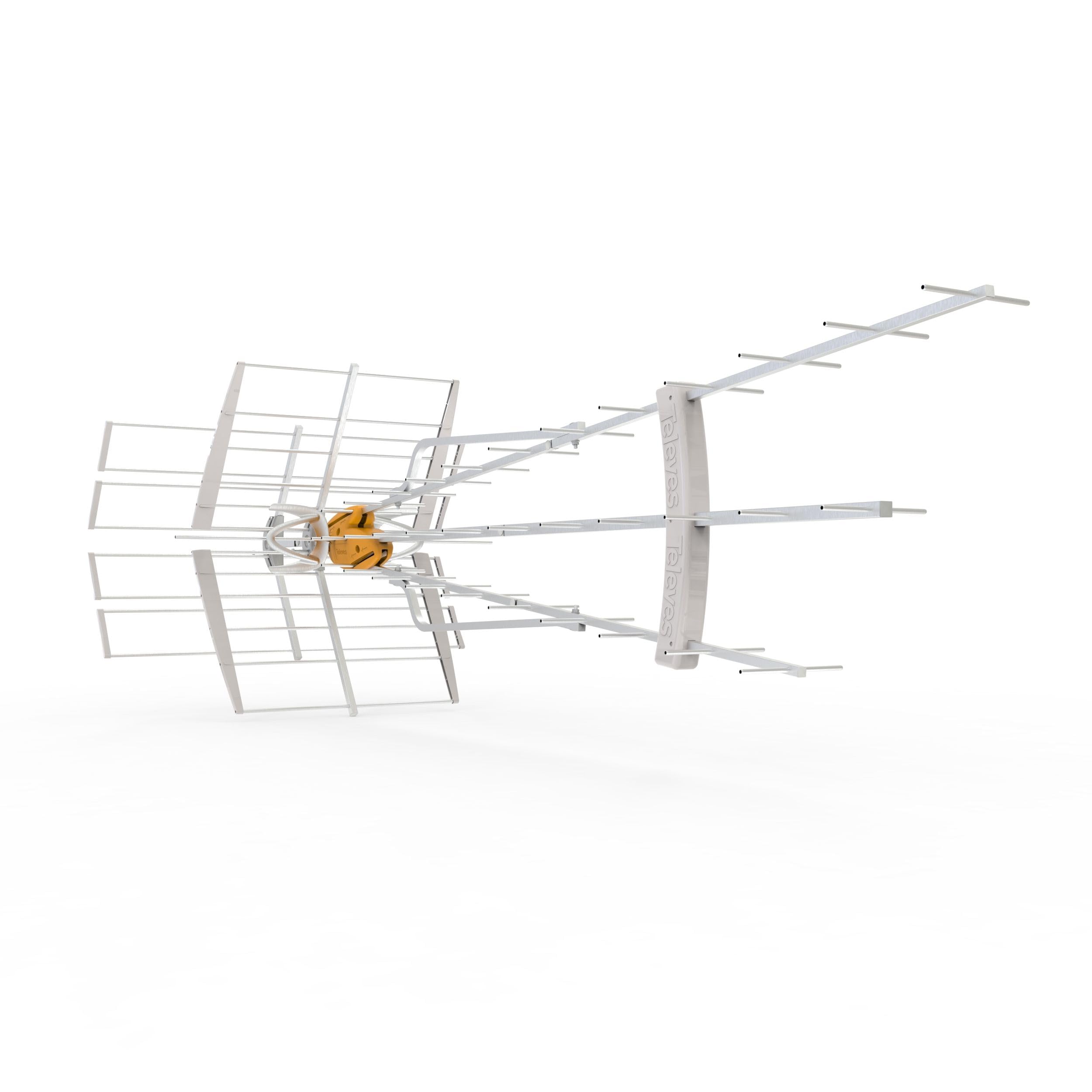
The Televes DAT BOSS is the most technically advanced unit here, and its price tag reflects that. The triple-boom stacked design with reflector elements achieves a staggering 46 dBi gain on UHF and 38 dBi on high-VHF—numbers that matter when you’re 70 miles from the nearest transmitter in a fringe zone. The built-in TForce amplifier uses closed-loop gain control per band, which prevents the overload you’d get from a generic preamp in mixed-signal environments.
Real-world reports from rural Wisconsin and the fringe of the Seattle market show an additional 16 to 37 usable channels versus previous setups, with pixelation eliminated entirely. The integrated FM and LTE/4G/5G filtering proved essential for buyers near cell towers, cleaning up the UHF spectrum enough to lock stations that previously dropped out during peak hours. The 84-inch physical width requires commitment on the mount location, but the all-metal construction suggests a 10-year lifespan outdoors.
The tradeoff is sheer size and cost. You need a sturdy mast rated for a 28-inch-deep, 84-inch-wide array, and the UL-listed 12V power inserter must be indoors. The antenna can pass signals in passive mode if power fails, but you lose the preamp advantage. For anyone in a deep-fringe or terrain-challenged location, this is the only antenna that guarantees no-pixelation reception at distances where lesser designs fail.
Why it’s great
- Closed-loop TForce amp adjusts gain per band to prevent overload at close range
- LTE/5G filtering above 608 MHz eliminates cellular interference on UHF
- Passive mode passthrough ensures basic reception even if the power inserter fails
Good to know
- Massive physical footprint requires a heavy-duty mast and careful wind-load planning
- Assembly is intricate; the manual assumes prior antenna installation experience
3. Five Star Outdoor HDTV Antenna

The Five Star antenna uses extended receiving elements—longer than typical 40-inch Yagis—to capture VHF and UHF signals at distances that most mid-range antennas cannot resolve. At 45 to 46 miles from Houston towers through buildings, one verified buyer pulled 128 channels, and another at 7,300 feet elevation in mountainous terrain locked 90 channels with 72 fully clear. The package includes a mounting bracket, J-pole, and TV splitter, so you don’t need to buy separate accessories.
The 200-mile range claim is the standard marketing exaggeration, but real-world performance at 45 to 60 miles is genuinely impressive. The key spec is the 11 dBi VHF gain, which directly translates to stable reception of channels 7-13 that many Yagi designs sacrifice. The splitter supports up to four TVs simultaneously, though each split halves the signal strength—you’ll need the included J-pole and an elevated mount to compensate.
Assembly instructions omit one critical detail: the VHF vibrator screw heads must all face the same direction to maintain correct element spacing. Reviewers who missed this step had intermittent dropout on one or two channels. The included mounting hardware is adequate for roof eave installation, but users with high-wind exposure should upgrade to a 1.5-inch mast and stainless steel U-bolts for long-term reliability.
Why it’s great
- Extended element length delivers sector-leading VHF gain for channels 7-13
- Includes 4-way splitter for multi-room setups without additional hardware
- ATSC 3.0 NextGen TV compatible at a budget-friendly price tier
Good to know
- Assembly requires attention to VHF element orientation; poor instructions
- Mount bracket is flimsy; plan to replace with a DirectTV-style mast bracket
4. 1byone Outdoor Omni-Directional Antenna

Most outdoor antennas require precise aiming—a single compass degree off and you lose a station. The 1byone eliminates that constraint with a 360-degree omni-directional design that pulls in UHF and VHF signals from every direction simultaneously. That’s a huge advantage in markets where towers are scattered around the city rather than clustered in one transmitter farm. The built-in Smart Pass amplifier adjusts gain dynamically, and the LTE filter blocks 4G/5G interference before it reaches the tuner.
In Manhattan, one buyer scanned 60 channels including CBS, NBC, FOX, and PBS with a south-facing window placement; in suburban setups, 58 channels appeared after a 15-minute auto-scan. The omni pattern does trade off gain versus a directional Yagi—at extreme fringe distances beyond 40 miles, you’ll get fewer stations than an equivalent directional antenna. But for a dense urban or suburban metro where towers surround you, this convenience justifies the premium.
The durability concern appears after extended outdoor exposure: one attic-mounted unit failed at two years when water ingress soaked the internal preamp and corroded the RF connector. Sealing the seam with dielectric grease and adding a drain hole at the lowest point drastically extends lifespan. The 39-foot RG6 coax is sufficient for most one-story homes, but two-story installations may need a coupler and extension.
Why it’s great
- Zero aiming required—captures signals from all 360 degrees simultaneously
- Built-in LTE/4G/5G filter eliminates cellular noise on UHF channels
- Simple 10-minute installation with included 39-ft coax and J-pole
Good to know
- Omni pattern sacrifices 10-15 miles of range versus a directional Yagi
- Preamp housing is not fully waterproof; seal seams for outdoor longevity
5. Channel Master FLATenna
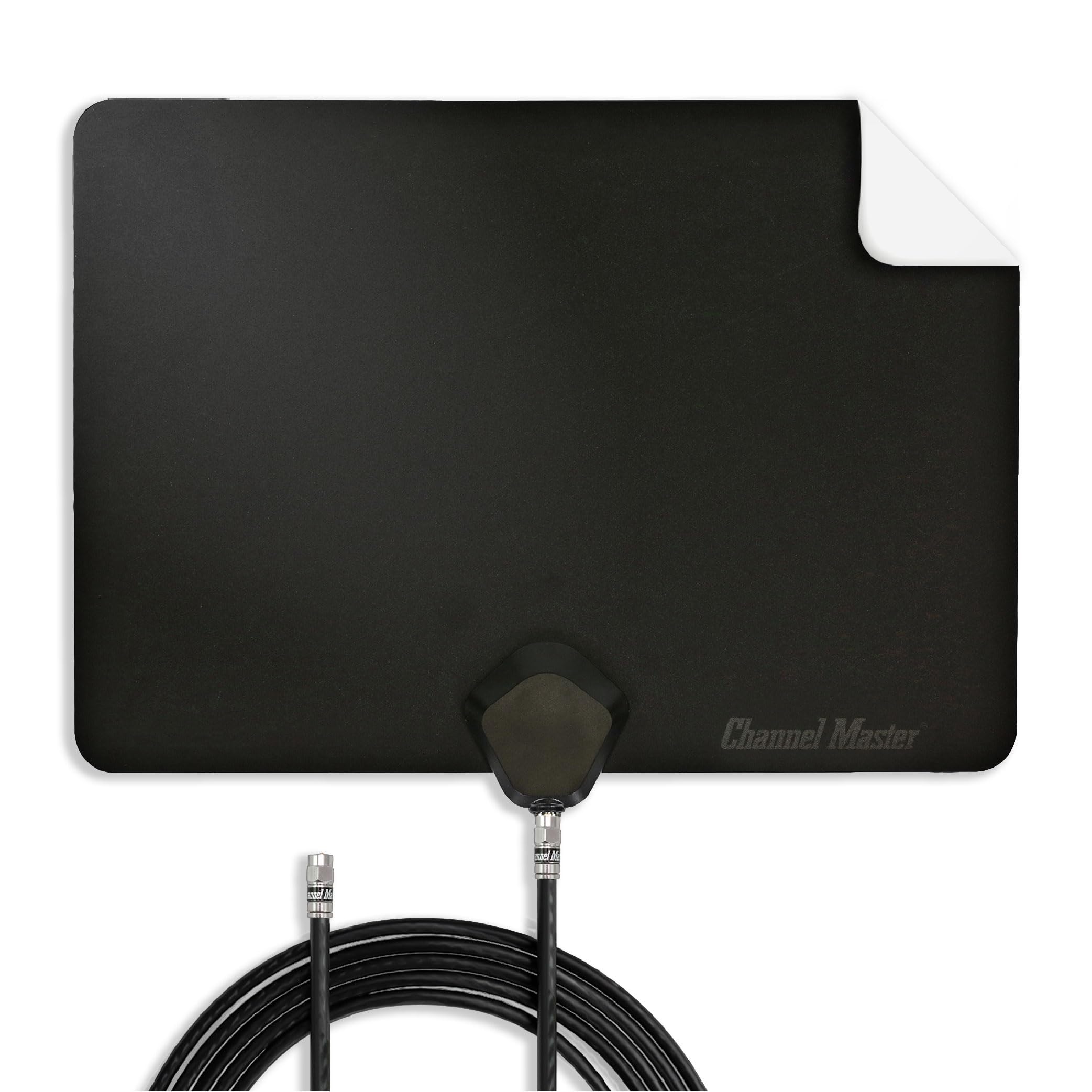
The FLATenna is the simplest path to free over-the-air TV for anyone within 35 miles of broadcast towers. The ultra-thin panel is reversible (white on one side, black on the other) and includes a 12-foot professional-grade RG6 coax with enhanced shielding that minimizes signal loss through the cable. No power source is needed—this is a purely passive design that works by attaching to a wall, window, or tabletop with the included mounting tape.
In metro Denver, a buyer scanned 71 channels including ABC, CBS, NBC, PBS, Fox, Univision, and Telemundo with no amplifier. The FLATenna supports ATSC 3.0 NextGen TV and 4K broadcasts, so it’s not obsolete if your market transitions to the new standard. The key differentiator versus budget flat panels is the RG6 cable: cheaper antennas use lossy RG59 that degrades the signal over 6 feet; the FLATenna’s RG6 preserves signal integrity over the full 12-foot run.
The realistic indoor range is about 30 miles through standard drywall and windows. Buyers further out or behind brick walls saw inconsistent reception on weaker stations like The CW or MyNetworkTV. The slim profile means you can hide it behind a picture frame or TV bezel, but placement experimentation is still required—a north-facing window versus an east-facing one can be the difference between 20 channels and 60. For the price, this is the lowest-friction entry point into cord cutting.
Why it’s great
- Zero power required; passive design consumes no electricity
- Professional-grade RG6 coax included instead of lossy RG59
- Reversible black/white finish blends into any room aesthetic
Good to know
- Realistic max range is 30 miles indoors, not the printed 35
- Thin coax cable is black only; white cable sold separately for clean wall runs
6. McDuory Yagi Outdoor Antenna

The McDuory Yagi is a no-frills passive outdoor antenna that delivers solid high-VHF and UHF reception for buyers who want attic mounting without the complexity of a powered amplifier. The Yagi design uses a long horizontal boom with multiple director elements—the longest elements capture high-VHF frequencies (channels 8 and 19, specifically), which is where many compact indoor antennas fail entirely. The 150-mile range rating is inflated, but real-world performance up to 50 miles from towers is consistent and reliable.
Buyers mounting this in attics 30 miles from transmitters report full signal bars on Fox, NBC, ABC, and CBS with no pixelation, outperforming amplified indoor antennas that barely picked up two stations. The all-metal construction with silver booms and black elements is weather-resistant enough for outdoor use, though the plastic element holders can loosen in direct sunlight over years of exposure. Assembly requires seating the rods into plastic sockets using a rubber mallet, then checking continuity with a multimeter—a 15-minute process that the instructions under-document.
The primary limitation is the lack of any built-in filtering. If you live within 500 feet of a cell tower, you’ll see intermittent UHF dropouts as the LTE signal overwhelms the front end. Adding an external LTE filter inline costs about and solves the issue. For the price, this is the most cost-effective attic antenna for suburban buyers who have wood shingle or asphalt roofs that don’t block signals significantly.
Why it’s great
- Long horizontal VHF elements capture channels 7-13 that flat antennas miss
- Passive design eliminates amp failure point and power draw
- Compact Yagi fits in most standard attic crawl spaces
Good to know
- Plastic element holders loosen over time; lubricating electrical joins with penetrox helps
- No LTE/5G filtering built-in; separate filter recommended near cell towers
7. GE Outdoor HD Digital TV Antenna 29884
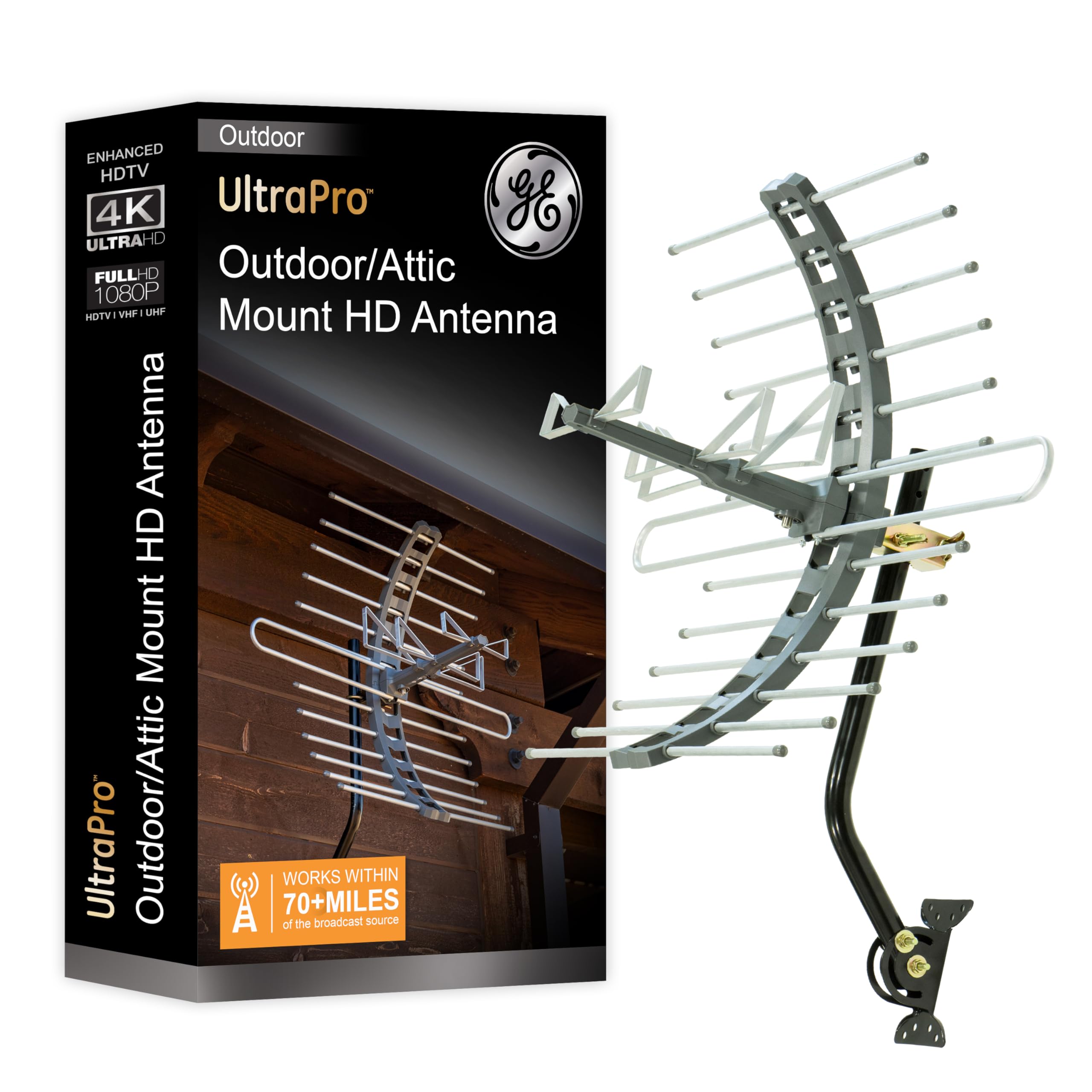
The GE 29884 is the lightest full-size Yagi on this list, weighing only 3 pounds, which makes it the easiest outdoor antenna to mount on a single-arm J-pole without reinforced bracing. The grey/white plastic housing simplifies installation and reduces wind load versus all-metal designs, but that plastic is also the durability weak point—buyers in high-UV regions report the housing becoming brittle after 18 to 24 months of direct sunlight. The 70-mile range rating is closer to 45-50 miles in practice, but that still covers most suburban and exurban use cases.
Verified reports from a far suburb picked up 106 channels without any amplifier, with only 3-4 pixelating. An elderly relative 62 miles from towers received approximately 20 clear channels using an RCA preamp, sufficient to replace a /month cable bill. The antenna supports 4K and 1080p HD at full broadcast quality, and the included J-mount works for both roof eave and attic installations. The 29-inch width is significantly more compact than the Televes or Five Star units, making it viable for smaller homes where a massive antenna would be an eyesore.
Assembly instructions are notoriously bad—the included diagrams omit washers and don’t show which screw goes into which hole. Watching a 5-minute YouTube assembly video beforehand saves frustration. The plastic construction also means the antenna is best suited for attic installation where UV exposure and rain are eliminated. If you mount it outdoors, plan to replace it every 2-3 years or seal all seams with UV-resistant silicone.
Why it’s great
- Lightest and most compact Yagi at 3 pounds for easy single-handed mounting
- Works without amplifier up to 40 miles; preamp extends range to 60+ miles
- Supports 4K/1080P HD at full broadcast bitrate, uncompressed
Good to know
- Plastic housing degrades in direct sunlight; best suited for attic installation
- Assembly instructions are incomplete; YouTube videos are essential
FAQ
Why do I get fewer channels with an indoor antenna than the box claims?
Do I need a preamplifier for an outdoor antenna?
What’s the difference between ATSC 1.0 and ATSC 3.0 compatibility?
Final Thoughts: The Verdict
For most users, the antenna for local channels in my area winner is the Antennas Direct ClearStream 2V because it combines genuine multi-directional UHF reception with a dedicated Hi-VHF element in a compact weather-resistant package that works indoors or out. If you need extreme fringe reception beyond 60 miles, grab the Televes DAT BOSS Mix LR. And for a no-fuss zero-power indoor solution under 35 miles, nothing beats the Channel Master FLATenna.