
Our readers keep the lights on and my morning glass full of iced black tea. As an Amazon Associate, I earn from qualifying purchases.
Specs are compiled from manufacturer listings and verified buyer reviews and can change over time — please confirm the key details on the product page before buying.
Cutting your monthly cable bill or getting local news and sports without buffering starts with one outdoor antenna that actually pulls in the stations you want — from the towers near you — without pixelation or dropouts every time the wind picks up.
I’m Min — the founder and writer behind Gadgets Feed. This guide is built by comparing the manufacturers’ published specifications and the patterns across verified customer reviews, so you get each pick’s real strengths and trade-offs instead of marketing spin.
From a budget-friendly Yagi (a directional antenna with multiple crossbars) that surprised reviewers with its VHF (Very High Frequency, channels 7–13) reception to a premium Televes with auto-adjusting gain that an engineer for TV stations called “excellent,” here is your plain-English breakdown of the antenna for ota that fits your home and your wallet.
Quick Picks
- Televes Ellipse Mix 148883 — Top Performer
- Televes DiNova Boss Mix 144286 — Compact Premium
- Five Star Outdoor HDTV Antenna — Best Value
- GE Outdoor HD Digital TV Antenna 33685 — Best Overall
- PIBIDI Outdoor TV Antenna UHD-8903 — Channel Hunter
- CeKay Outdoor Yagi HD Antenna — Budget Champion
- McDuory Yagi Outdoor TV Antenna — Entry-Level
How To Choose The Best Antenna For OTA
Picking the right antenna is less about the biggest number on the box and more about matching the design to your local towers. Here is what actually matters when you are standing in your attic or on your roof.
Directionality vs. Range
Most outdoor antennas are “directional” — they need to be pointed toward the broadcast towers. A Yagi design focuses its reception in one direction, which gives you stronger signal from those towers but means you might miss stations coming from a different direction. If your local towers are all clustered in one spot, a directional Yagi is your best bet. If they are scattered around you (say, some north and some west), you might need a multidirectional design or a rotator to turn the antenna.
VHF vs. UHF: The Two Flavors of TV Signals
TV stations broadcast on two different frequency bands. UHF (channels 14 and up) is the standard for most stations today, and almost any antenna handles it well. VHF (channels 2 through 13) uses lower frequencies that travel farther but are trickier to pick up cleanly. If your local channels include any in the VHF range (like channel 8 or 19), you need an antenna with proper VHF elements — not all “long range” antennas do VHF well. Check the working frequency range on the specs.
Amplified or Passive?
A built-in amplifier boosts weak signals, which sounds like a no-brainer. But if you live close to the broadcast towers (say, within 20 miles), too much amplification can actually overload the signal and make reception worse. For city and suburban homes, a well-designed passive antenna often does the job without the extra electronics. For rural or fringe areas, an amplified antenna — especially one with automatic gain control like the Televes units — makes a real difference.
ATSC 3.0 (NextGen TV) Readiness
ATSC 3.0 is the new broadcast standard rolling out across the US. It promises better picture and sound quality, stronger signals, and features like internet integration. Many newer antennas advertise “NextGen TV ready” or “ATSC 3.0 compatible,” which means they can receive those new signals when they become available in your area. If you plan to keep your antenna for years, it is worth getting one that is ready for the next generation.
Quick Comparison
| Model | Best For | Range | Channels | Amplified | Amazon |
|---|---|---|---|---|---|
| Televes Ellipse Mix | Fringe / weak-signal areas | 75 miles | 29 | Yes (auto gain) | Amazon |
| Televes DiNova Boss | HOA / compact premium | 60 miles | 35 | Yes (auto gain) | $129.95Amazon |
| Five Star Outdoor | Longest claimed range | 200 miles | 100 | No (passive) | $68.08$89.95Limited time dealAmazon |
| GE Outdoor Yagi | Reliable mid-range + brand support | 80 miles | 200 | No (passive) | $48.88Amazon |
| PIBIDI Outdoor | High channel count | 200 miles | 100 | No (passive) | $59.99Amazon |
| CeKay Outdoor Yagi | Value with included coax | 70 miles | 100 | No (passive) | Amazon |
| McDuory Yagi | Budget entry point | 150 miles | — | No (passive) | Amazon |
In‑Depth Reviews
1. Televes Ellipse Mix 148883
The antenna that an actual TV station engineer called “excellent” for pulling in weak signals.
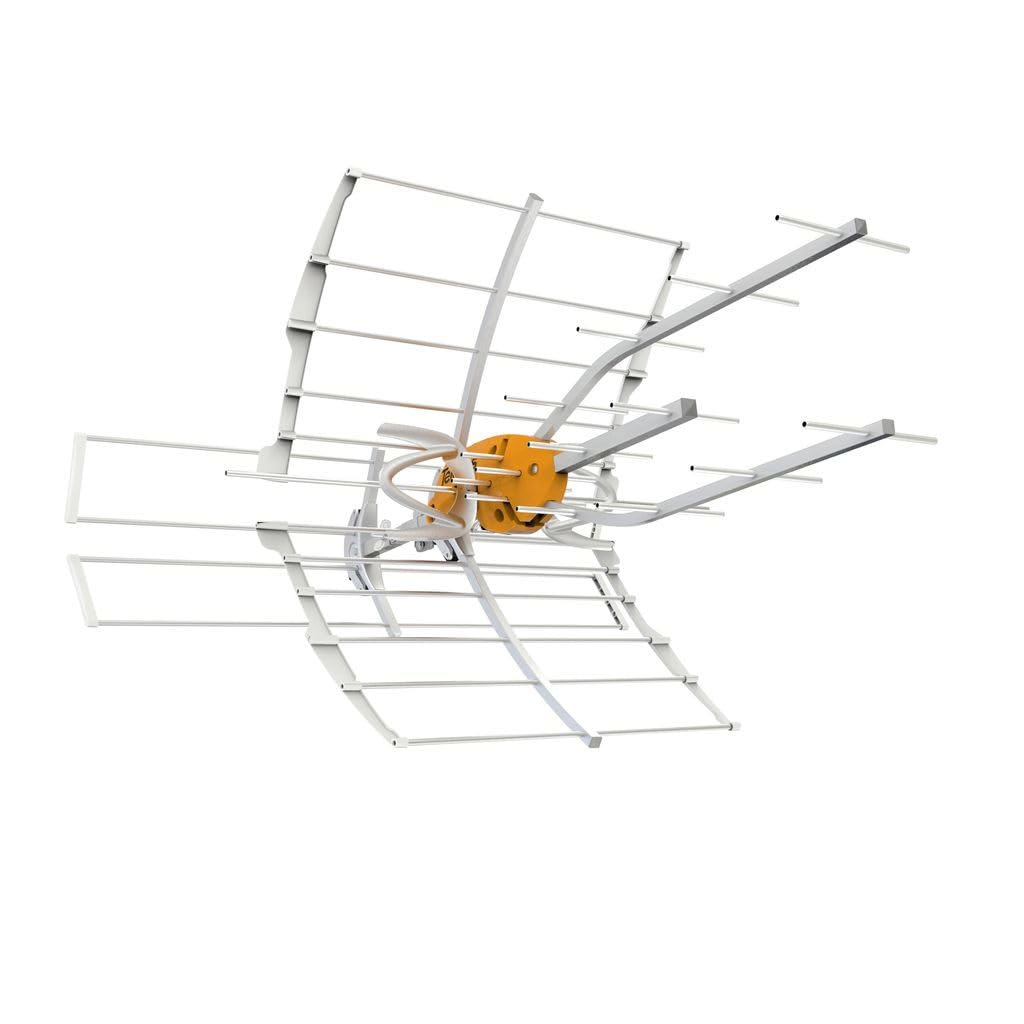
This is the serious contender for anyone stuck in a fringe zone — 75 miles of range may not sound like the highest on paper, but the real story is how it handles that distance. The built-in TForce preamplifier automatically adjusts gain (signal boost) separately for VHF and UHF (Ultra High Frequency, channels 14–51) bands — you get 36.5 dBi on High VHF and 40 dBi on UHF — preventing the overload that happens with simpler amplifiers when a strong signal comes in near a weak one. That proprietary BOSS-Tech system means you are not stuck fiddling with settings every time the weather changes.
The physical design is a triple-boom layout with curved reflectors, which helps it reject multipath interference — that ghosting or pixelation you get when a signal bounces off a building or hill. Reviewers consistently report big jumps in usable channels: one owner in Central Florida went from 85 to 113 channels after swapping an old RCA antenna, and another in Nebraska picked up 51 stations from an attic installation. The catch is the price — this is the most expensive pick here — and its 40-degree beamwidth means it is highly directional, so you need to aim it carefully toward your towers.
Where it shines
- Smart auto-gain amplifier prevents overload from strong nearby signals
- Triple-boom design delivers excellent rejection of multipath interference
- Tool-free assembly in under 60 seconds per the specs
Where it nudges
- Premium price — costs more than any other antenna here
- Very directional (40-degree beamwidth) requires precise aiming
Snag this if: you live more than 30 miles from towers or in a tricky signal area with hills and buildings between you and the broadcasters.
Look elsewhere if: you just need a cheap antenna close to town — a passive Yagi will do the same job for a fraction of the price.
2. Televes DiNova Boss Mix 144286

The antenna that hides in plain sight on your roof while delivering amplifier-smart reception.
If the Ellipse Mix is the powerhouse, the DiNova Boss is the sleek cousin that fits where aesthetics matter. Its white ABS plastic radome (a weatherproof housing) keeps the electronics dry and looks nothing like a traditional metal Yagi — one reviewer noted mounting it in an HOA community without complaints. Inside that shell, the same BOSS-Tech system works its magic, automatically adjusting gain per band (29 dBi on High VHF, 34 dBi on UHF) up to 60 miles of range.
The built-in filtering for FM, LTE, 4G, and 5G is a big deal if you live near a cell tower — those signals can sneak into your coax and mess up weak TV signals. One buyer mentioned picking up a CBS affiliate 90 miles away from an attic mount, which is impressive for a unit this compact. The tradeoff is that it tops out at 35 channels according to the specs, which is lower than some other options here. If you are in a dense urban area with lots of sub-channels, that cap might feel limiting.
One-cable verdict: The DiNova Boss is the pick for anyone who needs solid reception without a giant metal skeleton on their roof — the 31.22-inch length is compact enough for most attics and the automatic gain means less fiddling. skip it if you are within 30 miles of towers and want a cheaper passive antenna.
Second thought: At 60 miles of range and a 35-channel spec, it is best for suburban and city buyers, not rural fringe-zone chasers.
Reach for this if: your HOA or personal taste rules out a traditional metal Yagi, or you want an easy attic install with smart amp technology.
pass on it if: you need to hunt for 100+ channels from deep in the countryside — the Ellipse Mix or a high-gain passive antenna will serve you better.
3. Five Star Outdoor HDTV Antenna

A passive Yagi that packs a 200-mile claim and a splitter for multi-TV homes.
Five Star takes a different approach — no amplifier, no electronics, just a big 46-inch Yagi with a J-mount (a metal bracket that attaches to a pole) and a TV splitter in the box. The idea is that a well-designed passive antenna, properly aimed, pulls in signals cleanly without the risk of amplifier overload. Real-world results back that up: one reviewer 45 miles from Houston towers with buildings in the way picked up 128 channels, and another at 45 miles with a 2,500-foot mountain in the line of sight got 60 channels (up from 26 on their indoor antenna).
The included 40-foot RG6 coax gets you started, but reviewers caution that the claimed 200-mile range is optimistic for most terrain — one owner testing a 175-foot cable run lost a low-power station. Assembly is straightforward but picky: the instructions leave out a detail about aligning the VHF vibrator elements so screw heads face the same direction. For a mid-range price, this antenna delivers strong passive performance for multi-TV setups where you want to avoid adding a separate distribution amplifier.
Biggest win: The passive design means zero power draw and no overload worries — just aim it and scan for channels. The bundled splitter for up to 4 TVs is a real cost saver.
Honest catch: The “200-mile” claim works only on flat, clear terrain — buyers in hilly areas should expect more like 50-75 miles of reliable reception.
Best for: a multi-TV household that wants one antenna to feed every room without buying extra splitters or amps.
Not for: anyone who needs help pulling in weak signals — a passive antenna can only work with what the air delivers.
4. GE Outdoor HD Digital TV Antenna 33685

The name you know, backed by a lifetime replacement pledge and real-world proof from a Florida attic.
GE claims the number-1 spot in the antenna category for a reason: this Yagi delivers dependable reception in the 80-mile range without overpromising. The spec sheet shows 200 channels of capacity, and the real-world numbers from buyers line up. One reviewer mounted it in a Florida attic under a concrete tile roof — a notoriously difficult obstruction — and reported perfect reception from 4 different towers 35 miles away, with no pixelation even during storms. That same buyer noted the assembly instructions are poor but the actual build is easy enough to figure out.
The J-mount included in the box is weather-resistant, and the antenna supports ATSC 3.0 (NextGen TV, the latest broadcast standard for 4K and HDR) for future broadcasts. What sets GE apart here is the support: a limited-lifetime replacement pledge and free U.S.-based technical support by phone. That confidence matters when you are on a ladder mounting something to your roof. The 80-mile range is more conservative than the five-star numbers, but buyers consistently report it holds up in that zone — one reviewer 65 miles from downtown Cleveland got 36 channels, though they lost some signals depending on direction.
Why it works
- Limited-lifetime replacement and free US-based tech support add real security
- 80-mile range is realistic — reviewers prove it with concrete roof obstructions
- ATSC 3.0 ready for future broadcast upgrades
The small stuff
- Assembly instructions are thin — you might need a YouTube video
- No amplifier built in, so you may need a separate pre-amp for longer coax runs
Grab it for: a reliable, brand-backed antenna that does exactly what it says — no inflated ranges, no gimmicks, just solid reception for suburban and city homes.
Think twice if: you are in a rural fringe zone past 80 miles and need amplifier help — look at the Televes Ellipse Mix instead.
5. PIBIDI Outdoor TV Antenna UHD-8903

The antenna that one owner reported “blows me away” by pulling in 64 to 86 channels where others got 15 to 50.
PIBIDI takes a brute-force approach: longer and larger receiving elements than most competitors, designed to grab signals from further away. The spec sheet lists a 200-mile range and a 100-channel count. Real buyers report numbers that match: one reviewer in a rural area picked up all stations 40 to 100 miles away with a sharp, clear picture, beating their 12-to-15-year-old larger antenna. Another reviewer went from 15-50 channels with prior antennas to 64-86 with the PIBIDI, using old satellite dish coax and a booster.
The catch is that at this price point, you are getting a passive antenna with no built-in amplifier or smart gain control. One customer observed the signal was weaker than expected and that the company promised a free amplifier that never shipped after two months — customer service is a question mark. Also, unlike the Televes units, there is no automatic filtering for LTE or 5G interference, so if you live near a cell tower, you might need to buy a separate filter.
Real-world highlight: The extended element design clearly works for channel-hungry buyers — the jump from 15-50 channels to 64-86 is a massive real-world improvement that most antennas cannot match.
Watch out for: No included amplifier means you may need to buy one separately, and the support for that promise has been slow per some reviewers.
Ideal if: you want to maximize your channel count and are comfortable buying a separate amplifier or filter if your location needs it.
Avoid if: you want a plug-and-play package with everything in the box — the Televes or GE units give you fewer headaches.
6. CeKay Outdoor Yagi HD Antenna

A value-driven Yagi that owners mention picks up 30+ extra channels compared to what they had before.
CeKay keeps things simple: a Yagi-style antenna with 70 miles of range, a 100-channel capacity, and an all-metal build meant to survive heat, rain, wind, and snow. The package includes a 40-foot RG6 coax cable and a J-mount, so you have everything you need to get started except the ladder. One user highlighted picking up all channels with 100% signal metrics from an attic installation, getting 30+ extra channels over their old setup, with towers 20-plus miles away. Another buyer replaced a Channel Master 50 omnidirectional antenna that cost twice as much and saw their channel count jump from 13 to 35.
The all-metal construction is a plus for durability, but some customers note the included coax is thin and kinked (though still functional) and the pole connections feel loose for permanent outdoor use. Assembly requires forcing the rod elements into plastic holders — a few buyers used a rubber mallet or hammer. For the price, this is a solid entry-level Yagi that outperforms tiny indoor amplified stick antennas in almost every scenario.
Where it wins
- All-metal build with weather resistance for outdoor mounting
- Bundled 40ft RG6 coax and J-mount save you from buying extras
- Reviewers confirm real channel jumps (13 to 35, 30+ extra channels)
Where it cuts corners
- Included coax is thin — could kink during installation
- Rod elements fit so tightly you may need a rubber mallet
Perfect for: the budget-conscious cord-cutter who wants a real Yagi without spending for extras — the proven 13-to-35 channel jump is tough to top at this price. it’s not for you if you are beyond 50 miles from towers or need a preamplifier.
Skip if: you need a no-hassle outdoor install with premium coax — spend more on the GE or Five Star for beefier accessories.
7. McDuory Yagi Outdoor TV Antenna

The budget Yagi that a reviewer praised for “excellent high VHF reception” where two previous antennas failed.
At the lowest price point in this lineup, the McDuory Yagi is the entry-level choice for anyone who wants a real outdoor antenna without spending much. It covers both VHF (170-230MHz) and UHF (470-860MHz) frequencies, and one reviewer specifically called out “excellent high VHF reception (channels 8, 19)” after two other antennas failed on those exact channels. That is a real edge if your local stations broadcast on VHF — many cheaper antennas skip proper VHF elements.
The “150-mile total range” claim on the box is split into 70+ miles from the broadcast towers plus a “total” number that combines both directions — a marketing figure you should treat skeptically. Real-world installs show it works well within 20 to 50 miles of towers. The catch is assembly: reviewers point out the long rod elements need to be forced into plastic holders with a rubber mallet, and some recommend adding pop rivets or screws to reinforce them for wind resistance. The hardware can rust over time, so weatherproofing the connections is a good idea.
Standout detail: The LPDA design (log-periodic dipole array) is a legitimate antenna type used by serious hobbyists — the McDuory uses genuine Yagi engineering at a budget price.
Reality check: You get what you pay for — assembly is fiddly, the hardware may rust, and the range number is inflated, but it works great if you are within 50 miles of towers and willing to spend an hour with a rubber mallet.
Go for it if: you want the lowest-cost way to test if an outdoor antenna solves your reception problems — especially if VHF channels are what you need.
Pass if: you want a quick, tool-free install with premium build quality — spend more on the CeKay or GE for a smoother experience.
Understanding the Specs
Range (Miles)
The maximum distance the antenna can reliably pull in signals from a broadcast tower, assuming clear line of sight and flat terrain. Real-world range is almost always lower due to hills, trees, buildings, and weather. Think of the advertised number as the best-case scenario — cut it in half for realistic expectations in most suburbs.
VHF vs. UHF Frequency
TV signals come in two types. UHF (ultra-high frequency) handles channels 14 and up — that is most modern stations. VHF (very high frequency) covers channels 2-13. VHF signals travel farther but need larger antenna elements and are harder to pick up cleanly. If your local stations include any VHF channels, make sure the antenna spec lists VHF frequency range explicitly, not just “VHF/UHF” as a marketing line.
Amplification (Active vs. Passive)
An amplifier (or preamp) in the antenna boosts the signal before it travels through your coax cable. That helps if you are far from towers or have a long cable run. But if you are close to towers (under 20 miles), an amplifier can overload the signal and cause pixelation. Smart amplifiers with automatic gain control (like the BOSS-Tech in Televes antennas) adjust themselves to avoid this problem.
ATSC 3.0 / NextGen TV
The new over-the-air broadcast standard rolling out across the US. It offers better picture and sound quality, stronger signals, and features like internet integration. Most newer antennas are “ATSC 3.0 ready,” meaning they can receive those signals when they become available in your area. You will still need a TV or converter box that supports ATSC 3.0 to watch those channels.
FAQ
Will an outdoor antenna work in my attic?
How do I know which direction to point my antenna?
What is the difference between UHF and VHF?
Do I need an amplified antenna?
Can I use my old satellite dish coax for the antenna?
How many channels will I get?
What is ATSC 3.0 and do I need it?
Can I connect the antenna to multiple TVs?
What does “200-mile range” actually mean?
How do I weatherproof my outdoor antenna connections?
Final Thoughts: The Verdict
For the majority of shoppers, the best antenna for ota is the GE Outdoor Yagi 33685 because it balances a realistic 80-mile range, ATSC 3.0 compatibility, and a limited-lifetime replacement pledge from a brand that actually answers the phone. If you live in a fringe zone more than 40 miles from towers or battling hills and buildings, grab the Televes Ellipse Mix 148883 — its auto-gain amplifier and triple-boom design handle weak signals that passive antennas miss. And for the budget-conscious cord-cutter who just needs good reception within 30 miles, the CeKay Outdoor Yagi delivers with its all-metal build, included coax, and proven 13-to-35 channel jump.
How We Picked
We do not accept paid placement. Every pick is matched to a real buyer and a real use-case; we do not hands-on test units.
Sources & Methodology
Specifications: manufacturer listings and product documentation. Review insights: verified customer reviews, as of July 2026. Pricing: not shown on this page (it changes often); check the current price via the retailer link.
As an Amazon Associate, Gadgets Feed earns from qualifying purchases. This does not affect which products we feature.
Product prices and availability are accurate as of the date/time indicated and are subject to change. Any price and availability information displayed on Amazon at the time of purchase will apply to the purchase of this product. As an Amazon Associate I earn from qualifying purchases.
CERTAIN CONTENT THAT APPEARS ON THIS SITE COMES FROM AMAZON. THIS CONTENT IS PROVIDED "AS IS" AND IS SUBJECT TO CHANGE OR REMOVAL AT ANY TIME.
Amazon and the Amazon logo are trademarks of Amazon.com, Inc. or its affiliates.