
Our readers keep the lights on and my morning glass full of iced black tea. As an Amazon Associate, I earn from qualifying purchases.
Specs are compiled from manufacturer listings and verified buyer reviews and can change over time — please confirm the key details on the product page before buying.
When you pull into a wooded campsite or remote desert spot, you want a TV signal that works — not a screen full of snow.. The best antenna for your RV depends on one big choice: do you want the raw pulling power of a crank-up directional antenna (which you aim by hand) or the low-maintenance ease of a low-profile omnidirectional antenna (which grabs signals from every direction)? Both types have a clear winner here, and we will walk you through the exact trade-offs so you can pick the one that fits how you actually camp.
I’m Min — the founder and writer behind Gadgets Feed. This guide is built by comparing the manufacturers’ published specifications and the patterns across verified customer reviews, so you get each pick’s real strengths and trade-offs instead of marketing spin.
Whether you are replacing a damaged roof unit or upgrading a factory antenna that barely pulls in three channels,, the right antenna for rv depends on your tolerance for manual aiming and your travel style, and this guide breaks down five proven options to match your rig and your habits.
Our Picks at a Glance
How To Choose The Best Antenna For RV
Choosing the right RV antenna depends on your camping style, not the highest number on the box.. Do you stay in one spot for a week and want every possible channel? You will want a directional antenna you can aim. Do you move every day and hate fiddling with a crank? An omnidirectional model saves you the hassle. Here are the three specs that matter most.
Directional vs. Omnidirectional: The Core Decision
A directional (crank-up) antenna like a traditional batwing style concentrates its reception in one direction, so you physically rotate it toward the nearest broadcast towers. This gives you stronger signal in fringe areas — you trade convenience for range. An omnidirectional antenna picks up signals from all sides at once; it never needs aiming, but it generally pulls in weaker signals from distant towers. If you camp in remote national forests, directional wins. If you stay in full-hookup RV parks near cities, omnidirectional is fine.
Amplification and Signal Boosters
An amplifier boosts the weak over-the-air (OTA — signals sent through the air, not cable) signal before it reaches your TV. Most modern RV antennas include a built-in amplifier powered by 12V (the standard RV battery voltage) from your RV. Look for an integrated 4G LTE filter (a circuit that blocks cellular tower interference), which stops random signal dropouts from nearby cell towers. A “super signal booster” (a more powerful amplifier) can help in fringe areas, but an amplifier cannot create signal that is not there — if you are 70 miles from the nearest tower, no booster will save you.
Channel Count and Frequency Support
RV antennas pick up UHF (Ultra High Frequency) and VHF (Very High Frequency) channels — the standard bands for broadcast digital TV. Some also grab AM/FM radio through the same roof unit, a nice bonus if you listen to local stations while driving. The number of channels you get depends entirely on your location and the antenna’s ability to pull weak signals, not on an advertised “channel count” number on the package. A higher channel count in the specs generally reflects better tuning circuitry, but your actual reception varies by terrain.
Quick Comparison
| Model | Best For | Type | Range | Weight | Amazon |
|---|---|---|---|---|---|
| Winegard RV-3095 Sensar III★ Best Overall | Fringe-area campers who want max range | Directional Crank-Up | 65 miles | 6.5 lbs | Amazon |
| Winegard Air 360 A3-2035Easy Omni | low-maintenance, no-adjustment reception | Omnidirectional | — | — | Amazon |
| Continu.us CA1500 | Compact replacement with 2-TV output | Omnidirectional | 55 miles | — | Amazon |
| Magnadyne TV-1W | Dual TV + AM/FM reception in one unit | Omnidirectional Wing | — | 3 lbs | Amazon |
| GZMJRD RV Antenna | Budget-friendly omnidirectional upgrade | Omnidirectional | 200 miles* | 4 oz | Amazon |
In-Depth Reviews
1. Winegard RV-3095 Sensar III Amplified Outdoor RV Antenna – Crank-Up Batwing HDTV
Our pick — over 4.5★ from 500+ verified ratings; the strongest balance of quality and price.
The crank-up king that reaches deep into rural campsites where others fade out..
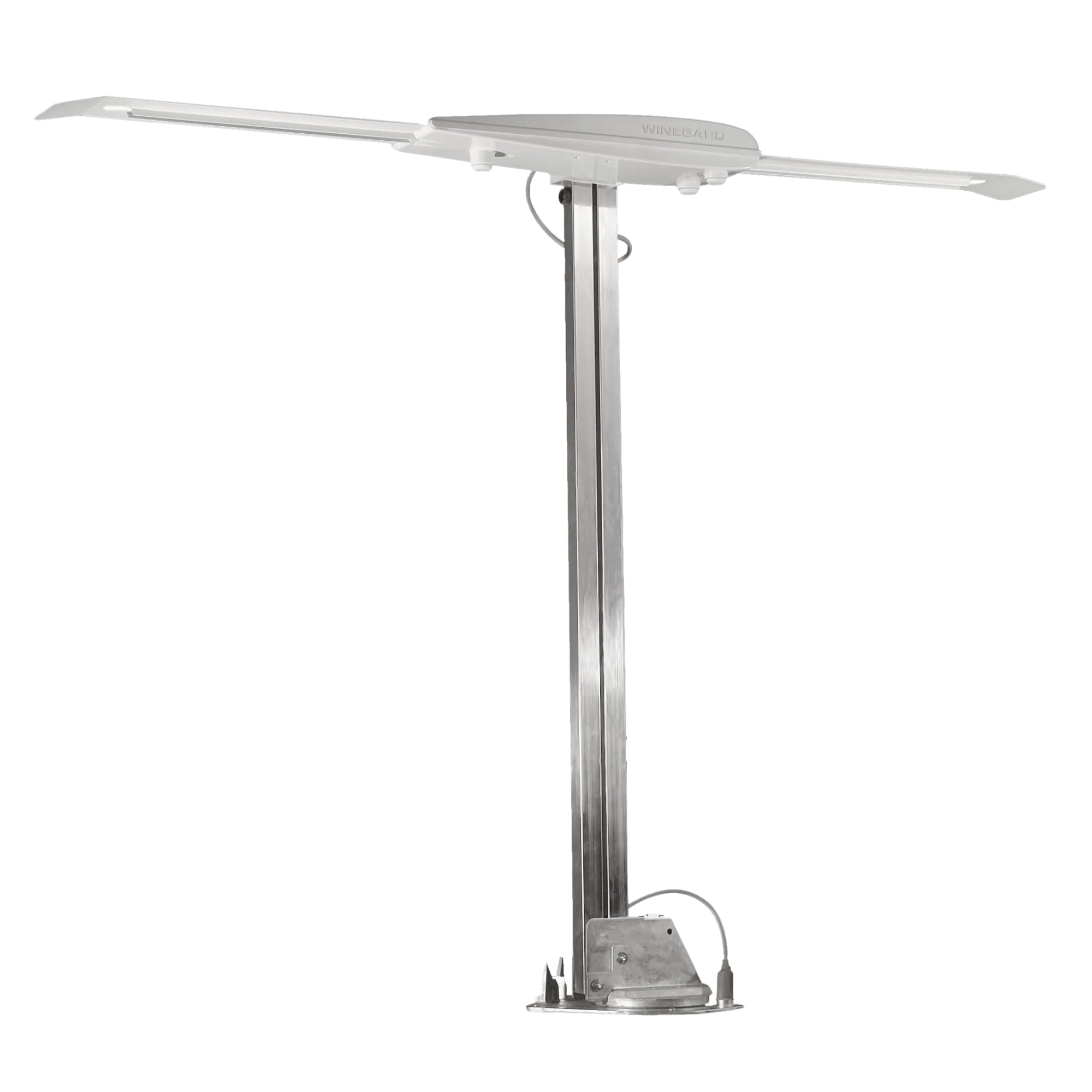
This antenna pulls in distant channels that compact omni models miss, thanks to its 65-mile range claim and 105-channel tuning capacity — a 26.2x gap versus the Air 360’s 4-channel limit. You raise the unit to a full 48.5 inches above the roof and rotate it from inside your RV, so you fine-tune the aim without climbing a ladder. Winegard claims clear reception up to 65 miles; buyers report pulling in roughly 60 channels at home, expecting similar results at campsites. At 6.5 pounds, it is far heavier than the 3-pound Magnadyne or the 4-ounce GZMJRD, but that size translates directly into pulling power.
The unit is 4K ready (able to handle the wider frequency for future Ultra HD broadcasts) and handles both UHF (Ultra High Frequency) and VHF (Very High Frequency) bands. One caveat: it is a directional antenna, so you crank and rotate it each time you park. Owners mention that the base plate may need an adapter if your RV roof is thicker than standard. The powder-coated finish resists UV and weather.
It replaces old crank-up models exactly, often reusing the same bolt holes, according to reviewers.
Long-Range Warrior
- 65-mile max range pulls in distant towers
- 105-channel tuning capacity (best in this list)
- Crank-up elevation to 48.5 inches + 360° rotation from inside
- 4K ready for future broadcast signals
Manual Work Required
- Must aim and crank up each time you park
- Heavy at 6.5 pounds — not a lightweight
- Tall profile catches wind on the road
Reach for this if: you camp in true fringe areas and are comfortable spending two minutes aiming an antenna for every new spot.
Look elsewhere if: you move daily and want zero setup — the Air 360 below is your match.
2. Winegard A3-2035 Air 360 Omnidirectional RV HDTV Antenna
The no-fuss roof dome that trades raw range for pure convenience..
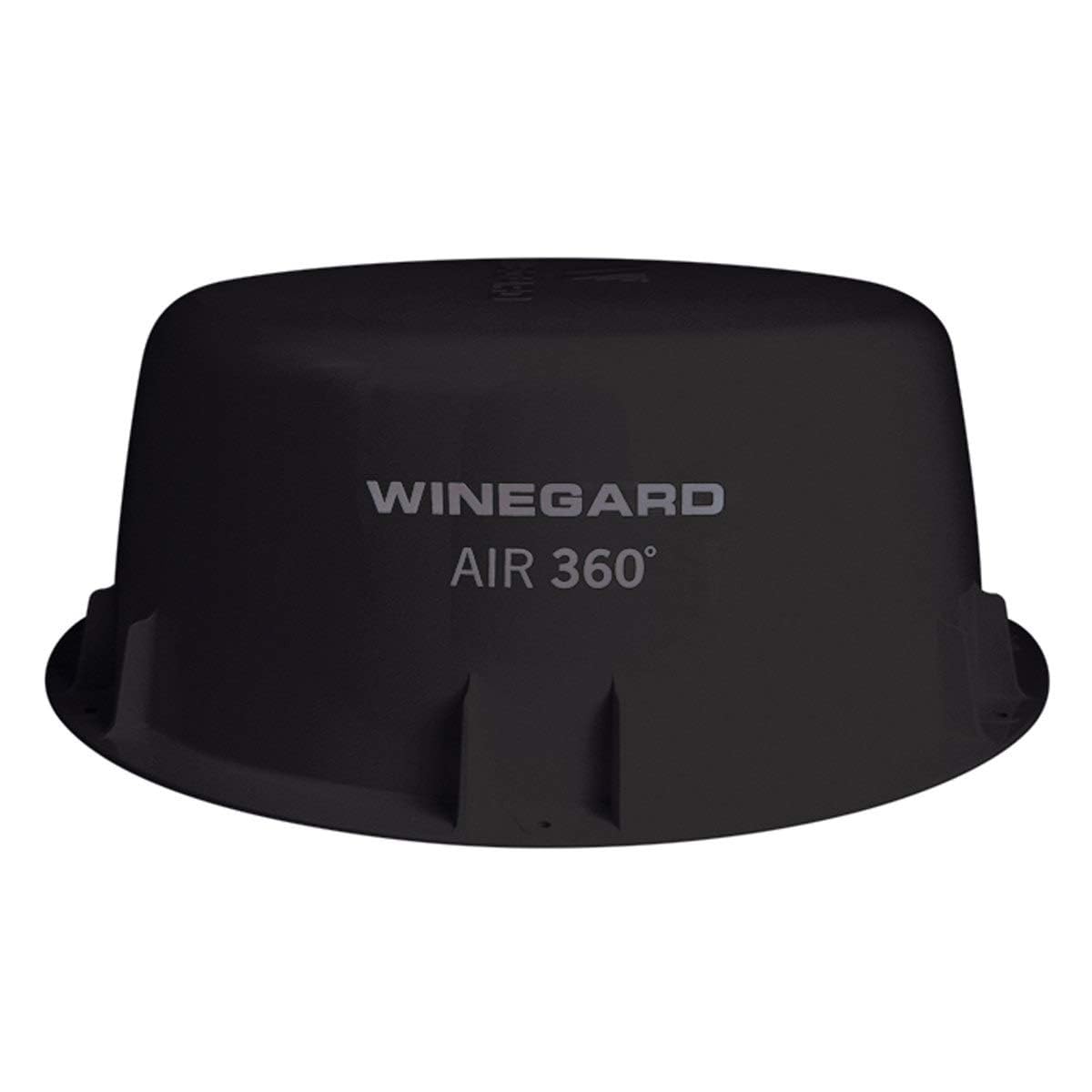
If cranking up a batwing at every stop sounds like a chore, this antenna swaps that chore for a 6.9-inch tall dome that grabs signals from all 360 degrees — you never adjust it, never aim it. Customers note it brings in channels that did not come in before with older antennas, and one reviewer noted it eliminated roof leaks that plagued their old crank-up unit. At 17.25 inches square, it covers a modest footprint and blends into the roofline.
The honest trade-off: its specification lists only 4 channels of tuning range. That is a massive 26.2x drop from the Sensar III’s 105 channels. Many buyers acknowledge it does not pull in as many distant stations as the batwing. The impedance (electrical resistance the antenna presents to the signal) is 50 Ohms versus the 75 Ohm standard on most other RV antennas, so you may need an adapter to match your existing coax cable.
Set-and-Forget Design
- 360° omnidirectional — no aiming or cranking
- Low profile (6.9 inches tall) reduces wind noise and drag
- Weather-resistant, leak-free roof mount
- Simple one-person installation over old hole
Limited Range
- Only 4-channel tuning capacity (much narrower than the Sensar III)
- Gets fewer stations than the batwing in fringe areas
- 50 Ohm impedance differs from standard RV coax — may need an adapter
Ideal for: RVers who stay near towns or parks with decent signal and do not want to fuss with a crank.
Not for: boondockers who chase weak signals 60 miles from a broadcast tower.
3. Amplified RV Antenna by Continu.us | CA1500 Digital TV 360° Reception

A compact 7-inch dome that covers two TVs and handles extreme temperatures..
This antenna powers two separate TV outputs through the included wall plate — so you can watch different channels in the living area and bedroom without adding a splitter. The manufacturer claims a 55-mile reach, and buyers back that up: one reviewer in a fringe area reported going from 1 channel before installation to 20 channels after. Another buyer noted it works from -25°F up to 145°F, surviving full-season travel. The unit sits just 7 inches tall and 7 inches square, making it the most compact dome on this list — no wind noise, no roof drag.
The 75 Ohm impedance matches standard RV coax directly, unlike the Air 360. One honest review points out it performs best when the mount is aimed toward the tower (pulling in 90+ stations), but a fixed-position mount gets fewer channels. At 55 miles of claimed range, it sits between the Sensar III’s 65 miles and the budget omnidirectional options.
Specs That Deliver
- 55-mile range with amplified omni reception
- Two independent TV outputs from the wall plate
- Operates from -25°F to 145°F — full-season use
- Ultra-compact 7-inch cube, UV-resistant
Aim Sensitivity
- Mount position matters — works best when aimed at towers
- Not as strong as directional batwing for distant signals
Best fit for: families who want one antenna feeding two TVs without signal loss.
Consider another: if you need true omni that does not care about mounting angle — the Magnadyne below is more direction-agnostic.
4. RV Omni Directional Amplified TV/AM/FM Antenna & Distribution Plate – Magnadyne TV-1W

The wing-style that pulls in TV and radio through one sleek roof unit..
Most RV antennas only handle TV, but this one adds AM/FM radio reception through the same 24-inch wing-style roof unit — so you can listen to local news or music while driving without a separate antenna. The included WS-B1 wall plate gives you two TV outputs plus a selectable shore cable input (for switching between over-the-air and campground cable at the press of a button). The unit has a built-in 4G LTE filter to minimize cell tower interference, which is valuable if you camp near busy highways. One buyer mentioned pulling 83 channels between 30 and 40 miles from the transmitter, saying “I’m surrounded by woods and still get a good strong signal.” At 3 pounds, it is 2.2x lighter than the 6.5-pound Sensar III.
The 24-inch wing is wider than dome-style antennas, and there is no published max range spec — range depends heavily on terrain. One creative buyer even mounted it on an SUV as a “cool spoiler.”
Two-Device Receiver
- TV (UHF/VHF) plus AM/FM radio in one unit
- 4G LTE filter prevents cellular signal dropout
- Wall plate with two TV outputs + shore cable switch
- Lightweight 3 pounds — easy roof install
Wing Profile
- 24-inch wing is wider than dome-style antennas
- No published max range spec — range depends heavily on terrain
Go for this if: you want one roof hole that delivers both TV and radio with cellular interference filtering.
skip it if: you only watch TV and prefer a smaller dome — the Continu.us or Air 360 take up less roof space.
5. RV TV Antennas Roof Mounted, 720° Long Range Omni Directional Reception (GZMJRD)

The entry-level omni that gives your factory antenna a clear upgrade path on a budget.
At just 4 ounces, this is the lightest antenna in the lineup — practically weightless on your roof. It features a 720° reception design (360° horizontal plus 360° vertical), and its smart IC chip (an integrated circuit designed to filter interference) claims to block cellular and FM interference for a cleaner picture. Reviewers point out it is a step up from factory antennas: one owner reported pulling in “15 more channels than the factory antenna without having to adjust.” The package includes a 35-foot coax cable (the standard cable that carries the signal), letting you place the signal booster anywhere inside the RV. The manufacturer offers a 2-year warranty, which is generous at this entry-level tier.
Be realistic about the advertised “200 miles” range — no standard broadcast tower reaches that far; it is a marketing number. The listed 65-channel count is modest compared to the Sensar III’s 105 channels. The 75 Ohm impedance matches standard RV coax, so install is straightforward.
Light & Affordable
- Ultra-light at 4 ounces — no roof load
- 35-foot coax cable included for flexible placement
- 2-year warranty — above-average coverage
- Smart IC chip designed to filter cell/FM interference
Reality Check
- The 200-mile range is a marketing figure, not a realistic expectation for broadcast TV reception.
- 65-channel count is moderate — less than the Sensar III
Best for: budget-conscious RVers replacing a dead factory antenna for basic campground reception.
Not for: fringe-area boondockers who need the 105-channel range of the Winegard crank-up.
Understanding the Specs
Impedance (Ohms) — Why 50 vs. 75 Matters
Impedance is the electrical resistance the antenna presents to the signal traveling down the coax cable. Most RV antennas and standard TV coax use 75 Ohms — the same impedance as your home cable TV setup. If you buy an antenna with 50 Ohm impedance (like the Winegard Air 360), you might need an impedance-matching adapter (a small connector that adjusts the electrical match) to avoid signal loss. In practical terms: 75 Ohm is plug-and-play with your existing cable; 50 Ohm may require an adapter.
Number of Channels — What It Actually Tells You
The “number of channels” in an antenna’s specs is the number of RF (radio frequency) channels its tuning circuitry can process, not the number of TV stations you will receive. A station like CBS or NBC may occupy one RF channel. The real-world number of stations you get depends on your distance from broadcast towers, terrain, and the antenna’s amplifier strength. For example, the Sensar III lists 105 channels — that means it can tune into that many RF frequencies. The Air 360 lists only 4 channels, which severely limits its tuning scope.
FAQ
Can I install an RV antenna myself?
Will an omnidirectional antenna work in a wooded campsite?
Do I need a separate antenna for AM/FM radio in my RV?
How do 4G LTE filters help my RV antenna?
Can I use a regular home TV antenna on my RV?
What does “4K ready” mean for an RV antenna?
How high should my RV antenna be above the roof?
Will a new RV antenna work with my existing coax cable?
Final Thoughts: The Verdict
For the majority of shoppers, the antenna for rv winner is the Winegard RV-3095 Sensar III because its crank-up directional design delivers the longest range (65 miles) and the most channel capacity (105) for the widest variety of campsites. If you value convenience over raw pulling power and rarely camp far from broadcast towers, grab the Winegard Air 360 for zero-adjustment ease. And for the best value that combines TV, radio, and a 4G filter in one aerodynamic wing, the standout is the Magnadyne TV-1W.
How We Picked
We do not accept paid placement. Every pick is matched to a real buyer and a real use-case; we do not hands-on test units.
Sources & Methodology
Specifications: manufacturer listings and product documentation. Review insights: verified customer reviews, as of July 2026. Pricing: not shown on this page (it changes often); check the current price via the retailer link.
As an Amazon Associate, Gadgets Feed earns from qualifying purchases. This does not affect which products we feature.
Related Guides
Product prices and availability are accurate as of the date/time indicated and are subject to change. Any price and availability information displayed on Amazon at the time of purchase will apply to the purchase of this product. As an Amazon Associate I earn from qualifying purchases.
CERTAIN CONTENT THAT APPEARS ON THIS SITE COMES FROM AMAZON. THIS CONTENT IS PROVIDED "AS IS" AND IS SUBJECT TO CHANGE OR REMOVAL AT ANY TIME.
Amazon and the Amazon logo are trademarks of Amazon.com, Inc. or its affiliates.