
Our readers keep the lights on and my morning glass full of iced black tea. As an Amazon Associate, I earn from qualifying purchases.
Specs are compiled from manufacturer listings and verified buyer reviews and can change over time — please confirm the key details on the product page before buying.
The stubby antenna that ships inside your scanner box is a compromise — it is short, narrowband, and built to a low cost. It might pull in the strong local tower, but the county you want to monitor, or that far-away air band (118–137 MHz), stays silent. A dedicated antenna made for wideband reception can unlock your scanner’s full potential. It turns a quiet device into a reliable window into public safety, aviation, and amateur radio traffic.
This guide compares the manufacturer’s published specs and patterns across verified customer reviews to give you real strengths and trade-offs instead of marketing spin. Here is your straightforward guide to the best antenna for scanner that cuts through the technical noise and gives you a clear upgrade path.
Quick Picks
- Antenna for Police Scanner Radios | 920S Remtronix — Best Overall
- Diamond Antenna SRH789 Wideband Telescopic Handheld Scanner Antenna — Premium Pick
- Comet BNC-W100RX Wideband Handheld Scanner Antenna — Top Performer
- Tram 1094-BNC Scanner 3 1/2″ Magnet Antenna — Best Value
- AEcreative Wide-Band Scanner Antenna — Budget Champion
- Tram 1411 Super Discone Base Antenna — Base Station
- Taurus Desktop 25-2000 Mhz Scanner Antenna — Indoor Powerhouse
How To Choose The Best Antenna For Scanner
Upgrading your scanner antenna is the single most effective way to improve reception. The wrong choice can actually make things worse. Focus on these three elements to find a match that pulls in the chatter you care about.
Match the Frequency Range to Your Listening
Every scanner antenna covers a specific slice of the radio spectrum, measured in megahertz (MHz). If you listen mostly to police and fire in the 700–900 MHz range, a narrow-band antenna tuned for 800 MHz works great. But if you want air band (118–137 MHz) or VHF marine (156–174 MHz) too, you need a truly wideband antenna — something covering 25–1300 MHz or broader. The wider the range, the more versatile the antenna. But a small gain in coverage may cost slight performance on a specific band.
Handheld vs. Base vs. Mobile Form Factor
The physical shape dictates where you use it. A short flexible whip (a “rubber duck”) fits in a pocket and survives drops — ideal for portable scanning. A telescopic whip extends for better gain on a specific band but is longer and more fragile. A magnetic-mount antenna sits on a car roof or metal shelf, often giving better range than any handheld. A large base-station discone antenna lives in an attic or rooftop, pulling signals from 50 miles or more away. Choose the form factor that matches your primary listening location.
Connector Type — SMA vs. BNC vs. Adapters
Modern scanners from Uniden and Whistler use either an SMA connector (a small, threaded screw-on type) or a BNC connector (a bayonet-style push-and-twist). Some antennas come with a BNC connector and include an SMA adapter; others are fixed. The wrong connector will not physically attach, so check your scanner’s port before you buy. For multiple scanners, an antenna with a BNC connector and a free adapter is the most flexible choice.
Quick Comparison
On smaller screens, swipe sideways to see the full table.
| Model | Best For | Frequency Range | Form Factor | Connector | Amazon |
|---|---|---|---|---|---|
| Remtronix 920S | Digital trunking (700–900 MHz) | 400–480 & 700–900 MHz | 9″ flexible whip | SMA | $59.99Amazon |
| Diamond SRH789 | VHF / Airband handheld | VHF/UHF/Airband | Telescopic whip | SMA | $35.99Amazon |
| Comet BNC-W100RX | Compact portable scanning | 25–1300 MHz | 6″ flexible whip | BNC | $44.95Amazon |
| Tram 1094-BNC | Mobile / roof mount | 30–950 MHz | 36″ magnet mount | BNC | $36.99Amazon |
| AEcreative Wide-Band | Budget wideband upgrade | 50–1200 MHz | 17″ flexible whip | BNC + SMA adapter | $25.99Amazon |
| Tram 1411 Discone | Base station / attic | 25–1300 MHz | Discone base antenna | SO-239 | $79.99Amazon |
| Taurus Desktop Discone | Indoor desktop / shelf | 25–2000 MHz | Discone desktop | BNC | $93.00Amazon |
In‑Depth Reviews
1. Antenna for Police Scanner Radios | 920S Remtronix

A tuned stub that turns a digital trunking scanner into a serious performer on the bands most police use.
This antenna from Zip Scanners is purpose-built for the 700–900 MHz P25 systems (the kind most US police and fire departments use). It delivers a claimed 6+ dB gain over stock handheld antennas from Whistler and Uniden, so you can hear a neighboring county’s traffic that was previously silent. One reviewer noted it “works very well in the 155 MHz band,” a bonus for an antenna optimized for UHF digital. On an Uniden SDS100, one reviewer heard a neighboring county’s traffic that the stock antenna missed entirely. But this is not a general-purpose wideband antenna — its focus is 400–480 MHz and 700–900 MHz. If you scan VHF air band (118–137 MHz) frequently, the Diamond SRH789 gives better all-round performance with its adjustable telescopic design.
Where it dominates
- 6+ dB gain over stock — a genuine boost on 700–900 MHz so number plates stay readable at night
- Works well on VHF 155 MHz too, per verified reviews
- High build quality reduces “unlistenable channels” according to users
Where it limits
- Narrowband design — less effective below 400 MHz and above 900 MHz
- SMA-only connector; needs adapter for BNC scanners
- Premium price reflects focused performance, not broad coverage
Your best bet if: you own a Uniden SDS100 or BCD436HP and want a real performance boost on digital trunked public-safety bands without switching to a base antenna.
Reconsider if: you scan a mix of air band, VHF marine, and UHF — a wideband whip like the Diamond SRH789 or Comet BNC-W100RX may serve you better.
2. Diamond Antenna SRH789 Wideband Telescopic Handheld Scanner Antenna

A telescopic whip you adjust to lock onto the band you want — collapsing for 800 MHz, extending for VHF or air band.
This Diamond antenna lets you extend or collapse its stainless steel sections to tune for optimal resonance on a specific frequency range. Collapse it for 800 MHz public safety, extend it partway for VHF, or fully extend for air band (118–137 MHz) — all with the same antenna. One buyer mentioned it “picks up VHF and Air Band better than any other antenna I’ve tried, and my 800 MHz traffic didn’t suffer at all,” a rare combination of broad-band coverage without trade-offs. It is light enough that it does not stress the SMA connector on your scanner. The trade-off is manual adjustment: you must change the length for best results, and the tuning chart printed on the antenna is a reflective silver that one buyer called “nearly unreadable without good lens and indirect lighting.” It is also SMA-only, so BNC radios need an adapter. For the dedicated listener who wants to dial in the perfect match for each session, this is a formidable tool — sharper at night than the Comet BNC-W100RX on VHF because of its extended length.
Adjustable resonance: The telescopic design lets you fine-tune for optimal gain on VHF, UHF, or air band, making it among the most versatile single-antenna solutions for a portable scanner.
Reach for this if: you want a single handheld antenna that adapts to different bands throughout the day — ideal for the hobbyist scanning air band, police, and ham frequencies.
Look elsewhere if: you prefer a low-maintenance whip and do not want to adjust length; the Comet BNC-W100RX is simpler.
3. Comet BNC-W100RX Wideband Handheld Scanner Antenna

A short, rugged whip that hides in a pocket yet hears further than you expect from a 6-inch antenna.
At just 6 inches long, this Comet antenna covers 25–1300 MHz — essentially everything a modern scanner can receive. Its flexible rubber whip survives being stuffed in a bag or dropped on concrete, and the BNC connector makes it a direct swap for the stock antenna on most Uniden and Whistler handhelds. One owner reported it “improved RISCOM Simulcast clarity on BCD536, avoiding SDS 200 purchase” — a strong claim that it handles tricky digital simulcast distortion (when your scanner receives the same signal from two towers at slightly different times). Another buyer noted for UHF and 800+ MHz, the antenna is compact enough to replace rubber duck antennas entirely. The compromise is that at 6 inches, it cannot match the gain of the longer Diamond SRH789 on VHF and air band. It costs more than generic replacements, but buyers consistently say the build quality is worth it — one called it “very well made” with a solid connector.
What makes it stand out
- Covers 25–1300 MHz in a 6-inch package — extremely portable
- Rugged flexible whip design that resists bending and breaking
- BNC connector fits most scanners without an adapter
Where it gives ground
- Lower gain on VHF and air band compared to a longer telescopic whip like the Diamond SRH789
- Premium price for a compact form factor
Perfect for: the mobile scanner — whether you carry the scanner in a backpack or run it in a vehicle, this antenna is tough, short, and wideband.
Not ideal if: your primary interest is distant VHF air band traffic, where a longer whip or base antenna outperforms it.
4. Tram 1094-BNC Scanner 3 1/2″ Magnet Antenna
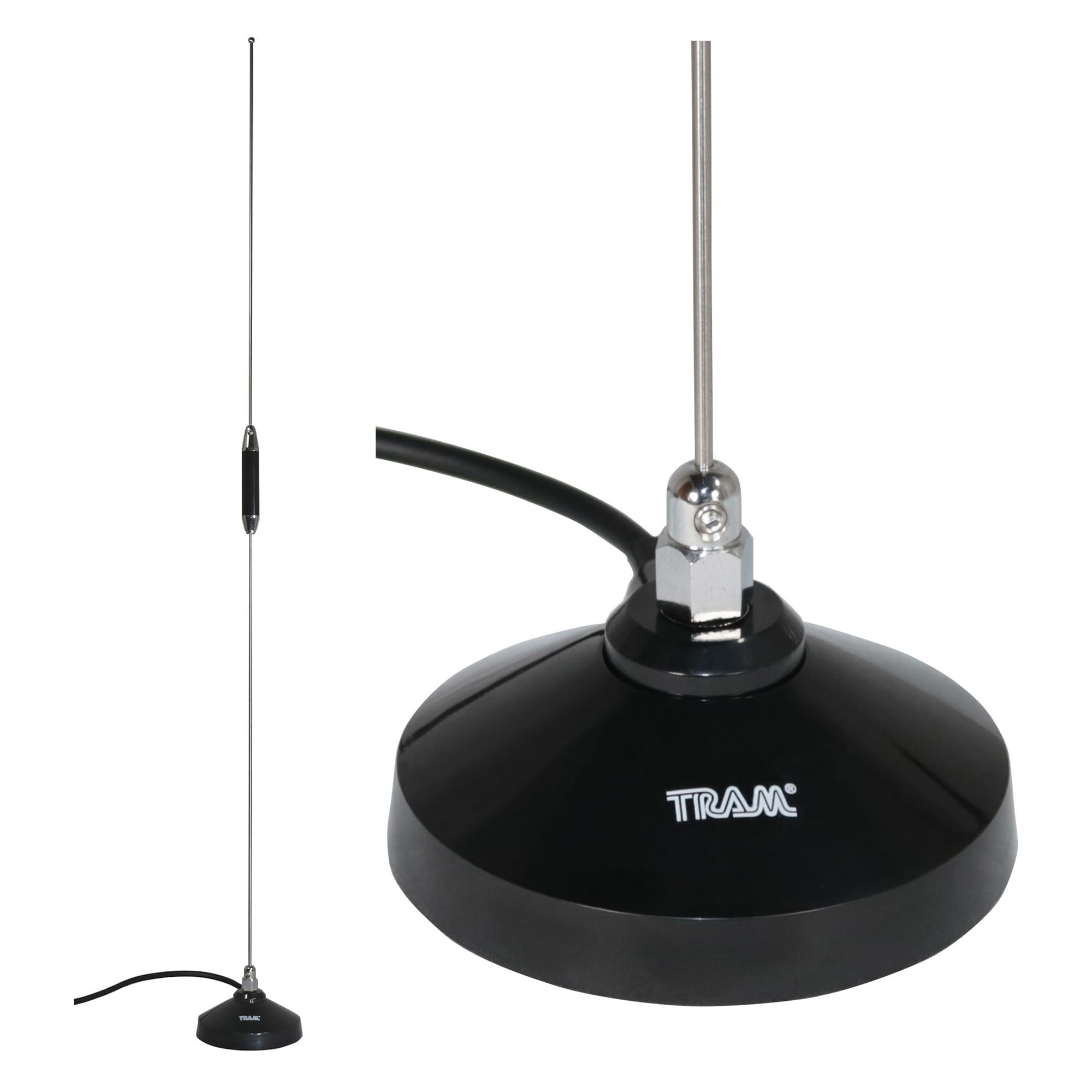
A magnetic mount that lifts your reception above the car roof — or a metal shelf at home — for the biggest single reception upgrade.
Moving the antenna out of your hand and onto a metal roof is the biggest reception upgrade you can make. This Tram antenna makes it simple. The 3.5-inch diameter magnet base sticks firmly to a car roof or any flat steel surface. The 36-inch stainless steel whip brings the listening element into the clear. One customer observed it “solved scanner interference” and they now “receive stations over 20 miles away.” Another in rural Maine described a “huge improvement over stock BNC antenna on Uniden Home Patrol” and was “hearing transmissions from ~70 miles away.” The 12-foot low-loss RG58/U cable gives you enough reach to run the coax into a vehicle cabin or through a window into a home office. The compromises are typical for a mobile antenna: the magnet can slide off in a hard corner or get knocked off in a car wash, and it needs a metal ground plane — on a fiberglass roof or wooden desk, reception drops off sharply.
Range for the money: The combination of a 36″ whip, magnetic mount, and 12′ cable gives you a serious range boost — buyers report grabbing stations 20 to 70 miles away, depending on terrain.
Grab it if: you want a fast, no-drill way to move your antenna to a metal roof or vehicle top and gain miles of reception.
Pass on it if: you have no metal surface available for the magnet to work — a handheld whip or a base-station discone is a better fit.
5. AEcreative Wide-Band Scanner Antenna

A long, bendable whip that costs little and covers a lot — if you can manage its 17-inch length.
At 17 inches, this is one of the longest flexible whips you can screw onto a handheld scanner. That extra length gives it a real advantage on VHF and air band compared to a short rubber duck. It covers 50–1200 MHz and comes with a free BNC-to-SMA adapter, working with both connector types. One user highlighted that when paired with an SDS100, it “dramatically improves air band signal strength and clarity vs stock.” The flexible material bends without breaking, useful when stowing the scanner in a bag. But as a reviewer put it, it is “very long and always in the way.” If you use the scanner on your belt or in a tight vehicle, the 17-inch whip flops around and catches on things. A few buyers noted that reception on some bands was “8-10 db better” on the factory antenna, suggesting unit-to-unit consistency may vary.
What you get for the price
- Long 17″ element for improved VHF and air band gain
- Includes both BNC and SMA compatibility in the box
- Flexible enough to stow without damage
What to watch for
- Unwieldy length makes it impractical for belt or pocket carry
- Mixed reviews on consistent performance across all bands
Best for: the budget-conscious listener who wants to try a long whip without spending much — works best when the scanner is sitting on a desk.
skip it if: you need a pocket-friendly antenna or you expect consistent performance on tricky digital simulcast systems.
6. Tram 1411 Super Discone Base Antenna
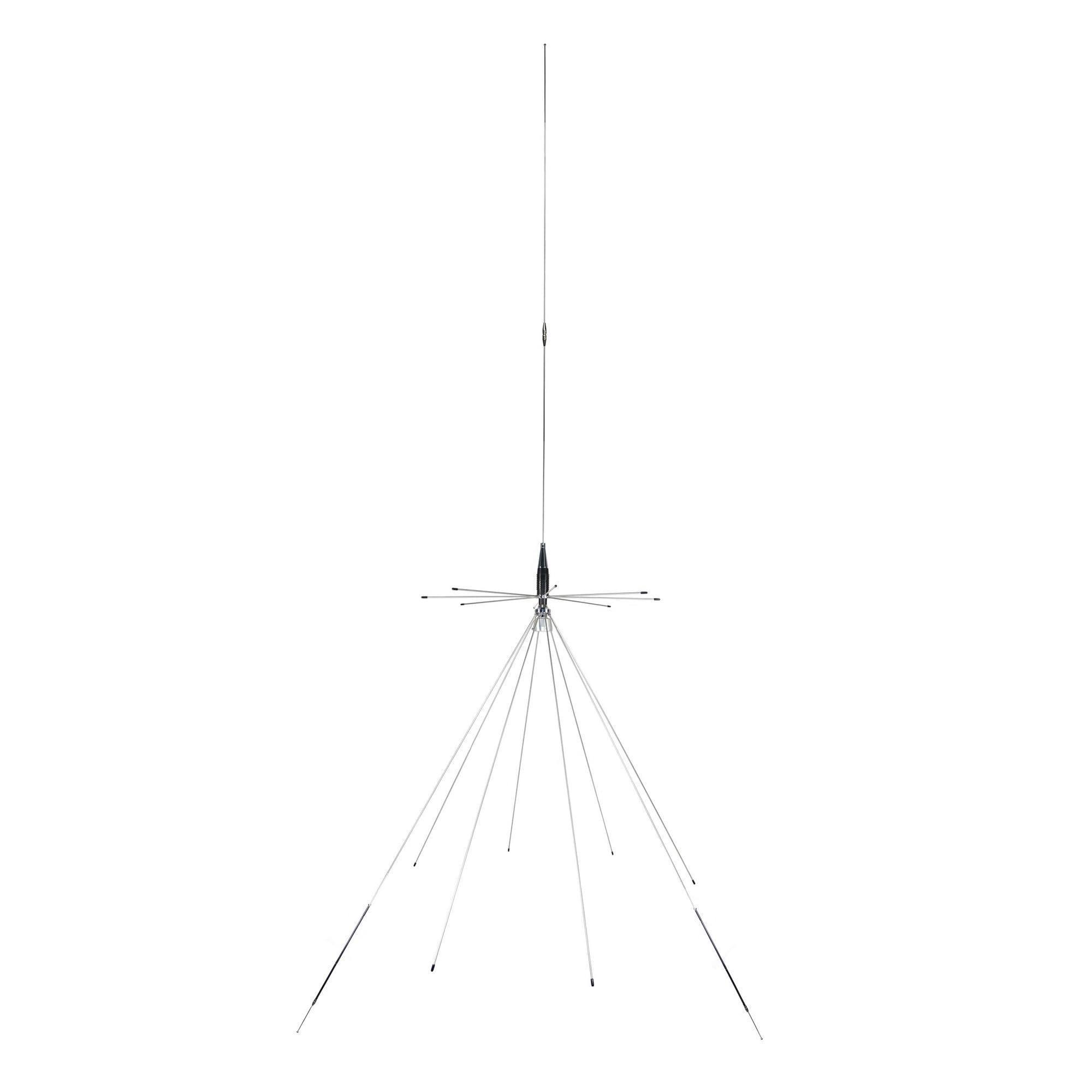
A full-size discone that turns a scanner into a serious monitoring station — covering 25 MHz to 1,300 MHz.
If you are ready to move beyond handheld antennas, this base-station discone from Tram offers immense wideband coverage from 25 MHz to 1,300 MHz, plus transmit capability on ham radio bands. The stainless steel structure has 8 upper radials at 10.5 inches each and 6 lower radials at 32 inches, plus a top whip of 55 inches. Assembly is straightforward, though one reviewer warned to “watch for tiny set screws in box.” Inside an attic, one shopper added “clear reception” with a Uniden scanner. Another used it outdoors and achieved an SWR (standing wave ratio, a measure of how efficiently the antenna transmits) of 1.1:1 on CB channel 19 — excellent efficiency. The trade-off is physical size: the assembled antenna is roughly 44 inches wide and 102 inches tall, requiring a mast pipe under 1.25 inches in diameter. It uses an SO-239 connector, so you need a BNC-to-SO-239 adapter for BNC scanners. One reviewer noted the SO-239 lacks the notch for PL-259 plug spikes, a minor annoyance.
Wideband reach: With coverage from 25 MHz to 1,300 MHz, this discone pulls in everything from shortwave utility stations to 900 MHz trunked systems — a true one-antenna solution for monitoring.
Choose this if: you have attic or roof space and want to hear distant signals that no handheld antenna can reach.
Avoid if: you need portability or cannot drill into a roof or mast — this is a stationary, full-sized base antenna.
7. Taurus Desktop 25-2000 Mhz Scanner Antenna

A desktop discone that brings base-station performance to your shelf — no drilling required.
This Taurus antenna solves the problem of wanting discone performance without a roof installation. It uses a heavy-duty 125mm magnetic plate as its base, so you sit it on a metal shelf or filing cabinet and get a solid ground plane instantly. The frequency coverage stretches from 25 MHz to 2000 MHz — wider than any other antenna in this guide. One reviewer called it “ridiculously well built” and said their “scanner came alive,” pulling transmissions 50+ miles away while local signals stayed crisp. Another user in a poor foothill area reported “great indoor reception” for their SDS200. At 70cm (about 27.5 inches) tall and roughly 18 inches in diameter, it is not small — one buyer mentioned it is “slightly bulkier than expected.” The magnetic base is stationary use only, though the manufacturer says it works on a car roof too. The 4-meter RG58 mil-spec coax cable gives you plenty of reach, and the BNC male plug fits most scanners directly. If you are in a tough radio location and cannot install a roof antenna, this is a serious indoor solution that rivals outdoor performance.
Why it works indoors
- Massive magnetic base creates an instant ground plane on any metal surface
- Covers 25–2000 MHz — more range than any other antenna listed
- Owners mention pulling signals 50+ miles away, even in poor reception areas
The size trade-off
- 18-inch diameter and 27.5-inch height take up noticeable desk space
- Magnetic base is for stationary use only — not for portable scanning
Perfect for: the listener in a basement apartment, apartment complex, or valley who cannot mount an outdoor antenna but still wants real range.
Not for: portable scanning — this antenna stays put on a desk or shelf and does not travel.
Understanding the Specs
Frequency Range (MHz)
This is the single most important number on the spec sheet. It tells you what slice of the radio spectrum the antenna can receive effectively. A range of 25–1300 MHz covers almost everything a consumer scanner can pick up — from VHF (30–300 MHz) through UHF (300–3000 MHz). Narrower ranges like 400–900 MHz trade off air band coverage for better performance on public-safety digital systems. Know what bands you listen to most, then pick an antenna whose range includes them.
Connector Type: BNC vs. SMA
Your scanner has one of these two ports. BNC is a bayonet-style connector that pushes on and twists to lock — common on older Uniden and Whistler models. SMA is a smaller threaded screw-on connector used on newer handhelds like the Uniden SDS100 and BCD436HP. Some antennas include an adapter to switch between the two; others are fixed. The wrong connector simply will not attach without an adapter, so check your scanner’s port before buying.
FAQ
Will a longer antenna always give better reception on a scanner?
Can I use a scanner antenna on a ham radio transceiver?
What is the difference between a wideband and a narrowband scanner antenna?
Does a magnetic-mount antenna need a metal roof to work?
Will a better antenna fix digital simulcast distortion?
Can I use a discone antenna indoors?
How do I clean and maintain a scanner antenna?
Why does my new antenna not pick up as well as the stock one on some bands?
Final Thoughts: The Verdict
If you want one dependable pick, the antenna for scanner that covers the widest range of needs is the Remtronix 920S because it delivers a genuine 6+ dB gain on the digital trunked bands that most modern police and fire departments use, all in a compact 9-inch whip. If you want a versatile wideband handheld that adapts to any band you throw at it, the Diamond SRH789 telescopic whip is an excellent choice. And for the listener ready to make the leap to base-station performance without drilling into the roof, the Taurus Desktop Discone brings 50+ mile reception right onto your shelf.
How We Picked
We do not accept paid placement, and we did not hands-on test every unit. Instead, we match each pick to a real buyer and use-case by comparing the manufacturers’ published specifications against the patterns in verified customer reviews — so you get each pick’s real strengths and trade-offs instead of marketing copy.
Sources & Methodology
Specifications: manufacturer listings and product documentation. Review insights: verified customer reviews, as of July 2026. Pricing: not shown on this page (it changes often); check the current price via the retailer link.
As an Amazon Associate, Gadgets Feed earns from qualifying purchases. This does not affect which products we feature.
Product prices and availability are accurate as of the date/time indicated and are subject to change. Any price and availability information displayed on Amazon at the time of purchase will apply to the purchase of this product. As an Amazon Associate I earn from qualifying purchases.
CERTAIN CONTENT THAT APPEARS ON THIS SITE COMES FROM AMAZON. THIS CONTENT IS PROVIDED "AS IS" AND IS SUBJECT TO CHANGE OR REMOVAL AT ANY TIME.
Amazon and the Amazon logo are trademarks of Amazon.com, Inc. or its affiliates.