
Our readers keep the lights on and my morning glass full of iced black tea. As an Amazon Associate, I earn from qualifying purchases.
The frustration is universal: you mount an antenna, run a channel scan, and get nothing but static or a handful of foreign-language channels. The box promised 100 miles, but your living room reality is closer to ten. The disconnect between marketing range and real-world reception is the single biggest pain point in over-the-air TV — and it’s entirely avoidable once you understand how antennas actually work.
I’m Min — the co-founder and writer behind Gadgets Feed. I’ve spent countless hours cross-referencing customer reception reports against technical specifications to build this guide, filtering out the exaggerated range claims to find the antennas that consistently deliver strong signals in real homes, not just ideal lab conditions.
After analyzing dozens of models against real-world reception data, these are the seven standouts that actually earn a spot in your home as the best antenna for tv reception across every installation scenario and budget tier.
How To Choose The Best Antenna For TV Reception
The antenna market is flooded with exaggerated claims, but the actual performance of any model boils down to three factors: the frequencies it supports, where you place it, and the amplifier quality. Ignoring any of these three guarantees disappointment.
UHF vs. VHF: The Frequency Divide That Determines Your Channels
Most antenna manufacturers love to talk about range, but the real question is whether the antenna handles both UHF (channels 14–51) and VHF (channels 2–13). Many slim indoor models are UHF-only, which means they will completely miss major networks like ABC and CBS that still broadcast on VHF in many markets. If you do not see “VHF” explicitly listed in the specs, you are buying a partial solution.
Amplified or Passive: When the Boost Actually Matters
A built-in amplifier sounds like a pure advantage, but it is not. If you live within 20–30 miles of broadcast towers, an amplified antenna can actually overload the TV tuner, causing pixelation and channel loss. Amplifiers are essential for long cable runs (over 30 feet) or for overcoming building materials like brick and stucco. For close-range, clear-line-of-sight setups, a passive antenna often delivers cleaner signal.
Omni-Directional vs. Multi-Directional: The Tower Trade-Off
Omni-directional antennas pick up signals from 360 degrees, making them ideal if towers surround your location — but they sacrifice gain in any single direction. Multi-directional or Yagi-style antennas concentrate power toward one or two specific directions, delivering stronger signal to distant towers but requiring precise aiming. Your choice depends entirely on whether your local broadcast towers are clustered in one direction or scattered around you.
Build Quality and Weather Resistance: The Outdoor Reality Check
If an antenna is going outdoors, the plastic housing and connector plating matter as much as the reception elements. Customer reports consistently show antennas that claim to be “outdoor-rated” but fail within two years due to water ingress corroding the preamp and RF connectors. Look for sealed seams, drainage holes in the design, and gold-plated connectors — features that separate a five-year installation from a two-year frustration.
Quick Comparison
On smaller screens, swipe sideways to see the full table.
| Model | Category | Best For | Key Spec | Amazon |
|---|---|---|---|---|
| RCA Compact Outdoor Yagi | Premium Outdoor | Long-distance attic installs | 70+ mile range, VHF+UHF | $64.59Amazon |
| Antennas Direct ClearStream 2V | Premium Multi-Directional | Suburban/rural with mixed tower directions | 60+ mile range, reflector included | Amazon |
| Channel Master Omni+ 50 | Premium Omni-Directional | Urban roofs with towers in all directions | 50+ mile range, 360° reception | $69.00Amazon |
| Antennas Direct ClearStream Eclipse | Mid-Range Indoor | Urban/suburban indoor use with flexible placement | 50+ mile range, 0.04″ thin | from $44.99Amazon |
| 1byone Outdoor Omni-Directional | Mid-Range Outdoor | Outdoor/RV use with 360° coverage | 100+ mile range, omni-directional | $59.99$79.99Amazon |
| Winegard FL5500A FlatWave | Mid-Range Indoor | Urban metro areas with close towers | 60 mile range, ultra-thin design | Amazon |
| URIIU Upgraded Indoor | Budget-Friendly Indoor | Entry-level cord-cutting | 3000+ mile claim, 33ft cable | Amazon |
In‑Depth Reviews
1. RCA Compact Outdoor or Attic Yagi HD TV Antenna

The RCA ANT751Z is a compact Yagi-style antenna that punches well above its size class. Its pre-assembled design with snap-lock UHF reflector and fold-out elements makes attic installation a 15-minute job, not an afternoon project. Real-world customer reports from suburban and exurban locations consistently show signal strengths of 80–100 percent on major networks at distances of 30–40 miles, often without needing an external preamp. The antenna catches both VHF and UHF bands, which is critical for markets where ABC or CBS still broadcast on low-VHF channels.
The included mast clamp and mounting hardware are robust, though the coax cable is sold separately — a minor inconvenience that allows you to choose your exact cable length and quality. Users in challenging topographies, such as foothills or areas with tree obstructions, report that the RCA ANT751Z pulls in stations that thinner indoor models miss entirely. The free RCA Signal Finder app helps align the antenna precisely, reducing the guesswork that plagues most Yagi installations.
Multiple customer reviews highlight that this antenna has been running flawlessly for over three years in attic installations, with no degradation in signal quality and no need for amplifier upgrades. For the vast majority of cord-cutters who have attic access and towers within 50 miles, this is the one antenna that delivers consistent, reliable reception across both VHF and UHF bands without the premium price tag of larger outdoor arrays.
Why it’s great
- Genuine VHF + UHF reception — catches ABC, CBS, NBC, FOX, and PBS in all markets
- Consistent 80–100% signal strength at 30–50 miles without an external amplifier
- Quick attic installation with pre-assembled snap-lock elements and included mounting hardware
Good to know
- Coaxial cable is sold separately — factor in –15 for a quality RG6 cable
- Requires precise aiming with the Signal Finder app for optimal performance
- Not recommended for extreme outdoor weather exposure without added weatherproofing
2. Antennas Direct ClearStream 2V
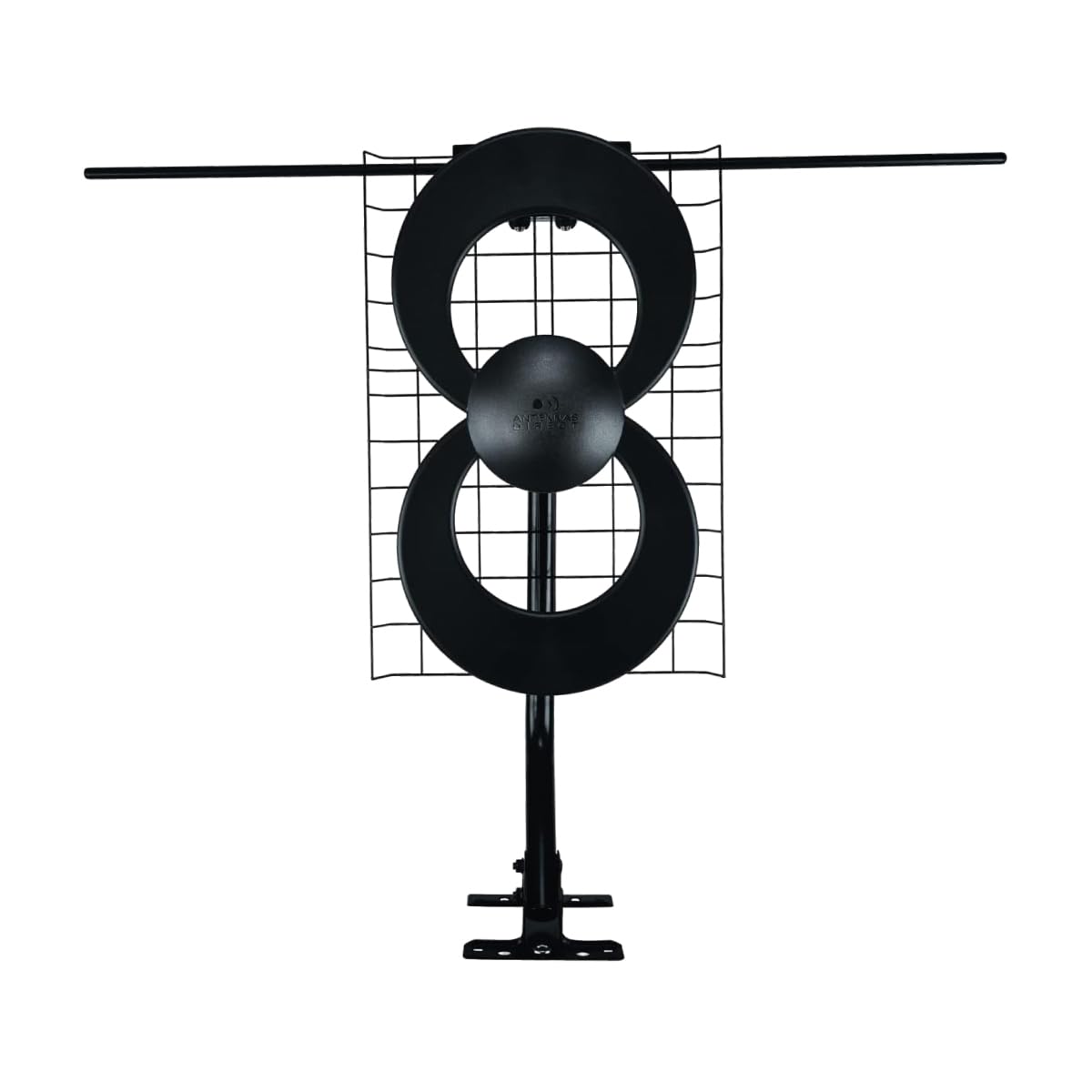
The ClearStream 2V is a dual-loop design that combines multi-directional UHF reception with a dedicated Hi-VHF element and a signal reflector for focused gain. This combination makes it uniquely suited for suburban and rural areas where broadcast towers are spread across different directions. The reflector physically blocks rear interference and focuses the antenna’s power forward, which dramatically reduces pixelation from signals bouncing off nearby structures. The included 20-inch mast with pivoting base installs on vertical or horizontal surfaces, giving you flexibility in attic or outdoor mounting.
Real-world reports from users 40 miles from towers with partial line-of-sight obstructions show the ClearStream 2V pulling in approximately 70–85 local channels with excellent video quality, especially when paired with a preamp. One customer in a valley with surrounding hills received stations from three different cities across 90-plus miles after raising the antenna to 30 feet. The antenna is notably strong on UHF and Hi-VHF (channels 7–13), but its low-VHF reception (channels 2–6) is weaker — a common trade-off in multi-directional designs. The lifetime manufacturer warranty on the antenna elements adds significant long-term value.
Setup requires assembly of the reflector and mast, but the all-weather hardware and clear instructions make it manageable. A common customer note is that no coaxial cable is included, so you will need to purchase one separately. For users who need to capture signals from multiple broadcast clusters in different directions without rotating a Yagi, the ClearStream 2V delivers the most versatile pattern in this price tier.
Why it’s great
- Reflector provides focused forward gain that reduces pixelation from rear interference
- Multi-directional UHF with Hi-VHF element catches channels from multiple tower clusters
- Lifetime warranty on the antenna elements — rare in this category
Good to know
- Low-VHF (channels 2–6) reception is notably weaker than mid/high bands
- No coaxial cable included in the box
- Requires assembly of the reflector and mast before installation
3. Channel Master Omni+ 50

The Channel Master Omni+ 50 solves a specific problem that Yagi and multi-directional antennas cannot touch: true 360-degree reception in a single, static installation. This antenna uses separate UHF and VHF elements — the UHF section is fully omnidirectional, while the VHF dipole is adjustable — so you can capture signals from every direction simultaneously without rotating or pointing. This is the ideal solution for urban and suburban roofs where broadcast towers are scattered around your location, or for RV users who change orientation frequently.
Customer feedback shows the Omni+ 50 improves signal strength by 60 percent or more compared to smaller indoor antennas in the same location, with one user reporting a jump from 60 percent to 95 percent signal strength and SNR improving from 70 percent to 98 percent. The design works best within 35 miles of towers — it is explicitly not a long-distance fringe antenna. For users in that 10–35 mile sweet spot, the Omni+ 50 delivers consistent reception of all major networks without the need for a rotor or manual repositioning. The included mounting bracket works with existing satellite mounts, wall surfaces, and mast poles, making it one of the most versatile installs in this list.
The trade-off for 360-degree coverage is that omni-directional antennas inherently have less gain in any single direction compared to a focused Yagi. Users trying to pull in distant towers beyond 50 miles will be disappointed. However, for the majority of cord-cutters in metro and suburban areas who are tired of adjusting their antenna every time they want to watch a different channel, the Omni+ 50 is the set-it-and-forget-it solution that actually works.
Why it’s great
- True 360-degree UHF reception with adjustable VHF dipole — no aiming required
- Signal strength improvements of 60–95% reported by urban/suburban users
- Mounts to existing satellite dish brackets, walls, or mast poles
Good to know
- Not a fringe antenna — optimal performance requires towers within 35 miles
- Mast pole not included in the box
- VHF reception is directional; dipole must be oriented toward VHF towers
4. Antennas Direct ClearStream Eclipse Amplified
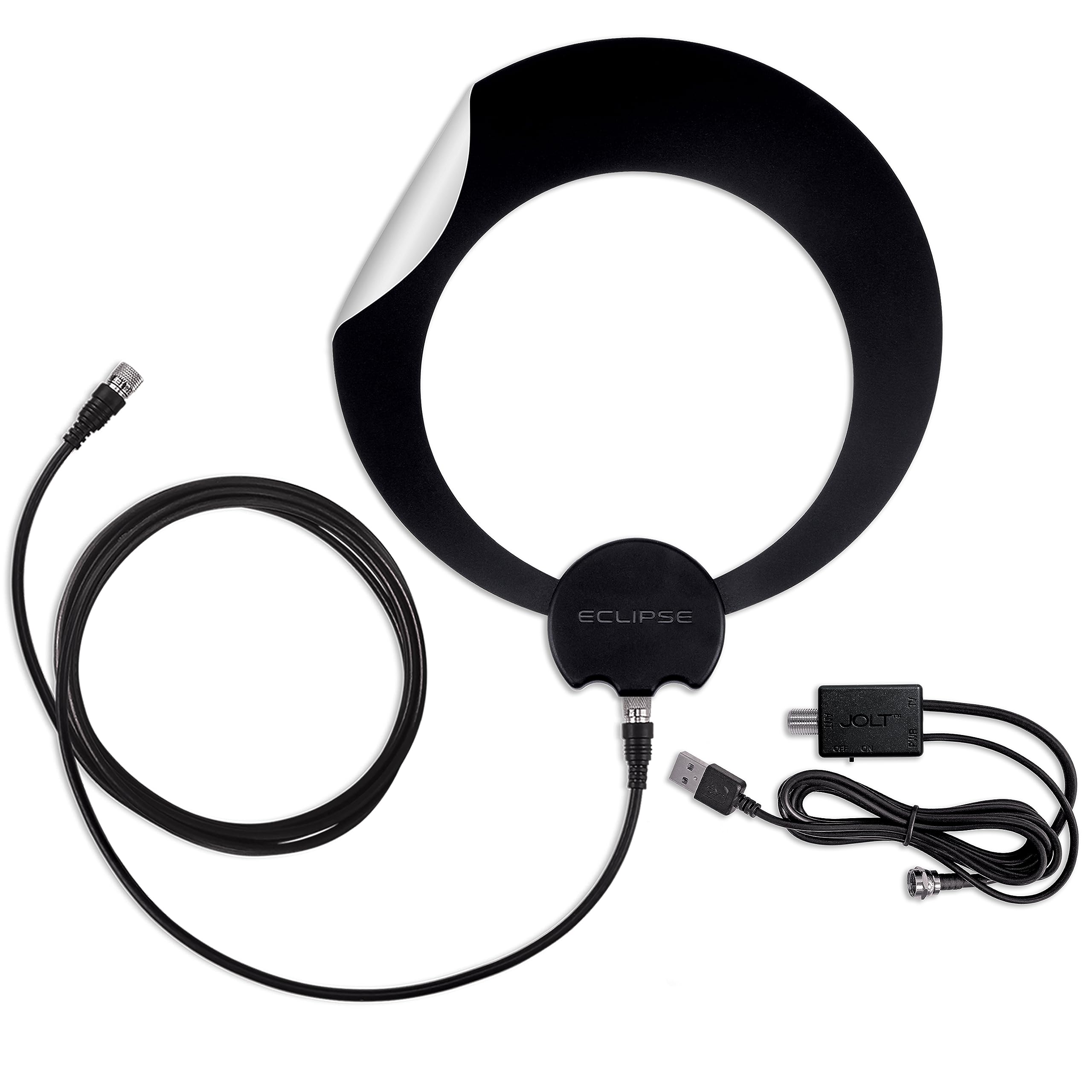
The ClearStream Eclipse is a paper-thin indoor antenna that breaks the industry pattern of promising performance while delivering only UHF. Its patented loop design, combined with the Jolt Switch in-line amplifier, gives it genuine UHF and limited VHF capability in a package that is 0.04 inches thick and fully reversible — you can paint it to match your wall. The 18 dB USB amplifier has a physical On/Off switch, which is a rare and valuable feature because it lets you test whether the amplifier helps or hurts your specific signal environment.
Customer reports from users 35 miles away from towers on the second floor show the Eclipse pulling in 59 channels with excellent reception after proper placement. One long-time antenna user reported that the Eclipse delivers more channels than any of the dozen indoor antennas they had tested over the years, crediting the use of a real coaxial cable connection rather than the cheap wire-based connectors found on budget models. The reversible black/white design and paintable surface mean it actually disappears on your wall rather than calling attention to itself like a black plastic square.
The real limitation is that the Eclipse cannot compete with outdoor or attic antennas for raw signal capture. Some users report signal pixelation on major stations like CBS even with the amplifier enabled, requiring repositioning to stabilize reception. The Jolt Switch helps, but this antenna remains fundamentally an indoor solution — if you have brick walls, stucco siding, or metal roofing between you and the towers, the Eclipse will struggle where an outdoor Yagi would not. For apartments and rental homes where outdoor installation is impossible, this is the best-performing thin antenna available.
Why it’s great
- Ultrathin 0.04-inch profile with paintable reversible design blends into any room
- Jolt Switch amplifier gives you real-time On/Off control to test signal conditions
- Real coaxial cable connection delivers superior signal transmission over budget wire designs
Good to know
- Signal pixelation can occur on major stations; repositioning is often needed
- Performs poorly through brick, stucco, and metal building materials
- Requires USB power for the amplifier; cannot run in passive mode without the USB
5. 1byone Outdoor TV Antenna 360° Omni-Directional

The 1byone outdoor antenna offers a compelling balance of 360-degree omni-directional reception and a surprisingly low price point for an outdoor-rated unit. It includes a built-in pre-amplifier with a 4G LTE filter to suppress mobile phone interference, a 39-foot RG6 coaxial cable, and moisture-proof, flame-retardant materials. The “Smart pass” amplifier technology adjusts gain automatically based on signal strength, theoretically preventing overload from close towers while still boosting weak distant signals.
Customer reviews reveal a polarized experience that depends heavily on location. Users in Manhattan reported receiving 60 channels with crisp HD quality in 15 minutes, including CBS, NBC, FOX, and PBS, though ABC was consistently missing. A user 10 feet off the ground outside received all desired local channels with no tools needed. However, other users reported the antenna initially showing 124–149 channels but later dropping to around 70, most of which were non-English or shopping channels, with only one major network retained.
The most critical long-term concern comes from a customer who mounted the antenna outdoors and found it filled with water after two years, corroding the preamp and RF connector. The antenna works well in attic installations, but its weatherproofing is questionable for permanent outdoor exposure in rainy climates. For the money, the included 39-foot cable and built-in preamp make this an excellent entry point for testing outdoor reception — just budget for additional weather sealing if mounting outdoors in a wet region.
Why it’s great
- Long 39-foot RG6 coaxial cable included — saves –20 over buying separately
- Built-in pre-amp with 4G LTE filter improves weak signal capture
- 360-degree omni-directional design requires no aiming or rotor
Good to know
- Weatherproofing is insufficient for long-term outdoor exposure in wet climates
- Channel count often drops significantly after initial scan; not all are major networks
- VHF reception is notably weaker than UHF; may miss ABC in some markets
6. Winegard FL5500A FlatWave Indoor HDTV Antenna
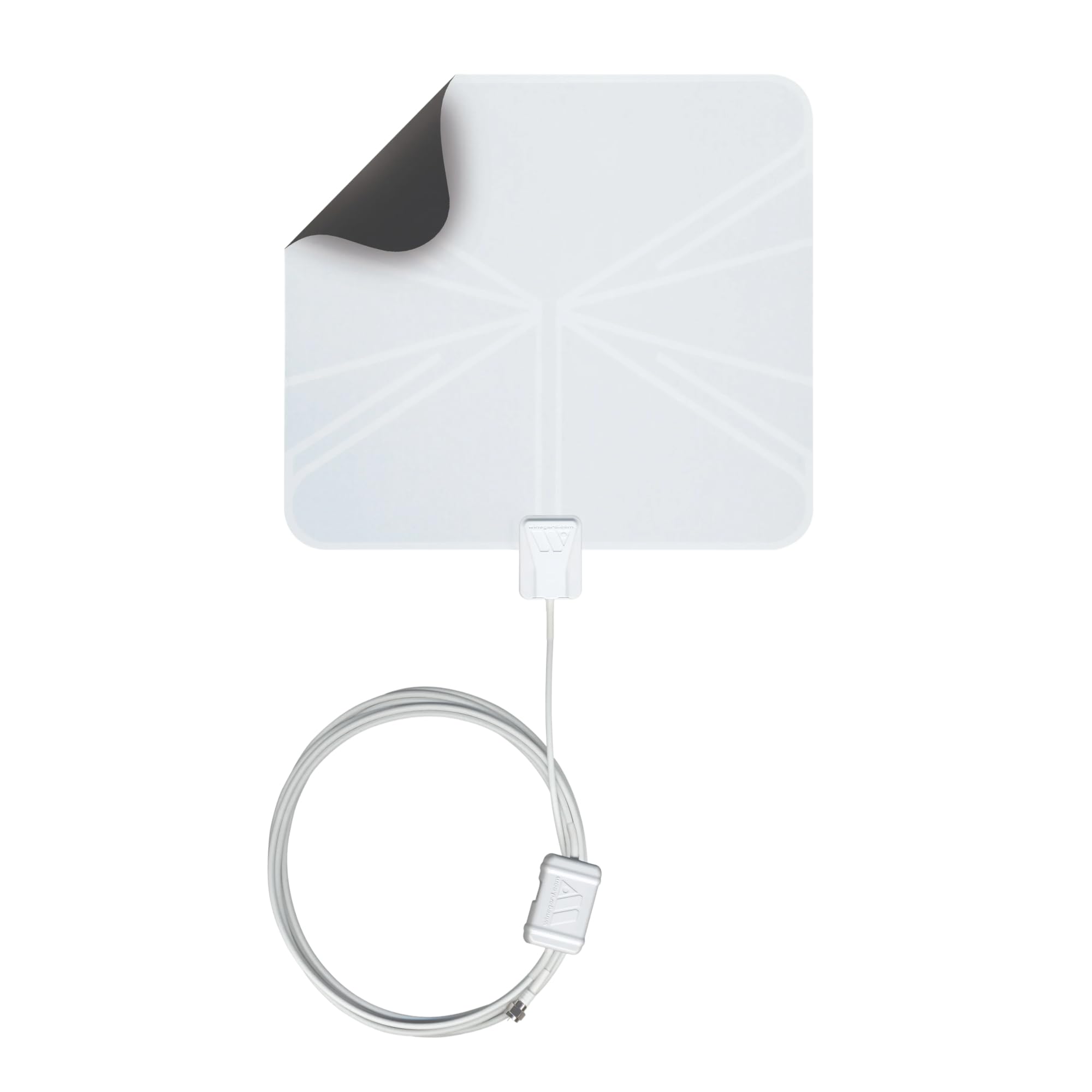
The Winegard FlatWave FL5500A is an amplified indoor antenna designed specifically for urban and close-suburban environments. Its 12-by-13-inch panel is ultra-thin and dual-colored (black on one side, white on the other), so you can flip it to match your wall. The amplifier is powered via USB, and the included Winegard app helps you find the optimal placement by identifying tower locations relative to your address. This app-guided setup is a genuine time-saver that eliminates the blind scanning approach.
Customer reports from users 10–15 miles from towers consistently show the FlatWave pulling in 22–40 channels with excellent HD clarity. One user in South Philadelphia mounted it on a first-floor ceiling and received 22 channels including all major networks. A user 35–40 miles from Chicago received 40 channels upstairs and 27 downstairs, with most HD channels crisp and clear. The antenna handles both VHF and UHF, which is essential for networks like ABC that still broadcast on VHF in many cities.
The limitation is that the coax cable is permanently affixed to the antenna panel — you cannot swap it for a longer cable or add a 90-degree adapter, severely limiting placement options in tight spaces. Some users report that the antenna cannot hold a weak signal for one specific important station, forcing them to choose between antennas. The design is clearly optimized for dense metro areas with towers within 20 miles; performance drops off noticeably beyond 40 miles or in areas with significant terrain obstructions. For urban apartment dwellers with a clear window facing the broadcast towers, this is a reliable, well-supported solution.
Why it’s great
- Reversible black/white panel blends into any room without hardware
- Winegard app guides you to the exact placement spot using your address
- Reliable VHF and UHF reception for users within 20 miles of towers
Good to know
- Permanently attached coax cable cannot be swapped or fitted with a 90-degree adapter
- Struggles to hold weak signals; performance drops significantly past 40 miles
- Some users report missing specific networks like ABC or NBC depending on placement
7. URIIU Upgraded Indoor TV Antenna
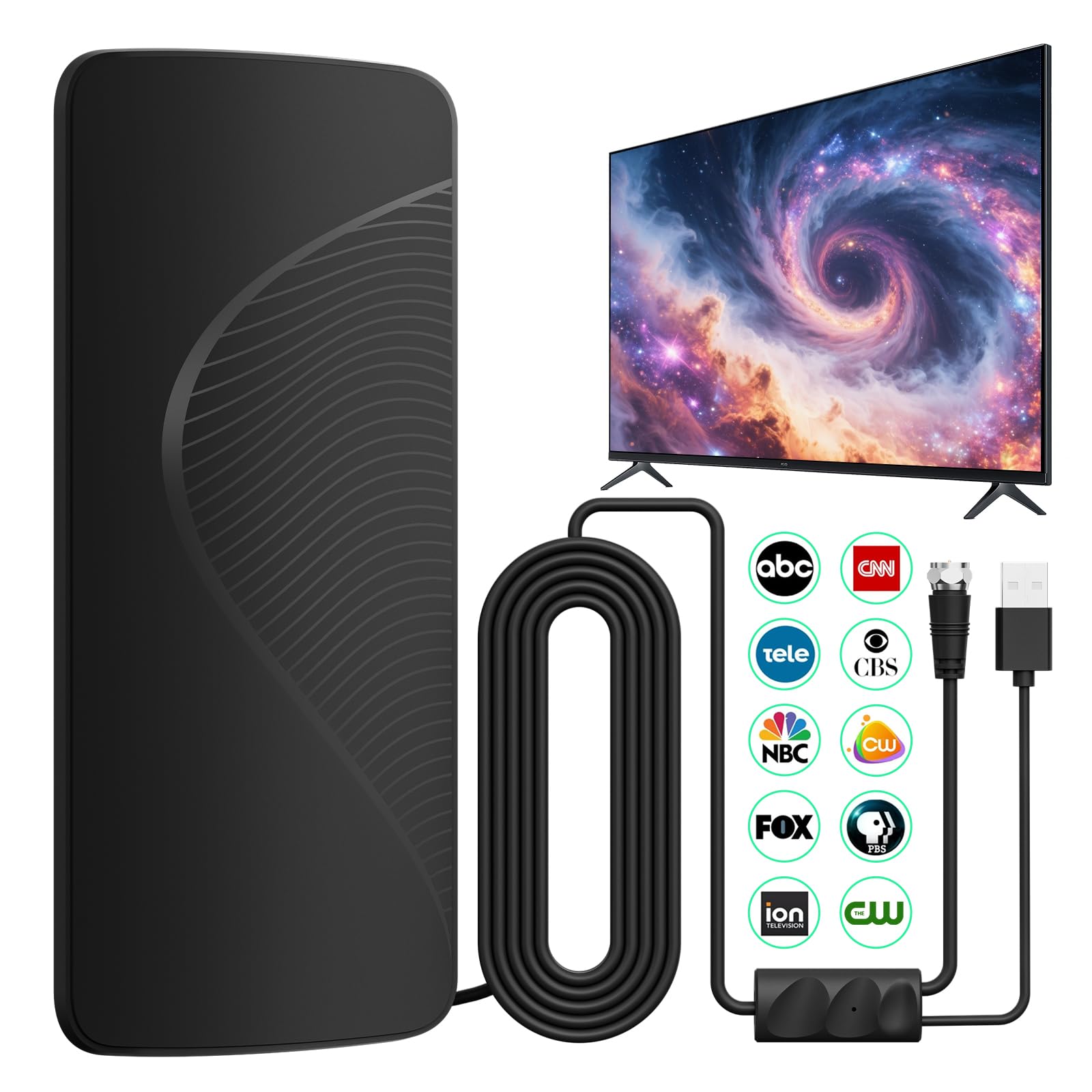
The URIIU indoor antenna is a budget-conscious entry into cord-cutting that includes an intelligent IC chip amplifier and a generous 33-foot high-performance coaxial cable. The long cable is the standout feature at this price point — it gives you the flexibility to place the antenna in a window, on a wall, or even in an attic far from your TV, which is critical for avoiding signal-blocking obstacles. The antenna supports 4K and 1080p HD signals and connects to any TV with a coaxial input.
Customer experiences are sharply divided. Users who placed the antenna on a wall or in a window facing broadcast towers reported receiving 47 channels with good reception and no breakup, with one user stating they did not even need to place it in a window. Another user in a residential area confirmed the antenna works great for all local stations. However, an equal number of users reported terrible reception, with one user 19 miles from the city receiving only 19 channels of which ten were blocked out. This split suggests the URIIU is highly sensitive to building materials and placement.
The 3,000-mile range claim on the packaging is pure marketing fiction and should be completely ignored — no indoor antenna can achieve that. Treat this antenna as a 20–30 mile solution at best. The amplifier requires USB power, so ensure your TV has a USB port or use a wall adapter. For the price, the included 33-foot cable alone justifies the purchase if you need that length, and the antenna works well enough for users with clear, unobstructed windows facing towers within 30 miles. Just manage your expectations on range.
Why it’s great
- 33-foot coaxial cable included provides exceptional placement flexibility at this price
- USB-powered amplifier helps pull in stations through standard wall materials
- Supports 4K and 1080p HD signals for clear picture quality on modern TVs
Good to know
- The 3,000-mile range claim is false — real-world range is 20–30 miles
- Highly sensitive to building materials and window orientation
- Inconsistent reception reports; requires trial-and-error placement
FAQ
Can I use an indoor antenna in an apartment building with concrete walls?
Why do I get different channels when I move the antenna a few inches?
How do I know if my local stations broadcast on UHF or VHF?
Will an amplifier fix bad reception in a weak signal area?
How can I connect an antenna to an older TV without a coaxial input?
Final Thoughts: The Verdict
For most users, the best antenna for tv reception winner is the RCA Compact Outdoor Yagi because its genuine VHF and UHF support, consistent signal strength at 30–50 miles, and easy attic installation make it the most reliable single-solution antenna for the widest range of cord-cutting scenarios. If you need 360-degree reception in an urban environment without aiming, grab the Channel Master Omni+ 50. And for rental situations where outdoor installation is impossible, the Antennas Direct ClearStream Eclipse delivers the best performance in a paint-friendly, paper-thin form factor.
Product prices and availability are accurate as of the date/time indicated and are subject to change. Any price and availability information displayed on Amazon at the time of purchase will apply to the purchase of this product. As an Amazon Associate I earn from qualifying purchases.
CERTAIN CONTENT THAT APPEARS ON THIS SITE COMES FROM AMAZON. THIS CONTENT IS PROVIDED "AS IS" AND IS SUBJECT TO CHANGE OR REMOVAL AT ANY TIME.
Amazon and the Amazon logo are trademarks of Amazon.com, Inc. or its affiliates.