
Our readers keep the lights on and my morning glass full of iced black tea. As an Amazon Associate, I earn from qualifying purchases.
Specs are compiled from manufacturer listings and verified buyer reviews and can change over time — please confirm the key details on the product page before buying.
Cutting the cord fails when you pick an antenna that can’t reach your local towers. Start by checking your distance to broadcast towers and whether you can mount outdoors; the seven picks below match different scenarios.
I’m Min — the founder and writer behind Gadgets Feed. This guide is built by comparing the manufacturers’ published specifications and the patterns across verified customer reviews, so you get each pick’s real strengths and trade-offs instead of marketing spin.
This guide to choosing the right antenna for tv tells you exactly what to expect before you buy, if you need a tiny indoor flat panel for a city apartment or a big outdoor rig for the countryside.
Our Picks at a Glance
How To Choose The Best Antenna For TV
Before you buy anything, look up your address on a free FCC tool like “dtv gov maps.” It shows where the broadcast towers are and how far away they sit. That single fact decides if you need an indoor panel or an outdoor array.
Indoor vs. Outdoor Placement
Indoor antennas are convenient and hide easily behind a TV, but they depend heavily on your walls and window direction. Outdoor antennas — on a roof, attic, or eave — sit higher and clear more obstructions like trees and neighboring buildings, which is why they almost always lock in more channels and more stable signals.
UHF and VHF — The Two Signal Types
Most stations broadcast on UHF (ultra-high frequency), but some — especially channels 2 through 13 — use VHF (very high frequency). A cheap antenna that only handles UHF will miss those. The best antennas in this guide list both, and they are usually labeled as “UHF/VHF” on the box.
Mile Range: Marketing vs. Reality
Manufacturers claim ranges from 60 to 250 miles, but those numbers assume a clear line of sight from a high mount. Real-world testing shows that tree cover, hills, building materials, and weather all cut into that figure. Treat the mile claim as a best-case ceiling, not a promise.
Can It Use an Amplifier?
An amplifier (a powered signal booster) helps when you are far from towers or splitting the signal to multiple TVs. But if you are close to towers, an amplifier can overload and kill reception. Look for antennas with a detachable or switchable amplifier, like the model with a manual short-range and long-range mode.
Quick Comparison
| Model | Best For | Mount Type | Claimed Range | Signal Support | Amazon |
|---|---|---|---|---|---|
| Antennas Direct ClearStream 2V★ Best Overall | Rural and suburban reach | Indoor / Attic / Outdoor | 60+ miles | UHF & Hi-VHF | Amazon |
| TV Antenna for Smart TV IndoorBest Value | Budget city apartments | Indoor window or wall | 250 miles | 4K & 1080p | Amazon |
| Outdoor TV Antenna Digital Amplified | Two TVs with rotation | Roof / Attic / Pole | 150 miles | 4K & 1080p | Amazon |
| Antennas Direct ClearStream Flex | Sleek indoor placement | Indoor window | 50+ miles | UHF & Hi-VHF | Amazon |
| GE Outdoor HD Digital TV Antenna | Attic installs | Roof / Attic / Mast | 80 miles | 4K Ultra HD & ATSC 3.0 | Amazon |
| PIBIDI Outdoor TV Antenna | Long VHF/UHF reach | Roof / Attic / Pole | 200 miles | 4K & 1080p | Amazon |
| Five Star Outdoor HDTV Antenna | Feeding up to four TVs | Roof / Attic / Pole | 200 miles | 4K & ATSC 3.0 | Amazon |
In‑Depth Reviews
1. Antennas Direct ClearStream 2V
Our pick — over 4★ from 5,500+ verified ratings; the strongest balance of quality and price.
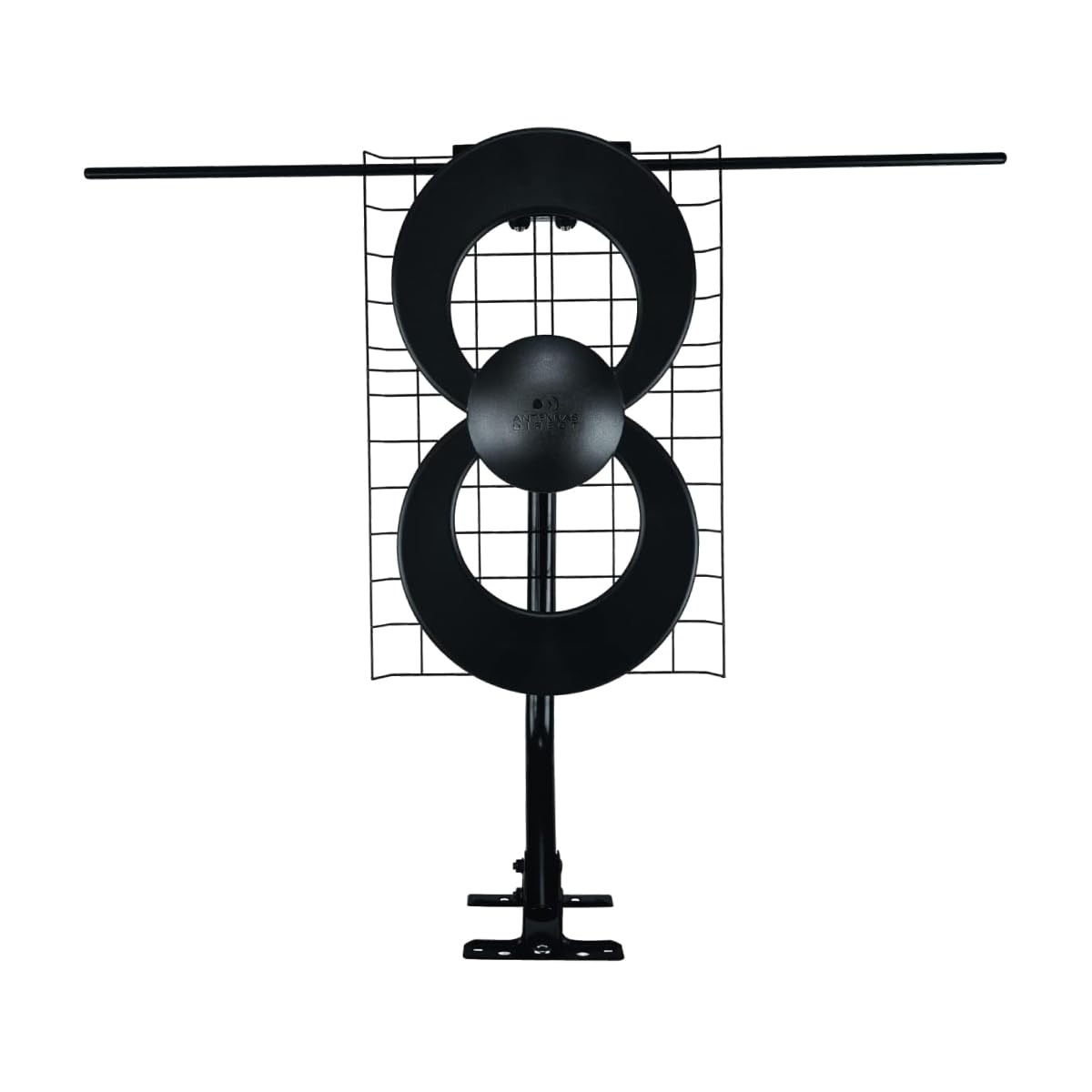
This double-loop design with a signal reflector pulls in clear HD even from cinderblock homes and wooded valleys.
This is the one for people who live where cheap antennas go to die. Its signature double-loop design with a signal reflector focuses the antenna’s power forward to block the interference that causes pixelation or a lost picture. The payoff shows up in real life: one setup on a roof 43 miles from LA towers locked in 144 channels, and an indoor install in a brick building jumped from 44 to 76-83 channels — vivid picture, zero pixelation. It’s a sharper performer indoors than the budget pick below because it handles both UHF and Hi-VHF bands.
It’s an 18″H x 31.4″W x 6.5″D unit, so it is not a tiny flat panel. The included 20-inch mast with a pivoting base lets you mount it on vertical or horizontal surfaces — indoors, in an attic, or outdoors — and it ships with all-weather mounting hardware plus the reflector. It carries a lifetime manufacturer antenna warranty with a 90-day accessory warranty, and it’s engineered in the USA. The catch: assembly is trickier than most, and buyers often need a YouTube video the first time, though the sturdy build makes it worth the effort.
It’s compatible with NEXTGEN TV, 4K, 8K UHD, and Full HD 1080p — no internet required. If you want to stream or record what it pulls in, it plays nicely with HDHomeRun FLEX 4k and Tablo, making it a true cable replacement.
What wins people over
- Consistently strong reception reported from cinderblock homes and brick buildings, where most antennas struggle.
- Multi-directional UHF and Hi-VHF elements plus a reflector for focused, clear reception.
- Sturdy, US-made construction with a lifetime warranty on the antenna itself.
Heads-up before you buy
- Assembly is a bit fiddly; several owners relied on YouTube guides.
- Larger footprint than a flat indoor panel — plan your mounting spot.
- Reception varies with your distance to towers and obstructions like trees.
Grab this if: you are in a suburban or rural area, want the best all-around reach, and don’t mind a real install.
Think twice if: you need a tiny, hide-behind-the-TV panel for a city apartment — the Flex or budget indoor pick suits that better.
2. TV Antenna for Smart TV Indoor
This palm-sized amplified panel boosted a Brooklyn apartment’s channel count from 44 to 83.
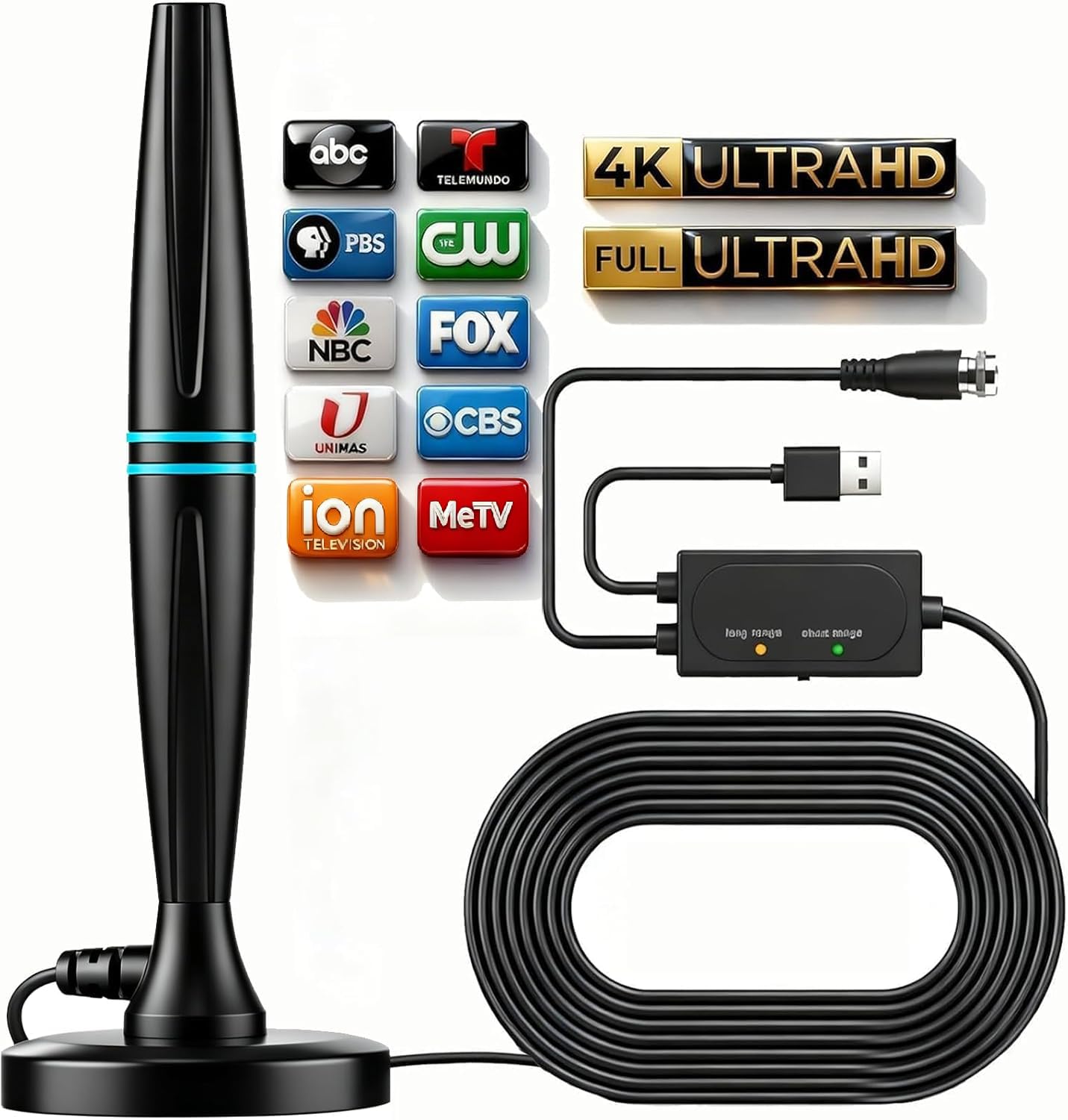
This is the no-fuss answer for renters and city dwellers who just want free local ABC, CBS, NBC, and FOX without climbing on a roof. Its built-in smart IC chip filters out cellular and FM signals so you don’t get interference, and it handles 4K, UHD, and 1080 HDTV broadcasts. The biggest selling point is genuinely useful: a manual mode switch lets you flip between short-range (under 35 miles) and long-range modes (35-250 miles) to match where you live.
Setup is a literal three-step list: plug into the ‘ANT IN’ port on any digital TV, place it near a window or wall, and run a channel scan. Buyers report it works with Vizio, Samsung Frame, and Roku TVs from the start. The claim of 250 miles is the most aggressive in this guide — treat it as a ceiling, since real results depend on your distance to broadcast towers. Even so, owners near towers picked up 18 to 40 free HD channels, and one 2-hours-from-broadcast buyer still found 14 stations sitting right next to the TV. It comes with a 1-year warranty.
At roughly a third of the price of the ClearStream 2V, it’s the easiest recommendation for anyone testing the cord-cutting waters on a budget — and plenty of buyers bought a second one for the bedroom. It’s far more forgiving than the ClearStream 2V when you don’t know your exact tower distance.
easy entry point: the smart IC chip plus the short/long-range switch makes it the most forgiving indoor antenna in this list for people who don’t know their exact tower distance. The trade-off is that its raw reach and build heft don’t match the outdoor rigs — for rural signal hunting, go bigger.
Best suited to: apartments, dorms, and first-time cord cutters within about 35 miles of towers who want free HD in minutes.
Look elsewhere if: your home is surrounded by hills or you’re beyond the suburbs — you’ll want the ClearStream 2V or a roof mount.
3. Outdoor TV Antenna Digital Amplified

This outdoor antenna features a remote-controlled motor that rotates 360° to chase signals from your couch.
This is the pick for people whose local towers sit in different directions. A built-in 360-degree motor rotates the antenna to a wider area when you press a button on the included wireless remote, so you are not climbing a ladder every time your signal drifts. It also supports two TVs at the same time without a splitter or special adapter, and the package includes a 60ft RG6 coaxial cable (the standard shielded cable that connects an antenna to your TV) plus a snap-on assembly that needs no tools.
One owner in a Chicago suburb found it “works really well and had no issues” after pointing it in the right direction — it delivered over 90 channels by one count. The same story repeats: aim it correctly and the picture is clear. The 17″L x 3.9″W x 12.2″H body is compact for an outdoor unit, about 85% smaller than the bulkier ClearStream 2V, which makes it easier to mount on an eave or porch rail. There is a lightning protection system for weather resistance.
The honest catch is the build. Several owners note the plastic snap joints feel cheap and need care during assembly, and the range claims are inconsistent — the listing says 200 miles while the packaging says 150 miles. The feedback is mixed: some pick up 10 more channels than before, while others at 60 miles struggle.
The clever parts
- Remote-controlled 360° rotation lets you fine-tune aim from indoors.
- Feeds two TVs simultaneously without needing a separate splitter.
- Includes 60ft of RG6 coaxial cable right in the box.
The parts to handle gently
- Plastic snap-on elements feel lightweight; treat them with care.
- Owner reports on long-range reception are genuinely split — aiming is everything.
- Listed range differs between the ad (200 mi) and packaging (150 mi).
Reach for this if: you want to power two TVs and like the idea of adjusting direction from the sofa.
skip it if: you want maximum build durability or a guaranteed long-range lock — choose the ClearStream 2V or Five Star instead.
4. Antennas Direct ClearStream Flex

This paper-thin panel delivers 88 channels and blends into your window frame.
This is the indoor antenna that doesn’t look like one. At a barely-there.04″D thickness, the Flex hangs flat against a window and comes in reversible black and white so you can match your decor. Its patented loop element with the Jolt Switch in-line amplifier gives it multi-directional UHF and Hi-VHF reach up to 50+ miles, and the switch lets you boost the signal in real time when channels get weak. Compatibility covers NEXTGEN TV, 4K, 8K UHD, and Full HD 1080p.
Expert feedback is telling: someone who has “bought hundreds of antennas” confirmed the indoor range is realistically 35-45 miles, not the 80-mile claim some listings make — but the Flex still outperformed a full attic yagi antenna in that expert’s testing. Real-world owners mention pulling in all the major network channels with ease, and one rural setup grabbed 88 channels over the air. The catch is placement. It needs a window facing the towers; mounting it on an interior wall away from windows can fail entirely. The removable coaxial cable connection makes it easy to swap or extend.
At 5 ounces, this is the lightest antenna in the roundup, and a far better fit than the ClearStream 2V for anyone who rents or simply refuses to put hardware on the roof. It’s the pick for people who care how their home looks while still wanting real reception.
Aiming is everything: owners succeed when it faces the towers, and fail on interior walls. The amplifier’s out-of-band filters are a genuine highlight — by one account it worked so well as a standalone amplifier that it improved a different, older antenna the owner already had.
Choose it for: a tidy, flat, reversible panel in city and suburban homes where outdoor mounting isn’t an option.
Not for: deep rural areas beyond the 35-45 mile balance, where the 2V or a roof rig will beat it.
5. GE Outdoor HD Digital TV Antenna

This yagi-style antenna thrives in attics, pulling 42 to 100+ channels even under a concrete tile roof.
This is the one for homes where the roof is not an option but the attic is. The 37″L x 26.5″W x 19″H yagi-style design (a long-boom directional antenna with cross-elements) is built for clear reception of HDTV, VHF, and UHF channels up to 80 miles, and it is engineered to stay out of sight while maintaining strong signal. It is also set for the future: NEXTGEN TV (ATSC 3.0) compatible, so you get the new over-the-air standard as soon as it reaches your market, plus 4K Ultra HD-ready performance.
The real-world results are strong. Under a concrete tile roof at 35 miles from four towers, customers note excellent performance with no pixelation — better than cable in one case. Another attic install with no amplifier at all still found 42 channels, and a rural mountain setup locked in 34 free channels from over 40 miles away. Over 100 channels is a common report. It reaches more channels than the ClearStream Flex in attic spots, but it demands a directional aim.
The trade-offs are real but manageable. Assembly instructions draw consistent complaints — the VHF dipole screw alignment is not obvious, and a few owners bought a coax cutter/crimper kit to trim the cable. The build quality reads “decently made” rather than heavy-duty, and one owner noted it is not ideal for harsh outdoor or wildlife-prone spots. It comes with a weather-resistant mounting bracket, mast clamp, and J-mount for wall, roof, or mast installation.
Where it shines
- Proven in attic installs under concrete tile roofs — a notoriously tough location.
- Feeds multiple TVs cleanly when paired with a splitter.
- ATSC 3.0 and 4K-ready so it stays relevant as broadcast standards upgrade.
Where it’s finicky
- Assembly instructions are the most-praised complaint; plan for trial and error.
- Build quality gets mixed feedback — it feels solid, not industrial.
- Directional design means aiming matters for full channel coverage.
Best fit: homeowners with attic access who want a future-proof 4K/ATSC 3.0 antenna that stays completely out of sight.
Think twice if: you need rock-solid performance in an exposed, windy rooftop spot — the ClearStream 2V’s all-weather build suits that better.
6. PIBIDI Outdoor TV Antenna

This long-element array reaches 40-120 miles and replaces antennas twice its size.
This is the one for people whose towers are genuinely far. The extended antenna length — longer and larger receiving elements than typical competitors — is designed for stable, strong signal on both VHF and UHF bands, working at VHF 170-230MHz and UHF 470-790MHz. It handles 1080p and 4K reception, and the 200-mile maximum range is the selling point for rural buyers. Real results confirm the reach: owners in a windy Ohio valley 120 miles from transmitters report solid pictures, one rural buyer says stations 40-100 miles away all arrive with a sharp, clear picture, and another scored up to 96 stations.
Assembly is genuinely easy — the antenna arrives mostly pre-assembled with only a few elements to combine, no tools required. It ships with a 40ft RG6 coaxial cable and a detailed guide, and it is lightning-protected with a durable, grounded design for tough outdoor weather. The premium positioning sits above the budget options because of that range and build.
The catch is the amplifier situation. The 200-mile claim assumes you add a signal booster; several owners note you’ll want one (a leftover Radio Shack booster worked great). One buyer waited two months for the promised free amplifier, though the company stayed in contact and the booster made a vast improvement. Also, there is no built-in rotator, so expect occasional roof adjustments as you chase channels. It carries a 1-year warranty.
The reach is real: this is the pick owners recommend for far-flung rural setups, and it regularly beats the larger, older antennas it replaces. The honest caveat is that you should budget for a separate amplifier to actually hit that full 200-mile figure — unlike the ClearStream 2V, which needs no booster for its range.
For you if: you are rural, far from towers, and want 4K-capable reach beyond what indoor panels can dream of.
Not for you if: you want zero extra purchases from the start — the ClearStream 2V needs no booster for its range.
7. Five Star Outdoor HDTV Antenna

This multi-directional outdoor antenna feeds four TVs and pulled in 128 channels near Houston.
This is the workhorse for whole-home cord cutting. The 46″L x 28″W x 25″H multi-directional design pulls in 1080p and 4K reception up to 200 miles, with superior VHF and UHF handling, and it supports up to four TVs via the included splitter — no extra hardware to buy. It’s ATSC 3.0 ready, so it is tuned for the next-generation broadcast standard, and the extended element length is built for stable signal capture.
Real-world results are impressive. One suburban Houston owner picked up 128 over-the-air channels about 45 miles from the towers. A rural buyer 50 miles out got 77 channels instantly by pointing it south from the porch, and another pulled 60 channels where an indoor antenna managed only 26 — even with a 2,500-foot mountain between the antenna and the towers. The assembly is straightforward for an outdoor rig, and the package includes the mounting bracket, J-pole, and TV splitter. Its multi-directional design is more forgiving on aim than the GE yagi.
The honest downsides: it’s lightweight, which helps installation but means it can move in the wind and occasionally drop a channel on gusty days. And the 200-mile claim runs into reality — several reviewers point out it doesn’t quite hit that, though three stations about 40 miles away came in fine. The recurring pointer is to run a channel scan monthly and after any signal loss to keep the lineup fresh. It sells at a mid-to-upper price point, justified by the four-TV support and ATSC 3.0 readiness.
The big wins
- Feeds up to four TVs with the included splitter — true whole-home solution.
- Proven in tough terrain, including a 2,500ft mountain blocking the path.
- ATSC 3.0 ready and multi-directional, so aiming is more forgiving than a strict yagi.
The fair warnings
- Lightweight build moves in wind, occasionally dropping channels.
- 200-mile max range overstates typical real-world results.
- VHF element alignment isn’t in the instructions — screw heads must face the same way.
Pick it if: you want one antenna to feed the living room, bedrooms, and more — the four-TV splitter makes it a standout over every other pick here.
Look at alternatives if: windy rooftop exposure is your reality, or you want the sturdiest possible build for that spot.
Understanding the Specs
Mile Range
The big number on the box — but treat it as a best-case ceiling, not a guarantee. It assumes a clear, unobstructed line of sight from a high mount. In reality, trees, hills, walls, and weather all eat into that figure, so a 200-mile antenna might realistically lock in stations 40-100 miles away depending on your terrain.
UHF vs. VHF
Most channels broadcast over UHF (ultra-high frequency), but channels 2-13 use VHF (very high frequency). An antenna labeled only “UHF” will miss those lower channels. Look for “UHF/VHF” on the spec sheet — the best picks in this guide handle both bands, so you don’t lose local network affiliates.
Amplified vs. Non-Amplified
An amplifier boosts the signal, which helps when you are far from towers or splitting to multiple TVs. But if you live close to broadcast towers, an amplifier can overload and actually kill reception. The most flexible designs give you a switch or detachable amp, like the indoor pick with short-range and long-range modes.
ATSC 3.0 and 4K Readiness
ATSC 3.0 is the next-generation over-the-air broadcast standard, promising better picture, sound, and signal. Antennas marked “ATSC 3.0 ready” or “NEXTGEN TV” are set for it. 4K readiness means the antenna can pass through 4K broadcast signals when they’re available — useful headroom even if your current channels are 1080p.
FAQ
How many channels will a TV antenna actually get?
What does mile range really mean for an antenna?
Is an indoor or outdoor antenna better for my home?
What is the difference between UHF and VHF channels?
Do I need an amplified TV antenna?
Will a TV antenna work with my smart TV or Roku?
Can one antenna feed multiple TVs?
What is ATSC 3.0 and do I need it?
How often should I rescan for channels?
Why does my antenna work well for one channel but not another?
Final Thoughts: The Verdict
Across the board, the genuine winner here is the Antennas Direct ClearStream 2V because it is the rare antenna that works reliably indoors, in an attic, or outdoors, and it has the strongest real-world track record in this roundup across brick buildings, cinderblock homes, and wooded valleys. If you want a no-tools, palm-sized indoor panel on a tight budget, grab the TV Antenna for Smart TV Indoor — its short/long-range switch makes it the most forgiving entry point. And for a whole-home setup feeding up to four TVs, the Five Star Outdoor HDTV Antenna is the one to reach for, bundling the splitter and ATSC 3.0 readiness in one package.
How We Picked
We do not accept paid placement. Every pick is matched to a real buyer and a real use-case; we do not hands-on test units.
Sources & Methodology
Specifications: manufacturer listings and product documentation. Review insights: verified customer reviews, as of August 2026. Pricing: not shown on this page (it changes often); check the current price via the retailer link.
As an Amazon Associate, Gadgets Feed earns from qualifying purchases. This does not affect which products we feature.