
Cutting the cord means little if you can’t reliably pull in every local broadcast. A single weak link—whether it’s a distant transmitter tower, a hillside blocking the signal, or interference from a nearby cell site—can leave you flipping through static instead of watching the game. The right antenna solves this by balancing VHF (channels 2-13) and UHF (channels 14-36) reception with enough gain to punch through obstacles without overloading.
I’m Min — the co-founder and writer behind Gadgets Feed. I’ve combed through hundreds of hours of real-world field reports and technical datasheets to separate the antennas that actually deliver clean, consistent reception from those that just look the part on a shelf.
This guide breaks down the top contenders across every mounting scenario and budget tier to help you pick the right antenna for uhf and vhf that will keep your signal lock solid for years.
How To Choose The Best Antenna For UHF And VHF
A good antenna for UHF and VHF isn’t a single universal shape. The choice depends entirely on where your local broadcast towers are, what’s between you and them, and whether you’re mounting on a roof, in an attic, or just inside a room. Get these three factors right and you will dodge most pixelation and dropouts.
Understanding VHF vs. UHF Reception
VHF (Very High Frequency, channels 2-13) travels in longer wavelengths that bend around hills and penetrate buildings better, but it demands larger, often longer elements. UHF (Ultra High Frequency, channels 14-36) carries more data (higher resolution) but is far more directional and easily blocked by trees and walls. A proper combined antenna must have dedicated elements for each band—not just a “UHF with a VHF sticker.”
Gain, Mile Range, and Real-World Limits
Manufacturers advertise “80 mile” or “200 mile” ranges, but those numbers assume perfect line-of-sight on flat terrain with no interference. Real-world gain is measured in dBi (decibels relative to an isotropic radiator). A 60-mile antenna with a 10 dBi gain will often outperform a claimed 200-mile model with poor directivity or cheap preamp filtering. Check the beam angle: a tighter beam (30-40 degrees) rejects side noise better in suburban areas; wider beams (60+ degrees) help in dense urban clusters with towers spread out.
Built-in Amplifiers and Filtering
An amplifier can rescue weak signals if you’re far from towers, but if you’re within 15 miles of strong transmitters, an amplified antenna may overload your tuner, causing dropouts. The best modern antennas include intelligent gain control (TForce or similar) that adjusts amplification per band. Additionally, LTE/4G/5G filters block the interference from nearby cellular towers that otherwise creeps into the low-UHF frequencies.
Quick Comparison
On smaller screens, swipe sideways to see the full table.
| Model | Category | Best For | Key Spec | Amazon |
|---|---|---|---|---|
| Televes DiNova Boss Mix | Premium | Smart gain control + filtering | 29 dBi VHF / 34 dBi UHF with LTE/5G filter | Amazon |
| Antennas Direct ClearStream MAX-V | Premium | Multi-directional suburban install | 60+ mile range, 65-degree beam | Amazon |
| Five Star Outdoor HDTV Antenna | Mid-range | Long range rural use | 200 mile range, 11db VHF gain | Amazon |
| GE Outdoor Yagi 33685 | Mid-range | Easy outdoor/attic set up | 80 mile range, Yagi style | Amazon |
| RCA ANT751E | Mid-range | Pre-assembled value | 70+ mile range, snap-lock UHF reflector | Amazon |
| Antennas Direct Element | Mid-range | Weak signal areas | 60+ mile range, 55-degree off-axis beam | Amazon |
| Midland MXTA12 Mag Mount | Budget | Vehicle mount / GMRS | 50W compliant, 12ft cable | Amazon |
In‑Depth Reviews
1. Televes DiNova Boss Mix 144286

The Televes DiNova Boss Mix stands apart from every other antenna on this list because of its TForce Intelligent Gain Control. Rather than blasting a single gain level across all channels, it independently adjusts amplification for High VHF (29 dBi) and UHF (34 dBi). This prevents the overload that plagues amplified antennas near strong towers while still digging weak signals out of fringe territory. The built-in LTE/4G/5G filtering cuts interference from nearby cell sites above 608 MHz, a common source of ghosting on channels 14-36.
The directional UHF microstrip array and High VHF elements are housed inside a weather-resistant ABS radome—no assembly required. At under 3 inches deep, it mounts flush against a wall or mast, making it one of the most discreet options for HOA communities where antennas must be subtle. It includes a 12V dual-output power inserter and a J-mount bracket right in the box.
Real-world results from users confirm it pulls in stations from 50+ miles away even through hilly terrain. One reviewer mounted it indoors in a rural area and still picked up 42 channels without pixelation. Its passive pass-through mode ensures it continues working even if the amplifier loses power—a redundancy most antennas lack.
Why it’s great
- Intelligent per-band gain control prevents overload
- Integrated LTE/5G filtering cleans up UHF interference
- No assembly required, low-profile ABS housing
Good to know
- Premium price point, though comparable to other high-end models
- Mounting fasteners not included
2. Antennas Direct ClearStream MAX-V
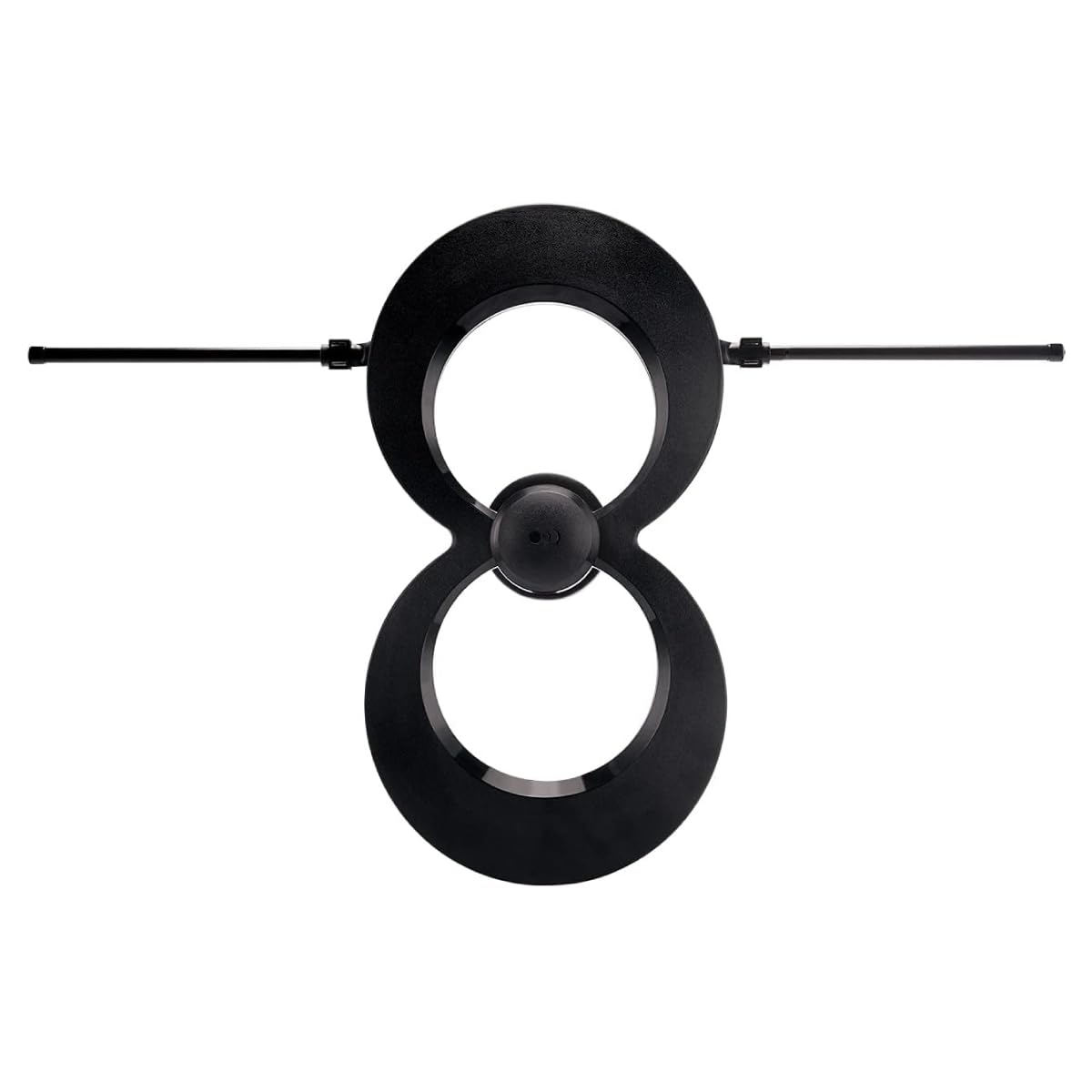
The ClearStream MAX-V uses a double-loop UHF design combined with Hi-VHF elements to achieve a 65-degree beam angle, which is unusually wide for a directional antenna. This means it picks up signals from towers that aren’t all clustered in one direction, making it ideal for suburban areas where towers straddle both east and west. With a 60+ mile range and 4K/8K UHD compatibility, it punches well above its compact dimensions of 27 x 17.4 x 3.5 inches.
Assembly requires just snapping two VHF elements and the UHF loop together—no tools needed. The included steel wall bracket allows flush mounting indoors or on an exterior wall, and the black finish doesn’t scream “antenna” the way bare silver Yagis do. The manufacturer backs it with a lifetime warranty, which speaks to the build quality.
Buyers consistently report that this is the antenna that finally worked after testing five or more alternatives. One reviewer 28 miles from NYC towers received 85 channels with an amplifier, including all major networks and tricky VHF stations like WABC. Another in Charlotte picked up 20-30 stations with an indoor mount behind an entertainment center.
Why it’s great
- 65-degree beam width covers multiple tower directions
- Minimal assembly, flush wall mount included
- Lifetime warranty from a trusted manufacturer
Good to know
- Maximum gain lower than amplified competitors
- Indoor placement may require an external preamp for fringe areas
3. Five Star Outdoor HDTV Antenna

The Five Star antenna pushes the boundaries of claimed range at 200 miles, but its real strength lies in the extended element length and 11 dB VHF gain. This makes it a strong contender for rural dwellers who are 45+ miles from broadcast towers and sitting behind hills. The design uses longer, larger receiving elements than typical Yagis, which directly translates to better capture of the longer VHF wavelengths.
Inside the box you get the antenna, mounting bracket, J-pole, and a TV splitter that supports up to four TVs. The included 40-foot coax cable is a generous touch. Assembly is straightforward, though one reviewer noted the instructions skip over aligning the VHF vibrator screws—make sure screw heads face the same direction. It’s large at 46 x 28 x 25 inches, so confirm your mounting space before purchasing.
Users 45 miles from Houston towers reported pulling in 128 channels after proper assembly. Another reviewer at 7,300 feet elevation and 46 miles from Sandia Crest got 90 channels with 72 crystal clear. The antenna works without an amplifier for many, but buyers in truly fringe locations may benefit from adding a preamp.
Why it’s great
- High 11dB VHF gain for deep fringe reception
- Includes J-pole, splitter, and 40ft coax
- Long elements capture more VHF signal
Good to know
- Large footprint requires significant mounting space
- Assembly instructions missing one alignment step
4. GE Outdoor Yagi 33685

GE’s Yagi-style 33685 is America’s #1 antenna brand for a reason: it delivers reliable 80-mile range in a classic open-Yagi design that’s been proven across decades. The 37-inch long elements are specifically tuned for both VHF (channels 7-13) and UHF (channels 14-36), and it supports ATSC 3.0 NextGen TV for future-proofing. It comes with a J-mount, mast clamp, and weather-resistant mounting bracket—everything you need except coax cable.
Assembly is required, which is the main trade-off at this price. You’ll need to follow the instructions carefully to align the UHF and VHF elements properly. The silver/black finish doesn’t hide easily on a roof, but its rugged construction stands up to high winds and rain without issue. GE backs it with a limited-lifetime replacement pledge and US-based technical support.
Buyers consistently praise its reception from 15 to 65 miles away. One attic-mounted user under a concrete tile roof at 35 miles reported better-than-expected performance with no pixelation even during storms. Another near Seattle at 15 miles picked up solid local sports and primetime channels. A few noted they needed an amplifier for distances over 50 miles.
Why it’s great
- Proven Yagi design with 80-mile range
- Includes J-mount, bracket, and clamp
- Limited-lifetime replacement pledge
Good to know
- Requires assembly with multiple elements
- May need external amplifier beyond 50 miles
5. RCA ANT751E

The RCA ANT751E is the go-to antenna for buyers who want minimal assembly without sacrificing performance. Its pre-assembled design means you simply fold out the UHF reflector and snap-lock the elements into place—no screwdrivers or measuring required. Despite its compact size (roughly 2 feet long), it claims a 70+ mile range and covers both VHF and UHF bands. It also supports 4K and 8K broadcasts and is NextGen TV compatible.
The package includes the antenna, mounting hardware, a mast, locking mast clamp, and a 75-ohm matching transformer. Coax cable is sold separately. RCA’s free Signal Finder app helps you align the antenna precisely by showing a digital compass and signal strength meter. The unit weighs only 2 pounds, making it easy to mount on a standard J-pole or even in an attic rafters.
Real-world results from attic installations are impressive. One reviewer 25 miles from towers in a hilly area picked up 51 stations after adding a Winegard LNA-200 preamp. Another 28-31 miles away got 79 channels without any amplifier, including major networks at 80-85% signal strength. A few buyers noted that ABC on VHF-Low can be weak compared to UHF channels.
Why it’s great
- Nearly tool-free assembly with snap-lock elements
- Lightweight and easy to mount indoors or outdoors
- Free Signal Finder app simplifies alignment
Good to know
- Coax cable not included
- VHF-Low reception can be weaker than UHF
6. Antennas Direct Element

The Antennas Direct Element is a focused, high-gain Yagi that excels where most antennas fail: weak signal areas with scattered towers. Its 55-degree off-axis beam is wider than traditional Yagis, allowing it to catch signals from towers not perfectly aligned, yet still tight enough to reject side-lobe noise. The 44.5-inch length houses both VHF and UHF elements that snap together without tools.
This is a passive (unamplified) antenna, which is a deliberate choice. By avoiding a built-in preamp, the Element avoids the overload and noise floor problems that plague amplified antennas in strong-signal areas. It’s ideal for users who want to add their own external preamp matching their specific signal environment. The all-weather mounting hardware works on an existing mast or in an attic.
Buyers in true fringe zones report excellent results. One user at 70-80 miles from towers paired the Element with an LNA and got no pixelation on any channel. Another at 42 miles replaced an amplified antenna and found the Element delivered stronger signals without needing any amplification. A third solved frequent UHF dropouts during wind and rain by mounting this in the attic with a 100-foot RG6 cable run.
Why it’s great
- 55-degree beam balances directionality and flexibility
- No built-in amplifier avoids overload issues
- Tool-free snap-together assembly
Good to know
- Does not include a mounting J-pole or coax
- Requires external preamp for deep fringe areas
7. Midland MXTA12 Mag Mount

The Midland MXTA12 is a magnetic mount base designed primarily for GMRS and ham radio applications, but its NMO connector makes it compatible with a wide range of VHF/UHF antennas. The 12-foot RG-58 coax cable handles up to 50 watts of power, making it suitable for mobile two-way radio setups. The magnet is exceptionally strong—users report it staying firmly attached at 80 mph on a vehicle roof.
This is not a TV antenna; it’s a radio antenna mount base. However, if you’re building a mobile communications system that needs reliable VHF and UHF coverage, this base provides the foundation. The 50-ohm impedance matches standard mobile radio antennas perfectly. The brass-free design means no rust issues after extended outdoor exposure.
Reviewers consistently praise the magnet’s hold and cable quality. One user noted it’s compatible with both the MXTA26 whip and stubby antennas, recommending the stubby for tall buildings and the whip for repeater hunting. The base has never fallen off in varied weather conditions. It’s a no-frills, durable choice for vehicle-mounted UHF/VHF communication.
Why it’s great
- Extremely strong magnet holds at highway speeds
- 12-foot cable length suits complex vehicle routing
- Compatible with multiple NMO antennas
Good to know
- Designed for radio, not TV reception
- Antenna whip sold separately
FAQ
What is the difference between VHF and UHF antenna elements?
Can I use an FM antenna for TV reception?
How do I know if I need a preamplifier with my antenna?
Does the number of elements matter for UHF/VHF reception?
Final Thoughts: The Verdict
For most users, the antenna for uhf and vhf winner is the Televes DiNova Boss Mix because its intelligent gain control and integrated LTE/5G filtering handle nearly every signal environment without the need for external accessories. If you want a multi-directional suburban workhorse with no-fuss assembly, grab the Antennas Direct ClearStream MAX-V. And for long-range rural setups where every dB of gain matters, the Five Star Outdoor HDTV Antenna delivers the reach and VHF gain to capture signals from deep fringe locations.