
Our readers keep the lights on and my morning glass full of iced black tea. As an Amazon Associate, I earn from qualifying purchases.
Specs are compiled from manufacturer listings and verified buyer reviews and can change over time — please confirm the key details on the product page before buying.
If your baby squirms, arches their back, and screams after every feed, the bottle is often the culprit — not your milk and not your technique. An anti-colic feeding bottle works by keeping air out of the milk, so your baby swallows milk instead of bubbles. Get that one thing right and the evening fussiness usually settles down. This guide sorts the nine bottles worth your money and tells you plainly which one fits your baby’s stage, your budget, and your dishwasher.
I’m Min — the founder and writer behind Gadgets Feed. This guide is built by comparing the manufacturers’ published specifications and the patterns across verified customer reviews, so you get each pick’s real strengths and trade-offs instead of marketing spin.
Colic relief, latch quality, and cleanup time all trace back to one feature — the vent — and this guide breaks down how each bottle handles it. best anti-colic feeding bottle.
Our Picks at a Glance

How To Choose The Best Anti-Colic Feeding Bottle
Every bottle on this list moves air away from the milk somehow — that is the whole point of the category. The differences that actually change your day are the vent type, the nipple flow level, the material, and the number of parts you have to wash at 4 a.m.
Start With The Vent Style, Not The Brand
There are three main approaches. An internal vent system (a tube that runs down the middle of the bottle) routes air through the center so it never mixes with milk. A base vent (a small opening at the bottom of the bottle) separates air from milk from underneath. A collapsing pouch (a soft silicone insert that shrinks as your baby drinks) pushes air out of the way entirely. None is automatically better — they just suit different babies and different cleaning tolerance levels.
Match The Nipple Flow To Your Baby’s Stage
Flow level is the number one reason a feed goes sideways. If your baby gulps, coughs, or spills milk down their chin, the flow is too fast. If they squirm, pull off frustrated, or collapse the nipple, it is too slow. Most of these bottles print the flow size on the nipple or sell separate sizes so you can step up gradually as your baby grows.
Decide How Much Cleaning You Will Actually Do
Internal vent systems deliver excellent colic control, but they add a tube and a brush to every wash. A silicone pouch or a three-piece design cuts that down to a rinse. Be honest about your energy at the end of the day, because a bottle you dread cleaning is a bottle that sits in the cupboard.
Quick Comparison
| Model | Best For | Vent Type | Material | Capacity | Amazon |
|---|---|---|---|---|---|
| Boon Nursh Silicone Baby Bottles★ Best Overall | Gassy babies and travel | Collapsing pouch | 100% food-safe silicone | 8 oz | Amazon |
| Comotomo (Gen 2) Silicone Baby BottleBest for Breastfed Babies | Breast-to-bottle switchers | Dual anti-colic vents | Food-contact grade silicone | 8 oz | Amazon |
| Dr. Brown’s Preemie Flow Bottle SetBest for Preemies | Preemies and newborns | Internal vent system | BPA-free | 4 oz / 120 mL | Amazon |
| Philips Avent Anti-Colic Baby Bottle | Quick daily use | AirFree vent | BPA-free | — | Amazon |
| NUK Perfect Match Glass Bottle | Breastfed babies wanting glass | Anti-colic vent system | Glass | 8 oz | Amazon |
| Lansinoh Anti-Colic Baby Bottles | Picky breastfed babies | NaturalWave air ventilation | BPA-free plastic | 5 oz | Amazon |
| Thyseed Anti-Colic Glass Baby Bottle | Nipple-confused breastfed babies | Base vent | Borosilicate glass | 5 oz | Amazon |
| Dr. Brown’s Anti-Colic Narrow Glass Bottle | Reflux and sensitive stomachs | Internal vent system | Borosilicate glass | 4 oz | Amazon |
| Pigeon PPSU Wide Neck Bottle | Combination feeding | Anti-colic vent | PPSU | 5 oz / 160 mL | Amazon |
In‑Depth Reviews
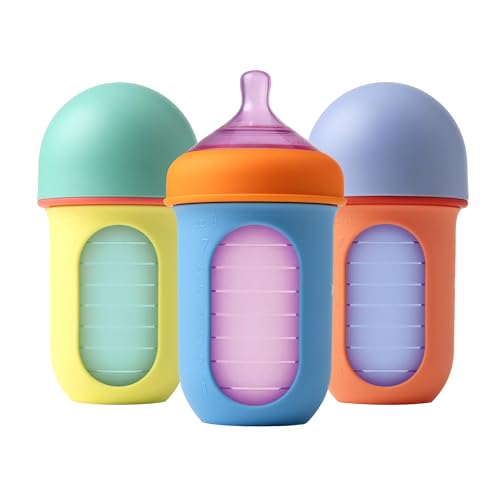
1. Boon Nursh Silicone Baby Bottles – Color Block – 8 Oz – 3 Count
Our pick — over 4.5★ from 17,500+ verified ratings; the strongest balance of quality and price.
The no-vent, no-valve bottle that empties itself by shrinking instead of burping out air.
You want the fussiest, gassiest baby on the block to stop swallowing air, and you do not want a five-part washing routine. This is the bottle for that job. Boon uses an 8 oz collapsing silicone pouch inside a reusable outer shell — as your baby drinks, the pouch shrinks and pushes air out of the way, so there are no complicated vents or valves to scrub. The only thing touching your baby’s milk is 100% food-safe silicone, made without BPA or PVC, and both the pouch and nipple can be boiled, sterilized, and frozen. The crowd favorite by a wide margin — 4.7 stars across 17,000+ owners.
What wins people over is the design itself, followed by how little work cleanup takes. Parents of gassy babies report it pulling ahead of Avent, Dr. Brown’s, and Nuk on both gas and cleaning, and the nipples hold their shape under intense sucking without collapsing. The shape and length are built to guide proper tongue positioning, which is why babies tend to latch on during their very first weeks of learning to feed. It also grows with your child — the same shell takes Nursh storage lids, storage buns, and future sippy nipples, all sold separately.
One gripe keeps coming back on the review pages: leakage. The pouch top has to seat perfectly, the silicone rim (the soft sealing ring) has to sit flat, and that rim needs to be dry before you screw it down. Do all three and it stays sealed. The 8 oz size also suits babies who already take full feeds better than tiny newborns, who usually want a smaller starting volume.
What Parents Keep Coming Back For
- Air-free pouch feeding means no vents, no valves, and noticeably less gas and spit-up
- 100% food-safe silicone interior, made without BPA or PVC
- Reusable pouches are dishwasher safe and can also be boiled, sterilized, and frozen
- Latch-friendly nipple shape and length support proper tongue positioning from the start
- Converts to a sippy cup or snack container with separate Nursh accessories
Where It Asks A Little More Of You
- Leaks if the rim is damp or the lid is not seated evenly — dry it and screw it down flat
- The 8 oz capacity is a lot for a brand-new newborn
- Extra pouches and conversion pieces are sold separately
Reach for this if: your baby fights gas after feeds and you want the simplest possible cleanup in a bottle that follows your child into the sippy-cup years.
Think twice if: you are feeding a preemie or a brand-new newborn who is still taking only an ounce or two at a time.
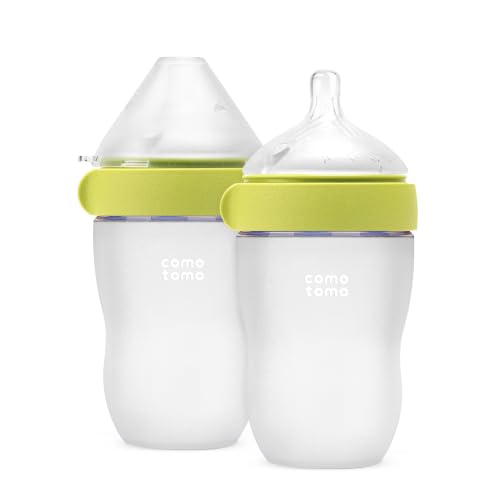
2. Comotomo (Gen 2) Silicone Baby Bottle, Green, 8oz, 2-Pack
The squeezy, skin-soft bottle that breastfed babies accept when everything else gets refused.
The Gen 2 redesign is the story here. Comotomo widened the base 40% over version 1 to stop tip-overs, and reworked the outer ring for simpler, more secure assembly that holds a seal better than the original. The body is soft, squeezable silicone with a naturally tapered nipple, and a reinforced structure inside the nipple keeps it from collapsing mid-feed. Two anti-colic vents handle air intake, and the flow level is printed right on the nipple so you can check the stage at a glance instead of squinting at a chart.
For combination feeders this is the pick, because the wide base and skin-like feel keep a deep latch through the switch. One breastfeeding mom of twins described going back to Comotomo after a failed run with a glass brand — her twins were slow to feed and one outright refused the bottle. Buyers report the switch was an instant night-and-day fix: soft, flexible, easy to clean, a true 8 oz capacity, and a medium-flow nipple already in the box. That is the pattern across the review pages, and the quality and ease of use scores back it up. Brown’s Preemie Flow set above, 8 oz against 4 oz, which matters once your baby is taking full feeds.
You pay for that seal with assembly patience. Seven mentions of leakage sit alongside the praise, and most trace back to the ring not seating squarely — the interior is built so milk touches only food-contact grade silicone, and that seal depends on the parts lining up. It also costs more per bottle, though parents who keep fewer bottles in rotation tend to shrug that off. And unlike the wide-neck glass options later on this list, there is no temperature indicator here — you test the milk yourself.
What stands out: the Gen 2 base is 40% wider than version 1, which is the single change that cut the tip-overs parents used to complain about.
The honest note: the wide-neck design cleans fast with no special brushes, but every part is pre-shrunken for a specific fit, so keep the pieces matched to their own bottle.
The combo-feeding answer: breastfed babies who need a bottle that feels like mom, with a medium-flow nipple ready to go from the start.
Look elsewhere if: you want one fewer thing to line up at 3 a.m. — the multi-part seal rewards patience.
3. Dr. Brown’s Preemie Flow Bottle Set, Anti-Colic Options+ Baby Bottles with Preemie Flow and Level T Nipples, 4oz/120mL, 0m+ – 3 Pack
A slow-flow starter kit built for babies who came early and need to feed at their own pace.
When your baby is a preemie or a newborn who cannot handle a normal flow rate, the whole game changes. This set gives you two nipple stages in one box — a Preemie Flow Nipple for the slowest possible feed and a Level T Nipple that steps up slightly so your baby can transition slowly. Dr. Brown’s internal vent system routes air through the center of the bottle so it never meets the milk, and the vacuum-free feeding is designed to sit closest to breastfeeding. That is the difference from the Boon pouch above: same goal, entirely different mechanism.
The reliability here is what owners talk about most. Families fostering NICU preemies lean on this set hard, and it comes up repeatedly as the no-leak option across three preemies in one household. Milk touches only silicone, and the anti-colic vent is built to help preserve bottle milk nutrients. Nipple flow sizing runs ultra preemie, preemie, transitional, then Level 1 and Level 2, so there is a defined next step when your baby is ready. The rule owners pass along is simple: upsize if your baby gets frustrated or the nipple collapses, downsize if they gulp, cough, or spill.
Set your expectations on cleanup, because this is the fussiest bottle on the list. Fourteen ounces of the complaints land on leakage after a while — the seal is not built to last forever, and the many small parts make washing tedious, so keep the tiny brushes handy. It is a trade most preemie parents happily make. Also note the 4 oz capacity is sized for early feeding, not for a baby drinking 6 or 7 oz at a sitting — that is when you move on.
Why Preemie Parents Choose It
- Includes both a Preemie Flow Nipple and a Level T Nipple so you can step up gradually
- Internal vent system reduces spit-up, burping, and gas
- Vacuum-free feeding with a consistent flow lets your baby set the pace
- Set bundles bottles and every needed piece rather than buying separately
- Anti-colic vent is designed to help preserve bottle milk nutrients
What To Prepare For
- Leaks develop over time as the seal wears — expect to replace after a stretch of use
- Many small parts make washing and drying the slowest job on this list
- 4 oz capacity is small once your baby is taking full feeds
Built for: NICU graduates, preemies, and newborns who need the slowest flow available before they can handle anything faster.
Not for you if: you want a low-part bottle you can rinse and go — the vent tube needs its brush every time.
4. Philips Avent Anti-Colic Baby Bottle with AirFree Vent, SCF403/24

One vent piece, zero complicated parts — the bottle you can wash with your eyes half shut.
Avent solves the anti-colic problem from the nipple instead of the middle of the bottle. The AirFree vent keeps the nipple full of milk rather than air, which is why a feed stays smooth even when your baby is feeding on an incline. It targets the most common feeding issues — colic, gas, and reflux — and unlike the multi-part internal vent systems on this list, its vent is a single piece that rinses clean in seconds. The bottle ships with 0month+ Newborn nipples, Size 1.
There is one design choice owners call out specifically and it is worth repeating: the bottom does not come off. That means no lost base, no misaligned silicone ring, and no mystery leak from a part that worked loose. Parents also push the flow range further than intended by swapping in adjustable-flow nipples, removing the insert to thicken feeds for older babies. It is a quiet, durable, unglamorous workhorse, and the seller also stands behind it — one buyer who received size 2 nipples instead of size 1 got the correct set shipped free within about a week.
The catch is that this bottle is not the fix for every baby. One parent found their baby choked on the flow, and the newborn Size 1 nipple is genuinely fast for some brand-new feeders — you may need to step down or work up. A puppy-feeding owner also noticed weeping where the top twists on after repeated washes. Both are edge cases, not the norm, but they are worth knowing before you buy six.
The one-piece advantage: no bottom to detach and no ring to misalign, so the leak-prone joints that plague multi-part bottles simply are not there.
Fit note: the included Size 1 newborn nipple suits most newborns, but a very slow feeder may need to start on a gentler flow until the latch matures.
The low-effort daily driver: anyone who wants real anti-colic performance without a sink full of tubes and rings.
skip it if: your newborn already gulps fast — a gentler flow level may suit them better at the start.
5. NUK Perfect Match Glass Natural + Anti-Colic Bottle, 8 oz. Glass Baby Bottles with SafeTemp Temperature Indicator, Newborn Essentials, 3-Pack
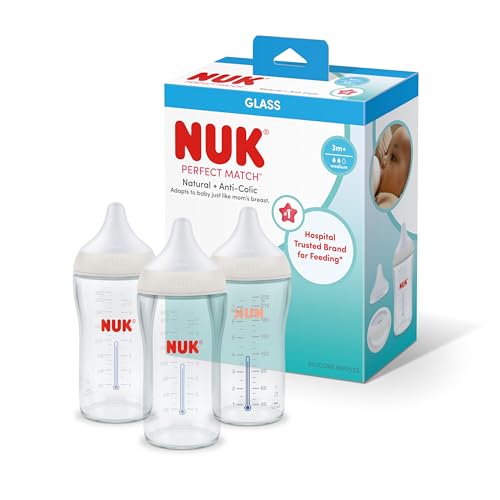
A glass bottle that tells you when the milk is warm enough without you testing it on your wrist.
You get a bottle that cleans up cleaner, stays clearer, and outlasts plastic — that is what this 8 oz, BPA-free glass set is built around. The feature you will actually use every night is the SafeTemp Indicator, a built-in signal that tells you when the milk has hit the right temperature for feeding, so no guessing on a sleepy 2 a.m. warm-up. The anti-colic vent system (a channel that lets air escape instead of mixing into the milk) prevents gas and air bubbles. The medical-grade silicone nipple is, by the brand’s claim, 2x softer than the average leading bottle nipple, and its shape adapts to your baby’s mouth for a natural latch.
Bottle quality is what this pick is known for, and the glass is the reason. Parents of twins report it as the bottle that stopped the choking and the milk dribbling down their chins, and the glass construction cleans more easily and holds up longer than plastic. One toddler dropped a bottle and it bounced twice without breaking. The variable flow lineup runs Slow Flow for 0M+, Medium Flow for 1M+, and Flow Control for 6M+, so the same bottle body grows with your baby — this one arrives with the Medium Flow nipple included. The brand reports a 98% baby acceptance rate and calls itself the #1 hospital-trusted brand for feeding.
Size is where owners split, and it is a real split — some parents want a smaller option for a newborn who is not yet drinking 8 oz. It is also a glass bottle with a premium-feeling body, so weigh if you want glass in the diaper bag. The thicker wall that makes it durable also means it takes a little longer to warm.
The Case For This One
- SafeTemp Indicator signals when milk reaches the right feeding temperature
- 8 oz BPA-free glass body cleans easily and outlasts plastic in daily rotation
- 2x softer medical-grade silicone nipple, by the brand’s comparison to leading bottle brands’ average
- Variable flow options from 0M+ Slow Flow up to 6M+ Flow Control
- Breast-like nipple shape supports a natural latch and back-and-forth transition
Weigh These First
- The 8 oz size is a lot for a newborn taking only a few ounces per feed
- Glass means real weight in the hand and in the bag
- Thicker glass takes longer to come up to temperature than thin plastic
Best for: breastfed babies whose parents want glass for cleanliness and longevity, plus a temperature check built right into the bottle.
Consider the smaller sizes if: your baby is still new and you want a lower volume to start with.
6. Lansinoh Anti-Colic Baby Bottles, 5 Ounces, 4 Count
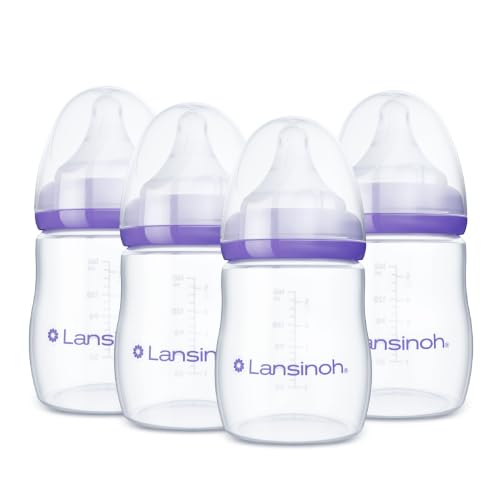
Three pieces, four bottles, and a nipple tip built to stretch with your baby’s suck.
What you notice first is the appearance — the design details get the most praise here — followed closely by how little cleanup it takes. The wide, gentle slope of the nipple molds to your baby’s mouth for a secure latch, and the reviews keep returning to the same theme: picky breastfed babies accept this one and settle. One parent who had tried ten-plus brands called it the only bottle her breastfed baby consistently took, and noted the anti-colic function keeps bubbles out of the feed. The flexible nipple tip also stretches with the sucking motion instead of fighting it, which is why combination feeders report no nipple confusion going back to the breast.
The mixed note is flow rate. Some find the sizing better than the Dr. Brown’s options, others want a different pace — worth buying a single set to test before you commit to a stash. Also, the Size S nipples cap out around the 3-month mark, so you will be shopping for the next flow level fairly early. One ordering hiccup turned up too: a first shipment that never arrived, with a refund that took some chasing.
Where it shines: the three-piece build and the strong, flexible nipple tip make cleanup and latching the two things you stop thinking about.
One thing to check: the flow sizes are better than some rivals for many babies, but not all — try one set before buying a full stash.
Pick this if: your breastfed baby is picky, you switch between breast and bottle, and you want the least cleaning possible per feed.
Note before you buy in bulk: the included Size S slow-flow nipples suit 1-3 months, so plan for the next size sooner than you might expect.
7. Thyseed Anti-Colic Glass Baby Bottle for Breastfed Infants, Natural Feeding, Breast-Like Newborn Medium Flow Nipple (2m+), 5 oz, 1 Pack
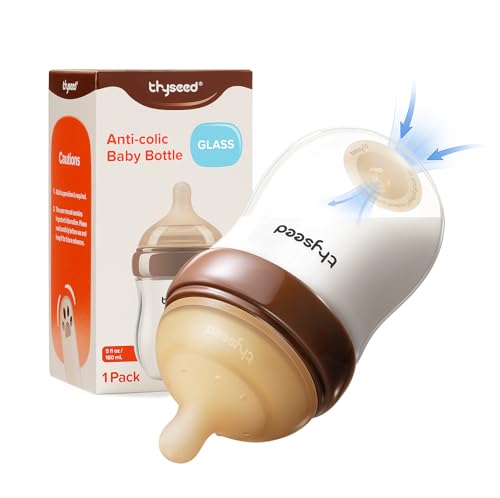
The bottle that fixes feeds when your baby has refused everything else for weeks.
Thyseed attacks the air problem from the base. A base vent separates air from milk underneath so bubbles and swallowed air drop away, and the design is clinically studied and published in JAMA. Multiple micro-openings in the nipple deliver a smoother, more even flow to cut down gulping and frustration, which is the piece most bottles miss. The silicone is soft and flexible enough to move with your baby’s tongue, and the wide, breast-shaped nipple base encourages a deeper, easier latch — the combination that tends to break a nipple-confusion standoff.
Materials are where this pick pulls ahead of the cheaper glass options. It uses liquid silicone from WACKER in Germany, premium PP from TotalEnergies in France, and food-grade borosilicate glass, all BPA-free, odor-resistant, and built for daily feeding. There are six flow rates so you can step up as your baby grows. Fewer parts and a wide neck keep assembly quick, and the components are dishwasher-safe on the top rack only. Parents describe it pulling a fussy baby who refused bottles for weeks to taking a full 4 oz in under five minutes, with the 5-hole nipple flowing only when the baby is actively nursing.
Quality is the trait owners name most — it is the brand’s strongest asset by a wide gap. The trade-offs are worth stating plainly: durability reviews split, with most bottles surviving drops and a few reporting a shatter within a month, and leak reports split the same way. Price is the other mixed point, since a single bottle costs as much as a multi-pack of plastic. If you break a lot of glass or want a low-cost rotation, the plastic and PPSU picks above stretch further.
Why It Breaks The Standoff
- Base vent separates air from milk to reduce bubbles and swallowed air
- Multiple micro-openings give even flow and cut gulping and frustration
- Wide, breast-shaped nipple base supports a deeper, easier latch
- Six flow rates to match your baby’s feeding stage
- Three-part build with a wide neck cleans and assembles fast
Be Realistic About
- Durability reports split — a few bottles have shattered within a month
- Leak reports split as well, though many report no leaks at all
- One bottle costs about the same as a multi-pack of plastic
Reach for this when: your baby has been refusing the bottle and you want the base-vent, wide-latch design that tends to win them over.
Think twice if: your household is hard on glass or you want several bottles without a multi-pack price tag.
8. Dr. Brown’s Anti-Colic Options+ Narrow Glass Baby Bottle, 4 oz, 4-Pack
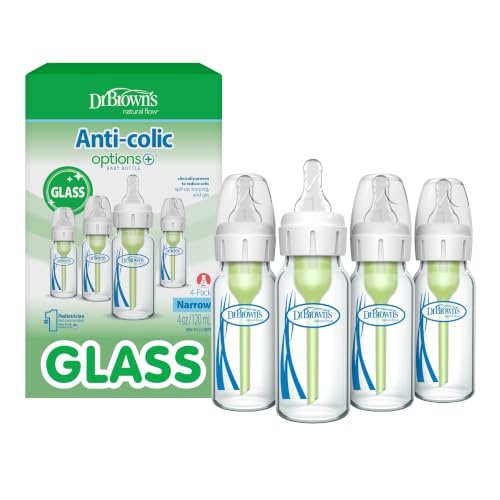
The internal vent system pediatricians name most often for babies with reflux and gas together.
Glass is the reason parents stay with it. It survives repeated sanitizing, feels high-quality in the hand, and cleans more easily than plastic — one owner has run theirs for four months of smooth feeding without issue. It is also lighter than other glass bottles on the market, which matters more than you think once you are holding it one-handed at 4 a.m. The breast-like nipple shape encourages a proper latch and eases the back-and-forth transition, and some parents report fewer burps than with other bottles.
Now the honest part. This bottle has more small parts to wash than anything else here — the vent tube, the insert, the nipple, the ring — and the tube needs the included wire brush every time or milk film builds up inside. A few parents also found the flow on the Size 1 nipple fast for a brand-new newborn, and the 4 oz capacity runs out quickly for hungrier babies. Leaks appear if you overfill past the line or fail to seat the vent upright, and one bottle did shatter on tile after a drop.
What Earns It A Place
- Vacuum-free feeding with consistent flow lets your baby feed at their own pace
- Borosilicate glass is heat and thermal shock-resistant
- Glass cleans easily and holds up to repeated sanitizing
- Breast-like nipple shape eases the transition from breast to bottle
The Honest Downsides
- More small parts than any other bottle here, and the vent tube needs a brush every wash
- 4 oz capacity is outgrown quickly by hungrier babies
- Size 1 nipple flows fast for some newborns — a slower size exists separately
Made for: reflux babies who need the vent system’s air separation and glass construction, in households that will keep up with the parts.
Not your bottle if: you want a fast rinse-and-go routine — the vent tube demands attention at every wash.
9. Pigeon PPSU Wide Neck Anti-Colic Nursing Baby Bottle, 5 oz, 2-Pack
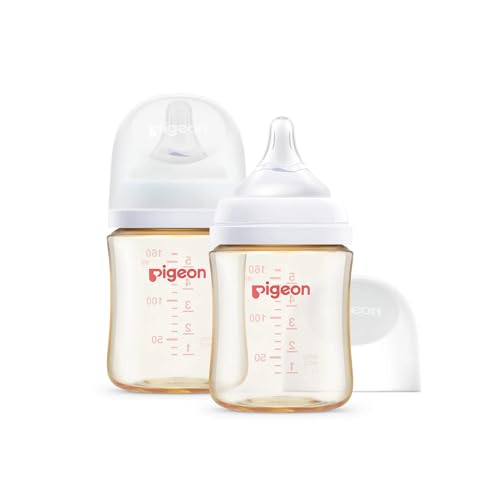
The durable plastic that survives boiling water and still feels lighter than glass in your hand.
PPSU (a tough, heat-resistant plastic) sits between plastic and glass, and this bottle shows why. It is lightweight with an amber tint, durable enough to survive frequent sterilization without clouding or picking up smell, and it handles warm milk without flinching — good news if you are reheating feeds. The wide neck and streamlined body clean and fill easily with few parts. The soft, flexible silicone nipple has a Latch-On Line built into the design, a curve that guides your baby’s latch into the right position for an effective seal. The 5 oz/160 mL bottle ships with an SS nipple for 0 months and up.
What makes this one click for combination feeders is the lack of friction going back to the breast. Parents report zero nipple confusion or refusal switching between breast and bottle, and the wide latch curve helps your baby get a deeper grip. PPSU also dodges the main complaint about glass — no weight, no breakage worry — while cleaning up better than an internal-vent tube. A parent who worked through several brands before settling here used theirs from 5 to 8 months and simply moved up to an L nipple as their baby grew. The slow nipple flow keeps gas down on top of the anti-colic vent.
The one practical snag is mixing formula, since the 5 oz capacity does not hold a full scoop set and you may need to mix in two batches. It is also a premium-priced bottle, though owners who factor in how long the PPSU lasts tend to push that aside. Nipple sizes span SS through 3L with different hole shapes, thicknesses, and softness, so there is a defined path as your baby grows, but you will buy those separately.
The PPSU advantage: it takes repeated sterilizing without fogging up or holding onto smells, so it stays clear wash after wash.
Snag to plan around: the 5 oz body can’t take a full formula scoop set, so batch your mixing.
Reach for this if: you switch between breast and bottle and want the heat-resistant durability of PPSU without the weight of glass.
Look elsewhere if: you want a one-bottle-per-feed routine with a generous capacity for bigger feeds.
Understanding the Specs
Vent Type: How Air Stays Out
Internal vents run a tube through the bottle’s center; base vents open at the bottom; collapsing pouches shrink with the feed. Internal vents give the most thorough air separation but add parts to wash. Base vents keep it simple while still separating air from milk. Collapsing pouches eliminate extra parts entirely — just be sure the rim is dry and seated flat, or the seal can weep.
Nipple Flow: The Setting That Changes Everything
Flow is sized by stage, and the sizes are not universal. Dr. Brown’s runs ultra preemie, preemie, transitional, then Level 1 and Level 2; Pigeon runs SS through 3L; NUK runs Slow Flow (0M+), Medium Flow (1M+), and Flow Control (6M+); Thyseed offers six rates. If your baby gulps, coughs, or spills, drop a size. If they pull off frustrated, step up. Most nipples print the flow level so you can check at a glance.
Material: Silicone, PPSU, and Glass
Silicone bodies stay soft and squeezable and can be boiled, sterilized, and frozen. PPSU is a lightweight, heat-resistant plastic that survives repeated sterilization without clouding or odors. Borosilicate glass is heat and thermal shock-resistant, cleans easily, and outlasts plastic, but it is heavier and can shatter if dropped. All three clean well; the difference is how you handle and carry them.
Extras That Actually Help
NUK’s SafeTemp Indicator tells you when milk is at the right feeding temperature. A Latch-On Line, like the one on the Pigeon, guides your baby’s latch into place. A capacity that matches your feeding stage matters too — 4 oz suits preemies and newborns, while 8 oz suits established feeders. Match the bottle to the phase your baby is actually in.
FAQ
Will an anti-colic bottle work if my baby is breastfed?
How do I know if the nipple flow is too fast or too slow?
Do anti-colic bottles leak?
Is glass better than plastic or silicone for a colicky baby?
How many parts will I actually have to wash each time?
Can I use these bottles for both breast milk and formula?
Which bottle is easiest to clean?
How long will one of these bottles last?
Are these bottles safe to boil, sterilize, and freeze?
Does a wide-neck bottle do anything a narrow-neck bottle does not?
Final Thoughts: The Verdict
For most families, the anti-colic feeding bottle that solves the most problems at once is the Boon Nursh Silicone Baby Bottles — it takes the fuss out of both gas and cleanup, and it follows your child from newborn feeds into sippy-cup territory. If your baby has been refusing the bottle and you suspect nipple confusion, the Thyseed Anti-Colic Glass Baby Bottle is the one to reach for, with its base vent and breast-shaped wide latch. And if your baby is a preemie or a newborn who cannot handle a normal flow, start with the Dr. Brown’s Preemie Flow Bottle Set, where the two nipple stages let you step up gradually.
One last thing worth saying plainly: the bottle is half the equation, and the nipple flow is the other half. Buy one set, watch how your baby handles the feed, and adjust from there. That habit solves more feeding problems than any brand name on the shelf.
How We Picked
We do not accept paid placement. Every pick is matched to a real buyer and a real use-case; we do not hands-on test units.
Sources & Methodology
Specifications: manufacturer listings and product documentation. Review insights: verified customer reviews, as of September 2026. Pricing: not shown on this page (it changes often); check the current price via the retailer link.
As an Amazon Associate, Gadgets Feed earns from qualifying purchases. This does not affect which products we feature.