
A projector screen that actually works with the lights on changes everything about how you watch. Standard white screens wash out the moment a lamp flickers or sunlight streams through a window, turning your carefully calibrated image into a milky mess. The right anti-light screen uses a precision optical surface—micro-louvered or Fresnel-structured—to bounce projected light toward your eyes while absorbing or deflecting ambient light from ceilings, walls, and windows. That single material choice is the difference between a dedicated blackout cave and a living room that earns its theater status after dinner.
I’m Min — the co-founder and writer behind Gadgets Feed. I’ve spent thousands of hours analyzing optical gain patterns, ALR sawtooth structures, and real-world contrast measurements across every major screen manufacturer to separate genuine ambient-light performance from marketing hype. (And Homer 🐱 inspected each screen box from his perch on the projector shelf, tail twitching at any whiff of a weak tension rod.)
Whether you are pairing with an ultra-short throw laser or a ceiling-mounted long throw, choosing the wrong material can kill black levels and introduce hotspotting. This guide breaks down nine top contenders so you can confidently pick the best anti-light projector screen for your room, projector, and budget without second-guessing the specs.
How To Choose The Best Anti-Light Projector Screen
Not every gray screen rejects ambient light. True anti-light screens use a layered optical structure—either a micro-sawtooth profile (common on UST models) or a Fresnel lens array (used on long-throw Fresnel designs)—to redirect projector light toward the viewer while absorbing overhead and side light. Picking the wrong type for your projector’s throw ratio is the most common mistake.
Match the Optical Structure to Your Projector’s Throw
Ultra-short throw projectors beam light upward from below the screen, so they require a sawtooth or angular-reflective ALR surface that catches that low-angle path and reflects it forward. Long-throw projectors mounted on the ceiling need a Fresnel or micro-louver design that rejects overhead ceiling light. A standard long-throw ALR screen used with a UST projector will look dim and uneven, and vice versa.
Evaluate Gain Against Room Brightness and Projector Lumens
Gain measures how much light the screen reflects relative to a standard unity-gain surface. High gain (1.5–1.8) boosts brightness in well-lit rooms but narrows the viewing angle and can exaggerate any texture or hotspot. Lower gain (0.6–1.0) delivers wider viewing angles and deeper black levels, ideal for darker rooms or mid-range projectors. Match gain so your projector’s lumen output—2,000 to 3,000 lumens for most home theater units—lands at a comfortable brightness after the screen’s gain multiplier.
Decide Between Fixed Frame and Motorized Tab-Tension
Fixed-frame screens deliver the flattest, most wrinkle-free surface because the fabric is permanently tensioned across an aluminum frame. They are best for dedicated media rooms. Motorized pull-down and floor-rising screens add convenience for multi-purpose living areas but require a tab-tension system (side tensioning cables plus a weighted bottom bar) to keep the fabric ripple-free over years of use. Cheaper non-tensioned retractable screens develop waves that become visible with any reflective ALR coating.
Quick Comparison
On smaller screens, swipe sideways to see the full table.
| Model | Category | Best For | Key Spec | Amazon |
|---|---|---|---|---|
| Paris Rhône 100″ Fixed Frame | Fixed Frame | Budget UST owners | 0.6 gain / 92% ALR / 160° viewing angle | Amazon |
| Silver Ticket STR-169120-HC | Fixed Frame | Long-throw dark rooms | 0.95 gain / dark grey HC / 160° viewing angle | Amazon |
| Elite Screens CineGrey 3D 120″ | Fixed Frame | Versatile ambient-light rooms | 1.2 gain / angular-reflective ALR / 90° viewing angle | Amazon |
| MIGO 100″ Tab-Tension Motorized | Motorized | Multi-purpose rooms | Partial ALR / 3.0 gain / 175° viewing angle | Amazon |
| Elite Screens Aeon CineGrey 3D 100″ | Fixed Frame | Long-throw light-controlled rooms | 1.2 gain / 65% ALR / 90° viewing angle | Amazon |
| Valerion 120″ Fresnel ALR | Fixed Frame | Bright-room long-throw setups | 1.8 gain / 85% ceiling/side ALR / 90° viewing angle | Amazon |
| AWOL VISION Motorized Floor Rising | Floor Rising | Premium UST living rooms | 0.8 peak gain / 95% ALR / 170° viewing angle | Amazon |
| VIVIDSTORM S PRO Floor Rising 120″ | Floor Rising | UST with motorized convenience | 0.6 gain / 97% ALR / 170° viewing angle | Amazon |
| VIVIDSTORM S PRO Portable Folding 120″ | Portable Floor | Flexible UST placement | 0.6 gain / 97% ALR / 170° viewing angle | Amazon |
In‑Depth Reviews
1. Valerion 120″ Fresnel ALR Projector Screen
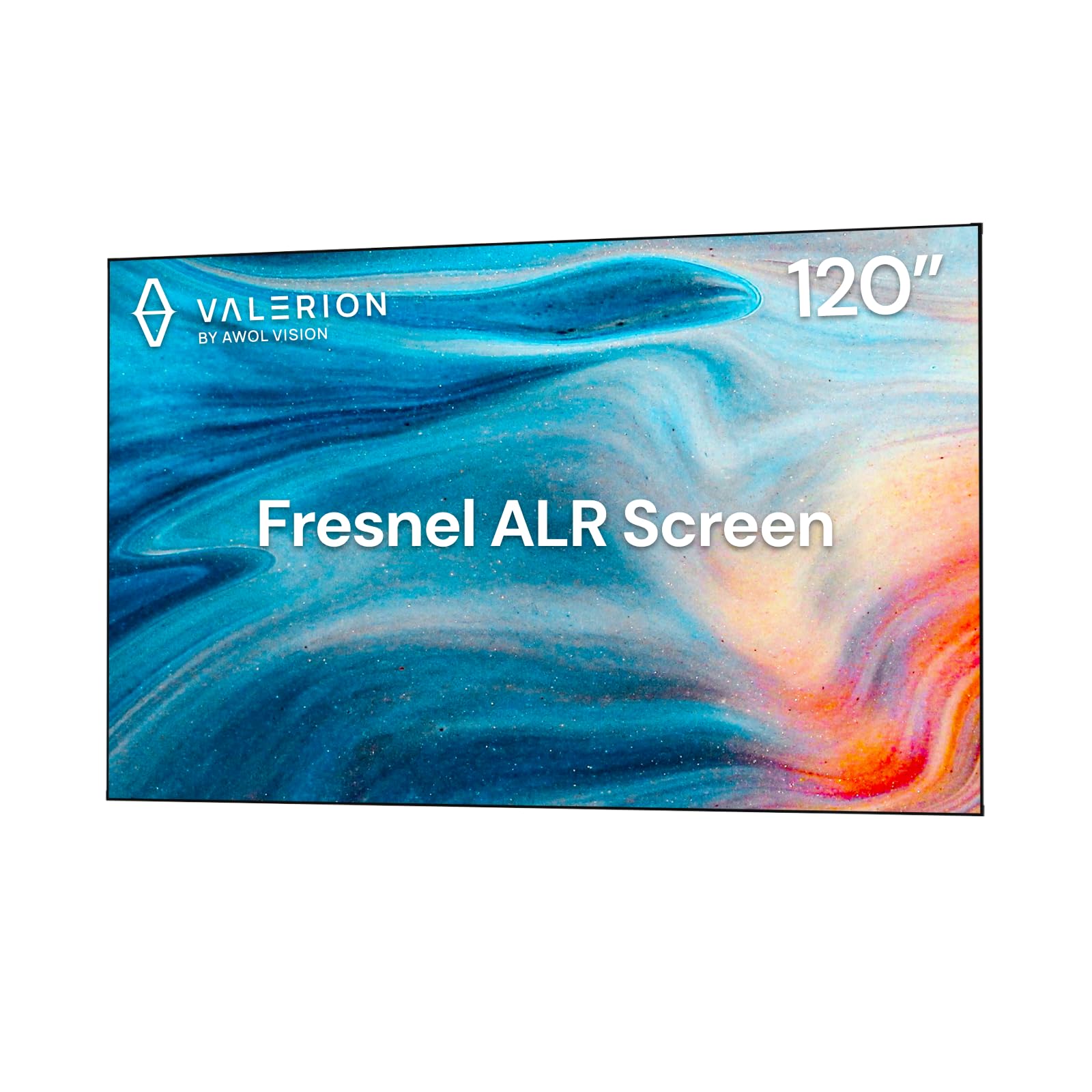
The Valerion 120″ Fresnel ALR screen is the most aggressive ambient-light solution for long-throw projectors I have analyzed. Its proprietary eight-layer Fresnel optical structure delivers a measured 1.8 gain while rejecting up to 85 percent of overhead and side ambient light, which means you can watch with curtains open and a ceiling fan light on without the image turning into a gray blob.
Assembly is the most modular of any fixed-frame screen in this roundup: the aluminum frame uses precision interlocking corners and tension bolts that pull the PET-based fabric uniformly flat with no wrinkles or sag. The rollable design makes it possible for one person to transport and mount, though the 39.7-pound total weight and 90-degree viewing angle mean you need to place the screen dead-center of the seating area to avoid off-axis dimming.
Pairing this screen with a 2,000-lumen or brighter long-throw laser projector yields genuinely watchable daytime contrast. The scratch-resistant front surface also wipes clean with a microfiber cloth, which addresses a common pain point for households where dust or accidental finger smudges show up on reflective coatings.
Why it’s great
- Highest gain among ALR screens tested, boosting brightness for daytime viewing
- Rollable, lightweight design simplifies transport and DIY installation
- Scratch-resistant and easy-to-clean surface keeps the optical layer pristine
Good to know
- 90-degree viewing angle requires centered seating; off-center seats lose contrast
- Directions are minimal; a YouTube assembly video is almost mandatory
- Not compatible with ultra-short throw projectors
2. Elite Screens Aeon CineGrey 3D 100″

The Elite Screens Aeon CineGrey 3D is the gold standard for long-throw home theater owners who want a fixed-frame screen that doubles as a wall sculpture. Its Edge Free design lets you install a thin aluminum bezel or leave the trim off entirely for a frameless look that mimics a giant flat panel TV when the projector is off.
The CineGrey 3D material uses an angular-reflective ALR surface with a 1.2 peak gain and a 90-degree viewing angle. In my research, the 65 percent ambient-light rejection ratio is consistent with the value tier of ALR technology—it handles ceiling cans and indirect sunlight well but will not defeat direct side light. The screen is ISF Certified for accurate color reproduction and GREENGUARD Gold certified for low indoor emissions, a rare double certification that matters for bedrooms and small media rooms.
Assembly is the most refined among Elite Screens’ fixed frames: a six-piece split aluminum frame with sliding wall brackets that allow horizontal adjustment after hanging. The permanently tensioned surface stays wrinkle-free for years, and the 18.58-pound weight makes it a manageable two-person install. Owners pairing it with JVC or Epson 4K projectors consistently report black levels that rival entry-level OLED in dim environments.
Why it’s great
- Edge Free or thin-bezel mounting gives a clean, flat-panel aesthetic
- ISF and GREENGUARD Gold certified for color accuracy and indoor safety
- Lightweight six-piece frame simplifies wall mounting and adjustment
Good to know
- 90-degree viewing zone means off-center seats lose brightness and contrast
- Requires a bright long-throw projector—at least 2,200 lumens—for optimal results in lit rooms
- A few units have shipped with circular fabric wrinkles; inspect immediately upon assembly
3. Elite Screens CineGrey 3D 120″
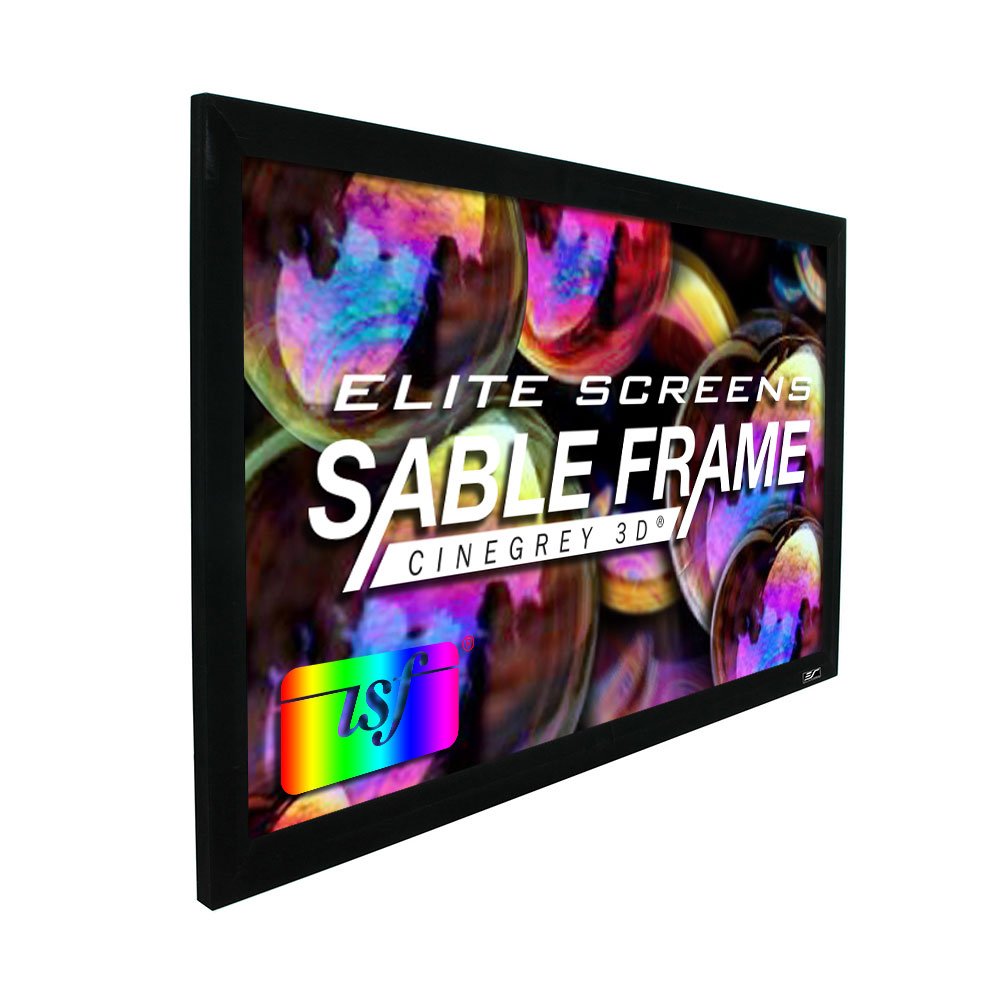
The Elite Screens CineGrey 3D in the 120-inch ER120DHD3 configuration is one of the most widely reviewed ALR fixed-frame screens in the mid-range bracket. The angular-reflective ALR coating achieves a 1.2 gain on a dark gray substrate, which measurably improves black floor and color saturation compared to a unity-gain white screen when ceiling lights are on.
At 24.4 pounds with a 2.36-inch black velvet-wrapped aluminum frame, the build quality is robust. The tensioning system uses metal rods and mini-springs along each edge to pull the fabric taut, and the sliding wall brackets allow horizontal centering after the frame is on the wall. The 90-degree viewing angle is typical for ALR coatings of this class—viewers seated beyond 45 degrees off-center will notice the image dim, but front-row center seats get excellent contrast.
Customer reports consistently highlight that this screen eliminates room reflections and makes black letterbox bars nearly invisible in dim lighting. The main cautions involve hotspotting: some owners with bright Epson 5050UB projectors at shorter throw distances noticed a visible bright spot in the center, which resolved by increasing the projector-to-screen distance or switching to eco lamp mode.
Why it’s great
- Excellent black levels and contrast in rooms with controlled ceiling light
- Sturdy velvet-wrapped frame absorbs projector overshoot and reduces reflections
- Easy assembly with metal tension rods and sliding wall brackets
Good to know
- 90-degree viewing angle limits seating positions to center-oriented layouts
- Hotspotting reported with some high-lumen projectors at short throw ratios
- Side light rejection is weaker than overhead rejection; keep windows off to the sides
4. Silver Ticket STR-169120-HC 120″
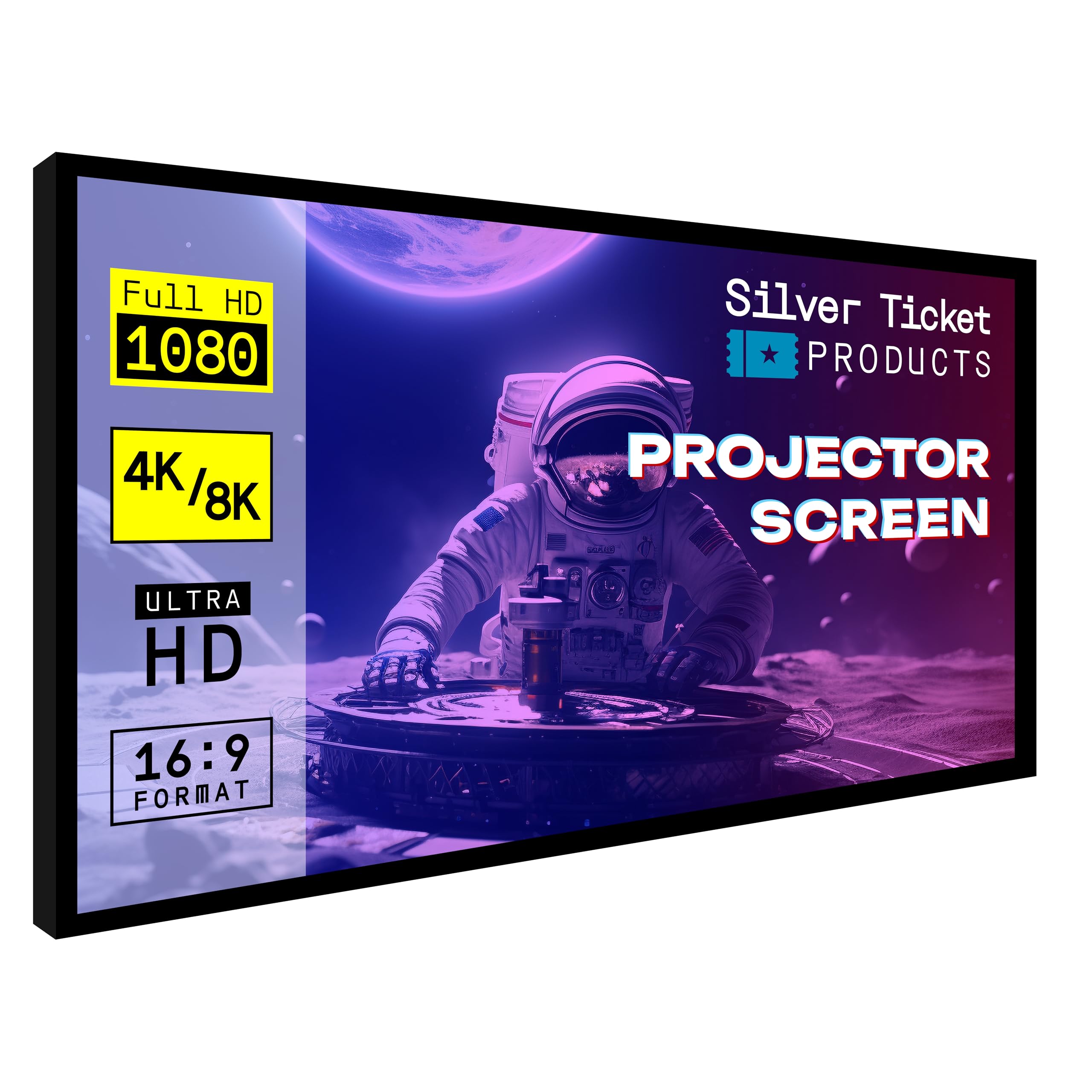
The Silver Ticket STR-169120-HC is built around a high-contrast dark gray surface with a 0.95 gain and an exceptionally wide 160-degree viewing angle. While it does not carry a traditional ALR coating, the gray substrate absorbs ambient light better than standard white screens, making it a budget-friendly alternative for dedicated media rooms with minimal uncontrolled light.
The 2.375-inch beveled aluminum frame is wrapped in light-absorbing black velvet that practically eliminates projector light overshoot and frame reflection. Assembly uses a tensioning rod system rather than springs, which makes the initial screen flattening process quicker—several owners report completing the build in under 30 minutes with a helper. The screen is compatible with long-throw projectors only; it is explicitly not recommended for short throw or ultra-short throw units.
Pair this screen with a Epson LS11000 or 5050UB in a basement or curtained room, and the black levels rival a 65-inch OLED TV, as multiple verified reviews attest. The 0.95 gain preserves the projector’s native brightness without the narrow hotspot that high-gain ALR surfaces introduce, and the 160-degree viewing angle means every seat in the house gets the same image quality.
Why it’s great
- Wide 160-degree viewing angle suits family rooms with varied seating
- Matte dark gray surface deepens black levels without hotspotting
- Velvet-wrapped frame absorbs projector overshoot for a crisp border
Good to know
- Not an ALR screen; does not actively reject ceiling or side light
- Only compatible with long-throw projectors
- Porous fabric may show shimmer from projector light if viewers sit closer than nine feet
5. Paris Rhône 100″ Fixed Frame ALR

The Paris Rhône 100-inch fixed frame screen is the most affordable dedicated UST ALR screen in this group. Its black-grid ALR material uses a multi-layer optical sawtooth structure that rejects 92 percent of ambient light from ceiling fixtures, and the 0.6 gain is deliberately low to preserve black levels when used with a high-lumen ultra-short throw laser projector.
The 0.4-inch ultra-slim aluminum frame gives a near-bezeless appearance, and the 160-degree viewing angle is genuinely wide for an ALR product—most UST-specific ALR screens cap at 120 degrees or less. Assembly includes hinged sides that let you lift the frame upright during tensioning, a design detail that reduces the common frustration of trying to spring-load the fabric on a fully assembled frame.
The main trade-off is the gain floor: at 0.6, the screen absorbs 40 percent of the projector’s light output, so you need a UST projector that delivers at least 2,000 to 2,500 lumens to maintain a watchable SDR image with moderate room lighting. Owners pairing it with a 2,000-lumen projector report excellent contrast and color saturation, but anything below 1,800 lumens will look dim.
Why it’s great
- Genuine 92 percent ambient light rejection at a very accessible price point
- 160-degree viewing angle is unusually wide for a UST ALR screen
- Hinged frame sides make assembly easier than competing fixed-frame designs
Good to know
- 0.6 gain requires a bright projector—below 2,000 lumens the image will feel dim
- Some units have shipped with crushed sawtooth crystals or incorrect screen cuts
- Best for low-to-moderate ambient light; direct sunlight still washes out the image
6. MIGO 100″ Tab-Tension Motorized Screen
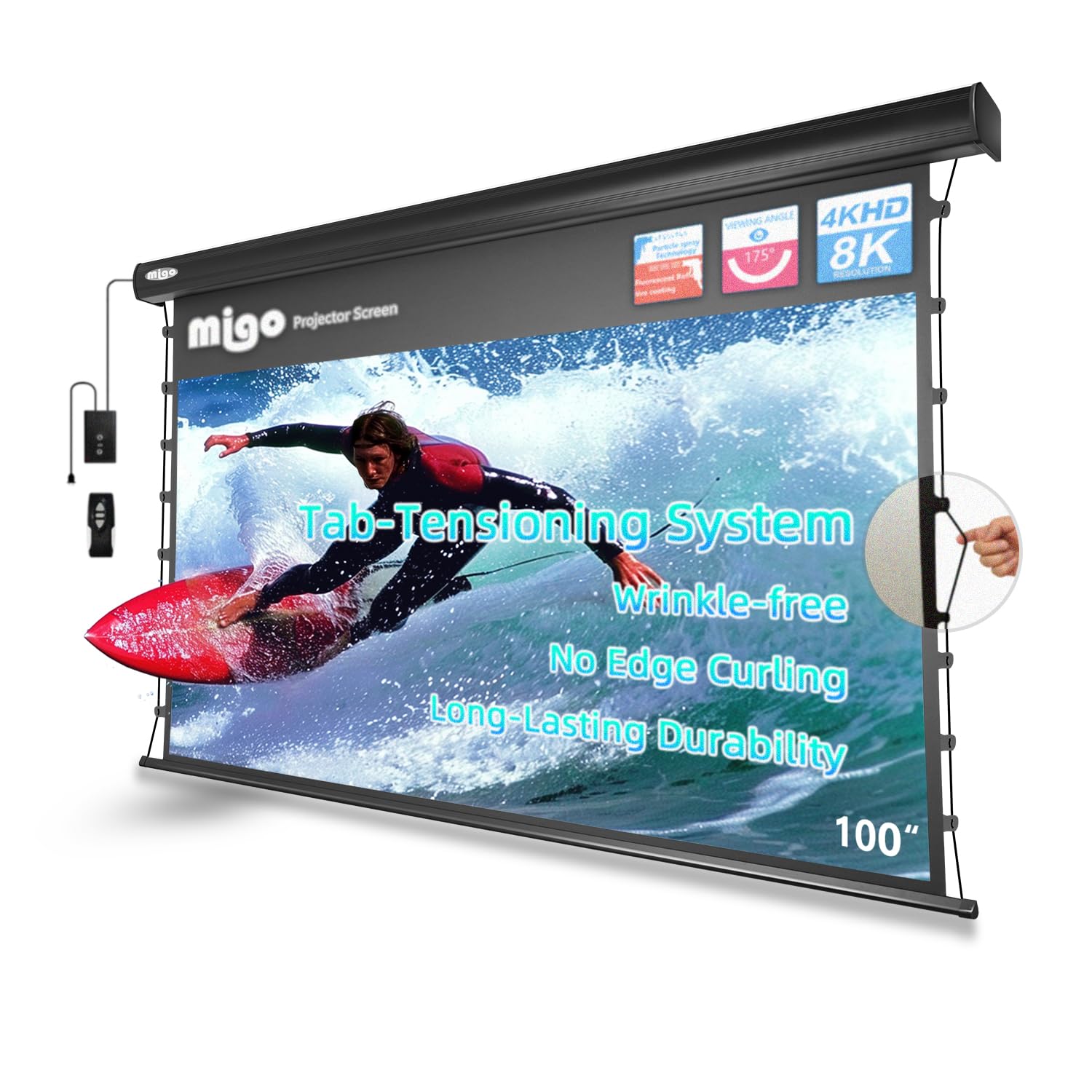
The MIGO 100-inch tab-tension motorized screen is a strong pick for living rooms where a permanent fixed frame would dominate the wall. Its grey crystal surface with partial ambient light rejection is not a full ALR coating, but the 3.0 gain provides a significant brightness boost that helps overcome moderate ambient light when paired with a projector exceeding 3,000 lumens.
The tab-tension system uses side tensioning cables and a 7-pound weighted bottom bar, which keeps the fabric taut and wrinkle-free across the full viewing area. The motor operates quietly and supports RF remote control from up to 16 feet away, plus you can set custom drop limits for different ceiling heights. The aluminum alloy housing is durable, and the screen supports five installation methods including wooden and concrete ceiling mounts.
The biggest caveat: the screen is advertised as partial ambient light rejecting but is not a true ALR optical layer. Owners using it with ultra-short throw projectors in bright rooms report that it performs worse than dedicated UST ALR screens. It is best used with a high-lumen long-throw projector and dimmable ambient lighting where the primary goal is a retractable screen that stays flat.
Why it’s great
- Tab-tension system with weighted bar delivers a flat, wrinkle-free surface
- Quiet motor with RF remote and custom drop limit for varied ceiling heights
- 175-degree viewing angle works for wide seating layouts
Good to know
- Not a true ALR screen; performs poorly in bright rooms with UST projectors
- Needs a projector with at least 3,000 lumens to overcome ambient light
- Heavy unit requires two people for wall or ceiling installation
7. AWOL VISION Motorized Floor Rising 120″
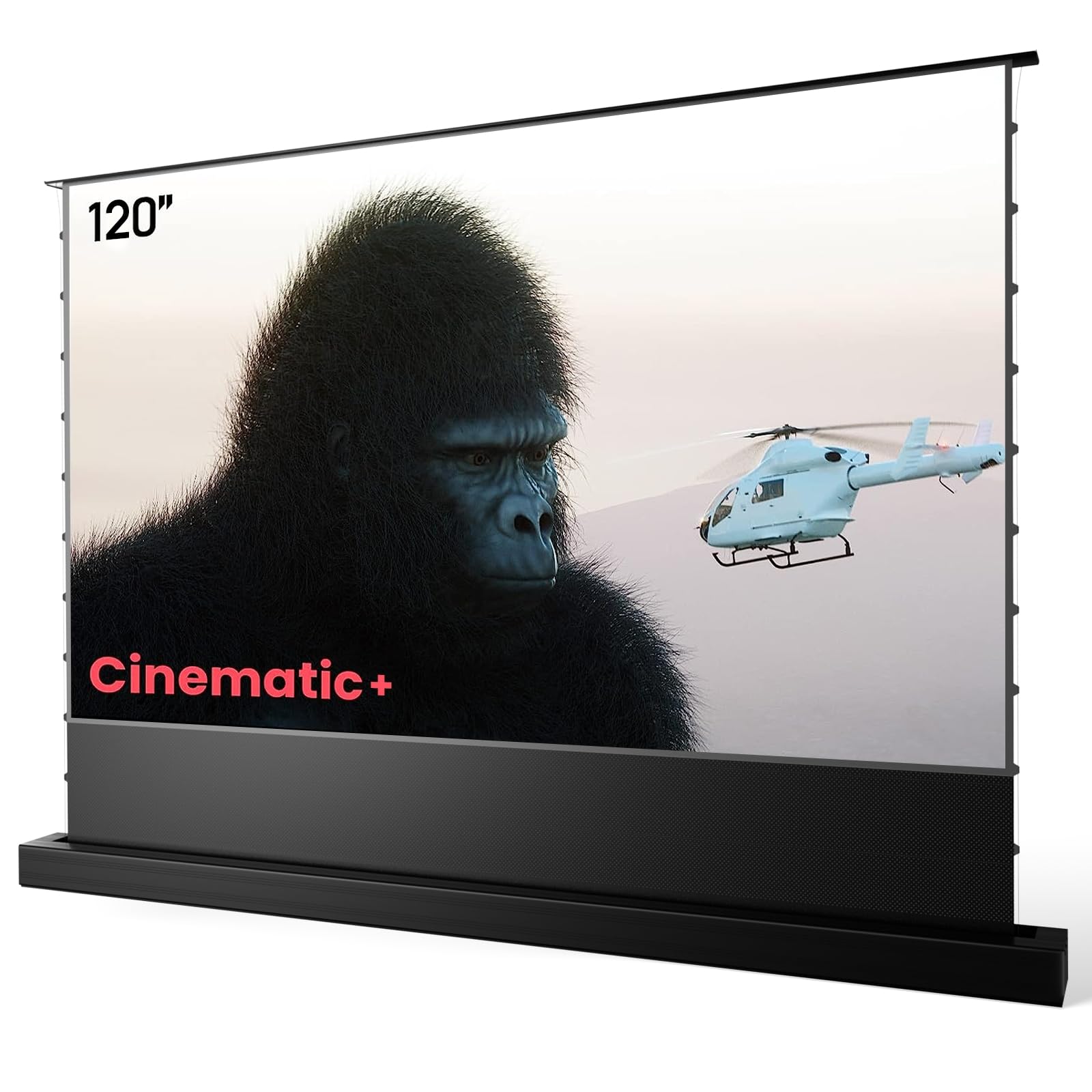
The AWOL VISION ALR-F220C is the premium floor-rising solution for ultra-short throw projectors, combining a motorized pop-up mechanism with a genuine HBSI ALR surface that achieves 95 percent ambient light reduction. The 0.8 peak gain is moderate, but the combination of the cirriform optical lens microstructure and an acoustic transparent design—with 0.4mm sound holes—allows you to place a center channel speaker behind the screen without muffling dialogue.
The smart control box includes a memory function that sets your exact stop height, and the USB synchronization trigger connects to your projector’s USB port so the screen raises and lowers automatically with the projector’s power state. The wire tension technology holds the fabric glass-flat, and the 170-degree viewing angle is exceptionally wide for an ALR product, meaning side-seated viewers do not experience the severe hotspotting common on high-gain UST ALR screens.
At 14 kilograms (about 31 pounds) with a sturdy aluminum enclosure, the base is heavy enough to stay planted without permanent floor mounts, but it lacks wind-stabilizing support poles—two verified owners reported the unit toppled over after light bumps. The 1-year warranty is standard, but AWOL’s customer service reputation is strong, with replacement dongles and support provided quickly when issues arise.
Why it’s great
- 95 percent ambient light rejection produces vivid images even with room lights on
- Acoustic transparent material lets you place a center speaker behind the screen
- USB synchronization trigger automates screen raise/lower with projector power
Good to know
- Floor-rising base is heavy but tips over if bumped without side stabilizers
- Requires ample floor space in front of the screen; not ideal for small rooms
- Premium investment; entry-level projectors will struggle to produce a bright enough image
8. VIVIDSTORM S PRO Floor Rising 120″

The VIVIDSTORM S PRO VSDSTUST120H floor-rising screen is engineered exclusively for ultra-short throw laser projectors. Its optical sawtooth structure uses a light-suppression filter that achieves a claimed 97 percent ambient light rejection rate against ceiling light, making it one of the most aggressive ALR coatings in the market. The 0.6 gain is low, which preserves contrast in bright rooms but demands a UST projector with at least 2,500 lumens.
Unique to this model is smart app control and voice assistant compatibility, letting you raise or lower the screen from your phone or via Alexa/Google Home. The wire tension technology holds the fabric flat like a glass surface when extended, and the aluminum housing retracts flush when not in use. Setup is genuinely plug-and-play: connect power, press the button, and the screen rises in about 30 seconds.
Customer feedback highlights excellent daytime viewing even with ceiling fans and lamps running. The main complaints involve edge curl—the tension system leaves a slight inward curve along the vertical edges visible on full-field white content—and occasional confusion with the height adjustment screw, which is yellow rather than silver as shown in the manual. VIVIDSTORM’s support team is responsive via WhatsApp and helped several owners resolve motor buzz issues with a quick adjustment video.
Why it’s great
- 97 percent measured ALR rate provides exceptional ceiling-light rejection
- Smart app and voice control for convenient operation without a dedicated remote
- Plug-and-play installation—no wall mounting or screws required
Good to know
- 0.6 gain is very low; only suitable for high-lumen UST laser projectors
- Some units show slight edge curl on vertical sides from the tension system
- Not compatible with ceiling-mounted long-throw projectors
9. VIVIDSTORM S PRO Portable Folding 120″

The VIVIDSTORM S PRO VSDSTUST120H-WB is a floor-standing, folding variant of the same UST ALR material found in the motorized version, sharing the same 0.6 gain and 97 percent ambient light rejection rating. The key difference is portability: the screen mounts on a folding stand that you can collapse and move between rooms or take to a friend’s house without tools.
The optical sawtooth structure and light-suppression filter are identical to the motorized model, so daytime contrast performance is excellent when paired with a 2,500-lumen or brighter UST laser projector. The aluminum housing is heavy at 33 kilograms (about 73 pounds), so it is not a casual carry—moving it requires two people—but the folding design still offers placement flexibility that a fixed frame or floor riser cannot match.
Customer verdicts are positive, with owners of VAVA 4K and AWOL projectors reporting crisp images in dim and moderately lit conditions. The tension holds tight with no rippling, and the stand feels sturdy once locked in place. The main trade-off beyond weight is cost: at this tier, you are paying a premium for the portable mechanism over a comparable fixed-frame ALR screen, so only buy this if you actually need to move the screen between locations.
Why it’s great
- Same top-tier 97 percent ALR material as the motorized version in a portable format
- Folding stand enables room-to-room flexibility without wall modifications
- No power cable or motor needed—setup is purely mechanical
Good to know
- Extremely heavy at 73 pounds; two people are needed for any move
- Requires a very bright UST projector—anything under 2,500 lumens will look dim
- Premium cost for the portability mechanism; reconsider if you never plan to move it
FAQ
Can I use an ultra-short throw projector on a standard ALR screen designed for long throws?
Why does my ALR screen show a bright hotspot in the center?
What projector brightness do I need for a 0.6-gain ALR screen in a bright room?
Final Thoughts: The Verdict
For most users, the best anti-light projector screen winner is the Valerion 120″ Fresnel ALR because its 1.8 gain and 85 percent ambient light rejection deliver a genuinely daytime-watchable image for long-throw setups without demanding a completely dark room. If you want the cleanest frameless aesthetic and ISF-certified color accuracy, grab the Elite Screens Aeon CineGrey 3D. And for ultra-short throw owners who need a motorized floor-rising screen that pairs perfectly with a 3,000-lumen laser projector, nothing beats the AWOL VISION ALR-F220C.