
Our readers keep the lights on and my morning glass full of iced black tea. As an Amazon Associate, I earn from qualifying purchases.
Specs are compiled from manufacturer listings and verified buyer reviews and can change over time — please confirm the key details on the product page before buying.
That grinding noise from your brakes has a cure, but the wrong tube of goop makes things worse. The real trick is finding a compound that handles extreme heat without turning into cement, so your next brake job doesn’t turn into a fight with a seized bolt. This guide breaks down the key differences between copper, ceramic, and silicone-based formulas so you know exactly which one to grab for your car.
I’m Min — the founder and writer behind Gadgets Feed. This guide is built by comparing the manufacturers’ published specifications and the patterns across verified customer reviews, so you get each pick’s real strengths and trade-offs instead of marketing spin.
Inside, you’ll find seven thoroughly vetted lubricants sorted by heat tolerance, consistency, and real-world buyer feedback — the anti seize for brakes that actually prevents rust and galling without the mess.
Our Picks at a Glance

How To Choose The Best Anti Seize For Brakes
Brakes generate serious heat, and a standard hardware-store lubricant will burn off or harden within months. You need a high-temperature compound that stays slippery above 1,800°F and resists water, salt, and corrosion. Here are the three specs that separate a good buy from a regret.
Upper Temperature Rating
This is the ceiling — the maximum heat the compound withstands before it breaks down. For brake work, look for at least 1,800°F. Copper-based pastes typically live at that number, while ceramic-silicone blends like the AGS hit 3,000°F. A higher rating means you can also use it on exhaust manifolds and turbine parts without worry.
Copper vs Ceramic vs Silicone
Copper formulas (bright copper color) are great for threaded fasteners — spark plugs, lug nuts, exhaust bolts — because they prevent galling, which is when metal welds itself together under heat and pressure. Ceramic and silicone greases (often purple or white) are better for sliding surfaces like brake caliper pins and pad backs, where you want quiet, vibration-free movement without contaminating rubber boots or EPDM seals.
Container Type and Application
A brush-top can lets you dab exactly where needed with zero waste, which is handy for caliper pins and small threads. A squeeze tube gives you more control over volume but can dry out at the tip. A bottle with a loose cap is messy and easy to knock over. Match the container to how often you work — mechanics grab tubes, weekend DIYers often prefer the brush can.
Quick Comparison
| Model | Best For | Upper Temp Rating | Volume | Base Material | Amazon |
|---|---|---|---|---|---|
| Keze Copper★ Best Overall | Large volume value | 1,800°F | 8 fl oz | Copper / Lithium | $14.99Amazon |
| AGS Ceramic-GlydeHighest Heat | Highest heat survival | 3,000°F | 4 fl oz | Silicone / Ceramic | $11.49Amazon |
| Loctite Marine Grade | Extreme corrosion protection | 2,400°F | 8 fl oz(0.24L) | Paste (Nickel/Grade) | $31.00Amazon |
| ZDBB Copper | Best value per ounce | 1,800°F | 8 fl oz | Copper | $13.99Amazon |
| Keze Ceramic Purple | Silent brake pins | — | 8 fl oz(0.24L) | Ceramic / Synthetic MCA | $16.99Amazon |
| Liqui Moly LM 508 | German precision / small jobs | 2,012°F | 3.4 fl oz(0.1L) | Lithium | $12.15Amazon |
| Loctite Copper C5-A | Firearm & gun bench use | 1,800°F | 4 fl oz(0.12L) | Copper / Graphite | $22.99Amazon |
In‑Depth Reviews
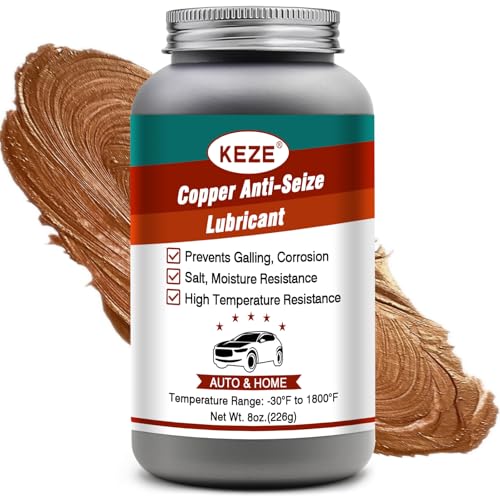
1. Keze Copper Anti-Seize Lubricant
Our pick — over 4.5★ from 850+ verified ratings; the strongest balance of quality and price.
An 8-ounce bottle that covers everything from lug nuts to lawnmower bolts without a refill.
This is the anti-seize that makes you wonder why you ever bought those tiny 4-ounce tubes. With 8 fluid ounces of copper-paste — that means you get a full 8 oz bottle, not a half-empty can — you have enough for multiple brake jobs, spark plug swaps, and exhaust work. The heat ceiling sits at 1,800°F, which covers every normal automotive bolt exposed to extreme temperatures, from your brake caliper brackets to your exhaust manifold studs.
The formula blends copper powder, lithium composite, and petroleum distillates (refined petroleum oils that help the paste spread evenly). That combination creates a durable barrier against rust and corrosion from road salt and moisture. Buyers report it works well in unexpected places — one reviewer used it on pool diving board and hand rail bolts where previous bolts rusted so badly they had to be cut off.
Unlike the Loctite C5-A tube that only gives you 4 oz, this Keze bottle gives you 8 oz (versus 4 oz) for a similar mid-range price. The one catch: the bottle has a screw cap, not a brush top, so you will need a small paintbrush or a gloved finger to apply it cleanly to caliper pins and small threads.
Spreads further: You get 8 oz of copper paste that handles up to 1,800°F (hot enough for brakes, spark plugs, and exhaust bolts), and buyers confirm it stops rust even on pool hardware.
Reach for this if: You want one big bottle that handles brakes, exhaust, and marine bolts alike and you do not mind using a separate brush to apply it.
Look elsewhere if: You prefer a brush-top can for zero-mess caliper pin lubrication.
2. AGS Ceramic-Glyde Silicone Brake Lubricant
The one lubricant that survives 3,000°F without burning off or turning into glue.
This is the highest temperature-rated brake lubricant on this list — 3,000°F, a full 1,200°F hotter than the copper pastes. If you drive a heavy vehicle over 4,000 lbs or do track days where rotors glow, this silicone-ceramic blend stays slippery when everything else has evaporated. Unlike copper grease, this formula is also safe for rubber components like EPDM seals and nitrile rubber boots on caliper slide pins, so you can use it liberally without worrying about swollen seals.
The brush-top can makes a real difference in your driveway. You dab the included brush right onto the caliper pin or pad backing plate — no drips, no wasted paste, no sticky fingers. Buyers specifically call out that high temp brake silicone is exactly what you want for spirited driving. The 4-ounce can holds less volume than the 8 oz Keze or ZDBB bottles, but with the brush-applicator, you waste far less, so the practical use is about even.
Because this is a silicone-based lubricant rather than a copper paste, it is better suited for sliding surfaces than for high-torque threaded fasteners. One reviewer noted the can arrived underfilled and needed mixing due to settling, but after stirring it worked well and the bright color ensured high visibility during application.
What stands out
- Highest temp ceiling here at 3,000°F — survives heavy braking and exhaust-level heat
- Brush-top can applies cleanly without extra tools or mess
- Safe for EPDM rubber and nitrile seals, unlike some copper greases
What to watch for
- Only 4 oz total — less volume than the 8 oz bottles
- Silicone formula may settle in the can; stir before each use
Best for: Drivers who push their brakes hard — heavy trucks, towing, or track days — and want a rubber-safe lubricant that does not burn off at 3,000°F.
Skip if: You need a bulk copper paste for threads on exhaust bolts and lug nuts, where a 1,800°F tube will work fine at half the cost.
3. Loctite 299175 Paste Anti-Seize Lubricant

A marine-grade paste that shrugs off salt water and hits 2,400°F without a flinch.
Loctite calls this marine grade for a reason. The 8-ounce can holds 0.24 liters of a heavy-duty paste that protects metal parts from corrosion and seizure all the way up to 2,400°F. That is 2,400°F versus the 1,800°F of common copper pastes, putting it in a class for fleet trucks, plant maintenance, water pump flanges, and pipe joints where you cannot risk a fastener seizing in a humid or salt-spray environment.
The paste is compatible with steel and designed for fasteners that live in tough conditions. Unlike the copper-based formulas, this Loctite compound uses a different base that resists washout from pressure washers and chemical exposure. That makes it a strong pick if you work on boats, snowplows, or any equipment that sees constant moisture. Buyers confirm it works well on water pump flanges and gaskets where standard anti-seize would wash away within a season.
The main trade-off is price — at over, this is the most expensive option on the list. You pay for the marine-grade certification and the 2,400°F heat rating. If your biggest enemy is road salt in the Northeast rather than saltwater submersion, the copper greases at half the price will serve you just as well.
The heavy-duty pick: 2,400°F marine-grade paste in a generous 8 oz can that resists washout and corrosion better than standard copper — but you pay a premium for that protection.
Reach for this if: Your equipment lives near salt water, steam, or chemical washdowns and you need a paste that stays put at 2,400°F.
Look elsewhere if: You are working on a daily-driver car in dry conditions — a copper tube will do the same job for less.
4. ZDBB Copper Anti-Seize Lubricant

Eight ounces of copper paste at a price that makes the tiny tubes look like a rip-off.
The ZDBB delivers the same 8 fluid ounce volume as the Keze Copper bottle and the same 1,800°F upper temperature limit, but it comes at an entry-level price that undercuts most competitors. That makes it the obvious choice if you need bulk copper grease for multiple vehicles, farm equipment, or community shop use. The copper-based formula prevents seizing, corrosion, and galling (galling is the metal-to-metal welding that happens under high heat and pressure), so your exhaust bolts and spark plugs come out clean years later.
Buyers in the Northeast confirmed this is a must-have for preventing rust on bolts and nuts, noting the paste has a good consistency and is hard to find locally in stores. The brush-top bottle makes application straightforward — you just dab the built-in brush onto the threads rather than squeezing from a tube. Unlike the AGS silicone lubricant which is best for sliding pins, this copper paste is ideal for threaded connections: spark plugs, exhaust manifold bolts, oxygen sensors, and brake hub bolts.
The one unknown is how well the anti-seize properties hold up after years of heat cycling. The paste consistency is good, but until you actually disassemble a part that has been coated for several seasons, you are relying on the 1,800°F rating and the copper base, both proven formulas in the industry.
Why it wins
- 8 oz of copper anti-seize at a budget-friendly price — more grease per dollar than most
- Brush-top bottle for clean application on threads and bolts
- Same 1,800°F rating as the pricier Loctite copper tube
The trade-off
- Less brand recognition than Loctite or Liqui Moly, so some buyers question long-term consistency
- Copper paste can stain light-colored garage floors and clothing if dripped
Best for: The DIYer who goes through a lot of anti-seize and wants the lowest cost per ounce without sacrificing the 1,800°F heat rating.
Skip if: You prefer a German-made paste with decades of racing pedigree and a smaller tube that will not go bad before you finish it.
5. Keze High Temp Ceramic Brake Caliper Grease
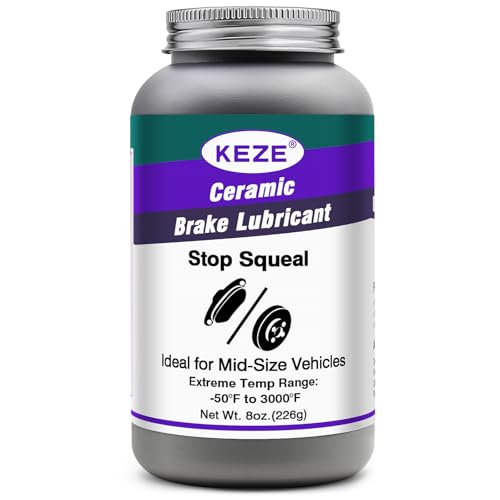
A thick purple ceramic grease that clings to caliper pins and stops brake squeal stone-cold.
Unlike the copper pastes above that focus on threads, this Keze formula is made for sliding surfaces — brake caliper pins, pad backing plates, and shims. The formula uses synthetic MCA and ceramic powder (a non-metallic ceramic additive that reduces friction without conducting heat into the rubber boots), creating a thick, color-coded purple grease that stays where you put it. The brush-top can gives you mess-free control, letting you paint a thin layer onto the exact spot without glops falling onto your rotor.
The 8-ounce (0.24 liters) can holds the same volume as the Keze copper bottle, but this is a dedicated brake grease, not a general-purpose anti-seize. The data does not list an upper temperature rating, but the synthetic MCA base is designed to survive repeated heat cycles on calipers without melting away or drying out. The grease also creates a corrosion-resistant shield against rust, dirt, and moisture — useful for anyone driving in wet or salted-road conditions.
Compared to the AGS Ceramic-Glyde above, this Keze ceramic grease is thicker and more paste-like, which helps it stay on vertical surfaces like caliper pins without running. The trade-off is that it is harder to spread thin on threads, so keep a dedicated copper paste for your lug nuts and exhaust bolts.
The caliper specialist: Thick purple ceramic grease in a brush-top 8 oz can that stops brake squeal, prevents seizing on pins, and resists moisture — but it is not a thread anti-seize.
Best for: DIY brake jobs where you want a dedicated caliper pin and pad lubricant that stays put and will not contaminate rubber seals.
Skip if: You need a one-bottle solution for both threads and pins — grab the Keze Copper bottle instead and use it sparingly on rubber parts.
6. Liqui Moly LM 508 Anti-Seize Compound

A German-made lithium paste trusted by mechanics for a decade of bolt-freeing service.
Liqui Moly packs a 100-gram (0.1-liter) tube with a lithium-based anti-seize compound rated from -31°F all the way to 2,012°F. That wide operating range means it works just as well in a freezing winter driveway as it does on a hot exhaust header. The paste is designed for threaded connections and parting surfaces on turbines, compressor equipment, exhaust systems, and spark plug threads — places where standard grease would burn off or wash out. Buyers with over ten years of use report it never gums up and prevents bolt failure when applied sparingly with a brush.
One thing that sets the LM 508 apart: it is a favorite among mechanics who keep a tube in every toolbox. That says a lot about real-world trust. The data notes that the paste can separate during storage, so you should knead the tube (squeeze and roll it with your fingers) before each use to re-mix the lithium fat and the solid lubricants. Apply it thinly with a brush or lint-free cloth — too much paste just makes a mess and attracts dirt.
The 0.1-liter volume is noticeably smaller than the 0.24 liters in the Keze or Loctite marine cans. That makes this a better choice for the occasional weekend mechanic than for a shop that goes through a can every month. The price lands mid-range, so you pay for the German engineering and the proven track record rather than for bulk quantity.
What makes it special
- German-engineered lithium formula rated from -31°F to 2,012°F
- Trusted by professional mechanics for over a decade — one buyer says it belongs in every toolbox
- Works on high-pressure compressor equipment and exhaust systems, not just car brakes
What to know
- Small tube (100 g / 0.1 L) — versus the Loctite C5-A’s 4 fl oz (0.12 L)
- Needs kneading before use because the paste separates in storage
Reach for this if: You want a proven German paste with a 2,012°F ceiling and you only need a small tube for occasional brake, spark plug, and exhaust work.
Look elsewhere if: You need bulk grease for a fleet of vehicles — the 8 oz ZDBB or Keze copper will give you more applications for a similar price.
7. Loctite 234194 Copper LB 8008 C5-A Anti-Seize

The 4-ounce tube that Glock armorers and suppressor owners swear by for carbon fouling.
Loctite C5-A is a familiar name in any mechanic’s drawer, but this 4-ounce tube has found a second life in the firearms world. The copper and graphite-based paste is rated from -20°F to 1,800°F, covering the full heat range of brake calipers, exhaust bolts, and even suppressor mounts. The paste uses a blend of copper, graphite, calcium dihydroxide, and petroleum distillates to prevent seizing on steel and stainless steel parts.
What sets this tube apart from the 8 oz bottles is its popularity with gun owners. Owners mention using it on Glock pistol slides — it collects less dirt and sand than standard gun grease — and on suppressor mounting surfaces where carbon lock (when carbon fouling fuses threads together under heat) used to need a hammer and strap wrench to separate. One tube lasts years because a little goes a long way; the paste stays put and does not run or drip.
The trade-off is value per ounce. At 4 fluid ounces (0.12 liters), this tube costs nearly as much as the 8 oz Keze or ZDBB copper bottles, so you are paying for the Loctite brand name and the specialized graphite-copper formula. For pure brake work on a single vehicle, the larger bottles give you more applications for less money. But if you also work on firearms or any carbon-fouled threaded parts, the C5-A’s anti-carbon performance is tough to top.
The dual-purpose specialist: A 4 oz copper-graphite paste that prevents seizing on brake fasteners up to 1,800°F and also solves carbon-lock on firearm suppressors — but the small tube means less value per ounce than the bulk copper bottles.
Best for: Shooters who also turn wrenches — one tube handles both brake calipers and carbon-fouled gun threads without buying separate products.
Skip if: You only work on cars and want the most grease for your dollar — the 8 oz ZDBB or Keze copper delivers 8 oz versus 4 oz for roughly the same spend.
Understanding the Specs
Upper Temperature Rating
This is the single most important number for brakes. The compound must survive the heat a rotor and caliper generate during heavy braking without burning off, hardening, or turning into glue. The range on this list runs from 1,800°F (copper pastes) to 3,000°F (ceramic-silicone blends). A higher number means you can also use the lubricant on exhaust manifolds and turbine parts, but for most passenger cars, 1,800°F is sufficient. Heavy trucks, towing vehicles, or track-day cars should aim for 2,000°F or higher.
Base Material: Copper vs Ceramic vs Silicone
Copper paste (copper-colored) prevents galling on threaded fasteners — spark plugs, lug nuts, exhaust bolts — because the copper particles act as a solid lubricant between the threads. Ceramic and silicone greases (often purple or white) work better on sliding surfaces like caliper pins and pad backing plates. They do not attack rubber seals and they reduce brake squeal. The rule of thumb: copper for threads, ceramic-silicone for pins and pads. Many mechanics keep both types in their toolbox.
FAQ
Can I use copper anti-seize on brake caliper pins?
What temperature does anti-seize need for brakes?
How long does anti-seize last once applied?
Will anti-seize loosen my lug nuts?
Can I mix copper and ceramic anti-seize?
What is the difference between copper and nickel anti-seize?
Why does some anti-seize have a brush top and others a tube?
Is it safe to use anti-seize on oxygen sensors?
Final Thoughts: The Verdict
For most people, the best anti seize for brakes winner is the Keze Copper because it gives you a generous 8 fluid ounces of 1,800°F-rated copper paste at a mid-range price, covering everything from brake calipers to exhaust bolts in one bottle. If you want the highest heat survival and a rubber-safe silicone formula, grab the AGS Ceramic-Glyde with its brush-top can and 3,000°F rating. And for marine-grade protection that shrugs off saltwater and hits 2,400°F, the standout is the Loctite Marine Grade paste.
How We Picked
We do not accept paid placement. Every pick is matched to a real buyer and a real use-case; we do not hands-on test units.
Sources & Methodology
Specifications: manufacturer listings and product documentation. Review insights: verified customer reviews, as of July 2026. Pricing: not shown on this page (it changes often); check the current price via the retailer link.
As an Amazon Associate, Gadgets Feed earns from qualifying purchases. This does not affect which products we feature.
Related Guides
Product prices and availability are accurate as of the date/time indicated and are subject to change. Any price and availability information displayed on Amazon at the time of purchase will apply to the purchase of this product. As an Amazon Associate I earn from qualifying purchases.
CERTAIN CONTENT THAT APPEARS ON THIS SITE COMES FROM AMAZON. THIS CONTENT IS PROVIDED "AS IS" AND IS SUBJECT TO CHANGE OR REMOVAL AT ANY TIME.
Amazon and the Amazon logo are trademarks of Amazon.com, Inc. or its affiliates.