
Our readers keep the lights on and my morning glass full of iced black tea. As an Amazon Associate, I earn from qualifying purchases.
Specs are compiled from manufacturer listings and verified buyer reviews and can change over time — please confirm the key details on the product page before buying.
Anti-seize is cheap insurance for a spark plug job: a thin smear on the threads stops the plug from seizing in the cylinder head, so the next removal takes a socket wrench instead of a drill. The crowd favorite is the ZDBB Copper Anti-Seize, the highest-rated paste here at 4.8 stars across 600+ ratings, in an 8 oz brush-top bottle that covers plugs, brake pads, and exhaust bolts. Below are nine options, each with its temperature ceiling, paste form, and container size.
This guide compares manufacturers’ published specifications against patterns in verified customer reviews, so each pick’s strengths and trade-offs come from the data rather than marketing copy.
Copper pastes dominate the shelf, but nickel and aluminum versions solve the metal-matching problems copper makes worse. anti seize for spark plugs The wrong paste on the wrong thread can freeze a plug permanently.
Our Picks at a Glance


How To Choose The Best Anti Seize For Spark Plugs
The single biggest mistake first-timers make is grabbing the tub of copper paste on the shelf without checking what the spark plug boss in their head is made of. Copper anti-seize is superb on iron and on most steel threads, but on an aluminum cylinder head in a marine or long-term application the copper can set up a galvanic reaction with the aluminum. That is the whole reason aluminum and nickel pastes exist. Pick the metal first, then the temperature rating.
Match the metal to the paste
Copper paste is the general-purpose choice for spark plugs in iron heads, exhaust manifold bolts, brake caliper pins, and brake cam assemblies. Aluminum paste is the one to reach for when you are threading into stainless steel or another sensitive alloy that copper would attack. Nickel paste sits at the top of the food chain for harsh chemical environments and the highest heat, and it is the version to consider when a copper paste is not recommended for your application.
Check the temperature ceiling
A spark plug tip on a hard-working engine can run very hot, and the paste on the threads has to survive it without burning off or turning to carbon. The pastes in this list publish upper ratings of 1600°F to 2012°F, which covers virtually every production engine you will touch. If you are also doing exhaust manifolds or turbo fasteners, buy the paste with the higher rating so one can does both jobs.
Container size and applicator
You apply anti-seize in a whisper-thin layer, so a single 8 oz bottle lasts through many jobs — one owner reported one bottle covering about 24 wheels. A brush-top bottle is the practical choice because it lets you dab a controlled amount straight onto the threads without dunking a separate brush. Knead the tube or stir the bottle before use, because these paste formulas separate as they sit.
Quick Comparison
| Model | Best For | Base Material | Max Temp | Size | Amazon |
|---|---|---|---|---|---|
| ZDBB Copper Anti-Seize 8 oz★ Best Overall | All-around plug and brake jobs | Copper paste | 1800 °F | 8 oz / 226 g | Amazon |
| Liqui Moly LM 508 100 gPrecision Pick | Precision dab on plugs and calipers | Lithium / copper paste | 2012 °F | 100 g / 0.1 L | Amazon |
| GreaseCo Copper Anti-Seize 8 ozBest for Brakes | Brake pins, cams, and marine work | Copper / calcium sulfonate | — | 8 fl oz / 0.23 kg | Amazon |
| GreaseCo Aluminum Anti-Seize 8 oz | Stainless and copper-sensitive threads | Aluminum paste | — | 8 fl oz / 0.23 kg | Amazon |
| TTL TAS 2000 Copper 9 oz | Hard-to-reach flange and marine bolts | Copper / graphite | 1800 °F | 9 oz / 8.96 oz wt | Amazon |
| Vibra-TITE 907C 8 oz Jar | Chemical-heavy and industrial threads | Copper paste | 1800 °F | 8 oz / 8 fl oz | Amazon |
| Loctite Silver Anti-Seize 8 oz | Coastal climates and mixed metals | Graphite / silver flake | 1600 °F | 8 oz / 8 fl oz | Amazon |
| CRC Copper Anti-Seize 8 oz | Brake jobs and rusty suspension | Copper grease | — | 8 wt oz / 0.12 L | Amazon |
| Loctite Nickel Anti-Seize 8 oz | Exhaust manifolds and stainless NPT | Nickel / graphite | — | 8 oz / 8 fl oz | Amazon |
In‑Depth Reviews
1. ZDBB Copper Anti-Seize Lubricant, 8 oz Brush-Top Bottle
Our pick — over 4.5★ from 650+ verified ratings; the strongest balance of quality and price.
The broadest-use copper paste here, with one bottle covering plugs, brakes, and exhaust bolts alike.
If you want a single can that lives on the shelf and covers nearly everything threaded on a car, this is the one to grab. The ZDBB bottle holds 8 oz of copper paste and is rated to an upper temperature of 1800 °F — hot enough that the threads on a hard-run cylinder head never threaten to cook it off. The brush built into the cap means you dab it straight onto a plug thread without a separate acid brush, so there is no mess on the workbench.
What wins people over is raw effectiveness — by a clear margin the most-praised quality in the review pages. It goes on like a slick coat and stays put rather than creeping, and owners run it on axles, exhaust bolts, hubs, and every spark plug they can find. As the review pages sum it up: “I use this on everything that has a spark plug keeps threads clean and plugs from getting stuck.” That is the whole point: a clean thread and a plug that comes back out next time.
The one caveat to have on your radar is the copper base itself. A few buyers whose vehicles specifically call for a copper-free paste end up returning it, because dealer guidance sometimes rules copper out for their application. If your manual names a nickel or aluminum paste, buy that instead. Otherwise, at 8 oz for the jobs, a single bottle will outlast several plug changes.
What earns it the top slot
- 1800 °F upper rating covers plug, exhaust, and brake heat
- 8 oz bottle with a built-in brush for clean, no-mess application
- Copper formula fights corrosion, oxidation, and thread damage
- Works on plugs, brake pads, hubs, and exhaust bolts from one can
Worth knowing before you click buy
- Copper base is not the right pick for applications that specify copper-free paste
- 8 oz is more volume than a casual user will finish in a year
Reach for this if: you want one general-purpose copper paste for spark plugs and brake hardware without overthinking the metal match.
Look elsewhere if: your service manual calls for a copper-free compound — a nickel or aluminum paste is the safer route.
2. Liqui Moly LM 508 Anti-Seize Compound, 100 g
The 100 g tube with the hottest published ceiling here — 2012 °F for the toughest thread jobs.
The straight number that separates this one is its operating range: −31 °F all the way up to +2012 °F. That is the highest published temperature window in this entire group, which is exactly what you want on spark plug threads that sit deep in a cylinder head and run brutally hot. It is a copper-based paste in a lithium fat carrier, applied with a paint brush or lint-free cloth, and it comes in a compact 100 g tube.
By weight this tube is a fraction of the ZDBB bottle — 100 g against 226 g, roughly a 2.3x gap — but the point of a tube this size is control, not volume. What earns the most praise here is pure anti-seize behaviour, and owners put it to work just as hard on brake calipers and winter lug bolts as on plugs. The knock that recurs is separation: the paste needs a good knead before use because it splits in the tube, though it wipes off cleanly and completely once worked in.
The result is a paste that a small amount goes a long way with, so the smaller tube still stretches across several jobs. It is a fussier product to handle than a wide brush-top bottle, and the separation the buyers mention means you cannot just grab and squeeze — you have to knead it first. For a precision-minded job on plug threads, that trade-off is fair.
The temperature argument: at +2012 °F the LM 508 tops the 1800 °F rating of the ZDBB and the TTL picks, so it is the paste to buy when the fastener runs hotter than a normal engine bay.
Handle it right: knead the tube before every use, because the formula separates as it sits — this is the one recurring gripe across the reviews.
Suits the methodical mechanic: someone who wants the maximum heat rating and does not mind prepping the tube before each dab.
Sidestep if: you would rather grab-and-go — a brush-top bottle is the lower-maintenance choice.
3. GreaseCo Copper Anti-Seize Grease, 8 oz Brush-Top
A calcium-sulfonate copper paste that shrugs off water, steam, and chemical exposure.
Build this one into a brake job and a plug change at the same time. The copper-fortified compound is thickened with calcium sulfonate — the same family of thickener used in greases that take water and steam for a living — so it stays put on brake pins, brake cams, and caliper hardware that see water, chemicals, and pressure. The 8 fl oz brush-top bottle gives you the accurate applicator for getting a controlled layer on threads.
Quality is the quality owners lead with here, and the paste delivers what the label promises: it reduces galling, seizing, and carbon fusion, laying down a dry-film of protective solids so you need less torque to break a fastener loose later. It spreads across threaded fittings, bolts, nuts, sprockets, gears, and plug threads, and it has a following among people working on marine and industrial equipment where corrosion is constant.
The brush is the one thing a few people wish were bigger, so if you are reaching deep into a tight plug well you may want a longer applicator in the toolbox. Beyond that, this is a clean all-round copper paste with the same brush-top convenience as the ZDBB but with a water-resistant thickening system behind it.
Where it pulls ahead: the calcium-sulfonate thickener handles water, steam, and chemicals, which is why it holds up on brake assemblies and marine fittings that ordinary paste washes off.
Buy it for: brake pins, cams, and plugs on vehicles that see rain, salt, or water exposure.
Think twice if: you need to reach very deep plug wells — the included brush is a little short for that.
4. GreaseCo Aluminum Anti-Seize Grease, 8 oz Brush-Top

The copper-free aluminum paste for stainless and other sensitive alloy threads.
Every other paste in this list carries copper; this one deliberately does not. Being free of copper lets it go safely onto stainless steel and other sensitive alloys where a copper compound would cause trouble, and the manufacturer lists it as compatible with aluminum, stainless steel, steel, and metal generally. It arrives in the same 8 fl oz brush-top bottle, so application is identical to its copper sibling — dab, wipe the thread, reinstall.
Owners reach for it on aluminum-to-steel contact points specifically to stop the two metals from melding together over time, and it has a clean following on spark plug threads and wheel hubs. One owner reported one bottle covering about 24 wheels, which tells you how far a thin coating stretches. On high-temp exhaust fasteners it holds up too — bolts that got the aluminum treatment came out easily months later with uncorroded threads.
The honest catch: aluminum paste runs thinner than the copper versions in this list, and if you prefer a paste that sits heavy on the thread you may find this one slides around more. A couple of buyers also report receiving the copper version instead of the aluminum one, so check the label when the box lands. For genuine stainless work, the trade-off is worth it.
Why it earns a spot
- Copper-free aluminum formula is safe on stainless and sensitive alloys
- 8 fl oz brush-top bottle for controlled, low-waste application
- Works on plugs, wheel hubs, and high-temp exhaust fasteners
- A little covers a lot — one bottle reported to handle about 24 wheels
Small things to note
- Runs thinner than the copper pastes, so it moves more on the thread
- Occasional reports of the copper bottle arriving in its place — check the label
The one to pick when: stainless steel or aluminum threads are on the job and a copper paste is off the table.
Not for you if: you want a thick, heavy-staying paste — the copper versions sit in place better.
5. TTL TAS 2000 Copper Anti-Seize, 9 oz with Extended Brush

The biggest bottle here at 9 oz, with an extended brush built for tight, awkward threads.
Reaching the fourth cylinder bank’s rear plug is the pain this paste was built to solve. The applicator brush is permanently attached and purposefully extended to push product out into hard-to-reach spots, which is exactly the problem a wide brush-top bottle cannot handle. The formula blends micro-fine copper with graphite to plate metal surfaces and cut friction, and it holds a temperature range of −40 °F to 1800 °F.
The copper and graphite mix is also washout-resistant — the maker rates it at under 2% water washout, under 2% oil separation, and under 1% evaporation loss — so a layer on a marine or industrial fitting survives where thinner pastes would be carried away. It is made in the USA, uses a tacky texture that stays where you put it, and this is the largest bottle in the group at 9 oz.
If you are doing fine threads where a light film is the goal, plan to work it in sparingly. For plugs, flange bolts, exhaust manifolds, and brake assemblies, the thicker paste is an asset.
The reach advantage: the extended brush pushes paste into deep plug wells and flange corners that a fat bottle brush cannot touch.
The trade-off: it is thicker than most pastes here, so light-duty fine threads need a sparing hand.
Worth grabbing for: awkward-to-reach plug and exhaust threads where application reach matters as much as the paste itself.
Skip if: you are chasing the lightest possible film on delicate fine-thread work.
6. Vibra-TITE 907C Copper Anti-Seize Compound, 8 oz Jar

A jar of copper paste built to resist harsh chemicals and metal-on-metal wear.
This is the paste to keep where solvents and chemicals are part of the job. The copper-filled compound is rated for environmental conditions up to 1,800 degrees Fahrenheit (982 degrees Celsius) and the manufacturer calls out excellent resistance to harsh chemicals and excessive wear alongside protection from rust and corrosion. It prevents seizing, galling, and cold welding on threads, gears, chains, cables, and rollers — a wider parts list than a spark-plug-only paste.
The jar format is the difference here. A jar with a brush lets you load the exact amount you want rather than squeezing a tube, and the paste is built for general-purpose lubrication across industrial and automotive fasteners. Owners say it does what it is supposed to, goes on easily, and gives good value, with a recurring tip to shake or stir it well before use since it separates.
One thing to keep straight: the jar is an open container, which is fine on a shop shelf but less convenient if you want to throw the anti-seize in a road kit. And a few buyers report the copper version behaves just like a nickel-filled paste for their ordinary automotive work, so there is no special advantage to copper if your application is generic. For chemical-heavy or high-wear environments, though, this is a strong, no-nonsense tub.
Where it shines: harsh chemical exposure and wear-heavy parts — gears, chains, cables, and rollers as well as plug threads.
Keep in mind: it is a jar, not a tube, so it lives on the shop shelf rather than in a travel kit.
Good fit for: shops and garages lubricating threads and moving parts in chemical-heavy environments.
Not the pick if: you want a compact squeeze-tube paste for a portable kit.
7. Loctite Silver Anti-Seize Lubricant, 8 oz Brush-Top

A petroleum-based, graphite-fortified paste for coastal corrosion and mixed-metal assemblies.
Live near salt water and this is the paste worth keeping on the shelf. The Loctite compound is a heavy-duty, petroleum-based lubricant fortified with graphite and metallic flake, and the maker states it will not evaporate or harden in extreme cold or heat. It protects metal from rust, corrosion, galling, and seizing at temperatures up to 1600 F, and it is specifically recommended for spark plug threads and electrical connections. It comes as an 8 oz liquid in a brush-top can.
Owners lean on it hard wherever aluminum meets steel. The recurring theme in the reviews is coastal duty — the paste earning its keep on fasteners that touch salt air, and on assemblies mixing aluminum and steel that would otherwise corrode into one lump. The applicator brush goes on easily, and buyers consistently call it top quality and a great value.
Two honest notes. It is a petroleum-based liquid rather than a copper paste, so the feel is different from the copper options in this list, and it carries a lower heat ceiling at 1600 F than the 1800 F and 2012 F pastes above. The other recurring observation is fill level: the bottles are reported to sometimes arrive only partially filled, even though the product is right. If you are working salt-belt fasteners and coastal corrosion is your real enemy, the chemistry here is the point.
Why coastal buyers keep it handy
- Recommended by the maker for spark plug threads and electrical connections
- Graphite and metallic flake fortification won’t evaporate or harden
- Proven on aluminum-to-steel assemblies exposed to salt air
- Protects up to 1600 F and goes on cleanly with the applicator brush
Points to consider
- Lower 1600 F ceiling than the highest-rated pastes here
- Bottles are reported to arrive partially filled on occasion
Made for: anyone fighting corrosion in a coastal or salt-belt climate with mixed aluminum and steel fasteners.
Look past it if: you want the highest possible heat rating — the nickel and Liqui Moly pastes go higher.
8. CRC Copper Anti-Seize & Lubricating Compound, 8 oz
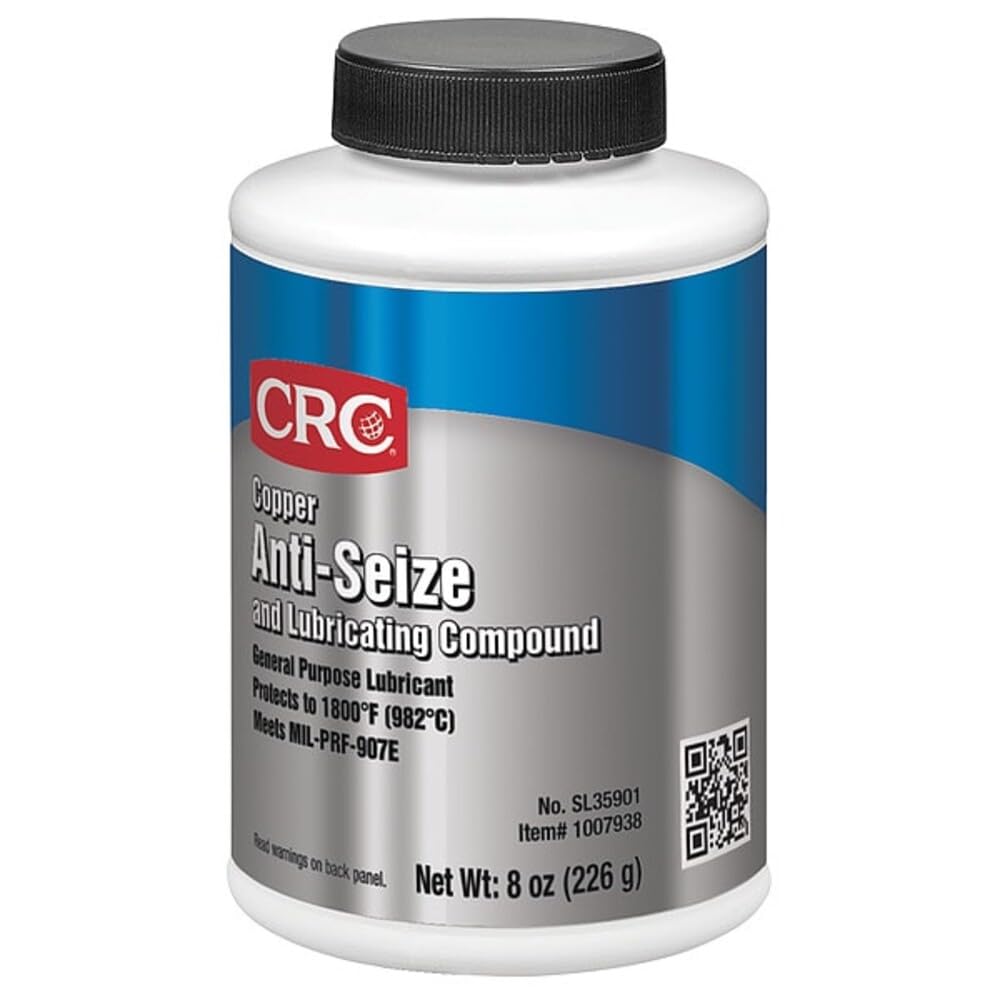
A copper grease with a steam- and water-resistant formula that shines on brake jobs.
Brake lube is where this one earns its reputation, and the smoke clears when you understand why. The copper formula is steam and water resistant, which means a coating on a caliper slide or a brake-pin surface stays effective through everything an undercarriage throws at it. It comes as an 8 wt oz bottle with a brush-top lid for easy application, and it works on fittings, bushings, flanges, headers, nuts, screws, studs, threaded surfaces, pipes, plugs, and manifolds.
The lid brush earns a special mention because it is intentionally bent so you can reach around a stud more easily — a small design feature that saves a lot of fumbling when you are working around brake hardware. It also shines on old disc brakes with sliding springs and on the metal rotor-to-hub interface where corrosion wants to freeze the two together. The formula is built to stop seizing from high temperature, heavy loads, corrosion, and vibration.
The one thing that stands out as a caveat is the price-per-ounce step up from the mid-range copper pastes, since you are paying for the CRC name and the formula. The paste itself is thick and does not run, which is what you want when it needs to stay in place during assembly. In the rust belt, this is one of the more valued copper pastes on the shelf.
The specific design win: the brush-top lid is bent at the tip to reach around studs — thoughtful for brake and hub work where access is tight.
The honest note: it costs more per ounce than the mid-tier copper pastes, so you are paying for the formula and the brand.
Pick it for: brake jobs, hub faces, and rust-belt threads where water and steam resistance matters.
Not the best fit if: you only need a coating on occasional plug threads — a mid-tier copper paste does that cheaper.
9. Loctite 77124 Nickel Anti-Seize, 8 oz Can

The copper-free nickel paste built for extreme heat and the harshest chemical environments.
When the job runs hotter or nastier than copper can handle, this is where you land. The 77124 is a copper-free nickel paste loaded with tenacious metals, oils, and graphite that the maker says cannot be burned away or removed by slow moving parts. It is designed for preventing corrosion, seizing, and galling in harsh chemical environments and at high temperatures — the same role copper plays, only for extreme duty. It ships as an 8 oz liquid in a brush-top can.
Owners put it to work where stainless and heat meet. The standout use is stainless NPT fittings, where it does a good job preventing galling on 316 stainless fittings of various sizes, and it earns praise for its heat resistance — the review pages note it carries a higher temperature specification than copper. It is also a favorite on exhaust manifolds, hub faces, rotor backs, and caliper hardware, and it goes on smooth and consistent without the lumps some other pastes have.
The trade-off is in the name: nickel is the premium option in this list, and it costs more per ounce than every copper paste here. If your application is an ordinary iron-head spark plug job, a copper paste does the same work for less. Save the nickel for genuine extreme-heat or extreme-corrosion threads, where its copper-free chemistry and superior heat spec are the entire reason to buy it.
What makes it the heavy-duty choice
- Copper-free nickel formula for harsh chemical and extreme-heat environments
- Graphite and metals that the maker states cannot be burned away
- Goes on smooth and consistent with no lumps
- Excellent on stainless NPT fittings like 316 stainless sizes
Where the cost shows
- Premium-tier pricing — the most expensive paste in this list per ounce
- Overkill for ordinary iron-head spark plug threads
Reserve it for: stainless fittings, exhaust manifolds, and threads that see extreme heat or aggressive chemicals.
Overkill if: you are only doing standard plug changes — a copper paste covers that for less.
Understanding the Specs
Base material: copper vs aluminum vs nickel
The metal inside the paste is the first thing to check, because it decides which threads the paste is safe on. Copper paste — the majority of this list — is the general-purpose choice for iron heads, brake hardware, and exhaust bolts. Aluminum paste is copper-free and is the option to pick when you are threading into stainless steel or another sensitive alloy that copper can react with. Nickel paste sits highest for extreme heat and harsh chemicals, and it is the choice when a service manual calls out a copper-free compound. Match the paste to the metal, or your protective layer can work against the assembly it was meant to protect.
Temperature rating and container format
The upper temperature rating, measured in degrees Fahrenheit, tells you how hot the threads can get before the paste gives up and bakes away. In this group that ceiling ranges from 1600 °F up to 2012 °F — all of which clear a normal engine’s plug and exhaust temperatures. Buy the highest rating you can afford if one bottle has to cover turbo or manifold fasteners as well. Container format matters just as much day to day: a brush-top bottle or can with a built-in applicator lets you dab a controlled amount straight onto a thread, while a tube is more portable but needs kneading because the paste separates as it sits.
FAQ
Is copper or nickel anti-seize better for spark plug threads?
Can I use anti-seize on spark plugs if the manual says not to?
How much anti-seize should I put on spark plug threads?
Will anti-seize stop my spark plug from getting stuck next time?
Does anti-seize go bad or separate in the bottle?
Can I use anti-seize on brake caliper pins too?
How long does one bottle of anti-seize last?
What is the temperature rating I actually need for spark plugs?
Is aluminum anti-seize the right choice for stainless steel?
Will anti-seize survive exhaust manifold heat without burning off?
Final Thoughts: The Verdict
For most spark plug jobs, the anti-seize to grab is the ZDBB Copper Anti-Seize — it is the strongest all-rounder here at 4.8 stars across 600+ ratings, with an 1800 °F ceiling and an 8 oz brush-top bottle that covers plugs, brakes, and exhaust bolts from one can. If you want the maximum heat rating and do not mind prepping the tube, the Liqui Moly LM 508 tops the group at +2012 °F. And if you are threading into stainless or an application that calls for a copper-free paste, the Loctite 77124 Nickel Anti-Seize and the copper-free GreaseCo Aluminum paste are the ones to keep on the shelf for those jobs.
How We Picked
We do not accept paid placement. Every pick is matched to a real buyer and a real use-case; we do not hands-on test units.
Sources & Methodology
Specifications: manufacturer listings and product documentation. Review insights: verified customer reviews, as of September 2026. Pricing: not shown on this page (it changes often); check the current price via the retailer link.
As an Amazon Associate, Gadgets Feed earns from qualifying purchases. This does not affect which products we feature.