
Our readers keep the lights on and my morning glass full of iced black tea. As an Amazon Associate, I earn from qualifying purchases.
Specs are compiled from manufacturer listings and verified buyer reviews and can change over time — please confirm the key details on the product page before buying.
If you are hunting for an antique plastic model kit, the thing you actually want to know is simple: which vintage-era kits still build cleanly today, and which ones turn into a filing, gluing, and swearing session. The short answer is that the classic-era reissues from MPC, AMT, Revell, Tamiya, Moebius, and Atlantis hold up best, because their molds were either tooled well to begin with or have been cleaned up over the decades. The kits below range from a 97-part 1/76 tank to a 139-part muscle car, and each one earns its spot for a different reason.
I’m Min — the founder and writer behind Gadgets Feed. This guide is built by comparing the manufacturers’ published specifications and the patterns across verified customer reviews, so you get each pick’s real strengths and trade-offs instead of marketing spin.
Vintage kits live and die on three things: whether the parts fit, whether the decals survive the years, and whether the box still matches what is inside. Every pick here was checked against those three, so you can sort the shelf of antique plastic model kits without guessing.
Our Picks at a Glance


How To Choose The Best Antique Plastic Model Kits
The first thing to accept is that buying a classic-era kit is not the same as buying a brand-new one. Old molds wear down, old decals dry out, and old instructions assume you already know what “test fit” means. That is fine once you know what to check. Here is what actually decides whether a vintage kit is a joy or a chore.
Scale tells you the finished size before you open the box
Scale is a ratio, and it is written as something like 1:25 or 1:76. The number after the colon tells you how many times smaller the model is than the real vehicle. So a 1:25 kit is a quarter-of-a-hundredth size model, and a 1:76 kit is much smaller still. If you want a model that sits on a shelf and reads clearly from across the room, go for a bigger number on the left, like 1:25. If you are short on shelf space or want a fleet of tiny armor, 1:76 keeps things compact. A 1:76 tank ends up only a couple of inches long, which is worth knowing before you expect a centerpiece.
Parts count decides how long the build takes
A kit with 97 parts is a weekend project. A kit with 139 parts is a month of evenings. Neither is better, but the number tells you how much patience you are signing up for. If you are building with a child or you want a quick win, look for the lower end of the range. If you want a long, absorbing build that keeps you busy through winter, the higher counts are what you want.
Skill level and what is actually in the box
Almost every vintage kit is rated on a skill scale where 1 is beginner and 4 or 5 is experienced. Two things trip people up here. First, a Level 2 kit still asks you to glue and paint, so it is not a snap-together toy. Second, paint and glue almost never come in the box, and you must add them. Check whether the listing names the parts you get, like decals, chrome, or a paint guide, because that is what separates a complete kit from one with hidden extras to buy.
Quick Comparison
| Model | Best For | Scale | Parts | Skill / Age | Amazon |
|---|---|---|---|---|---|
| MPC 1957 Chevy Bel Air Spirit of 57★ Best Overall | Classic 50s gasser builders | 1:25 | — | Level 2 / 10+ | Amazon |
| Airfix Panther A01302VBudget Champion | First armor builds and practice | 1:76 | 97 | Level 2 / 8+ | Amazon |
| Atlantis Mr. GasserRetro Icon | Ed Roth fans and retro cartoon kits | — | — | Kid | Amazon |
| AMT 1967 Shelby GT-350 | Muscle car detail work | 1:25 | 123 | Level 2 / 10+ | Amazon |
| AMT 981 1967 Chevrolet Impala SS | Gift builds and first cars | 1:25 | — | Adult | Amazon |
| Tamiya 31712 Yorktown CV-5 | Intermediate ship builders | 1:700 | — | — | Amazon |
| Revell 1971 Olds 442 W-30 | Experienced car builders | 1:25 | 139 | Level 5 / 13+ | Amazon |
| Tamiya 24136 VW Beetle 1966 | Detail-focused car builds | 1:24 | — | Kid | Amazon |
| Moebius 1967 Ford F-100 Service Bed | Customizing and kitbashing | 1:25 | — | 12+ | Amazon |
In‑Depth Reviews
1. MPC 1957 Chevy Bel Air Spirit of 57″ 1:25 Scale Model Kit
Our pick — over 4.5★ from 500+ verified ratings; the strongest balance of quality and price.
The 50s gasser that goes together like it was tooled yesterday, not decades ago.
This is the one to start with if you want a classic car kit that does not fight you. It is an MPC 1:25 scale 1957 Chevy Flip Nose Spirit of 57, which means a model built to one twenty-fifth of the real car’s size. The parts come molded in white, with clear, clear blue, and chrome plastic plus black vinyl tires, so a chunk of the detail is already done for you before you open a paint bottle.
What wins people over here is the fit. The single thing that comes up again and again is how well-made the kit feels, and how the pieces are happy to line up — one owner summed it up with “This was the nicest kit I have put together. Everything was happy to go together nothing was wrong,” and that “nothing was wrong” is the dream for a vintage build. Assembly is genuinely straightforward too, though a few note that the parts want a light filing for a tight fit. That is normal on classic molds, and it is the difference between a snug look and a gappy one.
Here is the honest part. A small number of these arrive with a cracked rear light or a missing radiator support, and that traces to the maker’s quality control rather than the seller — the fix is just to check the sprues the day it lands. Also worth knowing: paint and glue are not in the box, and the kit is rated Skill Level 2 and suggested for ages 10 and up, so an adult eye helps. If you want a bright, box-stock car that needs minimal fuss, this is the one to reach for.
Tri-five body accuracy
- Parts fit cleanly with almost no fighting, the thing buyers praise most.
- 7.5 inches long — a half-inch more than the AMT Shelby, so it has real shelf presence.
- Pre-molded chrome, clear blue, and black vinyl tires cut down the finishing work.
- Straightforward assembly that works for a patient beginner.
Decal sheet age
- Paint and glue are not included, and the kit is rated for 10+.
- Some parts need light filing for a tight fit.
- Occasional units arrive with a cracked rear light due to maker QC.
Period-correct builder: you want a classic 50s gasser that builds smoothly and looks right the first time.
Wants modern tooling: you want zero filing and zero QC checks — order a modern sealed kit instead.
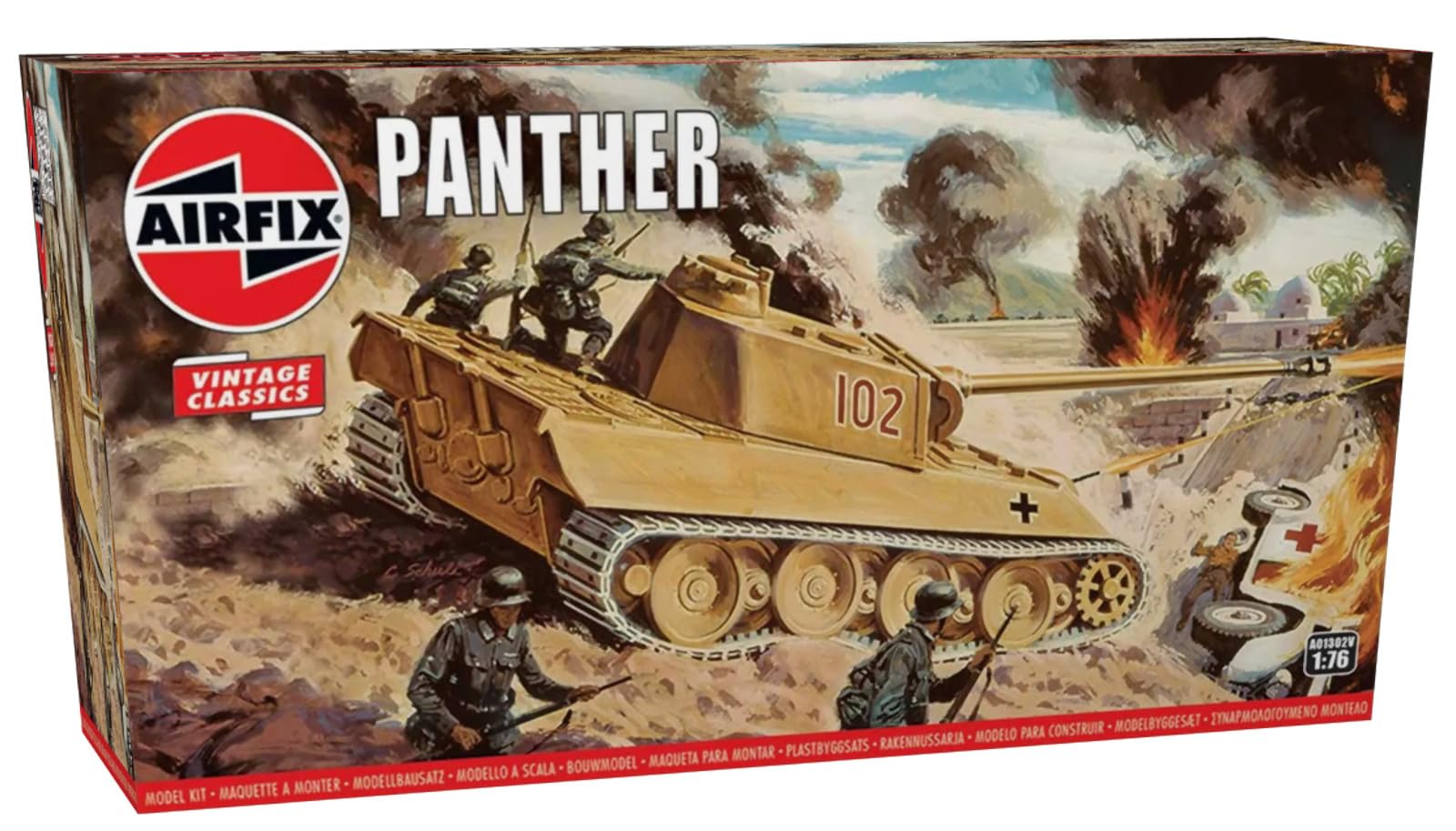
2. Airfix Model Tank – A01302V Panther, Plastic Model Kits for Adults & Kids 8+, 1:76 Scale
A tiny Panther with 97 parts and a grown-up barrier it does not advertise on the box.
Airfix is the UK’s oldest plastic model kit maker, going since 1952, and this Panther is one of their Vintage Classics reissues. It is a 1:76 scale World War 2 tank, meaning it is far smaller than the 1:25 car kits here — the finished model comes out around a couple of inches long. With 97 parts, that works out to roughly 27 percent fewer pieces than the AMT Shelby GT-350’s 123, and the age range is 8 and up against the Shelby’s 10 and up. So on paper it looks like the easier entry. It is not, quite.
What builds respect here is the challenge it offers. The recurring note in reviews is that tiny parts, tiny decals, and the need for careful painting make this a kit for someone with patience, and it doubles as good practice before you step up to a bigger 1/35 scale model. A longtime builder put it plainly: “May require some effort to make it look good, but well worth it.” That is the fair summary. Do it well and you get a crisp little Panther; rush it and you get a smear.
The catch is the size. At 1:76 the wheels and shafts are genuinely small, and reviewers warn that it needs patience, painting, and light weathering to look its best. One buyer’s 11-year-old found the whole thing “nearly impossible” — that is a fit mismatch, not a defect, and you should read it as a marker: this is not a first-time kit for a young child despite the 8+ age rating. Paint and glue are sold separately. Treat it as a skill-building piece and it earns its place.
Beginner-friendly small scale: it is a compact armor model that teaches careful painting and decal work without tying up months of evenings.
Track detail soft: the 1:76 scale makes every wheel and shaft small, so hands-on help and a steady table are more useful than a low age rating.
First armor kit: you want a cheap, compact armor kit to sharpen your skills before a bigger project.
After 1/35 detail: a young child is the main builder — the tiny parts demand adult patience.
3. PLASTIC MODEL KIT MR GASSER
The cartoon-faced 57 Chevy that throws you straight back to the monster-sticker era.
This is the Atlantis reissue of the Ed Roth Mr. Gasser, and it is the odd one out on this shelf — and the better for it. It carries retro box art, official licensing, and metal axles with decal sheets for the car and the goofy eyeballs. The kit is molded in plastic, weighs 4.8 ounces, and uses the same molding as the 1963 original, so the tooling is a genuine vintage vintage. The draw is the look: a cartoon-hot-rod face and a nostalgic box that stands out next to the muscle cars and warships here.
Owners call it a fun build first and a quality object second. Detailing and painting are pretty easy, and one buyer described it as “Fun kit to put together lots of options same molding as the 1963 original.” Others single out the low parts count and clean molding, which makes it one of the quicker builds in this lineup — much less of a marathon than the 139-part Revell W-30. The fun factor is clearly the draw, and it lands it.
The trade-off is scope. Compared with the 123-part AMT Shelby GT-350, the Mr. Gasser has fewer parts, which means less interior and engine detail to lose yourself in. If you want a 40-hour build with a full engine bay, this will feel light. If you want art, character, and a build you finish in a couple of sittings, it is a natural fit — and an easy gift for the Big Daddy fan in your life.
Gasser stance parts: Ed Roth’s licensed Mr. Gasser artwork, metal axles, and a decal sheet built for a cartoon finish, molded from the 1963 original.
Limited engine detail: the low parts count keeps it a fast build, so it suits character lovers more than detail fiends.
Straight-line fan: Ed Roth and “Big Daddy” collectors who want the nostalgia piece on their shelf.
Show-quality build: you measure a kit by how much engine and interior detail it hides inside.
4. AMT 1:25 Scale 1967 Shelby GT-350 Model Kit

The muscle car kit that gives you a real 289 to build and water-slide decals to finish it.
When you want a build with substance, the AMT 1:25 Shelby GT-350 delivers 123 parts and a finished length of 7 inches. Everything is molded in white, clear and transparent red, with black vinyl tires and some chrome-plated parts. Water-slide decals are included, and a paint guide lives inside the box.
People like the way it goes together. The recurring theme is that it fits really nicely and the detail lands — one gifted builder reported it “Turned out great my dad at 80 loves putting these together,” which tells you the instructions hold up even for older hands. Assembly is rated Level 2 for ages 10 and up. One buyer did flag that it is not the best quality, so the honest read is that this is a solid, detailed kit rather than the last word in precision. Paint and cement — Testors or Tamiya are recommended — are not included.
The one thing that comes up is the odd shipping knock. A few units arrive with a broken exhaust or a chipped part, and on that front AMT has stepped in with replacement kits when asked. Check the sprues on arrival and you sidestep the main gripe. If a detailed American muscle car is your target, this is a well-stocked kit at a fair mid-range price.
Shelby stripe decals: a full 289 V8, chrome wheels, and authentic water-slide decals in a 123-part package with a paint guide included.
Chrome parts flash: quality is called decent rather than outstanding, and paint and cement are on you — a broken part on arrival is rare but has happened, and AMT replaces it.
Ford muscle collector: you want a detailed American muscle car and you welcome the painting and cement work.
Snap-fit only: you want a flawless out-of-box experience with no chance of a chipped part on arrival.
5. AMT 981 1967 Chevrolet Impala SS 1:25 Scale Plastic Model Kit

The first-model-car kit that turns out to be the gift you keep hearing about months later.
This AMT 981 is a 1:25 scale 1967 Chevrolet Impala SS that leans on the things you want in a gift kit: retro packaging, full-color decals, and an accurate scale body. It is a mid-range build that stays friendly, and it punches above its weight as a present. A 71-year-old recipient was reported to be “reminiscing how he had the car loved putting together” — that sentimental pull is the whole reason these classic reissues exist. Builders who gift it keep calling it a great gift, and it does not need the buyer to be a modeler.
What people value most here is that it delivers for the money, and that it is genuinely fun rather than fussy. It also works as a first car for a kid — one grandparent built it with his grandson as the boy’s first model car, painting the parts on the sprues with rattle cans first, and reported it had sat proudly on a night stand for a couple of years. That is a strong first-kit result for a 1:25 car.
The honest note is fit. Assembly draws mixed reviews: some love how it goes together, while a few find the parts hard to seat. The muffler in particular is singled out as fiddly, and one painter was clear that you “have to paint EVERYTHING.” Treat fit as a two-step — test-fit and file — and it behaves. Paint and cement are not included.
Impala SS trim: retro packaging, full-color decals, and accurate 1:25 lines at a mid-range price that reviewers call worth the money.
Tire lettering plain: a few parts, notably the muffler, fit loosely enough to need test-fitting, and you will be painting from the ground up.
Chevy fan gift: buy it for a classic-car lover or a kid’s first proper build.
Prefers imports: you want parts that snap into alignment with no adjustment.
6. Tamiya 31712 1/700 US Aircraft Carrier Yorktown Plastic Model Kit

A 1/700 carrier with movable hangar doors for builders who like their models roomy.
For ship people, this Tamiya 31712 is a 1/700 scale US Aircraft Carrier Yorktown CV-5, and it packs in choices you rarely see at this size: the hangar doors can be built open or closed, and the stern elevator can be displayed up or down. Those touches let you set a diorama moment instead of a static hull. It belongs to Tamiya’s waterline series, which means the hull stops right at the waterline — no red antifouling to paint on the bottom. As one builder notes, that makes it “Good if you’re stuck for room.”
What lands is the difficulty curve and the detail. Reviewers call it an accurate molding with minimal flash, the parts fit well, and it comes with three plane types that add visual interest to the deck. It is rated as a kit for intermediate or advanced modelers, and the note from the field is that it is genuinely challenging because of the many tiny parts and decals, but satisfying when done. It is not a toy, and paint and glue are sold separately.
The catch is the scale. Even for 1/700, several buyers report the model is simply too small, so watch that expectation if you want a large display piece. A couple of sharper-eyed builders also corrected small inaccuracies, like missing bow guns and a nonexistent midship mount, so it rewards someone who knows the ship and wants to tweak. Some report poor fit or slow shipping from Japan. For the patient, hands-on builder, it is a rewarding and unusual subject.
7. Revell 1971 Olds 442 W-30 1/25 Scale Plastic Model
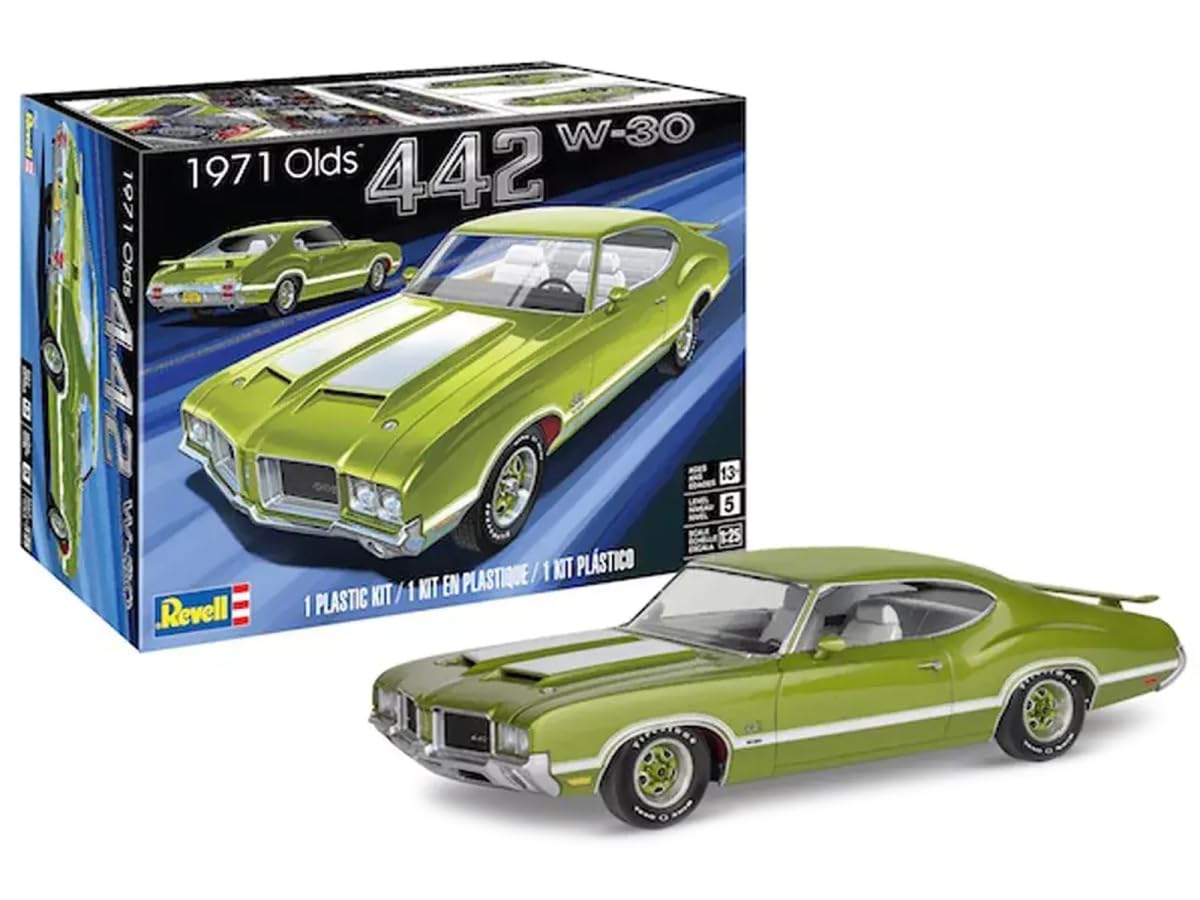
The 139-part W-30 that lets you choose your gearbox like you are ordering the real car.
Experienced builders will gravitate to this Revell 1971 Olds 442 W-30. Those parts go into a detailed Olds Rocket 455 c.i. V-8 engine, a detailed interior with a choice of two consoles, and an optional spoiler. You also get a choice of a 4-speed manual or a Turbo 400 automatic transmission, so the same kit can be built two ways.
Everything is molded in white and clear, with chrome-plated parts and black vinyl tires, and paint and glue are required on your end. The 139-part count is what makes this a Level 5 build rather than a weekend one — there is simply more to assemble and finish than on the smaller cars here. Owners describe it warmly, calling it very nice and fun to put together, and several buy it to match a car they actually own, planning to paint it the same color. Several buyers paint it to match the car in their driveway.
The trade-off is that this is not a starter kit. Level 5 and a 13+ rating mean it rewards patience and prior experience, and the higher parts count means it will eat evenings. Paint and glue are not included. If you are a beginner, go for the MPC Chevy or the Mr. Gasser instead and work up to this. If you are experienced and want maximum detail from a classic muscle car, this is the upper shelf.
8. Tamiya 24136 1/24 Volkswagen 1300 Beetle 1966 Plastic Model Kit

The Tamiya Beetle that goes together with almost no fuss and shows off a full engine.
If clean engineering is what you want, this Tamiya 24136 is a 1:24 scale 1966 VW 1300 Beetle, and at 1:24 it comes out slightly larger than the 1:25 cars around it. What impresses most is the fit and finish: a great replica of the bug with impressive engine detail that goes together with very little work. Everything lines up, and reviewers single out the absence of flash and sink marks on the finish areas — the little mold artifacts that usually need sanding off. Coming from Tamiya, the quality is the headline, and the count of people calling it excellent backs that up.
It is also genuinely enjoyable rather than intimidating. As one owner puts it, “these are not ‘entry level’ models, but not so difficult that the fun of assembly is lost.” That balance is the Beetle’s strength: enough detail for a seasoned builder, but not a punishment for a keen beginner. The value holds up too, and buyers treat it as a solid purchase they would make again.
The one gripe note is the imitation chrome, which some find below the kit’s otherwise high standard. The cure is easy — strip it and replace with a better metallic paint, as more than one builder has done — but it is a bit of extra work. Colors are unpainted, so you supply your own paint and glue, and the box carries a choking-hazard warning for small parts, so keep it away from little ones.
9. 1967 Ford F-100 Service Bed Pickup Plastic Model Kit 1:25

A vintage work truck built for going off-script with leftover parts and swapped bodies.
For the modeler who wants to cut and combine, this Moebius 1967 Ford F-100 Service Bed is a 1:25 scale kit molded in white and clear precision styrene, with a 352 cid V8 engine, soft PVC tires, and both clear and chrome-plated parts. Its real draw is how much it hands you to work with. A heavy-duty service truck is a rarer subject than the muscle cars here, and the kit comes with many small detail parts plus leftover parts builders save for other projects. Those spares are what make it the most customizable kit here.
That invitation gets taken. One builder combined the front of this kit with the rear body from a step-side “custom” kit from another company to recreate a 67 step-side truck they once owned, and called the result “perfect.” Others praise the mold for minimal flash and injector marks, and the solid plastic — quality good enough that it sent them back for more Moebius pickups. If you like old-school working trucks, this captures that look.
The honest caveat is the detail quality up close. It has a lot of detail, but it is a challenging, patience-heavy build, and one reviewer felt the attention to detail did not match the detail count — fine as an ornamental piece, less fun to handle. Rated for ages 12 and up, with no glue or paint included, it suits a builder with average skills and a taste for a less common subject.
Understanding the Specs
Scale Ratios, Explained Simply
A scale like 1:25 or 1:76 is a ratio that tells you how many times smaller the model is than the real thing. A 1:25 car is built to one twenty-fifth of the real car’s size, so it lands in the range of a shelf model you can hold in two hands. A 1:76 tank is far smaller, often just a couple of inches long, which suits a fleet of tiny armor on a narrow shelf. Neither scale is better — it is about how much display space you have and how much tiny detail your eyes and fingers can handle. If you are unsure, map the scale to a finished length and picture it on your shelf before you buy.
Parts Count And Skill Level
Parts count and skill level move together. A kit with around 97 parts tends to sit at the easier end and can often be finished over a weekend, while a kit with 139 parts is a longer, more absorbing project. The skill rating on the box, usually 1 to 5, tells you roughly the same thing: a Level 2 kit is still glue-and-paint, not a snap-together toy, and a Level 5 kit expects experience. The trap is assuming a low age rating means an easy build. Small scales with many tiny decals can be tougher than a bigger car with fewer pieces, so check both the age rating and the parts count together — and remember that paint and glue almost never come in the box.
FAQ
Do antique plastic model kits come with paint and glue?
What does 1:25 scale actually mean for the finished size?
Is a Level 2 model kit good for a beginner?
Why do some parts fit loosely on vintage reissues?
What is a waterline model kit and how is it different?
Are these antique kits hard to find replacement parts for?
Which skill level should I pick for a child?
Do I need an airbrush to paint a vintage model kit?
Can I customize an antique kit or swap parts between builds?
Why is imitation chrome sometimes a problem on these kits?
Final Thoughts: The Verdict
For most people who want the strongest all-round pick, the antique plastic model kits winner is the MPC 1957 Chevy Bel Air Spirit of 57, because its parts simply fit and its chrome and vinyl save you finishing work. It also carries 4.7 stars across 500+ ratings, the highest of any kit here. If you want maximum detail and are an experienced builder, the Revell 1971 Olds 442 W-30 with its 139 parts and choice of transmission is the one to reach for. And for a compact, budget-friendly armor build, the Airfix Panther earns its place on the practice shelf. The one honest nudge: buy your paint and cement in the same order as the kit — every pick here needs both, and starting a build without them is the only thing that stalls a first timer.
How We Picked
We do not accept paid placement. Every pick is matched to a real buyer and a real use-case; we do not hands-on test units.
Sources & Methodology
Specifications: manufacturer listings and product documentation. Review insights: verified customer reviews, as of September 2026. Pricing: not shown on this page (it changes often); check the current price via the retailer link.
As an Amazon Associate, Gadgets Feed earns from qualifying purchases. This does not affect which products we feature.