
Every second spent fighting a bulky mask is air stolen from your dive. A standard scuba mask holds extra volume that works against you at depth, demanding more air for equalization and creating extra drag on every head turn. The right apnea-specific mask eliminates that dead space, placing the lenses millimeters from your eyes and the nose pocket directly under your fingertips for effortless pressure release.
I’m Min — the co-founder and writer behind Gadgets Feed. I’ve spent hundreds of hours cross-referencing internal volume specs, silicone skirt durometers, and lens materials across dozens of freediving masks to separate true apnea performers from glorified snorkel gear.
This guide focuses exclusively on masks built for the specific demands of breath-hold diving — low internal volume, soft sealing skirts, and accessible nose pockets that let you equalize without breaking your streamline. Every pick here is a serious contender for the title of best apnea dive mask, ranked by real-world seal reliability, ease of equalization, and field of view at depth.
How To Choose The Best Apnea Dive Mask
Selecting a mask for breath-hold diving is different from picking a scuba mask. You need a low internal volume to minimize the air required for equalization, a skirt that seals without excessive pressure on your face, and a nose pocket you can pinch with two fingers without the mask shifting. These factors dictate how long you can stay down and how comfortable the descent feels.
Internal Volume and Equalization Efficiency
The mask’s internal volume is measured in cubic centimeters or square inches. Every cubic centimeter of extra air inside the mask must be equalized manually by pinching your nose and blowing air from your lungs. A lower volume means less air wasted per equalization, allowing you to reach depth with less effort and conserve oxygen for longer bottom time. Premium apnea masks typically hover around 83 to 100 cubic centimeters of internal volume.
Skirt Material and Face Seal
Apnea masks use silicone skirts, but the durometer (hardness) varies widely. Softer silicone, often described as “Gummi Bear” grade, conforms to irregular facial contours and creates a reliable seal even at negative pressure during descent. Stiffer skirts may hold their shape better but can leak on narrow or angular faces. The skirt also should sit close to the bridge of your nose without digging in, as any pressure point becomes painful over repeated dives.
Lens Type and Optical Clarity
Tempered glass remains the standard for its scratch resistance and distortion-free view. Some premium masks use polymer lenses (like Plexisol) that are lighter and can offer wider fields of view through curved designs, but they scratch far more easily and require careful handling. For freediving, a wide lateral field of view helps with situational awareness, but the lenses must be placed close to the eyes to keep the volume low.
Quick Comparison
On smaller screens, swipe sideways to see the full table.
| Model | Category | Best For | Key Spec | Amazon |
|---|---|---|---|---|
| Cressi Nano | Framed Low Volume | Ultra-low volume freediving | 83 cm³ internal volume | Amazon |
| Atomic Aquatics Venom Frameless | Frameless Premium | Exceptional optical clarity and comfort | UltraClear Schott Superwite lens | Amazon |
| Aqualung Sphera X | Curved Lens | 180-degree panoramic view | Plexisol polymer lenses | Amazon |
| SeaDive Oceanways Superview HD | Single Lens HD | Glare reduction and color enhancement | Sharpens faint edges, filters UV | Amazon |
| Hollis M-1 | Frameless | Wide single-pane view on narrow faces | Saint-Gobain Diamant crystal clear lens | Amazon |
| Cressi Superocchio | Classic Low Volume | Versatile freediving and spearfishing | Tempered glass dual lenses | Amazon |
| Cressi Matrix | Low Volume Value | Budget-friendly with wide field of view | Inverted tear-drop lenses | Amazon |
In‑Depth Reviews
1. Cressi Nano
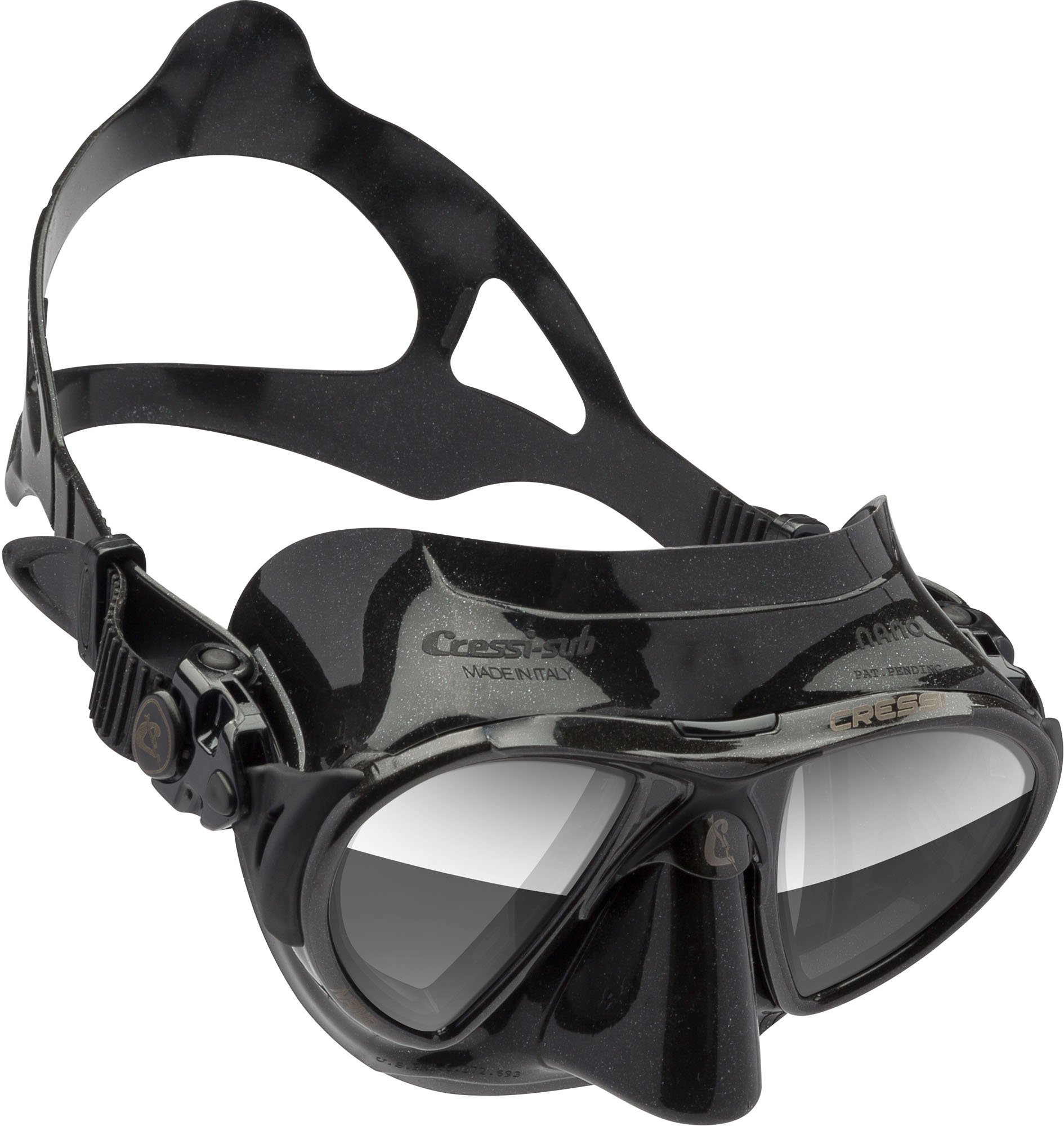
The Cressi Nano holds the lowest internal volume of any mask in this roundup at just 83 cubic centimeters — a benchmark figure that directly translates to less air wasted per equalization during deep freedives. Its patented Dual Frame Technology joins two rigid frames to shrink that internal space without sacrificing structural integrity. The inverted tear-drop lenses, also a Cressi patent, angle downward to improve visibility of your BCD or dive buddy below, a feature rarely found on masks this compact.
The silicone skirt uses a soft formulation that adapts well to narrow and oval face shapes, which is often where frameless masks fail. Users with slim facial profiles report zero pressure marks even after multiple hours of use. The buckle system is fully flexible and virtually indestructible, allowing strap adjustments with a single finger press. The Nano handles descent to 40+ meters without leaking, though the soft skirt can allow minor seepage on very broad faces.
The tempered glass lenses resist scratching well compared to polymer alternatives. The silver mirrored lens option reduces surface glare for spearfishing, but the standard black/black version delivers the same low volume performance. For freedivers who prioritize equalization ease and a compact hydrodynamic profile, this mask sets the standard.
Why it’s great
- Industry-leading 83 cm³ internal volume for effortless equalization
- Soft silicone skirt seals well on narrow and oval face shapes
- Patented dual frame construction is durable yet lightweight at 145 grams
Good to know
- Skirt can leak slightly on very broad or round faces
- Mirrored lens option scratches more easily than standard glass
2. Atomic Aquatics Venom Frameless

The Atomic Aquatics Venom Frameless uses Schott Superwite UltraClear glass that transmits up to 96 percent of available light, delivering noticeably sharper contrast and brighter colors than standard tempered glass masks. This optical advantage matters when scanning the reef or tracking fish at depth. The frameless design uses two silicone materials co-molded at different softness levels — the inner “Gummi Bear” layer is extremely pliable for a gentle face seal, while the outer layer adds rigidity to prevent skirt collapse during negative pressure descents.
The rigid silicone skirt keeps the mask firmly positioned even in turbulent conditions, a feature that sets it apart from softer frameless designs that can shift during head turns. The nose pocket is roomy and unrestrictive, allowing two-finger equalization without the mask lifting off your face. Users with high brow ridges may feel the top edge of the skirt pressing against the bone, and those with facial hair should expect some leakage until the mask is worn slightly lower on the nose.
The Venom tends to fog more aggressively than glass masks if the seal is broken during a dive, requiring extra anti-fog treatment before each session. The softness of the skirt also means it requires precise positioning — wearing it too high causes leakage at the nose bridge. For divers who prioritize optical clarity and a luxuriously soft face seal above all else, this mask delivers a premium experience.
Why it’s great
- UltraClear glass transmits 96% light for unmatched underwater clarity
- Co-molded dual durometer skirt offers exceptional comfort and seal stability
- Roomier nose pocket allows easy two-finger equalization
Good to know
- Requires precise positioning on the face to avoid nose bridge leaks
- Fogs more easily than glass masks if the seal is broken
3. Aqualung Sphera X
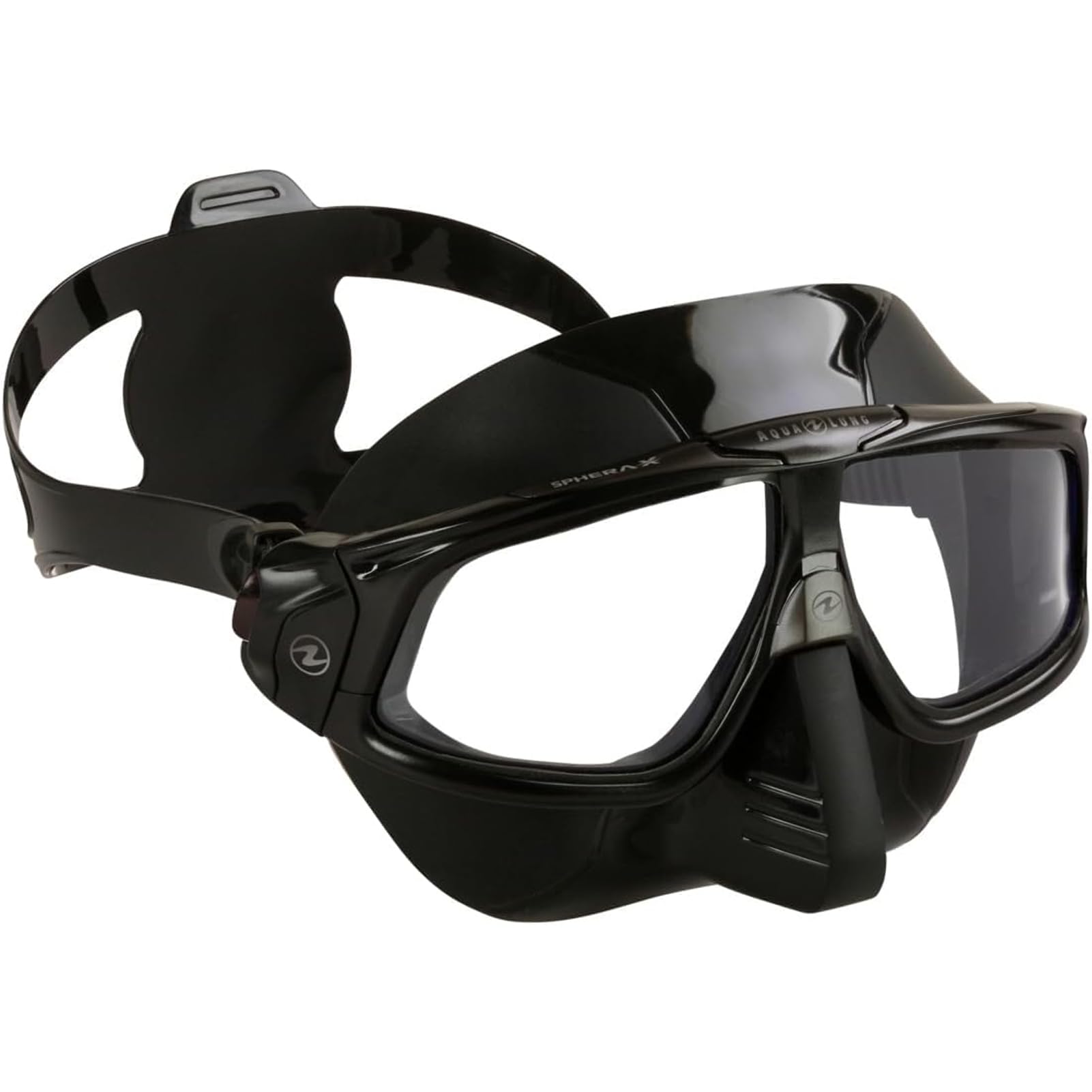
The Aqualung Sphera X uses a curved single Plexisol polymer lens that wraps around the diver’s face to deliver a 180-degree wide-angle field of view. This eliminates the frame obstruction present in dual-lens masks, giving freedivers a panoramic underwater perspective that helps maintain situational awareness during deep descents. The Advanced Fit Technology (AFT) in the skirt enhances the sealing properties of the silicone, adapting to facial contours with minimal pressure on the glabella and cheekbones.
The polymer lens is lighter than tempered glass, keeping the overall mask weight at 200 grams, and it eliminates the refractive distortion that can occur at the edges of flat glass lenses. However, Plexisol scratches far more easily — users report marks from simply brushing the lens against a towel or wetsuit zipper. The included zippered EVA case is essential for daily protection. The micro buckle system paired with a contoured head strap ensures the mask stays put during dynamic freediving fin kicks.
Freedivers with lower nose bridges or Asian facial profiles find the Sphera X fits exceptionally well, as the nose pocket is shallower than many European-designed masks. The low internal volume makes equalization straightforward, though the single large lens can make pinch equalization slightly less direct than dual-lens masks. For divers who value an immersive, unobstructed view and are willing to handle the lens carefully, this mask offers a unique visual experience.
Why it’s great
- Curved lens provides a true 180-degree panoramic field of view
- AFT skirt adapts well to low nose bridges and Asian facial profiles
- Lightweight at 200 grams with comfortable micro buckle strap
Good to know
- Polymer lens scratches very easily — must be stored in the included case
- Single lens design can make nose pinch equalization less intuitive
4. SeaDive Oceanways Superview HD

The SeaDive Oceanways Superview HD stands out for its SeeSharp High Definition lens technology that sharpens faint edges and filters out both UV and glare, reducing eye strain during long surface intervals and bright shallow dives. The lens appears orange on the black silicone version and blue on the white, but both treatments deliver the same benefit: converting harsh white light harshness to a calming blue tone that makes reef details pop. This HD optics approach is unique in the apnea mask category, where most brands focus on volume reduction rather than visual processing.
The frameless construction uses a single large lens and a 100 percent silicone skirt that seals reliably on most face shapes. Users report the mask stays fog-free even without aggressive pre-treatment, a significant advantage over many low-volume competitors. The included plastic storage box protects the lens during transport, though the box itself is basic compared to the EVA case included with the Sphera X. The strap adjustment system is simple and effective, though some users find the buckles less secure than framed alternatives at depths beyond 30 meters.
The seal holds well during stationary photography and reef cruising but can shift slightly during aggressive finning or head-first descents. The single lens design offers a wide unbroken view, but the internal volume is slightly higher than the dedicated freediving specialists like the Nano. For freedivers who spend equal time snorkeling on the surface and diving below, the HD color processing makes this a compelling choice.
Why it’s great
- SeeSharp HD lens filters UV and glare for reduced eye strain
- Excellent fog resistance without heavy pre-treatment
- Single large lens provides an unbroken wide field of view
Good to know
- Slightly higher internal volume than dedicated freediving masks
- Buckles can feel less secure at depths beyond 30 meters
5. Hollis M-1

The Hollis M-1 uses a Saint-Gobain Diamant crystal clear single lens that delivers distortion-free vision with excellent color visibility, rivaling the optical quality of masks costing twice as much. The frameless 100 percent pure silicone skirt keeps the internal volume low while allowing the mask to fold flat for travel. The dual strap design distributes pressure evenly across the back of the head, preventing the slippage common with single-strap frameless masks during dynamic freediving movements.
The nose pocket is generously sized, which eliminates the pinching sensation some divers experience with tighter pockets. However, on certain face shapes the skirt can seal against the nostrils during descent, requiring a conscious effort to pull the mask away or equalize more aggressively to break the seal. Users with narrow faces report the M-1 fits perfectly, while those with broader heads note that the skirt sits very close to the outer edge of the eye, potentially reducing peripheral vision compared to framed alternatives.
The dual strap also adds some complexity to the adjustment process, and the silicone material feels less robust than the framed Cressi designs. The Saint-Gobain lens is tough against scratches but not immune to pitting from salt crystal buildup if not rinsed thoroughly. For freedivers seeking a frameless, low-volume mask with premium glass and a wide single-pane view that packs flat for travel, the M-1 delivers impressive value.
Why it’s great
- Saint-Gobain Diamant crystal clear glass provides distortion-free optics
- Dual strap distributes pressure evenly for secure fit during movement
- Folds flat for easy travel storage
Good to know
- Skirt can seal against nostrils on some face shapes during descent
- Peripheral vision is narrower for users with broad faces
6. Cressi Superocchio

The Cressi Superocchio is a low-volume dual-lens mask that has remained a favorite among freedivers and spearfishers for years, not because of flashy new patents but because its straightforward design works reliably across a wide range of face shapes. The soft silicone skirt adapts to facial contours without excessive pressure, and the two-finger nose pocket allows easy equalization even with thick gloves. The tempered glass lenses are set close to the eyes, keeping the internal volume minimal without the complex engineering of the Nano.
The technopolymer frame is rigid and durable, outlasting many frameless designs through years of saltwater exposure and frequent buckle adjustments. The buckles attach directly to the frame, making strap length changes quick and tool-free. Users with facial hair report the Superocchio seals better than most low-volume masks, with minimal leakage even on trimmed beards. The black silicone skirt also reduces glare from the sides, a subtle advantage for spearfishers who want to avoid spooking fish with reflective surfaces.
The field of view is moderate — adequate for recreational freediving but not as wide as the Sphera X or the SeaDive HD. The rigid center bar between the two lenses also creates a small blind spot directly in front of the nose. For freedivers who want a proven, no-nonsense mask that seals reliably on a variety of face shapes and handles depths beyond 40 meters without complaint, the Superocchio is a classic that earns its place.
Why it’s great
- Proven low-volume design seals well even with facial hair
- Rigid technopolymer frame is durable through years of use
- Easy two-finger equalization pocket works with thick gloves
Good to know
- Dual-lens center bar creates a small blind spot
- Field of view is narrower than single-lens frameless designs
7. Cressi Matrix

The Cressi Matrix punches well above its tier by featuring the same patented inverted tear-drop lens design found on Cressi’s more expensive models. This lens geometry tilts to improve downward visibility, making it easier to check instruments or track a descending dive buddy without lifting your head. The internal volume is extremely low for a dual-lens mask, rivaling dedicated freediving masks in equalization performance while remaining accessible for scuba and snorkeling use.
The hypoallergenic silicone skirt provides a wide sealing surface that fits a broad spectrum of face shapes, including children as young as six years old. Users report zero leakage during pool sessions and recreational dives, though the skirt is slightly stiffer than the Nano or the Atomic Venom, which can create minor pressure points on high cheekbones during extended use. The frame-mounted buckles are simple and reliable, with no complex mechanisms that could fail in cold conditions.
The tempered glass lenses are scratch-resistant and provide clear, distortion-free vision. The Matrix lacks the extremely low volume of the Nano (83 cm³) but compensates with a wider field of view that makes it more versatile for divers who also snorkel or scuba. For freedivers on a strict budget who refuse to compromise on equalization ease and basic optical quality, the Matrix offers the best value-to-performance ratio in this lineup.
Why it’s great
- Inverted tear-drop lenses improve downward visibility for instrument checks
- Wide sealing surface fits a broad range of face shapes including children
- Extremely low internal volume for easy equalization at a budget-friendly price
Good to know
- Stiffer silicone skirt can create pressure points on high cheekbones
- Low volume but not as ultra-compact as the dedicated freediving Nano
FAQ
What internal volume should I look for in an apnea dive mask?
Are frameless masks better than framed masks for freediving?
Will an apnea mask work for scuba diving too?
Final Thoughts: The Verdict
For most freedivers, the best apnea dive mask is the Cressi Nano because it combines the lowest production internal volume (83 cm³) with a proven dual-frame design that seals reliably across a wide range of face shapes without the fragility of polymer lenses. If you want the widest panoramic view and don’t mind babying the lens, grab the Aqualung Sphera X. And for unmatched optical clarity with an ultra-soft face seal, nothing beats the Atomic Aquatics Venom Frameless.