
An APO refractor telescope eliminates the chromatic aberration that plagues cheaper achromatic doublets, delivering crisp, color-free views of the Moon, planets, and deep-sky objects. The real challenge isn’t deciding if you want APO performance — it’s choosing the right aperture, focal ratio, and glass type for your specific imaging or visual goals without overpaying for features you won’t use.
I’m Min — the co-founder and writer behind Gadgets Feed. I’ve spent countless hours analyzing optical designs, ED glass formulations, focuser mechanisms, and back-focus specifications to separate marketing claims from actual imaging performance in this competitive category.
This guide breaks down seven top contenders across budget, mid-range, and premium tiers to help you match the right optical tube to your mount, camera, and sky conditions. Read on for the definitive rundown of the best apo refractor telescope options available right now.
How To Choose The Best APO Refractor Telescope
Selecting an APO refractor comes down to balancing aperture, focal ratio, glass quality, and focuser precision against your mount’s payload capacity and your budget. A 60mm triplet is excellent for wide-field imaging but lacks the light grasp for small galaxies, while a 120mm doublet gathers more photons but demands a heavier, more expensive mount. Your decision should be driven by your primary use case — visual observation, deep-sky astrophotography, or planetary imaging.
Aperture and Focal Ratio
Aperture determines light-gathering ability and resolving power. A 70mm scope reveals detail on Jupiter’s bands; a 120mm scope splits tight double stars and shows more structure in nebulae. Focal ratio (f/ratio) controls exposure times for photography — faster ratios like f/4.5 require shorter subs but demand better optical correction, while slower ratios like f/9 are forgiving of cheap field flattener but need longer exposures. Most APO buyers settle between f/5.5 and f/7 for a versatile balance.
Optical Design: Doublet vs Triplet vs Petzval
A doublet APO uses two matched elements — typically one ED glass piece — to correct chromatic aberration adequately for visual use and basic imaging. A triplet APO adds a third element for superior color correction across the full frame, essential for demanding astrophotography with modern sensors. Petzval designs (like the SV555) incorporate a built-in flattener, delivering a flat field without a separate corrector, ideal for wide-field rigs where simplicity and weight matter.
Focuser Quality and Back Focus
A dual-speed focuser (10:1 or 1:10 micro-reduction) is non-negotiable for critical focus with high-resolution cameras. Crayford-style focusers offer smooth, backlash-free movement, while rack-and-pinion designs handle heavy loads better. Back-focus distance — the space between the focuser flange and the camera sensor — must match your optical train, usually 55mm for DSLRs or 17.5mm for dedicated astronomy cameras. A focuser that slips under camera weight will ruin every image.
Quick Comparison
On smaller screens, swipe sideways to see the full table.
| Model | Category | Best For | Key Spec | Amazon |
|---|---|---|---|---|
| Sky-Watcher EvoStar 100 ED | Premium Doublet | Visual & Photography Hybrid | 100mm f/9, 900mm FL | Amazon |
| Sky-Watcher EvoStar 120 ED | Premium Doublet | High Magnification Visual | 120mm f/7.5, 900mm FL | Amazon |
| SVBONY SV550 80ED Triplet | Mid-Range Triplet | Deep-Sky Astrophotography | 80mm f/6, 480mm FL | Amazon |
| SVBONY SV555 54mm Petzval | Petzval Triplet | Portable Wide-Field Imaging | 54mm f/4.5, variable aperture | Amazon |
| Askar 71F Flat-Field | Value Doublet | Entry-Level APO Imaging | 71mm f/6.9, 490mm FL | Amazon |
| Unistellar Odyssey | Smart Digital Scope | App-Controlled Ease of Use | 85mm f/3.9, 320mm FL | Amazon |
| Celestron NexStar Evolution 8 | Catadioptric Combo | Fully Automated GoTo | 8″ SCT, 2032mm FL | Amazon |
In‑Depth Reviews
1. Sky-Watcher EvoStar 100 ED Doublet APO

The EvoStar 100 ED is a 100mm f/9 doublet featuring a synthetic fluorite element for exceptional color correction. Its 900mm focal length provides enough magnification for planetary detail while still being manageable for framed deep-sky targets like M42 and M31. The 10:1 dual-speed Crayford focuser offers smooth, precise control for critical focus with heavy camera rigs or premium eyepieces.
Owners consistently report razor-sharp lunar views and pinpoint stars across 95% of the field, with virtually no false color visible even at high power on Jupiter and Saturn. The included 8×50 RACI finderscope, 2-inch dielectric diagonal, and hard aluminum case add significant value, though the stock eyepieces are basic and should be upgraded for serious visual work.
At 11 pounds, the optical tube pairs well with mid-range German equatorial mounts like the Sky-Watcher HEQ5. The long f/9 focal ratio is forgiving of field curvature, reducing the need for an expensive flattener for APS-C sensors. If you want a capable all-rounder that transitions from visual astronomy to entry-level astrophotography without compromise, this is the strongest contender.
Why it’s great
- Synthetic fluorite element delivers near-apochromatic color correction at a doublet price
- 10:1 dual-speed Crayford focuser provides backlash-free fine focus for imaging
- Complete accessory set including finderscope, diagonal, hard case, and two eyepieces
- F/9 ratio yields forgiving field curvature for budget flattener solutions
Good to know
- Included eyepieces are basic 5mm and 25mm LET — budget for upgrades
- Long 900mm tube can strike tripod legs near zenith; shift scope forward in rings
- Focuser may slip under the weight of a heavy DSLR with filter wheel
- Requires a sturdy mount; small GoTo mounts struggle with tube length
2. SVBONY SV550 80ED f/6 Triplet APO
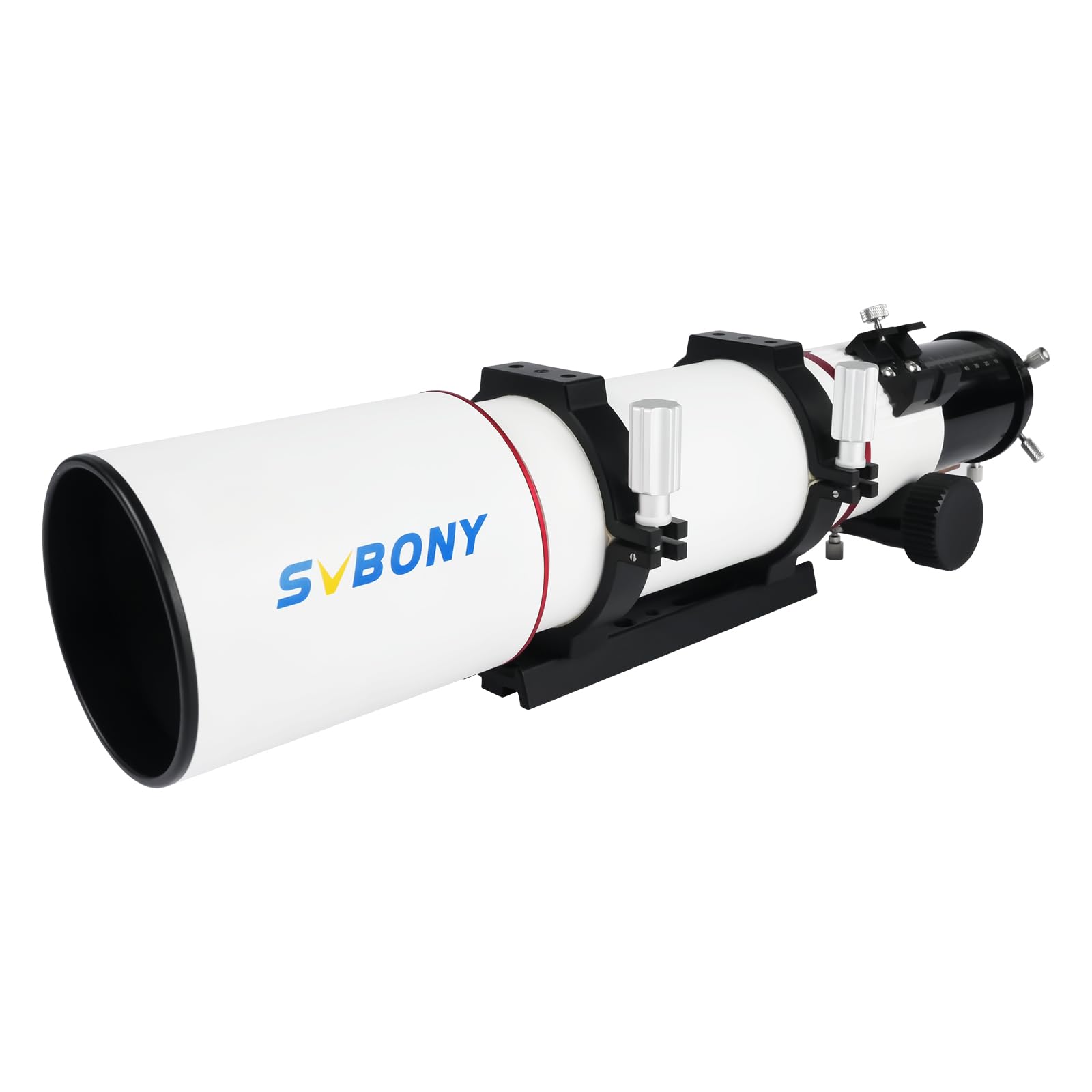
The SV550 is an 80mm f/6 triplet air-spaced APO using one S-FPL51 ED element and two correction lenses. At 480mm focal length, it provides a wide 5.6-degree field ideal for expansive nebulae like the North America and Pelican regions. The 2.5-inch magnesium alloy dual-speed focuser with 1:10 micro-reduction handles full-frame sensors with no vignetting and supports heavy imaging trains.
Users report pinpoint stars corner-to-corner with cameras like the ASI2600MM Pro, and the built-in multiple light baffles effectively suppress stray light for high-contrast images. The optical tube weighs only 6.3 pounds, making it an excellent match for lightweight mounts like the Sky-Watcher Star Adventurer or iOptron CEM26. Some users note that the focuser drawtube is long and can interfere with accessory spacing when using electronic automatic focusers.
For the price of entry-level doublets, you get true triplet color correction that rivals scopes costing twice as much. The f/6 focal ratio provides a practical balance between exposure speed and forgiveness for spherical aberration. If you want a dedicated deep-sky imaging rig that delivers clean data without breaking the bank, this is the smart choice.
Why it’s great
- Triplet air-spaced APO design with S-FPL51 ED glass virtually eliminates chromatic aberration
- Lightweight 6.3-pound OTA rides easily on portable star trackers and small GEM mounts
- 2.5-inch dual-speed focuser with 1:10 micro-reduction supports full-frame camera sensors
- Multiple internal baffles create high-contrast images with no stray light artifacts
Good to know
- Long focuser drawtube can limit back-focus clearance when using electronic AF accessories
- Some units exhibit mild spherical aberration — sharp inside focus, soft outside
- Stock dovetail plate may require a Losmandy adapter for heavy imaging trains
- Requires a separate field flattener for corner-to-corner sharp stars on larger sensors
3. Sky-Watcher EvoStar 120 ED Doublet APO

The EvoStar 120 ED is a 120mm f/7.5 doublet APO with a 900mm focal length, packing the largest aperture in this lineup. The matched doublet objective with a synthetic fluorite element delivers excellent color correction despite the fast f/7.5 ratio for a doublet. This translates to brighter, higher-contrast images than any 80mm or 100mm instrument, especially on globular clusters, galaxies, and fine planetary detail.
Owners praise its ability to cleanly split tight double stars and reveal subtle lunar rilles without a trace of false color. The 10:1 dual-speed Crayford focuser handles the heavier optical tube at 13.9 pounds, and the included hard case, 8×50 RACI finderscope, and 2-inch dielectric diagonal mirror repeat the generous accessory bundle of the 100ED. The long tube length (44 inches) can cause clearance issues at zenith with smaller mounts and may require sandbag dampening to kill vibration.
Because of its 120mm aperture, this scope demands a heavier mount — at least an HEQ5 or EQ6 class — which raises the total system cost considerably. The high light transmission and absence of central obstruction make it outperform many 8-inch Schmidt-Cassegrains for visual deep-sky work. If you prioritize visual performance and have the mount to support it, this is the best large-aperture doublet APO available.
Why it’s great
- 120mm synthetic fluorite doublet provides bright, color-free views exceeding 8-inch SCT contrast
- Brilliant on globular clusters, planetary nebulae, and lunar detail at high magnification
- Complete accessory package including hard case, RACI finder, diagonal, and two eyepieces
- No collimation needed and no central obstruction means maximum light delivery
Good to know
- 44-inch tube length requires a heavy-duty mount (HEQ5 minimum) adding significant cost
- Long tube can vibrate on smaller Go-To mounts; dampening pads or sandbags recommended
- Focuser may slip with heavy camera loads; some users report a click in the coarse knob
- Included hard case is functional but not airline-friendly for travel
4. SVBONY SV555 54mm Petzval APO Refractor
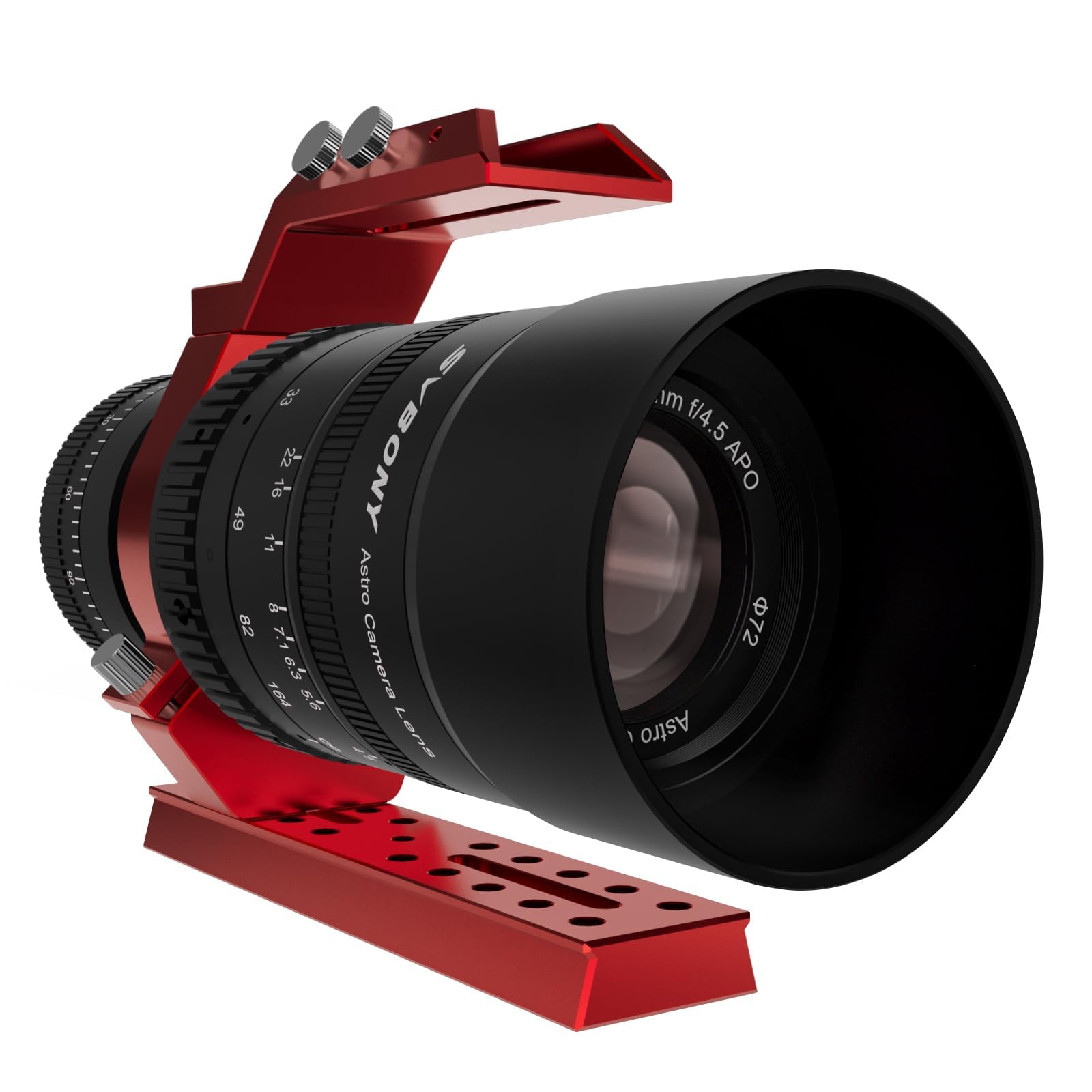
The SV555 is a 54mm f/4.5 Petzval triplet APO refractor designed specifically for wide-field astrophotography. Its integrated Petzval design delivers a flat field without needing a separate field flattener, and the variable aperture system (f/4.5 to f/22) lets you adjust depth of field and control star bloat depending on the target. The scope accepts 2-inch filters via the included holder and has pre-installed EAF adapter support for ZWO Gen1 auto-focusers.
Users report round stars across the full frame of APS-C sensors with minimal off-axis aberrations, and several compare its image quality favorably to the much more expensive Takahashi FSQ-106ED. The scope weighs 8.4 pounds and includes a soft padded case, making it genuinely travel-friendly. Some users have reported off-center halos around bright stars that persist after cleaning, which suggests a possible coating artifact on certain units.
At f/4.5, exposure times are short, making this an excellent choice for mounting on a lightweight star tracker like a Sky-Watcher Star Adventurer 2i. The variable aperture adds versatility for daytime landscape astrophotography as well. If you need a compact, fast Petzval that simplifies your rig and still delivers pro-quality data, this fits the bill.
Why it’s great
- Petzval triplet design delivers a flat field with no separate flattener needed
- Variable aperture from f/4.5 to f/22 adapts to different targets and conditions
- Pre-installed EAF adapter mount makes electronic autofocus integration simple
- Compact and lightweight with padded case — excellent for travel and remote imaging
Good to know
- Some units exhibit off-center halos around bright stars — potential coating issue
- Fixed Petzval design offers no option to swap numeric flattener/reducer
- 54mm aperture limits light grasp for faint galaxies and small planetary nebulae
- No eyepiece included; visual use requires a separate star diagonal and eyepieces
5. Askar 71F Flat-Field Refractor
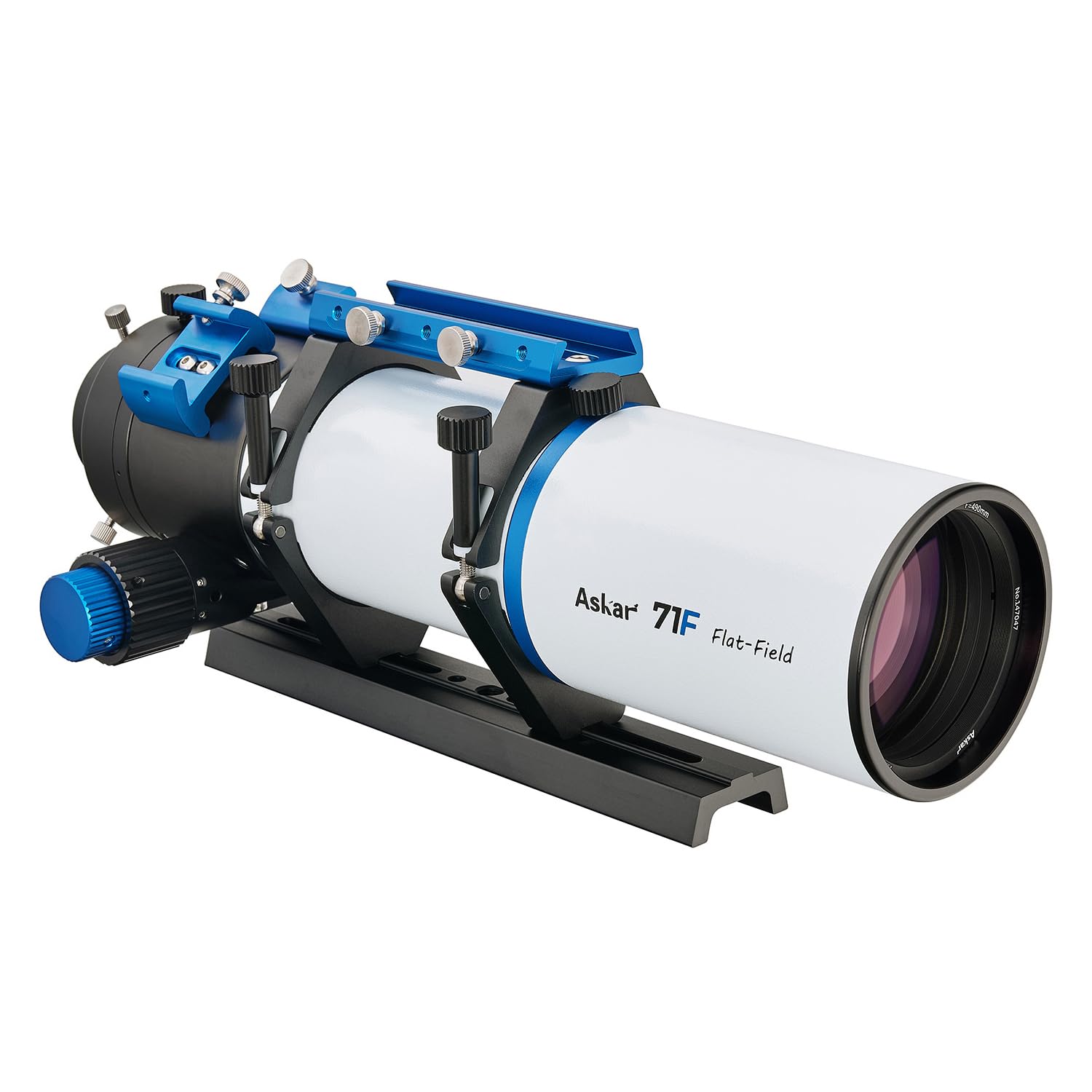
The Askar 71F is a 71mm f/6.9 quadruplet air-spaced APO refractor with built-in field flattening. Its 490mm focal length offers a 6.97-degree field, capturing expansive Milky Way vistas. The CNC-machined aluminum body with matte interior baffles effectively controls stray light, and the 360-degree rotatable focuser simplifies composition when attaching a camera. At only 5.5 pounds for the OTA, it’s one of the lightest APOs in this roundup.
Early users describe it as a stunning first imaging refractor, noting sharp, color-free views visually through a 2-inch diagonal and clean flat frames with full-frame DSLRs and ZWO ASI678MC cameras. The included imaging adapter simplifies connecting DSLRs, but the standard mounting rings sit close to the dovetail bar, requiring 3D-printed risers for some setups. The focuser is buttery smooth after a brief break-in period.
This scope is ideal for beginners transitioning from a basic doublet to a true APO without spending over a thousand dollars. The quadruplet design means you don’t need a separate field flattener, saving both budget and optical train complexity. If you want a self-contained APO imaging system that’s easy to transport and setup, the 71F delivers excellent value.
Why it’s great
- Quadruplet air-spaced APO design with integrated field flattener simplifies imaging
- Lightweight 5.5-pound OTA pairs easily with portable star trackers and small mounts
- High-quality CNC body with matte interior effectively suppresses stray light reflections
- 360-degree rotatable focuser aids composition with cameras and diagonals
Good to know
- Mounting rings sit too close to the dovetail bar for perfect balance without a riser
- Cap is functional but slightly loose — be mindful when carrying
- Focuser may need a back-and-forth break-in to distribute initial lubricant
- Plastic lens cover feels less premium than the aluminum body
6. Unistellar Odyssey Smart Telescope

The Unistellar Odyssey is an 85mm f/3.9 digital telescope with a fully integrated motorized alt-azimuth mount, autofocus, and onboard camera — no eyepiece required. The entire viewing experience happens through a smartphone or tablet app, which handles alignment, GoTo, and image stacking automatically. The 5-hour internal battery and compact 14-pound total weight make it genuinely grab-and-go, with setup quoted at under two minutes.
Users praise its ability to produce stunning deep-sky and planetary images from light-polluted urban skies (Bortle 8), replacing bulky 8-inch SCT setups. The 37-million-star database and 5,000-object catalog make navigation effortless, and the RAW/FITS export allows advanced processing in PixInsight or Photoshop. However, the reliance on Wi-Fi connectivity is a vulnerability — some users report frequent connection drops that interrupt viewing sessions.
The Odyssey is expensive and offers no manual control path — you cannot override the autofocus or bypass the app. It also has no dew heater, which limits usability in humid conditions. This is a specialized product for users who prioritize convenience and shareable social viewing over the hands-on experience of a traditional APO refractor. If you value instant results and your sky is bright, this is a unique option.
Why it’s great
- Complete integrated system — optics, mount, camera, and battery in one portable unit
- Automatic alignment and GoTo make observing accessible for absolute beginners
- RAW/FITS export enables advanced post-processing for serious astrophotographers
- Compact 4 kg OTA fits in the included backpack for true grab-and-go portability
Good to know
- Wi-Fi connection drops are a common complaint — can ruin an observing session
- No manual control; cannot override autofocus or bypass the app
- No built-in dew heater limits usability in humid or coastal environments
- Very expensive for an 85mm aperture compared to traditional APO refractors
7. Celestron NexStar Evolution 8 Schmidt-Cassegrain

The NexStar Evolution 8 is an 8-inch Schmidt-Cassegrain telescope with integrated WiFi for app-based control via the Celestron SkyPortal app. While not a traditional APO refractor, it competes in the premium all-in-one category with its computerized GoTo mount, high-performance worm gears, and fully integrated battery. The StarBright XLT coatings maximize light transmission across the 2032mm focal length.
Users upgrading from 130mm reflectors report dramatically brighter, sharper planetary views — Saturn’s rings and Jupiter’s bands snap into focus with clarity. The integrated battery eliminates cord management, and the built-in WiFi hand controller provides both app and physical control. Some customers received older 2014 units with RS-232 hand controllers instead of the newer USB version, and the WiFi can be sluggish when multiple devices compete for connection.
At 69 pounds total, this is not a portable telescope — it’s an observatory-in-a-case for regular backyard use. The SCT design has a central obstruction that reduces contrast compared to an equivalent-aperture refractor, but the GoTo accuracy and tracking make it excellent for automated deep-sky imaging. If you want a turnkey system with proven GoTo reliability and are willing to accept the SCT trade-offs, this package delivers.
Why it’s great
- 8-inch aperture provides excellent light grasp for planetary and deep-sky observing
- Integrated WiFi SkyPortal app control offers database-driven GoTo navigation
- Built-in rechargeable battery eliminates external power cords in the field
- StarBright XLT coatings maximize transmission for bright, high-contrast views
Good to know
- Central obstruction reduces contrast compared to refractors of equivalent aperture
- WiFi performance can be sluggish; phone auto-network switching causes connection drops
- Some units ship with older RS-232 hand controllers — verify before purchase
- Heavy 69-pound total weight makes it a dedicated backyard scope, not for travel
FAQ
What is the difference between a doublet and a triplet APO refractor?
Do I need a separate field flattener for my APO refractor?
What mount class is required for a 120mm APO doublet?
Can I use an APO refractor for daytime terrestrial viewing?
Final Thoughts: The Verdict
For most users, the best apo refractor telescope winner is the Sky-Watcher EvoStar 100 ED because it combines a 100mm synthetic fluorite doublet, dual-speed focuser, and complete accessory set at a price that undercuts equivalent triplets while delivering near-apochromatic color correction. If you want a dedicated deep-sky imaging triplet on a budget, grab the SVBONY SV550 80ED. And for ultra-portable wide-field work with no flattener required, nothing beats the SVBONY SV555 Petzval.