
You turn on the faucet and the smell hits you — that faint whiff of chlorine, or worse, a metallic tang that makes you second-guess every glass you pour. A quality water filter isn’t just about taste; it’s about protecting your appliances from scale buildup, removing the sediment that clogs showerheads, and ensuring your family drinks water free from lead, microplastics, and PFAS. Whether you are looking for a simple under-sink solution or a whole-house system, the right fit changes how you interact with water every single day.
I’m Min — the co-founder and writer behind Gadgets Feed. I’ve analyzed hundreds of technical data sheets, filter-life claims, and customer-installation reports to separate the products that actually deliver clean, great-tasting water from those that just look good in a box.
After weeks of comparing micron ratings, flow rates, and contaminant-reduction certifications, I have assembled this guide to the best aqua filtration system for every home — from compact countertop RO units to heavy-duty whole-house setups that protect every tap in the building.
How To Choose The Best Aqua Filtration System
Choosing a filtration system comes down to three factors: your water source (municipal vs. well), the specific contaminants you need removed, and whether you want filtered water at one tap or every tap in the house. A system designed for chlorinated city water may fail against well-water sediment or iron, while a powerful RO system will strip beneficial minerals if you don’t get a remineralization stage.
Point-of-Use vs. Whole-House
Point-of-use systems (under-sink and countertop) treat water at a single faucet, delivering the highest purity for drinking and cooking. Whole-house systems treat every tap, protecting your water heater, pipes, and showerheads from scale and sediment but generally don’t reduce TDS or fluoride. If your main concern is drinking water quality, an under-sink RO with remineralization is the standard. If your tap water leaves rust stains on fixtures, a whole-house sediment and carbon setup is the smarter investment.
Membrane Type and Filter Stages
Reverse osmosis membranes are rated by the pores they can block — consumer RO membranes typically reduce contaminants down to 0.0001 microns, capturing heavy metals, fluoride, and PFAS. Ultrafiltration (UF) membranes, like the 0.01µm membrane in some systems, retain beneficial minerals but cannot reduce TDS. Countertop and under-sink RO systems usually offer 3 to 8 stages, including sediment pre-filters, carbon blocks, RO membranes, and post-carbon or alkaline remineralization filters. More stages don’t always mean better water — what matters is the certified standard (NSF 58 for RO or NSF 53 for cyst and lead reduction) and the real-world tested reduction percentage.
Flow Rate and Recovery Time
Flow rate matters if you are filling a large pot or a half-gallon bottle frequently. Under-sink systems range from 0.27 GPM (SimPure T1-400) to 2.5 GPM (3M FF100 and Waterdrop TST-UF). Tankless RO systems bypass the storage tank but require electricity to pump water through the membrane. If you have multiple people filling bottles throughout the day, a 400+ GPD tankless system or a high-flow carbon filter will keep up without the wait. For whole-house, look for systems rated above 10 GPM so that running a shower while filling a sink doesn’t drop pressure.
Quick Comparison
On smaller screens, swipe sideways to see the full table.
| Model | Category | Best For | Key Spec | Amazon |
|---|---|---|---|---|
| iSpring RO500AK-BN | Tankless RO | High-output under-sink with minerals | 500 GPD / 2:1 pure-to-drain | Amazon |
| SimPure T1-400UV | Tankless RO + UV | Ultra-pure water with UV protection | 400 GPD / 1.5:1 pure-to-drain | Amazon |
| AquaTru Carafe | Countertop RO | No-plug, no-drill countertop RO | 4-stage RO / glass carafe | Amazon |
| Waterdrop T3-T | Under Sink RO | Remineralizing RO with tank | 220 GPD / 2:1 pure-to-drain | Amazon |
| Express Water WH300SCKP | Whole House | Whole-house heavy-metal reduction | 100K gal / 17 GPM flow | Amazon |
| iSpring WGB32B | Whole House | Whole-house chlorine/sediment removal | 100K gal / 15 GPM flow | Amazon |
| 3M Aqua-Pure FF100 | Under Sink Carbon | High-flow under-sink without drill | 2.5 GPM / NSF 42 & 53 | Amazon |
| Waterdrop TST-UF | Under Sink UF | Mineral-retaining under-sink filter | 0.01µm UF / 1.59 GPM flow | Amazon |
| Reverse Osmosis Revolution WHF-34F5 | Whole House | Whole-house 3-stage with extra filters | 10K gal / 5 micron sediment | Amazon |
In‑Depth Reviews
1. iSpring RO500AK-BN

The iSpring RO500AK-BN delivers the highest output in this lineup at 500 GPD, filling an 8 oz cup in roughly 10 seconds. Its tankless design saves significant under-sink space and eliminates the risk of bacterial growth that can occur in storage tanks. The 3-stage process — composite sediment/carbon block, advanced RO membrane, and carbon alkaline remineralization — reduces over 1,000 contaminants while restoring beneficial minerals like calcium, magnesium, and potassium for balanced pH water.
NSF 58 certification backs its TDS reduction claims, and the automatic self-cleaning function flushes the membrane every 24 hours of inactivity, extending filter life beyond the typical 2-year cycle. The 2:1 pure-to-drain ratio is industry-leading for a residential RO system, wasting far less water than conventional 1:1 or 1:3 systems. Multiple user reviews confirm consistent support from the iSpring team, with replacement parts sent quickly even after the warranty period.
The brushed nickel faucet included in the package matches most modern kitchen hardware, and the DIY installation is straightforward if you are comfortable with standard 1/2-inch or 3/8-inch supply lines. The only trade-off is the need for an electrical outlet to power the booster pump, which means this system is best suited for kitchens with accessible under-sink power.
Why it’s great
- 500 GPD is the fastest flow rate among under-sink RO systems reviewed.
- NSF 58 certification provides third-party verified TDS reduction.
- Remineralization stage restores pH and essential minerals for better taste.
- 2:1 pure-to-drain ratio minimizes wastewater significantly.
Good to know
- Requires an electrical outlet under the sink (not suitable for all cabinets).
- Filter replacement cartridges are specific to iSpring’s RO500AK line.
- Some users report the faucet included has a small base that may not cover existing sink holes.
2. SimPure T1-400UV

The SimPure T1-400UV adds a UV sterilization stage to its 8-stage filtration process, targeting bacteria and viruses that even a good RO membrane might miss. SGS-tested against NSF/ANSI Standard 58, it reduces over 1,000 contaminants and delivers near 0 TDS from tap water with initial readings between 200-500 PPM. The tankless design saves under-sink space and produces 400 gallons per day at a 1.5:1 pure-to-drain ratio, which is efficient but slightly less water-conserving than the iSpring’s 2:1.
Real-world customer feedback confirms that users with city water measuring 200-270 ppm see output drop to 0-14 ppm after installation. The UV light operates automatically based on water flow pressure, adding an extra safety layer without manual intervention. The BPA-free food-grade materials and quick-change twist filter cartridges make maintenance straightforward — each cartridge set lasts about 1,057 gallons, equivalent to roughly 8,000 single-use plastic bottles.
Users note that the system may require a 1-2 minute flush after idle periods to achieve the lowest TDS readings, and some units shipped with damaged O-rings that needed replacement using the included spares. The compact 15.6 x 5.3 x 15.7-inch footprint fits under most kitchen sinks easily.
Why it’s great
- UV sterilization provides an additional layer of protection against microorganisms.
- SGS-tested against NSF 58 for TDS reduction — verified third-party data.
- Near 0 TDS output delivers water purity comparable to distilled.
- Compact tankless design with easy twist-filter changes.
Good to know
- UV lamp and controller add complexity and a potential failure point.
- O-ring quality reported as inconsistent across multiple units.
- Initial flush required after periods of inactivity to achieve lowest TDS.
- Requires electrical outlet for the booster pump and UV system.
3. AquaTru Glass Carafe
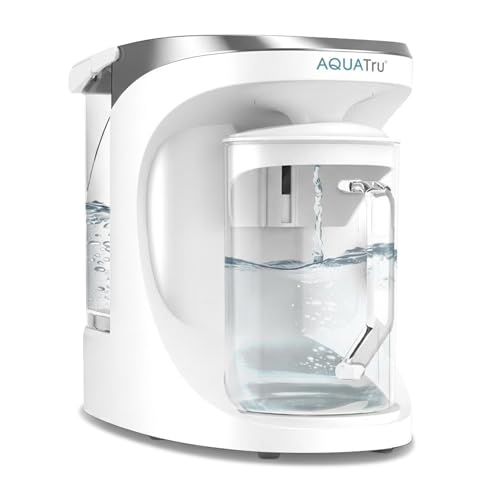
The AquaTru Glass Carafe is the ultimate no-installation solution for renters or anyone who doesn’t want to drill into countertops. It sits on the counter, plugs into a standard outlet, and uses a 4-stage RO process — including a pre/carbon filter, RO membrane, and VOC carbon filter — to remove 84 contaminants including PFOA, PFOS, lead, microplastics, and chromium-6. The borosilicate glass carafe eliminates the microplastic leaching risk associated with plastic pitchers.
Customer surveys indicate 98% of users report cleaner, safer-tasting water after switching to AquaTru. The Pre/Carbon filter lasts 6 months or 300 gallons, while the RO membrane lasts a full year. The machine recirculates water from the input tank through the filters into the carafe; one full purification cycle yields about 30 oz of clean water. The included magnetic shut-off stops dispensing automatically when the carafe is removed.
Users love the small footprint — comparable to a mid-size coffee maker — but note that the input tank is relatively small, requiring frequent refilling for households that go through several gallons a day. Some users also report that RO filter life was shorter than advertised when used with moderately hard water. Still, for a countertop unit that delivers genuine RO purity without any plumbing work, this is the most practical option.
Why it’s great
- Zero plumbing or drilling required — ideal for apartments and rentals.
- Borosilicate glass carafe prevents microplastic contamination from storage.
- IAPMO-certified to NSF standards for 84 contaminant reduction.
- Filter replacement is straightforward with clearly marked life cycles.
Good to know
- Input tank is small — requires frequent refilling for heavy usage.
- Produces wastewater that must be collected for plants or drained.
- RO filter life may shorten with hard water; some users report failures before 6 months.
- Purification cycle is slower than under-sink tankless systems.
4. Waterdrop T3-T
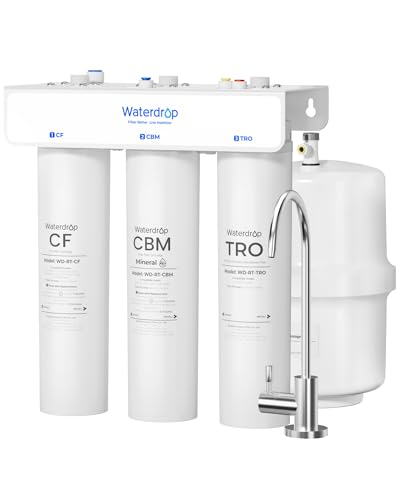
The Waterdrop T3-T is a 7-stage reverse osmosis system that packs remineralization into a compact under-sink footprint of just 12.6 x 6.1 x 14.69 inches. It produces 220 GPD, filling five 16.9 oz bottles in roughly one minute, and includes a mini tank for on-demand water without the bulk of traditional RO tanks. The 2:1 pure-to-drain ratio wastes less water than most RO systems in its class, saving a family of three up to 225 gallons per month.
The 7-stage process includes sediment removal, carbon filtration, RO membrane, and an alkaline remineralization cartridge that adds potassium, calcium, sodium, and magnesium back into the purified water. The NFC-enabled filter reminder lets you tap your phone to check filter life — a convenience that eliminates guesswork. Users report installation can be done in under 30 minutes with the simplified water lines, though faucet installation does require drilling a hole in the countertop.
Customer feedback is overwhelmingly positive, with many users replacing older RO units from other brands specifically because of the easy 3-second twist-and-replace all-in-one filter design. The RO filter lasts up to 24 months, CBM filter up to 12 months, and CF filter up to 6 months — keeping replacement costs predictable.
Why it’s great
- Remineralization stage adds beneficial minerals for improved taste and pH.
- 220 GPD flow rate is significantly faster than traditional 75 GPD RO systems.
- NFC filter reminders make maintenance easy.
- All-in-one twist-and-replace filter design minimizes mess during changes.
Good to know
- Requires drilling a hole in the countertop for the dedicated faucet.
- Mini tank still takes up some space under the sink.
- Replacement filters are specific to the T3-T model.
5. Express Water WH300SCKP

The Express Water WH300SCKP is a heavy-duty whole-house system designed to protect every tap from chlorine, heavy metals (lead, arsenic, chromium, mercury), and scale buildup. Its 3-stage filtration starts with a sediment filter to catch dirt and rust, followed by a catalytic coconut-shell carbon filter for chlorine and chloramine, and finishes with a scale-inhibiting polyphosphate cartridge. The freestanding stainless steel frame includes three pressure gauges and pressure release buttons, making filter changes safer and more manageable than bracket-mounted systems.
With a maximum flow rate of 17 GPM and 100,000-gallon capacity, this system can handle the demands of a large household without pressure drop. Users report immediate improvement in water taste, reduced spotting on dishes, and less scale in water heaters. The 1-inch inlet/outlet connections are standard for whole-house setups, and the included mounting bracket simplifies DIY installation with PVC or copper plumbing.
One key limitation: like most whole-house systems, it does not reduce TDS or remove dissolved solids — those require a separate under-sink RO system for drinking water. The filter cartridges need replacement every 6-12 months, and the combined cost of all three filters runs around per change.
Why it’s great
- 17 GPM flow rate supports large households without noticeable pressure loss.
- Freestanding stainless steel frame with pressure gauges for easy monitoring.
- Polyphosphate anti-scale protection extends appliance lifespan.
- Reduces heavy metals (lead, arsenic, mercury) throughout the entire home.
Good to know
- Does not reduce TDS — you need a separate RO for drinking water.
- Stainless steel frame adds significant weight (63 lbs) and requires floor space.
- Filter replacements cost roughly per set every 6-12 months.
6. iSpring WGB32B

The iSpring WGB32B is the gold standard for whole-house sediment and chlorine reduction. Its 3-stage design uses a 5-micron sediment filter followed by two 20-inch carbon block filters, collectively rated to remove up to 99% of chlorine, tastes, odors, herbicides, and sediment. The 100,000-gallon capacity provides roughly a year of filtration for a typical family before cartridge replacement is needed, and the 15 GPM flow rate keeps up with simultaneous shower and faucet use without noticeable pressure loss.
The industrial-standard 20 x 4.5-inch filter housings offer high dirt-holding capacity, and the 1-inch NPT inlet/outlet connections make installation compatible with standard home plumbing. iSpring’s customer service is frequently praised in user reviews, with multiple reports of free replacement manifolds and filter housings even years after purchase. The filters use premium coconut shell carbon that is third-party tested to meet NSF/ANSI standards for contaminant reduction.
Users with well water report excellent sediment removal and noticeable improvement in water clarity. The system does not reduce TDS, which is expected — iSpring recommends pairing it with one of their under-sink RO systems if mineral-free drinking water is desired. The included filter housing wrench and installation manual make DIY setup achievable for most homeowners.
Why it’s great
- 15 GPM flow rate handles heavy simultaneous usage without pressure drops.
- 100,000-gallon capacity extends time between filter changes.
- iSpring customer support is consistently praised for out-of-warranty replacements.
- Coconut shell carbon filters are third-party tested to NSF standards.
Good to know
- Does not reduce TDS — not a replacement for an RO system.
- Large 24.5 x 8 x 28-inch footprint requires adequate space.
- Heavy water-filled housings can be difficult to unscrew during filter changes.
7. 3M Aqua-Pure FF100

The 3M Aqua-Pure FF100 is a full-flow under-sink carbon filter that connects directly to your existing faucet — no dedicated faucet or countertop drilling required. Its Sanitary Quick Change (SQC) design allows filter changes in seconds without shutting off the water supply or touching the filter media. The integrated shut-off valve means you can swap the cartridge without tools or wrench, making it one of the most convenient maintenance-free filter systems available.
Certified under NSF Standard 42 (chlorine taste and odor) and Standard 53 (lead, cysts, VOCs), the FF100 reduces microplastics, lead, and select VOCs like benzene. The flow rate of up to 2.5 GPM means almost no noticeable pressure drop from your standard faucet, unlike many under-sink filters that restrict flow. The system weighs just 4 pounds and fits in tight under-sink spaces without needing electrical power.
Multiple user reviews emphasize that the included plastic push-fit tubing is a weak point and recommend using braided steel supply lines with compression adapters for a leak-proof install. Replacement filters (3MFF101) cost roughly -70 each and last a full year or 10,000 gallons, making the annual operating cost around -140 depending on water quality.
Why it’s great
- No dedicated faucet or countertop drilling needed — connects to existing faucet.
- 2.5 GPM full flow minimizes pressure drop during use.
- NSF 42 and 53 certified for lead, cysts, and microplastic reduction.
- Tool-free SQC filter changes with built-in shut-off valve.
Good to know
- Included plastic push-fit tubing is prone to leaking — replace with braided steel lines.
- Does not reduce TDS or remove dissolved solids (carbon filter only).
- Replacement filters are expensive at roughly -70 per cartridge.
8. Waterdrop TST-UF

The Waterdrop TST-UF uses a 0.01-micron ultrafiltration membrane to remove 99% of impurities — including chlorine, heavy metals, and sediment — while retaining beneficial minerals like potassium, calcium, and magnesium. This 3-stage system is specifically designed for municipal tap water and works best on cold water connections. The 304 stainless steel housing is lead-free, durable, and leak-resistant, offering a significant upgrade over plastic systems in the same price tier.
With a flow rate of up to 1.59 GPM, this system fills an 8 oz cup in about 2.3 seconds, making it one of the faster non-RO under-sink filters. The filter life cycle is impressive: the PP sediment filter lasts 6-8 months, the UF membrane lasts up to 12 months, and the CT carbon filter lasts 12-24 months, depending on water quality and usage. Total capacity is rated at 8,000 gallons before the system needs a full overhaul.
Installation requires no drilling and connects directly to 1/2-inch or 3/8-inch female NPT threads. Users report a straightforward 10-minute install with the included wrench and Teflon tape. The critical catch: this system does not reduce TDS, so if you want distilled-quality water, you need an RO system instead. Additionally, the push-connect fittings can be difficult to seat correctly, and the stainless steel housing threads may feel gritty during initial assembly.
Why it’s great
- 0.01µm ultrafiltration removes 99% of contaminants while retaining healthy minerals.
- 304 stainless steel housing is durable, lead-free, and leak-resistant.
- Fast 1.59 GPM flow rate fills cups in seconds.
- Long filter life with up to 24-month cartridge intervals.
Good to know
- Does not reduce TDS — retains minerals but won’t remove dissolved solids.
- Not suitable for well water or hot water connections.
- Push-connect fittings can be difficult to install correctly under tight sinks.
9. Reverse Osmosis Revolution WHF-34F5
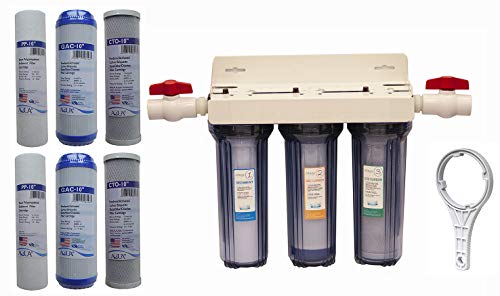
The Reverse Osmosis Revolution WHF-34F5 is a no-frills whole-house 3-stage system that comes with an extra year’s worth of filters (2 full sets for a total of 6 cartridges) included in the box. The first stage uses a 5-micron sediment filter to trap dirt, silt, and rust; the second stage is a granular activated carbon (GAC) filter for chlorine, VOCs, and odors; and the third stage uses a CTO carbon block to polish the water and improve taste. The 3/4-inch threaded ports are compatible with most home plumbing setups.
Users report excellent results on well water with sulfur taste and odor, as well as significant reduction in sediment and chlorine from municipal supplies. The included installation kit comes with valves and adapters, making DIY setup relatively simple. Each filter set lasts 4-6 months, so the extra year of filters provides true value — you won’t be buying cartridges again for 12-18 months depending on usage and water quality.
The 10,000-gallon capacity is lower than the whole-house giants from iSpring and Express Water, making this more appropriate for smaller homes or apartments with lower water consumption. Some users note that the included faucet fitting didn’t fit their existing setup and required additional adapters, and the warranty registration process is reportedly cumbersome. Still, for the price, this is the most affordable way to start filtering water throughout an entire home.
Why it’s great
- Includes an extra year of replacement filters directly in the box.
- Simple 3-stage setup with sediment, GAC, and CTO block filtration.
- Effective on well water with sulfur taste and sediment issues.
- DIY-friendly installation with included valves and adapters.
Good to know
- 10,000-gallon capacity is lower than premium whole-house systems.
- 3/4-inch ports may require additional reduction fittings for some homes.
- Warranty registration process is reported as frustrating by multiple users.
FAQ
What is the difference between an under-sink RO and a countertop RO?
Will an RO system remove beneficial minerals from my water?
How often do I need to replace the filters?
Can I use a whole-house filter and an under-sink RO together?
Do all under-sink water filters require drilling a hole in the countertop?
Final Thoughts: The Verdict
For most users, the clear winner for the best aqua filtration system is the iSpring RO500AK-BN because it combines the fastest flow rate (500 GPD), NSF 58 certification, and excellent 2:1 pure-to-drain ratio with the convenience of a tankless design and a remineralization stage that restores healthy minerals for great-tasting water. If you want the absolute highest purity with UV sterilization, grab the SimPure T1-400UV. And for a no-drill, no-plumbing solution that still delivers genuine RO filtration, nothing beats the AquaTru Glass Carafe.