
Our readers keep the lights on and my morning glass full of iced black tea. As an Amazon Associate, I earn from qualifying purchases.
Specs are compiled from manufacturer listings and verified buyer reviews and can change over time — please confirm the key details on the product page before buying.
Choosing the right filter for a 20-gallon tank can feel like a biology and plumbing exam rolled into one. You just want clean, healthy water for your fish — without a noisy motor, tricky maintenance, or media that costs a fortune to replace. This guide cuts through the three-stage jargon and flow-rate hype to find the handful of filters that actually deliver on that promise for your size tank.
I’m Min — the founder and writer behind Gadgets Feed. This guide is built by comparing the manufacturers’ published specifications and the patterns across verified customer reviews, so you get each pick’s real strengths and trade-offs instead of marketing spin.
Whether you keep goldfish, tetras, or a turtle, these are the top performers for a tank that size. This is your shortlist for the very best aquarium filter 20 gallon setup money can buy, ranked by what owners actually experience.
Our Picks at a Glance


How To Choose The Best Aquarium Filter 20 Gallon
The filter is the heart of your aquarium. For a 20-gallon tank, you need enough flow to cycle the water at least four to six times per hour without creating a whirlpool that stresses your fish. Sizing a filter isn’t just about the tank volume — it’s also about the fish load, the type of decor, and your tolerance for noise and maintenance.
Flow Rate and Turnover
To keep your 20-gallon tank clean without tiring out your fish, look for a filter rated at 80 to 120 gallons per hour (GPH — how many gallons it can pump in one hour). That flow rate turns over the water enough to remove waste, but it won’t create a strong current that exhausts small or slow-moving fish. Too little flow lets waste build up and ruins water quality, so the GPH rating is the most important number on the box for your tank size.
Filtration Stages: Mechanical, Chemical, Biological
Good filters use three stages. The mechanical stage involves a sponge or floss that physically traps debris, fish waste, and uneaten food. The chemical stage uses activated carbon to remove toxins, odors, and discoloration, keeping the water crisp. The biological stage provides a surface area — often ceramic rings or bio-balls — for beneficial bacteria to colonize and break down ammonia and nitrites. All three work together, but for a 20-gallon tank, reliable biological filtration is often the hardest feature to nail.
Internal vs. Hang-On-Back (HOB)
Internal filters sit completely inside the tank, taking up some swimming room. They are often submersible and can be hidden behind decor. Hang-on-back (HOB) filters sit outside, hanging on the tank rim, so they don’t steal interior space. HOBs generally allow more media capacity and are easier to service without wetting your hands. Submersible types are quieter, as the water dampens the motor hum, and they are the only option for tanks that are too full to hang a box on.
Quick Comparison
| Model | Best For | Flow Rate (GPH) | Item Weight | Filtration Type | Amazon |
|---|---|---|---|---|---|
| TARARIUM IX-120★ Best Overall | Power & Value | 290 GPH | 2.99 lb | 3-Stage Mechanical/Bio | Amazon |
| Aqueon SmartCleanEasiest to Maintain | Mess-Free Maintenance | — | 1.03 lb | Mechanical/Chemical/Bio | Amazon |
| Marina S20Slim & Quiet Build | Slim Design & Quiet | — | 16 oz | Mechanical/Chemical/Bio | Amazon |
| TARARIUM IX-90-NEW | Bottom Suction Cleaning | 220 GPH | 1.72 lb | 3-Stage Sponge/Bio | Amazon |
| Atlantis Aqua | No Replaceable Pads | — | 2.07 lb | Mechanical/Biological | Amazon |
| AquaMiracle SV-800 | Algae & Green Water | 225 GPH | 1.7 lb | Mechanical w/ UV Light | Amazon |
| Marineland Penguin 200 | Wet/Dry Bio-Wheel | 200 GPH | 2.3 lb | Mechanical/Chemical/Bio-Wheel | Amazon |
| Penn Plax Cascade 400 | Budget Submersible | 110 GPH | 16 oz | Mechanical/Chemical/Bio | Amazon |
| Fluval AC50 | Premium Performance | — | 0.55 lb (0.25 kg) | 3-Stage w/ Bio-Max | Amazon |
In‑Depth Reviews
1. TARARIUM IX-120 (Power Adjustable 20-75 Gal)
Our pick — over 4★ from 750+ verified ratings; the strongest balance of quality and price.
A powerhouse filter that doesn’t sound like a washing machine in your living room.
If raw capacity is your priority, the TARARIUM IX-120 stands alone. It moves a massive 290 gallons per hour. That kind of flow is overkill for a lightly stocked community tank, but it is exactly what a heavy-load tank — goldfish, cichlids, or a turtle — demands to stay clear and healthy. The filter uses a dense, double-sided mesh sponge (the first two stages are in one sponge) plus a canister of ceramic bio-balls for biological breakdown.
What wins people over is the combination of sheer functionality (85 owners praise it directly) and cleaning performance. The motor is surprisingly unobtrusive, and the waterfall outlet actually creates a pleasant, calming sound rather than a loud crash. A buyer with a 50-gallon tank described the sizing as “perfect,” noting the quick installation. The trade-off you need to know is its size and weight. At 2.99 pounds and measuring 8.15 x 4.13 x 11 inches, the TARARIUM IX-120 weighs 2.99 pounds, while the Aqueon SmartClean weighs 1.03 pounds. — so it demands a sturdy tank rim or a solid internal mount. The water quality outcomes are slightly split: many tanks stay cleaner for longer days, but a minority report it becoming murky within a day, likely due to the tank being overstocked for the bio-balls to handle alone.
Why You Want This One
- Massive 290 GPH flow rate — handles heavy fish loads and messy turtles.
- 3-stage waterfall filtration with ceramic bio-balls for biological health.
- Adjustable water flow to dial down the current for smaller or more delicate fish.
The Honest Trade-off
- Large and heavy (2.99 lb) — takes up significant space and requires a sturdy mount.
- Water quality is hit-or-miss if the tank is very overstocked; a few owners see cloudiness within a day.
Ideal for: Stocked tanks, goldfish, cichlids, or turtle semi-aquatic setups where maximum flow and aggressive mechanical filtration are non-negotiable.
Consider something else if: You have a sparsely populated 20-gallon tank with small tetras — the 290 GPH flow may create a strong current that exhausts timid fish, and the filter’s size will dominate your tank’s appearance.
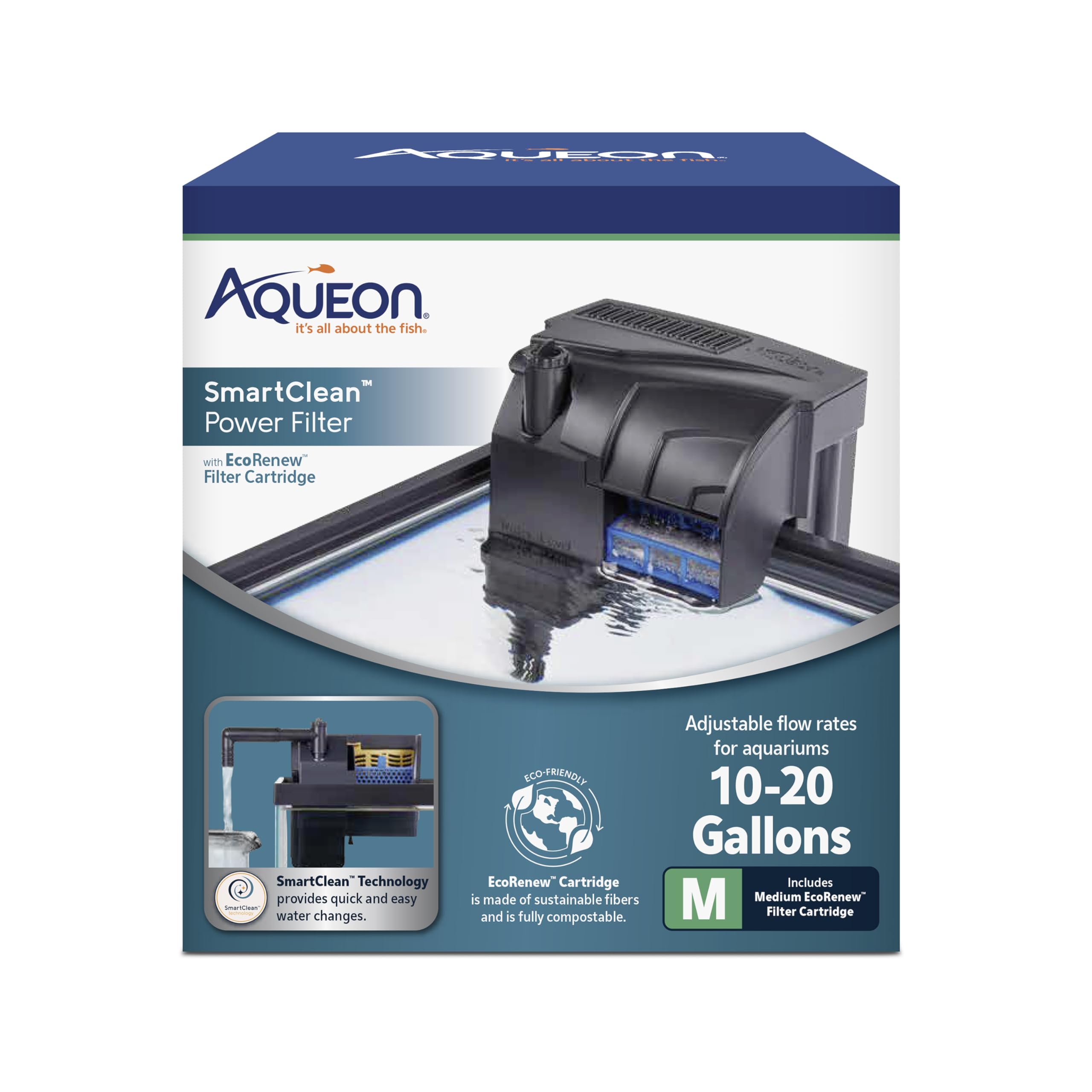
2. Aqueon SmartClean Power Filter (10-20 Gal)
The filter that finally makes water changes as simple as lifting a lever.
The Aqueon SmartClean changes the game for aquarium maintenance. Its signature trick is the SmartClean Technology: you simply lift and rotate the filter nozzle to perform a partial water change without removing the filter or spilling a drop. The NoDrip cartridge and holder design means you never have to worry about water dripping onto the floor or into the cabinet below. It is an absolute blessing if you have ever wrestled with a traditional HOB filter that runs down the side of the tank.
For a 10-20 gallon freshwater or saltwater setup, this filter is the most thoughtfully engineered option here. The adjustable flow rate lets you pace the current for betta fish or axolotls — owners of axolotls specifically praise it for just this reason. The motor is quiet, and the auto-start pump requires no priming; if the power blinks off and on, it restarts automatically. That said, reliability is the most-discussed aspect, and the reviews are mixed: some owners find the motor starts to make noise within a few months, while others happily buy a second unit as a replacement. The filter media is proprietary, which costs more over time than DIY-friendly models.
Who Wins: The hygiene-first aquarist who hates wet hands and messy water changes — this filter solves that single problem better than anything else on the list.
Reach for this if: You want the absolute easiest maintenance experience for a small, lightly stocked 20-gallon tank and appreciate the NoDrip cartridge design.
Look elsewhere if: You need a filter for a heavy bioload (like large goldfish) or you want to use custom, bulk-bought filter media; the proprietary cartridges add to the ongoing cost.
3. Marina S20 Power Filter (20 Gal)
An elegant, whisper-quiet HOB that barely steals any space from your tank rim.
The Marina S20 is a cult favorite for a reason. It is remarkably small and slim — its compact profile is thinner than any standard hang-on-back filter, leaving the top open for feeding and viewing. It is also dead quiet. The submerged motor design keeps the hum dampened, and the filter quality is the most-praised aspect across its reviews. The adjustable flow control gives you real command over the water current, and the included strainer sponge makes it safe for tanks with small fish or fry, preventing them from being sucked into the intake.
Owners consistently say this filter keeps the water cleaner than other brands they have tried, and many rank it above the Tetra and AquaClear models they used before. The four included cartridges (two Bio-Carb and two Bio-Clear) incorporate Ceramitek, a highly porous ceramic medium that powers the biological filtration. The catch, as some owners note, is the filter’s media path: the cartridges sit in a straight line rather than a sequential stack, so the water does not pass through coarse-to-fine in a traditional order. This is a minor nit for most, but purists who insist on sequential mechanical-then-biological filtration may be irked. The filter is rated precisely for 20 U.S. gallons (76 liters), so it is a perfect fit with no excess capacity.
Best for: Aquascapers and living-room display tanks where noise and visual footprint are the deciding factors — the Marina S20 excels on both without sacrificing water clarity.
Go with this if: A near-silent room, a tight tank rim, and a classic hang-on-back filter is all you need for a standard 20-gallon community tank.
Hold off if: You plan to stack custom filter media in sequential layers; the simple cartridge system may limit your custom approach.
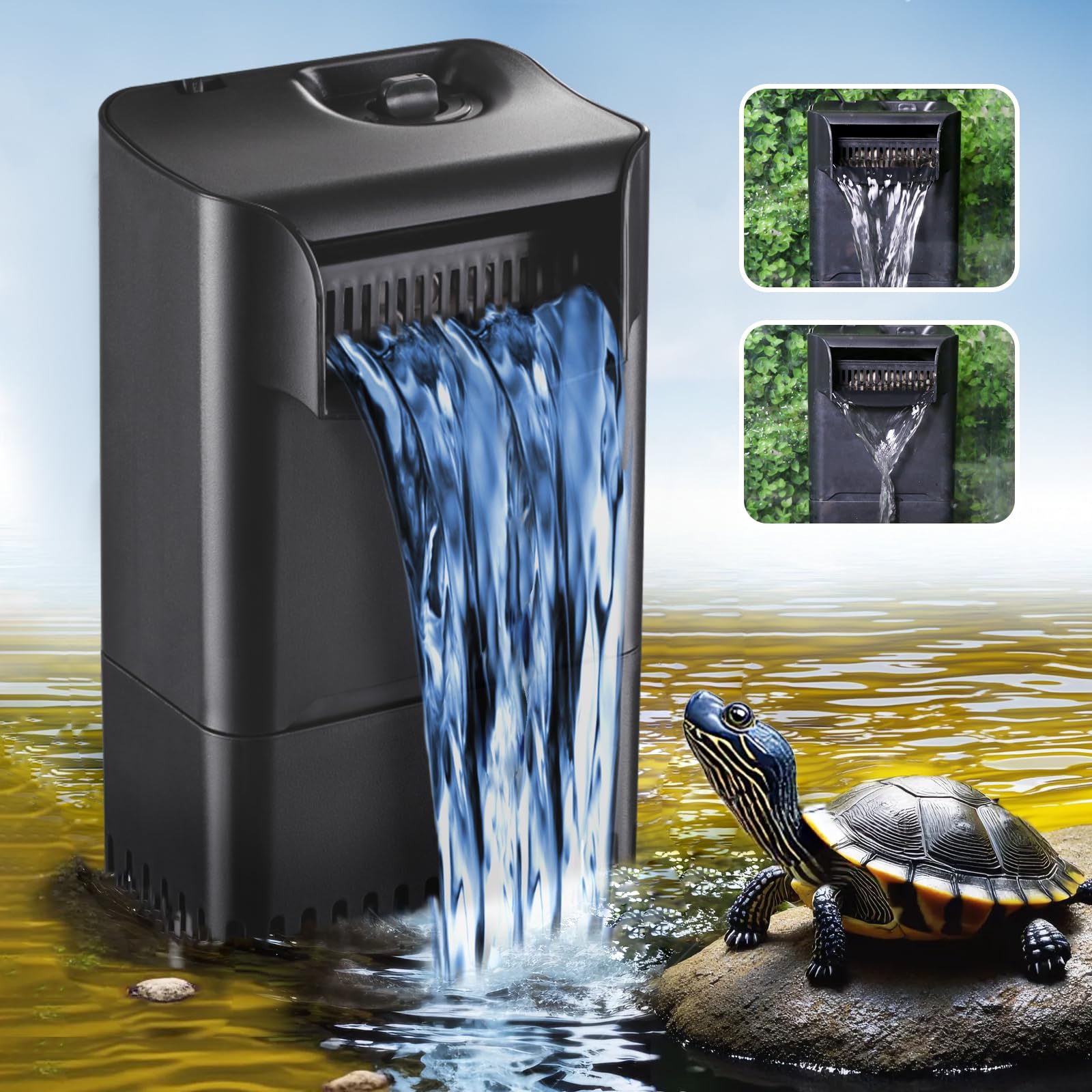
4. TARARIUM IX-90-NEW (Turtle Filter 20-45 Gal)
Built to scrub the bottom — where a turtle’s mess usually ends up.
If your 20-gallon tank is home to a red-eared slider, a painted turtle, or an amphibian, the TARARIUM IX-90-NEW is built for exactly that kind of filth. Its defining feature is a bottom suction system that pulls water from the very base of the tank, efficiently removing fish waste and food debris that sink to the floor. For a turtle, which produces a disproportionate amount of waste relative to its body size, this design makes a tangible difference in how often you need to do full water changes.
The filter moves 220 GPH. — and uses a three-stage process with a double-sided mesh sponge and ceramic bio-balls. It works in fresh and saltwater, and the minimum water level is only 2.6 inches, so it keeps running even in a partially filled turtle tank. Owners rave about its effectiveness: many report tanks that required no cleaning for a full month, staying crisp with just the one filter. At 1.72 pounds, it is significantly lighter than the larger TARARIUM model, and four suction cups let you mount it at any angle. A few people note the power cord is a bit short, so placement near an outlet is worth planning for.
The Right Tool: Turtle keepers and amphibian owners — the bottom-intake design is purpose-built for their heavy, sinking waste.
Pick this if: You own a turtle, frog, or salamander tank and want a dedicated filter that vacuums the floor continuously.
skip it if: Your tank has fine sand substrate — the bottom intake can pull sand into the motor, requiring more frequent cleaning of the spiral motor port as the manual advises.
5. Atlantis Aqua Submersible Filter (20-55 Gal)

Stop buying filter cartridges forever — this sponge is built to last your whole tank’s life.
The Atlantis Aqua is a submersible internal filter that goes against the grain. Its most controversial and most loved feature is the same thing: the filter sponges are designed to last a lifetime. There is no monthly cartridge purchase. You simply rinse the sponge when it gets dirty, and it keeps going. The filter body is also detachable into sections, so you can size it for a 20-gallon tank (at 7.6 inches with one section removed) or extend it for a 55-gallon tank (11.4 inches full height).
Unlike many internal filters that draw water from the side (which lets unfiltered water bypass the sponge), the Atlantis Aqua pulls water through the bottom of the unit, forcing it to travel the entire length of the filter media before exiting. This is a genuinely better design for thorough mechanical and biological filtration. It also explicitly aerates the water as it runs — owners often drop their separate air stone after installing this filter. The main downsides: the coarse sponge is not fine enough to trap very tiny debris, and the adjustable flow direction only goes side-to-side, not up and down. The filter is also not suitable for small shrimp or nano-fish that could be pulled into the intake.
Standout feature: Lifetime sponges and detachable sections — this is the most cost-effective long-term filter for a 20-gallon tank, assuming you do not mind a little DIY rinsing every couple of weeks.
Best for: Budget-conscious aquarists who want strong internal filtration without recurring media costs and who appreciate the built-in aeration that eliminates a separate air pump.
Think twice if: You keep very small fish or shrimp — the intake can be a hazard — or you need fine particulate polishing, which this sponge cannot provide.
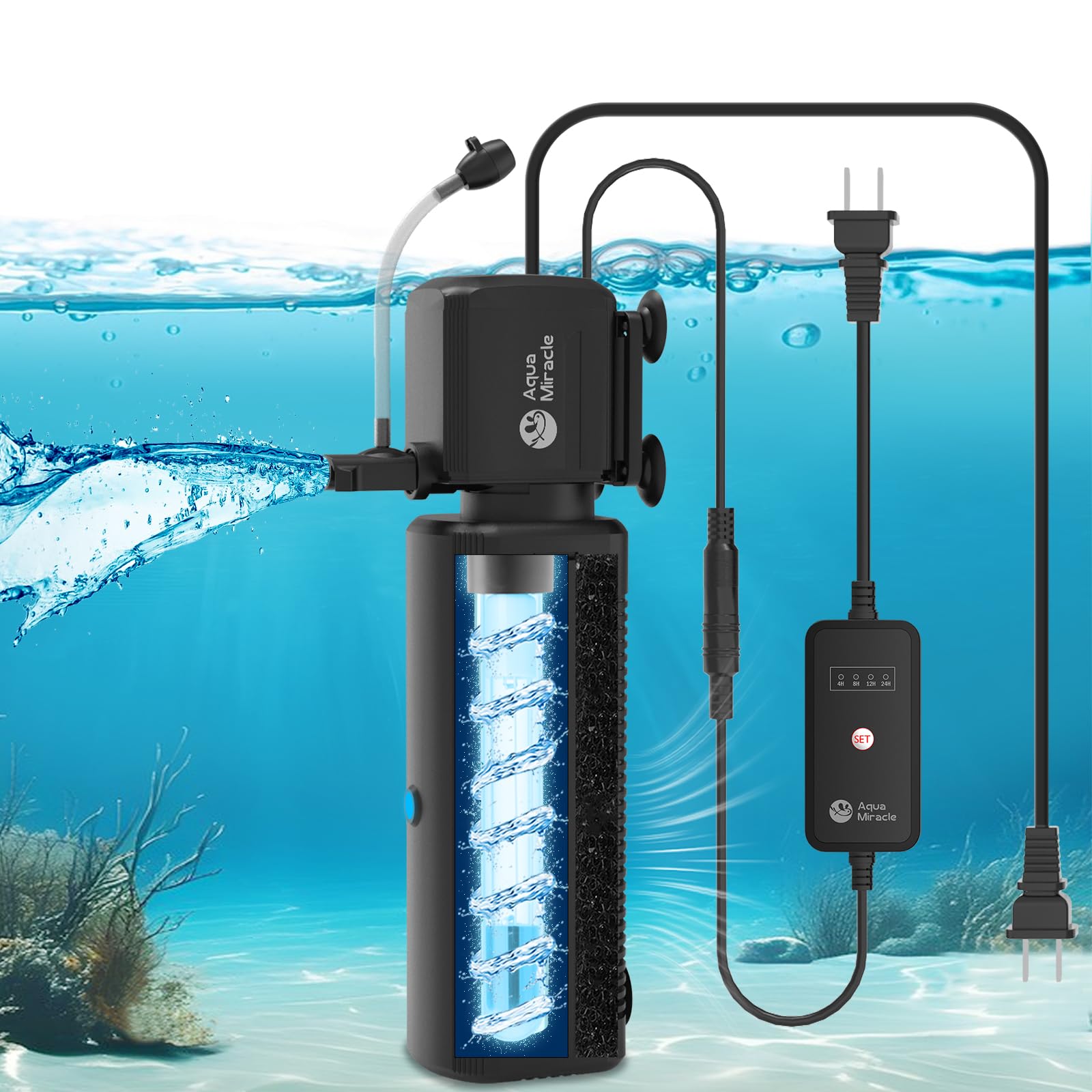
6. AquaMiracle SV-800 (with UV Light, 20-70 Gal)
The green-water killer — a proper UV light in a submersible filter body.
The AquaMiracle SV-800 solves the single most frustrating problem in aquarium keeping: green, pea-soup water caused by free-floating algae. It packs an 8-watt UV light right into the filter housing, with a built-in timer offering 4, 8, 12, or 24-hour cycles. For any 20-gallon tank battling a sudden bacterial bloom or a persistent algae outbreak, this filter can clear the water in under 48 hours — buyers report crisp results within two days of installation.
Beyond the UV function, it is a solid dual-mode filter. The Aerating Mode uses an air venturi to boost oxygen levels, while the Rainfall Mode spreads filtered water through a spray bar for gentle surface movement. It fits tanks from 20 to 70 gallons and operates at 8 watts with a max flow of 225 GPH. The tank that had “muddy water” became clear in just 12 hours for one owner. The caveat: the water flow adjustment is a bit binary — it goes from strong to stronger, according to some owners, so it may be too vigorous for tanks with delicate fish or long-finned bettas. The filter is also better at clearing algae than at trapping fine waste, so pairing it with a secondary mechanical filter can yield the best results.
The Trade-off: An excellent algae-fighting weapon, but its primary mechanical filtration is basic — consider this a UV add-on with a pump, not a standalone full-mechanical system.
Ideal for: Aquarists whose main problem is green water or unsightly algae; also a great emergency tool for clearing a bacterial bloom fast.
Not for: Heavily stocked fish tanks that need sturdy multi-stage mechanical filtration first. Buy it for the UV, not the sponge.
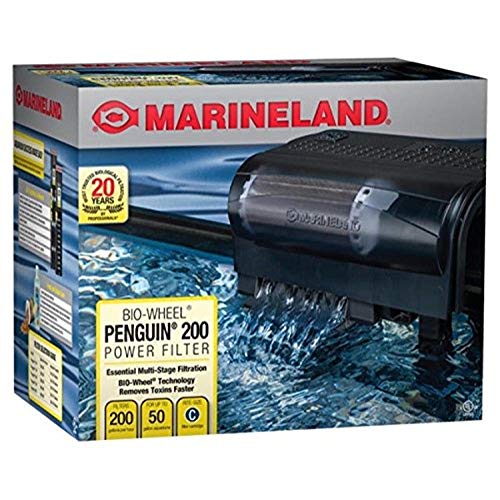
7. Marineland Penguin Bio-Wheel 200 GPH
The rotating wheel that grows beneficial bacteria in open air for superior biofiltration.
The Marineland Penguin Bio-Wheel is a genuine classic in the hobby. Its secret is the rotating Bio-Wheel, which provides wet/dry biological filtration — the wheel turns constantly, exposing colonies of beneficial bacteria to both tank water and oxygen-rich air. This cycle dramatically increases the bacteria’s efficiency at breaking down ammonia and nitrites. It is a proven design that owners have trusted for decades, often lasting 10 to 15 years with basic upkeep. The 200 GPH model is the right size for a 20-gallon tank, providing a strong but manageable flow.
The filter quality is praised by thousands of owners — the most-discussed aspect here is the noise level, which is honestly mixed. The Bio-Wheel is solid and reliable, but if it is not perfectly aligned, or if the water level drops too low, it can produce a noticeable rattling or bubbling sound. Many owners fix it by simply lifting the intake tube to purge air. The filter uses Marineland Rite-Size cartridges, which are an ongoing expense, though the dual-slot design lets you run two cartridges at once or add custom media. The reliability score is a point of caution — some owners experience motor failure after a year or two, though this is not the majority experience. For most, it remains the “reliable, reasonably priced” workhorse they keep coming back to.
Why It Endures
- Wet/dry Bio-Wheel provides exceptional biological filtration that is hard to match with standard bio-media.
- Room for two cartridges allows extra media customization (carbon, Purigen, sponge).
- Simple, tough construction that owners mention lasting through multiple tank upgrades over a decade.
Where It Stumbles
- Noise is the biggest recurring comment — the wheel can rattle if not perfectly seated, especially at lower water levels.
- Not self-priming: you must fill the filter chamber with water before starting it, or the motor will run dry.
For the enthusiast: If you want dedicated biological filtration that outperforms simple sponge media, the Bio-Wheel is the real deal — just be prepared to tinker with the wheel alignment for quiet operation.
Pass on this if: You want an absolutely silent filter or you prefer a maintenance-free, no-cartridge design. The Marineland requires regular cartridge changes and some acceptance of potential wheel noise.
8. Penn Plax Cascade 400 (Up to 20 Gal)

A tiny submersible that can be hidden away, but its weak points reveal a budget design.
The Penn Plax Cascade 400 is a fully submersible internal filter sized for 10 to 20-gallon tanks. At just 16 ounces and a slender 2.75 x 2.5 x 9.5 inches, it is one of the smallest and lightest options on the list, making it easy to conceal behind rocks or driftwood. It delivers 110 GPH, which is a gentle, appropriate turnover for a small community tank. The spray bar option is a nice addition — it diffuses the outflow into a gentle rain that aerates the tank without creating a strong current.
Filtration is the most-praised aspect: the activated carbon cartridge removes chemicals and odors, while the internal sponge encourages beneficial bacteria growth. But the Cascade 400 has several documented weak points. The suction cups are widely criticized — they lose grip over time, causing the filter to slide down the glass. The plastic construction feels thin, and there are reports of water bypassing the sponge entirely if the assembly isn’t perfectly tight. The noise level is mixed: some find it quiet, others note a plastic hum from the motor. This filter is best seen as a secondary or clean-up filter for polishing water, not a primary workhorse for a heavily stocked 20-gallon tank.
Best role: A secondary internal filter for polishing water or adding gentle circulation in a planted tank — its limitations become clear if you rely on it alone for a bioload-heavy setup.
Reach for this if: You need an ultra-compact submersible for a small, lightly stocked tank and appreciate the spray bar for gentle aeration.
pass on it if: You want a primary filter that can handle a heavy fish load or strong suction cup mounting; the weak points are a real annoyance for daily users.
9. Fluval AC50 Power Filter (20-50 Gal)
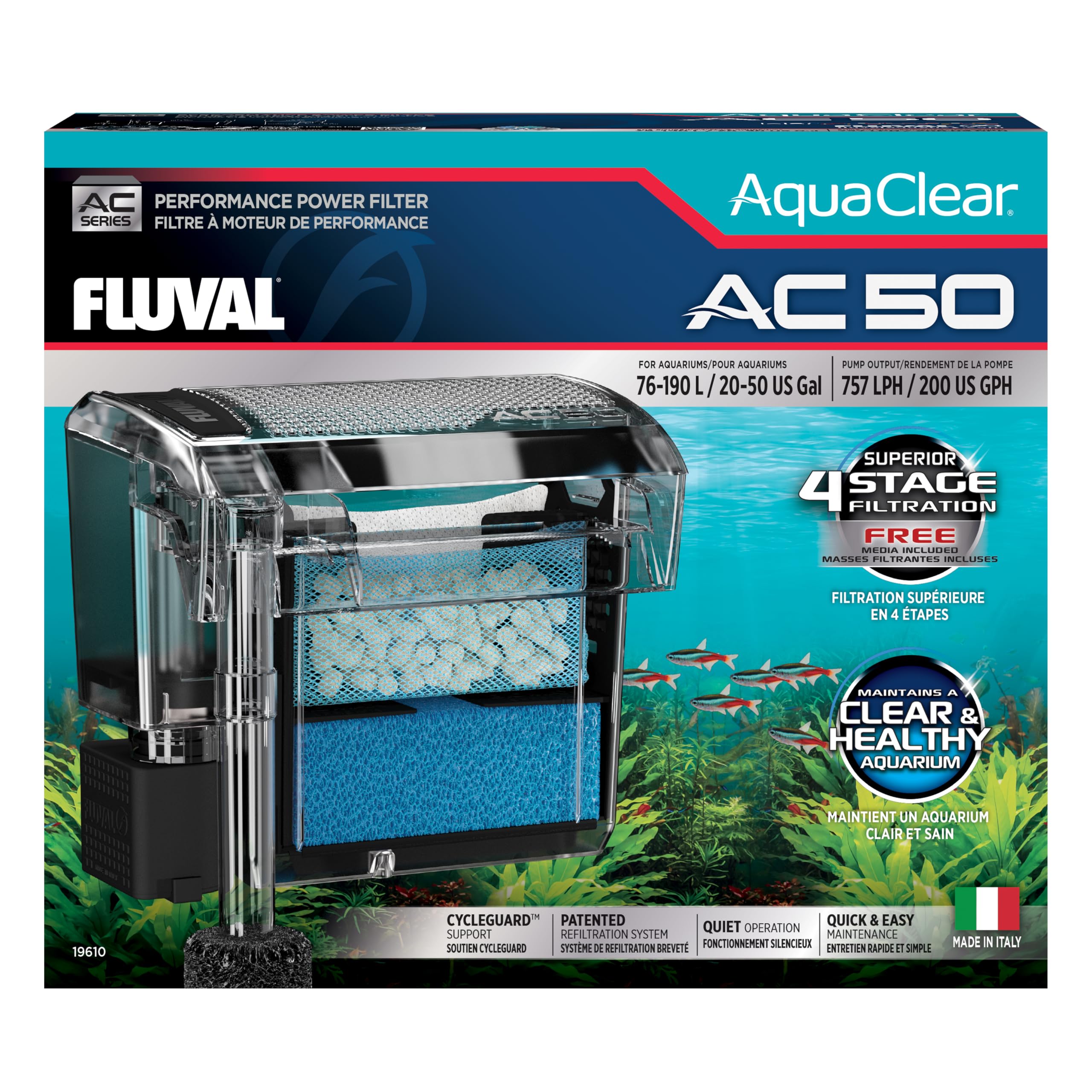
Fluval’s signature build quality arrives in a 20-50 gallon filter that is as quiet as it is effective.
Fluval is a name that commands respect in the aquarium world, and the AC50 lives up to that reputation. It is a hang-on-back filter designed for tanks from 20 to 50 gallons, making it a premium choice for a 20-gallon setup that you might eventually upgrade to a larger tank. It comes ready to run with a complete media set: a pre-filter sponge to catch large debris, a biofoam insert for finer particles, a Biomax insert for biological filtration, and a carbon insert for chemical polishing. This four-media approach is more comprehensive than most filters in this price range.
Reliability is the most-praised aspect — customers note it running smoothly for months on end, with one noting it “works perfectly” on a 38-gallon axolotl tank because the gentle current is ideal for axolotl gills. A newer model version specifically fixed problems from the previous generation, and owners confirm it works much better from the start. The noise level is remarkably low — several owners replaced older Top Fin filters specifically because the Fluval AC50 is so much quieter. The only downside: a few people note that the unit sometimes arrives looking like it has been opened or handled before, though the performance is consistently excellent after setup. At just 0.25 kg (0.55 lb), it is also impressively light for its capacity.
The premium pick: If you want a filter that feels engineered — complete media set, silent operation, and a brand with a decades-long track record — the AC50 is the one to spend on.
Best for: First-time buyers who want a premium, no-compromise setup from day one, or anyone with delicate fish (axolotls, bettas) who need a gentle, reliable flow.
Hold off if: Your budget for a filter is strictly under — the AC50 sits at a premium tier, but the build quality and complete media set justify the extra spend.
Understanding the Specs
GPH — Gallons Per Hour
This is the flow rate. For a 20-gallon tank, you want the water to circulate at least four to six times per hour (80-120 GPH). A higher GPH means more turnover, which is great for heavy fish loads, but it can create a strong current that stresses small or slow-moving fish. Adjustable flow models let you dial it in, which is a valuable feature when your tank inhabitants change.
Three-Stage Filtration
Mechanical filtration uses a sponge or pad to trap visible waste. Chemical filtration uses activated carbon to absorb toxins and odors. Biological filtration uses a porous material (ceramic rings, bio-balls) to house good bacteria that break down ammonia and nitrite. A filter that does all three keeps your tank healthy. If it skips the biological stage, your water chemistry will struggle to stabilize over time.
FAQ
How often should I clean the filter on a 20-gallon tank?
What does GPH mean and how much do I need for a 20-gallon tank?
Can I use a filter rated for a larger tank on my 20-gallon tank?
HOB filter vs internal submersible filter — which is better for a 20-gallon?
How long should a fish tank filter last in a 20-gallon setup?
Can I use a 20-gallon filter in a 10-gallon tank?
Is a UV light filter worth it for a 20-gallon tank?
What is the difference between a bio-wheel and standard bio-media?
How often should I replace the carbon in my aquarium filter?
Why is my aquarium filter making a loud humming or rattling noise?
Final Thoughts: The Verdict
For most buyers, the aquarium filter 20 gallon winner is the TARARIUM IX-120 because it matches a massive 290 GPH flow with a quiet waterfall design and three-stage biological filtration at a fair mid-range price. If you want the easiest water changes and the lowest mess, grab the Aqueon SmartClean. And for a turtle-heavy tank that needs constant bottom scrubbing, the TARARIUM IX-90-NEW is the one to reach for.
How We Picked
We do not accept paid placement. Every pick is matched to a real buyer and a real use-case; we do not hands-on test units.
Sources & Methodology
Specifications: manufacturer listings and product documentation. Review insights: verified customer reviews, as of July 2026. Pricing: not shown on this page (it changes often); check the current price via the retailer link.
As an Amazon Associate, Gadgets Feed earns from qualifying purchases. This does not affect which products we feature.