
A 30-gallon aquarium is a sweet spot for hobbyists—large enough for a community of fish or a single showpiece inhabitant, but small enough that a single filter failure can cloud the water and spike ammonia within hours. The wrong filter leaves you battling green water, stressed fish, and constant media swaps.
I’m Min — the co-founder and writer behind Gadgets Feed. I’ve spent hundreds of hours cross-referencing flow rates, media capacity, and real owner experiences to isolate which models actually protect a mid-sized ecosystem without driving up maintenance.
After combing through thousands of reviews and technical spec sheets, the contenders for the top aquarium filter for 30 gallon tank are easy to overthink until you nail down the right filtration method and flow.
How To Choose The Best Aquarium Filter For 30 Gallon Tank
Selecting a filter for a 30-gallon tank forces you to balance turnover rate against noise and media capacity. Too much flow stresses slow-swimming fish; too little flow lets debris settle. Understanding these core specs narrows your field fast.
Flow Rate (GPH) and Turnover
For a 30-gallon tank, you want a filter rated for 4 to 6 times the tank volume per hour—roughly 120 to 180 GPH. A unit rated for exactly 30 gallons (often called a “30-gallon filter”) skims by at minimum turnover. Aim for a model rated 40–60 gallons, giving you headroom for heavy bioloads and reducing the chance of dead spots. Check the spec for max GPH and look for an adjustable flow control so you can dial it down for delicate fish or crank it up when the tank needs a deep turnover.
Filtration Type: Mechanical, Chemical, Biological
The best filters for a 30-gallon tank hit all three stages. Mechanical—sponges or floss that trap visible particles—needs to be easy to rinse without killing beneficial bacteria. Chemical—activated carbon or similar media—removes discoloration and odors, but you should replace it monthly. Biological—ceramic rings, bio-balls, or Bio-Wheels—houses the nitrifying bacteria that convert toxic ammonia. A filter with a dedicated biological media chamber prevents you from accidentally purging your cycle when you swap the carbon pack.
HOB vs Canister vs Internal
For a 30-gallon, hang-on-back filters offer the best blend of performance and ease. They sit outside the tank, leaving floor space for aquascaping, and you can swap media without reaching into the water. Canister filters sit below the tank and provide immense media capacity—great if you want the clearest possible water and don’t mind hose maintenance. Internal submersible filters save space in the stand but take up room inside the tank; they are best used as supplemental circulation or UV units.
Quick Comparison
On smaller screens, swipe sideways to see the full table.
| Model | Category | Best For | Key Spec | Amazon |
|---|---|---|---|---|
| Fluval 50 Power Filter | HOB | Best Overall Filtration | 7x larger media volume vs. comparable filters | Amazon |
| Marineland Bio-Wheel Penguin 150 | HOB | Reliable Bio-Filtration | Patented rotating Bio-Wheel for wet/dry bio | Amazon |
| Fluval AC30 Power Filter | HOB | Ultra-Quiet Operation | 3–4 dB quieter than comparable HOBs | Amazon |
| Grech CBG-800 UV HOB | HOB / UV | Green Water & Algae Control | 5W UV sterilizer + 211 GPH flow | Amazon |
| Zoo Med Turtle Clean 30 | Canister | Heavy Bioloads / Turtles | Spray bar for aeration, remote canister design | Amazon |
| COOSPIDER U-V Internal Filter | Internal / UV | Budget-Friendly Green Water Fix | 5W U-V light, 20–75 gallon range | Amazon |
| hygger HOB Filter 210 GPH | HOB | Budget Entry-Level HOB | Adjustable flow 210 GPH max, LED clog indicator | Amazon |
In‑Depth Reviews
1. Fluval 50 Power Filter
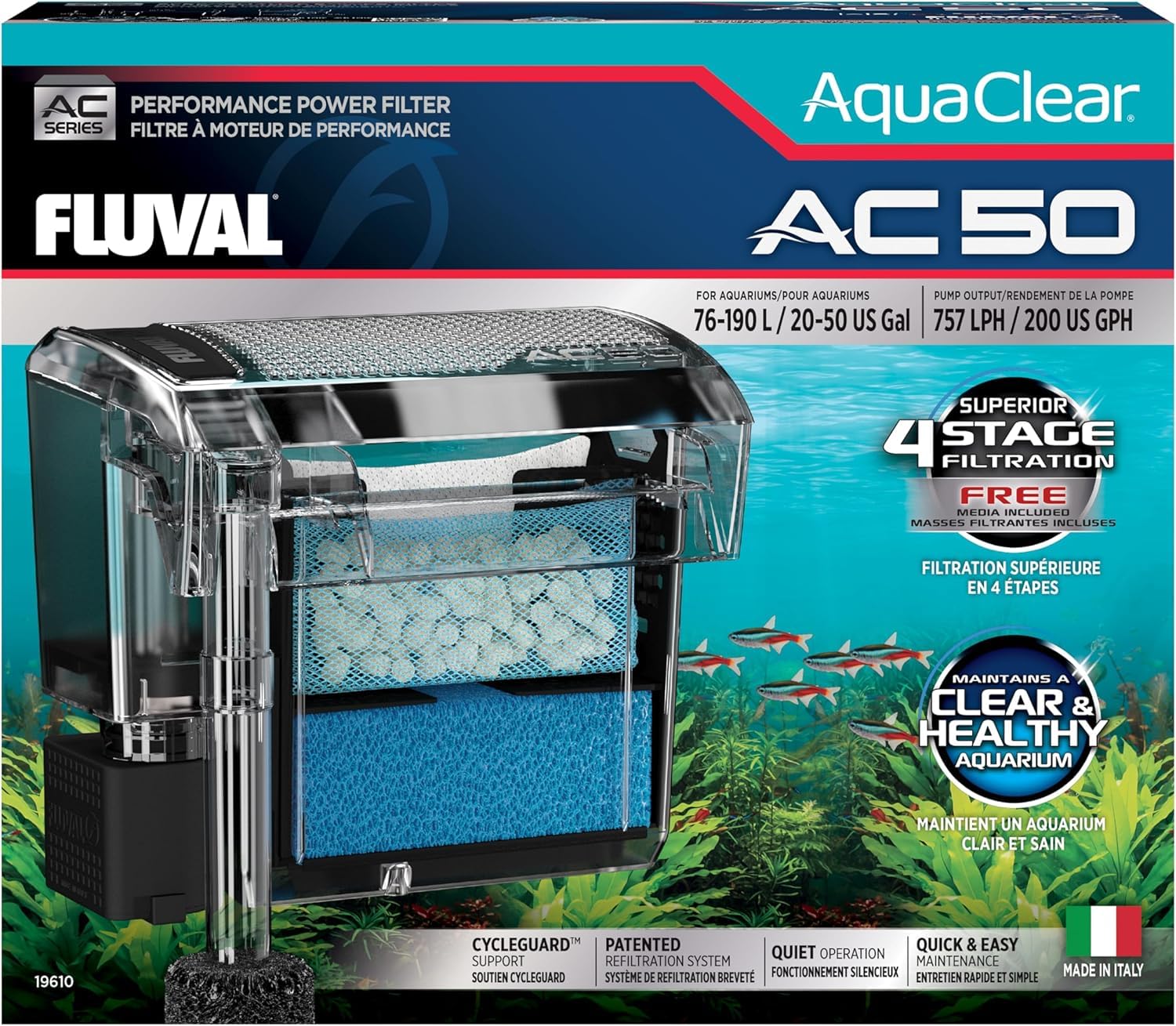
The Fluval 50 (formerly AquaClear 50) is the gold standard for mid-sized tanks for a reason: its basket holds up to seven times more media volume than most HOB filters in its class. That means you can stack coarse sponge, ceramic biomax rings, and a carbon pouch without sacrificing water flow. For a 30-gallon tank, this provides serious biological surface area that keeps ammonia and nitrite at zero even during heavy feeding periods.
Flow is rated for tanks 20 to 50 gallons, and the adjustable intake strainer lets you position it deep or shallow. Owners widely report clearing cloudy water within 24 to 36 hours, and the motor is known to restart after accidental dry starts—a sign of decent quality control. The foam and ceramic media are nearly free to replace, and you can wash the sponge in tank water to preserve the bacterial colony.
Noise is generally rated as low, though isolated reports mention a hum that fades after the motor breaks in. The power cord is on the short side, so account for outlet placement. The design has been in production for years, so part availability is excellent. If you want one filter to handle a 30-gallon planted tank or a community full of medium-bodied fish, this is the proven choice.
Why it’s great
- Massive media capacity for robust bio-filtration
- Easy to hack with custom foam and ceramic rings
- Quiet operation after break-in period
Good to know
- Short power cord may require an extension
- Leveling bracket can shift during maintenance
- Some units arrive with manufacturing chatter (returnable)
2. Marineland Bio-Wheel Penguin 150 GPH
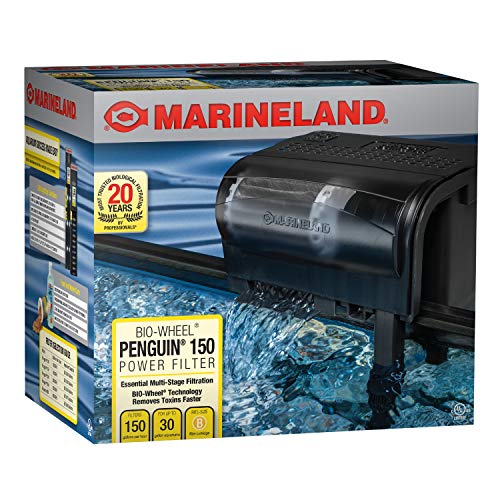
Marineland’s Bio-Wheel technology remains a unique selling point in the HOB market. The slowly rotating wheel exposes beneficial bacteria to air during half the rotation, providing wet/dry biological filtration that can cycle a tank faster than a submerged sponge alone. For a 30-gallon tank, the Penguin 150’s 150 GPH turnover gives you roughly five times the tank volume per hour—solid for most community setups.
Multi-stage filtration passes water through the Rite-Size cartridge for mechanical and chemical polishing, then over the Bio-Wheel for bio-filtration. The system is prized for its reliability across saltwater and freshwater tanks, with many owners reporting 10–15 years of service without motor failure. The cartridge swap is a breeze, and you can add your own biomedia inside the cartridge cavity to boost capacity.
Noise can be an issue if the Bio-Wheel becomes misaligned or if the water level drops too low, causing a rattling or splashing sound. The filter is not self-priming, so you must fill the chamber with water after cleaning. Despite these quirks, the Penguin 150 delivers clear water fast and is considered a workhorse among experienced hobbyists who appreciate a proven mechanical design over gimmicks.
Why it’s great
- Unique Bio-Wheel boosts nitrifying bacteria growth
- Extremely durable motor, often lasts a decade or more
- Strong mechanical filtration clears debris in minutes
Good to know
- Bio-Wheel can rattle if not perfectly aligned
- Ongoing cartridge cost adds up over time
- Not self-priming; requires manual water fill after cleaning
3. Fluval AC30 Power Filter
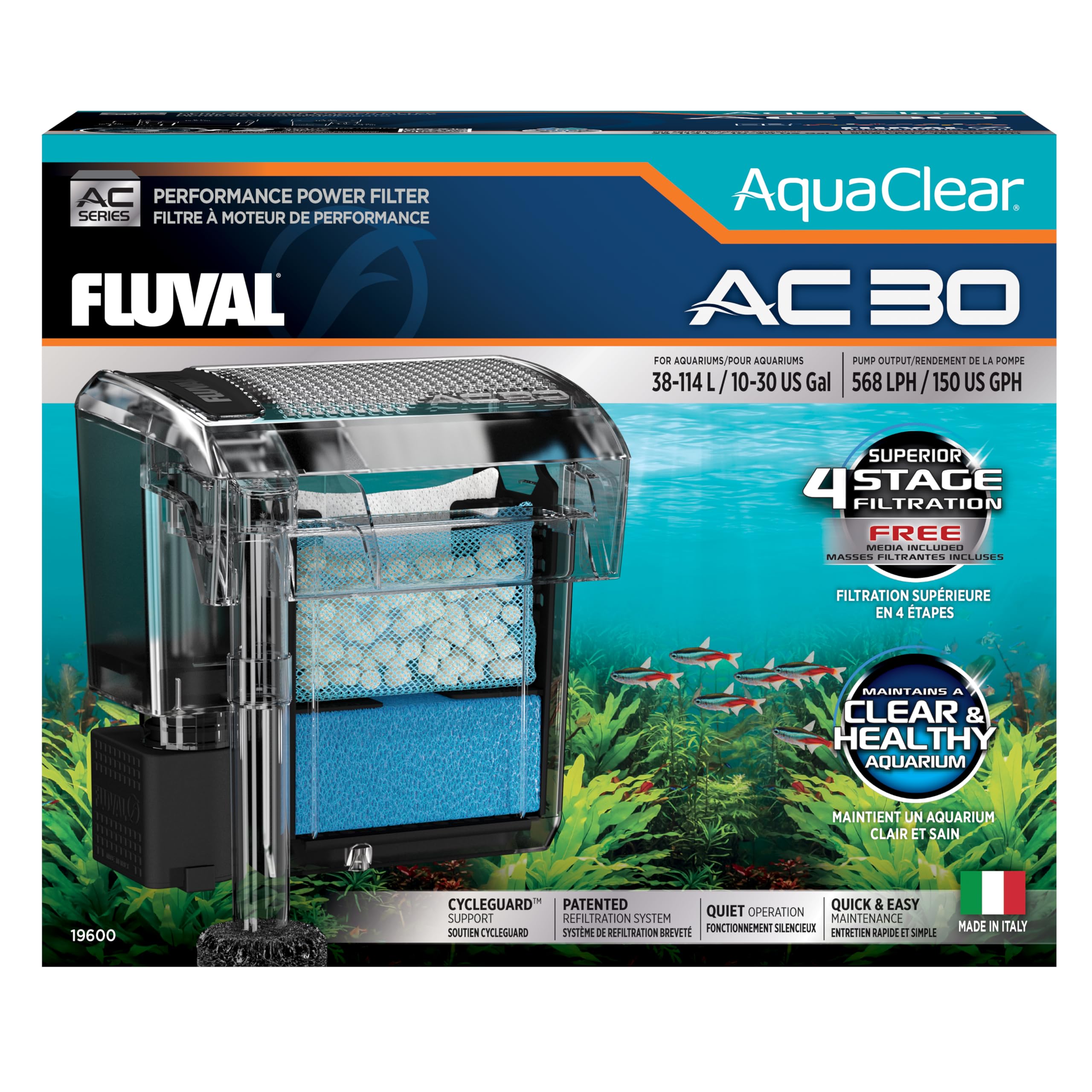
The Fluval AC30 is essentially the U.S. version of the widely regarded C series from Fluval, sized for 10 to 30 gallons. For a 30-gallon tank, this filter runs right at its maximum rating, so it is best suited for lightly stocked or planted tanks where you want whisper-quiet operation in a living room or bedroom. Owners comparing it directly to the Seachem Tidal 35 measure it 3 to 4 dB quieter—enough to matter over a long evening.
The filter ships with a pre-filter sponge, biofoam insert, Biomax ceramic rings, and a carbon insert—everything you need for mechanical, biological, and chemical filtration out of the box. The adjustable flow lever works smoothly, and the unit is self-priming, meaning you don’t need to manually add water after a power outage or cleaning restart. It is also one of the flattest HOB designs, fitting tight spaces behind the tank.
A few units have arrived with leaking pump seals, so inspect the seal and O-ring immediately upon opening. The lid feels a bit thin compared to the tank-like build of older Fluval models, but the internals are solid. If you keep the tank in a noise-sensitive area and your bioload remains moderate, the AC30 delivers clean water with barely a hum.
Why it’s great
- Significantly quieter than most HOB competitors
- Self-priming mechanism reduces restart hassle
- Includes four types of filter media out of the box
Good to know
- Some units have defective pump seals causing leaks
- Rated at the max for a 30-gallon, not ideal for heavy bioload
- Lid plastic feels less durable than older Fluval builds
4. Grech CBG-800 5W UV HOB Filter

The Grech CBG-800 packs a 5W UV sterilizer into an HOB filter at a mid-range price point that undercuts most UV-equipped competitors by a wide margin. For a 30-gallon tank, 211 GPH gives you a healthy 7x turnover, and the UV bulb effectively targets free-floating algae, bacteria, and parasites that cause green water and disease outbreaks. Owners battling chronic green water see visible improvement within two weeks—sometimes faster if the bulb is run continuously.
The filter includes separate bays for mechanical and biological media, plus a spot for the included activated carbon. You can easily replace the stock media with your own floss and ceramic rings to save money long-term. The surface skimmer is a nice touch for eliminating oily films, though it is adjustable and can be turned down if it sucks in shrimp or snails. The impeller occasionally sticks after shipping—a quick flick starts it spinning again.
The skimmer mechanism can produce an annoying gurgling noise if the water level is low, and the stock media quality is average. Some users removed the skimmer assembly entirely to quiet the unit. If you prioritize water clarity over absolute silence and want UV sterilization without the cost of a dedicated canister, the Grech CBG-800 delivers excellent value.
Why it’s great
- Integrated 5W UV sterilizer at a budget-friendly price
- Surface skimmer removes oily film effectively
- Customizable media compartments for advanced hobbyists
Good to know
- Stock filter media is low quality, replace with own
- Skimmer can make noise if not adjusted properly
- Impeller may need a manual push to restart after shipping
5. Zoo Med Turtle Clean 30 Canister Filter

The Zoo Med Turtle Clean 30 is a rare canister filter designed specifically for messy aquatic setups—turtles, large cichlids, or axolotls—in tanks up to 30 gallons. Its canister design sits below the tank, freeing up rim space for basking docks or heavy lids. The included spray bar returns water with even distribution and increases surface agitation for better oxygen exchange, which is critical when dealing with high-waste animals.
Flow is adjustable, and the filter uses standard tubing that you can cut to length. The media baskets are spacious enough to hold coarse foam for mechanical filtration and ceramic rings or bio-balls for biological filtration. Many owners report crystal-clear water after running the unit for just a few hours, and the washable media means you aren’t constantly buying replacement cartridges. The unit is rated for 60 gallons maximum, so on a 30-gallon tank it runs with ample headroom.
The assembly instructions are notoriously vague—the inlet and outlet ports are easily confused on first setup, so reading the manual carefully is essential. Several buyers reported receiving a defective unit, so test the seal immediately. Priming requires filling the canister completely with dechlorinated water before starting. For the keeper willing to invest in setup, this canister offers the raw filtration power that no HOB can match for such messy tanks.
Why it’s great
- Powerful canister filtration for high-waste bioloads
- Spray bar improves aeration and reduces dead spots
- Washable media eliminates recurring cartridge costs
Good to know
- Confusing assembly; ports are easy to reverse
- Some units arrive with manufacturing defects
- Priming procedure is manual and requires dechlorinated water
6. COOSPIDER U-V Internal Filter
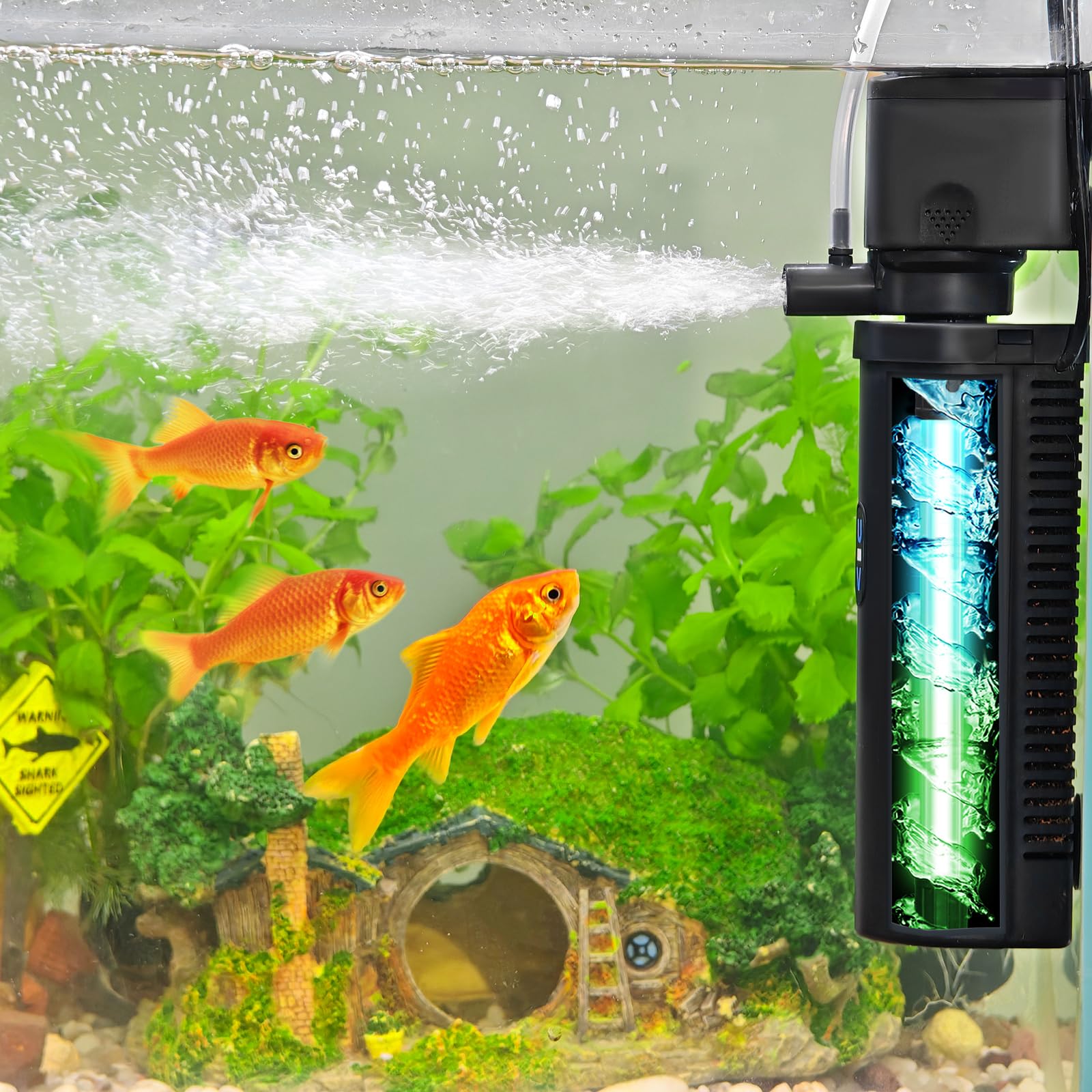
The COOSPIDER U-V filter is a slim internal submersible unit with a 5W UV light aimed squarely at green water control. It is rated for tanks from 20 to 75 gallons, making it overkill for a 30-gallon in terms of UV capacity, but the motor and pump are sized appropriately. The best use case is as a supplementary filter—drop it in to run alongside your main HOB when algae blooms appear, then pull it out once the water is clear.
The manufacturer claims a pure copper motor that resists overheating and passes a full power-on test before shipping. Owners with hopelessly green tanks report visible clearing within one to three days, which is impressive for the price point. The built-in sponge provides basic mechanical filtration, and you can run the hose above water for oxygenation or submerge it for wave motion current.
However, the stand-alone evidence is mixed: one verified review reports the unit fried several fish within minutes—a potential manufacturing defect that suggests quality control is inconsistent. The flow is not adjustable, so the current may be too strong for nano fish. Consider this a low-risk, high-reward supplementary tool, not a primary filter. If you’re dealing with a stubborn green water problem on a tight budget, it is worth trying alongside your existing filtration.
Why it’s great
- UV light clears green water within 1–3 days
- Compact size fits in tight tank spaces
- Copper motor design resists overheating
Good to know
- Isolated reports of electrical failure killing fish
- Flow is not adjustable
- Best used as a secondary filter, not a primary
7. hygger HOB Filter 210 GPH
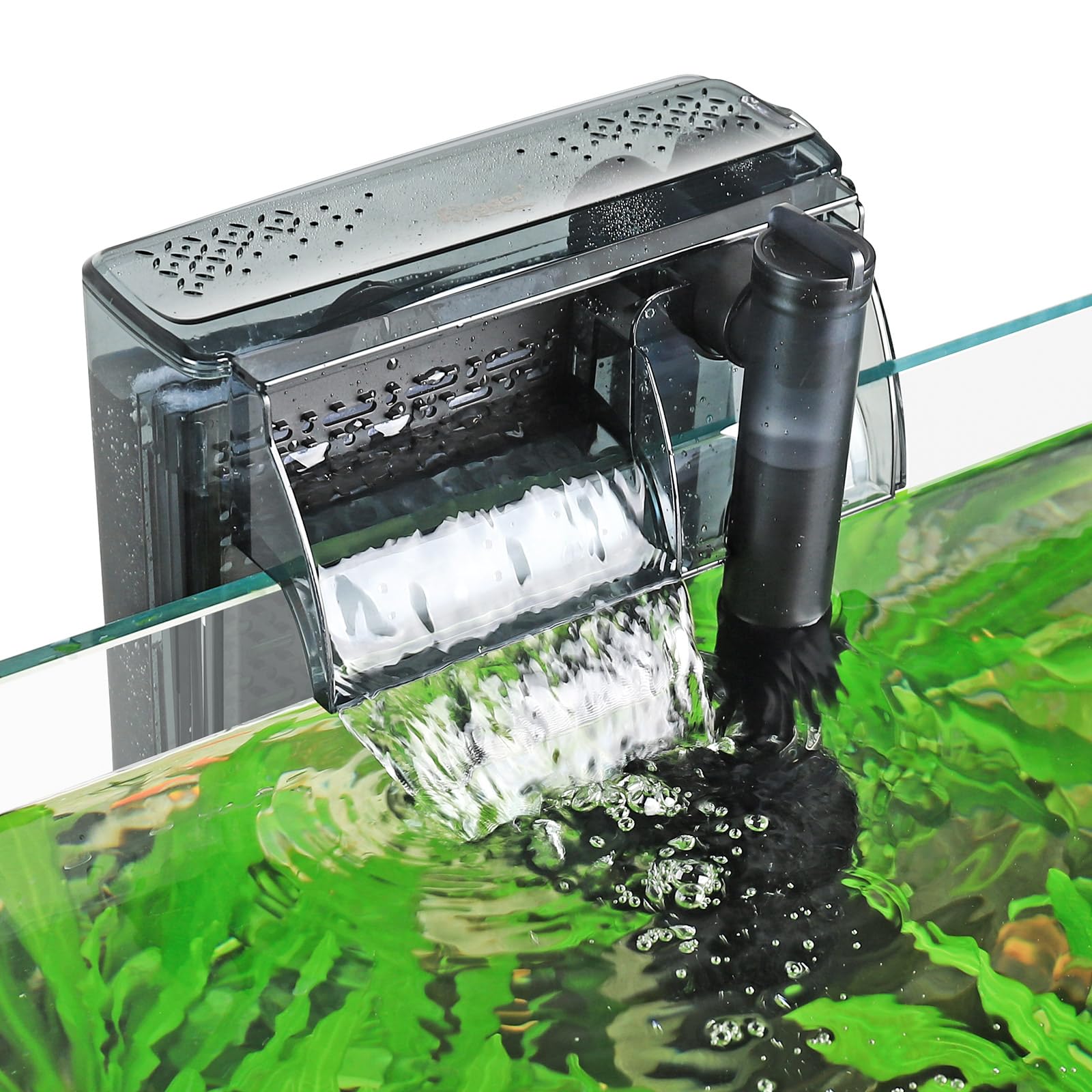
The hygger HOB filter brings a clutter-free HOB design and a useful LED indicator that lights up when the cartridge is clogged and water starts overflowing the filter chamber. For a 30-gallon tank, 210 GPH provides a 7x turnover rate that keeps water polished and prevents debris from settling. The intake tube extends to fit deeper tanks, and the inlet sponge prevents shrimp or fry from getting sucked into the impeller.
Owners praise the near-silent operation—a common complaint with cheap HOBs is motor hum, and hygger seems to have dialed in the impeller tolerance. The adjustable flow knob gives you control over current, making it safe for guppies and bettas on the lower setting and suitable for goldfish on high. The waterfall outflow improves aeration, though the noise of falling water can be mitigated by raising the water level.
The supplied filter cartridges tend to clog quickly under heavy bioload, causing bypass water to overflow the filter lid. Replacing the stock cartridges with a better-quality brand or using custom-cut sponge solves the issue. The media compartment is relatively small, reducing space for extra bio-media. For a lightly stocked community tank on a budget, this filter works well out of the box, but you should plan to hack the media setup for long-term reliability.
Why it’s great
- LED clog indicator prevents media bypass
- Very quiet motor, suitable for bedrooms
- Adjustable flow and extendable intake tube
Good to know
- Stock cartridges clog quickly under heavy bioload
- Small media compartment limits customization
- Not self-priming; must fill chamber after cleaning
FAQ
Can I use a filter rated for a 50-gallon tank on a 30-gallon tank?
How often should I replace the media in a 30-gallon tank filter?
Final Thoughts: The Verdict
For most users, the aquarium filter for 30 gallon tank winner is the Fluval 50 Power Filter because its massive media capacity and proven reliability handle everything from planted community tanks to modestly stocked cichlid setups without breaking a sweat. If you want a near-silent operation in a bedroom or office, grab the Fluval AC30 Power Filter. And for the keeper battling algae and turtles with high bioloads, nothing beats the Zoo Med Turtle Clean 30 Canister Filter.