
The substrate you choose dictates the entire visual foundation of your aquascape and the long-term health of your biological filter. Whether you are breeding corydoras that need rounded surfaces, planting a carpet of dwarf baby tears, or simply wanting a dramatic black backdrop that makes your neon tetras pop, the weight and grain size of your gravel directly impacts water chemistry and waste management. The wrong choice can trap debris, cloud your tank, or alter pH levels, so selecting the correct grade is as critical as choosing your filter.
I’m Min — the co-founder and writer behind Gadgets Feed. I’ve spent countless hours analyzing grain grading standards, color retention claims, and the nitrogen cycle implications of seeded substrates versus inert materials to build this guide.
After sorting through thousands of reviews and cross-referencing product specs against real aquarist needs, I’ve narrowed the market to the best aquarium gravel options that balance visual impact, ease of maintenance, and biological support for a thriving tank.
How To Choose The Best Aquarium Gravel
Selecting the right gravel starts with understanding your tank residents and your maintenance routine. Gravel serves as the anchor for your aquascape, a surface for beneficial bacteria colonization, and a physical filter that traps uneaten food. A mismatch in grain size or material composition can create dead zones or chemical imbalances that harm fish and plants.
Grain Size
Gravel particles typically range from 2 mm to 5 mm. Larger grains (4–5 mm) allow better water flow through the substrate bed, preventing anaerobic pockets that release toxic hydrogen sulfide. Smaller grains (1–2 mm), often sold as sand, create a dense surface that is easier for bottom-dwellers like corydoras to sift through but require deeper cleaning to avoid compaction. For planted tanks, a mixed-grade substrate with a fine top layer supports root spread while the coarser base promotes drainage.
Bioactivity and Seeding
Standard inert gravel provides no nutrients and simply acts as a mechanical base. Bioactive substrates contain beneficial bacteria cultures that accelerate the nitrogen cycle, converting ammonia to nitrite and then nitrate within days rather than weeks. Products like the Aqua Natural Bio Substrate kit combine active bacteria with dry gravel, allowing for instant cycling if the filter is already mature. For planted aquariums, nutrient-rich soils like ADA Amazonia offer clay-based minerals, but these can leach ammonia initially and require careful water monitoring.
Color and Coating
Dyed gravels can introduce toxins if the coating is not aquarium-safe. Fish-safe paints use non-toxic, epoxy-based resins that resist chipping and fading over long-term submersion. Spectrastone and imagitarium products use such coatings, though heavy scrubbing during cleaning can abrade the surface. Natural river rocks (often tumbled) offer durable, fade-resistant color without the risk of dye leaching, making them ideal for long-term setups where color stability matters.
Quick Comparison
On smaller screens, swipe sideways to see the full table.
| Model | Category | Best For | Key Spec | Amazon |
|---|---|---|---|---|
| Aqua Natural Bio Substrate Kit | Bioactive Kit | Instant cycling | 5 lb Bio + 10 lb Dry (2–4 mm) | Amazon |
| Aqua Natural Galaxy Sand 20 lb | Fine Sand | Bottom-dwellers | 20.4 lbs, fine grain (~1 mm) | Amazon |
| FANTIAN 20 lb Natural Gravel | River Rock | Natural aquascapes | 20 lbs, 1/4 inch grain | Amazon |
| CRMADA River Rock 18 lb | River Rock | Large tanks | 18 lbs, 1–2 inch pebbles | Amazon |
| Imagitarium Blue Jean 20 lb | Dyed Gravel | Color accents | 20 lbs, mixed blue | Amazon |
| Spectrastone Turquoise 5 lb | Dyed Gravel | Small tanks | 5 lbs, vibrant turquoise | Amazon |
| Pulovin Pea Gravel 10 lb | Decorative Pebble | Plant top dressing | 10 lbs, ~3/8 inch | Amazon |
In‑Depth Reviews
1. Aqua Natural Bio Substrate and Dry Substrate Kit

This kit bundles a 5-pound bag of live bacteria-seeded substrate with a 10-pound bag of kiln-dried, diamond black dry gravel. The bacteria are already colonized, so dropping the bio substrate into a new tank can cycle the water in as little as nine days when paired with an existing filter. The dry portion is triple-washed and graded to 2–4 mm, which is an ideal size for rooted plants and debris management.
The diamond black color offers high contrast against green plants and bright fish, and the quartz finish reflects light subtly without a gaudy sparkle. Multiple review reports note that the dry substrate must be rinsed several times to remove black dust and any residual dye, but the bioactive component should never be rinsed. When mixed according to the included ratio, the combined weight (15 lb) is enough to cover a 15-gallon tank with a 2-inch depth at the standard 1 lb per gallon guideline.
Water clarity after initial cloudiness clears quickly, and plants root firmly in the 2–4 mm grain. The biological seeding gives this kit a major advantage over inert gravels for new setups. It saves weeks of waiting for the nitrogen cycle to establish, making it the most efficient choice for aquarists stocking fish early.
Why it’s great
- Bacteria-seeded component accelerates cycling
- Kiln-dried, triple-washed for minimal clouding
- 2–4 mm grain supports plant root growth
Good to know
- Dry portion requires multiple rinses to remove black dust
- Not suitable for shrimp-only tanks that need buffered pH
2. Aqua Natural Galaxy Sand 20 lb

Galaxy Sand is a fine black sand with mica flecks that catch light, giving the substrate a subtle starry appearance. At 20.4 pounds per bag, it provides substantial coverage — roughly 1.5 inches of depth in a 20-gallon tank. The sand arrives clean, with most reviewers reporting only one or two rinses needed to remove dust, far less than typical fine substrates.
The fine grain (approximately 1 mm) is soft enough for bottom-dwellers like corydoras and kuhli loaches to sift through without damaging their barbels. The black color makes a dramatic backdrop for brightly colored fish and hardscape elements like seiryu stone or driftwood. It is not suitable for heavily planted tanks using root tabs, as the sand can compact and restrict root penetration over time unless supplemented with root feeders.
During filling, the sand can cloud the water temporarily, but the particles settle relatively quickly. It does not contain any added bacterial spores, so it functions as an inert substrate and will require a separate bacteria source for cycling. The ethically sourced tag provides peace of mind for environmentally conscious aquarists.
Why it’s great
- Very fine grain ideal for sensitive bottom-feeders
- Deep black color with natural shimmer
- Minimal dust — quick rinsing only
Good to know
- Can compact and hinder root growth in planted tanks
- Not bioactive — needs separate cycling
3. FANTIAN 20 lb Natural Gravel

FANTIAN offers 20 pounds of 1/4-inch mixed-color river rocks that are naturally collected rather than dyed. The stones are polished smooth, with no sharp edges, making them safe for all species including soft-bodied catfish. The advertised 1/4-inch grain size is reported by some users as slightly larger, but this variability falls well within the natural river rock grading tolerance.
This gravel is great for medium to large tanks where a natural, multi-shade look is desired. Colors include browns, tans, grays, and white streaks, which hide waste better than uniform gravel. It does require washing 2–3 times before use to remove dust and any residual organics. The weight provides decent depth for a 20–30 gallon tank if used as a base layer, though some reviewers note that a single bag may not reach 2 inches of depth for a 20-gallon planted system.
Unlike dyed gravels, these stones never chip or fade, making them a one-time purchase. They also work well for potted plant drainage or terrarium substrates, adding versatility. The FANTIAN gravel is inert and will not alter pH or hardness, suitable for community setups with sensitive species like discus or wild-caught tetras.
Why it’s great
- Natural river rock with smooth polished surface
- Will never fade or chip like dyed alternatives
- Multipurpose use: aquarium, succulent, planter drainage
Good to know
- Grain size may vary slightly from spec
- 20 lb bag may not cover deep planted tank alone
4. CRMADA River Rock 18 lb

These 1–2 inch polished river pebbles are significantly larger than standard aquarium gravel, ranging from the size of a large marble to a golf ball. This makes them unsuitable for tanks with small species or as a primary substrate, but ideal for creating focal points, capping planted substrate, or building hardscape features like riverbeds. The 18-pound bag contains a mix of brown, black, and white natural stones.
Customers using these with turtles or large cichlids report that the rocks hold up well and provide burrowing enrichment. Red-eared sliders enjoy digging around the larger pebbles without ingesting them. The stones arrive with a waxy or oily coating from the tumbling process, which must be removed through hot water and vinegar soaks before introduction to the tank. This extra preparation step may surprise those expecting ready-to-use gravel.
The weight (18 lb) covers only a small area due to the size of the pebbles, but their primary role is decorative accent rather than full-coverage substrate. For aquascapers building a riverine aesthetic, these large pebbles paired with a finer sand or gravel base create excellent visual depth. They are also useful for outdoor water features or as a top dressing for large potted plants.
Why it’s great
- Large polished pebbles for statement aquascaping
- Turtle-safe — no sharp edges
- Natural multicolored finish
Good to know
- Requires extensive cleaning to remove waxy coating
- Too large for small fish or as a full substrate
5. Imaginitarium Blue Jean 20 lb
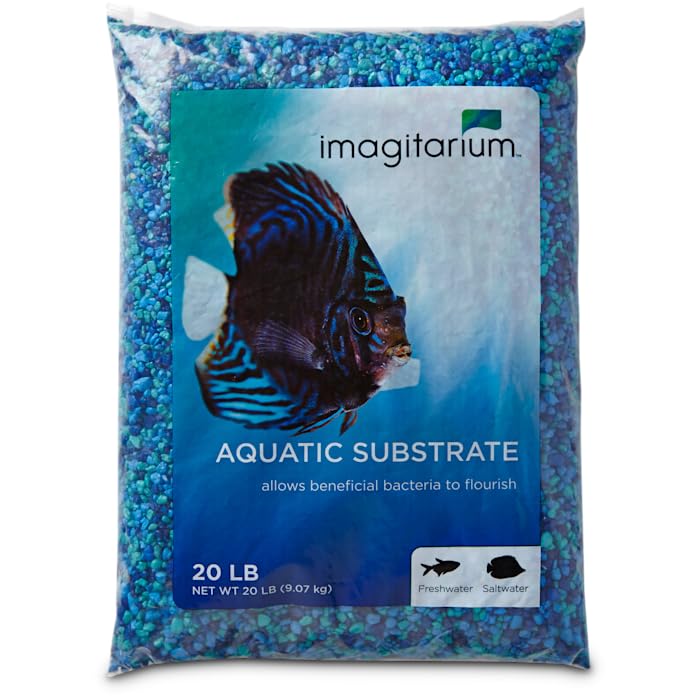
Imaginitarium’s Blue Jean gravel delivers 20 pounds of blue-toned, fish-safe coated gravel that replicates a denim-inspired look. The color has held vibrant for several years in some reported setups without significant fading, although some customers note that heavy scrubbing during cleaning can cause paint chipping. The coating uses non-toxic materials, verified through the Petco-based safety standards of the imagitarium brand.
This gravel is medium-grade, approximately 3–5 mm per piece, and works well for tanks between 10 and 20 gallons using the standard 1 lb per gallon rule. It promotes bacterial colonization on its irregular surface, and the blue color contrasts sharply with red and black fish. Some bags require minimal rinsing, but others produce notable cloudiness or floating paint flecks from the last quarter of the bag, suggesting inconsistent quality control during the coating process.
The primary trade-off is long-term color stability — several long-term users confirm the color holds up for years, but a minority report fading after 12–18 months. The bag size is generous for the price point, making it one of the most cost-effective color gravels available. For budget-conscious aquarists wanting a bright, non-brown option, this remains a solid choice.
Why it’s great
- Vibrant blue color holds well over several years
- Large 20 lb bag covers deep substrate beds
- Fish-safe non-toxic coating
Good to know
- Some bags have paint chipping or floating flecks
- Color may fade after 12–18 months
6. Spectrastone Turquoise 5 lb

Spectrastone’s turquoise gravel offers a bold, bright color for small tanks or accent spots. The 5-pound bag is best suited for tanks under 5 gallons — ideal for desktop aquariums or as a decorative top layer over a darker base. The non-toxic coating is pH neutral and safe for freshwater fish. The roughly 3–5 mm grain size is standard gravel grade and easy to vacuum.
Reviewers who have used this gravel for yard art or glass vase projects also praise its consistent color. The turquoise shade is uniformly applied and does not chip off during light handling. The bag is lightweight and easy to pour, making it a good choice for nano tanks or shrimp bowls where heavy substrate weight could cause structural issues. For full-size aquariums, you would need multiple bags, driving the cost up compared to larger bags from other brands.
Color fading over a year is minimal, though the coating can show tiny abrasions if the gravel is scrubbed vigorously. The gravel is inert and does not buffer pH or hardness, which makes it safe for soft-water species. However, the packaging is a simple stand-up bag without resealable closure, which may not keep leftovers fresh for future top-ups.
Why it’s great
- Very clean, consistent turquoise color
- pH neutral — safe for community tanks
- Lightweight, easy to handle for nano tanks
Good to know
- 5 lb bag only covers tiny tanks
- Not resealable, leftovers hard to store
7. Pulovin Pea Gravel 10 lb

Pulovin’s pea gravel is a 10-pound bag of mixed-color, 3/8-inch pebbles marketed primarily for plant top dressing but perfectly safe for aquariums. The stones are natural river pebbles with a slight polished shine. They are not dyed, so there is zero risk of paint leaching into the water. The small size makes them suitable for small tanks, terrariums, or as a cap over aquasoil to prevent nutrient leaching into the water column.
Some reviewers suspect that certain stones are painted to enhance color variation, but the bulk of customer feedback confirms the stones are natural. The bag requires minimal cleaning — most users report no dust — and the colors (tans, grays, whites, and occasional rust tones) create a natural creek-bed aesthetic. For a planted nano tank where heavy root feeders are absent, these pebbles provide structure without compaction issues.
The 10-pound bag covers roughly a 2-inch depth in a 5-gallon tank. If used as a primary substrate for large tanks, you would need multiple bags. The stones are smooth enough for bottom-feeders, but the 3/8-inch size may be too large for very small shrimp like cherry shrimp to easily move. It is a solid value for small-scale projects where natural aesthetics and safe materials are the priority.
Why it’s great
- Natural stones, no dye or coating
- Minimal dust, ready to use after a quick rinse
- Great for nano tanks and terrariums
Good to know
- Small bag size limits large tank use
- Some stones may have artificial coloring
FAQ
How much gravel do I need for my aquarium?
Can dyed gravel harm my fish?
Do I need to rinse gravel before putting it in my tank?
What grain size is best for plants?
Final Thoughts: The Verdict
For most users, the best aquarium gravel winner is the Aqua Natural Bio Substrate Kit because it combines biological acceleration with a beautiful diamond black finish, making it ideal for new setups. If you want a fine sand for bottom-dwellers, grab the Aqua Natural Galaxy Sand. And for a natural river-rock look that never fades, nothing beats the FANTIAN 20 lb Natural Gravel.