
Our readers keep the lights on and my morning glass full of iced black tea. As an Amazon Associate, I earn from qualifying purchases.
Specs are compiled from manufacturer listings and verified buyer reviews and can change over time — please confirm the key details on the product page before buying.
You want a PC case that shows off your build like a living room aquarium, but all that glass can trap heat and cook your components. The best aquarium PC case wraps your hardware in tempered glass without suffocating it — smart dual-chamber layouts and pre-installed fans make the difference between a hot box and a cool showpiece. The cases here skip the gimmicks. Each one pairs clear panels with proven airflow engineering, so your CPU and GPU stay cool while everyone stares at your build.
I’m Min — the founder and writer behind Gadgets Feed. This guide is built by comparing the manufacturers’ published specifications and the patterns across verified customer reviews, so you get each pick’s real strengths and trade-offs instead of marketing spin.
Dual-chamber layouts, pre-installed fans with addressable RGB (ARGB, meaning lighting you can customize per-LED), and support for radiators up to 420mm make this generation of cases genuinely capable. Here is the shortlist for the best aquarium pc case in 2025, ranked by real-world cooling, build ease, and visual payoff.
Our Picks at a Glance

How To Choose The Best Aquarium PC Case
Every aquarium case looks similar at a glance — glass front, glass side, clean lines. What separates the good from the merely pretty is how air actually moves through that glass box, and how much room you have to work inside it.
Prioritize Dual-Chamber or Wide Interior Layouts
You want a case that physically separates the power supply (PSU) and drive bays from the motherboard. That dual-chamber design leaves the main zone open so fans can pull fresh air directly across the CPU cooler and graphics card (GPU). Without it, aquarium cases trap heat — the PSU and cables block airflow, raising your component temperatures.
Pre-Installed Fans Are Your Starting Point, Not the Limit
A case that ships with 5 to 8 ARGB fans saves you money and build time. But look beyond the count — notice whether they are reverse-blade fans on the intake side (those show the pretty face of the fan inward) and whether a fan hub is included. The best cases let you add more or swap without rebuying the whole ecosystem.
Verify Your Radiator and GPU Clearance, Not Just Max Numbers
Specs like “up to 420mm radiator” or “460mm GPU” are generous in this category. The real fit test is whether you can mount a thick radiator on top and still clear tall RAM sticks, or whether your oversized GPU blocks the bottom fan positions. Always check the CPU cooler height limit — 160mm is standard, 170mm+ is spacious (so you can fit the biggest air coolers without hitting the glass).
Quick Comparison
| Model | Best For | Pre-Installed Fans | Max GPU Length | Radiator Support | Amazon |
|---|---|---|---|---|---|
| MUSETEX Y6★ Best Overall | Best Overall Value | 7x 120mm ARGB | 410mm (16.14″) | 360mm Top | Amazon |
| KEDIERS K4Cooling Beast | Maximum Airflow & Expansion | 8x PW ARGB | 460mm | 420mm Top/Right | Amazon |
| Okinos Aqua 9 | Premium Aesthetic on a Budget | 5x 120mm ARGB PWM | 420mm | 360mm Top & Side | Amazon |
| NZXT H9 Flow RGB+ | Premium Build Quality & Ready-to-Go | 6x 140mm + 1x 120mm RGB | Spacious | 420mm Top/Right | Amazon |
| HAVN HS 420 | Ultimate Enthusiast Build | None (11x 140mm slots) | Vast | 420mm Top/Right/Bottom | Amazon |
In‑Depth Reviews
1. MUSETEX Y6
Our pick — over 4.5★ from 950+ verified ratings; the strongest balance of quality and price.
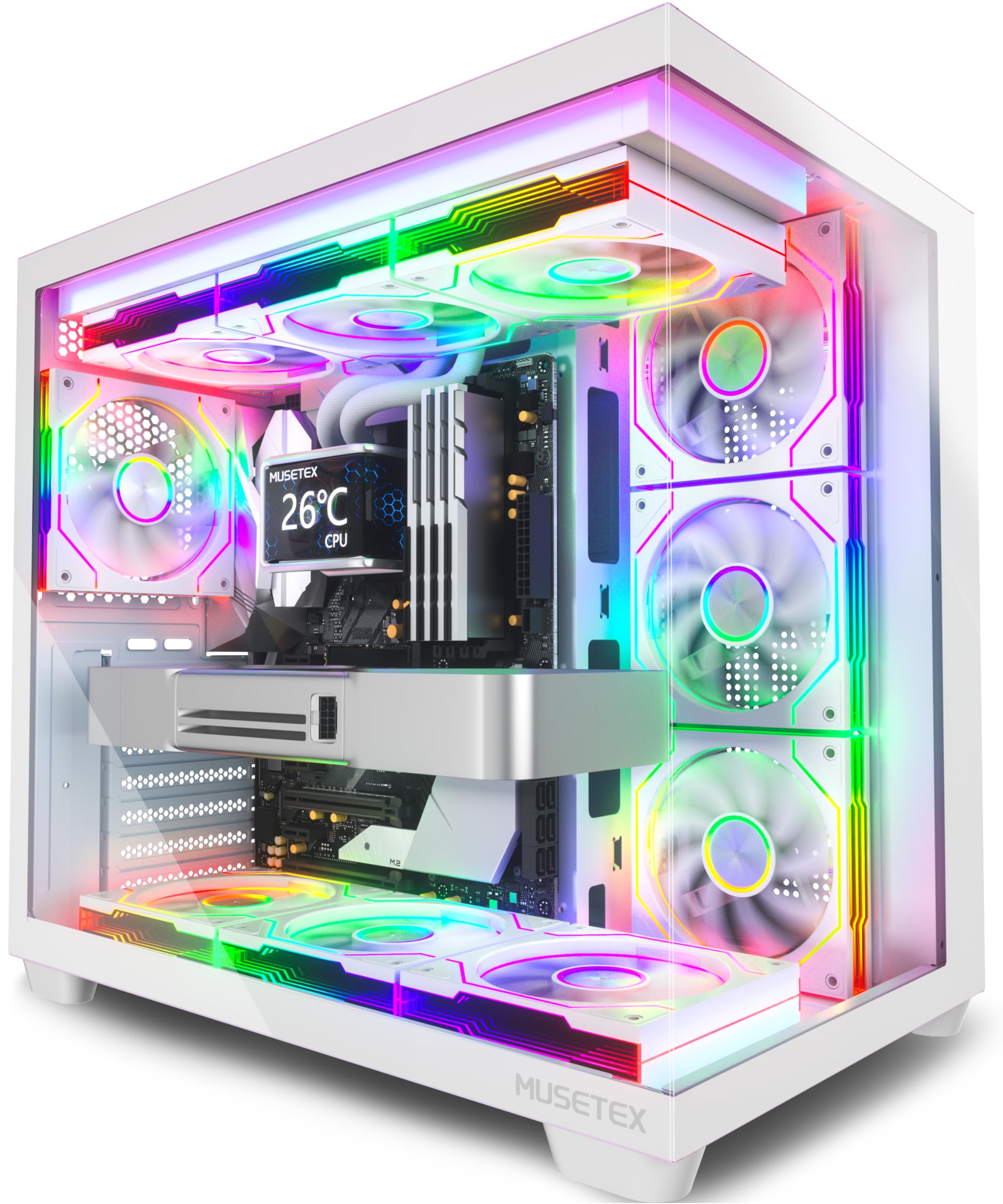
The MUSETEX Y6 gives you 7 pre-installed fans and 270-degree glass for a price that leaves your budget open for better components — few competitors offer this many fans ready to go without a premium charge.
The MUSETEX Y6 packs 7 pre-installed 120mm Infinity Mirror ARGB fans — including 3 reverse-blade fans on the side and 3 on the bottom. A reverse-blade fan pulls air inward while showing its attractive LED ring face, so your build looks clean from every angle. These anti-vortex (noise-reducing) fans deliver smooth color transitions, and you control speed and lighting through your motherboard software. The 270-degree fully transparent tempered glass front and side panels give you a wider view than most standard cases. Buyers report it “exceeded my expectations with its spacious design, strong airflow.” At 14.64 pounds and dimensions of 16.73″ x 10.83″ x 15.67″ (a 15% smaller footprint than the KEDIERS K4), it fits more desks without overwhelming your workspace.
Inside, the Y6 supports ATX, Micro-ATX, and Mini-ITX motherboards. Graphics cards up to 410mm (16.14″) fit comfortably, CPU coolers up to 160mm (6.3″) clear the glass, and you can mount a 360mm radiator on top. The I/O (input/output) panel includes a Type-C port (faster charging and data transfer than older USB), one USB 3.0, and one USB 2.0. The case quality is the most-discussed positive in reviews, followed closely by its appearance. The cable management system draws mixed feedback — some find it spacious, others find it tricky when wiring a full ATX board. Plan your cable runs before mounting the motherboard to avoid frustration.
What owners rave about
- 7 pre-installed fans with reverse-blade design for clean intake looks
- 270-degree glass panel gives a genuine aquarium showpiece view
- Type-C port included at the mid-range price tier
The catch to know
- Cable management can be tight with a full-size ATX board — plan ahead
- Fan cables are ribbon-style with 2-pin connectors, limiting individual color control
This is your pick if: You want a white-themed showpiece with fans already included and enough budget left for a better GPU or CPU cooler. The value here beats the NZXT H9 Flow RGB+ on price per included fan.
But skip it if: You demand per-fan addressable RGB control without buying a separate controller — the ribbon cables with 2-pin connectors restrict customization.
2. KEDIERS K4
The KEDIERS K4 ships with 60% more fans than the Okinos Aqua 9 — 8 PWM (pulse-width modulation, meaning you can control each fan’s speed independently) units — and supports 460mm GPUs, the longest clearance in this lineup.
The KEDIERS K4 ships with 8 PWM ARGB fans — 3 reverse-blade on the side, 3 exhaust on top, and 2 at the rear — using a daisy-chain design (fans plug into each other instead of separate cables) and a 1-to-3 splitter to keep cables tidy. The dual-channel airflow layout pushes horizontal air for the CPU and vertical air for the GPU independently, so your graphics card gets dedicated cooling without fighting the CPU for airflow. At 19.29″ deep, 11.22″ wide, and 18.11″ tall (19% deeper than the Y6), it is a substantial desk presence that demands dedicated space.
Clearance is the real story here. GPU length maxes at 460mm, which fits virtually every graphics card on the market. CPU cooler height reaches 175mm, covering the biggest air coolers (tower-style heatsinks that rival liquid cooling). The K4 supports both 360mm and 420mm radiators, and fits up to 11 total 120mm fans if you fill every slot. The 270-degree panoramic glass panels wrap around with diamond-cut corners. Owners call it “a great option for the price” and note the fans are “high quality and quiet at full speed.” Cooling performance and clean aesthetics are the most common praise. The top-mounted I/O (input/output) port positioning is a recurring minor annoyance — some wish they were angled differently for easier access.
What gives it an edge
- 8 pre-installed fans with daisy-chain design simplify cable management
- GPU support up to 460mm fits virtually any graphics card on the market
- Back-connect motherboard ready for a cable-free front view
One thing to note
- The top-mounted I/O ports could sit at a more user-friendly angle
- No printed build instructions — you will rely on your own DIY knowledge
Reach for this one if: You want the highest fan count and the longest GPU clearance (460mm vs 410mm in the Y6) in this price range, and plan to use a back-connect motherboard (one that hides all cables behind the board) for a pristine front look.
pass on it if: Desk space is tight — this tower is 19% deeper than the Y6 and needs a dedicated spot with careful handling.
3. Okinos Aqua 9

The Okinos Aqua 9 brings dual 360mm radiator support — a rarity at this price — and an inclined PSU (power supply) shroud that channels air directly to your GPU, a smarter cooling trick than many cases twice its cost.
The Okinos Aqua 9 develops the aquarium aesthetic further with 270-degree panoramic tempered glass and a uniquely angled power supply shroud (a cover for the PSU and cables). That sloped shroud is not just a visual trick — it directs air from the bottom intake toward the GPU, which is the part of your build that runs hottest under load. The case comes with 5 pre-installed 120mm ARGB PWM fans (4 intake, 1 exhaust) for positive pressure (more air coming in than going out, which keeps dust from settling through unfiltered gaps). At 9.14 kilograms and dimensions of 17.83″ x 9.13″ x 20.39″, it is noticeably narrower than the KEDIERS K4 but taller — a space-saving shape for wider desks.
Dual 360mm radiator support — both top and right side — is the standout spec at this price, offering more flexible liquid cooling layouts than the Y6’s single 360mm slot. The water cooling tubes on the right side need to face down, so plan your loop direction accordingly. GPU clearance reaches 420mm, CPU cooler clearance is 170mm, and PSU space is 220mm. The Type-C 3.2 Gen 2 port runs at 10Gbps (gigabits per second, fast enough for modern external drives and docks). Buyers praise the fish-tank glass design and the cable management from 41mm of rear space with pre-installed hook-and-loop straps. One experienced builder notes: “Spacious interior fits full ATX; excellent cable management.” The trade-off the reviews flag is a tight PSU area — plug your cables into the power supply before you slide it into place.
Standout strengths
- Dual 360mm radiator support (top and side) for flexible liquid cooling layouts
- 41mm rear cable space with Velcro straps for clean routing
- Inclined PSU shroud improves airflow to the GPU
Know before you buy
- PSU area is cramped — connect all cables before mounting the power supply
- Incompatible with SFX (small form factor) power supplies without an adapter
Pick this if: You want a genuine fish-tank aesthetic with dual-radiator cooling capability and a footprint narrower than the KEDIERS K4. The dual 360mm support is a meaningful upgrade for liquid cooling enthusiasts on a budget.
Choose the Y6 or K4 instead if: You plan to use an SFX power supply — you will need a separate mounting adapter, adding cost and complexity.
4. NZXT H9 Flow RGB+

The NZXT H9 Flow RGB+ arrives with 7 RGB fans and a centralized control hub, so you spend zero additional time or money on cooling — a genuine out-of-box experience that the HAVN HS 420 (which ships empty) does not offer.
The NZXT H9 Flow RGB+ includes everything you need from the start: two F420 RGB Core single-frame fans at the front-right, four more 140mm units, one F120 RGB Core fan at the rear, and an NZXT Control Hub for centralized RGB and fan speed management. The dual-chamber layout separates the PSU and drives entirely from the motherboard zone, improving thermal performance and making cable management as close to easy as it gets in an aquarium case. At 20.08″ deep, 19.29″ wide, and 12.6″ tall, it is deep rather than tall — a shape that suits a desk-width layout rather than a tall tower.
The H9 Flow supports up to nine 140mm fans plus one 120mm rear fan, and fits both top and front-right radiators up to 420mm (larger than the Y6’s 360mm limit). Perforated steel panels on the non-glass sides maintain airflow, while the wraparound tempered glass paneling gives you a smooth panoramic view. Back-connect compatibility with ASUS BTF and MSI Project Zero motherboards (both move connectors behind the board) lets you hide every cable. Experienced builders have called it “the best case I have ever built in” and praise the included zip ties, Velcro, and screws. One builder who has assembled over 35 systems picked this as their favorite. The only consistent note: the fans can be slightly audible at higher RPMs, though they move effective air for cooling.
Why it justifies the premium
- 7 RGB fans plus a central control hub means zero additional fan spending
- 420mm radiator support on top and front-right for elite liquid cooling
- Back-connect motherboard ready for a completely cable-free front view
One realistic consideration
- Premium price — you pay for the included fans and NZXT build quality
- Fans can be slightly audible at high speeds (still effective, not silent)
Your move if: You want the smoothest out-of-box experience with high-end visual and cooling performance, and you value a build that takes an evening instead of a weekend. This is the most turnkey option here — the Y6 gives you more fans for less money, but the H9 Flow’s 420mm support and control hub justify the premium.
it’s not for you if: You are on a strict budget — the upfront cost is real, and the Y6 or Okinos Aqua 9 deliver strong value for less.
5. HAVN HS 420

The HAVN HS 420 supports three separate 420mm radiators simultaneously and uses a heat-formed single-panel glass curve — a build canvas so capable that one owner reported an RTX 5090 (the brand’s newest flagship GPU) “never above 61°C.”
HAVN engineers the HS 420 with a heat-formed UniSheet glass panel that achieves the smallest possible curve radius for a wrap-around view with minimal visual distortion. It is heavy — 17.83 kilograms — and that weight comes from thick panels and premium materials. The dual-chamber mid-tower supports a total of eleven 140mm fans across the top, right, and bottom, plus three separate 420mm radiators simultaneously (triple the capacity of the Y6’s single 360mm slot). The hybrid structure directs cool air from the bottom intake toward the centrally positioned GPU, which is where 40-series and 50-series cards need the most airflow. One owner testing an RTX 5090 reported it “never above 61°C.”
The SimpliCable routing system uses top-to-bottom grooved guides and a PWM fan hub, making cable management a genuine pleasure rather than a chore. The 3-way adjustable GPU support bracket handles cards of all shapes without looking like an afterthought. All fan brackets have flexible rubber pads to isolate vibration from the chassis, so noise stays low even with many fans spinning. Build quality receives the most praise by a significant margin — it is the aspect buyers single out most. The trade-offs are minor: the back panel magnets could be stronger, and the top panel can be tricky to seat properly. But as one builder put it, the HS 420 offers “superior build quality vs. -180 cases.”
What makes it the top-tier choice
- Triple 420mm radiator support for the most ambitious custom loops
- Heat-formed single-piece glass with minimal distortion
- SimpliCable routing guides and vibration-dampened brackets
Honest downsides
- No fans included — you supply all 11, which adds significant cost
- Back panel magnets are a touch weaker than ideal for a case this heavy
Build this if: You are planning a high-end custom water loop or a flagship GPU build and want the most capable, best-finished aquarium chassis available today — nothing else here offers three 420mm radiator slots.
Choose the NZXT H9 Flow or the Y6 if: You want a case that arrives ready to power on with fans pre-installed — the HS 420 is a blank canvas, not a turnkey solution, and filling those 11 fan slots will cost you.
Understanding the Specs
Dual-Chamber Design
This divides the case into two zones: one for the motherboard, CPU, and GPU (the visible side behind the glass), and a separate chamber for the power supply (PSU), hard drives, and cables. The benefit is that cables stay hidden and the main chamber has unobstructed airflow. Every case on this list uses some form of dual-chamber layout, which is what makes the aquarium style viable without choking your components.
Reverse-Blade Fans
A standard fan shows its hub and support struts on the intake side — that is the ugly face. A reverse-blade fan places the intake on the back side so the attractive housing with uniform LED rings faces inward toward your components. Cases that include reverse-blade fans (like the MUSETEX Y6 and KEDIERS K4) look significantly cleaner in an aquarium build because every visible fan presents its best side.
Back-Connect Motherboard Compatibility
Back-connect (or “BTF”) motherboards move all power and data connectors to the rear of the board, so the front shows only the CPU socket, RAM, and expansion cards. Cases labeled “back-connect ready” have cutouts and routing channels built into the motherboard tray to support this layout. You see a completely clean motherboard area through the glass panel, which is the ultimate goal in aquarium-style builds.
FAQ
Will an aquarium PC case fit my standard ATX motherboard?
Does an aquarium case cool as well as a traditional mesh case?
How many fans do I really need in an aquarium case?
What is the difference between a 360mm and a 420mm radiator?
Can I install a vertical GPU mount in an aquarium case?
How do I keep an aquarium case clean and dust-free with all that glass?
Is tempered glass safe for a PC case?
What does “back-connect motherboard” mean, and do I need one?
Final Thoughts: The Verdict
Across the board, the best aquarium pc case winner is the MUSETEX Y6 because it delivers seven pre-installed fans, 270-degree glass, and genuine build quality at a mid-range price that leaves your budget for a better GPU or CPU cooler. If you want the absolute largest cooling capacity and fan count without moving to the enthusiast tier, grab the KEDIERS K4. And for the builder who wants a turnkey premium experience with zero extra fan spending, the NZXT H9 Flow RGB+ is the one to reach for — it includes everything you need and leaves you with a build that is genuinely ready to power on from the first boot.
How We Picked
We do not accept paid placement. Every pick is matched to a real buyer and a real use-case; we do not hands-on test units.
Sources & Methodology
Specifications: manufacturer listings and product documentation. Review insights: verified customer reviews, as of July 2026. Pricing: not shown on this page (it changes often); check the current price via the retailer link.
As an Amazon Associate, Gadgets Feed earns from qualifying purchases. This does not affect which products we feature.