
Every aquarium owner knows the dread of water-change day — fighting with a clumsy siphon, accidentally sucking up gravel or tiny fish, and inevitably spilling water across the floor. The right pump transforms this messy chore into a fast, controlled operation that keeps your tank healthy and your home dry.
I’m Min — the co-founder and writer behind Gadgets Feed. I’ve spent hundreds of hours analyzing the technical specifications, real-world user feedback, and design trade-offs across the entire market for aquarium cleaning equipment to bring you this focused guide.
This guide cuts through the noise to help you find the best aquarium siphon pump for your setup, whether you maintain a nano shrimp tank or a 125-gallon planted community aquarium.
How To Choose The Best Aquarium Siphon Pump
Selecting the right siphon pump isn’t just about picking the cheapest option. You need to match the tool to your tank’s size, substrate type, and your own tolerance for manual effort. Here are the three factors that matter most.
Tank Size and Tube Length
The physical distance from your aquarium to your sink or bucket dictates the minimum hose length you need. A 7-foot hose works for small desktop tanks near a utility sink, but a 25-foot hose is essential if your tank sits across the room from the nearest faucet. Short hoses restrict where you can drain water; overly long hoses reduce flow rate due to friction loss.
Priming Method
How you start the siphon determines how much effort each water change requires. Hand-pump bulbs are the most common — you squeeze them a few times to create negative pressure. Faucet-connected systems use household water pressure to start and stop flow without any manual pumping. Some budget models require you to suck on the hose to start the siphon, which is unsanitary and unpleasant.
Substrate and Inhabitant Safety
The gravel tube opening and any internal screen determine whether you pull up debris alone or also suck up gravel, sand, and small fish. A wide intake tube with a grille or slotted guard is safer for sand substrates and shrimp tanks. Adjustable flow-control valves let you slow the suction when cleaning near fry or bottom-dwellers like corydoras catfish.
Quick Comparison
On smaller screens, swipe sideways to see the full table.
| Model | Category | Best For | Key Spec | Amazon |
|---|---|---|---|---|
| hygger Upgrade Kit | Premium | Large tanks, no-spill faucet hookup | 25 ft hose, brass valves | Amazon |
| Aqueon Large Siphon | Premium | 40+ gallon tanks, deep gravel cleaning | 16-inch intake tube | Amazon |
| Fluval GravelVAC | Mid-Range | Precision cleaning, planted tanks | Thumb-operated flow regulator | Amazon |
| SEAOURA Manual | Mid-Range | Medium tanks, adjustable length | Dual airbags, flow clip | Amazon |
| Seltomer 7ft | Mid-Range | Budget-friendly, routine maintenance | Siphon ball pump | Amazon |
| AREPK Compact Kit | Budget | Small tanks, tight spaces | Three cleaning heads | Amazon |
| Python 10EX | Accessory | Extending Python No Spill system | 10 ft vinyl hose | Amazon |
In‑Depth Reviews
1. hygger Upgrade Aquarium Water Changer Kit

The hygger kit is a semi-automatic system that connects directly to your faucet, using household water pressure to both drain dirty water and refill the tank without any manual pumping or heavy bucket carrying. The 25-foot 1/2-inch inner-diameter hose provides enough reach for most living-room setups, and the dual orange control valves let you switch between drain and fill modes with a quarter-turn.
Users consistently report that this unit cuts water-change time from 45 minutes to under 20 minutes on 40-gallon tanks. The brass faucet adapters resist corrosion better than the plastic fittings found on competing systems, and the kit includes three adapter sizes (3/4″, 15/16″, and M21) to fit standard and metric faucet threads. The hose is slightly stiffer than rubber tubing, which prevents kinks but requires careful routing around corners.
A few users note minor leakage at the sink attachment point, usually resolved by tightening the connection or applying plumber’s tape. For any medium to large aquarium where the tank sits within 25 feet of a threaded faucet, this is the fastest, most spill-free solution available at its tier.
Why it’s great
- No manual pumping — faucet pressure does the work
- Long 25-foot hose reaches across most rooms
- Includes brass fittings for durable, rust-free connections
Good to know
- Sink attachment can leak if not fully tightened
- Requires a threaded faucet for direct connection
2. Aqueon Aquarium Siphon Vacuum Gravel Cleaner Large

Aqueon’s large model is a no-frills, gravity-driven siphon built for aquariums 40 gallons and larger. The 16-inch self-priming intake tube creates a wide cleaning path that covers more gravel surface per pass than any compact model. The 6-foot flexible drain hose includes a clip that attaches securely to the inside of a standard bucket, preventing the hose from flopping out during draining.
Users appreciate that the large tube diameter moves water and debris quickly — a 55-gallon tank can be drained in about 10 minutes. The priming method requires an up-and-down plunging motion in the water column rather than a squeeze bulb, which some users find less intuitive. The tube is tall enough that on tanks shallower than 18 inches, the hose may bend sharply over the rim, slightly restricting flow.
Over time, the PVC hose can stretch and develop small air leaks that weaken the siphon, though electrical tape around the connection points solves this. For keepers of big tanks who want a simple, fast, wide-mouth siphon without faucet connections, this is a reliable workhorse.
Why it’s great
- Wide 16-inch intake cleans large areas fast
- Self-priming with up-and-down motion, no bulb needed
- Included bucket clip prevents hose from slipping out
Good to know
- Too large for tanks under 40 gallons
- Hose may develop air leaks over time
3. Fluval GravelVAC Multi Substrate Cleaner Small

Fluval’s GravelVAC is engineered for precision — its thumb-operated flow regulator gives you granular control over suction strength, making it safe for delicate planted tanks and habitats with small shrimp or fry. The easy-start priming bulb initiates the siphon with just two or three squeezes, eliminating the need to mouth-start the hose. The included gravel guard at the intake prevents larger stones from clogging the tube.
Users with high-tech planted aquariums love that they can dial down the flow to gently vacuum around rooted plants without uprooting stems. The kit works with all substrate types — fine sand passes through the guard without being sucked up, while gravel gets agitated just enough to release trapped debris. The unit disassembles completely for cleaning, which prevents biofilm buildup inside the mechanism.
The trade-off is that the siphon is slightly harder to start than some other bulb designs, requiring a fully submerged tube and a few extra pumps. The plastic components feel slightly less dense than premium-grade materials, but they hold up well under weekly use. For keepers of smaller tanks (up to 40 gallons) who prioritize control over raw speed, this is the finest manual option available.
Why it’s great
- Thumb-operated flow regulator offers precise control
- Safe for all substrates including sand and fine gravel
- Easy-start bulb avoids unsanitary mouth priming
Good to know
- Siphon can be slightly harder to start initially
- Plastic feels less durable than premium alternatives
4. SEAOURA Aquarium Siphon Pump Gravel Cleaner

The SEAOURA manual cleaner uses a dual-airbag push-button mechanism to start the siphon — you press the button repeatedly to create negative pressure without needing to submerge the entire tube or suck on the hose. The spliced extension tubes allow four length configurations ranging from 17 inches to 35 inches, so the same kit can serve a 10-gallon nano tank or a 55-gallon show tank. The included flow-control clip attaches to the side of a bucket to regulate drainage speed.
Users consistently note that the push-button priming is faster and more intuitive than traditional squeeze-bulb designs, especially for beginners. The duckbill suction head prevents large debris from clogging the intake, and the fixed suction cup holds the hose steady during operation. The hard plastic tubing is the weakest structural point — it can crack if bent too sharply or stepped on, but replacement standard-size tubing is inexpensive and easy to source.
A small number of users report loss of suction after several uses, often caused by a loose seal in the button assembly. Regular inspection and re-seating the rubber gasket resolves most cases. For the price, this is the most versatile length-adjustable siphon on the market.
Why it’s great
- Push-button priming is fast and beginner-friendly
- Four adjustable length configurations fit multiple tank sizes
- Flow-control clip prevents accidental over-draining
Good to know
- Hard plastic tubing can crack under stress
- Button seal may loosen over time, affecting suction
5. Seltomer 7ft Aquarium Gravel Vacuum Cleaner
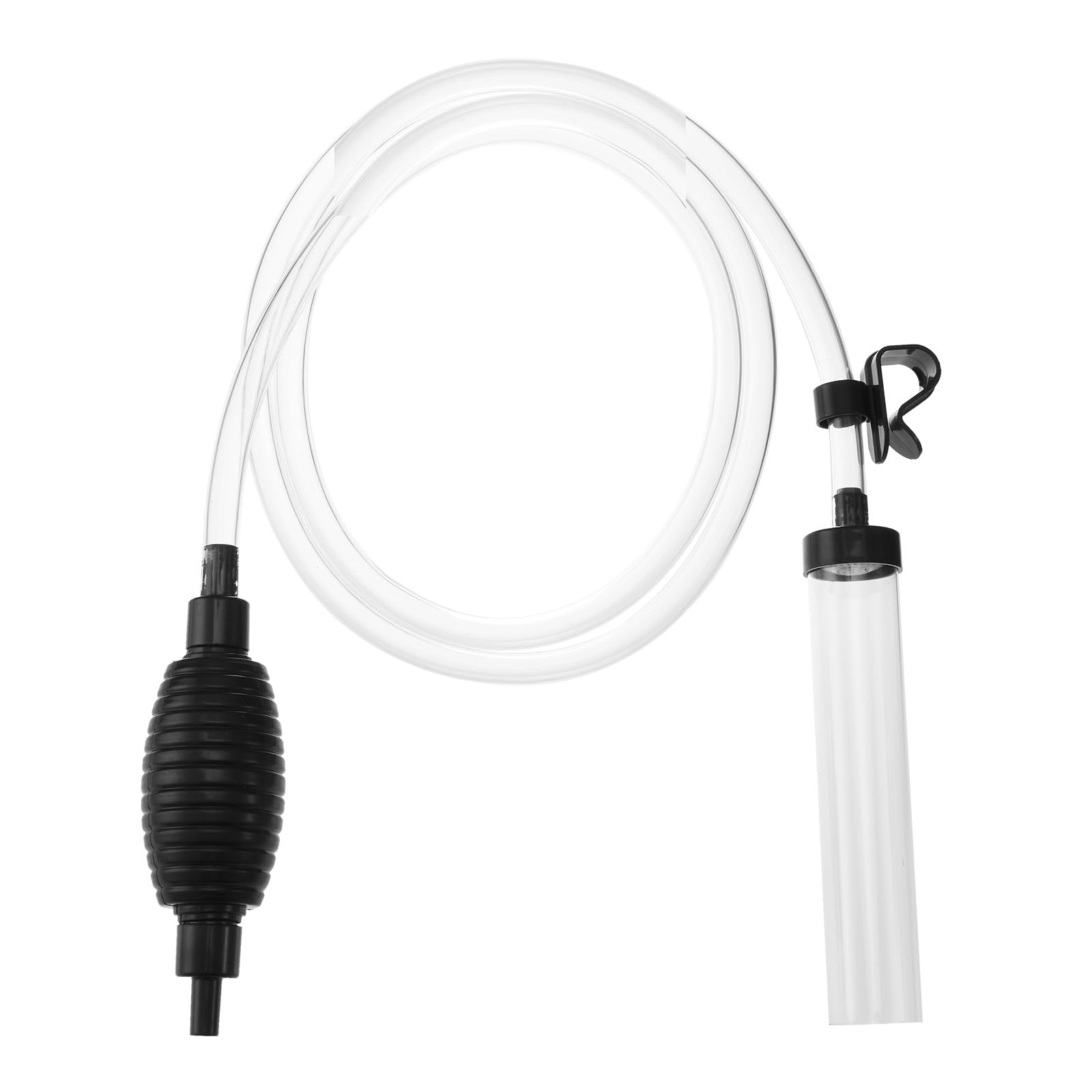
The Seltomer is a straightforward, no-surprises gravity siphon with a classic squeeze-ball priming system. The 7-foot hose is made from clear, kink-resistant plastic that lets you see the debris flow, and the sinkable gravel tube includes a detachable filter screen that prevents fry and small gravel from being sucked into the bucket. The hose clip secures the outflow to a standard bucket rim.
Users with 10- and 29-gallon tanks find the 7-foot length sufficient for draining into a nearby bucket, though deeper tanks may require the optional larger size. The squeeze ball primes reliably on the first few pumps as long as the gravel tube is fully submerged. The filter screen is a thoughtful touch for breeders who need to clean around newly hatched fry without losing them.
The main limitation is the short hose — anything beyond a 29-gallon tank requires multiple bucket trips, and the thin-walled plastic tube can develop leaks if bent sharply at the aquarium rim. At its entry-level price point, this is a functional, no-regret purchase for small-scale weekly maintenance.
Why it’s great
- Squeeze-ball siphon starts reliably when submerged
- Detachable filter screen protects fry and small gravel
- Clear hose lets you monitor flow and debris
Good to know
- 7-foot hose is short for tanks over 29 gallons
- Thin plastic tube may kink or leak at the rim
6. AREPK Compact Aquarium Siphon Vacuum and Water Changer Kit

The AREPK kit differentiates itself by bundling three independent cleaning heads: a standard gravel tube for water changes, a brush for scrubbing decorations, and a sponge attachment for wiping algae off tank walls. The compact design is purpose-built for small aquariums under 10 gallons, including nano tanks, betta bowls, and turtle enclosures. The transparent PVC tubing is made from fish-safe, odorless material, and the included pipe-fixing clamp holds the hose securely to prevent spills.
Users praise the kit’s ability to reach tight spots between rocks and plants thanks to the thinner cleaning straw, and the fan-shaped attachment excels at cleaning substrate without disturbing the entire tank. The 8.1-ounce weight makes it easy to maneuver one-handed, and the detachable pump head simplifies unclogging if debris gets stuck.
The primary durability concern is the pump mechanism — multiple users report the bulb failing after about two months of weekly use, which aligns with the low-end pricing. The instructions are also poorly translated, with the arrow direction on the pump body sometimes pointing the wrong way. For the cost, it performs admirably while it lasts, making it a good backup or starter unit for very small tanks.
Why it’s great
- Three interchangeable heads for gravel, algae, and decorations
- Compact size reaches tight spots in small tanks
- Fish-safe materials with no chemical odor
Good to know
- Pump bulb may fail after 2-3 months of regular use
- Assembly instructions are confusing and potentially incorrect
7. Python No Spill Clean and Fill Gravel Tube Hose Extension, 10-Feet

The Python 10-foot extension is a specialized accessory for users who already own a Python No Spill Clean and Fill system. It adds exactly 10 feet of durable, pet-safe vinyl tubing with one male and one female adapter for quick daisy-chaining. The material is flexible enough to route around furniture corners yet rigid enough to resist crushing under furniture legs.
Reviews consistently highlight that this extension turns a cramped water-change setup into a smooth, remote operation — run the 25-foot base hose plus this extension to reach a basement laundry sink from a second-floor tank. The barbed fittings create a leak-proof seal when properly pushed in and secured with the included clamps. The tubing is suitable for both freshwater and marine environments.
The obvious caveat is that this product is useless without a full Python system base unit, so it is not a standalone siphon pump. It also adds friction to the water flow, slightly reducing drain speed compared to a shorter, single-piece hose. For Python owners needing extra reach, this is the only genuine first-party extension available and it works exactly as advertised.
Why it’s great
- Genuine Python accessory, no compatibility guesswork
- Flexible vinyl tubing routes easily around obstacles
- Leak-proof barbed fittings with included clamps
Good to know
- Requires a complete Python No Spill system to function
- Extra length slightly reduces water flow rate
FAQ
Can I use a siphon pump with a sand substrate without sucking it all up?
How often should I clean the gravel with the siphon pump?
Why does my siphon pump lose suction after a few uses?
Final Thoughts: The Verdict
For most users, the winner of the aquarium siphon pump category is the hygger Upgrade Kit because its faucet-powered semi-automatic system eliminates manual pumping and bucket hauling, saving significant time on every water change. If you want precise control for a planted tank or shrimp colony, grab the Fluval GravelVAC. And for a budget-friendly starter unit on small tanks under 10 gallons, nothing beats the versatility of the AREPK compact kit.