
A cold tank stresses fish, weakens their immune system, and can turn a thriving aquarium into a health crisis within hours. A submersible heater that delivers consistent, accurate warmth is the single most important piece of equipment for any tropical or marine setup, and choosing the wrong one means gambling with your aquatic livestock’s well-being.
I’m Min — the co-founder and writer behind Gadgets Feed. I’ve spent countless hours dissecting temperature control specs, failure rates, and real-world performance data to identify the submersible heaters that actually hold a stable set point without cooking your tank or shutting off prematurely.
Whether you’re nursing a nano betta tank or managing a large reef system, finding the best aquarium submersible heater comes down to wattage accuracy, build reliability, and safety features that prevent catastrophic overheating.
How To Choose The Best Aquarium Submersible Heater
Selecting the right submersible heater means matching your tank volume, fish sensitivity, and desired safety margin. The wrong wattage or material can lead to temperature swings or equipment failure that harms your aquatic life.
Wattage: Match Power to Water Volume
A general rule is 3 to 5 watts per gallon of water. A 25-watt heater handles nano tanks up to 6 gallons, while a 200-watt unit covers 20 to 45 gallons. Oversizing can cause rapid temperature spikes if the thermostat fails, so always pair higher wattage with a reliable controller.
Construction Material: Glass vs. Quartz vs. Titanium
Standard glass heaters are affordable but brittle. Quartz glass offers better thermal conductivity and shatter resistance. Titanium heaters are virtually indestructible and corrosion-proof, making them ideal for saltwater and reef tanks where long-term durability matters most.
Thermostat Type: Preset vs. Adjustable vs. External Controller
Preset heaters lock in a single temperature range (typically 76–78°F), which works for general tropical fish. Adjustable heaters let you dial in a specific set point. External digital controllers provide the highest precision, often within ±0.5°F, and offer safety alarms and dual-probe redundancy for sensitive species.
Quick Comparison
On smaller screens, swipe sideways to see the full table.
| Model | Category | Best For | Key Spec | Amazon |
|---|---|---|---|---|
| EHEIM Jager 125W | Premium | Precise temp stability | ±0.5°F accuracy, shatterproof glass | Amazon |
| Hygger Titanium 200W | Premium | Saltwater / reef tanks | Titanium tube, dual LCD display | Amazon |
| Aqueon 200W | Mid-Range | Large freshwater tanks | 1°F adjustable, 75-gal capacity | Amazon |
| Inkbird ITC-306A WiFi | Premium | Remote monitoring / dual probes | WiFi, two probes, 1200W load | Amazon |
| Inkbird ITC-306T Probe | Mid-Range | Dual heater redundancy | Dual outlets, day/night cycles | Amazon |
| HiTauing 200W | Mid-Range | Adjustable temp with digital display | External controller, quartz glass | Amazon |
| Fluval P25 25W | Budget | Nano / betta tanks | Preset 76-78°F, shatterproof polymer | Amazon |
In‑Depth Reviews
1. EHEIM Jager Aquarium Thermostat Heater 125W

The EHEIM Jager series has earned a reputation for rock-solid temperature stability, and the 125W model lives up to that legacy. Users report holding a set point of 79.5°F with a variance of just 0.125°F, which is exceptional for a submersible heater without an external controller. The thick, shatterproof glass tube absorbs impacts from large cichlids and plecos without cracking, and the TruTemp dial allows recalibration if the factory setting is slightly off.
At 12.5 inches long, this heater requires vertical or diagonal placement in tanks deeper than 10 gallons. The 6-foot power cord provides flexibility, and the built-in thermosafety control automatically shuts the unit off if the water level drops below the heating element.
One minor drawback is the calibration process: the blue temperature dial and red calibration ring can be stiff to turn while submerged, so you may need to remove the heater to fine-tune it. The suction cups hold firmly for the first year, but a few buyers noted they weaken over time. Overall, the Jager’s accuracy and build quality justify its premium position.
Why it’s great
- Exceptional ±0.5°F temperature accuracy
- Thick shatterproof glass withstands fish impacts
- TruTemp recalibration ring for precise adjustments
- Auto shut-off when water level is too low
Good to know
- 12.5-inch length requires vertical placement in deeper tanks
- Calibration dial is stiff to turn while submerged
- Suction cups may lose grip after extended use
2. Hygger Pinpoint Saltwater Aquarium Heater 200W

The Hygger HG802 is purpose-built for saltwater and reef tanks, using a shatterproof titanium heating tube that resists corrosion from high-salinity environments. The external digital controller features a dual LCD display that shows both the current water temperature and the set point simultaneously, eliminating any guesswork. With a control accuracy of ±0.5°C and a range from 32°F to 104°F, this heater can handle discus tanks requiring 90°F or cooler brackish setups.
At 10.7 inches long, the titanium tube mounts horizontally near strong water flow, ensuring even heat distribution. Users report that a 200W unit heats a 36-gallon tank from 71°F to 79°F in approximately three hours, with the heater activating only when the temperature drops by 1°F. The automated shut-off prevents overheating, and the external power block keeps electronics away from moisture.
Some buyers experienced suction cup failure that caused the heater to tilt and short out, though the manufacturer replaced units under warranty. A few users noted a 1°F temperature swing compared to the EHEIM’s 0.2°F swing, but the titanium build is essentially unbreakable. If you need a corrosion-proof heater for a reef or high-temperature discus tank, the Hygger is a strong contender.
Why it’s great
- Titanium tube is completely shatterproof and corrosion-resistant
- Dual LCD display shows both actual and set temperature
- Heats 36 gallons from 71°F to 79°F in ~3 hours
- Wide temperature range (32°F–104°F) for discus and reef
Good to know
- Suction cups may fail and cause the heater to tilt
- Temperature swing of ~1°F is wider than premium glass heaters
- Manual translation is poor but functional
3. Aqueon Submersible Aquarium Heater 200W

The Aqueon 200W heater is a workhorse for freshwater tanks up to 75 gallons, offering precise 1°F temperature adjustment across a 68–88°F range. The electronic thermostat stops heating once the set point is reached, and an LED indicator confirms active heating. Its shatter-resistant glass construction adds a layer of safety, and the auto shut-off feature activates if the unit overheats, resetting automatically when it cools down.
Users consistently praise the heater’s ability to heat water quickly and hold a stable temperature, even in large tanks. The dial is located on the power cord, allowing adjustments without reaching into the tank. A limited lifetime warranty from the manufacturer provides peace of mind, and many owners report years of trouble-free use.
The main complaint centers on the suction cups, which lose adhesion over a few days and require frequent replacement. Additionally, the built-in temperature gauge is often slightly off by a few degrees, so pairing this heater with a separate aquarium thermometer is advisable. For its combination of capacity, adjustability, and warranty, the Aqueon remains a solid mid-range pick.
Why it’s great
- 1°F adjustable thermostat for precise control
- Heats up to 75-gallon freshwater tanks effectively
- Limited lifetime warranty from the manufacturer
- LED indicator and automatic safety shut-off
Good to know
- Suction cups lose grip frequently
- Built-in temperature gauge is not perfectly accurate
- Dial can be difficult to set to an exact temperature
4. Inkbird ITC-306A WiFi Temperature Controller

The Inkbird ITC-306A is not a heater itself but a WiFi-equipped external controller that turns any standard heater into a smart, fail-safe system. Two independent probes placed at opposite ends of the tank cross-check each other; if the temperature difference exceeds 5°F, the controller sounds an alarm and pushes a notification to your phone via the Inkbird app. The unit handles up to 1200W (110V) and supports both Celsius and Fahrenheit settings from 68°F to 95°F.
Users who pair this with a quality heater like the EHEIM Jager report incredible stability, maintaining a range of 74.5°F to 75°F with 0.1°F incremental control. The WiFi history log allows you to track temperature trends over days or weeks, which is invaluable for sensitive reef systems. The heater-safety mechanism uses dual relays to ensure the connected heater turns off if overheating is detected.
Some buyers experienced connectivity issues with the required 2.4 GHz network, and a few reported unit failures after about a year, including false alarms and fried heaters. The initial WiFi pairing can be finicky, but once connected, the system is reliable. If you want remote monitoring and dual-probe redundancy, the ITC-306A is the most capable controller in this lineup.
Why it’s great
- WiFi monitoring with push notifications and history log
- Two independent probes for cross-checking temperature
- Dual relay safety for overheating protection
- 0.1°F incremental control for precise stability
Good to know
- WiFi requires a 2.4 GHz network; pairing can be tricky
- Some units reported failures after one year
- Requires a separate heater (sold separately)
5. Inkbird Aquarium Heater with Probe Thermostat ITC-306T
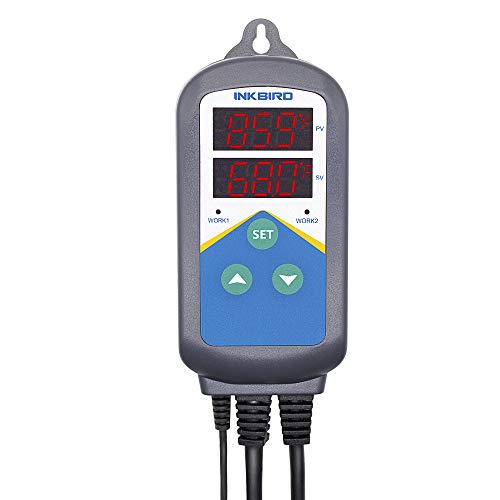
The Inkbird ITC-306T is a standalone temperature controller designed for dual heater redundancy. It features two heating outlets, allowing you to plug in two separate heaters so that if one fails, the other maintains temperature. The unit supports day/night temperature cycles, which is useful for simulating natural thermal shifts in coral and shrimp tanks. The probe comes with a suction cup tray for secure placement in the tank.
Users appreciate the peace of mind this controller provides, especially in tanks with sensitive livestock. The over/under-temperature alarm is fixed but effective: if the temperature strays outside the -58°F to 210°F range, the unit buzzes, shuts off outputs, and displays “HL”. The maximum load is 1200W at 110V, making it compatible with most standard heaters.
The initial setup is not intuitive, and many buyers rely on YouTube tutorials to program the dual-time cycles. The suction cup probe holder tends to fail over time, causing the probe to float, but this can be mitigated with a zip tie or aftermarket holder. For those running two heaters in a large system, the ITC-306T is an affordable safety net that prevents catastrophic temperature swings.
Why it’s great
- Dual heating outlets for heater redundancy
- Day/night temperature cycling for natural simulation
- Over/under-temperature alarm with automatic shutdown
- Handles up to 1200W load
Good to know
- Setup is not user-friendly; YouTube guides are helpful
- Probe suction cup holder tends to fail
- Alarm thresholds are fixed and not adjustable
6. HiTauing Aquarium Heater 200W

The HiTauing 200W heater brings an external digital controller to the mid-range price bracket, offering a temperature range of 63°F to 94°F with switchable Fahrenheit and Celsius readouts. The explosion-proof quartz glass construction uses nickel-chromium heating wire with silicon carbide heat conduction, which heats water quickly and evenly. An intelligent water sensor automatically stops heating if the unit is fully exposed to air, and over-temperature protection kicks in if the set point is exceeded.
Users report that a 200W unit heats a 30-gallon tank within 30 minutes after a water change and holds the set temperature within 0.5°F of the target. The plastic guard protects fish from direct contact with the hot quartz tube, and the dual suction cups allow secure mounting. After two years of continuous use, some buyers have experienced zero issues, praising the value versus premium competitors.
The single-button temperature adjustment requires cycling through all possible settings to reach the desired degree, which can be tedious (up to 40 clicks for a 1°F change). A few units arrived with inaccurate temperature readouts, but these were isolated cases. For aquarists who want a digital display and adjustable control without spending premium money, the HiTauing is a compelling choice.
Why it’s great
- External digital controller with Fahrenheit/Celsius display
- Quartz glass construction with fast heat transfer
- Intelligent water sensor and over-temperature protection
- Holds temperature within 0.5°F of the set point
Good to know
- Single-button adjustment requires many clicks to change temp
- Some units shipped with slightly inaccurate readouts
- Plastic guard may reduce water flow around the heating element
7. Fluval P25 Submersible Aquarium Heater 25W

The Fluval P25 is a preset submersible heater designed for nano tanks up to 6 gallons, making it ideal for betta bowls, shrimp habitats, and small planted aquariums. The factory-set thermostat locks the temperature at 76–78°F, so there are no controls to adjust — simply submerge, attach the suction cups, and plug it in. The strong polymer construction is shatterproof, eliminating the risk of glass breakage in a small tank where space is tight.
Users with 3 to 5-gallon tanks consistently report that the P25 maintains a stable temperature with minimal fluctuation, and the LED indicator provides clear visual confirmation of active heating. The compact dimensions (5.9 x 2.8 x 1.2 inches) allow it to fit discreetly behind decor or in the filter compartment. Many owners have used the heater for over three months without any issues, praising its simplicity and reliability for low-maintenance setups.
The non-adjustable temperature can be a limitation if your tank consistently runs warmer or cooler than the preset range. Some units failed after a year, and the suction cups tend to degrade, causing the heater to shift position. Adding a secondary thermostat can mitigate the lack of adjustability. For a no-fuss entry-level heater in very small tanks, the Fluval P25 is the best affordable option.
Why it’s great
- Shatterproof polymer construction is safe for nano tanks
- Preset 76–78°F thermostat requires zero adjustment
- Compact size fits easily in small aquariums
- LED indicator confirms when heating is active
Good to know
- Non-adjustable temperature may not suit all environments
- Suction cups can degrade and lose hold over time
- Some units reported failure after 12 months of use
FAQ
What wattage do I need for my aquarium?
Can I use a glass heater in a saltwater aquarium?
What does an external temperature controller do?
Why is my submersible heater flashing or not turning on?
Final Thoughts: The Verdict
For most users, the best aquarium submersible heater is the EHEIM Jager 125W because it delivers unmatched temperature accuracy and long-term reliability in a shatterproof glass package. If you need a corrosion-proof option for a reef tank, grab the Hygger Titanium 200W. And for the budget-conscious nano tank keeper, nothing beats the simplicity and safety of the Fluval P25 25W.