
Our readers keep the lights on and my morning glass full of iced black tea. As an Amazon Associate, I earn from qualifying purchases.
Specs are compiled from manufacturer listings and verified buyer reviews and can change over time — please confirm the key details on the product page before buying.
Turtles are messy — way messier than fish. They produce more waste, eat messily, and if your filter can’t keep up, you will be changing murky water every few days. The key is matching a filter’s flow rate to your tank and getting one with biological filtration (media that grows helpful bacteria to break down waste). This guide looks at seven filters designed to handle exactly that, from compact units for small tanks to powerful models that keep big tanks clear.
I’m Min — the founder and writer behind Gadgets Feed. This guide is built by comparing the manufacturers’ published specifications and the patterns across verified customer reviews, so you get each pick’s real strengths and trade-offs instead of marketing spin.
Whether you have a single baby turtle in a 20-gallon tank or a full-grown red-eared slider in a 140-gallon setup, the right aquarium turtle filter makes the difference between clear water and a constant cleaning chore.
Quick Picks
- Kulife 3-Stage Aquarium Filter — Best Overall
- TARARIUM UV-C Filter IX-120-U-V — Premium Pick
- TARARIUM 222GPH 10W Turtle Tank Filter — Top Performer
- TARARIUM 220GPH IX-90-NEW Turtle Filter — Green Water Fix
- TARARIUM 290GPH IX-120 Internal Filter — Best Value
- TARARIUM 290GPH IX-120-NEW Turtle Filter — Compact Option
- Zoo Med Turtle Clean 30 Canister Filter — Canister Choice
How To Choose The Best Aquarium Turtle Filter
Picking the wrong filter means either a motor that burns out from the load or a tank that stays cloudy no matter what you do. These are the four specs that separate a good turtle filter from a bad fit.
Flow Rate — Gallons Per Hour (GPH)
This is the single most important number. Turtles need a filter that moves the whole tank volume at least three to four times every hour. A 40-gallon tank needs at least 120 GPH (gallons per hour — the amount of water the pump moves in sixty minutes). If you pick a filter rated for 220 GPH with a 20-45 gallon range, you know the math checks out. Undersize here, and waste settles before the filter catches it.
Filtration Stages — Mechanical, Chemical, Biological
A good turtle filter does three jobs. First, a sponge catches solid waste and food scraps (mechanical). Second, carbon or similar media absorbs odors and discoloration (chemical). Third, ceramic bio-balls or porous media grow beneficial bacteria that break down ammonia and nitrites (biological — the living layer that removes toxic turtle waste compounds). If a filter skips the bio stage, ammonia builds up fast in a turtle tank.
Low Water Level Support
Many turtle tanks are only half full — turtles need dry basking areas. Standard aquarium filters often require deep water to run. Look for filters that state a minimum water level, like 2.6 inches (the shallowest water it can handle before it sucks air). Without this, your filter will suck air and burn out if the water drops below the intake.
Maintenance Access
You will clean a turtle filter more often than a fish filter because turtles produce more waste. A top-lid canister or easy-access compartments make this a five-minute job instead of a hassle. Check that replacement sponges are available — some filters list a search code for refills, which tells you the maker supports the product long-term.
Quick Comparison
On smaller screens, swipe sideways to see the full table.
| Model | Best For | Max Flow (GPH) | Tank Size (Gal) | Power (W) | Amazon |
|---|---|---|---|---|---|
| Kulife 3-Stage | Power on a budget | 300 | 70-100 | 12 | $26.99Amazon |
| TARARIUM 222GPH 10W | Small low-water tanks | 222 | 10-40 | 10 | $26.99Amazon |
| TARARIUM 220GPH IX-90-NEW | 20-45 gallon tanks | 220 | 20-45 | — | $29.99Amazon |
| TARARIUM 290GPH IX-120 | Medium-large tanks | 290 | 20-75 | — | $39.99Amazon |
| TARARIUM 290GPH IX-120-NEW | 20-85 gallon tanks | 290 | 20-85 | — | $39.99Amazon |
| TARARIUM UV-C IX-120-U-V | Cloudy / green water | — | 40-155 | — | $57.99Amazon |
| Zoo Med Turtle Clean 30 | Canister filter fans | — | Up to 30 | — | $69.94Amazon |
In‑Depth Reviews
1. Kulife 3-Stage Aquarium Filter

This filter moves 300 GPH (gallons per hour), versus the 220 GPH models below, so heavy turtle waste gets pulled out before it settles.
That 300 GPH flow rate matters because turtles create heavy waste loads that weaker pumps leave sitting. It uses three sponge blocks: a coarse sponge for food scraps and waste, a carbonized sponge for odor and chlorine, and a fine sponge that polishes the water before it returns. The whole assembly is fully submersible (safe to put underwater) with an epoxy-sealed motor, so you can place it low in the tank without worrying about water damage.
An air venturi (a small tube that pulls air into the water stream) and tubing add oxygenation, which turtles need since they breathe air but the bacteria in the filter need oxygen to break down ammonia. Buyers report the filter is quiet and easy to clean, with one reviewer mentioning their unit has lasted about three years. The transparent outer box lets you see exactly when the sponges need rinsing, so you are not guessing.
Why It Leads
- 300 GPH flow — highest in this lineup for sub- pricing
- Three sponge layers plus aeration venturi
- Transparent housing to check sponge cleanliness
Keep in Mind
- Rated for 70-100 gallons — too large for small tanks under 20 gallons
- No ceramic bio-balls (porous ceramic media for biological filtration)
Reach for this if: you have a 70-100 gallon tank and want the most flow per dollar in this guide.
Look elsewhere if: your tank is smaller than 40 gallons or you want biological media included.
4. TARARIUM 290GPH IX-120 Internal Filter

This filter adds ceramic bio-balls (porous media that grow bacteria to break down toxic ammonia and nitrites) for healthier water in 20-75 gallon tanks.
This filter uses true three-stage filtration that includes ceramic bio-balls. Without that stage, turtle waste decomposes into toxins that stress your turtle. The dense double-sided mesh sponge catches solids first, then the bio-balls handle the biological side, and the waterfall outlet aerates the water as it returns.
Owners mention it improves water clarity quickly and runs quietly, with one reviewer noting it works great in their 75-gallon turtle tank. A follow-up point: the water flow weight can cause the suction cups to slip on smooth glass, so consider a small support underneath. The adjustable flow dial lets you turn down the current for smaller tanks or smaller turtles.
Standout Features
- Ceramic bio-balls for biological filtration — the Kulife lacks this
- Adjustable flow control for customized water movement
- Runs at low water levels (2.6 inches minimum)
Possible Hassle
- Suction cups may slip on glass; some buyers added a support bridge
- Heavier than compact filters at 2.99 pounds
Go for this if: you want biological filtration with ceramic media in a 20-75 gallon tank.
skip it if: your tank is smaller than 15 gallons or you want a lighter internal unit.
5. TARARIUM 290GPH IX-120-NEW Turtle Filter

Same 290 GPH pump as the IX-120, but this one pulls waste off the tank floor with a bottom intake — where turtle mess collects — so it stays cleaner between cleanings.
Bottom suction pulls waste directly from the substrate, which is where turtle mess collects — food crumbs and waste sink, and this filter grabs it before it breaks down. The double-sided mesh sponge does the first pass, ceramic bio-balls handle the chemistry, and a waterfall outlet adds oxygen. One buyer using two of these on a 140-gallon half-filled tank for a red-eared slider says they have only done one full water change since April, cleaning the filters twice in that time.
Another reviewer noted the wire is short and it comes with filters already inside. The adjustable flow control lets you turn it down for smaller tanks or lower levels. At 2.9 pounds it is slightly lighter than the regular IX-120 and shares that model’s 2.6-inch minimum water level.
Strengths
- Bottom intake pulls waste off the tank floor
- Rated up to 85 gallons — widest single-unit range among internal picks
- Includes ceramic bio-balls for complete 3-stage filtration
Watch For
- Short power cord limits placement options
- Four suction cups hold well but need a clean, flat surface
Best for: medium-large tanks up to 85 gallons where bottom waste collection is a priority.
Potential issue: if your tank is under 20 gallons the 290 GPH flow may be too strong even on the lowest setting.
6. TARARIUM UV-C Filter IX-120-U-V
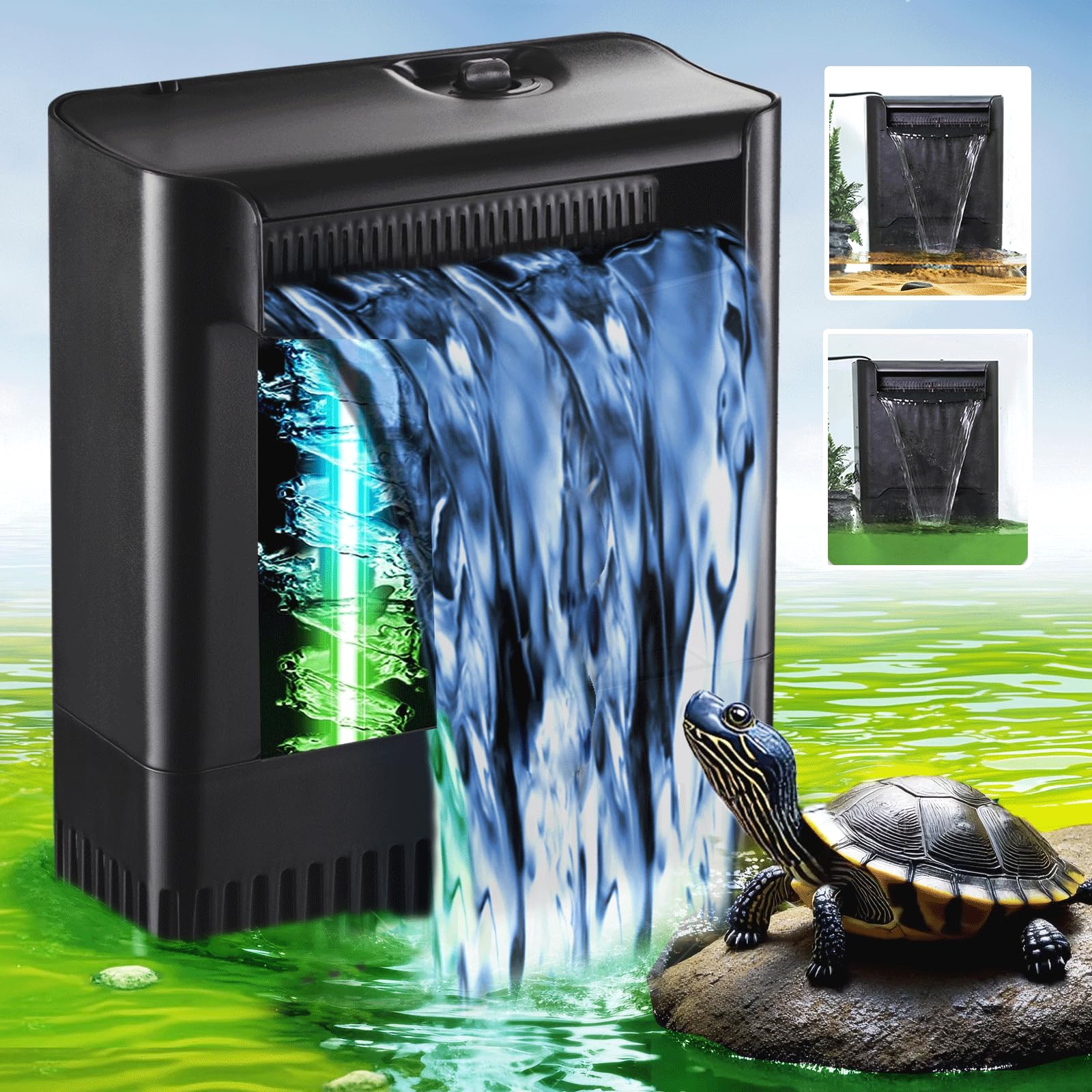
This filter adds a 254nm UV-C light (an ultraviolet bulb that kills free-floating algae) to the standard 3-stage cleaning, so green cloudy water clears in days.
Green, cloudy water from algae blooms is a common headache in bright turtle tanks. This filter adds a 254nm UV light that kills free-floating algae as water passes through, with the maker stating it can clear cloudy and green water in 4-8 days. Separate switches let you run the pump without the light or the light without the pump, so you are not burning the UV bulb 24/7 if the water is already clear.
Triple filtration works like this: first the UV light zaps microorganisms, then ceramic bio-balls break down waste, then the final sponge absorbs remaining particles. Customers note it is quiet and works great on half-filled large tanks — one reviewer runs two on a 140-gallon tank and has needed only one water change since April. A known hitch: if the UV bulb arrives damaged in shipping, the replacement bulb may not fit the lid properly.
Why It Stands Out
- UV-C light targets algae and cloudiness — unique in this lineup
- Rated for 40-155 gallons with a low water level of 2.6 inches
- Separate pump and light switches for flexible use
The Catch
- UV bulb replacement fitment issues reported in reviews
- Heavy at 3.21 pounds — needs sturdy placement
Reach for this if: green water or algae is your persistent problem and you have a 40+ gallon tank.
Look elsewhere if: you just need basic waste filtration and do not have algae issues.
2. TARARIUM 222GPH 10W Turtle Tank Filter

At 222 GPH and a 10-watt motor, this filter runs on less electricity than most, and its 2-inch minimum water level is the shallowest in the guide.
This power rating — 10 watts — matters if you are cost-conscious about electricity or running it on a timer. The three-stage setup uses a double-sided mesh sponge (white side must face out, as one reviewer discovered) and ceramic bio-balls for biological filtration. It runs at water levels as low as 2 inches, making it one of the shallowest-water-capable options here.
Reviewers point out it works great in turtle tanks: one reviewer noted it is quiet and easy to clean, another called it “perfect for low-level water in a baby turtle tank.” The waterfall design adds oxygen back into the water. At 1.72 pounds it is easy to reposition with the included suction cups. On the downside, several reviewers mentioned the power cord could be longer.
What Works
- Lowest minimum water level in the guide — 2 inches
- Ceramic bio-balls included for complete bio-filtration
- Adjustable flow for delicate or small setups
What Limits It
- Rated for 10-40 gallons — too small for larger tanks
- Power cord length could be longer
Pick this for: small tanks under 40 gallons, especially with low water levels for baby turtles.
Not for: tanks over 50 gallons or setups where the outlet must reach far from the outlet.
3. TARARIUM 220GPH IX-90-NEW Turtle Filter
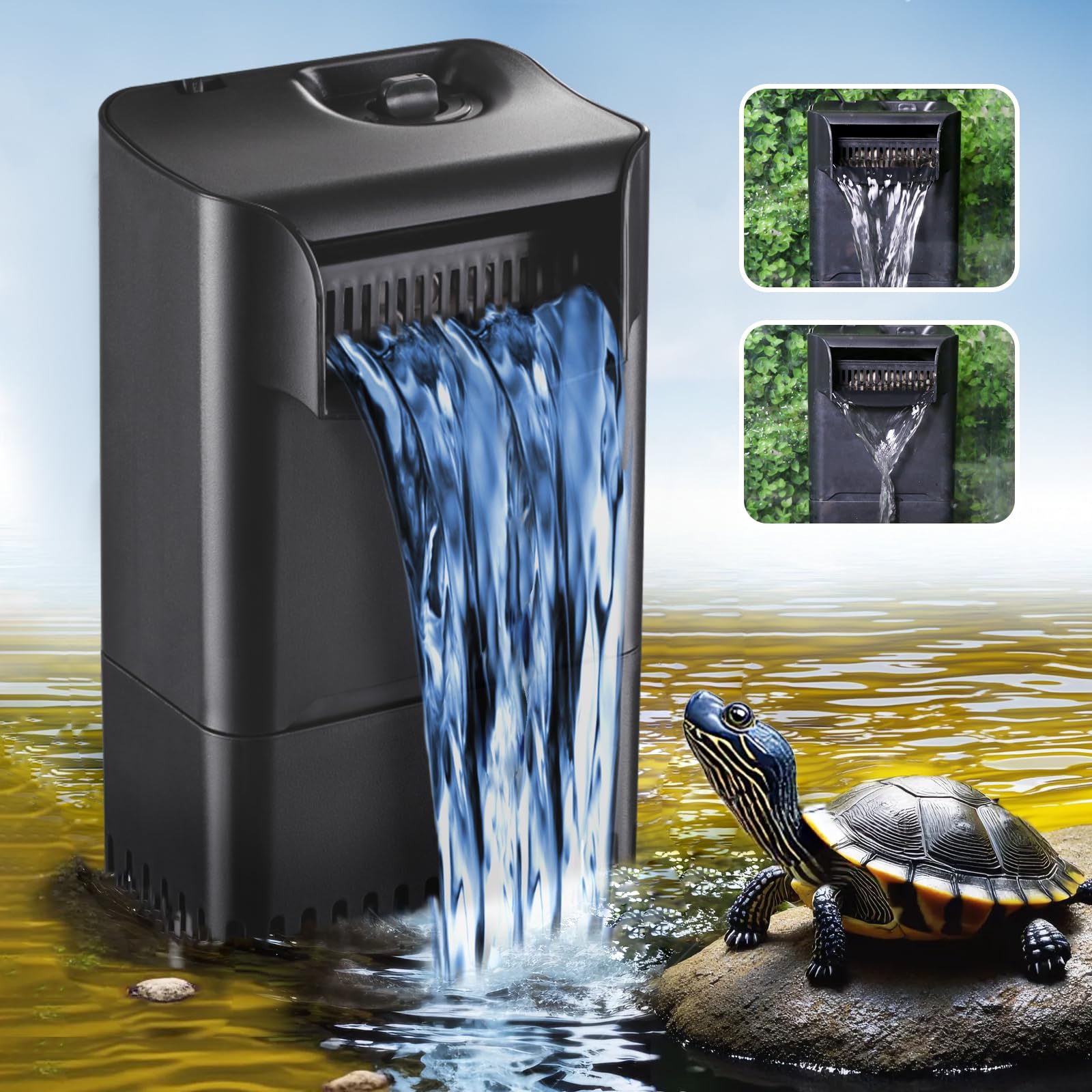
Shoppers say this 220 GPH filter runs almost silently — only a soft waterfall sound — and its bottom suction pulls waste straight off the tank floor.
This model shares the same 8.66 x 2.56 x 4.6 inch frame as the IX-90 series, but it is tuned for tanks in the 20-45 gallon range — a good fit for a single juvenile turtle. The bottom suction system pulls waste from the floor, which is where turtles drop most of it. Double-sided mesh sponge and ceramic bio-balls handle the three stages.
One buyer running this on a half-filled 140-gallon tank (yes, it handles that much volume when used creatively) reported it is quiet with only waterfall noise and that only algae under the heat lamp was an issue. Another reviewer emphasized the four suction cups hold securely even in deep setups. The minimum water level is 2.6 inches.
Good Points
- Very quiet in operation — buyers mention only soft waterfall sound
- Bottom intake catches waste before it dissolves
- Includes ceramic bio-balls for bio-filtration
Trade-offs
- Only rated for 20-45 gallons; larger tanks need two units
- Short power cord reported by multiple users
Use for: a quiet, low-maintenance setup in a 20-45 gallon turtle tank.
Avoid if: your tank is over 55 gallons or you need a longer cord to reach an outlet.
7. Zoo Med Turtle Clean 30 Canister Filter

This external canister filter sits entirely outside the tank, so turtles that love knocking things over cannot dislodge it.
Unlike all the others here, this is a canister filter — it sits outside the tank, connected by hoses, with only the intake and spraybar inside the water. The included spraybar provides greater aeration, and the adjustable flow control system lets you fine-tune the return rate. For turtles that love to push things around, an external canister means nothing inside the tank to knock over.
Buyers have mixed reactions on setup: one reviewer called assembly complex and the instructions confusing, noting you must fill the canister completely with dechlorinated water to prime it. But once running, several say it makes the water crisp quickly and keeps it that way. One user runs theirs 12 hours a day and says the washable media saves money on replacements. A warning: one buyer experienced a tube disconnection that caused a leak, so check the hose connections periodically.
Why a Canister?
- No bulk inside the tank — turtles cannot knock it down
- Spraybar provides extra aeration
- Adjustable flow for different turtle sizes
Difficult Bits
- Complex setup with vague instructions
- Must be at same level as the tank, not below
- Hose connection leak risk reported
Choose this for: a clean, external setup in a 30-gallon or smaller tank, especially with large turtles that knock over internal filters.
pass on it if: you want an easy out-of-box setup or have a tank over 40 gallons.
Understanding the Specs
Flow Rate (GPH) — Gallons Per Hour
This tells you how much water the pump moves every hour. For turtles, you want the GPH (gallons per hour) to be at least three times your tank volume. A 40-gallon tank needs at least 120 GPH. Higher GPH means more water passes through the filter media each hour, which is critical because turtles produce much more waste than similarly sized fish. Filters with 290-300 GPH handles 70-100 gallon tanks well, while 220 GPH units suit 20-45 gallon setups.
Low Water Level Operation
Standard aquarium filters need deep water — sometimes 4-6 inches minimum. Turtle tanks are often half full so the turtle can bask under a heat lamp on dry land. Filters that state a “minimum water level” of 2 inches or 2.6 inches can run safely in shallow water. If a filter does not list this spec, it may suck air and burn out if the water level drops below the intake. Always check this number before buying for a half-filled tank.
FAQ
What GPH filter do I need for my turtle tank?
Can I use a regular fish filter for a turtle tank?
What is the difference between internal and canister filters for turtles?
How often should I clean my turtle filter?
Do turtle filters need biological filtration?
Will a turtle filter work in saltwater or brackish setups?
How low can the water level go in a turtle tank filter?
Can I use two filters on one large turtle tank?
Replacements — are filter sponges easy to find?
Does a turtle filter need a separate air pump?
Final Thoughts: The Verdict
For most people, the aquarium turtle filter winner is the Kulife 3-Stage because it delivers 300 GPH flow at a great price point. If you want biological filtration with ceramic bio-balls for a 20-75 gallon tank, grab the TARARIUM 290GPH IX-120. And for clearing up green algae water in a large setup, the TARARIUM UV-C model adds a UV light that other filters here lack.
How We Picked
We do not accept paid placement, and we did not hands-on test every unit. Instead, we match each pick to a real buyer and use-case by comparing the manufacturers’ published specifications against the patterns in verified customer reviews — so you get each pick’s real strengths and trade-offs instead of marketing copy.
Sources & Methodology
Specifications: manufacturer listings and product documentation. Review insights: verified customer reviews, as of July 2026. Pricing: not shown on this page (it changes often); check the current price via the retailer link.
As an Amazon Associate, Gadgets Feed earns from qualifying purchases. This does not affect which products we feature.
Product prices and availability are accurate as of the date/time indicated and are subject to change. Any price and availability information displayed on Amazon at the time of purchase will apply to the purchase of this product. As an Amazon Associate I earn from qualifying purchases.
CERTAIN CONTENT THAT APPEARS ON THIS SITE COMES FROM AMAZON. THIS CONTENT IS PROVIDED "AS IS" AND IS SUBJECT TO CHANGE OR REMOVAL AT ANY TIME.
Amazon and the Amazon logo are trademarks of Amazon.com, Inc. or its affiliates.