
Your work day ends at the ground, but the work itself happens 80 feet up in the canopy. No piece of gear carries more responsibility, or sits on your body longer, than the arborist climbing harness you choose. Get it wrong and you fight your gear all shift — the leg straps bite, the bridge sits wrong, and the gear loops force you to reach and twist. Get it right, and the harness disappears beneath you, letting you focus entirely on the cut.
I’m Min — the co-founder and writer behind Gadgets Feed. I’ve spent hundreds of hours parsing manufacturer spec sheets, cross-referencing ANSI and ASTM standards, and analyzing real-world climber feedback across dozens of saddles to understand exactly which design decisions separate a day-long comfort saddle from a cheap hang.
This guide breaks down the nine best contenders on the market by build quality, suspension comfort, adjustability, and practical gear organization so you can confidently choose the best arborist climbing harness for your specific climbing style and body type.
How To Choose The Best Arborist Climbing Harness
Choosing an arborist saddle comes down to three pillars: comfort under load, adjustability for layering and body movement, and durability against sap, moisture, and daily wear. A harness that scores high on all three won’t just feel better — it will keep you safer and allow longer, more productive climbs.
Bridge & Attachment System
The bridge is the central connection point between you and your rope. A textile adjustable bridge, found on premium saddles like the Petzl SEQUOIA and Weaver Denali, lets you reposition your tie-in point for better balance during ascent or limb walking. Fixed rope bridges are simpler and lighter but limit movement. For double rope technique (DdRT), look for a bridge with smooth gated rings that won’t catch or bind during redirects.
Padding & Breathability
All-day suspension compresses soft tissue against the saddle. Memory foam, as used in the Weaver Cougar, conforms to your body shape but retains heat. Open-cell AirFlex foam, found in the Denali, creates airflow channels that keep your lower back and hips cooler during summer climbs. Thicker padding is not always better — the padding must be dense enough to avoid bottoming out after months of use without adding excessive bulk that restricts leg movement.
Hardware & Adjustability
Leg and waist closure types dictate how quickly you can suit up and how precisely you can dial in fit. Buckle-style closures (tongue or speed-cinch) offer micro-adjustability and are easier to service than plastic snap clips. Look for aluminum hardware on high-end saddles to shave ounces — every gram matters when you’re hauling it up 60 feet of trunk. Quick-release waist buckles, like Petzl’s FAST system, let you open the belt entirely without fighting a webbing tail, which is critical when you need to get in and out repeatedly during a removal.
Gear Loops & Attachment Points
A professional arborist carries a chainsaw, lanyard, carabiners, throw line, and multiple friction hitches. The number and positioning of gear loops determines how quickly you can access tools one-handed. Side rigging plates, like those on the Weaver Denali, provide multiple D-shape attachment options for lanyards and suspended gear. D-rings on the hips should be angled to accept snap hooks without wrist twisting. Do not underestimate the frustration of a saddle with only two small gear loops.
Quick Comparison
On smaller screens, swipe sideways to see the full table.
| Model | Category | Best For | Key Spec | Amazon |
|---|---|---|---|---|
| Weaver Cougar | Mid-Range | All-Day Comfort | Memory Foam Padding | Amazon |
| Petzl SEQUOIA | Premium | DRT Specialization | FAST Auto Waist Buckle | Amazon |
| Weaver Denali | Premium | Leather Durability | Water Buffalo Leather | Amazon |
| Weaver WLC-730 Batten | Premium | Extended Suspension | 4″ Batten Seat w/ Aluminum Bar | Amazon |
| 3M ExoFit X300 Comfort Construction | Premium | Construction & Positioning | Weight Distribution System | Amazon |
| 3M DBI-SALA ExoFit NEX | Premium | Vest-Style Fit | Stand-Up Back D-Ring | Amazon |
| Weaver Leather Logging Belt Kit | Mid-Range | Ground & Felling Work | Latigo Leather Build | Amazon |
| 3M Protecta Comfort Construction | Budget | Entry-Level Fall Protection | Auto-Resetting Lanyard Keeper | Amazon |
| Frontline Combat Series Full Body | Budget | OSHA Compliance on Budget | Suspension Trauma Straps | Amazon |
In‑Depth Reviews
1. WEAVER ARBORIST Cougar Tree Saddle

The Weaver Cougar sits in a sweet spot that few saddles hit — it offers premium-level memory foam padding and a solid fit without the premium price tag. The contoured leg and back support straps use dense, conforming foam that does not pack out after months of daily use, which means you avoid that sagging, fatigue-inducing feel that cheaper saddles develop fast. Testers on the job for 10-hour shifts routinely report a noticeable reduction in hip and lower back soreness compared to their previous harnesses.
Build quality is typical Weaver — the nylon webbing is tightly stitched and the aluminum hardware is lightweight without feeling fragile. The saddle provides ample room for attaching climbing gear, and the leg straps adjust enough to accommodate varied thigh circumferences. Riders around 260 lbs report the Cougar handles their build comfortably, a testament to the saddle’s broad weight tolerance and the foam’s ability to distribute load evenly across the waist and thighs.
The main trade-off is the Velcro leg strap closure system. A few users note that the Velcro panels are longer than ideal, leaving a strap tail when cinched tight for smaller legs. This can cause the leg loop to feel looser than desired unless you fold the excess webbing back. It’s a fixable annoyance, not a dealbreaker, but worth noting if you have particularly slim thighs. For a first saddle, the Cougar delivers exceptional comfort per dollar.
Why it’s great
- Memory foam padding retains shape and comfort over extended shifts
- Lightweight aluminum hardware keeps overall saddle weight manageable
- Accommodates larger climbers comfortably with solid load distribution
Good to know
- Velcro leg closures may leave excess strap for smaller thighs
- Suspenders must be purchased separately for full support
2. PETZL SEQUOIA Arborist Seat Harness
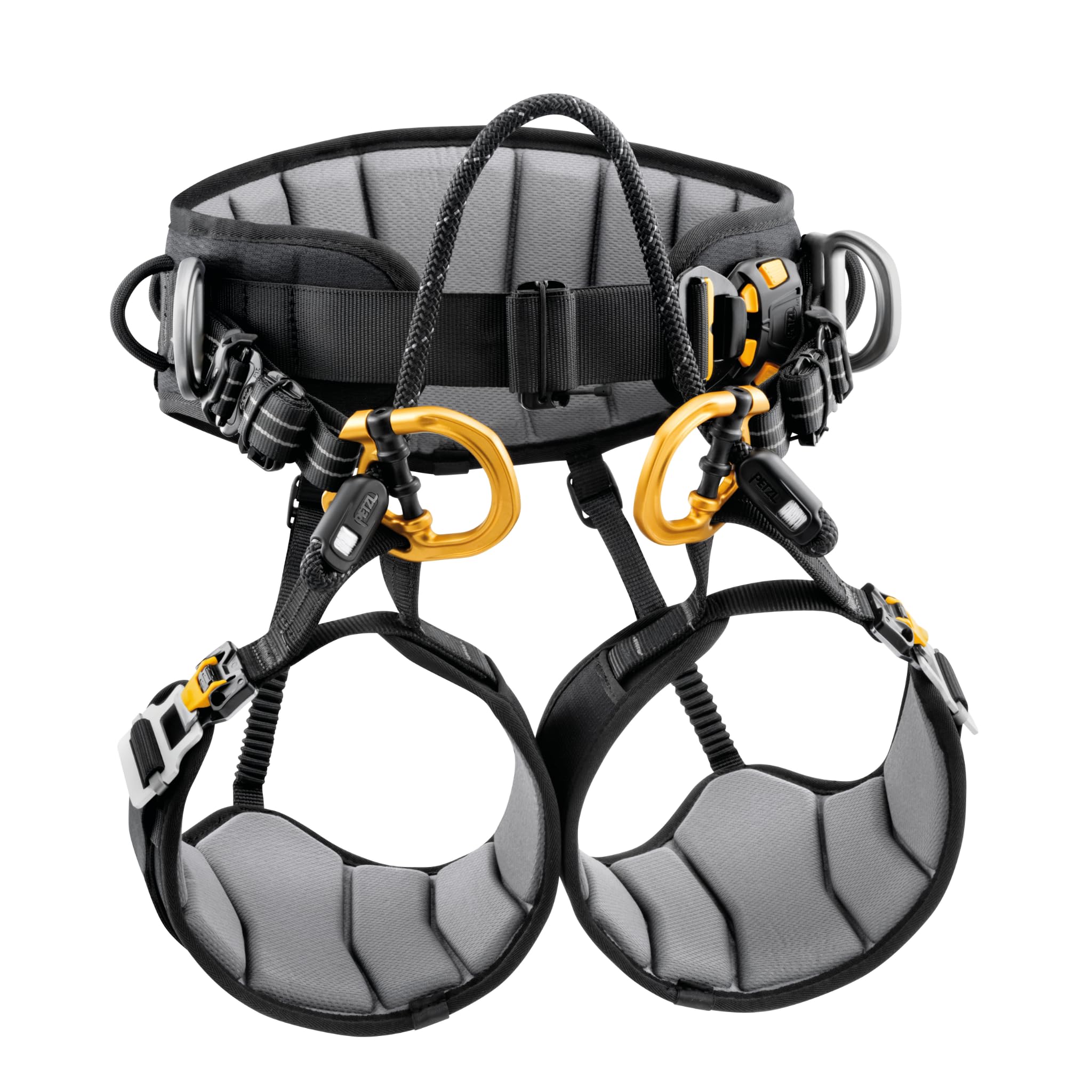
Petzl engineered the SEQUOIA specifically for double rope technique (DdRT) — this is not a general-purpose fall protection harness adapted for tree work. The semi-rigid waistbelt stays open when you step into it, making donning fast even with gloves on, and the FAST automatic buckle on the waist closes with a simple push-and-click motion. The entire saddle, from the perforated foam padding to the textile adjustable bridge, is built around one goal: maximum lateral mobility without sacrificing security.
The gated bridge rings allow you to attach directly to the waistbelt at different positions or install Petzl’s RING2RING and SWIVEL accessories for smoother redirects. This is critical for arborists who spend hours advancing their tie-in point — the ability to fine-tune bridge height without rethreading webbing saves real time. Leg loops use FAST LT PLUS buckles that release instantly when you hit the ground, which is a welcome convenience during a removal job where you’re in and out of the saddle repeatedly.
Weight is remarkably low for the feature set, and the breathable foam padding actually works — your back and thighs stay noticeably cooler than with denser closed-cell foam saddles. The one caveat is sizing. Some buyers have reported receiving a size 1 inside a size 2 bag, so verify the tag before your first climb. The SEQUOIA is a specialized tool that rewards arborists who already know their preferred climbing style.
Why it’s great
- FAST buckle system allows one-handed waist closure even with thick gloves
- Textile adjustable bridge provides fine control over tie-in position
- Low weight and breathable foam reduce fatigue on long ascents
Good to know
- Not designed for single rope technique (SRT) without modification
- Verify size tag matches box — packaging errors have been reported
3. WEAVER ARBORIST Denali Saddle
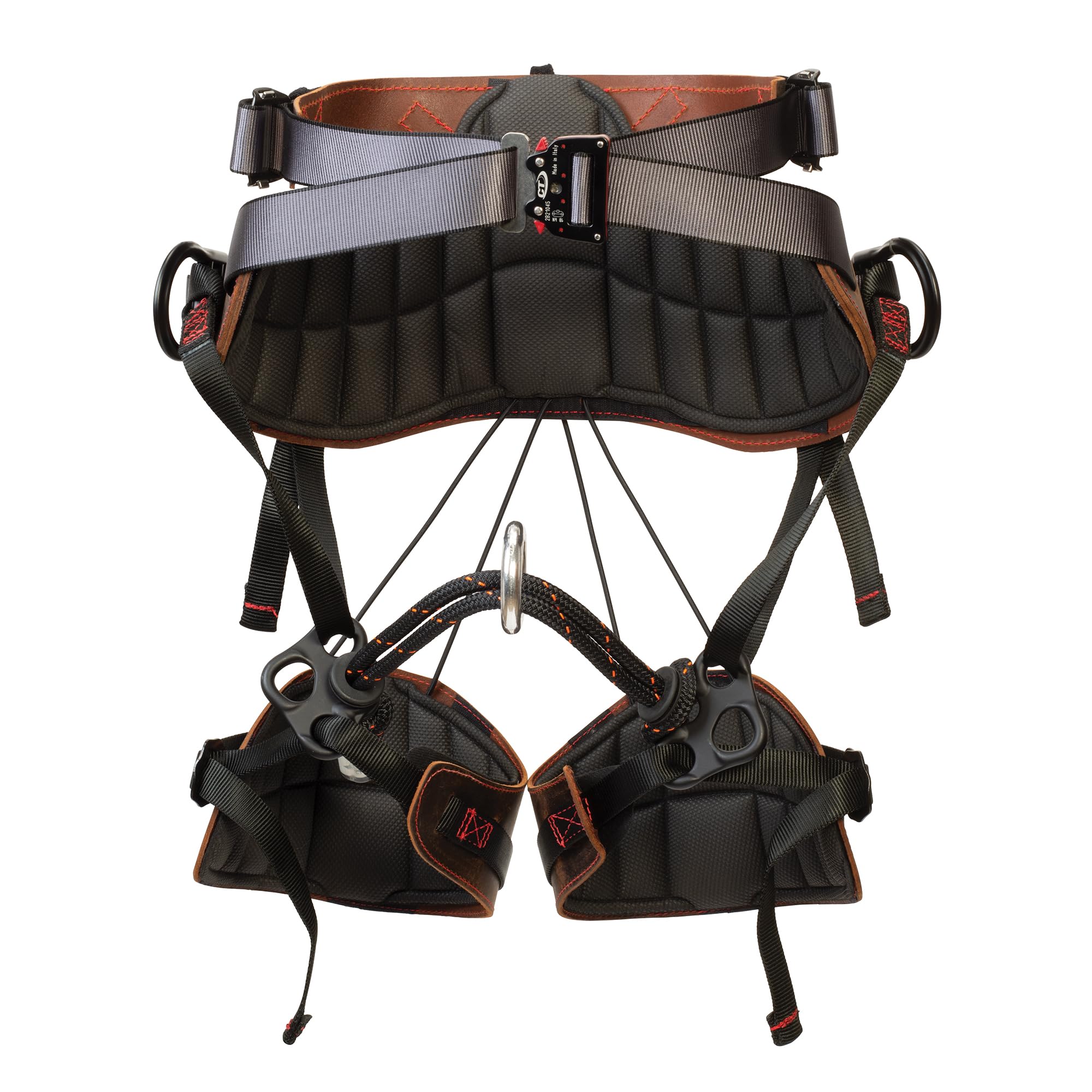
The Denali is Weaver’s top-tier leather saddle, built around a thick water buffalo leather waistbelt that conforms to your hips over time without breaking down like synthetic materials can after repeated sap and moisture exposure. The leather is paired with an AirFlex foam layer that introduces cooling air channels — a thoughtful addition for hot-weather climbing where sweat-soaked padding becomes a comfort and hygiene issue. The double rope suspension bridge uses a diamond knot and girth hitch ends that are simple to inspect and replace.
Aluminum hip dees and rigging plates provide multiple D-shape attachment points, and the quick-release waist buckle allows you to pop the entire belt open without rethreading webbing. The side rings are angled for one-handed snap-in, which is a small but noticeable time-saver. The saddle comes as a one-size configuration that adjusts from a 24-inch to a 48-inch waist, though bulkier climbers around 6 feet and 210 lbs seem to hit the comfort sweet spot.
The biggest criticism is the leg strap design — they lack integrated buckles, using a webbing-only system that requires threading. Several users have installed aftermarket Cobra buckles for faster closure. Additionally, the bridge positioning can ride high, pulling the leg straps upward into the groin if not adjusted carefully. Expect a longer trial-and-error setup period than with a buckle-equipped saddle. This is a saddle for experienced climbers who know exactly how they want their rig dialed in.
Why it’s great
- Water buffalo leather outlasts synthetic saddles in wet/sappy conditions
- AirFlex foam channels keep your back cool during extended climbs
- Aluminum rigging plates offer versatile attachment options
Good to know
- Leg straps lack factory buckles — requires threading or aftermarket mod
- Setup requires significant trial and error to avoid groin pressure
4. Weaver Leather WLC-73 Saddle with Batten Seat

The WLC-73 is the batten seat specialist in Weaver’s lineup. The four-inch-wide batten seat is reinforced with an aluminum bar running through foam padding — this bar prevents the seat from collapsing under load, which is the primary cause of “bottoming out” on long suspension hangs. If you spend extended periods suspended in the saddle during limb walks or large removals, this seat design significantly reduces pressure points compared to standard padded belts.
The extended back pad wraps further forward around the hips than typical saddles, distributing the load across a wider surface area. The waist buckle uses a roller mechanism that reduces friction and wear on the belt webbing during adjustments, a detail that extends the saddle’s service life. Tested to ASTM F887 standards and compliant with ANSI Z133.12, this saddle meets the rigorous requirements of professional tree care operations.
The trade-off is weight. At over eight pounds, the WLC-73 is among the heavier saddles on this list. The aluminum bar and dense foam padding add mass that you feel when hauling the saddle up a trunk or carrying it between jobs. Additionally, the batten seat is optimized for suspension comfort, not ground mobility — it can feel restrictive when walking or dragging brush. This is a dedicated climbing saddle, not a multi-surface tool.
Why it’s great
- Aluminum-reinforced batten seat prevents padding collapse under load
- Extra-wide hip wrap distributes weight over a larger surface area
- Roller buckle reduces webbing wear during adjustments
Good to know
- Over 8 pounds — noticeably heavier than most modern saddles
- Batten seat is restrictive for ground work and walking
5. 3M ExoFit X300 Comfort Construction Positioning Harness

The ExoFit X300 is less a tree saddle and more a full-body fall protection harness with tree-friendly positioning features. Where pure arborist saddles prioritize bridge mobility, the X300 focuses on distributing the weight of heavy tool belts and tool bags across the shoulders and hips. The patented weight distribution system uses webbing channels that transfer load away from the spine and shoulders — a feature construction ironworkers have adopted specifically for jobs where tool weight exceeds typical climbing gear.
The auto-locking quick-connect buckles on the chest and legs make donning and doffing extremely fast. The stand-up back D-ring stays upright for easy one-handed lanyard connection. Combined with 6,000-pound polyester webbing and reflective Scotchlite panels, this harness meets ANSI Z359.11 and OSHA 1926.502 standards. For arborists who also do commercial construction or confined space work, the X300 eliminates the need to maintain two separate fall protection systems.
The trade-off is that the ExoFit X300 is not optimized for pure tree climbing ergonomics. The bridge is less flexible than a dedicated arborist saddle, and the full-body vest design adds torso coverage that can feel restrictive when reaching overhead canopy branches. It is a premium cross-functional tool, but a dedicated arborist will likely prefer a saddle that gives them lateral freedom to pivot and reach.
Why it’s great
- Weight distribution system effectively transfers heavy tool bag load away from shoulders
- Auto-locking quick-connect buckles are the fastest in this category
- Meets full OSHA and ANSI fall protection standards for construction work
Good to know
- Full-body vest design restricts lateral mobility compared to saddle-style harnesses
- Not optimized for pure DRT or SRT tree climbing techniques
6. 3M DBI-SALA ExoFit NEX Vest Style Harness

The ExoFit NEX is 3M’s answer to the question “how comfortable can a fall protection harness actually be?” The vest-style design distributes padding across the shoulders, back, and legs in a way that truly reduces the pressure points typical of H-style harnesses. The auto-locking quick-connect buckles on the chest and legs make this harness exceptionally fast to put on — users report 5-second donning compared to 2-3 minutes for traditional tongue-buckle harnesses. For aerial work like bridge inspections, lift work, and basket crane operations, this speed is transformative.
The anti-slide dorsal D-ring pad keeps the back ring from sliding down your spine when you lean or reach forward. The revolving torso adjusters lock webbing into place even after shedding layers throughout the day — a major advantage for arborists working a morning chill that turns into afternoon heat. The stand-up back D-ring stays upright for easy single-handed connections, a feature often missing on construction-focused harnesses.
The downside for tree work is the same as the X300 — it is a full-body vest harness, not an arborist-specific saddle. The padding that feels great for two hours in a lift can feel hot and restrictive during an all-day canopy climb. Additionally, the leg pads are thick enough that they can interfere with the tight clearance required when ascending through dense branches. This is an exceptional general-purpose fall protection harness that happens to work for arborists in specific confined-space or lift scenarios.
Why it’s great
- 5-second donning with auto-locking quick-connect buckles on chest and legs
- Revolving torso adapters maintain fit during weather-related gear changes
- Anti-slide dorsal pad keeps the connection point stable during forward reach
Good to know
- Vest padding generates heat during sustained canopy climbing
- Thick leg pads can interfere with tight branch clearance
7. Weaver Arborist Leather Logging Belt Kit

This kit is designed for felling and ground-based logging work rather than canopy climbing, making it a companion piece rather than a replacement for a dedicated climbing saddle. The latigo leather belt is stiff and supportive — it holds axes, wedges, and heavy gear without sagging or twisting. The included suspenders shift the weight of the tool load from your waist to your shoulders, a feature that makes a real difference during an eight-hour day of bucking and limbing on the ground.
The kit includes an axe pouch, wedge pouch, and first aid pouch, all built from the same latigo leather. The adjustable sternum strap features a built-in emergency whistle on the buckle, a practical safety touch for remote logging operations. The waist belt accommodates sizes from 30 to 52 inches, and the suspenders adjust to fit most torsos. For the price, you get a fully assembled and pocketed system ready to go out of the box — no separate pouch purchases needed.
The limitation is clear: this is not a climbing saddle. There are no hip D-rings designed for bridge attachment, no leg loops, and no provision for being suspended in the canopy. The included gear pouches are functional but basic — the first aid pouch is small, and the axe strap works best with hatchets and single-bit axes under four pounds. Serious loggers already own a climbing saddle and pair this kit with it. New arborists should not mistake this for a full climbing harness.
Why it’s great
- Full kit includes belt, suspenders, axe pouch, wedge pouch, and first aid pouch
- Latigo leather stands up to years of wet, sappy field conditions
- Suspenders shift heavy tool weight from waist to shoulders for reduced fatigue
Good to know
- Not a climbing saddle — no bridge rings or leg loops
- Axe pouch fits best with smaller axes under 4 pounds
8. 3M Protecta Comfort Construction Style Harness

The 3M Protecta Comfort is the entry-level option from a brand that dominates professional fall protection. It hits all the compliance requirements — ANSI Z359.11 and OSHA 1910.140 — while keeping the feature set streamlined. The auto-resetting lanyard keepers on the shoulders hold your lanyard webbing neatly when not in use, reducing the tripping hazard that loose lanyard tails create on a crowded jobsite. The web adapter called Easy-Link allows for simple tool tethering without additional hardware.
The harness uses zinc-plated steel hardware, which adds heft compared to aluminum but keeps the cost low. The polyester webbing is standard 5,000-pound breaking strength material, sufficient for construction and general fall arrest. Multiple users report the harness adjusts easily and fits naturally, feeling more comfortable than similarly priced Miller models they used previously. The moisture-wicking padding helps manage sweat, though it does trap heat in warm conditions.
The biggest complaint centers on sizing. The waist belt runs small for larger climbers — a 300-pound user with tools within the 420-pound rated capacity found the belt too short and had to source a replacement. The padding system also creates bulk that causes sweat buildup despite the wicking claim. Additionally, no visible service life expiration tag is provided near the chest, which means you need to track service life manually. For light-duty use or as a backup harness, the Protecta serves its purpose, but it is outclassed by purpose-built arborist saddles for tree work.
Why it’s great
- Meets full ANSI and OSHA fall protection standards at a low entry cost
- Auto-resetting lanyard keepers reduce tripping hazards on site
- Easy-Link web adapter works for tool tethering without extra hardware
Good to know
- Waist belt runs small — may not fit users near the 420-lb capacity
- Padding causes sweat buildup despite moisture-wicking surface
- Steel hardware adds weight compared to premium aluminum alternatives
9. Frontline Combat Series Full Body Harness

The Frontline Combat Series harness is the budget buy that checks the regulatory boxes without hiding its cost-saving compromises. The standout feature for the money is the integrated suspension trauma straps — these loop down from the waist and allow you to stand up in the harness after a fall, relieving pressure on leg veins and preventing suspension trauma while awaiting rescue. That feature alone makes this harness more safety-complete than many quiet competitors at double the price.
The moisture-wicking padding covers the back, shoulders, and waist. The aluminum quick-connect chest buckle and tongue-buckle leg straps make adjustments reasonably fast. Contrasting webbing stitching helps with inspection — the orange safety webbing against black stitching makes frayed threads or damaged sections visible at a glance. The reinforced belt pad supports tool bags without the harness sagging downward, and a back web loop connector allows attachment of a twin SRL for advanced fall arrest setups.
Where the Frontline struggles is long-duration comfort. Users wearing it for 14-hour shifts report it is comfortable enough, but the padding density is lower than premium saddles, meaning it packs out faster. The steel hardware on the standard models adds weight, though the Combat Lite version uses aluminum hardware to address this. This harness is a solid choice for compliance-oriented jobsites where the user is not spending all day in sustained suspension, but full-time arborists will quickly graduate to a saddle with better foam and adjustability.
Why it’s great
- Integrated suspension trauma straps at a budget price point
- Contrasting webbing stitching makes safety inspection straightforward
- Aluminum quick-connect chest buckle offers fast, secure closure
Good to know
- Padding is less dense than premium saddles — compresses faster over time
- Standard models use steel hardware that adds noticeable weight
FAQ
What is the difference between a tree saddle and a fall protection harness?
How should an arborist climbing harness fit across the waist and legs?
Can I use a construction harness for professional tree climbing?
Final Thoughts: The Verdict
For most users, the best arborist climbing harness winner is the Weaver Cougar because it combines memory foam comfort, lightweight aluminum hardware, and a broad weight range at a midline price. If you want maximum canopy mobility and the fastest on/off buckle system, grab the Petzl SEQUOIA. And for extended suspension in a leather-built, long-lasting platform, nothing beats the Weaver Denali.