
Our readers keep the lights on and my morning glass full of iced black tea. As an Amazon Associate, I earn from qualifying purchases.
Specs are compiled from manufacturer listings and verified buyer reviews and can change over time — please confirm the key details on the product page before buying.
If your TV’s built-in speakers turn every explosion into a polite tap and every whispered line into a mumble, an ARC soundbar is the fix. ARC (Audio Return Channel) is just a feature on one HDMI port that sends TV audio down a single cable to the bar while also letting your TV remote change the volume. All nine bars below have ARC, spanning compact bedroom upgrades to full Dolby Atmos room-fillers.
I’m Min — the founder and writer behind Gadgets Feed. This guide is built by comparing the manufacturers’ published specifications and the patterns across verified customer reviews, so you get each pick’s real strengths and trade-offs instead of marketing spin.
If you want the highest-rated pick, the Sonos Arc Ultra is the best ARC soundbar for most people — it holds 4.6 stars across 700+ ratings. For big dialogue gains without a premium system, the Westinghouse 2.0 and the TCL S45H are the smart entry points. Everything below sorts by what matters once the box is open: how many channels you get, how the connection behaves, and whether the bass stands on its own.
Our Picks at a Glance

How To Choose The Best ARC Soundbars
Get the connection right first, because a bar with excellent sound and a flaky HDMI handshake will drive you up the wall. Check that your TV has an HDMI ARC port (usually labeled “ARC” or “eARC” on the back). Then you make three decisions: how many channels you want, if you need a separate subwoofer for bass, and how much room calibration matters to you.
Start with ARC versus eARC
ARC and eARC use the same HDMI port, but eARC carries more data — enough for Dolby Atmos and uncompressed formats. If your TV is a few years old, plain ARC still works fine for standard surround. If you’re buying a Dolby Atmos bar and want the full effect, check that your TV’s port says “eARC” before you assume it will pass the highest-quality audio.
Channels tell you where sound comes from
A 2.0 bar sends audio left and right with no dedicated bass driver. A 2.1 adds a separate subwoofer for the low end — the rumble you feel in an action scene. A 9.1.4 layout, like the Sonos Arc Ultra, places sound in nine ear-level directions, one bass channel, and four height channels for overhead effects. More channels means more precise placement, but it also means a bigger footprint and typically a bigger commitment.
Subwoofer options: built-in, wireless, or add-on
Some bars build the bass driver right into the cabinet, so you get one box and one power cord. Others ship with a wireless subwoofer that pairs on its own but still needs its own wall outlet. A few, like the Yamaha SR-B30A, include a pre-out (a connection for an external subwoofer) so you can hook up an existing powered sub later. Think about if you want the extra box in your room before you decide.
Room calibration and dialogue modes
Calibration uses a microphone to measure your room and adjust the output — the Sonos Arc Ultra uses Trueplay, the TCL S45H and S55H use AI Sonic, and the Bose Smart Ultra uses an ADAPTiQ headset. Dialogue modes do something different: they boost the frequency range where human speech lives, so quiet conversations stay intelligible over background music. Both features are genuinely useful in real rooms with hard floors or odd shapes.
Quick Comparison
| Model | Best For | Channels | Output | Subwoofer | Amazon |
|---|---|---|---|---|---|
| Sonos Arc Ultra★ Best Overall | Best Overall — full Atmos rooms | 9.1.4 | — | Add-on (Sub/Era) | Amazon |
| Philips B7305 (TAB7305)Budget Bass Pick | Budget bass with a wireless sub | 2.1 | 300 W | Wireless included | Amazon |
| Westinghouse 2.0 CompactCompact Pick | Compact Atmos for small TVs | 2.0 | 120W | None | Amazon |
| TCL S45H 2.0 | Dialogue lift in apartments | 2.0 | 100 W | None | Amazon |
| Hisense HS2100 | Budget sub + EQ modes | 2.1 | 240W max | Wireless included | Amazon |
| Samsung HW-B400 | Compact Samsung-TV companion | 2.0 | — | Built-in woofer | Amazon |
| TCL S55H 2.1 | Entry-level sub + Atmos | 2.1 | 220 W | Wireless included | Amazon |
| Yamaha SR-B30A | All-in-one with sub pre-out | 2.1 (built-in subs) | — | Built-in + pre-out | Amazon |
| Bose Smart Ultra | Premium Atmos + voice control | Dolby Atmos (6 transducers) | — | Add-on (Bass Module) | Amazon |
In-Depth Reviews
1. Sonos Arc Ultra Soundbar with Dolby Atmos – Black
Our pick — over 4.5★ from 700+ verified ratings; the strongest balance of quality and price.
The nine-driver bar that makes dialogue enhancement feel redundant.
The Arc Ultra gives you a full surround layout in a single cabinet — 9.1.4 channels of spatial audio. That means nine ear-level directions, one bass channel, and four height speakers aiming sound at your ceiling so it bounces back down as overhead effects. Setup takes one HDMI eARC cable and the Sonos app, which walks you through the steps. You control it with your TV remote, the app, touch controls on the bar, Sonos Voice Control, or Amazon Alexa.
What wins people over is the sound itself — a huge volume of listeners single out how precisely effects get placed around the room and how clearly voices land. Speech Enhancement, powered by AI, detects the human voice and pulls it forward, but many owners find they never even need it. Buyers report: “Moved from Denon AVR/wired speakers to Sonos… movies great spatial sound, phenomenal dialogue clarity, no speech enhancement needed.” A quick Trueplay tune using your phone mic adjusts the output to your room’s shape.
Here’s the honest trade-off: this bar is designed as the start of a system, and it shows. Adding a Sonos Sub and Era 300 rears open up the full Atmos effect, which raises the total cost. The app’s own calibration results can also vary depending on your phone model, and connectivity setup occasionally needs a re-pair to settle in. Bass is full and rich on its own, but a few owners say the deepest low end benefits from the separate sub. Contrast this with the Westinghouse at 2.0 channels and 120W — the Arc Ultra’s nine-channel layout and Atmos height virtualization sit in a different league.
Where this bar earns its spot
- 9.1.4 Dolby Atmos layout with height virtualization places effects around and above you
- AI-powered Speech Enhancement clarifies dialogue without manual tweaking
- Single HDMI eARC cable setup with step-by-step app guidance
- Trueplay room tuning adjusts output to your specific space
- Streaming via WiFi, Bluetooth, Apple AirPlay 2, and Spotify Connect
- Expandable — add Sonos Sub, Era 300 rears, or whole-home speakers
What to know before you buy
- Optimal Atmos performance benefits from adding a Sub and rear speakers — raising total cost
- Trueplay calibration accuracy can vary depending on your phone model
- Occasional TV pairing hiccups that resolve after re-pairing
- No dedicated remote — you use your TV remote or the app
Reach for this if: you want the highest-rated pick with the most channels in this lineup, and you’re ready to build a whole-home Sonos system over time.
Look elsewhere if: you want a complete Atmos effect straight from the start without buying additional subwoofer or rear speakers.
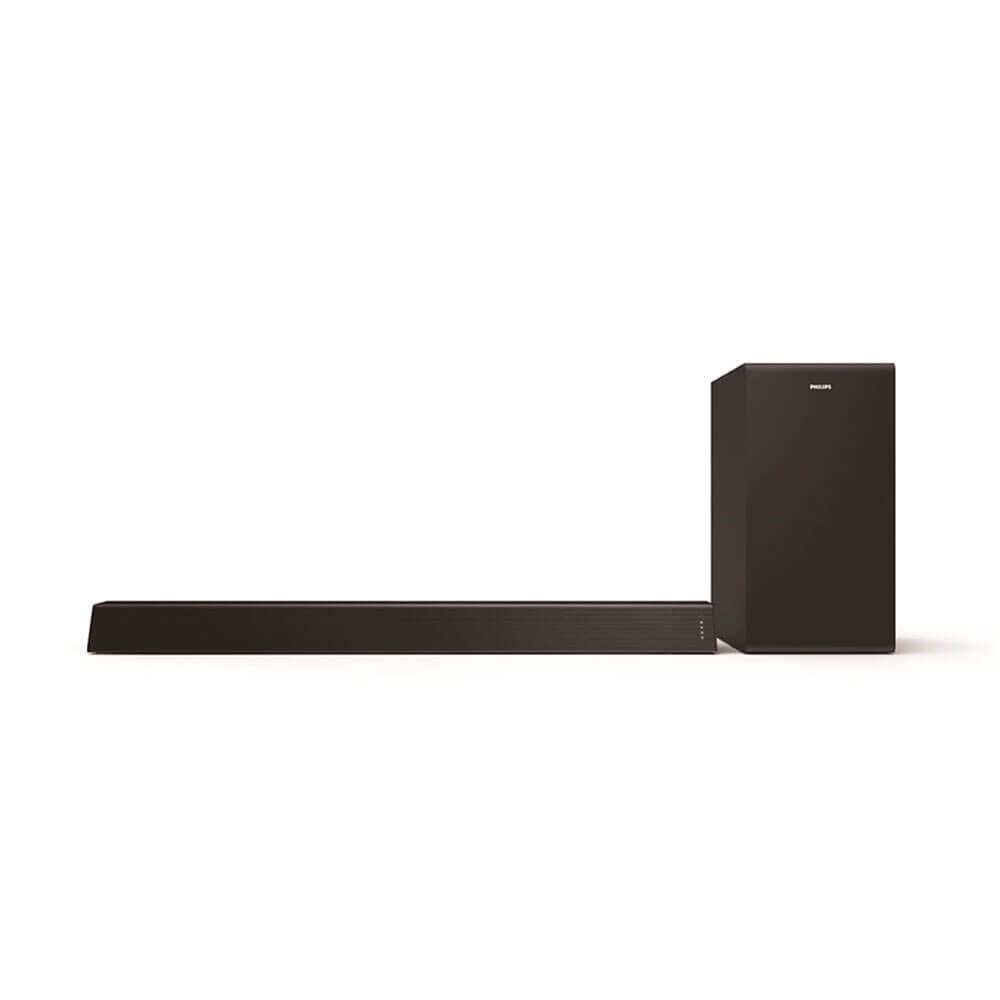
2. Philips B7305 2.1 Channel 300 Watts Soundbar with Wireless Subwoofer
A 300W two-piece system for buyers who want thump without the premium bill.
Two midrange drivers paired with two tweeters handle the mid and high frequencies, while a separate wireless subwoofer delivers the low end. The bar carries a 300W rating and supports Dolby Digital Plus, which expands the soundstage for movies and shows. Placement is flexible too — there’s a slanted low-profile design and included wall brackets, and the compact sub slides out of sight easily.
The HDMI ARC connection means your TV remote controls the volume, so no more juggling two remotes. Buyers consistently find setup quick and intuitive to hook up. The value angle is the other big draw — a full 2.1 system with a wireless sub at this price point is genuinely rare, and plenty of owners use it in garages, bedrooms, or secondary rooms where a main system wouldn’t make sense.
The recurring gripe is software, not hardware. Some units have trouble pairing the wireless subwoofer on first attempt, occasional connection drops have been reported, and a faulty auto-off can shut the bar down mid-show. There’s also a slight ARC audio delay with some Samsung TVs. A minority of units have failed over time. Those are the honest reasons the rating sits at 3.8 rather than higher — but the value and setup praise keeps plenty of buyers happy. The Philips is rated 300W versus the Hisense HS2100’s 240W.
The honest math: For the money, you’re getting a subwoofer-included 2.1 system with real 300W output and HDMI ARC — features that often cost more elsewhere. The catch is that the software side needs a gentle hand during setup.
The fit question: If you want a fire-and-forget bar with rock-solid connection every time, the higher-rated Hisense at 4.2 stars is a steadier bet. If you’re willing to re-pair occasionally and love a bass-heavy budget system, the Philips delivers the low-end punch.
Pick this if you want the most bass per tier: a wireless sub, 300W of power, and HDMI ARC make it a strong budget bass play.
Think twice if you want plug-and-play certainty: subwoofer pairing and occasional auto-off quirks mean it’s not the “low-maintenance” bar of the bunch.
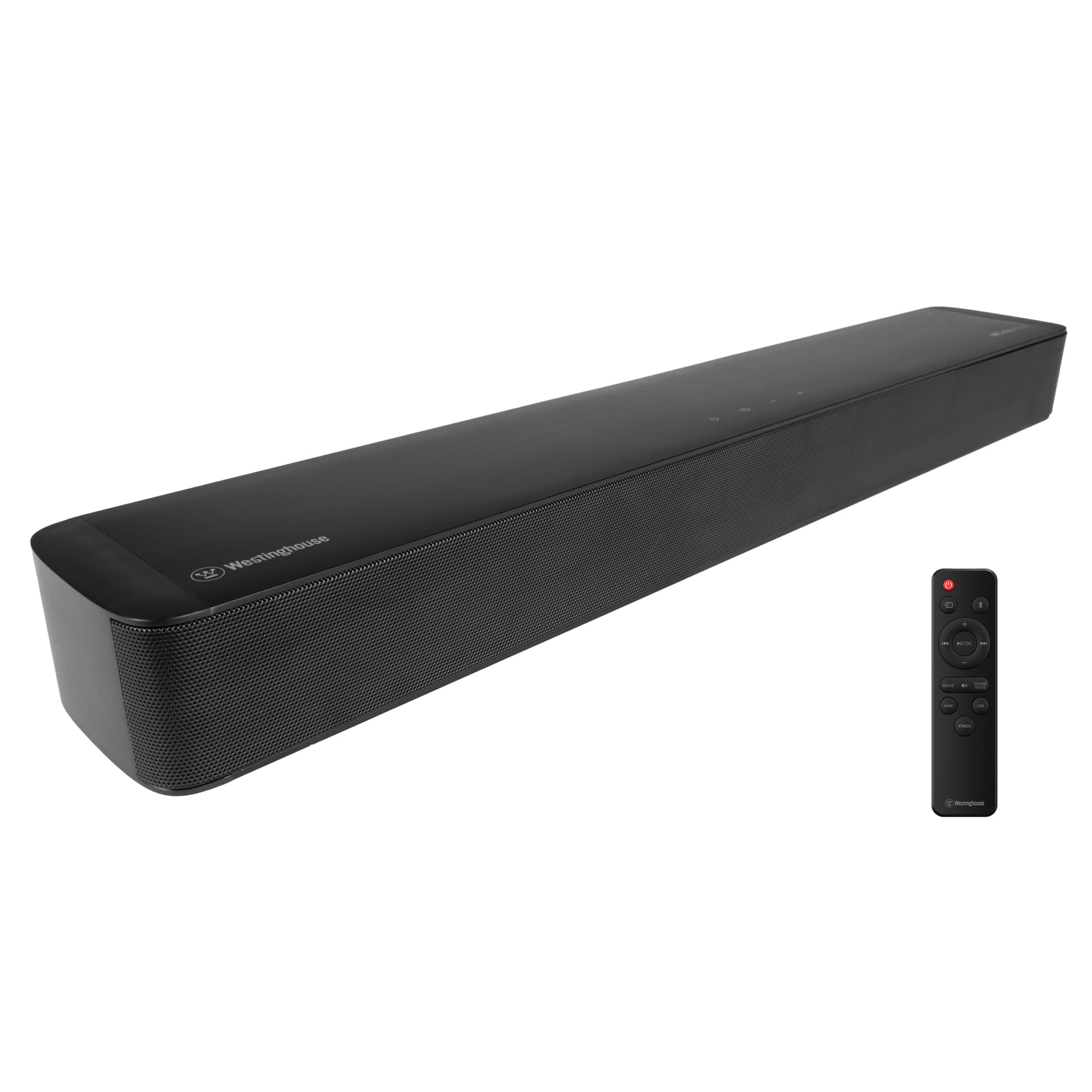
3. Westinghouse Sound Bar 2.0 Compact with Dolby Atmos, 120W
The rare 2.0 bar that puts Atmos processing in a compact footprint.
If your TV lives on a small console or in a bedroom, this bar’s compact 2.0 design with 120W of output is built to fit where bigger systems won’t. It carries Dolby Atmos and Dolby Digital Plus, which give it a sense of depth and direction usually reserved for multi-piece setups. Being Roku TV Ready is a bonus for Roku owners — setup is smooth and the included Roku remote ties right in.
Sound quality is the top draw here, with owners noting it projects into the room surprisingly well for its size rather than sounding muddy. Extended bass capabilities also come up — impressive for a bar with no separate subwoofer. Connectivity is the second strength: HDMI ARC handles the TV remote control, and Bluetooth, USB, Optical, and 3.5mm AUX give you plenty of device options. Wall-mount hardware and an HDMI cable come in the box.
The honest caveat: the “mode” indicator on some units is only a light sequence with no clear labeling, so cycling through sound modes takes a bit of trial and error. A few buyers have also hit wall-mount bracketry that didn’t line up cleanly with certain TV stands, needing a workaround. Those are minor for a 2.0 bar at this tier. The Westinghouse runs 2.0 channels versus the Sonos Arc Ultra’s 9.1.4, so don’t expect the same Atmos precision.
Who it fits: Roku households and anyone with a compact TV setup who wants Atmos processing and clear dialogue without adding a subwoofer box.
The catch: No dedicated subwoofer means bass stays modest, and the mode indicator takes some getting used to.
A natural fit for: Roku TV owners and small-room setups where a compact bar with real Atmos processing is the priority.
Second-guess it if: you want strong low-end extension — a 2.0 bar without a subwoofer won’t deliver rumble the way a 2.1 does.
4. TCL S45H 2.0 Sound Bar for Smart TV

A slim 100W bar that treats apartment-sized sound like a real job.
Some rooms just don’t have space for a full surround array, and the S45H is designed for exactly those spaces. It packs Dolby Atmos and DTS Virtual:X, which simulate height and surround effects without extra speakers, and delivers up to 100W of output — enough that owners describe voices and music arriving clear and clean, not muddy. The built-in AI Sonic auto calibration adjusts the output to your specific layout via the TCL app.
What everyone appreciates is how well it handles real content: dialogue is easier to follow, music sounds more dynamic, and the low-profile size slips neatly under a TV without clutter. Connection options cover HDMI eARC/ARC, optical, Bluetooth, and AUX, and the included HDMI cable, remote with batteries, and wall-mount kit mean you’re set from the start. Once the bar takes over, the TV’s native volume drops from 30-34 to 8-11 — plenty of headroom with no distortion at normal levels.
The mixed point is the volume display itself. Some owners love the control scheme, others find it frustrating — the settings indicator is on top of the bar, only visible from directly above, which makes on-the-fly changes awkward when you’re seated. Connection and durability complaints show up too, though they’re in the minority. Below the Hisense HS2100’s 240W max output, the S45H’s 100W is honest about what it is: an apartment and bedroom bar, not a full-scale theater replacement.
What buyers gravitate to
- Dolby Atmos and DTS Virtual:X simulate surround without rear speakers or a sub
- Up to 100W output fills small-to-medium rooms with clear, non-muddy sound
- AI Sonic auto room calibration via the app tailors output to your layout
- Slim low-profile cabinet fits neatly under most TVs
- Full port set: HDMI eARC/ARC, optical, Bluetooth, AUX, USB
- HDMI cable, remote, batteries, and wall-mount kit all included
What to weigh up
- Settings display sits on top of the bar — only visible from directly above
- No separate subwoofer, so deep bass stays modest
- A minority of owners mention connection or durability issues over time
A smart call for: apartment and bedroom setups where dialogue clarity and space-saving design matter more than raw bass output.
Less ideal if: you want deep low-frequency rumble — a 2.0 bar without a subwoofer won’t deliver that punch.
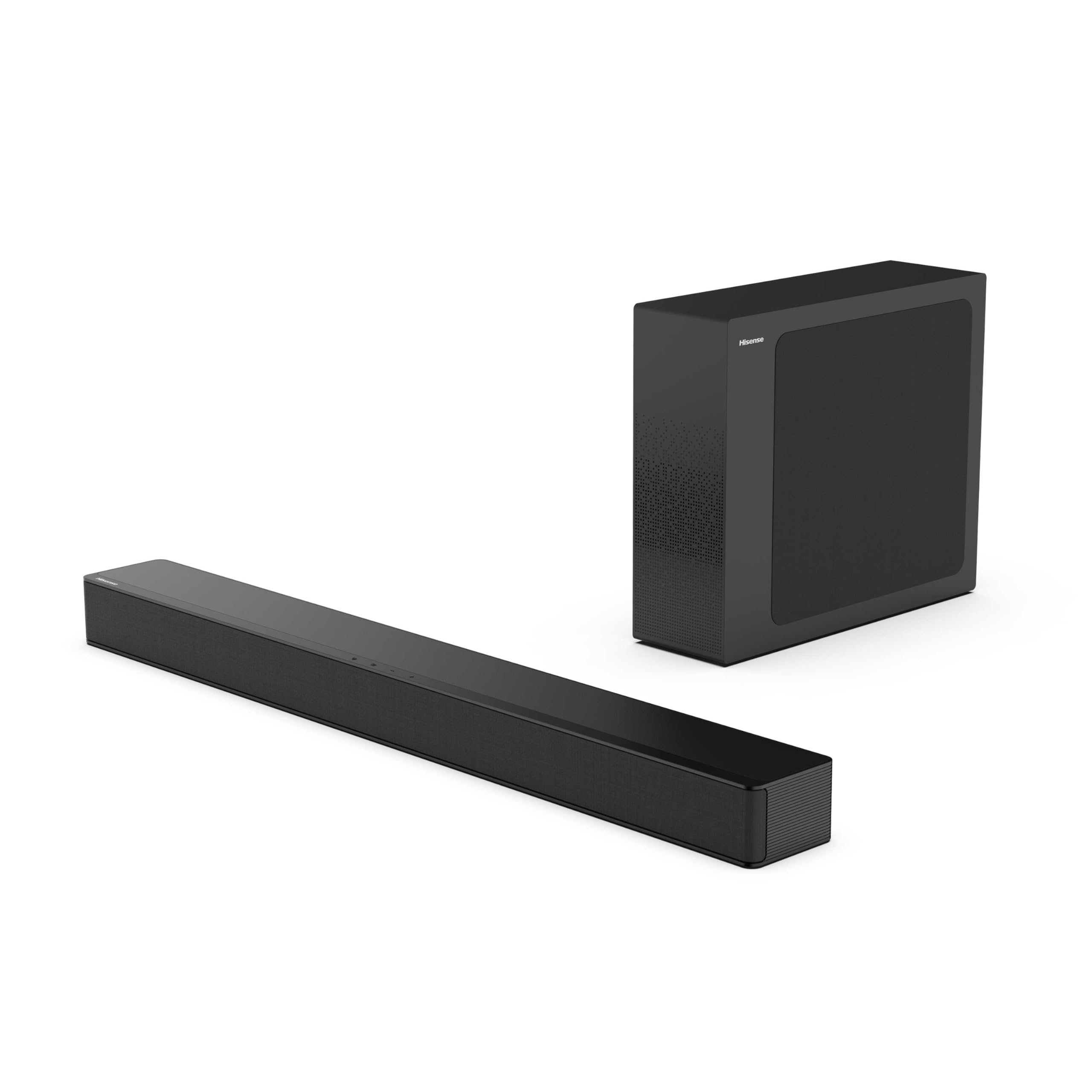
5. Hisense HS2100 2.1ch Soundbar with Wireless Subwoofer
Two speakers, a wireless sub, and 240W — the value-per-dollar king here.
The HS2100 pairs two front-facing speakers with a wireless subwoofer for a 2.1 system that puts out 240W max audio power. DTS Virtual:X adds a spatial sound layer across games, movies, and music, and Dolby Digital Plus decoding keeps effects expansive. Six preset EQ modes — spanning movies, music, sports, and games — let you change the sound signature with a tap of the remote.
This is the crowd-favorite value proposition in the whole lineup, and the praise backs it up: nearly a quarter of the aspects owners mention are about value for money, with one recurring sentiment being that it’s a night-and-day difference over standard TV audio. The included HDMI cable, single-remote setup, and compatibility across Hisense/Roku televisions mean you’re watching better audio within minutes of opening the box. Bluetooth 5.3 (a wireless standard for streaming audio) streams from your phone or tablet, and the sub fits discreetly beside a sofa.
The less reliable edge is HDMI ARC compatibility with some third-party TVs. A small number of units have hit on/off cycling handshake conflicts with specific TV and Roku device combinations, and high-volume treble can crack on some units. The bass is also characterized by some owners as more punchy than deep. Those are real caveats, but they’re not the majority experience for a bar this widely owned. It’s the most versatile budget pick — five ways to connect and a real sub, which the S45H doesn’t offer at all.
Best value read: A full 2.1 system with HDMI ARC, wireless sub, six EQ modes, and Bluetooth 5.3 checks more boxes per tier than almost anything else here.
What to know: If your TV is a Roku or Hisense model, the handshake is usually trouble-free. If it’s an older or less common brand, keep the receipt handy in case ARC compatibility needs a workaround.
The unequivocal pick for: anyone who wants a subwoofer-included system that sounds dramatically better than TV speakers without spending a lot.
Caution for: older or off-brand TVs where HDMI ARC handshake conflicts are a known risk.
6. Samsung HW-B400 2.0 Channel Sound bar

A slim Samsung companion that hides bass inside the bar — no sub to place.
If you have a Samsung TV and want the simplest possible upgrade, this is the one shaped for you. The HW-B400 packs a built-in woofer right into its 25.23-inch-wide cabinet, so there’s no separate box to plug in. HDMI ARC means your Samsung TV remote runs the whole system — power, volume, and sound effects — and surround sound expansion widens the stage without needing extra speakers. It runs on 110-240V for worldwide use.
A genuinely nice touch is the “do not disturb” behavior: it lowers volume and minimizes bass so late-night viewing doesn’t wake the house. Setup is quick, and buyers appreciate that it synced smoothly with Samsung TVs, Fire TV controllers, and Dish TV boxes. Sound quality is exactly what you’d expect — an honest improvement over stock TV speakers for casual viewing. The bar’s own slim proportions match Samsung’s TV design language, which helps it disappear visually.
Not everything lines up though. Some units ship without the HDMI cable that the listing implies is included, and owners who needed it had to buy their own. That’s the number-one frustration, and it’s worth knowing before you open the box. The rest of the story is a slim, honest 2.0 bar — it doesn’t chase Atmos or spatial audio the way the TCL S45H does, because that’s not the point here. If a single remote, a clean install, and good-enough sound is the goal, this delivers all three.
What owners call out: The single-remote convenience and ease of pairing with Samsung ecosystem devices come up most in feedback, which fits the bar’s whole design philosophy.
The honest snag: HDMI cable inclusion has been inconsistent based on customer feedback, so budget for buying a spare if your setup needs one.
Suits Samsung-TV households and minimalists: one remote, no external sub to hide, and a genuinely slim cabinet.
Skip if you want Atmos or a separate subwoofer: this is a straightforward 2.0 bar, not a multichannel replacement.
7. TCL S55H 2.1 Sound Bar with Wireless Subwoofer

The S45H’s bigger sibling — same app smarts, plus a dedicated sub.
Step up from the S45H and you get a wireless subwoofer plus 220W of output, which is why the low-end rumble actually lands here. A 5.5-inch driver lives in the bar itself, while the companion sub takes over the deepest frequencies so dialogue stays crisp in the mids. Dolby Atmos and DTS Virtual:X both ride on top, and AI Sonic auto calibration tunes the output to your specific room via the TCL app. HDMI eARC/ARC, optical, Bluetooth, and AUX cover almost any TV or phone.
Sound quality is where this one shines — a very large share of owner feedback zeroes in on it, and the sentiment is consistent: it’s a huge upgrade over stock TV sound, with bass you can feel even at volume 20. The wireless sub pairs on its own without extra cables, setup takes minutes through HDMI ARC, and the bar looks sleek enough to leave in plain view. TCL TV owners get an extra-smooth handshake.
The honest limits: this is entry-level audio, and nothing changes that. Some customers note the sub is directional and slightly hard to blend with the bar, and the light output indicators run off the top of the bar rather than the front, which is fine if you’re standing but quiet when you’re seated. The remote also feels basic. The bigger consideration is physical size — the bar runs a bit larger than expected and might not slot under every TV. Set expectations at “great for the tier” and it delivers; expect audiophile-scale detail and you’ll be disappointed.
The strongest cases for it
- 220W output plus a wireless subwoofer for bass that actually thumps
- Dolby Atmos and DTS Virtual:X push effects above a flat 2.1 layout
- AI Sonic auto calibration and TCL app control keep setup simple
- Wireless sub pairs instantly — no cable runs to the corner
- eARC/ARC, optical, Bluetooth, AUX inputs cover most setups
Limits worth knowing
- Bar is larger than expected and may not fit under every TV
- Sub can be directional and slightly tricky to blend with the bar
- Light-based indicators sit on top of the bar, not the front
- Remote feels basic compared with the sound quality
A solid step up for: buyers who want entry-level Atmos plus a real subwoofer and don’t mind a bigger footprint under the TV.
Keep looking if: your TV console has minimal clearance or you want an audiophile-grade sub blend — this bar asks for a bit of room.
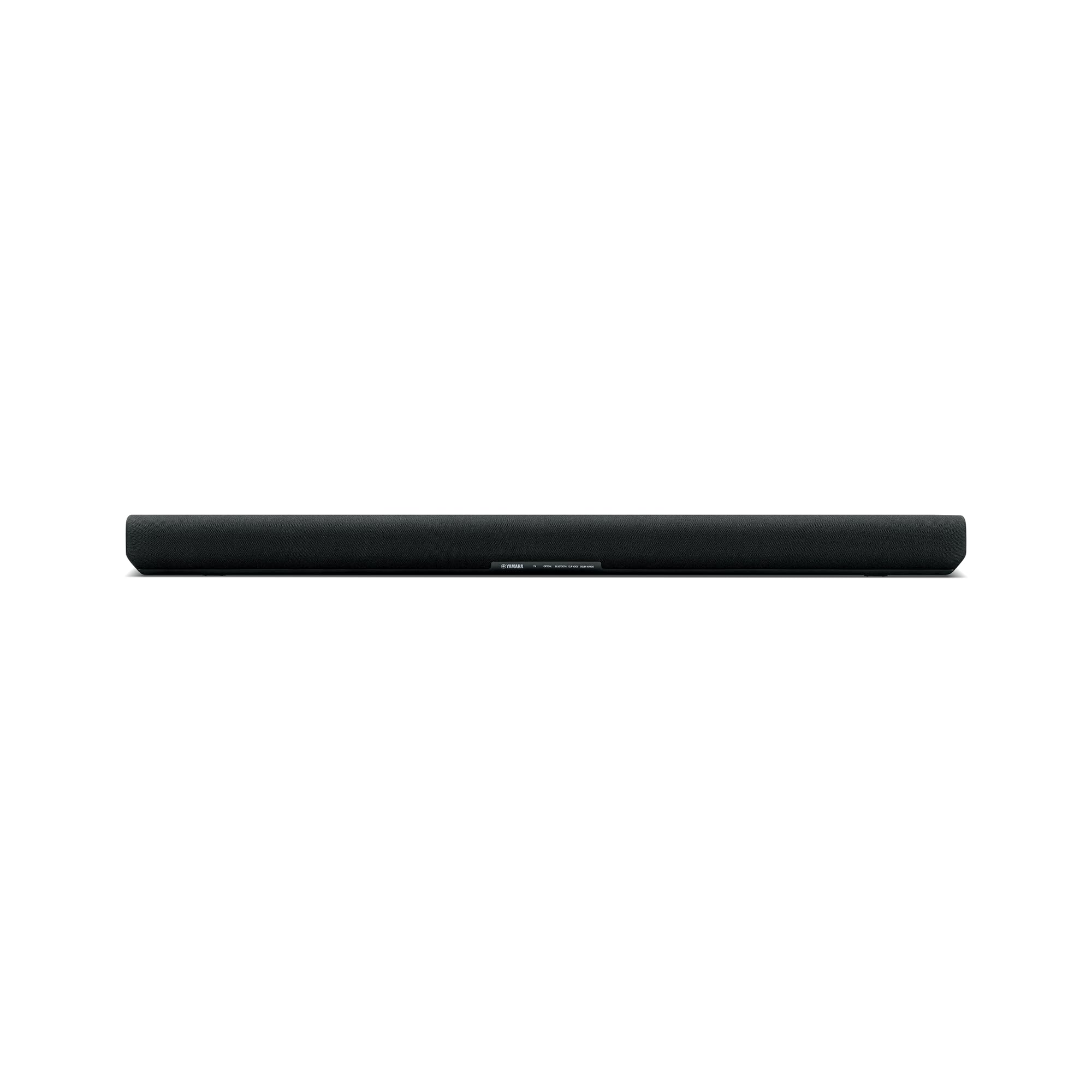
8. Yamaha SR-B30A Sound bar with Built-in Subwoofers
Two subwoofers, one bar, zero extra boxes and a sub pre-out for later.
Two subwoofers live inside this bar’s cabinet, so you get real bass without needing to plug in a separate unit or find floor space for one. That makes it a natural fit for apartments and small rooms where a dedicated sub is awkward. Add Dolby Atmos with Yamaha True Sound, Clear Voice technology for dialogue, and HDMI eARC/ARC for uncompressed high-bitrate audio, and the package handles movies, games, and music without needing to be reconfigured.
Sound quality is what owners rave about most — clarity, balance, and a “full, no hollow feel” keep coming up. The HDMI eARC connection holds steady without cutouts, and setup takes about two minutes with the included HDMI cable. Bluetooth multipoint lets you switch between two devices, and the on-bar controls plus app give you Movie, Stereo, Standard, and Game presets. If you already own a powered subwoofer, there’s a sub pre-out that lets you pair it directly — a feature that’s genuinely rare at this tier.
The main trade-off is on the app side. Some owners describe it as basic and occasionally needing a reconnect, and there’s no Bluetooth headphone support. If you have a Bluetooth source playing while the TV is on via eARC, the TV takes priority and disables the Bluetooth stream. That’s a design choice you should know about if you like background music over TV sound. Also worth noting: a Night mode and Dynamic Range control are absent, and volume can occasionally spike during source changes. For a bar this size with dual subs, those are manageable trade-offs.
Where it shines: Dual built-in subwoofers, Clear Voice dialogue clarity, and a sub pre-out for buyers who already own a powered sub — a rare combination in a single-box bar.
Where it asks patience: The app is on the basic side, and TV/Bluetooth priority takes getting used to.
An easy call for: buyers who want genuine bass without a separate subwoofer box, especially those who already own a powered sub to add on.
Not for you if: you want a rich app experience or Bluetooth headphone support — the companion app here is deliberately simple.
9. Bose Smart Ultra Dolby Atmos Soundbar

Six transducers and AI dialogue balancing make this the premium voice-control flagship.
The Smart Ultra puts six transducers to work, including two custom-engineered upward-firing dipole speakers that aim sound at the ceiling for overhead effects. Dolby Atmos with Bose TrueSpace places audio in different parts of the room, and A.I. Dialogue Mode balances voice against surround sound so lines stay intelligible through chaotic scenes. Setup uses a single HDMI eARC or optical cable, and the ADAPTiQ headset that comes in the box measures your room to correct the output.
What buyers consistently praise is how full and clear it sounds — dialogue lands crisp and the spatial imaging makes it feel like speakers are scattered around the room. Voice control runs through Amazon Alexa, Google Assistant, and Bose Voice4Video, which lets you control the TV and cable box with your voice. Streaming supports AirPlay 2 and Chromecast, and Bose SimpleSync can group it with select Bose headphones or speakers for private listening. The compact cabinet and included remote round out a genuinely polished package.
The honest friction is setup and app behavior. Configuration requires a phone, the Bose app, a Bose account, and accepting terms — you can’t skip straight to TV via HDMI without initial registration. Some reviewers point out the connection takes a minute or two to fully sync, and one common complaint is the bar going to sleep and needing to be re-paired with the TV. The app usability side is where the reliability criticisms land. Those are the reasons the rating sits at 4.2 despite genuinely excellent sound — because the hardware shines and the software asks patience.
Where it wins
- Six transducers including upward-firing dipole speakers for real Atmos height
- A.I. Dialogue Mode keeps voices balanced against surround effects
- Alexa, Google Assistant, and Bose Voice4Video voice control built in
- ADAPTiQ room calibration headset included in the box
- AirPlay 2, Chromecast, SimpleSync pairing with Bose headphones or speakers
Where it asks patience
- Setup requires the Bose app, an account, and terms acceptance
- App usability and reliability gripes show up consistently
- Some units need re-syncing with the TV after sleep
- Bass is satisfying but lighter than a bar with a dedicated sub
A clear choice for: buyers who want premium Atmos sound with voice control and don’t mind doing a proper app setup to get there.
Better skipped for: anyone who wants plug-and-play simplicity — the Bose app dependency is real and unavoidable.
Understanding the Specs
Channels and layout
Channel numbers like 2.0, 2.1, 5.1.2, and 9.1.4 are simply shorthand for how many speakers fire in which direction. The first digit counts ear-level directions, the second counts subwoofer channels, and the third counts overhead height speakers. A 2.0 bar — like the Westinghouse Compact or the TCL S45H — sends only left and right, so there’s no dedicated bass driver. A 2.1 like the Philips B7305, Hisense HS2100, or TCL S55H adds a separate subwoofer. A 9.1.4 like the Sonos Arc Ultra fills the room with spatial effects; a bar like that needs Atmos-encoded source material to shine.
ARC, eARC, and Dolby Atmos
ARC (Audio Return Channel) uses a single HDMI port to send TV audio back to the soundbar while letting the TV remote change volume. eARC is the newer version that carries more data — enough for Dolby Atmos and lossless audio. If your TV has eARC and you’re pairing a bar like the Yamaha SR-B30A or Bose Smart Ultra, that’s what open up the highest-quality audio the source can deliver. Standard ARC still handles Dolby Digital Plus, which is what most streaming services send.
Room calibration versus dialogue modes
Calibration and dialogue modes solve different problems. Calibration — think Trueplay on the Sonos Arc Ultra, AI Sonic on the TCL S45H and S55H, or ADAPTiQ on the Bose Smart Ultra — uses a microphone to measure your room and adjust output so the sound is balanced from your seat. Dialogue modes — Clear Voice on the Yamaha, Speech Enhancement on the Sonos — boost the frequency range human speech lives in, so conversations stay intelligible over background score. Both are genuinely helpful in real rooms; neither replaces the other.
Subwoofers: built-in, wireless, and pre-out
Bass is where most buyers feel the biggest leap from TV speakers, and there are three ways to get it. Built-in subwoofers — the Yamaha SR-B30A has two, the Samsung HW-B400 has one — keep everything in one cabinet with no extra power cord. A wireless subwoofer, like on the Hisense HS2100, TCL S55H, or Philips B7305, pairs on its own but still needs its own wall outlet and some floor space. A sub pre-out on the Yamaha lets you connect an existing powered subwoofer for even more low-end control.
FAQ
What is HDMI ARC and do I really need it on a soundbar?
What’s the difference between ARC and eARC?
Will a 2.1 soundbar sound noticeably better than my TV speakers?
Do I have to buy a separate subwoofer, or will the soundbar’s bass be enough?
What are Dolby Atmos and DTS Virtual:X doing in a 2.0 or2.1 soundbar?
How much clearance do I need under my TV for a soundbar?
Can I control the soundbar with my existing TV remote?
What’s the difference between a wireless subwoofer and a built-in one?
Do premium soundbars like the Sonos Arc Ultra or Bose Smart Ultra need extra speakers to sound good?
How many channels do I really need for a bedroom or small apartment?
Final Thoughts: The Verdict
The Sonos Arc Ultra’s 4.6 stars across 700+ ratings top this list for good reason. If you want a compact Atmos bar without a subwoofer, the Westinghouse 2.0 Compact is Roku TV Ready and 120W strong in a very small footprint. And if the goal is a subwoofer-included 2.1 system at the friendliest tier, the Hisense HS2100 gives you 240W, six EQ modes, and Bluetooth 5.3 without the complexity of a premium system.
One quick nudge for the fence-sitters: the Hisense HS2100 sits at 4.2 stars across 850+ ratings — the value benchmark of this lineup.
How We Picked
We do not accept paid placement. Every pick is matched to a real buyer and a real use-case; we do not hands-on test units.
Sources & Methodology
Specifications: manufacturer listings and product documentation. Review insights: verified customer reviews, as of September 2026. Pricing: not shown on this page (it changes often); check the current price via the retailer link.
As an Amazon Associate, Gadgets Feed earns from qualifying purchases. This does not affect which products we feature.