
Bunions create a painful chain reaction, forcing your foot mechanics out of alignment and rolling your arch inward with every step. The right arch support doesn’t just cushion a sore joint — it repositions the entire foot to offload pressure from that bony protrusion so you can walk without wincing.
I’m Min — the co-founder and writer behind Gadgets Feed. I’ve spent weeks analyzing podiatrist insights and rigorously comparing the specific arch profiles, material rigidity, and metatarsal pad placement that actually counter the mechanics of bunion deformity in real-world shoe fits.
Whether you need rigid carbon fiber for toe joint control or cushioned support for long days on concrete, this guide breaks down the proven designs and construction details that matter in the best arch support inserts for bunions.
How To Choose The Best Arch Support Inserts For Bunions
Bunions are a structural foot deformity where the big toe drifts toward the second toe, creating a bony bump at the MTP joint. Simply padding that bump ignores the root cause: an unstable arch and collapsed medial column. The right insert must support the arch and limit big toe motion to prevent further misalignment. Here are the features that separate effective orthotics from useless cushions.
Morton’s Extension vs. Metatarsal Pad
A Morton’s extension is a rigid plate that extends under the big toe joint, limiting dorsiflexion and reducing grind on the arthritic joint — essential for hallux limitus and rigidus that often accompany bunions. A metatarsal pad sits behind the ball of the foot, lifting the metatarsal heads to offload pressure from the painful joint. Some cases benefit from both; severe bunions with restricted motion need the extension, while milder bunions with forefoot pain need the pad.
Arch Height and Heel Cradle Depth
Bunions almost always coexist with overpronation — the arch collapses inwardly, rolling the foot and worsening toe drift. Look for firm, medium-height arch support that aligns the heel and forefoot. A deep, U-shaped heel cup (at least 5–7 mm deep) locks the calcaneus in neutral position, preventing the entire foot from sliding into the bunion-exacerbating pronated posture.
Material Rigidity and Flexibility
Nylon and polypropylene semi-rigid shells provide controlled motion for daily walking but bend enough for comfort. Carbon fiber inserts offer maximum stiffness with minimal thickness — ideal for fitting into low-profile shoes while delivering full toe-joint immobilization. Foam or gel inserts alone lack the structural integrity to counteract the mechanical forces driving bunion progression; they only mask symptoms temporarily.
Quick Comparison
On smaller screens, swipe sideways to see the full table.
| Model | Category | Best For | Key Spec | Amazon |
|---|---|---|---|---|
| PowerStep Pinnacle | Insole | All-day wear plus pronation control | Moderate pronation arch; 2.4 oz | Amazon |
| PowerStep Morton’s Extension Carbon Fiber | Carbon Fiber | Arthritic big toe joint relief | Carbon fiber plate; 5.93 oz | Amazon |
| Morton´s Extension Carbon Fiber Rigid Insole | Carbon Fiber | Rigid big toe immobilization | 3K carbon fiber; 2.89 oz | Amazon |
| Kelaide Metatarsalgia Insoles | Insole | Ball-of-foot and bunion pressure | Built-in metatarsal pad; 5.29 oz | Amazon |
| 10 Seconds Pressure Relief 3030 | Cushion Insole | Daily cushioned comfort | Plastazote memory foam topper; 4.97 oz | Amazon |
| Psveb Professional Heavy Duty Support | Insole | High-weight work boot use | Dual PORON cushioning; 8.15 oz | Amazon |
| Pedag Holiday 3/4 Length Sheepskin | 3/4 Orthotic | Low-profile dress and loafers | Leather shell; 1.44 oz | Amazon |
In‑Depth Reviews
1. PowerStep Pinnacle Insoles

The PowerStep Pinnacle delivers a podiatrist-grade semi-rigid nylon shell with a deep heel cradle that actively corrects overpronation — the primary mechanical driver of bunion progression. The full-length design eliminates the need for trimming, saving you the hassle of transferring the shape from old shoes. Users consistently report a dramatic reduction in plantar fasciitis pain alongside bunion discomfort, a sign that the Pinnacle’s arch contour stabilizes the entire foot chain from heel to toe.
The dual-layer cushioning starts firm but breaks in after roughly three days of walking, settling into a support profile that works for both running shoes and casual sneakers. At 2.4 ounces, the Pinnacle is light enough for daily rotation without introducing noticeable bulk inside the shoe. Several reviews from users weighing over 200 pounds confirm the shell doesn’t flatten over time, maintaining its spring through 10-hour shifts.
Because the arch support is fixed rather than adjustable, those with very low or very high arches may find the medium profile either too aggressive or insufficient. For the majority of standard-arch users dealing with mild to moderate bunions and concurrent pronation, however, the Pinnacle is the most versatile and clinically proven entry point.
Why it’s great
- Semi-rigid nylon shell corrects overpronation immediately
- No trimming required — fits most athletic and casual shoes
- Podiatrist-backed design with proven relief for heel and arch pain
Good to know
- Medium arch profile doesn’t accommodate extreme low/high arches
- Firm heel posting may feel stiff during first 15,000 steps
2. PowerStep Morton’s Extension Carbon Fiber Orthotic

This PowerStep model integrates a lightweight carbon fiber plate that runs under the entire big toe joint, fundamentally changing how the foot loads during push-off. For bunions complicated by hallux rigidus or turf toe — where every stride grinds the arthritic joint — the Morton’s extension limits dorsiflexion to prevent painful compression of the bunion bump. The carbon fiber sits flush within a full-length contoured shell, so the rigidity is directed exactly where it’s needed without raising your heel inside the shoe.
Users with fibromas, bone spurs, and post-fusion ankles report immediate walking pain relief, confirming that the plate offloads the first ray effectively. The arch support is firm and shaped for standard arches, with a deep heel cradle that controls pronation without fighting the toe plate. Several reviews note that Hoka Arahis and other rocker-soled shoes accommodate the insert without fit issues — a rare win for a thick carbon fiber orthotic.
The price point reflects the dual material construction: carbon fiber isn’t cheap, and neither is the dual-layer cushioning top fabric. The break-in period requires loosening laces and gradually building up wear time. If your bunion pain originates from toe-joint arthritis rather than simple pronation, this is the single most effective insert on the list.
Why it’s great
- Carbon fiber plate stops painful big toe extension
- Dual-layer cushioning reduces impact without sacrificing stability
- Deep heel cradle locks pronation even during jogging and hiking
Good to know
- Requires consistent break-in period to avoid arch soreness
- Premium price limits it to those with confirmed big toe joint issues
3. Kelaide Metatarsalgia Arch Support Insoles

The Kelaide insoles target the specific pressure point where bunions cause the most forefoot discomfort — the metatarsal heads behind the ball of the foot. The raised metatarsal pad lifts the transverse arch, redistributing weight away from the painful MTP joint and the bunion bump itself. Users with Morton’s neuroma alongside bunions find the 10–12 mm pad height effectively spreads the metatarsal heads without the rigid edge that hard plastic pads sometimes create.
The neutral arch support plate is semi-rigid, offering more stability than a foam-only insole but less corrective force than a full carbon fiber extension. This makes the Kelaide a smart middle ground for bunions that haven’t yet progressed to joint stiffening but cause significant ball-of-foot pain with every step. Breathable fabric and a relatively low heel cup (approx 4 mm) keep the insert feeling light during all-day wear.
The primary limitation is the metatarsal pad’s position — it sits in a fixed location and cannot be adjusted for foot length variations. Users with shorter toes may feel the pad positioned slightly too far forward. The foam layer compresses after roughly four to six months of heavy use, requiring replacement to maintain the same level of forefoot lift.
Why it’s great
- Integrated metatarsal pad offloads bunion area directly
- Semi-rigid arch provides pronation control without extreme stiffness
- Breathable top layer minimizes heat and friction for long wear
Good to know
- Metatarsal pad position is fixed; may not suit all foot lengths
- Foam layer compresses faster than rigid shell options
4. Psveb Professional Heavy Duty Support Orthotics

The Psveb orthotic is built around a Golden Triangle three-point support system that braces the forefoot, arch, and heel simultaneously — exactly the kind of structural triangulation bunions need when overpronation is driven by heavier body weight. The double PORON cushioning layers absorb high-impact shock without bottoming out, a critical factor for users over 230 pounds who report that standard insoles flatten within two weeks. The deep U-shaped heel cup prevents lateral slippage that would otherwise torque the bunion joint during long work shifts on concrete.
The medium arch contour sits higher than most mass-market inserts, providing noticeable lift for collapsed medial columns. Users confirm 9–10 hour shifts in work boots with reduced foot fatigue and no odor after three weeks of daily use, thanks to the sweatproof PU top layer. The trim-to-fit design requires cutting down the forefoot to match shoe size, which introduces some opportunity for user error if the cut line is not followed precisely.
The thickness of the full PU layer — roughly 5–6 mm under the heel — may create tightness in low-volume sneakers and dress shoes. For work boots, hiking boots, and roomier athletic shoes, the thickness is a non-issue. If you carry extra body weight and need an insert that won’t compress under load, the Psveb outperforms many premium-priced competitors at a more accessible cost.
Why it’s great
- Triangulated support braces forefoot, arch, and heel simultaneously
- Double PORON layers resist compression for heavy users
- Anti-odor and breathable fabric withstands prolonged daily wear
Good to know
- Thick PU layer may crowd low-volume sneakers or dress shoes
- Some users with very flat feet desire even higher arch lift
5. 10 Seconds Pressure Relief 3030 with Metatarsal Pad

The 10 Seconds 3030 deviates from the rigid-support approach by relying on a thick Plastazote memory foam topper that molds to the unique shape of your foot over the first few wears. The metatarsal pad is a soft foam rise rather than a hard plastic nub, making it ideal for bunion sufferers who also have diabetic sensitivity or neuroma pain where hard edges trigger sharp discomfort. The Poron strike pads under the heel and forefoot add impact dampening that reduces the shock transmitted to the big toe joint during walking.
The arch is classified as cushioned-medium, meaning it provides mild structural lift rather than aggressive correction. This works well for mild bunions where the primary issue is forefoot pressure and fatigue, but users with moderate overpronation will likely find the arch insufficient to prevent foot collapse. The foam’s memory properties mean it gradually takes on the contour of your foot, delivering a custom-like fit over roughly five wears.
The main tradeoff is longevity — Plastazote compresses faster than polypropylene or carbon fiber, and users report noticeable flattening after three to four months of daily use. The step-in feel out of the box is plush, but the insert is not designed to arrest bunion progression. It’s a comfort-focused option best used as a first step into orthotics or for low-impact daily walking.
Why it’s great
- Moldable Plastazote topper creates a custom foot bed over time
- Soft foam metatarsal pad suits sensitive and diabetic feet
- Excellent heel and forefoot shock absorption
Good to know
- Foam compresses noticeably within 3–4 months of daily use
- Mild arch lift insufficient for moderate to severe overpronation
6. Morton´s Extension Carbon Fiber Rigid Insole
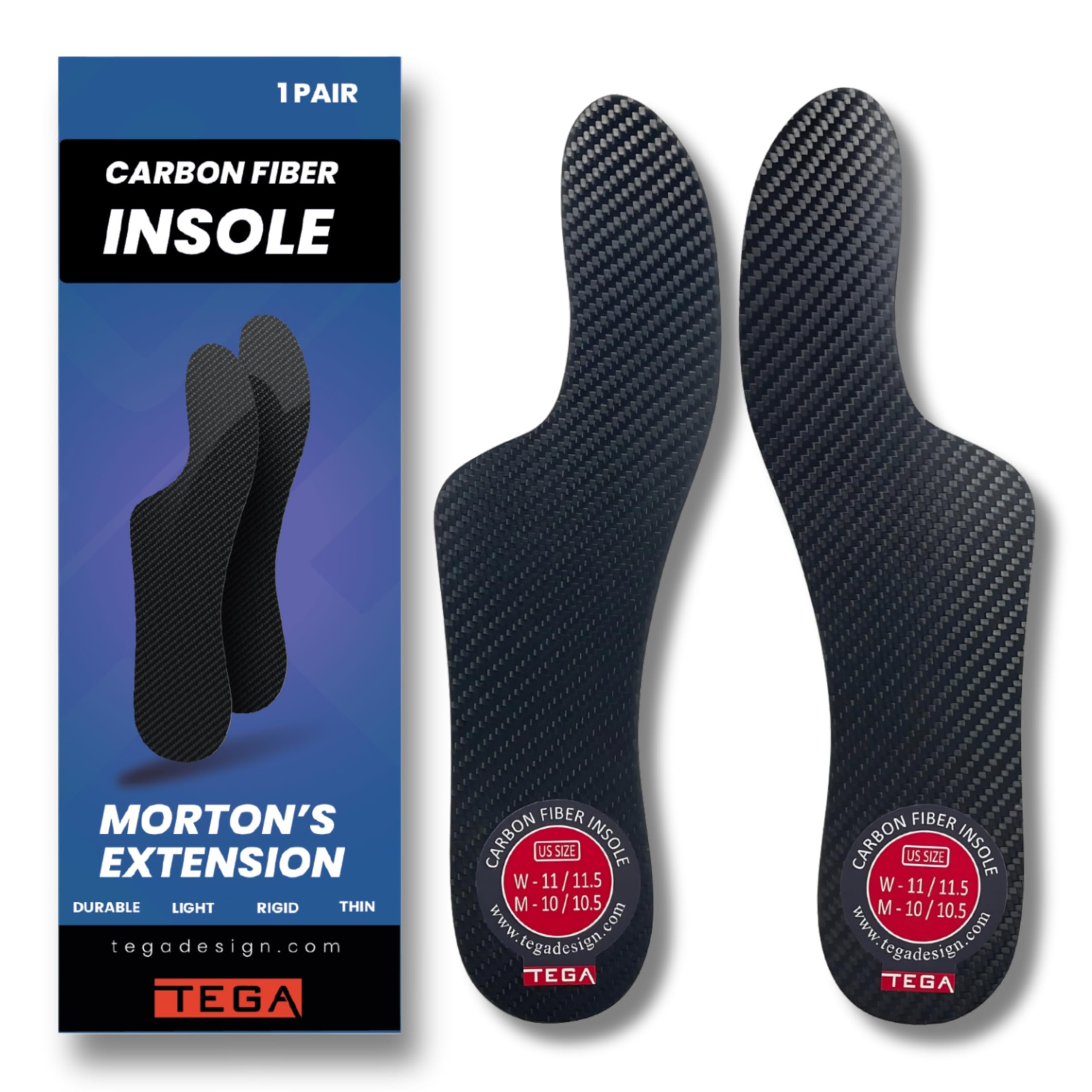
This is the purest Morton’s extension on the market — a unibody 3K carbon fiber plate with zero cushioning or arch contour built in. It functions like a stiff splint under the first ray, forcing the big toe joint to remain neutral through the entire gait cycle. For bunions where the toe has already drifted significantly and the joint is arthritic, this bare-plate design delivers the most direct immobilization without the extra height and weight of a full-length insole.
The thickness is just 1.5 mm, which lets you slide the plate under your existing insole or directly inside low-profile shoes like loafers and ballet flats — virtually impossible with full orthotics. Users with fused ankles and severe hallux rigidus describe the effect as “instant relief” because the plate eliminates the painful end-range dorsiflexion that triggers bunion compression. The mirror-set design means you receive a pair for both feet, or you can double up one foot for additional stiffness.
The carbon fiber edges are sharp out of the box and can cut into the shoe lining if not positioned precisely inside the insole pocket. Some users report that the plate wears out at the tip over time, causing small carbon flakes that dig into the toe. It’s a niche tool — perfectly suited for rigidus-dominant bunions, but too aggressive for mild cases that only need arch support.
Why it’s great
- Extremely thin 1.5 mm carbon fiber fits in tight shoes
- Complete immobilization of the big toe joint for arthritic relief
- Sold as a pair for both feet or doubling up on one foot
Good to know
- Sharp edges require careful placement to avoid shoe damage
- No arch support or cushioning — purely a toe-control device
7. Pedag Holiday 3/4 Length Sheepskin Orthotic Inserts

The Pedag Holiday is a 3/4-length orthotic that terminates before the toe box, leaving toe room for bunions and hammertoes that cramp inside full-length inserts. The sheepskin leather top layer provides natural moisture wicking and comfort against bare skin, while the hard plastic bottom shell delivers firm arch support for overpronation correction. The built-in metatarsal pad and heel cushion provide the essential support architecture for bunion-related forefoot pain without occupying space in the toe area.
Handmade in Germany, the Holiday uses a thin profile — just 3 mm thick at its thickest — that fits into loafers, oxfords, and flat ballet shoes where full orthotics simply cannot go. The APMA Seal of Acceptance confirms its medical credibility.
The adhesive strip on the bottom is designed to secure the insert to the shoe’s footbed, but this prevents easy transfer between multiple shoe pairs. The arch height, while firm, is moderate — users with very high arches or extreme flat feet may find the correction insufficient. For bunion sufferers who need support in dress shoes or low-profile footwear, the Holiday is the only viable choice that doesn’t compromise on arch structure.
Why it’s great
- 3/4 length leaves critical toe room for bunion deformity
- Thin sheepskin leather profiles fit dress shoes and loafers
- APMA Seal of Acceptance with decade-long durability
Good to know
- Adhesive pad prevents swapping between multiple shoe pairs
- Moderate arch height won’t satisfy severe pronation or flat feet
FAQ
Can arch support inserts actually reverse a bunion deformity?
Should I choose a rigid carbon fiber insert or a cushioned foam insert for my bunion?
Will arch support inserts fit my wide or extra-wide shoes?
How often should I replace arch support inserts for bunions?
Final Thoughts: The Verdict
For most users, the best arch support inserts for bunions winner is the PowerStep Morton’s Extension Carbon Fiber Orthotic because it combines the structural toe-joint stabilization of carbon fiber with the proven pronation-correcting arch shell that PowerStep is known for. If you want a versatile, trim-free orthotic that works for daily walking and lighter activity, grab the PowerStep Pinnacle. And for low-profile dress shoes where every millimeter counts, nothing beats the Pedag Holiday 3/4 Length Sheepskin Orthotic.