
A bowhunter’s shot dies at the wrong yardage marker. The difference between a clean harvest and a wounded animal often comes down to feet, not yards. An archery sight rangefinder must compensate for angle, read low-reflectivity targets like deer hide, and deliver sub-yard precision — tools that fail at this create misses that haunt you for seasons.
I’m Min — the co-founder and writer behind Gadgets Feed. I’ve spent hundreds of hours cross-referencing laser divergence figures, angle compensation algorithms, and glass transmission specs across the biggest names in optics to separate the rangefinders that actually work for archers from overpriced gadgets.
The best gear fades into the background so you can focus on the stalk. This guide stacks the top contenders for the best archery sight rangefinder and tells you exactly which specifications matter most before you spend your money.
How To Choose The Best Archery Sight Rangefinder
Archery is the most demanding discipline for a laser rangefinder — the targets are smaller, darker, and often hidden behind brush. You aren’t shooting at a 24-inch reflective steel plate; you’re ranging a deer’s chest at 40 yards in the last five minutes of legal light. That requires specific hardware. Here is what separates a dedicated archery unit from a general-purpose rangefinder.
Angle Range Compensation (ARC) — The Real Yardage
Standard line-of-sight distance is irrelevant for a bowhunter when you’re 20 feet up a treestand. ARC technology calculates the true horizontal distance to the target, which is the number your pins need. An ARC unit with 1-degree angle precision — like the Bushnell Bone Collector 1000 — gives you genuine uphill and downhill distances. Without it, you’ll shoot high on steep angles consistently.
Archery-Specific Accuracy at Short Range
A rifle rangefinder might boast 1,500-yard range, but its accuracy at 30 yards often falls apart on dark, non-reflective surfaces. The Bushnell Broadhead solves this with a Full Spectrum ranging system that maintains ±0.3-yard accuracy out to 150 yards on 3D archery targets and animal hide. If you shoot 3D tournaments or whitetail from a stand, sub-yard precision inside 80 yards is the metric that actually matters.
Display Readability and Target Acquisition Modes
Red illuminated displays (like the Sig Sauer Buckmasters 1500) improve visibility in deep woods, but some lack manual brightness adjustment. Look for units with auto-adjusting or multi-level reticles. “Bullseye mode” and “Brush mode” are essential for archery — Bullseye locks onto small targets for pin-point accuracy, while Brush mode ignores foreground branches and reads the background deer. The Bushnell Broadhead includes both, which is rare at its price.
Quick Comparison
On smaller screens, swipe sideways to see the full table.
| Model | Category | Best For | Key Spec | Amazon |
|---|---|---|---|---|
| Bushnell Broadhead | Archery Rangefinder | Tournament 3D & Bowhunting | ±0.3 yd accuracy to 150 yd | Amazon |
| Leupold RX-FullDraw 5 | Premium Bow Ballistics | Custom Arrow Ballistics | Flightpath + Archer’s Advantage | Amazon |
| Leupold RX-1400i | Hunting Rangefinder | Long-Range Bow/Rifle Combo | TBR/W + Bow Flightpath | Amazon |
| Vortex Sonora HD 1800 | HD Optics | All-Purpose Hunting | HCD angle-comp, 1800 yd range | Amazon |
| Nikon Aculon | Lightweight Rangefinder | Pocket Carry Bowhunting | 6 oz, 8-1600 yd range | Amazon |
| Bushnell Bone Collector 1000 | Value Hunting Rangefinder | Budget-Conscious Bowhunters | ARC + 2X brighter optics | Amazon |
| Sig Sauer Buckmasters 1500 | Rifle/Bow Hybrid | Buckmasters BDC Scopes | 8 onboard ballistic groups | Amazon |
| Precision Pro NX9 | Golf Rangefinder | Bowhunting/3D (Used as Golf Tool) | Slope switch, 900 yd range | Amazon |
| Halo Optics XL 600 | Budget Entry Rangefinder | First-Time Bowhunters | Angle Intelligence, 600 yd max | Amazon |
In‑Depth Reviews
1. Bushnell Broadhead Hunting Laser Rangefinder

The Bushnell Broadhead was engineered specifically for archery, not adapted from a rifle unit. Its Full Spectrum ranging system maintains ±0.3-yard accuracy out to 150 yards on dark, low-reflectivity targets — that includes 3D archery foam, deer hide, and black bear fur. Most rangefinders struggle below 50 yards on these surfaces; the Broadhead treats them the same as white reflective steel.
<
The ActivSync display is the smartest auto-adjustment system in this price range — the reticle and numbers morph from black to red depending on your background, so you never lose the reading against dark timber or a bright sky. Combined with Bullseye mode (for small target acquisition) and Brush mode (which ignores foreground branches to read the deer behind them), the Broadhead gives tournament shooters and bowhunters two distinct tools in one body.
The 6x24mm configuration delivers a wide enough field of view to track moving game, and ARC technology with 1-degree angle precision handles treestand shots up to 25 feet high. The only compromise is the smooth plastic exterior, which lacks the rubberized armor of premium units — but the internal performance outweighs the feel. At 5.9 ounces, it’s one of the lightest archery rangefinders you can buy.
Why it’s great
- Exceptional accuracy on dark archery targets with ±0.3 yards to 150 yd
- ActivSync display auto-adjusts reticle color for maximum contrast in any light
- Dual Bullseye and Brush modes solve real archery ranging problems
Good to know
- Plastic housing feels less rugged than rubberized competitors
- Ranging beyond 150 yards drops in accuracy on low-reflectivity targets
2. Leupold RX-FullDraw 5 Rangefinder with DNA

The Leupold RX-FullDraw 5 is the most advanced archery-specific rangefinder on the market. Its Archer’s Advantage system uses your exact arrow weight, arrow velocity, and peep height to calculate ballistic solutions that are unique to your bow setup — no generic “bow mode” approximations. The result is an angle-compensated yardage that accounts for your specific arrow drop at every distance.
Flightpath technology takes it further by displaying the highest point of your arrow’s arc over a 2D representation of the terrain. This means you can see whether your arrow will clear a low-hanging limb or a ridgeline before you ever draw. For 3D tournament shooters shooting through tight lanes or TAC events with obstacles, Flightpath eliminates the guesswork that causes broken arrows and missed targets.
The selectable OLED display offers adjustable brightness for low-light performance, and Last Target mode ensures twigs and grass don’t accidentally register as the range. The build quality is aluminum throughout, and the DNA (Digital Network Assistant) integration allows for firmware updates. At 7.5 ounces, it’s heavier than the Broadhead, but the custom ballistics processing makes it the most accurate archery tool at any price.
Why it’s great
- Custom bow ballistics using your exact arrow weight, speed, and peep height
- Flightpath visualizes arrow clearance over obstacles before you shoot
- Premium aluminum construction with firmware update capability
Good to know
- Premium-tier price reflects advanced ballistics processing; budget bows may not benefit fully
- Initial setup requires chronographing arrow speed and precise weight measurement
3. Leupold RX-1400I TBR/W Gen 2 w/Flightpath

The Leupold RX-1400i bridges the gap between pure archery and hunting versatility. Its Bow mode includes Flightpath technology — rare in a unit that also offers True Ballistic Range / Wind (TBR/W) compensation for rifle shooters out to 800 yards. That means you can range a buck at 40 yards from a treestand with ARC correction, then switch to rifle mode for the long-range shot across a canyon on the same trip.
The TOLED display uses bright red characters with adjustable brightness settings that work in the worst low-light conditions — overcast evenings, thick brush, and pre-dawn hours where deer are most active. The 1,200-yard range on trees gives you headroom for Western hunting scenarios where you need to range across basins, but the 5x magnification is slightly tighter than the standard 6x found on most competitors, which can make target acquisition slower in close timber.
Users consistently report that the RX-1400i works in fog and light rain without losing readings — a critical trait for Pacific Northwest and Southeast archery seasons where weather changes fast. The IP54 waterproofing and aluminum body hold up to years of abuse. It’s heavier than the Vortex Sonora HD at a comparable range class, but the TBR/W wind module gives you data no other mid-range unit can match.
Why it’s great
- Dual Bow Flightpath and rifle TBR/W in one unit
- Excellent fog and rain performance for wet-season hunting
- Adjustable red display with strong low-light readability
Good to know
- 5x magnification is narrower than the 6x standard on competing models
- Slightly heavier than comparable 1,200-yard rangefinders
4. Vortex Optics Sonora HD 1800 Laser Rangefinder

The Vortex Sonora HD 1800 brings the company’s renowned HD optical system to a rangefinder, delivering exceptional resolution and chromatic aberration control that makes identifying animals at long distances far easier than standard multi-coated lenses. The fully multi-coated glass and ArmorTek exterior coating resist scratches and fingerprints, crucial when you’re pulling the unit from a damp pocket mid-stalk.
HCD (Horizontal Component Distance) technology provides angle-compensated ranges for both bow and rifle shooters, calculating the true horizontal distance that matters for accurate shot placement. The 1,800-yard reflective range gives you massive headroom for Western pronghorn hunting or spotting across canyons, while the 700-yard range on game is more than sufficient for any bow scenario. The includes soft carry case, utility clip, and CR2 battery.
The real advantage here is Vortex’s VIP Warranty — unlimited, unconditional, lifetime, and fully transferable. If you damage the Sonora HD, Vortex repairs or replaces it regardless of fault. For a rangefinder you’re taking through rain, mud, and the occasional drop from a treestand, that warranty is worth more than any spec number. At 6.1 ounces, it’s nearly as light as the Nikon Aculon but with significantly better glass and angle compensation.
Why it’s great
- HD optics with superior resolution and color fidelity over standard glass
- VIP lifetime warranty covers any damage, fully transferable
- Very lightweight at 6.1 oz with full angle compensation
Good to know
- Reticle display is not as bright as illuminated red competitors in deep shade
- No archery-specific ballistics modes like Flightpath
5. Bushnell Bone Collector 1000 Rangefinder

The Bushnell Bone Collector 1000 brings critical technology — ARC angle compensation with 1-degree precision — to a price point accessible for hunters who can’t justify the premium-tier units. Developed in collaboration with the Bone Collector brand, its 50% larger objective lens and multi-coated all-glass optic system deliver up to 2X brighter images compared to standard rangefinders, which makes a real difference in the dawn and dusk windows when deer movement peaks.
The ultra-fast scan mode updates ranges four times per second, so you can sweep a field edge and get continuous yardage updates as deer move. This is particularly useful for spot-and-stalk archery where the target shifts between trees. The 1,000-yard range covers all bow and most rifle hunting scenarios, and the IPX4 waterproof rating handles rain without hesitation. At 0.5 pounds, it’s featherlight for pocket carry.
Customer feedback consistently praises its accuracy and speed, but some users report the battery life is shorter than premium competitors — the included CR2 battery should be treated as a starter cell, not a long-term solution. It also lacks the Full Spectrum ranging system of the Broadhead, meaning dark targets may return inconsistent readings at longer distances. For the price, however, the ARC and brightness combination is unmatched.
Why it’s great
- ARC angle compensation at a very accessible price
- 50% larger objective lens provides noticeably brighter images in low light
- Ultra-fast 4 Hz scan mode for tracking moving targets
Good to know
- Included CR2 battery has short life; replace immediately with high-quality cell
- Dark target performance not as reliable as the Broadhead
6. Nikon Aculon Rangefinder
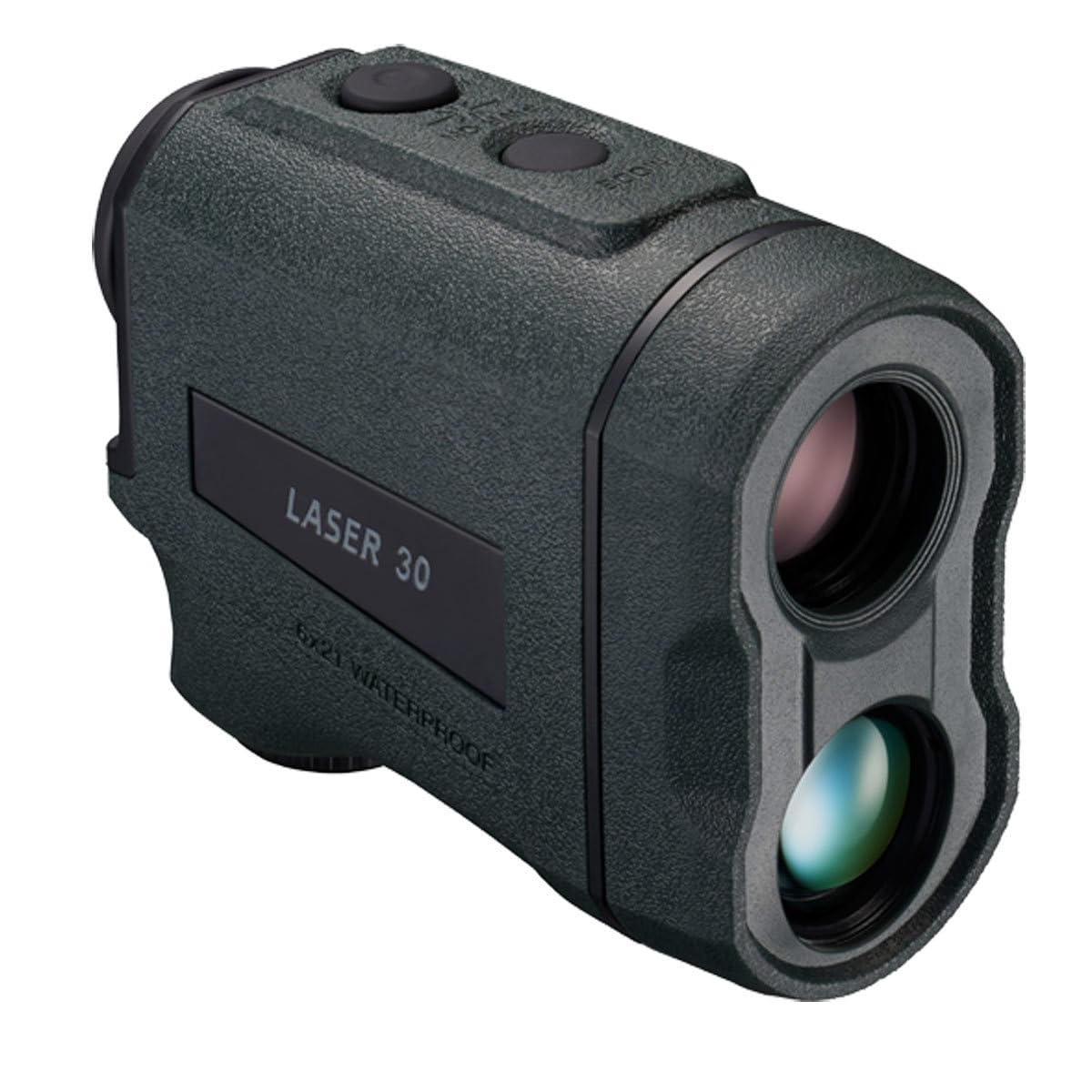
The Nikon Aculon packs into a tiny frame — 6.2 ounces with a slim profile that disappears into a breast pocket or bow pack. This is the rangefinder for the bowhunter who wants to travel ultralight and doesn’t need 1,500-yard range. Its 8- to 1,600-yard measuring range is more than adequate for eastern whitetail stands, and the 21mm objective lens keeps the form factor minimal while still delivering bright optics.
Nikon’s anti-reflection multicoated optics maximize light transmission, and the automatic brightness adjustment function fine-tunes the red internal display based on ambient light. The 6x magnification with a wide field of view makes it easy to acquire targets quickly — crucial when a buck is moving through a shooting lane. The IP54 waterproof rating handles rain and snow.
The major limitation for archers is the lack of a manual brightness control; the auto-display can wash out against bright backgrounds or appear dim in deep shadow. Some users also note that steadying the unit freehand is difficult beyond 200-250 yards, and the auto-off kicks in after eight seconds, which can be frustrating when ranging multiple animals in a group. For sub-100-yard archery shots, however, the Aculon’s accuracy is excellent against a tape measure.
Why it’s great
- Extremely lightweight and pocket-sized for backcountry bowhunting
- Nikon optics deliver clean, clear image quality
- Accurate to tape-measure standards within 100 yards
Good to know
- Auto-display brightness cannot be manually overridden in difficult light
- Short 8-second auto-off timer requires frequent re-activation
7. Sig Sauer Buckmasters 1500 Rangefinder

The Sig Sauer Buckmasters 1500 is a hybrid unit designed for hunters who carry both a bow and a rifle. Its defining feature is the “Buckmasters Mode” with 8 pre-loaded onboard ballistic groups that indicate which Buckmasters BDC holdover dot to use in a compatible riflescope. For the archer, it functions as a fast, reliable 6x22mm rangefinder with a vivid red illuminated display optimized for low-light situations.
The 1,500-yard reflective range with 600-yard range on deer gives you plenty of headroom for open-country glassing, but the real value is the build quality at its price point. The aluminum housing feels solid compared to plastic competitors, and the IP54 waterproof rating holds up against the elements. At 8.48 ounces, it’s heavier than most dedicated archery units, but the included CR2 battery and lanyard make it ready out of the box.
One notable limitation is the lack of manual brightness adjustment on the red display — some users report the reticle washes out in bright midday conditions or becomes too bright in low light. The battery type (CR2) is less common than standard coin cells, which means carrying spares is mandatory for multi-day trips. For hunters who already use Buckmasters scopes, the ballistic group integration adds genuine value; for pure archers, the Broadhead offers better target-specific performance.
Why it’s great
- Pre-loaded ballistic groups integrate with Buckmasters BDC scopes for rifle shooting
- Aluminum housing provides durable, premium feel at a mid-range price
- Red illuminated display works well in low-light hunting conditions
Good to know
- No manual brightness adjustment for the display
- Heavier than dedicated archery rangefinders at 8.48 oz
8. Precision Pro NX9 Golf Rangefinder with Slope Switch
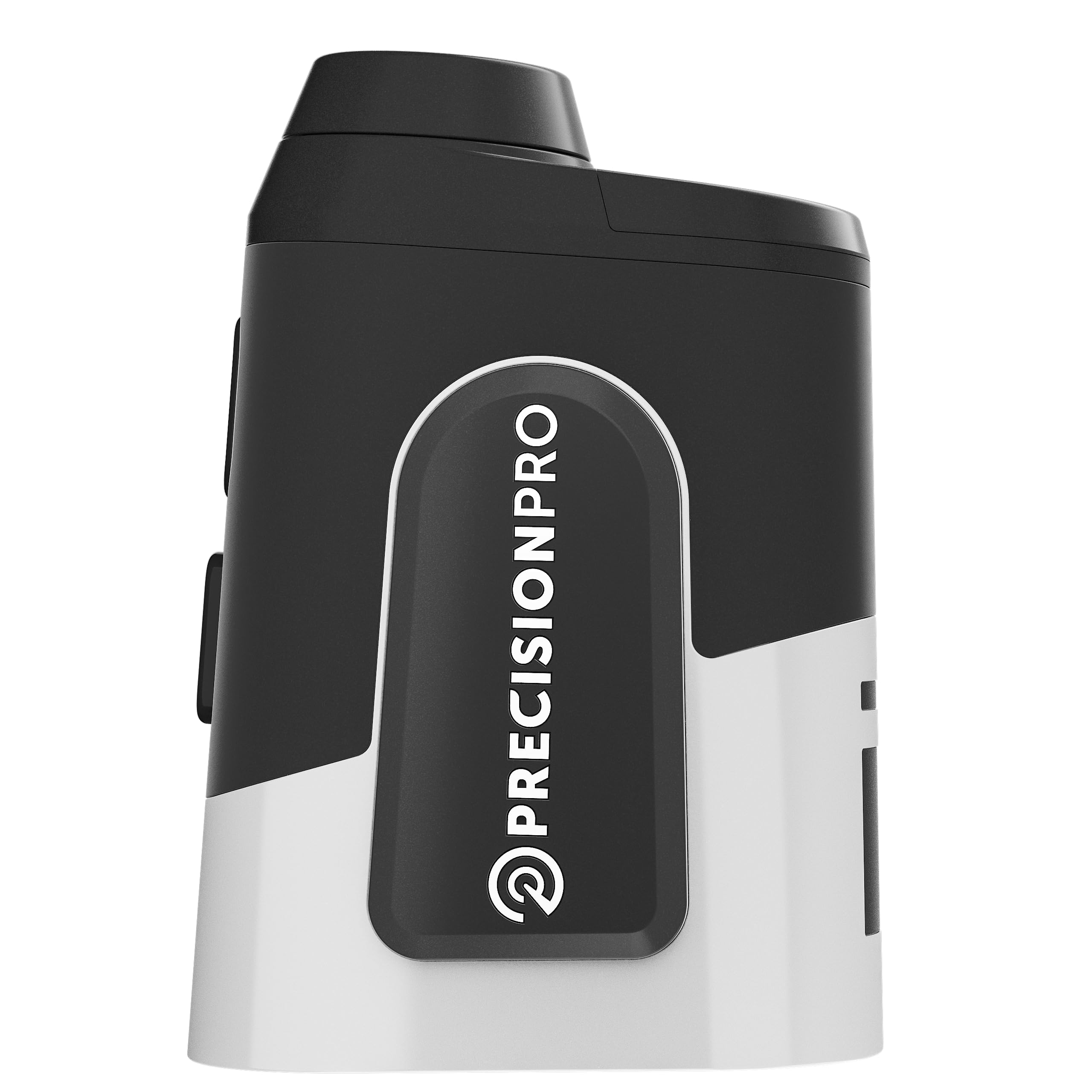
The Precision Pro NX9 is a golf rangefinder that archers have discovered works surprisingly well for 3D archery and general distance checking. Its slope switch dynamically adjusts for terrain elevation — while designed for fairways, the same adaptive slope technology calculates angle-compensated distances that are useful for bowhunting practice. The flag lock vibration, which confirms when you’ve locked onto a target, is a satisfying feedback mechanism for pin-point ranging.
The 6x magnification with HD optics delivers crisp clarity up to 900 yards, and the water-resistant design lets it survive light rain. The magnetic cart mount is a golf-specific feature, but it also sticks to metal treestand rails and truck bumpers. At 12 ounces, it’s the heaviest unit in this comparison, but the physical slope on/off switch makes it tournament-legal for golf and allows archers to toggle angle compensation quickly.
The main drawback for serious bowhunters is the lack of archery-specific features — no brush mode, no bullseye mode, and the ranging system is optimized for high-contrast golf flags rather than dark animal hide. For the price, it’s a capable cross-sport tool, but a pure archery rangefinder will outperform it on dark targets and in heavy brush. If you split time between the course and the 3D course, this is your bridge device.
Why it’s great
- Slope switch provides easy angle compensation for practice and 3D archery
- Flag lock vibration confirms target acquisition immediately
- Magnetic mount sticks to metal treestands and vehicles
Good to know
- Optimized for high-reflectivity golf flags, not dark animal hide
- Heaviest unit in this comparison at 12 ounces
9. Halo Optics XL 600 Laser Range Finder

The Halo Optics XL 600 is the entry-level gateway for new bowhunters who need angle compensation and reliable ranging without spending a season’s worth of tag fees. Its Angle Intelligence technology calculates true horizontal distance at any elevation — the exact same ARC math that powers units costing three times as much. The 600-yard reflective range is more than enough for eastern archery, where most shots occur under 40 yards.
The 6x magnification with Auto Acquisition technology targets between multiple objects almost instantaneously, giving you the correct yardage to your intended target within ±1 yard. The Scan Mode locks in multiple targets at different yardages, useful for ranging a herd of does to find the nearest shooter. The ergonomic housing with non-slip grip feels better in the hand than the price suggests, and the included CR2 lithium-ion battery means you’re ready immediately.
The biggest compromises are in glass quality and build durability — the optics are noticeably less bright than Bushnell or Vortex units in low light, and the plastic housing won’t survive repeated drops onto rocks. The battery drain is real; several users report the stock battery dying within months. Replace it with a high-quality CR2 immediately, and this unit becomes a capable tool for the budget-conscious archer. For the price, the Angle Intelligence alone justifies the purchase.
Why it’s great
- Angle Intelligence provides true horizontal distance at any elevation
- Auto Acquisition and Scan Mode for fast multi-target ranging
- Ergonomic non-slip grip feels better than its price suggests
Good to know
- Glass quality and brightness are noticeably lower than premium units in low light
- Plastic housing lacks durability for hard-use scenarios; battery should be replaced immediately
FAQ
Can I use a golf rangefinder for bowhunting?
What magnification is best for an archery rangefinder?
What does “Brush Mode” do on a rangefinder?
How much does angle compensation affect my bow shot?
Why do some rangefinders struggle with dark targets?
Final Thoughts: The Verdict
For most archers, the best archery sight rangefinder winner is the Bushnell Broadhead because it offers ±0.3-yard accuracy on dark targets, dual Bullseye and Brush modes, and a smart ActivSync display — all at a weight that disappears on your belt. If you want custom bow ballistics and Flightpath obstruction visualization, grab the Leupold RX-FullDraw 5. And for a budget-conscious entry with reliable angle compensation, nothing beats the Halo Optics XL 600 for the price.