
Our readers keep the lights on and my morning glass full of iced black tea. As an Amazon Associate, I earn from qualifying purchases.
Specs are compiled from manufacturer listings and verified buyer reviews and can change over time — please confirm the key details on the product page before buying.
Choosing an argon gas welder means deciding how much control you need over the puddle, how often you work with aluminum, and whether portability matters more than raw power output. This guide breaks down eleven models that all use the TIG process with argon shielding — from compact 90-amp machines for light garage repairs to 200-amp multi-process stations that handle aluminum, stainless, and steel.
I’m Min — the founder and writer behind Gadgets Feed. This guide is built by comparing the manufacturers’ published specifications and the patterns across verified customer reviews, so you get each pick’s real strengths and trade-offs instead of marketing spin.
Whether you are setting up a home workshop or looking for a production-ready unit for the shop floor, you will find a clear-eyed assessment of the argon gas welder that matches your skill level and the metal you weld most.
Our Picks at a Glance

How To Choose The Best Argon Gas Welder
The TIG process is about heat control. You control the heat with a foot pedal, the current type (AC or DC), and pulse settings. Every choice in this guide revolves around those three things.
AC vs DC — The Metal Decides
DC TIG works on steel, stainless steel, copper, and titanium. The arc is steady and narrow, which makes it great for thin material. AC TIG alternates the polarity to scrub the oxide layer off aluminum. If you plan to weld aluminum, you need a machine with AC output. A DC-only machine will simply ball up the puddle on aluminum and never fuse it properly.
Duty Cycle — How Long You Can Weld
Duty cycle is the number of minutes out of a ten-minute period you can weld at a given amperage before the machine needs to cool. A 40% duty cycle at 200A means four minutes of welding and six minutes of rest. Higher is better for production work. For the home hobbyist, 20% to 40% is usually enough.
Pulse TIG — The Thin-Metal Lifesaver
Pulse TIG rapidly switches between a high peak current and a low base current. This reduces overall heat input to the material, which prevents warping and burn-through on thin sheet metal. If you weld exhaust tubing, body panels, or anything under 1/8 inch, pulse control is worth the upgrade.
Quick Comparison
| Model | Best For | Max Amps | Weight | Processes | Amazon |
|---|---|---|---|---|---|
| Weldpro 200A AC/DC★ Best Overall | Overall bang for buck | 200A | 61.8 lb | 5-in-1 AC/DC TIG, Pulse, Stick | Amazon |
| Forney 100STCompact Pick | Portable light repairs | 90A | 13.7 lb | DC TIG, Stick | Amazon |
| ARCCAPTAIN iControl TIG 205PSmart Pick | App-controlled precision | 205A | 22.8 lb | DC TIG, Pulse, Spot, Stick | Amazon |
| HITBOX HBT250P | Budget AC/DC with pulse | 200A | 26 lb | 6-in-1 AC/DC TIG, Pulse, Stick | Amazon |
| Sunstac SS-250P/ACDC | Aluminum on a budget | 250A | 29.9 lb | AC/DC TIG, Pulse, Spot, Stick | Amazon |
| SSimder SD-4050Pro | Welder & plasma cutter combo | 200A | 23.3 lb | MIG, TIG, Stick, Plasma | Amazon |
| LOTOS TIG200ACDC | Hobby AC/DC with pedal included | 200A | 37 lb | AC/DC TIG, Stick | Amazon |
| ARCCAPTAIN TIG200PACDC | Waveforms for aluminum | 200A | 42.7 lb | 7-in-1 AC/DC TIG, Pulse, Stick | Amazon |
| AHP AlphaTIG 203Xi | Durable pro-level TIG | 200A | 69 lb | AC/DC TIG, Pulse, Stick | Amazon |
| Everlast PowerPro 164Si | TIG, stick & plasma in one | 160A | 60 lb | TIG, Stick, Plasma Cutter | Amazon |
| Miller Multimatic 220 AC/DC | Industry standard pro machine | 220A | 56 lb | MIG, TIG, Stick, Flux-Cored | Amazon |
In‑Depth Reviews
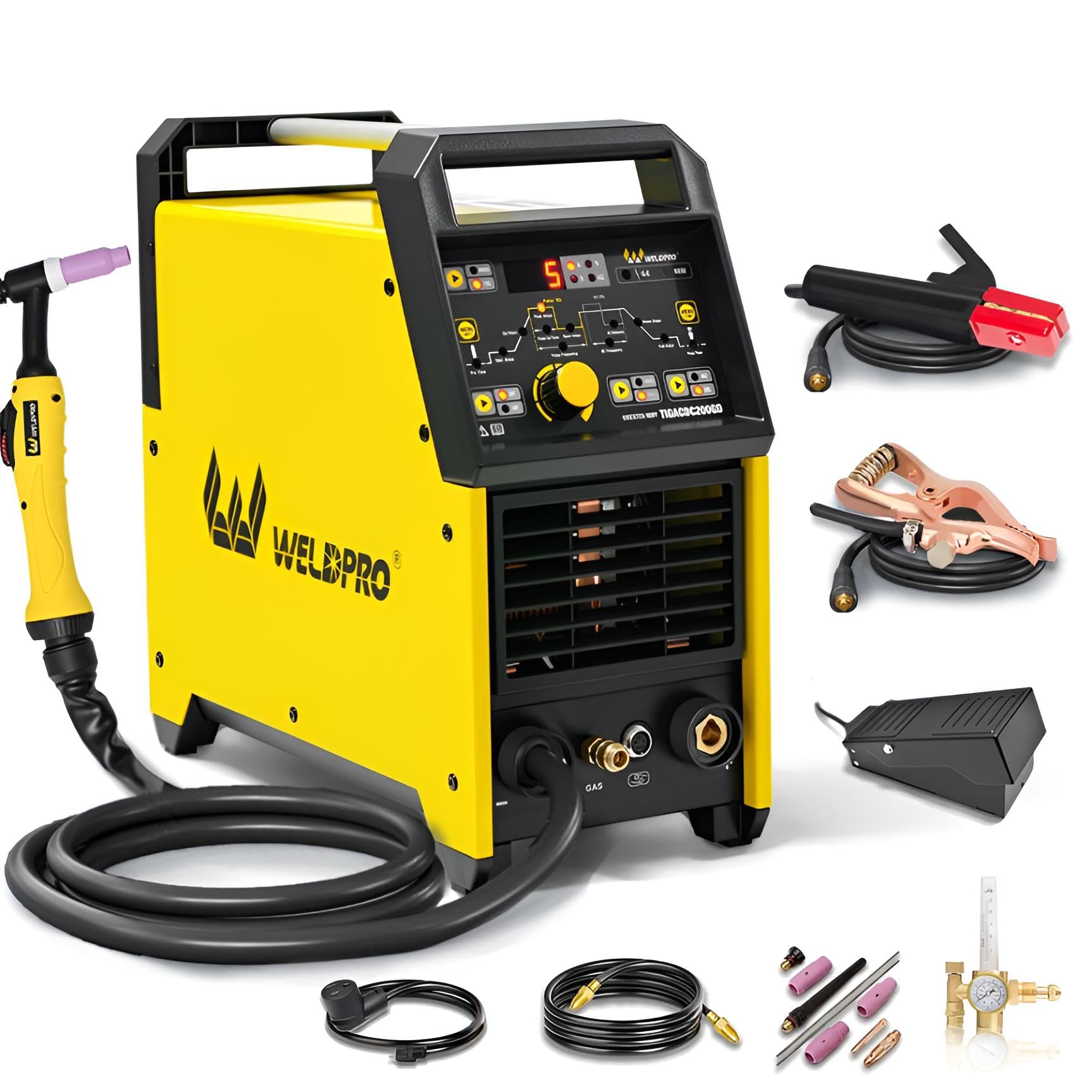
1. Weldpro 200A AC/DC TIG Welder with Pulse, 110V/220V Dual Voltage
Our pick — over 4.5★ from 800+ verified ratings; the strongest balance of quality and price.
The multi-process workhorse that handles five welding modes and weighs 61.8 pounds.
This is the machine you buy once and stop looking. The Weldpro combines AC/DC TIG, Pulse TIG, and Stick into a single 5-in-1 unit, and it runs on both 110V and 220V with automatic detection — so you can use it in the garage on a regular outlet and still get full power at the shop. The 200-amp output with a 40% duty cycle means you can weld 1/4-inch aluminum and 3/8-inch steel without the machine shutting down every two minutes. A heavy-duty foot pedal comes in the box for real-time amperage control, which makes a huge difference when you are chasing a consistent bead on a long seam. Buyers report it works very well on 16-ga and 18-ga stainless exhaust work, with “easy starts, good controls for upslope / amps / purge / downslope.” The thing everyone praises is the quality — 89 owners single it out — and the functionality gets 65 mentions. Shop owners note it produces decent welds immediately and that the CK17 flex torch and responsive pedal feel like premium upgrades. At 61.8 pounds it is not a throw-in-the-truck portable, but the built-in carrying handle and dual-voltage flexibility make it surprisingly mobile for a machine this capable. The only honest trade-off is the weight: this is a 61.8-pound unit compared to the 13.7-pound Forney, so it stays in the shop.
What Owners Rave About
- 5 welding modes (AC/DC TIG, Pulse TIG, Stick) on one machine — no second unit needed.
- Includes a real foot pedal, flow meter, and high-performance TIG torch right in the box.
- Automatic dual-voltage switching (110V/220V) works smoothly between home and shop outlets.
The Real-World Catch
- At 61.8 pounds, it is not a portable grab-and-go machine — keep it on a cart.
- The included work clamp spring is very stiff and opens less than one inch.
The one for most buyers: If you want a single machine that does TIG on steel, aluminum, and stainless with pulse control and Stick backup, this is the pick that saves you from buying three separate welders.
Think twice if: You need a sub-15-pound machine for crawling under a truck or working on a jobsite staircase — the Forney weighs 13.7 pounds.
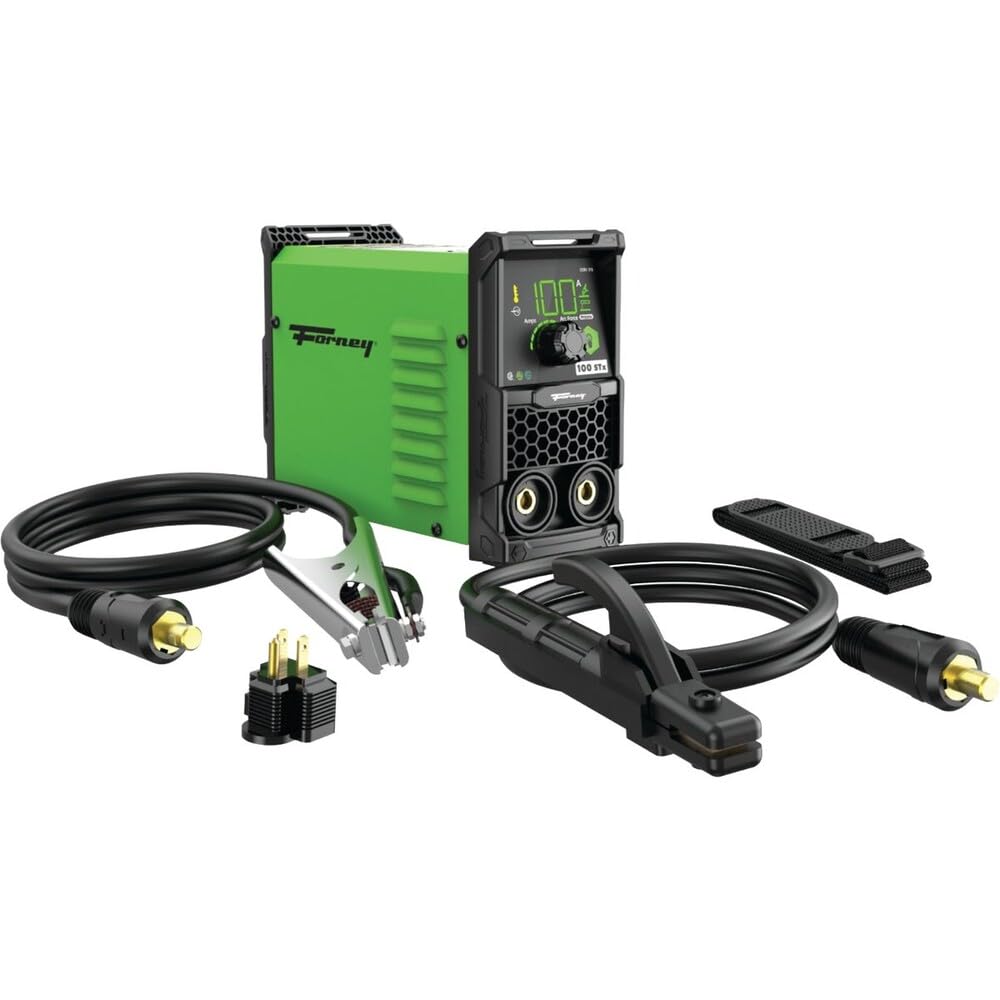
2. Forney 298 Easy Weld 100ST 90 Amp Welder
A sub-14-pound welder that plugs into any 120V outlet and runs Stick or TIG.
This is the machine for light-duty repairs around the house where dragging out a heavy 220V unit is overkill. The Forney runs on a standard 120-volt household outlet, weighs just 13.7 pounds, and is Stick-ready from the start with a TIG-capable output if you add the torch. It delivers up to 90 amps, which is enough for 1/16-inch to 3/16-inch steel, and the all-metal case holds up to being tossed in a trunk. Owners mention that “tested with 5/64” E6013 at 45A on 1/16” to 3/16” steel” produced an easy arc strike and a smooth arc. Performance gets 70 mentions from owners, and the quality gets 75 — both strong signals for the price point. The TIG capability is DC-only, so you cannot weld aluminum with this machine; it is strictly for steel and stainless. Certified welders note it is excellent for learning or minor jobs like bodywork, but even they cap it at 3/8-inch with multiple passes. If you are a professional welder looking for a portable backup for small repair calls, this is your kit. The on-off switch is a little hard to operate with welding gloves on, which is a small ergonomic gripe several owners flag.
The honest limit: This is a 90-amp, DC-only travel companion. It does not weld aluminum, and it does not have pulse control. Pick it for Stick and light steel TIG work where carrying 60+ pounds does not make sense.
3. ARCCAPTAIN iControl TIG 205P Pro Welder With APP Control
A smartphone-connected TIG welder that lets you tune parameters from the app.
The headline feature here is real: scan the barcode, connect your phone via the ARCCAPTAIN app, and you can monitor the welder status, select welding mode, adjust parameters, and even recall presets — all without bending down to the machine panel. Owners who have used the app say they doubt they will touch the machine panel again. The unit itself is a 5-in-1 DC welder supporting DC TIG, Pulse TIG, Lift TIG, Spot TIG, and Stick. It runs on 120V or 240V, weighs 22.8 pounds, and pulls from a dual-voltage power supply. The MCU-controlled arc start has a claimed 99.99% success rate, which means the arc lights every time you press the pedal. The catch is this machine is DC-only — there is no AC output, so it cannot weld aluminum. For steel, stainless, and copper, it delivers very stable arc performance with minimal spatter. One experienced user noted it “does a great job for what it is” and was laying decent beads within an hour after a 20-year hiatus from TIG. The included accessories are decent but not professional-grade, and the machine needs a water-cooled torch before pushing past 1/4-inch on steel.
Reach for this if: You weld steel or stainless and want the convenience of smartphone parameter control and preset recall — the app genuinely changes how quickly you dial in settings.
Look elsewhere if: You need AC TIG for aluminum or magnesium — the ARCCAPTAIN 205P does not have AC output.
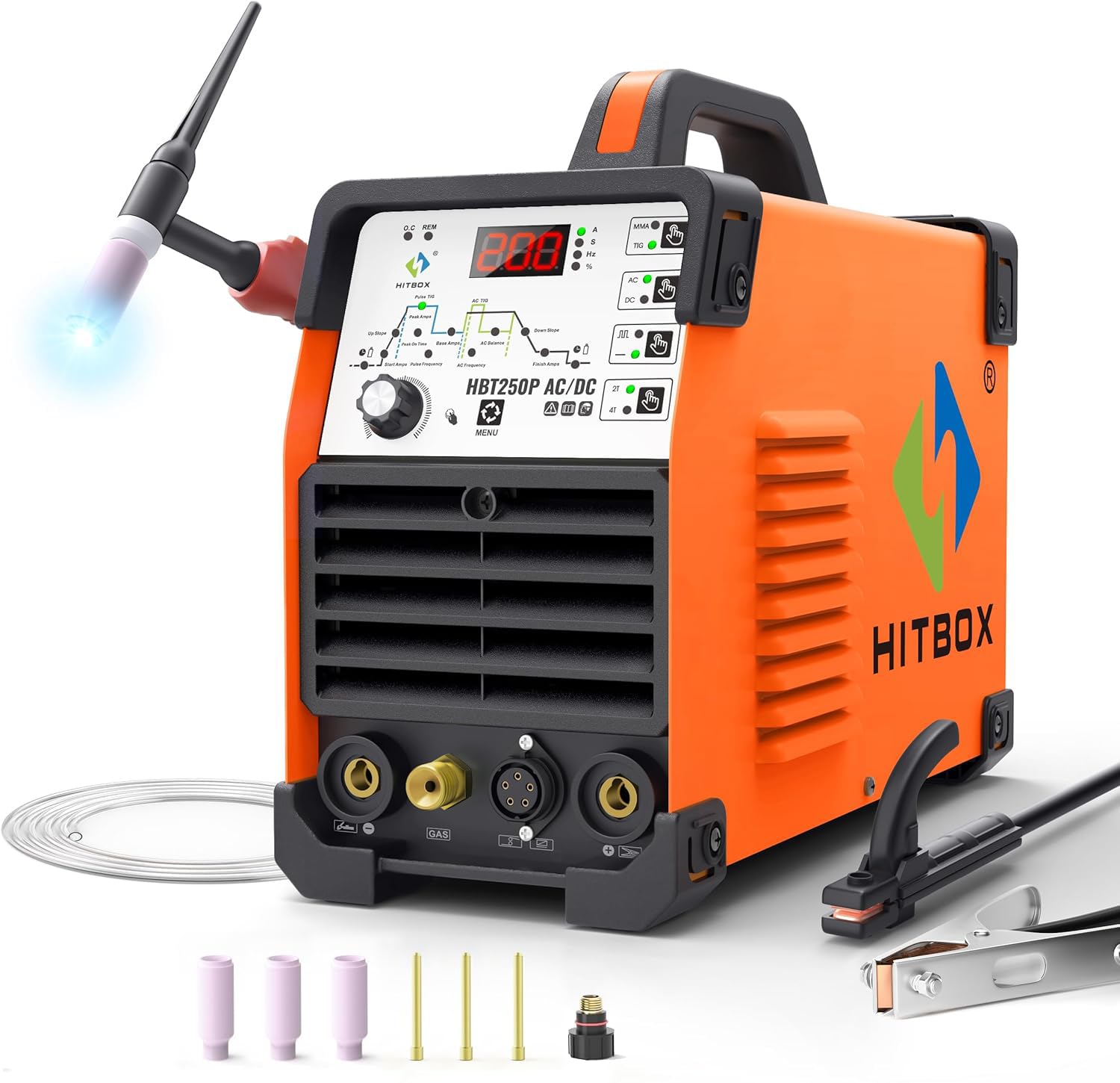
4. HITBOX 200A AC/DC TIG Welder 6-in-1 with Pulse & Square Wave (HBT250P)
A 6-in-1 AC/DC TIG welder with pulse and square wave that welds aluminum for the price of a DC-only machine.
The HITBOX HBT250P is the cheapest way into AC TIG with pulse control that we have found. It runs on 220V only, outputs up to 200A, and includes HF start, square wave AC, and pulse frequency adjustable from 0.5 to 200Hz. That means you can weld aluminum up to about 1/4 inch with a cleaning action that scrubs the oxide layer, and you can switch to DC TIG for steel and stainless. The build quality earns 17 positive mentions from owners, and the overall performance gets 22. The 6-in-1 setup includes MMA, DC HF/Pulse TIG, AC HF/Pulse TIG, and AC Pulse TIG Square — plenty of options to dial in exactly the heat and arc shape you need. The controls are clear and easy to adjust for pre-flow, start amps, up-slope, down-slope, and pulse parameters. The cons are that the foot pedal is not included, the stock stick stinger and ground clamp are cheap, and the gas hose connection uses a non-standard fitting (a nipple rather than a B-size fitting). A few owners flag that the foot pedal does not show peak current on the display unless you are actually welding, which makes fine-tuning awkward without an assistant reading the screen. At 26 pounds, it is light enough to move around the shop but heavy enough to stay put.
What Carries It
- Full AC/DC TIG with pulse, square wave, and HF start — rare at this price point.
- Welds both aluminum and steel with adjustable AC balance and frequency for precise puddle control.
- 6-in-1 processes cover TIG, Pulse TIG, and Stick with 2T/4T trigger modes for long welds.
Where It Cuts Corners
- Foot pedal is not included — you will need to buy one separately for hands-free amperage control.
- Included stick stinger and ground clamp are basic and many owners upgrade them immediately.
The best budget gate into AC TIG: If you need to weld aluminum but cannot justify premium pricing, this is the most direct path — just budget for a foot pedal and a better stinger.
Not for you if: You need dual-voltage 110V/220V portability — this machine is 220V only.
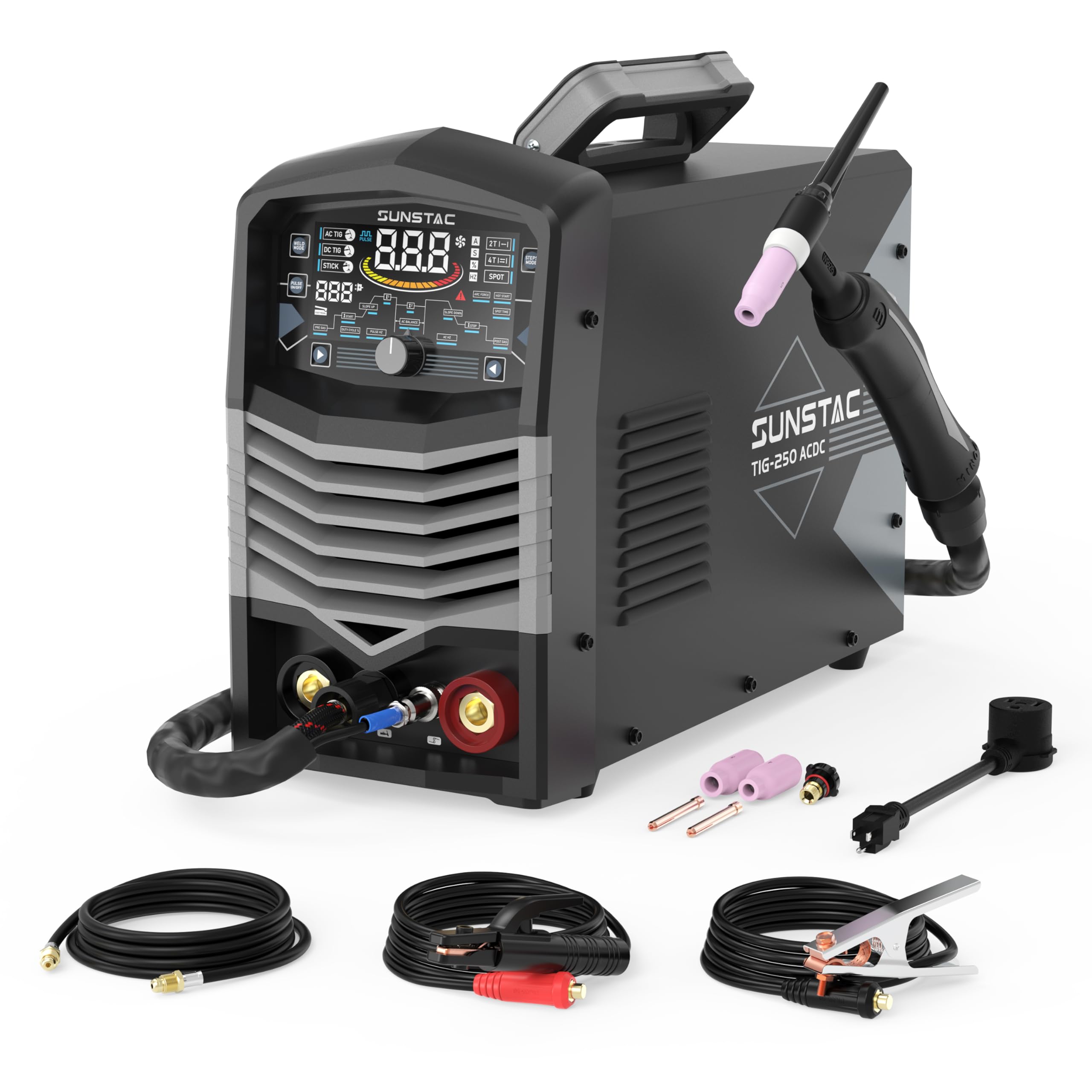
5. Sunstac 250A AC/DC Aluminum TIG Welder with Pulse, 110V/220V Dual Voltage
A 250-amp AC/DC machine with an LCD screen and dual-voltage that is built around aluminum work.
The selling point here is power: 250 amps vs the 200-amp ceiling most machines in this tier hit. That extra headroom matters when you are welding thicker aluminum — customers note it handles 1/4-inch aluminum on 220V without struggling. The LCD screen is a real upgrade from the typical LED panels; the digits stay readable even with a welding helmet on, so you can check your settings without flipping up the mask. It supports AC TIG, DC TIG, Pulse TIG, Spot TIG, and Stick, and it runs on both 110V and 220V. The built-in intelligent parameter saving function remembers your previous settings so you pick up right where you left off. Performance gets 27 positive mentions, and value for money gets 20. The catch is that AC current measurement is reportedly inaccurate — the manufacturer acknowledges that the current reading in AC mode varies due to inconsistent AC balance. A few buttons on early units stuck, though the seller reached out to resolve it. The ground cable is short, and the air-cooled torch heats up fast on heavy material — that is typical for this price bracket. For aluminum-focused work at a budget, the extra 50 amps over the HITBOX or Weldpro is a real advantage.
The honest trade-off: You get more amperage and a nice screen, but the AC current reading is not reliable — trust your puddle, not the display number. If you can accept that, this is a very capable aluminum TIG machine for the garage.
6. SSimder 10-in-1 Welder Plasma Cutter Combo (SD-4050Pro)

One machine that MIG welds aluminum, TIG welds stainless, Stick welds thick steel, and plasma cuts 1/2-inch plate.
This is the ultimate space-saver for a small shop. The SSimder packs Pulse MIG (with a dedicated spool-gun port for aluminum up to 1/4 inch), HF TIG, 200A Stick, and a 50A pilot-arc plasma cutter that slices through 1/2-inch steel — all in a 23.3-pound package. It runs on 110V or 220V, and the Synergic auto-set mode picks the right parameters for the material and thickness you choose, which is a real help for beginners. The HF TIG torch starts the arc without touching the workpiece, which is essential for clean starts on stainless and titanium. Owners love the idea of having all functions on demand, and the machine performs well on 120V without overheating. The plasma cutter is the standout — owners use it to cut 1/4-inch steel “like butter.” The downside is the instructions are skimpy and there is no included chart for voltage settings by metal thickness. The gas hose uses a hose clamp connection instead of a standard fitting, which some find odd. Accessories are decent but not pro-grade, and you will need to buy a spool gun and foot pedal separately to open up the full MIG aluminum and TIG capability. For the hobbyist who wants one machine that does everything, this is a compelling single-cord solution.
Take it if: Shop space is tight and you need MIG, TIG, Stick, and plasma cutting from one box — the 50A pilot-arc plasma cutter alone justifies the footprint for many owners.
Pass if: You need pro-level accessories or detailed parameter documentation — this machine asks you to figure some things out on your own.
7. LOTOS TIG200ACDC 200A AC/DC Aluminum Tig Welder

A square-wave AC/DC machine that comes with a foot pedal and an argon regulator right in the box.
The LOTOS is a well-established hobby-level TIG welder that includes everything you need to start welding aluminum and steel from the start: the power supply, TIG torch, Stick clamp, foot pedal, argon regulator, and a 220V-to-110V converter pigtail. The 200A AC square-wave inverter produces a stable arc on aluminum up to 3/8 inch with multiple passes, and the HF start eliminates the need to scratch-start the arc. Quality gets 60 positive mentions, performance gets 59, and value for money gets 49 — all strong counts. It handles Stick welding well too, running 7018, 6011, and even 5/16 7018 rods. The trade-off is that you must power-cycle the machine to switch between TIG and Stick modes, or between pedal and non-pedal operation, which is a workflow interruption. The amp dial numbers do not match the digital display, and the foot pedal cord is very long. Some owners note the control labels are incorrect — “Clearance Effect” turns out to be the AC balance setting, where 0 equals 50/50 EN/EP and -3 equals 30/70 EN/EP. The documentation is poor, so expect a learning curve on setting up the AC balance and frequency. Over 40 hours of use, it holds up well, and customer support replaces broken parts quickly.
The real barrier: If you are patient enough to work through the inaccurate dials and trial-and-error documentation, the LOTOS rewards you with solid AC and DC TIG performance at a very accessible price — but the learning curve is real.
8. ARCCAPTAIN TIG Welder AC/DC 200Amp with Pulse, 7 in 1 (TIG200PACDC)

A 7-in-1 AC/DC machine with square, triangular, and pulse waveforms for precise aluminum and steel work.
What sets this ARCCAPTAIN apart from the iControl 205P is the AC output. The TIG200PACDC runs square wave, triangular wave, and pulse on both AC and DC, which gives you three distinct arc shapes to choose from depending on the material. The triangular wave reduces heat input during aluminum welding, which helps prevent distortion on thin 0.5mm sheets. The square wave cleans the oxide film aggressively. Between those two options, you can match the arc to the alloy and thickness. Performance and quality both get 27 mentions from owners. It runs on 110V and 220V, and the large LED display clearly shows pre-flow, initial current, up-slope, peak current, base current, down-slope, crater current, and post-flow — all adjustable via the panel. A professional welder praised the DC stainless performance as the best budget option they had seen. The foot pedal uses a proprietary XS12 connector and the pedal itself is bulky, which is an annoying compatibility restriction. The ground clamp on a few units overheated at 90-140 amps, though the manufacturer sent replacement parts promptly. If you want the full waveform toolkit — square, triangular, and pulse — for both AC and DC, this is the most affordable path to that level of control.
The waveform advantage: For aluminum welders who want to switch between square-wave cleaning and triangular-wave low-heat input without buying a second machine, this is the most feature-rich option at its price.
The catch: The proprietary XS12 foot-pedal connector locks you into ARCCAPTAIN’s ecosystem — a standard DINSE-compatible pedal will not work here.
9. AHP AlphaTIG 203Xi Amp IGBT AC DC Tig/Stick Welder with PULSE 110/220v

A 69-pound pro-grade machine with a 60% duty cycle that competes with welders costing twice as much.
The AHP AlphaTIG 203Xi is the machine that experienced welders buy when they want Miller-class performance without the Miller-class price tag. It runs on 110V and 220V, and the 2024 update introduced HV Start (electronic, solid-state simulated HF) that eliminates the need to manage a point gap on the HF starter. Quality gets 104 mentions, the highest count of any product in this guide, and functionality gets 74. Owners say the Stick mode is the best they have ever used, with a smooth arc that runs 6011, 6013, 7018, and 308L rods without effort. The TIG performance is on par with a Lincoln Square Wave, and the included Nova foot pedal and Rotaflex 9/17 TIG torch are proper components. The included ground clamp is cheap and many owners replace it immediately. At 69 pounds, this is the heaviest machine in the guide — at 69 pounds versus the Forney’s 13.7 pounds. The foot pedal slides on smooth floors, and a few owners mounted it to a board. Customer support replaced a damaged front panel from UPS shipping quickly. This is the pick if you weld daily and want a duty cycle that keeps you working.
The Pro Difference
- 100% duty cycle at 155 amps — you can weld continuously at that output without cooldown.
- HV Start (2024 model) removes the mechanical point gap maintenance of older HF starters.
- AC stick mode with adjustable frequency — a rare feature for running electrodes on aluminum.
The Weight Reality
- 69 pounds — this is a permanent shop fixture, not a portable tool. Plan for a cart.
- Accessories are mixed: good torch and pedal, but the ground clamp and included consumable kit are basic.
Built for daily production: If you weld for hours every day and the 60% duty cycle at 200A saves you real cooldown time, this is the machine that pays for itself in uptime.
Too heavy to haul: If you need a machine that goes from truck to jobsite, the 69-pound weight will wear you out fast — look at the 22.8-pound ARCCAPTAIN or the 13.7-pound Forney.
10. Everlast PowerPro 164Si 160Amp TIG Stick Pulse 40Amp Plasma Cutter

A 160-amp TIG welder combined with a 40-amp plasma cutter that cuts up to 3/8-inch steel.
The Everlast PowerPro 164Si is a three-tool station in a single chassis: TIG with pulse, Stick, and a plasma cutter. The TIG side welds up to 3/16-inch aluminum and 1/4-inch steel in a single pass, and the Stick mode supports 1/8-inch electrodes at up to 130 amps. The 40-amp pilot-arc plasma cutter cuts cleanly through 3/8-inch steel and can sever up to 5/8 inch. The unit runs on 120V or 240V, though the plasma cutter needs 220V or a dedicated 40-amp breaker to perform at full capacity. Owners say the plasma cutter cuts 1/4-inch steel “like butter” and that TIG is easy to learn on this machine. Quality gets 10 positive mentions, and functionality gets 9. The AC frequency and balance controls are adjustable for precise aluminum TIG work, and the dual-speed TIG pulse gives you control over heat input. A few units had a violent internal short in the first week, but Everlast’s customer support replaced them immediately — that responsiveness is a recurring theme in the owner feedback. The paper manual is poor, but the online manual is excellent. For a small shop that needs TIG, Stick, and plasma cutting without buying three separate machines, this is the most practical 3-in-1 option in this guide.
The honest verdict: The plasma cutter is the star here — it cuts steel that would take minutes with a grinder. If you need all three processes and the 60-pound weight is manageable, this is a great multi-tool.
11. Miller 907757 Multimatic 220 AC/DC Multiprocess Welder

The Miller you buy when second-best is not an option — does MIG, flux-cored, Stick, and AC/DC TIG.
The Miller Multimatic 220 AC/DC is the flagship of this entire list. It runs MIG, flux-cored, Stick, and AC/DC TIG, all from a single 56-pound machine. Auto-Set Elite and Pro-Set features automatically determine the polarity, select the process, and recall your last-used settings — you spend more time welding than fiddling with knobs. It runs on 120V and 240V thanks to the included multi-voltage plug, and it needs a generator with at least 10,000 watts to run off-grid. The MIG performance is immediate; reviewers point out it made the “best looking weld of my life right from the start.” The TIG torch and heavy-duty foot control are included, and the package also includes a flux-cored wire drive roll. While the raw specs (220A, 60% duty cycle) are matched by the AHP at a fraction of the weight, the Miller delivers a level of arc stability, consistency, and brand support that professional fabricators trust implicitly. The catch is the price gap — this is the most expensive machine here by a wide margin. It is not for the beginner on a budget; it is for the shop owner or serious fabricator who bills by the hour and cannot afford downtime from a finicky welder. If you need MIG in addition to TIG, you are buying one machine that replaces three, and it does each process at a professional level.
The Professional Edge
- True multi-process: MIG, flux-cored, Stick, and AC/DC TIG in one machine — each as good as a dedicated unit.
- Auto-Set Elite eliminates setup guesswork for consistent, high-quality welds on the first pass.
- Included heavy-duty foot control and TIG torch are professional-grade components, not accessory-bin throw-ins.
The Investment
- The price is several times higher than every other machine in this guide — reserved for those who make money with their welder.
- Runs on both 120V and 240V, but full TIG or MIG output on 120V is limited; you really want 240V for this machine.
For the professional shop: If you want a single machine that delivers Miller reliability across MIG, TIG, and Stick, and you are comfortable with the investment required, there is no better all-in-one multiprocess welder on this list.
Not the pick for: The budget-conscious hobbyist or anyone who only needs TIG — you are paying for MIG and flux-cored capability that you will not use, and the AHP or Weldpro delivers equivalent TIG performance at a much lower price.
Understanding the Specs
AC vs DC Output
AC (alternating current) switches polarity dozens of times per second. This scrubs the oxide layer off aluminum and lets the weld puddle flow properly. DC (direct current) keeps the current flowing in one direction, which gives a narrower, more stable arc on steel, stainless, and copper. A machine with both AC and DC output can weld aluminum and steel; a DC-only machine cannot weld aluminum. If you plan to work with aluminum, AC output is a non-negotiable feature.
Duty Cycle and Amperage
The duty cycle tells you how many minutes out of a ten-minute period you can weld at a given amperage before the machine needs to cool. A 40% duty cycle at 200A means four minutes of welding and six minutes of cooling. A 60% duty cycle means six minutes of welding. For light hobby work, 20% to 40% is fine. For production or repair shops, 60% or higher keeps you working longer. Amperage determines how thick a metal you can fuse — 90A is enough for 1/8-inch steel, while 200A handles 1/4-inch aluminum or 3/8-inch steel with ease.
FAQ
Can I weld aluminum with a DC-only TIG welder?
What is the difference between HF start and lift TIG?
Do I need a foot pedal for TIG welding?
Will a 110V welder run on a regular household outlet?
What does pulse TIG actually do for the weld?
How much argon gas does a TIG welder use?
Can I use a TIG welder without argon gas?
What size tungsten electrode should I use for thin steel?
Is a 200-amp machine overkill for a home garage?
What does a 60% duty cycle mean in practice?
Final Thoughts: The Verdict
For the majority of shoppers, the argon gas welder winner is the Weldpro 200A AC/DC because it packs five welding modes, dual-voltage flexibility, and a genuine foot pedal into a single machine that rivals units costing significantly more — the crowd favorite with strong owner endorsement and consistent arc quality. If you primarily weld steel in light repair scenarios and need a truly portable machine, grab the Forney 100ST. And for aluminum-focused work on a budget where every extra amp matters, the Sunstac 250A AC/DC is the one to reach for.
How We Picked
We do not accept paid placement. Every pick is matched to a real buyer and a real use-case; we do not hands-on test units.
Sources & Methodology
Specifications: manufacturer listings and product documentation. Review insights: verified customer reviews, as of July 2026. Pricing: not shown on this page (it changes often); check the current price via the retailer link.
As an Amazon Associate, Gadgets Feed earns from qualifying purchases. This does not affect which products we feature.