
The specific demands of arid, sandy, and rocky terrain expose weaknesses in standard footwear faster than almost any other environment — loose gravel shifts underfoot, fine dust infiltrates every stitch, and the relentless heat tests both material integrity and your foot’s endurance. Army desert boots are purpose-built to counter these exact conditions, balancing ventilation against debris protection, and aggressive tread against lightweight mobility.
I’m Min — the co-founder and writer behind Gadgets Feed. My approach to analyzing gear like this involves cross-referencing hundreds of verified user accounts across multiple seasons of field use, checking for common failure points like sole delamination, eyelet durability, and moisture management in sustained heat.
After parsing through years of real-world feedback on dozens of models, these reviews represent the most reliable best army desert boots for anyone who needs proven performance on dry, demanding ground.
How To Choose The Best Army Desert Boots
Selecting boots for desert deployment or frequent hot-weather training isn’t about general comfort — it’s about preventing specific problems like heat buildup, blister formation from sand ingress, and accelerated wear from abrasive grit. Understanding the materials and construction methods that withstand these conditions is essential.
Upper Material: Leather vs. Nylon vs. Suede
Full-grain leather offers the best abrasion resistance against rocks and brush but traps heat and retains moisture longer. Nylon and Cordura panels improve breathability and dry faster after sweat saturation, but they are more prone to tearing if snagged on sharp edges. Suede, common on modern lightweight tactical boots, provides a middle ground but requires a water-repellent treatment to prevent staining and stiffness from moisture contact.
Sole Construction and Tread Pattern
A deep, self-cleaning lug pattern is critical because desert silt compacts into flat tread and eliminates grip instantly. Look for a chevron or V-shaped tread that ejects debris with each step. The outsole’s rubber compound should remain flexible in high heat — cheap PVC-based soles harden and lose traction when the ground temperature exceeds 100°F.
Ventilation and Moisture Management
A boot that lacks adequate airflow will turn into a sauna within an hour, accelerating sweat breakdown and increasing blister risk. Mesh-lined panels and perforated tongue gussets help. A moisture-wicking lining, often branded as Coolmax or Dri-Lex, actively pulls sweat away from the foot. Avoid waterproof membranes for pure desert use — they trap heat and slow evaporation.
Quick Comparison
On smaller screens, swipe sideways to see the full table.
| Model | Category | Best For | Key Spec | Amazon |
|---|---|---|---|---|
| Belleville TR501 AMRAP | Tactical Boot | Zero-drop running feel | 13.7 oz (per boot, size 9) | Amazon |
| GARMONT Combat Boots | Leather/Nylon | Long-term field durability | Double-stitched seams | Amazon |
| Oakley Boot | Lightweight | Mixed terrain & urban | 2.95 lbs per pair | Amazon |
| 5.11 Speed 3.0 | Leather | All-day uniform wear | Side zip + speed lacing | Amazon |
| Reebok RB8895 Rapid Response | 8-inch | Wide feet & ankle support | 4E width available | Amazon |
| Bates Tactical Sport 2 | Composite Toe | Industrial safety compliance | Composite safety toe | Amazon |
| First Class Ryno Gear 6″ | Value | Budget hiking & light duty | Coolmax lining | Amazon |
In‑Depth Reviews
1. Belleville TR501 AMRAP Military Boots
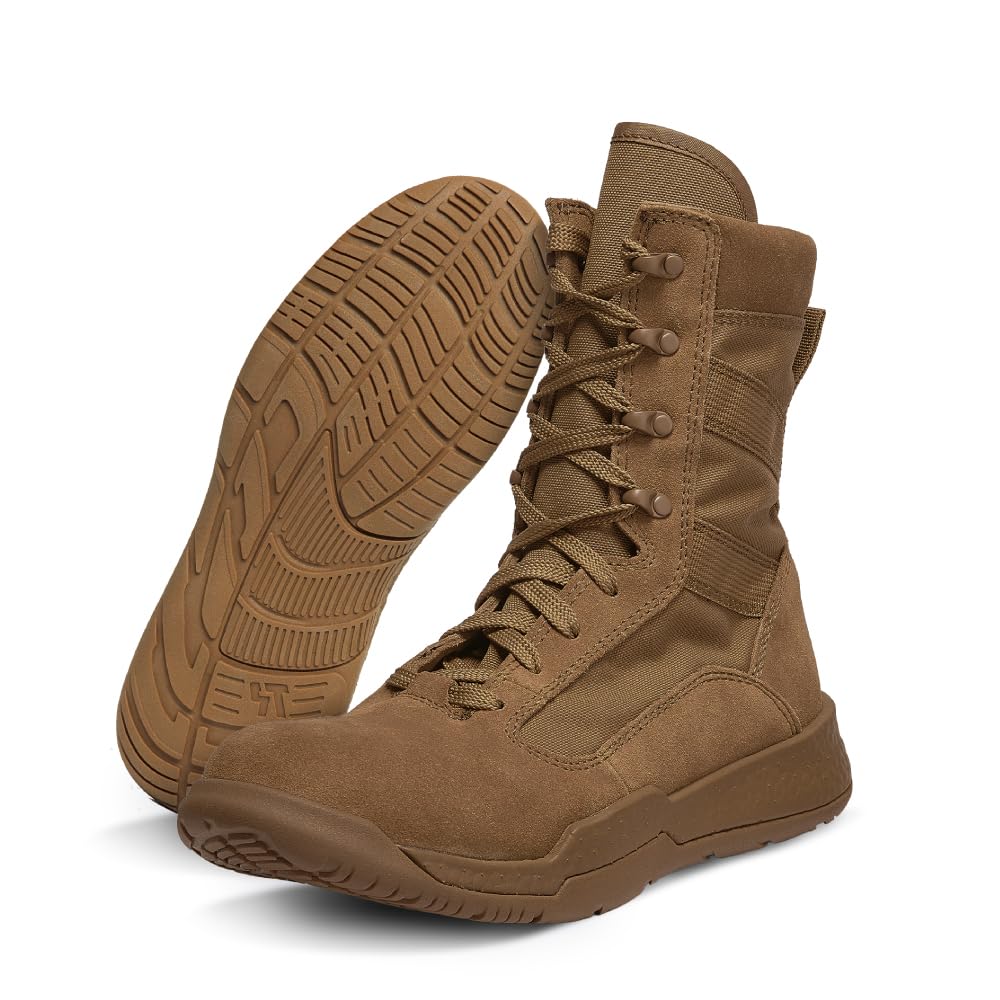
Its zero-drop EVA midsole encourages a natural midfoot strike, which reduces fatigue on long rucks over packed desert trails. The wide toe box allows the forefoot to splay, a critical feature for maintaining blood flow and blister prevention on 10-mile marches.
Users consistently report minimal to zero break-in period, which is rare for any military boot, let alone one that offers this level of support. The removable molded EVA insole lets you swap in orthotics without altering the boot’s internal geometry. Traction is excellent on dry rock and hardpan, though multiple reviews note that the outsole becomes treacherous on wet pavement or mud — a trade-off inherent to the firm rubber compound used for hot-weather durability.
The moisture-wicking lining performs well for its intended role, keeping feet dry during sustained sweat. However, the suede components stain easily from water droplets, so a preventive treatment like a silicone-based spray is wise before first wear. For a lightweight AR 670-1 option that prioritizes mobility and foot health, this boot leads the class.
Why it’s great
- Zero-drop design reduces lower-leg fatigue on long movements
- Exceptionally light at 13.7 oz per boot
- Virtually no break-in period required
Good to know
- Outsole is dangerously slippery on wet surfaces
- Suede material stains easily without treatment
- Lace eyelets reported as a potential weak point under hard use
2. GARMONT Combat Boots

GARMONT has a reputation earned on the feet of infantrymen, and this pair justifies that status with construction that prioritizes field longevity over weight savings. The combination of full-grain leather panels and nylon fabric creates a boot that breathes better than a full-leather design while resisting the tearing and fraying that pure textile boots suffer when crawling through rocky wadis. Double stitching at every stress point is a detail that becomes obvious only after months of hard use.
One verified user reported wearing a previous pair for 19 years, spanning deployments in Iraq and years on construction sites. That kind of lifecycle is not normal for tactical boots, and it indicates that GARMONT uses a higher-grade leather and a more robust lasting board than most competitors. The fit runs true to size with a standard width, and the boot feels broken in from the first few wears — no blood-blister stage required.
A minor concern is the closed-cell foam midsole, which compresses over time for a custom fit but will eventually bottom out after 18–24 months of daily use. The outsole is equipped with a multi-directional tread that performs well on dry, loose surfaces but lacks the aggressive self-cleaning lugs of a dedicated desert sole. For someone looking for a boot that can survive multiple seasons of field training and still look presentable for garrison, this is the long-term investment.
Why it’s great
- Proven multi-year durability with reports of 19-year lifespan
- Double-stitched seams resist field abuse
- Comfortable with minimal break-in
Good to know
- Foam midsole compresses and loses cushion after extended use
- Tread pattern not optimized for pure desert silt
- Warranty coverage limited to one year
3. Oakley Boot

The Oakley boot redefines what a tactical boot feels like on your foot — at 2.95 pounds per pair, it is practically indistinguishable from a thick-soled tennis shoe in weight. This is a deliberate engineering choice for personnel who need to transition from a vehicle to foot patrol to a sprint without feeling like they are dragging dead weight. The low-profile sole and moderate lug depth make it excellent for urban environments and mixed terrain where you need to feel the ground without losing grip.
Long-term reviews confirm that this boot holds up well for daily wear — one user reported two years of continuous use before considering a replacement. The quick break-in is a recurring theme, with multiple accounts noting that the boot requires zero training time. It is not waterproof, and the lightweight nylon upper does not offer the same puncture resistance as leather, so it is best suited for conditions where you prioritize speed and agility over brute protection.
The main limitation is ankle support. The collar is lower and softer than traditional 8-inch combat boots, which means carrying a heavy rucksack over uneven ground may increase the risk of rolling an ankle. The outsole also struggles on wet, smooth surfaces, which confirms its focused design for dry environments. For light infantry, support roles, or anyone who spends more time on their feet than in the dirt, this is an outstanding choice.
Why it’s great
- Weighs as much as a standard running shoe
- Nearly instant break-in for immediate comfort
- Good ventilation for hot-weather patrolling
Good to know
- Not waterproof; damp grass will soak through
- Limited ankle support for heavy loads
- Sole is slippery on wet surfaces
4. 5.11 Tactical Speed 3.0 Side Zip

The 5.11 Speed 3.0 is a staple for daily uniform wear, and its longevity on the market is a testament to how well it balances professional appearance with practical comfort. The full-grain leather upper provides a clean, polished look that meets dress and appearance standards, while the side zipper and speed lacing system allow for rapid donning and doffing — a quality-of-life upgrade for anyone who has ever fumbled with traditional laces before a briefing. The padded tongue and collar reduce pressure points without adding bulk.
Multiple users have purchased this boot repeatedly, with one citing five pairs worn between 2017 and today. It holds up well for garrison, light field work, and even yard labor, but the sole and heel can separate under sustained heavy forest or mountain use after about 11 months. The leather responds well to regular conditioning, which extends the life of the boot significantly. The fit is true to size and accommodates standard-width feet comfortably from the first wear.
Quality control appears to be the main variable — some units arrive with cosmetic scuffs or minor assembly issues like missing insoles, which suggests batch inconsistency. The outsole uses a moderate tread that works well on hard surfaces but clogs in mud and deep sand. For the price point, this is a reliable, comfortable boot that meets most non-combat and garrison roles, but buyers should inspect their pair immediately for any defects.
Why it’s great
- Professional appearance with comfortable leather build
- Side zipper makes on/off fast and easy
- Consistent fit with minimal break-in
Good to know
- Inconsistent quality control between units
- Sole/heel separation possible under heavy field use
- Not ideal for deep sand or mud due to tread design
5. Reebok RB8895 Rapid Response 8″

The Reebok RB8895 is a dedicated wide-foot solution in a category that often neglects broader sizing. Available in up to 4E width, it accommodates feet that simply cannot squeeze into standard D-width tactical boots. The 8-inch shaft provides substantial ankle coverage compared to the 6-inch models, offering better protection against debris entry and more structural support for lateral movement over uneven ground. The soft toe is non-metallic, making it suitable for environments with metal detectors.
A user with 4E-wide feet reported surviving eight years of heavy use, including motorcycle riding, hiking, and range work, with only lacing adjustments required. That kind of durability for a non-leather boot is impressive and points to a well-designed nylon upper and solid outsole bonding. The side zipper is a consistent highlight, though the plastic eyelets are identified as a potential failure point — relying on the zipper for daily use reduces stress on them significantly.
The fit runs slightly large, so buyers with standard-width feet may find the boot too loose. The interior sole has been criticized for developing low spots after extended wear, which may require an aftermarket insert to restore comfort. For anyone with broad feet looking for an 8-inch tactical boot that doesn’t require a custom order, this is the most generous option in the lineup.
Why it’s great
- Available in 4E width for genuinely wide feet
- 8-inch height provides superior ankle protection
- Remarkable longevity reported by wide-foot users
Good to know
- Runs half-size large; narrow feet will feel loose
- Plastic eyelets are a potential failure point
- Insole may develop low spots over time
6. Bates Tactical Sport 2 Mid Side Zip
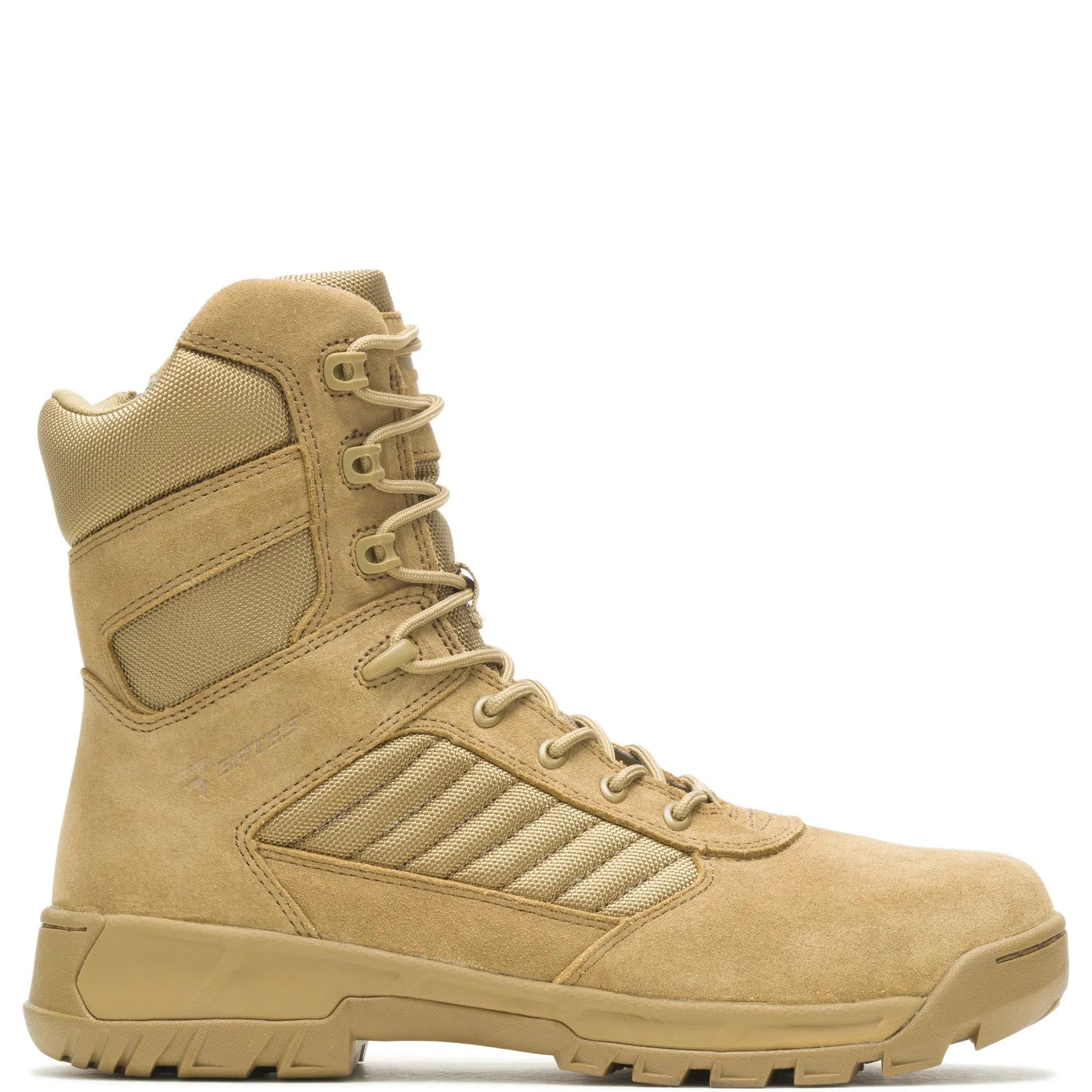
The Bates Tactical Sport 2 is the only composite-toe entry in this guide, making it the correct choice for anyone who needs impact protection in a hot environment without the thermal conductivity of steel. The composite cap reduces weight and cold transfer while still meeting safety standards for industrial and range environments. The boot is noticeably lightweight, coming in at near-hiking boot weight, which is rare for any safety-rated footwear.
Users praise the immediate comfort and easy break-in, with the side zipper providing quick access for short work assignments. The vented design helps with airflow, though the tongue seam has been noted as a potential rubbing point against the ankle during initial wear. The outsole provides good traction on dry industrial floors and packed dirt, but it is not designed for long-distance hiking or technical terrain.
The main durability concern is sole separation after 6–12 months if the boot is repeatedly soaked and broken in wet — this is a known weakness of the bonding adhesive used in this price tier. Sizing runs large, with multiple users recommending ordering 1.5 sizes down from your usual measurement. For light industrial work, range duty, or situations where toe protection is mandatory, this is a capable and affordable option.
Why it’s great
- Composite safety toe for impact protection without heat conduction
- Lightweight for its safety rating
- Side zipper enables quick on/off for shift work
Good to know
- Sole adhesive may fail if boots are soaked and broken in wet
- Runs large, order 1.5 sizes down
- Tongue seam may rub ankle during break-in
7. First Class 6″ Coolmax Ryno Gear

The First Class Ryno Gear boot delivers surprising quality for its cost, earning a strong reputation among hikers and light-duty users who need a functional desert boot without a premium price tag. The Coolmax lining is a standout feature at this level — it actively pulls moisture away from the skin, reducing the blister-inducing friction that occurs when socks get damp in hot conditions. The side zipper adds convenience normally reserved for higher-priced models.
Multiple users report zero break-in time, with one describing the comfort as feeling like a walking shoe. The included thick socks are a practical bonus that helps with the boot’s tendency to run slightly large — since half sizes aren’t available, the socks effectively fill the gap. Traction on gravel, wood, and dry trails is excellent, and the reinforced toe and rugged stitching suggest the boot can handle moderate abuse without rapid failure.
The limits become apparent under extreme conditions. One user noted that the sole material melted slightly while stomping out a grass fire, indicating the rubber compound is not designed for extreme heat sources. Long-term durability beyond a year of heavy use is unproven compared to premium options. For recreational hiking, backup boots, or budget-conscious field use, this is the most capable entry-level option available.
Why it’s great
- Coolmax lining provides real moisture management at a low cost
- Comfortable from first wear with no break-in
- Includes quality thick socks to fix half-size fit issues
Good to know
- Runs slightly large with no half-size options
- Sole rubber not resistant to extreme heat
- Untested for heavy-duty long-term field use
FAQ
Can I wear army desert boots in wet conditions?
What is AR 670-1 compliance and why does it matter?
How should army desert boots fit compared to running shoes?
Final Thoughts: The Verdict
For most users, the best army desert boots winner is the Belleville TR501 AMRAP because it combines AR 670-1 compliance with a zero-drop, lightweight design that prevents fatigue on long movements. If you want maximum field durability that can last through multiple deployments, grab the GARMONT Combat Boots. And for a budget-friendly recreational option that punches above its price, nothing beats the First Class Ryno Gear.