
Our readers keep the lights on and my morning glass full of iced black tea. As an Amazon Associate, I earn from qualifying purchases.
Specs are compiled from manufacturer listings and verified buyer reviews and can change over time — please confirm the key details on the product page before buying.
You want an art board game that fits your game night, but “art” means different things to different people. Do you want to create something beautiful, bid on masterpieces, build a mosaic, or just laugh with friends drawing silly pictures? This list sorts through the best options across every style—from the award-winning tile placement of Azul to the auction-driven drama of Modern Art—so you can find the one that matches your vibe.
I’m Min — the founder and writer behind Gadgets Feed. This guide is built by comparing the manufacturers’ published specifications and the patterns across verified customer reviews, so you get each pick’s real strengths and trade-offs instead of marketing spin.
Whether you’re a collector seeking a centerpiece or a family wanting a creative night in, this roundup helps you navigate the world of art board games with confidence and ease.
Our Picks at a Glance


How To Choose The Best Art Board Games
The art board game shelf is wonderfully diverse. Before you buy, focus on three things: who’s playing, how long you want to play, and if you want to create, collect, or compete.
Match the Game to Your Player Count
This is the most common mismatch buyers hit. Some excellent games are strictly for two people, like Patchwork. Others, like Pictures or Canvas, scale up to five players and are ideal for larger groups. Check the player count first—a game that needs 5 players won’t work for a cozy couples’ night, and a 2-player game will frustrate a full table.
Consider the Playtime and Complexity
Art games range from 20-minute fillers to 90-minute epics. If you’re playing with kids or casual friends, look for a 30-minute game with simple rules. If you want a deep strategy session, a longer playtime like 45-90 minutes might be worth it. Shorter games trade strategic depth for quicker learning, so match the playtime to your group’s patience.
Quick Comparison
| Model | Best For | Players | Playtime | Mechanic | Amazon |
|---|---|---|---|---|---|
| Azul★ Best Overall | The Best Overall | 2-4 | 45 min | Tile Placement | Amazon |
| Rio Grande PicturesCreative Party Pick | Family Creativity | 3-5 | 30 min | Party/Abstract | Amazon |
| CanvasMost Artistic | Card Crafting | 1-5 | 30 min | Card Drafting | Amazon |
| Buffalo Planted | Plant Lovers | 2-5 | 30 min | Set Collection | Amazon |
| Patchwork Americana | Two-Player Duels | 2 | 30 min | Puzzle/Tile | Amazon |
| Modern Art | Auction Enthusiasts | 3-5 | 45 min | Auction/Bidding | Amazon |
| Art Society | Strategy Collectors | 2-4 | 60 min | Auction/Tile | Amazon |
| Wingspan | The Premium Centerpiece | 1-5 | 70 min | Engine Building | Amazon |
| Botany | Victorian Adventure | 1-5 | 45-90 min | Adventure/Strategy | Amazon |
In‑Depth Reviews
1. Azul Mosaic Tile-Placement Strategy Board Game
Our pick — over 4.5★ from 16,500+ verified ratings; the strongest balance of quality and price.
The reigning champion that turns a Portuguese palace wall into a cutthroat puzzle of beautiful weighted tiles.
Azul isn’t just a game about making art—it’s a game about making your opponents lose points while you build your mosaic. You draft colorful resin tiles from shared factory displays, complete pattern rows, and score for your wall. The rules are simple enough to teach in one round, but the draft-and-deny mechanic turns friendly family night into a duel of sabotage where you force rivals to take tiles they don’t want.
The tactile feel of the 100 resin tiles is a huge part of the appeal. Owners describe them as gorgeous and weighted, and the game’s physical beauty is a constant point of praise. It’s an award winner—the 2018 Spiel des Jahres—and the crowd consensus backs that up. The gameplay earns the most mentions by far, with well over a thousand owners singling out the balance between strategy and luck, and nearly 800 more mentioning how easy it is to learn.
It plays in about 45 minutes and scales from a tense 2-player duel to a chaotic 4-player free-for-all. The only real gripe is that the cover tile designs shown on the box aren’t included in the game—a minor cosmetic note. The box is also on the larger side, but the travel version exists if you need it.
What wins people over
- Easy to learn, deep to master—teaches in one round
- Gorgeous, weighted resin tiles feel premium
- Perfect at 2 players for head-to-head duels
- Quick 45-minute playtime with huge replayability
The honest trade-offs
- Some rules can feel confusing on first read
- Box art tile designs aren’t actually in the game
- Becomes cutthroat—not for non-competitive players
The crowd favorite: If you want the single most reliable art-adjacent game for 2-4 players, this is the one that earns its shelf space every single game night.
Think twice if: You want pure cooperative fun with zero conflict—Azul forces you to block and sabotage opponents to win.
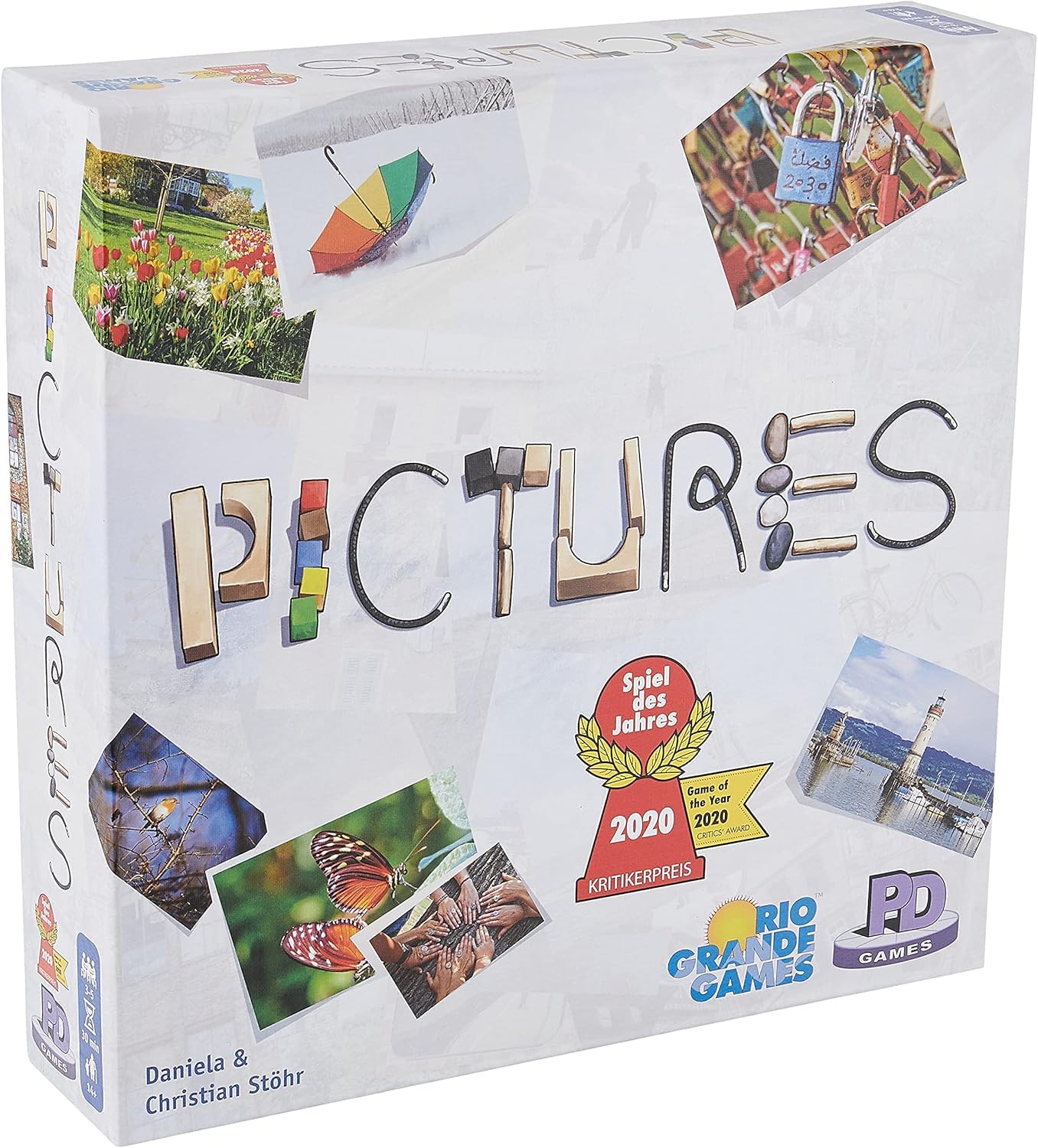
2. Rio Grande Games Pictures Family Board Game
The party game where everyone becomes an abstract artist using shoelaces, blocks, and sticks—no drawing skill required.
Pictures takes the creativity of Pictionary and removes the biggest barrier: drawing ability. You’re given a secret image and a set of weird components—blocks, ropes, icons, or sticks—and you must recreate the picture using only those tools. Everyone plays simultaneously, so there’s zero downtime, and the interpretations are often hilarious. As buyers put it: “This game is so fun! And its fun to explain to people just how creatively this game is played!”
It’s a fantastic game for 3-5 players and ages 8 and up, making it a true multi-generational hit. The rules are incredibly simple, and the creativity aspect gets praised constantly. With a 30-minute playtime, it moves fast enough to keep energy high. The educational objective is even listed as improving observational skills, creativity, and logical thinking—so it feels like a workout for the imagination.
The only consistent complaint is the box size. Owners note it’s oversized and could easily be a quarter of the size—a minor issue for storage, but not for gameplay. If you want a game that’s different every single time you play it, this is the one.
A party essential: The thing everyone raves about is the creativity—the game forces you to look at everyday objects in a completely new way, and the results are always a different game each time.
The storage catch: The box is needlessly huge; expect to find a creative spot on your shelf for it.
Reach for this if: You host mixed-age gatherings and want a laugh-out-loud game where non-artists feel like geniuses.
Look elsewhere if: You only have 2 players—this needs at least 3 to really shine.
3. Canvas Board Game – Strategic Card Crafting Game
The game that produces actual finished art—you layer transparent cards to create a one-of-a-kind painting worth points.
Canvas is the art board game that creates real art. You layer three transparent Art Cards on top of each other, physically composing a new piece of artwork on your canvas play mat. The icons on each transparent card combine or hide, and you score based on what’s visible. It’s a genuine puzzle where aesthetics meet strategy. A group of three friends who like very different game styles all rated it highly—it’s that universally appealing.
The components are outstanding: 60 transparent cards, 100 ribbon tokens, 20 pallet tokens, and a deck of 32 more cards, all packed in a reinforced box with foam inserts. The cardboard tokens are solid, and the artwork is beautiful—often compared to the whimsical style of Dixit. It’s easy to learn, works for 2 players just as well as 4, and even offers solo play against a “Vincent” AI opponent. Owners praise the unique transparent-card layering mechanic above all else.
At 30 minutes, it’s a quick filler that still offers deep strategy through set collection and hand management. The repeated refrain is that everyone who plays it wants to play again immediately.
A true original: The novelty of overlapping transparent cards is the hook—it’s a mechanic you won’t find anywhere else.
Who it fits: Ideal for casual gamers who want something beautiful and accessible, and for art lovers who appreciate the finished product.
Pick this if: You want a game where the “board state” is literally a piece of art you created.
skip it if: You’re looking for a high-interaction, cutthroat game—this is a peaceful, brain-burning puzzle, not a fight.
4. Buffalo Games Planted Strategy Boardgame

The gardening game where you trade and collect 42 unique plant cards—from fiddle leaf figs to monsteras—to build the best nursery.
Planted is an art game disguised as a botany lesson. For plant lovers, the art is the whole point—each of the 42 unique plant varieties is beautifully illustrated, and the cards are high-quality and tactile. You gather resource tokens like water and plant food, then trade cards to collect the plants you need. The strategy is easy to grasp: match plants to the environment they want and score big. It’s often described as “Sushi Go meets Wingspan”—a familiar, fast-paced set-collection formula.
The quality is the most-praised aspect, with over 50 owners highlighting the well-made pieces and vibrant printing. It’s designed for 2-5 players, ages 10 and up, and plays in a snappy 20-30 minutes, making it a fantastic family option. It’s a fast, fun set-collection game focused on hand optimization rather than deep engine-building.
The only minor complaint is the token supply: with higher player counts, you may run short, and the game uses a “1 token equals 4” representation that requires math. It’s a small wrinkle in an otherwise excellent, aesthetically pleasing game.
A fast, beautiful filler: The quality and art win people over instantly—the game is “eye candy” that’s still fun to play.
A light strategy: It’s on the casual end of the spectrum; veteran gamers might want more depth.
Best for: Plant enthusiasts and families with kids aged 7-10 who will love the subject matter and the gorgeous cards.
Not for: Hardcore strategy players looking for a deep, multi-hour investment.
5. Patchwork Americana Edition Board Game

The legendary two-player quilting duel where stitching a perfect 9×9 quilt is a tense race against time and your opponent.
Patchwork is the gold standard for two-player board games, and the Americana edition adds a fresh red, white, and blue coat of paint. This puzzle game by Uwe Rosenberg has you buying irregular quilt patches and placing them on your 9×9 board. The catch? Every patch costs you time and buttons, and the player who falls behind on the time track is forced to pass. It’s a tight, spatial puzzle where you tune layouts to boost your score and avoid empty spaces.
It’s exceptionally easy to learn—a 30-minute playtime makes it a perfect couples’ game or a go-to for a quick evening session. Players universally praise its simple rules that hide a surprisingly deep spatial puzzle. It’s the kind of game that becomes a “go-to 2 player game,” as many owners have found. The Americana theme is a fun, US-exclusive twist that celebrates quilting traditions.
There’s a minor wrinkle: the directions can be a bit hard to follow on a first read, with some buyers resorting to a quick YouTube search to get started. Once you’re past that initial hurdle, it’s a brilliant, short, and strategic game.
The classic duel: It’s short and simple, yet strategic—the perfect 30-minute head-to-head challenge.
The initial hurdle: The rulebook could be clearer; watch a quick video tutorial first to avoid frustration.
Reach for this if: You and a partner or friend want a competitive, brain-teasing game that fits in a lunch break.
Look elsewhere if: You need a game for 3 or more players—this is strictly a 2-player experience.
6. Modern Art Abstract Board Game

The cutthroat auction house where you buy and sell paintings by five artists, and “beauty is in the eye of the bidder.”
Modern Art puts you in charge of a museum, and your job is to make money by buying and selling masterpieces. Over four rounds, players take turns playing cards that depict art from five different artists, then auction them off using five different auction styles. The more popular an artist becomes, the more their paintings are worth. It’s a game of economics and psychology, not just aesthetics—you need a cutthroat attitude to walk away the winner.
It’s a deep strategy game for 3-5 players, ages 14 and up, with a 45-minute playtime. The design and production values are consistently praised, with buyers calling it one of designer Reiner Knizia’s better offerings. The included components are extensive: 70 artist cards, 5 museum screens, 12 artist value tiles, and 132 money tokens. Its five auction styles keep every turn interactive and tense, a mechanic owners say no other game replicates.
The artwork itself is a highlight; each piece is “breathtaking to behold.” If your group enjoys games like poker or social deduction, the bidding wars here will be a hit.
An economic masterpiece: The gameplay is the star—a brilliant, interactive auction system that keeps everyone engaged on every turn.
Not for casual players: It requires a willingness to read opponents and embrace the competitive spirit of bidding.
Pick this if: Your group loves player interaction, bluffing, and economic manipulation more than quiet puzzle-solving.
pass on it if: You prefer cooperative or low-conflict games—Modern Art is all about outbidding your friends.
7. Mighty Boards: Art Society – Collection Board Game

The art-world simulator where you bid at auctions, arrange paintings on your wall, and gamble on fleeting trends.
Art Society takes the auction concept and layers on spatial tile placement. You bid on works of art, collect them, and then physically arrange them on your wall while trying to predict which artists will become trendy. Fashion is fleeting, and the trends are hard to predict, so your collection strategy shifts every round. It blends visual pattern recognition with logical auction and placement choices.
It’s a gorgeous game with a top-notch table presence. The components and box are praised for their quality, and the art is a humorous parody of famous paintings—an in-joke that art history fans will appreciate. The rules feel complex at first but click easily after a few rounds. It plays in about an hour with 2-4 players, and the auction and museum mechanics add constant tension. It’s highly replayable, with owners reporting great experiences even after 8 plays.
The catch is the strict 4-player limit, and some players note the player mat could use a border to make tile placement easier. If you’re an art lover who wants a strategy game with a bit of cultural flair, this is a strong choice.
Gorgeous and engaging: The design wins people over instantly—the humorous art parodies and strategic auction-mechanics make for a memorable game night.
A learning curve: It starts complex than it ends; give it a couple of rounds before you judge it.
Best for: Strategy fans who also love art history and want a game that looks stunning on the table.
Think twice if: You have 5-6 players—this one is capped at 4, so look at Pictures or Modern Art instead.
8. Stonemaier Games: Wingspan by Elizabeth Hargrave

The award-winning bird-collecting epic that’s as much a nature documentary as it is a strategic engine-building game.
Wingspan is the heavy hitter of the art-game world, and for good reason. You’re a bird enthusiast building a wildlife preserve, attracting birds to your habitats. The bird cards are gorgeously illustrated in a realistic, naturalistic style, and every element—from the nest type to the food required—is tied to real ornithology. It’s an educational experience wrapped in a deeply strategic game. The artwork is so beloved that it earns hundreds of mentions from owners who simply want to look at their cards.
The gameplay is a rich engine-builder: you gain food tokens via custom dice in a birdfeeder dice tower, lay eggs, and play over 170 unique bird cards. Each bird extends a chain of powerful combinations. It’s a 2019 Kennerspiel des Jahres winner, designed by Elizabeth Hargrave. With a 60-90 minute playtime and only a 6-minute setup, it’s accessible for families yet deep enough for hardcore gamers. The solo play mode against an Automa is a huge plus for single players.
The one thing to know: the difficulty gets mixed feedback. Some find it complex at first, and the learning curve is real. But the low-interaction, non-attacking style makes it a peaceful, relaxing strategy game. The components are exceptional—the birdfeeder dice tower alone is a centerpiece. It’s a premium investment, but it’s the kind of game that anchors a collection.
A masterpiece of design: The gameplay and artwork are both top-tier, but the bird representation is what owners love most—it’s genuinely educational.
The learning curve: Expect a challenging first game; the strategic depth unfolds over multiple plays.
Reach for this if: You want a beautiful, high-end centerpiece game that works for solo play, couples, and full tables of 5.
Look elsewhere if: You want a quick 30-minute filler or a high-conflict game—Wingspan is a longer, peaceful engine-builder.
9. Botany Board Game | Dux Somnium Games

An heirloom-quality hunt for the Queen’s Prize that feels like an epic RPG adventure set in the Victorian era.
Botany is the art board game for people who want an epic, rich evening rather than a quick round. You play as a Victorian-era plant hunter traveling the world to discover flowers and win the Queen’s Prize. The game is heavy—5.63 pounds—and the components feel like heirloom-quality artifacts. The illustration style rivals the books and maps of the Victorian era, and owners call it “frame-worthy” and “absolutely gorgeous.” The Victorian-era illustrations appeal to both plant experts and newcomers.
The gameplay is a strategic adventure. The rule system is simple to learn, but the strategy emerges as you invest in characters and make decisions. It’s designed for 1-5 players, ages 8 and up (though the manufacturer recommends 10+). The playtime is listed at 45-90 minutes, though some buyers report epic sessions stretching longer. Its rich adventure turns into a memorable family ritual, with one owner’s daughter even writing a story about their first session.
The catch is the difficulty disagreement: some find it very simple to learn, while others find the gameplay complicated at first. It’s a game that rewards a second or third play before you form a complete strategy. If you’re looking for a beautiful, tactile, and rewarding adventure rather than a quick filler, this is it.
A stunning centerpiece: The aesthetics are the hook—the artwork and quality pieces make it a game you want to leave on the table.
An investment of time: Expect a longer play session and a real learning curve; it’s an epic, not a sprint.
Pick this if: You love birds, nature, and gorgeous production values, and want a solo-able game that feels like a grand adventure.
it’s not for you if: You need a fast, easy-to-teach party game for a mixed crowd—this demands commitment.
Understanding the Specs
Player Count
This is the first spec to check. A game like Patchwork is strictly a 2-player duel. Others, like Pictures, are designed for 3-5 players and won’t work with two. If you buy a game that doesn’t fit your typical group size, it will sit on the shelf.
Playing Time
Art games vary wildly here. A 20-30 minute game like Planted is a quick filler for casual nights. A 60-90 minute game like Wingspan or Botany is an event. Match the playtime to the attention span of your group to avoid a game that feels too long or too short.
FAQ
What is the difference between an art collection game and an art creation game?
Can you play art board games solo?
Which art board game is best for kids?
Which game is best for exactly 2 players?
Are these games easy to learn for beginners?
What is a tile-placement game?
Is Modern Art suitable for a casual game night?
What does “engine building” mean in games like Wingspan?
Which art board game has the best components?
Can these games be played with 5 players?
Final Thoughts: The Verdict
For most buyers, the art board games winner is the Azul because it perfectly balances easy-to-learn rules with deep, cutthroat strategy and gorgeous components. If you want a creative, laugh-filled party game, grab the Rio Grande Pictures. And for a premium, rich centerpiece that works solo or with a full table, the Wingspan is the one to reach for.
How We Picked
We do not accept paid placement. Every pick is matched to a real buyer and a real use-case; we do not hands-on test units.
Sources & Methodology
Specifications: manufacturer listings and product documentation. Review insights: verified customer reviews, as of August 2026. Pricing: not shown on this page (it changes often); check the current price via the retailer link.
As an Amazon Associate, Gadgets Feed earns from qualifying purchases. This does not affect which products we feature.