
The era of the sterile, all-black or all-white PC chassis is fading. A new wave of computer cases blends high-performance hardware with furniture-grade aesthetics, featuring genuine walnut, oak, and beech wood accents that let a powerful rig sit proudly in a living room or office without screaming “gamer den.” These cases marry industrial cooling engineering with the warm, geometric lines of the Art Deco and mid-century modern movements.
I’m Min — the co-founder and writer behind Gadgets Feed. For this guide, I spent dozens of hours cross-referencing thermal performance data, material specifications (walnut thickness, aluminum alloy grades, steel gauge), and real user feedback to separate the genuine craftsmanship from the veneer-deep pretenders claiming the “Art Deco” mantle.
Whether you prioritize an oak-and-aluminum showpiece for your desk or a walnut-accented tower that cools a 14900K and RTX 5090, this analysis of the current art deco computer case landscape will point you to the chassis that earns its premium.
How To Choose The Best Art Deco Computer Case
Selecting a chassis in this category requires balancing thermal performance against aesthetic integrity. A case that looks like a retro radio but suffocates a modern GPU is useless. Conversely, a chassis that prioritizes airflow vents over cohesive design fails the promise of its walnut and aluminum facade.
Material Authenticity: Solid Wood vs. Veneer vs. Vinyl
The defining feature of this category is the front panel material. Premium options use genuine solid walnut or oak slats (typically 15mm–20mm thick) that provide mass damping for vibration and a tactile warmth no printed grain can replicate. Entry-level models may use a thin wood veneer over steel or even a vinyl wrap. Check whether the wood is sustainably sourced and if the finish is lacquered for scratch resistance. Solid wood expands and contracts with humidity—ensure the chassis design accounts for this with expansion gaps or floating mounts.
Thermal Architecture Behind the Slats
A solid wood front panel can restrict intake airflow. The best designs mitigate this with wide vertical gaps between slats, a mesh backing behind the wood, or side-intake vents. Look for cases that include at least two 140mm intake fans (or larger 170mm variants) and a dedicated mesh path. GPU and CPU clearance specs are critical: a top-mounted 360mm radiator is the standard for high-end builds, but some compact “furniture” cases limit you to air cooling or a single 120mm AIO. Measure the maximum GPU length (many premium cases fit cards up to 355mm) and CPU cooler height before committing.
Build Quality and Layout Flexibility
Art Deco-inspired cases often use aluminum alloy frames or heavy-gauge steel (0.8mm–1.2mm) for rigidity. Check for tool-less side panels, velcro cable management straps, and a PSU shroud that hides the power supply. Some models offer dual PSU mounting orientations or back-connect motherboard support for a completely cable-free front view. The I/O panel is also worth examining—USB-C 3.2 Gen 2 (10Gbps or 20Gbps) is the baseline for any modern build in this price tier.
Quick Comparison
On smaller screens, swipe sideways to see the full table.
| Model | Category | Best For | Key Spec | Amazon |
|---|---|---|---|---|
| Fractal Design North | Premium Mid-Tower | Best overall performance & design | Walnut slatted front, 140mm PWM fans | Amazon |
| Lian Li LANCOOL 217 | Mid-Tower | Best airflow with wood accents | 2x170mm front fans, walnut wood trim | Amazon |
| Geometric Future M5 | Mid-Tower | Best for RGB & E-ATX builds | 5x 140mm ARGB fans, 420mm rad support | Amazon |
| HYTE X50 | Premium Mid-Tower | Unique louvered ventilation & style | 4mm curved acoustic glass, 360mm rad | Amazon |
| Okinos Cypress 7 | Mid Tower | Best value with genuine walnut | 4x 120mm PWM fans, Type-C 3.2 Gen 2 | Amazon |
| JONSBO T9 | SFF Mini-ITX | Compact Art Deco desktop build | 4mm aluminum shell, 20mm walnut base | Amazon |
| Fractal Design Terra | SFF Mini-ITX | Smallest walnut & aluminum design | 10.4L volume, PCIe 4.0 riser | Amazon |
| SilverStone FLP02W | Full Tower | Retro sleeper with modern cooling | 360mm rad, 386mm GPU clearance | Amazon |
| JONSBO BO400 | Premium Mid-Tower | Triple glass & aluminum showcase | Aluminum frame, BTF/back-connect MB | Amazon |
In‑Depth Reviews
1. Fractal Design North Charcoal Black

The Fractal Design North has become the benchmark for the entire wood-accented PC case category. Its front panel features sustainably sourced solid walnut slats with generous gaps that allow the two included 140mm Aspect PWM fans to pull ample air through a fine nylon mesh backing. The chassis itself is a spacious mid-tower supporting ATX/mATX/ITX motherboards, GPUs up to 355mm (or 300mm with a 360mm front radiator), and CPU coolers up to 170mm tall. The open front design delivers airflow that rivals full-mesh cases, keeping a Ryzen 9 + RTX 4080 combo under 75°C under sustained gaming load.
The internal layout is equally thoughtful. Seven bridgeless expansion slots, two combined 3.5″/2.5″ drive mounts, and two dedicated 2.5″ mounts provide flexibility for either a high-storage workstation or a clean, minimalist gaming rig. The tempered glass side panel is scratch-resistant and tinted slightly dark to hide cable clutter while still showing off premium components. Cable management is aided by pre-installed Velcro straps and generous routing channels behind the motherboard tray.
What truly sets the North apart is its furniture-grade finish. The charcoal black steel body, the anodized aluminum power button, and the real walnut wood create a visual warmth that fits seamlessly into a living room or home office. It is the rare case that earns praise from both thermal benchmarkers and interior designers. If you want one case that perfectly bridges Art Deco aesthetics with high-performance ATX cooling, this is the undisputed top pick.
Why it’s great
- Genuine walnut slatted front panel with excellent airflow
- Supports full-size ATX builds and 360mm radiators
- Premium build quality with scratch-resistant tempered glass
Good to know
- Only two fans included; additional purchases recommended for max cooling
- GPU length limited to 300mm when using front 360mm AIO
2. Lian Li LANCOOL 217

Lian Li disrupts the mid-tower market with the LANCOOL 217, a chassis that prioritizes raw airflow without sacrificing the wood-accented aesthetic. The headline feature here is the pair of massive 170x30mm front fans, which move an immense volume of air at low RPM. These fans can be repositioned vertically within the front bracket: set them low for balanced GPU and CPU cooling, or slide them up to focus airflow directly onto the CPU tower. Two additional 120mm reversed-blade fans at the bottom and a 140mm rear exhaust complete the five-fan stock configuration, delivering out-of-the-box thermal performance that many competitors require aftermarket spending to match.
The wood trim is present but restrained — a real walnut or beech accent strip runs vertically along the front edge, complementing the black or white mesh panel. The interior shows Lian Li’s design maturity: a dual PSU mounting orientation (standard or rotated outward for easier cable routing), support for back-connect motherboards (BTF standard), and tool-less fan mounting brackets that make swapping configurations painless. The steel chassis is sturdy enough to handle E-ATX boards and GPUs up to 415mm, though the stock focus is clearly on ATX builds.
Cable management is straightforward thanks to grommeted routing holes and velcro straps, though the included fan hub requires a SATA power connection that needs to be planned for. Two power buttons (one on the top, one on the side) accommodate both desk and floor placements. For builders who refuse to compromise between a furniture-grade wood look and aggressive thermal performance, the LANCOOL 217 is arguably the most capable value proposition in this category.
Why it’s great
- Unique 170mm front fans deliver exceptional airflow at low noise
- Five pre-installed PWM fans with tool-less repositioning
- Real walnut or beech wood accents with dual PSU orientation
Good to know
- Fan hub needs dedicated SATA power from PSU
- Wood accent is a trim piece, not a full front panel
3. Geometric Future M5

The Geometric Future M5 is the enthusiast’s choice for those who want the Art Deco feel — anodized aluminum and tempered glass — but also demand extreme component clearance and vibrant ARGB lighting. The chassis arrives with five 140mm ARGB PWM fans pre-installed, which drastically reduces the upfront cost of a matching fan set. The steel frame uses 0.8mm to 1.2mm gauge panels for rigidity, and the tool-less tempered glass side panel swings open for quick component access. The overall design philosophy is “dual chamber showpiece,” with a separate PSU compartment and a unique display window that shows off the power supply or sleeved cables.
Thermal capability is where the M5 truly punches above its price tier. It supports up to a 420mm radiator in the front, 360mm in the top, and 10 total 120mm fan positions. GPU clearance extends to an enormous 460mm, making this one of the few wood-accent-adjacent cases that can accommodate an RTX 4090 without any length anxiety. E-ATX motherboards fit easily, and the eight expansion slots allow for multi-GPU or high-end capture card setups. The included ARGB controller synchronizes with major motherboard ecosystems (ASUS Aura, Gigabyte RGB Fusion, MSI Mystic Light).
The trade-off is cable management complexity. The dual-chamber layout creates a very tight space for PSU wiring, especially with larger modular units exceeding 160mm in length. Builders should plan their cable routing carefully and potentially invest in custom-length sleeved cables for a clean look. At its price point, however, the M5 delivers a blend of lighting, cooling headroom, and premium materials that is hard to beat. It is the right choice for a builder whose priority is maximum hardware compatibility with an elegant, metallic design language.
Why it’s great
- Five pre-installed 140mm ARGB PWM fans with motherboard sync
- Radiator support up to 420mm and GPU clearance up to 460mm
- Durable steel frame with tool-less glass side panel
Good to know
- Cable management in dual-chamber layout is tight with large PSUs
- ARGB controller requires manual sync with some older motherboards
4. HYTE X50 Matcha Milk
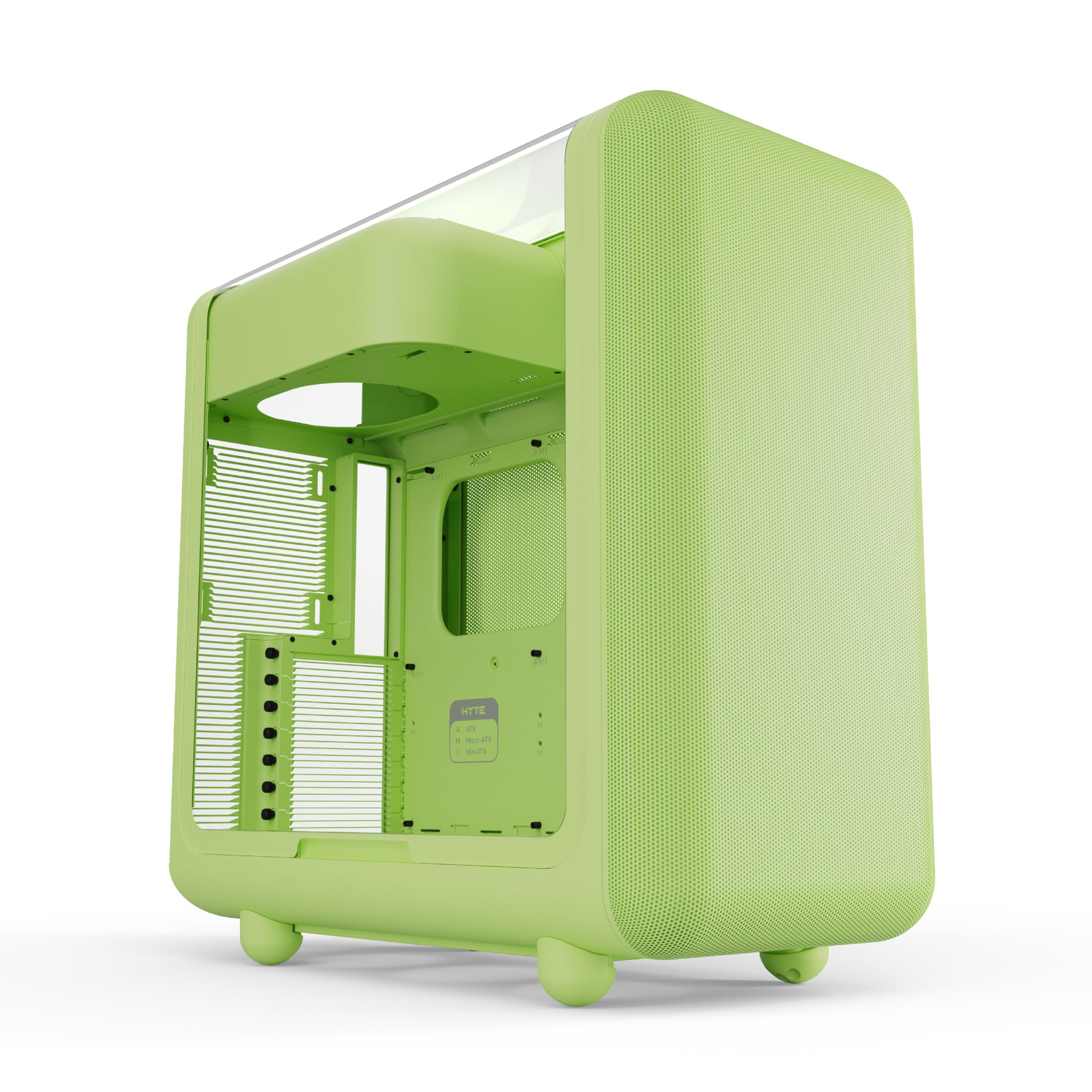
HYTE’s X50 is a design-forward chassis that interprets Art Deco through a modern, almost brutalist lens. Instead of wood slats, it uses a front micro-mesh panel flanked by louvered blade vents that slice through exhaust air while reinforcing chassis rigidity. The materials are top-shelf: the 4mm thick curved acoustic glass side panel minimizes shatter risk and provides a distortion-free view of the interior, while the stamped steel frame keeps the 25.8-pound case feeling dense and tank-like. The Matcha Milk green finish is a unique color that brings a mid-century appliance vibe without resorting to retro pastiche.
Thermally, the X50 is optimized for high-performance air and AIO cooling. The front mesh panel offers low-impedance intake that feeds up to three 120mm fans, and the PSU canopy is intentionally placed at the top to improve cable management and provide velcro tie-down points within easy reach. The bottom fan mount area can accommodate three extra-thick 120mm fans that blow directly onto the GPU, a boon for modern cards with large fin stacks. The interior is cavernous enough for E-ATX motherboards, GPUs up to 360mm, and dual 360mm radiators in push/pull configurations.
The user experience is refined: tool-less access to the glass and mesh panels, a hinged top case that swings open for radiator installation, and an integrated RGB controller for HYTE’s own fans. The main caveat is the sheer weight and size — at 25.8 pounds, it is a heavy case to move around, and its footprint is larger than a traditional mid-tower. The price reflects the premium materials and unique louvered design. For users who want a statement piece that diverges from the wood-panel trend while still offering a high-end, architectural look, the X50 is a compelling alternative.
Why it’s great
- 4mm curved acoustic glass is exceptionally durable and clear
- Excellent airflow via front mesh and bottom GPU fan mounts
- Top-tier build quality with unique louvered ventilation
Good to know
- Very heavy (25.8 lbs), difficult to move once built
- Larger footprint than typical ATX mid-towers
5. Okinos Cypress 7

The Okinos Cypress 7 is the budget-tier champion that refuses to cut corners on the most critical aesthetic element: the front panel is genuine walnut wood, not a printed veneer or sticker. For a price that undercuts most competitors by a significant margin, you get a mid-tower case that features a magnetic tempered glass side panel, four pre-installed 120mm PWM fans delivering 200 CFM of total airflow, and a Type-C 3.2 Gen 2 (10Gbps) front port. The walnut panel has a satin lacquer finish that resists fingerprints and blends with both dark and light desk environments.
Internally, the Cypress 7 is a conventional but well-executed ATX layout. It accommodates motherboards up to ATX, GPUs up to 415mm (though the user must note that installing a 240mm side-mounted AIO can interfere with GPUs wider than 280mm), and supports up to five SSDs. The PSU area is shrouded with a mesh cover, and the negative pressure space behind the rear fan (37mm) helps exhaust hot air efficiently. The included fans are quiet at idle and ramp up predictably under load, keeping a Ryzen 7 14700K + RTX 3090 build at respectable temperatures according to user reports.
Some compromises exist: the case does not support vertical GPU mounting, and the cable management channels are adequate but not as generous as pricier cases. The steel panels are thinner than premium competitors, though the structure remains rigid once assembled. However, for a shopper who wants a real walnut front panel and functional cooling without spending two to three times the asking price, the Cypress 7 represents the smartest value in the category. It proves that an Art Deco-inspired case does not have to cost a fortune.
Why it’s great
- Genuine walnut wood front panel at an accessible price
- Four pre-installed PWM fans with 200 CFM total airflow
- Type-C 3.2 Gen 2 (10Gbps) front I/O port
Good to know
- No vertical GPU mount support; horizontal installation only
- Side-mounted AIO may conflict with wider GPUs
6. JONSBO T9
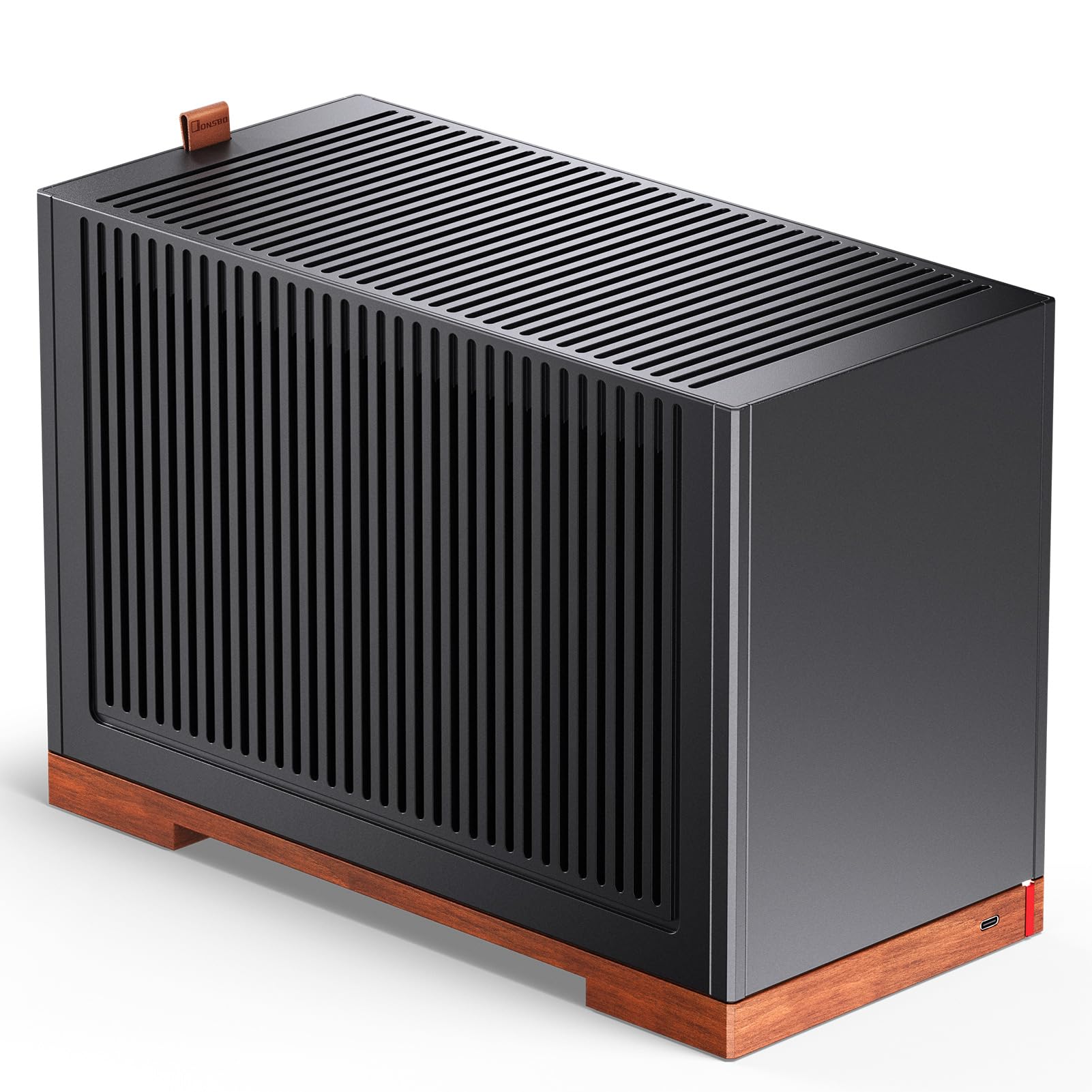
The JONSBO T9 is a small-form-factor (SFF) masterpiece that takes the Art Deco philosophy to the desktop level. At just 11 liters (155mm x 325mm x 224mm), it is one of the most compact cases to feature a solid wood base. The chassis is built from 4mm thick aluminum alloy with a sandblasted, anodized finish, and the 20mm solid walnut base is CNC-machined and seamlessly integrated into the frame. The three-sided CNC grille pattern on the side panels provides both structural rigidity and passive heat exhaust.
Internally, the T9 uses a clever three-level adjustable motherboard tray that allows the builder to shift the ITX board to accommodate different GPU thicknesses and CPU cooler heights. The three levels correspond to: Level 1 (58mm cooler height for 3-slot GPUs), Level 2 (68mm cooler height for 2.5-slot GPUs), and Level 3 (78mm cooler height for 2-slot GPUs). This stepless sliding mechanism means you can fine-tune the internal layout for maximum clearance. The included PCIe 4.0 riser cable (with a planned upgrade to PCIe 5.0 in a future revision) connects the GPU horizontally to the motherboard.
Assembly is tool-free for the mesh panels, but the tight 11L volume demands careful component selection. The case supports SFX power supplies, GPUs up to 310mm (or 202mm with a 3.5-inch HDD installed), and a single 120mm top exhaust fan. There is no room for liquid cooling beyond a single 120mm AIO, so air cooling is the primary thermal strategy. The solid wood base includes an integrated channel for hidden cable routing. For users who want a literal “wooden pedestal” for their powerful, compact gaming or workstation rig, the T9 delivers a level of material quality uncommon at this price point.
Why it’s great
- 4mm thick aluminum shell with CNC grille and sandblasted finish
- 20mm solid walnut base with hidden cable channel
- Three-level adjustable motherboard tray for component flexibility
Good to know
- Limited to 120mm top fan and low-profile air coolers
- Tight cable management; no room for long GPUs with 3.5″ HDD
- Includes PCIe 4.0 riser, not 5.0 as some early stock indicates
7. Fractal Design Terra Graphite

The Fractal Design Terra is the most refined small-form-factor expression of the wood-and-metal aesthetic in this roundup. At just 10.4 liters, its solid walnut front panel and 8mm thick anodized aluminum exterior panels give it a density and tactile quality that feels like a precision instrument, not a PC case. The internal architecture is anchored by a stepless, slidable central wall that provides 30mm of adjustment range, allowing the builder to shift the motherboard tray to balance GPU clearance (up to 322mm) with CPU cooler height (up to approximately 77mm depending on configuration).
Fractal Design includes a PCIe 4.0 riser cable that connects the GPU horizontally, keeping the layout compact and eliminating the need for a traditional expansion slot panel. The front I/O is minimal but premium: an aluminum power button, a single USB-C 20Gbps port, and one USB 3.0 port. The case is designed for air cooling primarily — a single 120mm fan mount at the top provides exhaust, and the open front and ventilated side panels create a natural convection path. User reports confirm that a Ryzen 7 9700X paired with an RX 9070 runs within safe thermal limits at stock settings, though the side panel may need to be removed during sustained heavy load.
The Terra’s main limitation is its single 120mm fan exhaust, which struggles to cool high-TDP components (14900K, 13900K) under extended all-core loads. Builders should opt for a 65W or 105W TDP CPU and a GPU with an efficient cooler. The price is high for the volume, reflecting the CNC-machined aluminum panels and walnut craftsmanship. For a desk-top SFF build that looks like an heirloom radio and takes up minimal space, the Terra remains the design benchmark.
Why it’s great
- Solid walnut front panel with anodized aluminum body
- Stepless sliding motherboard tray for internal flexibility
- Premium build quality and incredibly small footprint (10.4L)
Good to know
- Limited to single 120mm fan exhaust; not ideal for high-TDP CPUs
- Requires careful low-profile cooler selection (e.g., Noctua NH-L12S)
- Premium price for the SFF form factor
8. SilverStone FLP02W
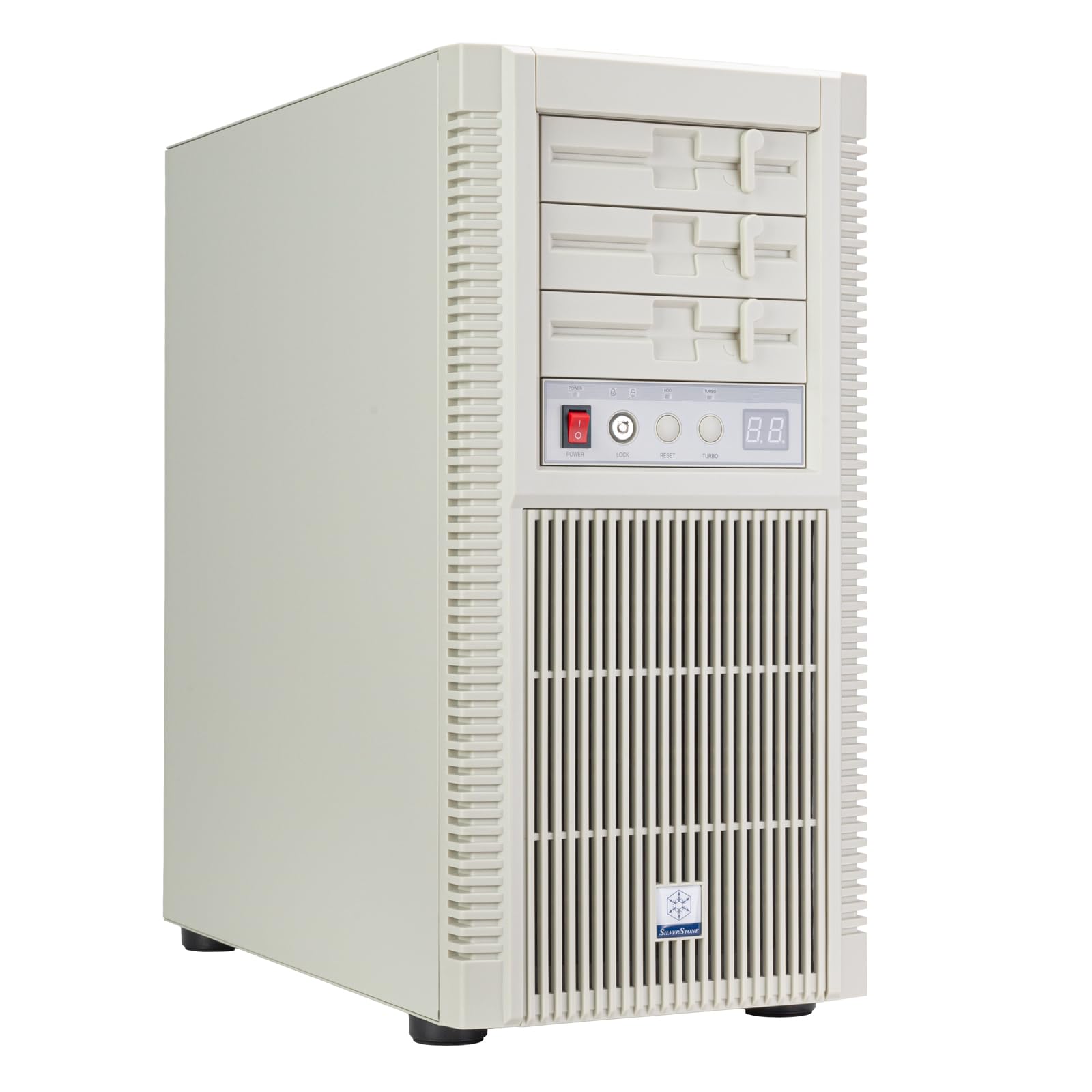
The SilverStone FLP02W is a retro-inspired full-tower that channels the beige-box era of the 1990s but packs modern cooling and hardware support. It is the only case in this roundup with a classic Turbo button on the front panel that instantly ramps all pre-installed fans to maximum RPM, a genuine throwback that also serves a practical function for quick cooling before a gaming session. The chassis is built from heavy-gauge steel with rounded interior edges (no sharp cuts during assembly) and weighs enough to feel permanent.
Despite its vintage exterior, the internal layout is thoroughly modern. It supports 360mm liquid cooling radiators in the front, graphics cards up to 386mm in length, and standard ATX power supplies. Three front 5.25-inch expansion bays are compatible with hot-swap adapter cages or optical drives — a rarity in 2024 that appeals to enthusiasts who still use Blu-ray drives for media playback. The top I/O panel includes a USB-C port, two USB 3.0 ports, and a combo audio jack. The integrated fan hub can control up to six fans, and the case ships with three quiet 120mm fans that SilverStone has tuned for balanced airflow.
The price commands a premium due to the niche tooling costs and the fact that it solves a very specific problem: wanting a retro sleeper case without the DIY headaches of modifying a 1990s tower. The build quality is excellent, with thick steel panels, a powder-coated finish, and a key-lockable power switch. However, the interior is slightly smaller than modern full-towers, so cable management requires patience, especially with non-modular PSUs. For the retro enthusiast who wants a modern PC hidden inside a beige, VCR-like chassis with a real Turbo button, the FLP02W is the only product of its kind on the market.
Why it’s great
- Authentic retro beige design with real Turbo button
- Three front 5.25″ bays for optical drives or hot-swap cages
- Supports 360mm AIO and GPUs up to 386mm
Good to know
- Interior is slightly smaller than modern full-towers for cable management
- Premium price reflects niche manufacturing; not a budget option
9. JONSBO BO400

The JONSBO BO400 is the most ambitious chassis in this lineup, targeting builders who want an unadulterated view of their hardware from every angle. The frame is constructed from T6-grade CNC-machined aluminum alloy with an anodized brushed finish, and the factory default metal top cover can be swapped for an included tempered glass panel to achieve a three-sided (top, front, and side) glass display. This “open concept” approach is the polar opposite of a traditional closed box, and it is designed specifically for back-connect motherboards (BTF standard) that route all cables to the rear.
The dual-chamber layout separates the motherboard and GPU from the PSU and drive bays, resulting in a clean, clutter-free front chamber. The case supports GPUs up to 435mm, ATX power supplies up to 200mm, and up to three 360mm radiators simultaneously — making it one of the most flexible water-cooling platforms in this segment. The front I/O includes a USB 3.2 Gen 2 Type-C port and two USB 3.2 Gen 1 Type-A ports. The tool-less buckle-opening mechanism for the glass and mesh panels simplifies the build process considerably.
The BO400’s primary challenge is its weight — 18.1 kilograms empty — and the demanding cable management required to truly keep the front chamber clean. A back-connect motherboard is strongly recommended; a standard front-connect board will negate the visual benefit of the three-sided glass. The price reflects the all-aluminum construction, the triple-glass panels, and the sheer scale of the chassis. For the builder who wants a furniture-grade showcase that looks like a museum display piece for high-end components, the BO400 is a definitive statement.
Why it’s great
- Triple-sided tempered glass and CNC aluminum frame
- Supports 3x 360mm radiators and GPUs up to 435mm
- Designed for back-connect motherboards for clean cable management
Good to know
- Very heavy (18.1 kg) and requires a BTF back-connect motherboard
- Standard front-connect boards defeat the visual purpose
FAQ
Does a solid wood front panel reduce airflow significantly compared to a mesh case?
Can I install a 360mm AIO radiator in a case with a wood slat front panel?
Are Art Deco computer cases compatible with modern back-connect (BTF) motherboards?
Final Thoughts: The Verdict
For most users, the art deco computer case winner is the Fractal Design North because it perfectly balances genuine walnut craftsmanship, spacious ATX layout, and thermal performance that rivals full-mesh cases. If you want the best out-of-the-box airflow with wood accents, grab the Lian Li LANCOOL 217 for its massive 170mm front fans and five-fan stock configuration. And for a compact desktop showpiece that fits in a living room, nothing beats the Fractal Design Terra.