
Our readers keep the lights on and my morning glass full of iced black tea. As an Amazon Associate, I earn from qualifying purchases.
Specs are compiled from manufacturer listings and verified buyer reviews and can change over time — please confirm the key details on the product page before buying.
Choosing an art print printer is a long-term investment, so picking the right one is crucial. The printers here all handle 13-inch-wide paper or wider, and they all use pigment inks, which is what you need for prints that resist fading for decades. Your choice hinges on speed needs, print volume, and tolerance for ink costs.
I’m Min — the founder and writer behind Gadgets Feed. This guide is built by comparing the manufacturers’ published specifications and the patterns across verified customer reviews, so you get each pick’s real strengths and trade-offs instead of marketing spin.
Whether you sell prints or just want gallery-quality results on your own wall, this breakdown of the best art print printer options helps you match the machine to your real workflow and budget.
Our Picks at a Glance

How To Choose The Best Art Print Printer
Before you spend serious money, understand what separates a true art printer from an office machine. A real art printer accepts paper wider than standard letter size, so you can print 13×19-inch gallery pieces or even larger. It also uses pigment-based ink, which sits on top of the paper instead of soaking into it, keeping colors stable for years without fading.
Paper Width Sets Your Ceiling
Start with the biggest print you plan to sell or frame. A 13-inch-wide printer handles up to 13×19-inch borderless prints, so you can produce standard portfolio pieces and framed art without extra margins. If you need true gallery or poster sizes, a 24-inch-wide machine open up those larger formats, but it takes up more floor space and raises the cost per print.
Ink Colors and Black Density
Count the ink colors, because more colors usually means smoother gradients and better skin tones. A 9-color system with a dedicated matte black and photo black gives you deep, rich shadows on both glossy and fine-art papers. Auto-switching black inks save you from manually swapping cartridges when you change paper types, which also stops ink waste.
Anti-Clogging and Reliability
Pigment ink can dry in the print head if the printer sits idle, so an anti-clogging system is your best friend. Look for features that clear or prevent blocked nozzles automatically. For irregular printers, this feature prevents more frustration than any other spec.
Quick Comparison
| Model | Best For | Max Paper Width | B&W Speed | Color Speed | Amazon |
|---|---|---|---|---|---|
| Canon PRO-310★ Best Overall | Gallery-quality color accuracy | 13 inches | 2 pages/min | 2 pages/min | Amazon |
| Epson R2000 | Fast production on 13-inch media | 13 inches | 20 pages/min | 3.2 pages/min | Amazon |
| Epson R3000 | Versatile fine-art on many papers | 13 inches | — | 14 pages/min | Amazon |
| Canon PRO-2100 | True 24-inch gallery prints | 24 inches | — | — | Amazon |
In‑Depth Reviews
1. Canon imagePROGRAF PRO-310
Our pick — over 4★ from 90+ verified ratings; the strongest balance of quality and price.
The 9-color pigment engine that turns your monitor’s colors into museum-grade paper.
For the artist who obsesses over color accuracy, the PRO-310 delivers prints that buyers consistently call outstanding. The 9-color system with its LUCIA PRO II ink produces enhanced gloss uniformity and scratch resistance, so your finished pieces look smooth and stay protected. Buyers report that prints match a calibrated monitor closely, which is the entire point of a fine-art workflow.
Setup is genuinely painless, with owner accounts describing a smooth wireless configuration that takes about an hour and a half. The 3.0-inch color LCD monitor lets you check ink levels and printer status at a glance without touching a computer. The anti-clogging system and skew correction handle the boring maintenance for you, which is a real relief for anyone who prints in bursts.
The honest trade-off shows up in the numbers. At 2 pages per minute in both black and color, this is a precision instrument rather than a production machine. That is fine when you are proofing and printing a handful of gallery pieces, but the review pages note that ink runs on the expensive side and one owner reported a feed failure after fewer than 200 sheets. For a working studio pushing out hundreds of client cards, this is too slow and too fragile; for a discerning artist, it is a joy.
Why Owners Rave
- Print quality is the single most-praised trait — 33 people single it out
- Easy setup gets 11 positive mentions
- Deep matte black ink for rich dark areas
- Handles glossy, luster, metallic, and fine-art papers
What To Know
- Slow at 2 pages per minute in color
- Ink is pricey, with 6 owners flagging usage
- Reliability is mixed — some report it stopping after months
Reach for this if: you are a photographer or artist who values gallery-quality color and easy setup over raw speed.
Look elsewhere if: you need to print high volumes daily — the 2 pages-per-minute pace will frustrate a busy studio.
2. Epson Stylus Photo R2000

The speed demon of the 13-inch class, racing through prints at 20 pages per minute.
The R2000 is the pick for someone who prints a lot and wants to move fast. Its 20 pages-per-minute black-and-white speed completely dominates this lineup, leaving the Canon PRO-310’s 2 pages per minute in the dust — a full 10x gap that matters if you are fulfilling orders. The Epson UltraChrome Hi-Gloss 2 pigment ink produces vivid, colorful prints with beautiful skin tones and a smooth, glossy finish.
Media flexibility is the other headline feature. The printer accepts cut-sheet and roll paper up to 13 inches wide, plus photographic paper, fine-art paper, canvas, board up to 1.3 mm thick, and even inkjet-printable CD/DVDs. Owners say it handles Ilford Smooth Pearl and Red River Polar Metallic beautifully, and the larger individual cartridges mean fewer swaps, with the ink shaker feature keeping pigment from settling.
Reliability is where the reviews split hard. The top praise is print quality — 94 owners mention it — but the wireless connectivity gets mixed feedback with some finding it easy and others calling it a pain. The most serious complaints describe a clogged head after a week idle that produced blue prints, and one seller refusing a replacement entirely. Buyers who push non-Epson paper also report wasted ink and miss-feeds. For a careful photo enthusiast, this is a capable workhorse; for heavy production duty, the reliability risk is real.
Value read: faster than anything here at 20 pages per minute black-and-white, and the 13-inch media range is superb. Keep in mind the color speed drops to 3.2 pages per minute, and the wireless setup divides opinion.
Best for: serious hobbyists who print regularly on varied media and want speed without stepping up to a 24-inch pro machine.
Think twice if: you must have flawless wireless reliability — the mixed owner feedback is a genuine wildcard.
3. Epson Stylus Photo R3000

Nine high-capacity cartridges and auto-switching black inks for easy fine-art versatility.
The R3000 earns its value reputation by removing the biggest annoyance in photo printing: switching black inks manually. Its auto-switching black ink system achieves high black density on both glossy and matte fine-art papers without you lifting a finger. That feature alone saves ink, since the old way flushed ink through the nozzles every time you swapped paper types.
Color quality is the other standout, with 55 owners praising print quality and 15 more highlighting color output. The Epson UltraChrome K3 with Vivid Magenta ink technology delivers stunning color and black-and-white prints with an attractive premium glossy finish. Nine 25.9 ml individual cartridges mean you replace only the color you actually run dry, and the front-in, front-out paper path keeps feeding consistent.
The catch is ink cost and clogging. Owners consistently flag the nine expensive cartridges, with 21 mentions about ink price and 12 about ink capacity being mixed. The more serious reports describe constant head clogs requiring 1-3 cleaning cycles weekly, sometimes costing a few dollars each. On the other hand, one long-time Epson owner found the speed equivalent to their old model and the wireless setup took under 15 minutes. The color speed here is 14 pages per minute, which beats the PRO-310’s 2 pages per minute by a 7x margin, though this printer tops out at 13-inch roll paper.
Bottom line: superb color and fade-resistant prints with the easiest black-ink handling in this group. The trade-off is that you will feed it expensive cartridges regularly, and clogging demands attention.
Grab it for: the artist who switches between glossy and fine-art papers constantly and hates wasting ink on manual swaps.
skip it if: you are on a tight ink budget — the cartridge costs are the loudest recurring complaint.
4. Canon imagePROGRAF PRO-2100
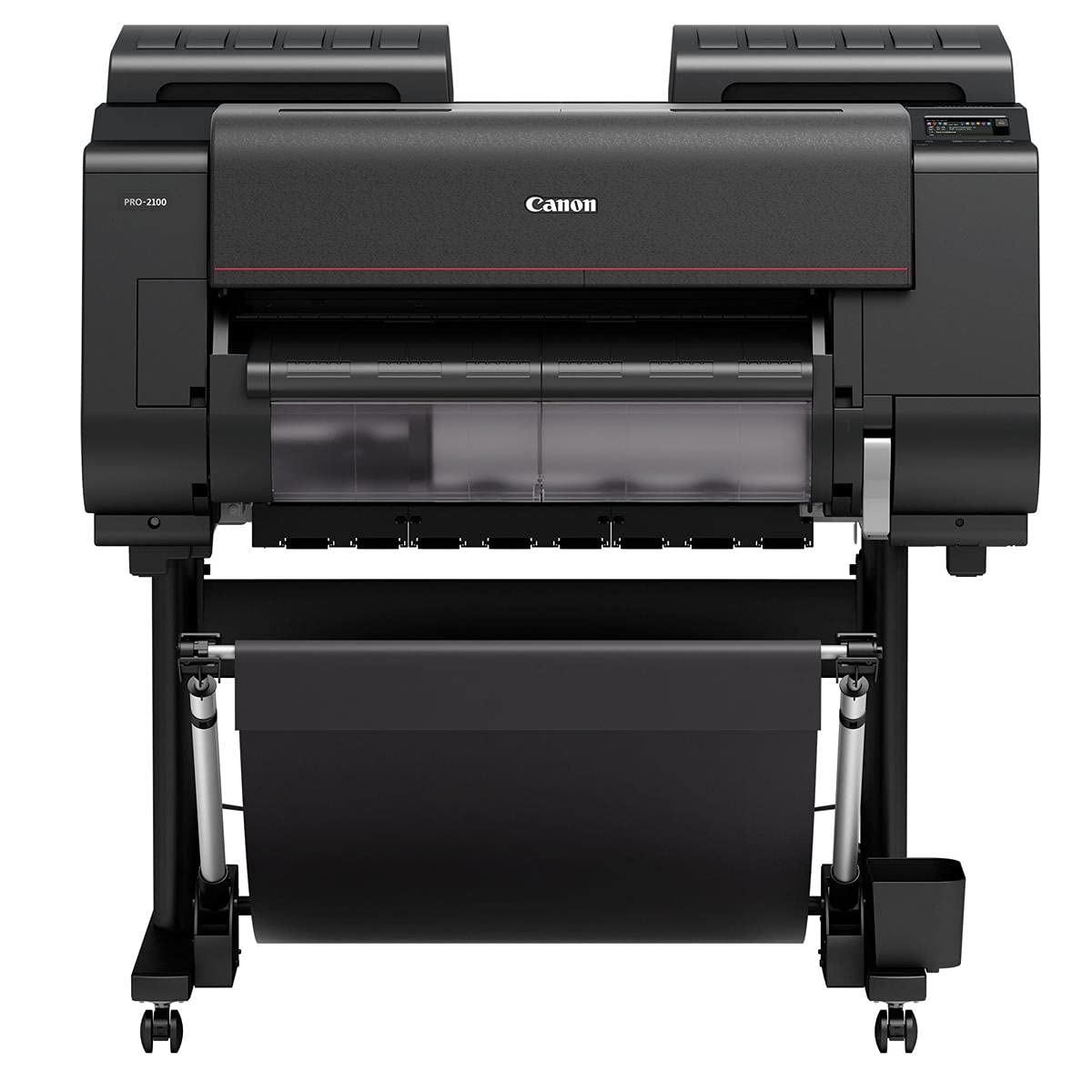
The 24-inch-wide fine-art studio that turns your living room into a gallery workshop.
This is the machine you buy when 13 inches is not enough. The PRO-2100 prints 24 inches wide, which means true gallery and poster-sized pieces that you simply cannot produce on any other printer in this list. Owners describe it as a professional print studio in your own home, with flawless color accuracy and incredibly rich deep blacks that make fine-art paper sing. The 48-bit color depth is the highest here, powering those smooth tonal transitions.
Setup wins praise across the board, and the included Multifunction Roll System (RU-23) plus Roll Holder Set (RH2-29) make loading paper rolls easy. The rotary cutter (CT-07) trims prints cleanly, and the maintenance cartridge (MC-30) keeps things tidy. It is also remarkably user-friendly for such a capable machine — the on-screen guides walk you through startup, software, and paper roll changes, with the first page printing in 98 seconds. Canon backs it with a 1-year on-site warranty, and the seller, a Canon Platinum Reseller, even offers a setup call.
The price of entry is real, and so is the ink. Owners note you only get starter cartridges in the box and will need to buy the 12-color large cartridges, which are costly. A few mention the ink refill cost is higher than expected, though one owner found a 100-foot roll lasts longer than a full ink set. For a working artist selling large prints, the 24-inch width pays for itself; for a casual hobbyist, the footprint and ink bill may be more than you need.
The big leap: no other pick here can print a 24-inch-wide gallery piece in one go. Ease of use and print quality are the two most-praised aspects, tied at 8 mentions each, with deep blacks and museum-quality results repeatedly cited.
Choose this for: selling large-format prints or producing serious fine-art work where width and color depth matter most.
Pass on it if: your largest print is 13×19 — you would be paying a premium for width you will not use.
Understanding the Specs
Pigment vs. Dye Ink
Pigment ink sits on the paper’s surface as solid particles, resisting fading and smudging for decades. Dye ink soaks into the paper and looks vibrant but fades much faster in light. For art prints you want to sell or display for years, pigment ink is the only real choice, which is why every printer here uses it.
Pages Per Minute Realities
Black-and-white pages per minute tells you how fast the machine can lay down monocrome prints, while color pages per minute shows its pace for full-color work. A 20 pages-per-minute black-and-white speed is genuinely fast, but that figure often assumes simple documents rather than dense photo prints. Always expect photo jobs to run slower than the headline number.
Paper Width and Media
Maximum paper width decides the largest print you can make. A 13-inch-wide machine produces 13×19-inch borderless prints, perfect for most framed art. A 24-inch-wide machine opens up true poster and gallery sizes. Also check whether the printer accepts roll paper and thick fine-art board, which matters for canvas and textured papers.
Anti-Clogging Systems
Pigment ink can dry and block the print head when a printer sits idle for days or weeks. An anti-clogging system automatically clears nozzles, ensuring clean prints on the first try. For occasional printers, this feature outweighs nearly every other spec.
FAQ
What paper width do I need for selling art prints?
Why is pigment ink better than dye ink for art prints?
How many ink colors do I really need?
What does auto-switching black ink mean?
Will a clogged print head ruin my printer?
What is the true cost of ink for these printers?
Can I print on canvas or fine-art paper?
How fast can each printer produce prints?
Is a 24-inch printer worth the extra cost?
Final Thoughts: The Verdict
For most artists, the art print printer winner is the Canon PRO-310 because its 9-color pigment system and easy setup deliver gallery-quality color without a steep learning curve. If you value raw speed and media versatility, grab the Epson R2000 at 20 pages per minute black-and-white. And for true 24-inch gallery prints with rich deep blacks, the Canon PRO-2100 is the one to reach for, assuming your wall space and ink budget can handle it.
How We Picked
We do not accept paid placement. Every pick is matched to a real buyer and a real use-case; we do not hands-on test units.
Sources & Methodology
Specifications: manufacturer listings and product documentation. Review insights: verified customer reviews, as of August 2026. Pricing: not shown on this page (it changes often); check the current price via the retailer link.
As an Amazon Associate, Gadgets Feed earns from qualifying purchases. This does not affect which products we feature.