
Our readers keep the lights on and my morning glass full of iced black tea. As an Amazon Associate, I earn from qualifying purchases.
Specs are compiled from manufacturer listings and verified buyer reviews and can change over time — please confirm the key details on the product page before buying.
Every parent or therapist knows the moment: a child is trying to say a word, but the sound just won’t come out right. The right articulation cards turn that struggle into a small victory, giving you a structured, visual way to drill tricky sounds like “S,” “R,” and “L” without it feeling like homework. This guide compares five sets built for speech therapy, focusing on what actually helps kids (and adults) make progress: real photos, clear sound targets, and designs that survive daily use.
I’m Min — the founder and writer behind Gadgets Feed. This guide is built by comparing the manufacturers’ published specifications and the patterns across verified customer reviews, so you get each pick’s real strengths and trade-offs instead of marketing spin.
Whether you are a speech-language pathologist (SLP, a professional speech therapist) stocking your clinic or a parent looking for home practice tools, these are the articulation cards for speech therapy that reviewers consistently praise for helping learners open up clearer communication.
Our Picks at a Glance

How To Choose The Best Articulation Cards For Speech Therapy
Choosing the right set depends on what sounds you need to target, how many cards you get, and how easy they are to use in a real session. Beginners often grab the cheapest deck, only to find it skips critical sound positions or uses confusing clip art that slows down recognition.
Prioritize Real Photos Over Clip Art
Real photographs reduce visual ambiguity. A child who sees a real photo of a “seal” instantly connects the image to the word, making the sound target clearer. Cartoon illustrations can be cute, but they sometimes add visual noise that distracts from the articulation goal.
Check the Sound Position Coverage
The best sets include words with your target sound at the beginning, middle, and end of the word (initial, medial, final positions). This variety mirrors how speech-language pathologists (SLPs) structure therapy goals, letting you practice the same sound in different contexts without having to buy extra cards.
Look at the Build Quality and Size
Cards that are too small can be hard for little hands to hold. Large-format cards (around 5.9 by 3.9 inches) are easier to see and handle during sessions. Thick, scratch-resistant cardstock with a smudge-proof coating will survive being passed around a classroom or tossed into a therapy bag.
Quick Comparison
| Model | Best For | Card Count | Card Size | Sound Targets | Amazon |
|---|---|---|---|---|---|
| Visual Communication Book★ Best Overall | Non-verbal communication | 162 | 1.5 x 1.5 in | Categories (Food, Toys, etc.) | $82.99Amazon |
| Picture My Picture Articulation CardsTop Performer | Deep sound drill | 210 | 5.9 x 3.9 in | S, R, L, Z, S/R/L Blends | $54.95Amazon |
| Stages Learning Language Builder | Core vocabulary | 353 | 3.5 x 5 in | Nouns (9 categories) | $133.23$139.81Amazon |
| Picture My Picture Language Flash Cards | Language concepts | 200 | 5.9 x 3.9 in | Emotions, Verbs, Prepositions | $54.95Amazon |
| Who What Why Conversation Cards | Social & critical thinking | 60 | 6.5 x 4.92 in | Scenarios & Questions | $16.99$23.99Amazon |
In‑Depth Reviews
1. Smile4Autism Visual Communication Book (162 Cards)
Our pick — over 4.5★ from 950+ verified ratings; the strongest balance of quality and price.
A ready-to-use binder with plastic cards and a PECS-style system for non-verbal or limited-communication learners.
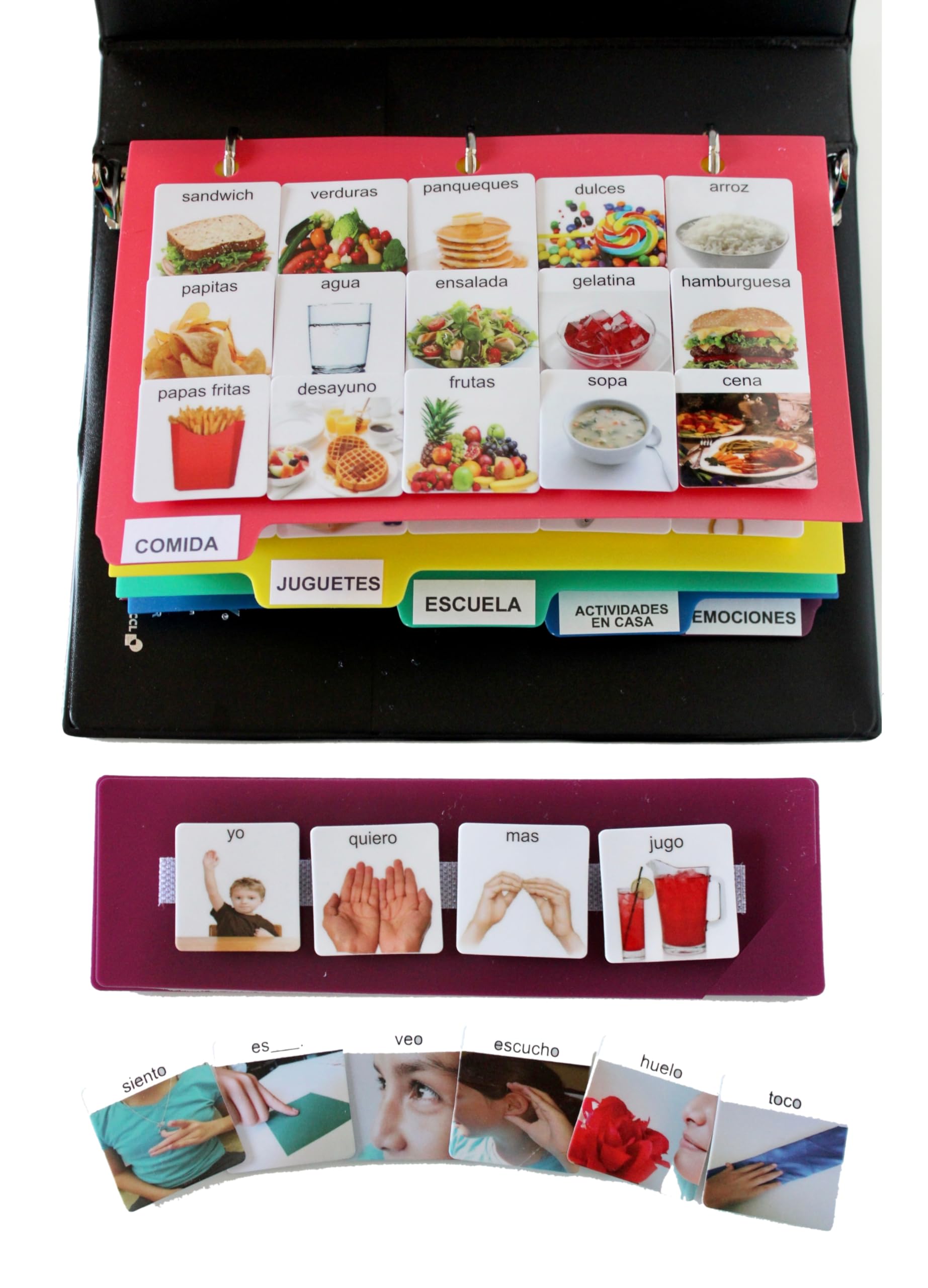
The Smile4Autism book takes a different approach: instead of a card deck, you get a 9-by-7-inch binder with 162 pre-cut plastic cards (each 1.5 by 1.5 inches) organized into eight common categories — Food (30 cards), Toys (31), School (15), Places (15), Home Activities (15), Signs (15), Emotions (15), and Actions (15). The cards are made of thick plastic, so they are wear-resistant, tear-resistant, and moisture-resistant — ideal for a child who mouths items or drops things constantly. The binder includes five heavy-duty 10-mil poly dividers (each with rough strips that hold up to 30 cards on both sides) and two interior storage pockets for loose materials.
Reviewers point out that the book arrives “already assembled and ready to use,” which saves you the laminating and cutting that other kits require. One teacher using it with a newcomer student said “the cards are a thick plastic and the pictures are great quality.” The system follows a Picture Exchange Communication System (PECS) style (a method where a non-verbal child hands a picture to request an item), starting with single-icon exchanges and progressing to sentence construction like “I want paint” or “I see park.” A reviewer mentioned their special son “feels comfortable communicating with family and friends” using this book. The binder measures 11 by 8.5 by 0.1 inches, making it larger than the card decks — something to consider for backpack storage.
If you are comparing this to the Stages Learning set above, the Visual Communication Book is much more portable as a binder but has fewer cards (162 vs. 353). It is also designed for the exchange-based PECS method, whereas the Stages set is meant for labeling and matching drills. Choose based on your child’s communication stage.
What’s Great
- Plastic cards are wear-resistant, tear-resistant, and moisture-resistant — built to last
- Binder format is ready to use from the start with zero prep work
- PECS-style system helps non-verbal learners initiate communication
What’s Limiting
- Small card size (1.5 x 1.5 inches) may not suit children who need larger visuals
- No articulation-specific sound targets — it is a communication system, not a drill deck
Reach for this if: you have a non-verbal or minimally verbal child who is ready to exchange pictures for items — the binder approach saves prep time and holds up to real use.
Look elsewhere if: the child is already using words but needs help shaping specific speech sounds.
2. Picture My Picture Articulation Cards (210 Pack)
The deep-dive deck that covers seven high-priority sounds with real photos and a built-in progression plan.
You get 210 large-format cards (each 5.9 by 3.9 inches) targeting the seven sounds SLPs address most often: S, R, L, Z, plus three blend groups (S Blends, R Blends, L Blends). Every sound includes 30 word cards covering all three positions (beginning, middle, end — for example “seal” for initial S, “dinosaur” for medial S, “eggs” for final S). This positional variety mirrors how SLPs structure therapy goals, letting you move through the stages of articulation therapy step by step.
The cards use real photographs on clean, distraction-free backgrounds — not cartoons. That helps toddlers, adults recovering from a stroke, or English as a Second Language (ESL) learners working on clear pronunciation recognize each target instantly. The included activity guide walks you from simple sound identification all the way to using words in sentences and conversation, so you do not have to invent drills yourself. Buyers report the oversized cards are easy for children to handle and that the scratch-resistant, smudge-proof coating holds up during daily clinical use, though one reviewer noted the cardstock “could be heavier.”
Shorter on general vocabulary than the Stages Learning set below, this deck is much more focused — it exists purely to fix sound production, making it the sharper tool for a targeted articulation goal.
Why It Leads
- 210 cards across 7 specific sound targets — the most articulation-focused set here
- Real photographs with no distracting background, which aids quick recognition
- Includes initial, medial, and final word positions for each sound
- Comes with a step-by-step activity guide for progression planning
Where It’s Less
- Cardstock is coated but some reviewers wish it was a touch heavier for heavy clinic use
- No coverage of vowel sounds or less common consonants
Grab this if: your main goal is drilling the trickiest consonant sounds (S, R, L, Z, blends) with a system you can follow from start to finish.
Look elsewhere if: you need a broader vocabulary builder with categories like emotions or verbs — that is a job for a different deck.
3. Stages Learning Materials Language Builder Picture Noun Cards

The biggest early-vocabulary collection here, built for ABA therapy and core language drills.
You get 353 cards — far more than any other set in this guide — covering nine basic categories: animals, food, vehicles, furniture, clothing, toys, everyday objects, shapes, and colors. Each card is 3.5 by 5 inches, printed on sturdy cardstock with a gloss varnish on the photo side so you can wipe off smudges, and a writable surface on the back for labels or notes. The photos are realistic, current images (not drawings), which is exactly what Applied Behavior Analysis (ABA) therapy and early autism education curricula recommend.
This set teaches core skills: receptive labeling (pointing to a picture when asked), expressive labeling (naming the card), matching identical cards, sorting into categories, and building adjectives, features, functions, and classes. Owners mention that the cards are thick enough for daily home ABA sessions and that the variety keeps children engaged — one parent noted their son learned “raisins” and “car” from using the cards. A reviewer working with aphasia patients (people who have lost the ability to understand or express speech after a stroke) mentioned the images work well, though they wished the label text on the back was larger so seniors could read it easily.
Unlike the Picture My Picture Articulation deck, this is a vocabulary foundation tool. It does not target specific speech sounds (phonemes). If you need to fix a child’s “S” or “R” sound, this set will not organize practice by sound position. It excels at building a rich noun vocabulary that you can then use for articulation practice — but you have to pull the target words yourself.
What Stands Out
- 353 cards — the largest quantity of any set reviewed here
- Gloss varnish on photo side allows easy wipe-off; writable back for custom labels
- Teaches multiple ABA and early autism lessons (matching, sorting, categorizing)
The Catch
- No verbs, emotions, or prepositions — strictly nouns
- Small print on the back of cards can be hard for older learners to read
Choose this for: building a broad core vocabulary for a child or adult in ABA, autism, or stroke rehab — you get more cards per dollar than any competitor.
Pass if: you specifically need articulation drill cards organized by initial, medial, and final sound positions.
4. Picture My Picture Language Flash Cards (200 Card Set)

The all-rounder that covers emotions, verbs, prepositions, categories, and go-togethers in one organized box.
This set from Picture My Picture is not strictly an articulation deck — it is a language concept builder that works beautifully alongside articulation practice. It gives you 200 large cards (5.9 by 3.9 inches each) covering five key areas: Emotions (identifying and expressing feelings like happy, frustrated, proud), Verbs (actions like jumping, drawing, brushing teeth), Prepositions (spatial concepts like under, between), Categories (grouping objects), and Go Togethers (associating items like a sock and shoe). Each concept is separated by a color-coded divider tab, so you can grab exactly what you need without flipping through unrelated cards.
Customers note that the real-life photography is “superb” and that children as young as 3 years old love the emotions and go-together cards. One reviewer using the set with their son noted it has been an additional tool for speech therapy, helping them practice sentence building and descriptive language. The step-by-step activity guide gives you ideas that progress from simple touching and sorting to more advanced describing and conversation. A common note in reviews is that the set feels “pricey” for what you get, but the quality of the thick cardstock and the durability of the storage box tend to justify the cost over time.
Compared to the Stages Learning set, this one adds critical language dimensions (verbs, emotions) that Stages purely noun-focused set lacks. If you already own an articulation sound deck (like the Picture My Picture Articulation Cards above), this language set fills the vocabulary and concept gaps that make communication truly functional.
Why It Works
- Covers five distinct language concepts in one organized box with color-coded dividers
- Real photos on large-format cards aid fast recognition for kids and adults
- Includes a comprehensive activity guide with progression ideas
The Trade-off
- Not organized by speech sound — you cannot grab “all the S words” easily
- Several reviews mention the price feels a bit high for 200 cards
Pick this if: you want a single set that teaches emotions (happy, frustrated), verbs (jumping, drawing), and prepositions (under, between) using real-life photos — perfect for mixed language goals.
skip it if: you only need pure articulation sound drill with no language scaffolding.
5. Clever Fox Play Who What Why Conversation Cards

The affordable social-skills deck that uses cute animal scenes to spark reasoning and description.
Clever Fox Play’s “Who What Why” cards are the smallest and most budget-friendly set here, but they fill a specific niche: building social skills, emotional intelligence, and critical thinking through conversation. The deck contains 60 laminated cards (each measuring 6.5 by 4.92 inches) featuring friendly animal characters in everyday situations a child might encounter at home or school. Each card uses a “Who, What, Why” format (for example, “Who is in the picture? What are they doing? Why do they feel that way?”) to push kids beyond one-word answers into describing context, sequencing events, and exploring emotions.
Shoppers say that a 6-year-old “asks to play” with the cards and that the scenes help build vocabulary and descriptive language naturally. A speech therapist in private practice noted the cards are “helpful working on social skills with children” and praised their colorful detail and sturdy lamination. One parent who bought them to work on social cue recognition said their child “has started noticing things around her more.” Each card is laminated, which makes them feel high quality and durable for small hands. The back of the card includes the questions, so you can hold up the image and prompt the child without flipping.
Compared to the Picture My Picture Language set above, this deck is much smaller (60 cards vs. 200 cards) and more narrowly focused on social scenarios. It is not an articulation sound deck — you use it to practice describing, reasoning, and reading social cues, not to drill the “S” sound. For a parent or teacher on a tight budget who wants to encourage a child to speak in full sentences about real situations, this is a smart entry point.
Why It’s Useful
- Laminated cards feel sturdy and resist spills and bending
- Animal-based scenarios are relatable and low-stress for kids ages 4+
- Larger card size (6.5 x 4.92 in) makes group viewing easy
Where It Falls Short
- Only 60 cards — you will exhaust the scenarios faster than a larger set
- No structured articulation or phoneme target system — pure social-language focus
Choose these for: a low-cost conversation starter that gets kids describing scenes, identifying emotions, and building social scripts at home or in small group therapy.
Skip if: you need a targeted articulation deck with sound positions and drill structure — these cards won’t organize practice by “S” or “R.”
Understanding the Specs
Card Count & Sound Targets
More cards give you more practice variety, but the real difference is what sounds they cover. A set like the Picture My Picture Articulation Cards (210 cards) concentrates on 7 specific speech sounds (S, R, L, Z, plus blends), which means you can drill those tricky phonemes (individual units of sound) repeatedly. A general vocabulary set like Stages Learning (353 cards) covers many nouns but does not organize practice by sound — you have to find the target words yourself. Choose based on if you want narrow, deep articulation work or broad vocabulary exposure.
Real Photographs vs. Illustrations
Real photographs reduce visual ambiguity. A child seeing a real photo of a “zebra” connects the image to the word faster than with a cartoon, because the image is exactly what the word represents. This is especially important for learners with autism, stroke survivors, or anyone who struggles with abstract symbols. Every set in this guide uses real photos except the Who What Why Conversation Cards (which use friendly animal illustrations for a different purpose — social storytelling). For pure articulation drill, stick with photo-based cards.
FAQ
What is the difference between articulation cards and language flashcards?
How many cards do I need for effective speech therapy?
Can I use these cards for an adult with aphasia or stroke recovery?
What does initial, medial, and final sound position mean?
Are plastic cards better than paper cardstock?
Can I use articulation cards for ESL learners?
What is a PECS system?
Do I need separate cards for each sound my child struggles with?
How do I store articulation cards to keep them organized?
Can I use these cards with a child under 3 years old?
Final Thoughts: The Verdict
If you want one dependable pick, the articulation cards for speech therapy winner is the Picture My Picture Articulation Cards because it gives you 210 real-photo cards targeting the seven most commonly difficult sounds, with a structured activity guide you can follow from start to finish. If you want the broadest vocabulary foundation for ABA or autism therapy, grab the Stages Learning Language Builder with 353 cards. And for a budget-friendly conversation starter that builds social skills and descriptive language, the Who What Why Conversation Cards get kids talking for the lowest cost.
How We Picked
We do not accept paid placement. Every pick is matched to a real buyer and a real use-case; we do not hands-on test units.
Sources & Methodology
Specifications: manufacturer listings and product documentation. Review insights: verified customer reviews, as of July 2026. Pricing: not shown on this page (it changes often); check the current price via the retailer link.
As an Amazon Associate, Gadgets Feed earns from qualifying purchases. This does not affect which products we feature.
Related Guides
Product prices and availability are accurate as of the date/time indicated and are subject to change. Any price and availability information displayed on Amazon at the time of purchase will apply to the purchase of this product. As an Amazon Associate I earn from qualifying purchases.
CERTAIN CONTENT THAT APPEARS ON THIS SITE COMES FROM AMAZON. THIS CONTENT IS PROVIDED "AS IS" AND IS SUBJECT TO CHANGE OR REMOVAL AT ANY TIME.
Amazon and the Amazon logo are trademarks of Amazon.com, Inc. or its affiliates.