
Forget everything you think you know about eyewear. The latest wave of smart frames packs a camera, microphone array, speaker system, and a neural AI copilot into a package that looks like a standard pair of shades. The challenge isn’t finding a pair that can record video or answer questions—it’s choosing the one that actually fits your face comfortably, delivers clear visuals without cutting off the corners of the screen, and provides a genuinely useful AI assistant rather than a frustrating voice-command gimmick.
I’m Min — the co-founder and writer behind Gadgets Feed. I’ve spent countless hours analyzing the technical specifications, real-world customer feedback, and comparative performance data across the current landscape of AI-powered smart glasses to identify which models actually deliver on their promises.
Whether you want hands-free content capture, real-time language translation, or a private cinema strapped to your face, this guide breaks down the real-world strengths and dealbreakers of the top contenders. Here is my researched take on the best artificial intelligence eye glasses.
How To Choose The Best Artificial Intelligence Eye Glasses
Smart glasses today fall into two distinct categories: AI-assistant glasses with a camera and speaker for hands-free interaction, and AR display glasses that project a virtual screen in front of your eyes. Your choice depends on whether you need to capture your perspective, have an AI assistant whisper answers in your ear, or watch movies and play games on a giant floating display. Comfort, audio quality, and the specific AI features available in your region are the non-negotiable filters.
Display Technology and Field of View
If you are buying AR display glasses, the display technology is the entire experience. Micro-OLED panels with 120Hz refresh rate and HDR support deliver the sharpest, most vibrant picture. Field of view (FOV) determines how large the virtual screen feels — a 46-degree FOV produces a 201-inch virtual display at a distance, while a 57-degree FOV pushes that to 171 inches from four meters. A wider FOV is more immersive but requires precise IPD adjustment and comfortable nose pads to keep the edges of the screen from being cut off.
AI Assistant Capabilities and Regional Availability
The “AI” in smart glasses ranges from a basic voice assistant that sets timers to a multimodal AI that can identify objects and translate languages in real time. The Meta AI in Ray-Ban glasses is the most advanced consumer implementation, but its live translation and “Hey Meta” question-answering features are restricted to certain countries. Some budget models claim GPT-4o integration but require a companion app and may have limited real-world accuracy. Always verify that the AI features you actually want work in your location before purchasing.
Comfort, Fit, and Prescription Lens Support
Smart glasses are heavier than standard eyewear due to the embedded electronics. A pair weighing 51 grams is quite light; models pushing 80-100 grams will cause nose bridge soreness after an hour. Adjustable nose pads and flexible temples are critical for aligning the display optics with your pupils. If you wear prescription lenses, check whether the manufacturer offers prescription lens inserts (sold separately) or if the frame accepts standard prescription lenses. Glasses that cannot accommodate your vision correction are essentially unusable for daily wear.
Quick Comparison
On smaller screens, swipe sideways to see the full table.
| Model | Category | Best For | Key Spec | Amazon |
|---|---|---|---|---|
| Ray-Ban Meta (Gen 2) | AI Camera Glasses | Hands-free content & Meta AI | 3K Ultra HD video, 8hr battery | Amazon |
| XREAL One Pro | AR Display Glasses | Immersive gaming & spatial screen | 57° FOV, 171″ display, 3ms latency | Amazon |
| RayNeo Air 4 Pro | AR Display Glasses | Best value HDR10 movie viewing | 120Hz, HDR10, Bang & Olufsen audio | Amazon |
| Ray-Ban Meta (Gen 1) | AI Camera Glasses | Stylish AI assistant with open-ear audio | 12MP ultrawide camera, 5-mic array | Amazon |
| Lenovo Legion Glasses Gen 2 | Personal Monitor | Portable 120Hz gaming display | Micro-OLED, 120Hz, plug-and-play USB-C | Amazon |
| BooaBei AI Smart Glasses | AI Camera Glasses | Budget multitool with translation | 8MP camera, IP67, 32GB storage | Amazon |
| RayNeo Air 4 Pro (Alt) | AR Display Glasses | Travel entertainment & 3D movies | HDR10, 3840Hz flicker-free, 76g | Amazon |
In‑Depth Reviews
1. Meta Ray-Ban (Gen 2), Wayfarer
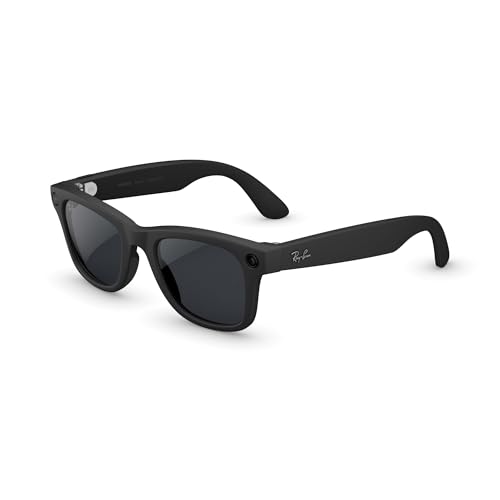
The Gen 2 Ray-Ban Meta glasses fix the primary complaint of the first generation: battery life. Now offering up to 8 hours of moderate use on a single charge and a charging case that provides up to 48 hours of total power, these are the only AI camera glasses you can realistically wear for a full day without anxiety. The 3K Ultra HD video from the 12MP ultrawide camera is noticeably sharper than the Gen 1’s 1080p output, and the open-ear speakers deliver clear audio without isolating you from your environment.
Meta AI integration is the headline feature here. You can ask the glasses to identify landmarks, translate conversations in real time between English, French, Italian, Spanish, Portuguese, and German, or set reminders hands-free. The five-microphone array with 90% wind and street noise blocking makes phone calls surprisingly intelligible even in windy conditions. The Transitions grey lenses automatically darken in sunlight and clear indoors, eliminating the need to carry a second pair.
The Gen 2 retains the classic Wayfarer design, weighs only 51 grams, and looks indistinguishable from standard Ray-Ban sunglasses — a critical privacy and style advantage. The main downside is that continuous video recording drains the battery to about 30 minutes of capture time, and the advanced AI translation features are currently limited to select regions. It is also not water-resistant, so rain or heavy sweat requires caution.
Why it’s great
- Industry-leading Meta AI with real-time translation and object recognition
- 8-hour moderate use battery plus 48-hour charging case
- Ultra-light 51g frame looks like standard sunglasses
Good to know
- Continuous video recording limited to ~30 minutes per charge
- AI translation features not available in all countries
- Not water-resistant; avoid rain and heavy sweat
2. XREAL One Pro AR Glasses

The XREAL One Pro is the most technically advanced AR display glasses on this list, thanks to XREAL’s self-developed X1 spatial computing chip. This chip provides native 3DoF tracking with an ultra-low 3ms M2P latency, meaning the virtual screen stays anchored in place even when you turn your head quickly. The 57-degree field of view produces a 171-inch virtual display from four meters, and the Sony 0.55-inch Micro-OLED panels deliver FHD resolution at 120Hz with 700 nits of peak brightness, making it usable even outdoors in sunlight.
The X-Prism optics are a genuine engineering achievement — they project a sharp, distortion-free image while remaining slim enough for a glasses form factor. The dual IPD design offers two size options (M: 57-66mm, L: 66-75mm) that cover over 95% of users, and the three-stage adjustable arms plus three sizes of zero-pressure nose pads ensure a comfortable fit for extended sessions. Audio is tuned by Bose, delivering spatial sound without needing separate headphones.
The optional XREAL Eye accessory adds a camera for 6DoF spatial anchoring and photo capture, but that is an extra cost. There is no built-in myopia adjustment, so prescription lens inserts (sold separately) are required for users who wear glasses. Some users report occasional screen drifting on mobile devices and that the plastic frame can feel uncomfortable when lying on your side. This is a premium tool for serious gamers and media enthusiasts, not a casual everyday wearable.
Why it’s great
- Native 3DoF with 3ms latency — screen stays anchored during head movement
- Best-in-class 57° FOV for immersive 171-inch virtual display
- Bose-tuned audio with 700 nit brightness for outdoor use
Good to know
- No built-in myopia adjustment; prescription inserts sold separately
- Optional XREAL Eye camera accessory is an extra purchase
- Some users experience drifting on mobile and discomfort when side-lying
3. RayNeo Air 4 Pro AR/XR Glasses
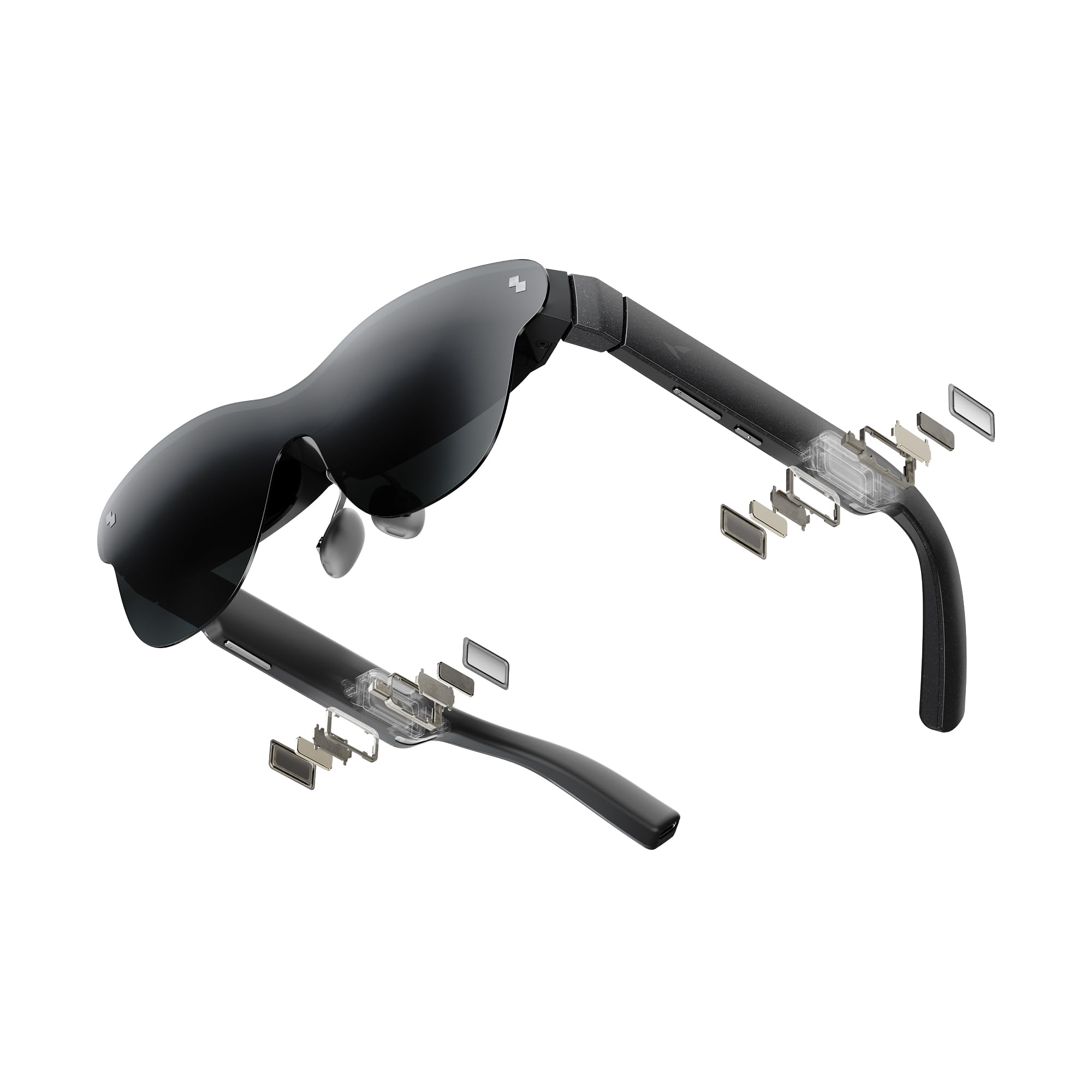
The RayNeo Air 4 Pro delivers the best price-to-performance ratio in the AR display category. It is the world’s first AR glasses with HDR10 certification, rendering over 10 billion colors with deeper blacks and brighter highlights than standard LCD-based smart glasses. The 201-inch virtual display at a 46-degree FOV is slightly less immersive than the XREAL One Pro but still feels massive for movies, gaming, and productivity work. The Vision 4000 chip, co-developed with Pixelworks, provides AI SDR-to-HDR upscaling and supports a smooth 120Hz refresh rate.
The audio system, co-engineered with Bang & Olufsen, uses four precision speakers to deliver 360-degree spatial sound. A whisper mode enables private listening in public spaces, and an optional Sound Tube accessory boosts volume by up to 15dB. The glasses weigh only 76 grams and feature 9-way fit adjustment with adjustable temples and interchangeable nose pads to reduce blurry edges caused by misalignment. The 3840Hz flicker-free display is TÜV-certified for low blue light, reducing eye strain during long gaming or movie sessions.
Connectivity is purely USB-C — no WiFi or app required — and it works with iPhone 17/16/15 (USB-C models), Android phones, MacBook, iPad, Steam Deck, and PlayStation consoles. The lack of an internal battery keeps the weight down but means it drains power from the connected device. Some users report that the nose pads can cause soreness after an hour of wear, and the fixed 46-degree FOV means you have to adjust the glasses carefully to see the full screen without top or bottom cut-off.
Why it’s great
- World’s first HDR10 AR glasses with stunning color and contrast
- Bang & Olufsen audio with whisper mode for private listening
- Exceptional value — comparable display quality to glasses costing twice as much
Good to know
- No internal battery; drains power from connected USB-C device
- Nose pads can cause discomfort after 60+ minutes of wear
- Fixed 46° FOV requires precise adjustment to avoid edge cut-off
4. Ray-Ban Meta (Gen 1), Skyler
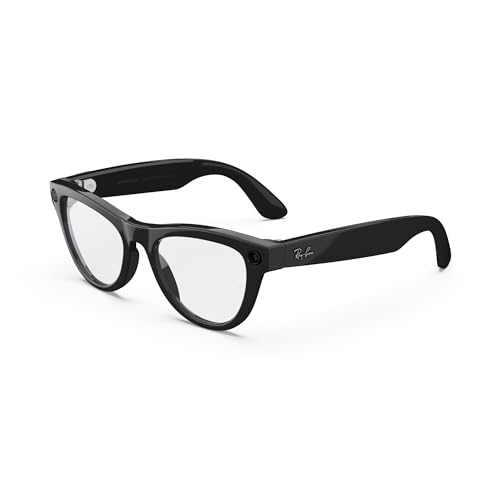
The Gen 1 Ray-Ban Meta glasses are still an excellent option if you prioritize style and the full Meta AI ecosystem over maximum battery life. The Skyler frame in Shiny Black with clear lenses looks like a premium fashion accessory, not a gadget. The 12MP ultra-wide camera captures photos and 1080p video that is impressively clear for a glasses-mounted lens, and the five-microphone array provides outstanding audio capture for hands-free calls and video recording.
Meta AI features include real-time translation between English, French, Italian, Spanish, German, and Portuguese, the ability to ask “Hey Meta, what am I looking at?” for object identification, and hands-free calling and messaging. The open-ear speakers deliver rich audio without blocking ambient noise, making these safe for walking or cycling. Livestreaming directly to Facebook and Instagram is seamless, and the glasses integrate with the Meta View app for easy media transfer.
The glasses weigh 310 grams (including case), which is heavier than the Gen 2’s 51-gram frame, and continuous video recording drains the battery quickly. The translation and AI features are geo-locked to the US, Canada, and Australia, so international buyers should verify regional availability. It also lacks water resistance.
Why it’s great
- Classic Ray-Ban style; looks like normal glasses, not a wearable computer
- Full Meta AI suite with translation, object ID, and hands-free calling
- Excellent 12MP camera and 5-mic audio capture for content creators
Good to know
- Battery life is around 4-6 hours — significantly less than Gen 2
- AI features geo-locked to US, Canada, and Australia
- Not water-resistant, and heavier than the Gen 2 frame
5. Lenovo Legion Glasses Gen 2

The Lenovo Legion Glasses Gen 2 is a specialized portable monitor for your face, designed primarily for gaming on the Lenovo Legion Go, Steam Deck, and any USB-C device that supports DisplayPort Alt Mode. The Micro-OLED display delivers a crisp 1920×1080 resolution at a smooth 120Hz refresh rate, which is ideal for fast-paced competitive gaming and action movies. The plug-and-play setup requires no software or apps — just connect the USB-C cable and the glasses instantly mirror or extend your device’s screen.
The display is rated at 126 inches virtual screen size, providing an immersive experience for gaming in bed, on a plane, or on a train. High-fidelity speakers built into the temples provide adequate audio, though audiophiles will still prefer separate Bluetooth earbuds. The glasses come with an adjustable nose pad, a light shield for blocking peripheral light, and a prescription lens frame (lenses sold separately) so glasses wearers can use them comfortably.
The critical flaw that surfaces in multiple user reviews is fit: the nose pads are difficult to adjust, and many users report that the glasses slide down their nose, cutting off the top or bottom of the screen. Long sessions can cause eye strain, and the cable that connects to your device can be annoying during use. It also has no internal battery, no AI assistant, and no camera — this is purely a display device, not a smart glasses platform.
Why it’s great
- True 120Hz FHD Micro-OLED display perfect for gaming
- Zero setup — plug-and-play with any USB-C DP device
- Includes light shield, carry case, and prescription lens frame
Good to know
- Nose pad adjustment is finicky; many users report screen cut-off
- No AI, camera, or internal battery — display only
- Cable connection to device can be cumbersome during use
6. BooaBei AI Smart Glasses
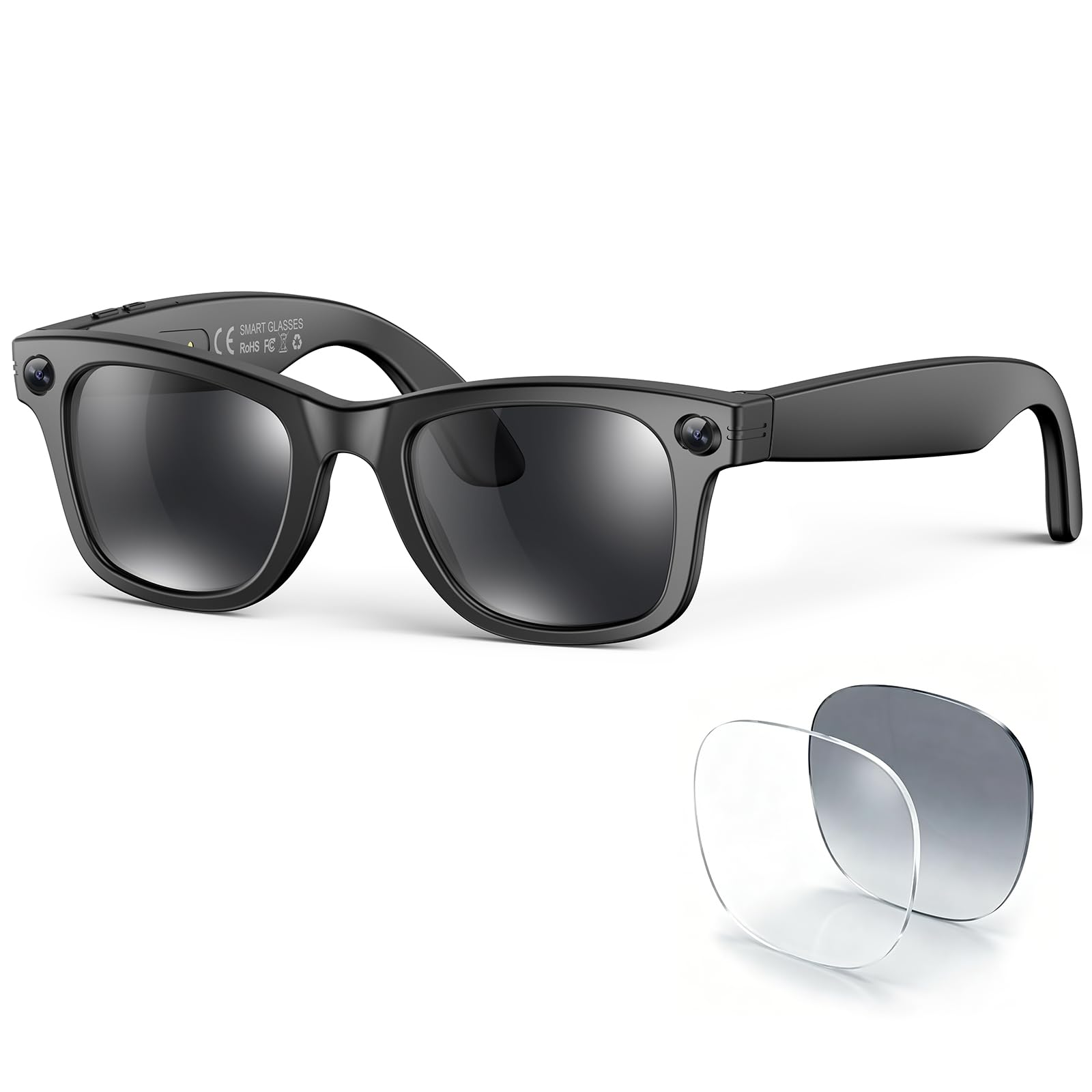
The BooaBei AI Smart Glasses pack an extraordinary number of features into a budget-friendly frame. The 8MP camera captures 2K video and photos, and the glasses include AI-powered photo recognition, real-time translation via a companion app, and a GPT-4o voice assistant activated by saying “Hello Xiaocheng”. The 270mAh battery provides over 12 hours of music playback and up to a week of standby, while Bluetooth 5.3 ensures a stable connection up to 15-18 meters.
One of the most unique features at this price point is the IP67 dust and water resistance rating, which makes these glasses suitable for high-intensity workouts, rain, and dusty environments. The tool-free magnetic lens system lets you swap between blue light blocking lenses for work, photochromic transition lenses for outdoor sun protection, and transparent lenses for night use in seconds. The glasses also include 32GB of onboard storage for saving photos and videos directly.
The trade-offs are real: the frame feels less premium than Ray-Ban or XREAL offerings, and the AI voice assistant’s accuracy is inconsistent compared to Meta AI. The companion app is required for translation and image recognition, which adds friction compared to truly hands-free systems. Some users report that the photochromic lenses do not darken as aggressively as dedicated sunglasses, and the overall build quality is mid-range. For the feature set, however, the value proposition is undeniable.
Why it’s great
- IP67 water and dust resistant — rare for AI glasses
- 32GB onboard storage for offline photo and video capture
- Tool-free magnetic lens swap system for versatile use
Good to know
- AI voice assistant accuracy is inconsistent
- Companion app required for translation and image recognition
- Build quality feels less premium than established brands
7. RayNeo Air 4 Pro (Alternate SKU)
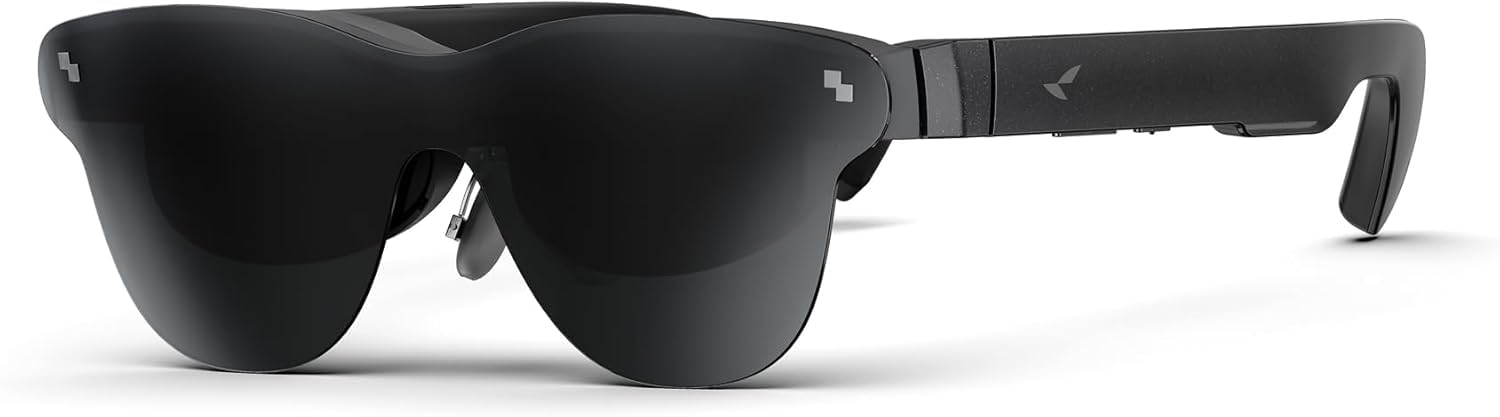
This alternate listing of the RayNeo Air 4 Pro shares the same core hardware — 120Hz HDR10 display, Bang & Olufsen audio, and Vision 4000 chip — but is specifically marketed with a stronger focus on travel and 3D movie viewing. The 3840Hz flicker-free display is TÜV-certified for zero visible flicker, making it ideal for long-haul flights, train commutes, or extended binge-watching sessions where eye strain is a major concern. The 76-gram weight is among the lightest in the AR display category.
The AI depth enhancement feature can convert standard 2D video into 3D with a single toggle, adding theater-like depth to any content. Universal USB-C compatibility means it works with iPhone 17/16/15, Android phones, MacBook, iPad, Steam Deck, and PlayStation consoles without any WiFi or app setup. The whisper mode is particularly useful for public spaces like airplanes, allowing you to watch movies without disturbing seatmates.
As with the other RayNeo model, the lack of internal battery means it draws power from the connected device, and the fixed 46-degree FOV can cause screen cut-off if the glasses are not positioned perfectly. Some users note that the nose pads cause soreness after an hour, and the optional Sound Tube accessory (sold separately) is almost necessary for loud environments. If your primary use case is travel entertainment at the best possible price, this is a strong contender.
Why it’s great
- 3840Hz flicker-free TÜV-certified display — ideal for long sessions
- AI 2D-to-3D conversion adds depth to any video content
- Ultra-light 76g frame perfect for travel and commuting
Good to know
- No internal battery — drains power from connected device
- Fixed 46° FOV requires precise positioning to avoid edge cut-off
- Sound Tube accessory needed for loud environments (sold separately)
FAQ
Can I use AI smart glasses if I already wear prescription lenses?
How long does the battery last on AI camera glasses during continuous video recording?
Are AR display glasses safe to wear while walking or driving?
Final Thoughts: The Verdict
For most users, the best artificial intelligence eye glasses winner is the Meta Ray-Ban (Gen 2) Wayfarer because it combines the most advanced Meta AI assistant with a classic, discreet design and a full day’s battery life. If you want a private cinematic experience with stunning HDR10 quality, grab the RayNeo Air 4 Pro for unparalleled value. And for immersive spatial computing with native 3DoF tracking that rivals a home theater, nothing beats the XREAL One Pro.